
Wall Street Journal: Texas AG Seeks to Enforce Government Employees’ First Amendment Rights Under Janus v AFSCME
The Editorial Board at The Wall Street Journal published a column on May 31, 2020, detailing efforts in Texas to enforce the landmark Janus v AFSCME U.S. Supreme Court decision argued and won by National Right to Work Foundation staff attorneys:
The Attorney General of Texas, Ken Paxton, plans to release an advisory opinion soon that could help free public employees who are fed up with their union. In 2018 in Janus v. Afscme, the Supreme Court said that union fees couldn’t be deducted from the paycheck of a government worker who didn’t ‘affirmatively consent.’
“The question is what flows from this logic. Last fall Alaska Governor Michael Dunleavy, citing Janus, signed an order to let state workers quit the union anytime, instead of only during 10 enchanted days once each year. Union members also would have to refresh their consent forms periodically.
The move by Attorney General Paxton came after Foundation President Mark Mix and staff attorney William Messenger — who argued the Janus case at the Supreme Court — called on states like Texas to emulate Alaska. They wrote that “state officials, along with federal agencies, should follow Alaska’s example” in an op-ed for The Wall Street Journal last August.
In addition, Mix and Messenger highlighted how Janus requires that government workers must voluntarily waive their First Amendment rights before union dues or fees can be deducted from their paycheck through a voluntary waiver:
Fourteen months ago the Supreme Court held that the First Amendment protects government employees from being forced to subsidize unions. Janus v. Afscme affirmed that some five million state and local workers have the legal right to stop such payments.
Another aspect of Janus, however, has been overshadowed. The decision requires that the government obtain proof that workers voluntarily, knowingly and intelligently waived their First Amendment rights not to subsidize union speech before deducting union dues or fees from their paychecks. “To be effective, the waiver must be freely given and shown by ‘clear and compelling’ evidence,” Justice Samuel Alito wrote. “Unless employees clearly and affirmatively consent before any money is taken from them, this standard cannot be met.”
Yet the federal government and many states and localities continue to deduct union dues without evidence that workers waived their speech rights, usually based on pre-Janus authorization forms that come nowhere close to demonstrating a waiver. Labor Department figures suggest unconstitutional deductions could be coming out of the paychecks of as many as 7.2 million government employees nationwide. The fix is simple: Governments must cease transferring wages to unions until they amend their dues-deduction policies to comply with Janus.
West Virginia Supreme Court Cites Foundation-Won Janus Case in Decision to Uphold Right to Work Law
In April the West Virginia Supreme Court upheld West Virginia’s Right to Work law, ending a multi-year union boss legal challenge.
National Right to Work Foundation Vice President and Legal Director Raymond LaJeunesse wrote an article for The Federalist Society analyzing the decision in the case: Morrisey v. West Virginia AFL-CIO. LaJeunesse just published piece highlights how the justices relied heavily on the Foundation-won Janus v. AFSCME U.S. Supreme Court decision to uphold the law protecting workers against being forced to subsidize union activities:
“Four of the five Justices concluded in Morrisey that the United States Supreme Court’s decision in Janus v. AFSCME, 138 S. Ct. 2448 (2018), required that result. Janus held that forcing nonmembers to pay union fees as a condition of public employment violates the First Amendment. As Justice Workman put it, concurring in the judgment of the Court in Morrisey, ‘there is no principled basis on which to conclude that under the legal analysis upon which Janus is based, a prohibition on the collection of agency fees is constitutional for public employees’ unions but unconstitutional for private employees’ unions.'”
Foundation staff attorneys filed 10 legal briefs in Morrisey in defense of West Virginia’s Right to Work law. Foundation President Mark Mix hailed the decision as a “a great victory for Mountain State employees.”
Since 2012, Foundation staff attorneys have defended and enforced five newly passed Right to Work in states including West Virginia.
San Diego Charter School Teachers Demand Election to Oust Union Bosses
The following article is from the National Right to Work Legal Defense Foundation’s bi-monthly Foundation Action Newsletter, March/April 2020 edition. To view other editions or to sign up for a free subscription, click here.
Union bosses attempt to block educators from voting to escape controversial union

Dr. Kristie Chiscano, chemistry teacher at GPA, spearheaded the effort for a vote to remove SDEA union bosses from the school. Despite having the signatures of more than enough teachers, union bosses are trying to block the vote.
SAN DIEGO, CA – Teachers at San Diego’s Gompers Preparatory Academy (GPA) have collected enough signatures to trigger a vote to remove the San Diego Education Association (SDEA) union from monopoly bargaining power at the school.
Dr. Kristie Chiscano, a chemistry teacher at the charter school, submitted the decertification petition at the California Public Employment Relations Board (PERB) with free legal aid from the National Right to Work Legal Defense Foundation. However, rather than allow the teachers to vote in a secret ballot election whether to remove the union, SDEA bosses have filed “blocking charges” at the PERB in an attempt to block the election.
Teachers and Parents Oppose Union Power Grab at School
Controversy has surrounded the SDEA’s presence at GPA, as the union installed itself in January 2019 after conducting a “Card Check” drive. In the abuse-prone “Card Check” process, union organizers bypass a secret-ballot election and instead rely on a variety of pressure tactics to get employees to sign union cards that are later counted as “votes” for unionization.
GPA transitioned from being a regular public school to a charter preparatory academy in 2005 as the result of a campaign by parents, teachers, and administrators who believed that school district and union bureaucracies were not serving the students’ interests. Specifically, many in the community felt the old regime was failing to combat gang violence and teacher attrition at the school.
Since the school’s unionization without a secret ballot vote in January 2019, no monopoly bargaining contract has been approved. All the while, GPA parents and educators have accused SDEA agents of sowing division at the school, including by supporting anti-charter school legislation, making unnecessary and disparaging comments to school leadership during bargaining sessions, and plotting to prevent the California NAACP from giving the school’s director, Vincent Riveroll, an award for helping minority students succeed.
“It all changed once the union started,” GPA parent Theressah Rodriguez told the San Diego Union-Tribune about the union in January. “Now, whenever you come in, you feel the hostility.”
Foundation Aids Educators in Filing Popular Petition to Remove Union
Dr. Chiscano, who teaches chemistry to 10th and 11th grade students, began circulating the decertification petition last October. She soon obtained the signatures of well over the number of her fellow educators necessary to trigger a PERB-supervised secret-ballot vote to remove the union. The petition was filed with PERB immediately following the one-year anniversary of the union’s installation, the soonest she could file the petition under California law.
However, last December, union officials preemptively filed a charge at PERB seeking “that the certification year be extended.” That would block the educators’ right to remove the union from their workplace for another year despite no evidence or even an allegation that any educator violated the law. Such “blocking charges” are a tactic union lawyers frequently use to block rank-and-file employees from holding secret-ballot elections that could result in the removal of union officials from power as the employees’ designated monopoly representative.
With an impending legal battle over the union’s attempt to block her decertification petition, Dr. Chiscano turned to the National Right to Work Foundation to challenge this attempt by union officials to stymie her and her coworkers’ right to hold a decertification vote to oust a union they believe lacks the support of a majority of the school’s educators.
“Rather than face a secretballot vote of the rank-and-file educators they claim to represent, SDEA union bosses are resorting to legal trickery to trap teachers in a union they oppose by blocking their right to hold a decertification election,” observed National Right to Work Foundation Vice President Patrick Semmens. “By using these coercive tactics to attempt to trap teachers in union ranks, SDEA union officials do wrong by GPA’s namesake, AFL-CIO union founder Samuel Gompers, who himself urged devotion to ‘the principles of voluntarism’ and reminded all American workers that ‘no lasting gain has ever come from compulsion.’”
Foundation Aids Workers Nationwide in Cases to Vindicate Janus Rights
The following article is from the National Right to Work Legal Defense Foundation’s bi-monthly Foundation Action Newsletter, March/April 2020 edition. To view other editions or to sign up for a free subscription, click here.
Workers seek rulings ordering union bosses to refund dues taken in violation of landmark decision

Connecticut public employees Kiernan Wholean (left) and James Grillo are fighting SEIU bosses at the Second Circuit Court of Appeals, demanding years of dues seized in violation of their Janus rights.
NEW YORK, NY – The Foundation’s victory at the Supreme Court in Janus v. AFSCME set a groundbreaking precedent. The High Court finally recognized that requiring public sector workers to pay union dues as a condition of employment violates their First Amendment rights, and that “affirmative and knowing” consent is required before deducting dues from any employee.
But union bosses from AFSCME and other public sector unions still refuse to relinquish dues money that they seized from employee paychecks without their consent before the Janus decision came down. While Mark Janus continues his case to get back seized dues, Foundation staff attorneys are also arguing in federal Courts of Appeals for other public servants from Connecticut and New Hampshire seeking the return of dues seized from thousands of workers in violation of the Janus precedent.
Connecticut, New Hampshire Public Workers Demand Refunds for Thousands
At the Second Circuit Court of Appeals, Connecticut Department of Energy and Environmental Protection (DEEP) employees Kiernan Wholean and James Grillo seek a ruling that will make Service Employees International Union (SEIU) Local 2001 bosses give back at least two years’ worth of fees exacted from their paychecks in violation of Janus, plus interest. Because their lawsuit is a class action, a favorable ruling could result in refunds for hundreds of Connecticut public employees.
At the First Circuit Court of Appeals, Foundation staff attorneys are litigating another class action lawsuit for New Hampshire public employees Patrick Doughty and Randy Severance. Doughty and Severance are asking the court to make New Hampshire SEIU bosses return three years of unconstitutionally seized fees, as permitted by the statute of limitations.
All four employees are not members of their respective SEIU local unions. In these and similar cases, union bosses have used a dubious “good faith” argument to defend their seizing of dues before Janus came down. Foundation staff attorney Jeffrey Jennings points out in his argument for Wholean and Grillo that, on top of the Janus ruling making those deductions illegal, union bosses certainly have “no reasonable grounds for believing [they] could keep their money” after the Janus decision.
In Connecticut, Foundation staff attorneys in 2019 successfully secured a refund of dues seized before Janus for UConn accounting professor Steven Utke, whom American Association of University Professors (AAUP) bosses targeted with illegal dues deductions since he was hired in 2015. When AAUP officials chose to settle the case in 2019 after Foundation staff attorneys filed a lawsuit, Utke received back over $5,000 in refunds.
“The Supreme Court was crystal clear in Janus: All union fees seized from a public worker without his or her consent violate the First Amendment,” observed National Right to Work Foundation President Mark Mix. “Despite that clarity, union hierarchies around the country are still flush with dues money that was seized in violation of public employees’ First Amendment rights.”
Since the Janus decision in 2018, Foundation attorneys have litigated more than 30 cases seeking to enforce and expand the Janus victory. Ten of those have already resulted in refunds of seized dues for employees, including Oregon wildlife employee Debora Nearman’s case, the first case in the nation to result in a refund of dues seized in violation of the Janus precedent. SEIU bosses were forced to settle and give back to Nearman nearly $3,000 in illegal fees they had seized from her over two years, during which they sponsored an aggressive political campaign against Nearman’s own husband, who ran successfully for the Oregon Legislature in 2016.
NLRB Cases Challenge Coercive ‘Neutrality Agreements’ Used to Impose Forced Unionism
The following article is from the National Right to Work Legal Defense Foundation’s bi-monthly Foundation Action Newsletter, March/April 2020 edition. To view other editions or to sign up for a free subscription, click here.
Housekeepers demand NLRB block unionization resulting from back-room “Card Check” deals
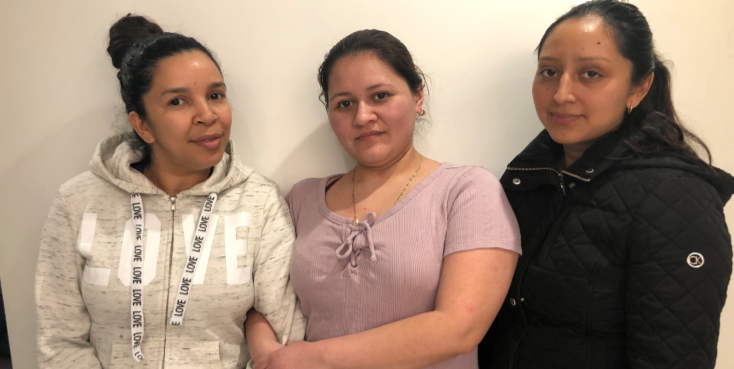
From left, housekeepers Lady Laura Javier, Cindy J. Alarcon Vasquez, and Yesica Perez Barrios are charging hotel officials and union bosses with illegally corralling workers into union ranks with a corrupted “Card Check” recognition.
SEATTLE, WA – Housekeeper Gladys Bryant was granted an appeal by the National Labor Relations Board (NLRB) General Counsel in her case challenging the use of a so-called “neutrality agreement” between UNITE HERE union officials and her employer to impose a union on the hotel’s workers.
Meanwhile, four Boston housekeepers have filed similar NLRB charges against their employer Yotel Boston and UNITE HERE Local 26, alleging that union officials violated federal law by imposing union representation on workers through a coercive “Card Check” drive with their employer’s assistance.
General Counsel Finds That UNITE HERE “Card Check” Unionization Was Tainted
Bryant filed the unfair labor practice charges after the UNITE HERE Local 8 union was installed at the Embassy Suites hotel in May 2018 through an oft-abused “Card Check” drive which bypassed the NLRB’s secret ballot election process.
As part of its so-called “neutrality agreement,” Embassy Suites agreed to give union organizers access to the hotel to meet and solicit employees. The agreement also provided union officials with a list of all employees’ names, jobs, and contact information to assist the union in collecting authorization cards from employees.
After NLRB Region 19 officials declined to prosecute the union or employer for violations of the National Labor Relations Act (NLRA), Bryant appealed the case to the NLRB General Counsel in January 2019. The NLRB General Counsel agreed with Bryant’s Foundation attorneys that Embassy Suites provided UNITE HERE’s organizing campaign with more than “ministerial aid” and thus violated the NLRA.
The NLRB has long held that an employer taints employees’ efforts to remove a union if it gives the employees support such as providing a list of bargaining unit employees or use of company resources. Bryant’s appeal successfully argued that the “ministerial aid” standard must also apply when an employer aids union officials’ efforts to gain monopoly bargaining power over workers.
Boston Housekeepers Argue Union “Card Check” Must Be Overturned
Faced with a similar situation, Boston-area housekeepers Cindy J. Alarcon Vasquez, Lady Laura Javier, Yesica Perez Barrios, and Danela Guzman filed unfair labor practice charges with the NLRB. With free legal aid from the National Right to Work Foundation, the housekeepers argue that UNITE HERE union officials violated federal law by imposing union representation on workers through a coercive “Card Check” drive with the assistance of their employer, Yotel Boston.
As in the Seattle case, they charge that Yotel Boston company officials provided UNITE HERE’s organizing campaign with more than “ministerial aid” and therefore illegally tainted the union’s installation as the employees’ exclusive representative in the workplace. The housekeepers charge union officials with violating the NLRA by requesting and accepting the illegal assistance, and the hotel for providing it.
“It is long past time that the NLRB put an end to this biased double standard that allows union bosses to abuse workers’ rights,” said National Right to Work Foundation Vice President and Legal Director Ray LaJeunesse. “The General Counsel is correct to finally recognize that what qualifies as more than ‘ministerial assistance and support,’ and thus violates the National Labor Relations Act, cannot depend on whether the employer is helping outside union organizers impose unionization on workers or assisting workers in exercising their right to remove an unwanted union.”
“These cases represent another breakthrough in the Foundation’s challenges to the pro-forced unionism skew at the NLRB,” added LaJeunesse.
Michigan Nurse Sues Teamsters for Violating Michigan’s Right to Work Law
The following article is from the National Right to Work Legal Defense Foundation’s bi-monthly Foundation Action Newsletter, March/April 2020 edition. To view other editions or to sign up for a free subscription, click here.
Lawsuit: Union bosses illegally ignored repeated requests to stop union dues deductions

Since former Michigan Gov. Rick Snyder signed Right to Work into law, Foundation staff attorneys have filed well over 100 cases for workers fighting forced unionism in the state.
FLINT, MI – Madrina Wells, a nurse at the Genesys Regional Medical Center, first tried to exercise her right to end all union dues deductions from her paycheck in December 2018, in accordance with Michigan’s Right to Work Law.
But, for well over a year now, the Teamsters union bosses at her workplace have continuously violated that right and kept requiring her to pay union fees. Finally, in December, she filed a lawsuit against them with free legal aid from National Right to Work Foundation staff attorneys.
Teamsters Officials Ignored Six Attempts by Nurse to Exercise Rights
According to the complaint filed in Genesee County Circuit Court, Wells resigned her union membership in February 2018 and requested that Teamsters officials cease all dues deductions from her paycheck in December of the same year.
Notwithstanding her request, Teamsters bosses sent her a letter in January 2019 demanding that she pay them non-member forced fees after she returned from a stint on medical leave, which she had begun in December 2018.
Though a reduced amount of union dues can be charged to private sector employees who abstain from formal union membership in non-Right to Work states, in Right to Work states like Michigan no public or private sector employee is required to pay any amount of union fees as a condition of employment.
Wells resumed work in July 2019, and sent a letter to Teamsters officials “renewing her objection” to tendering any dues or fees whatsoever to the Teamsters hierarchy. Teamsters bosses again rebuffed her request and subsequently demanded forced fees from Wells for July through December of 2019, all in clear violation of her rights.
Wells responded to each demand by reiterating her objection to the illegal fees, but submitted the fees demanded by Teamsters bosses under protest. Even so, Genesys Regional Medical Center not only deducted the Teamsters’ so-called “agency fee” from Wells’ paycheck in August 2019, but also seized the full amount of union dues from her paycheck in October.
Scores of Workers Turn to Foundation After Right to Work Enacted
Since Michigan’s Right to Work Law went into effect in 2013, Foundation staff attorneys have provided free legal aid to Wolverine State workers in over 120 cases.
In 2018, Foundation staff attorneys won a settlement for Port Huronarea public school employees Tammy Williams and Linda Gervais, ending dues demands made by the Michigan Education Association union (MEA) in violation of the Right to Work law. To date, as a result of that settlement, over 20 Wolverine State teachers have been freed from illegal dues demands.
“Once again Michigan union bosses have been caught shamelessly violating the Wolverine State’s Right to Work law,” commented National Right to Work Foundation Vice President Patrick Semmens. “Foundation staff attorneys will continue the fight until all Michigan workers can freely exercise their right not to fund unions they fundamentally disagree with.”
Foundation Urges NLRB to Kill Policies Used to Trap Workers
The following article is from the National Right to Work Legal Defense Foundation’s bi-monthly Foundation Action Newsletter, March/April 2020 edition. In April 2020, the NLRB announced that it would effectively eliminate the “blocking charge” and “voluntary recognition bar” policies. To view other editions or to sign up for a free subscription, click here.
Comments: End arbitrary restrictions on employee votes to remove unwanted unions

Free at last: Lead petitioner Liz Chase (front, left) and her fellow Alaska bus drivers hold up “no-union” buttons after finally ousting an unpopular Teamsters union from their workplace. Union bosses trapped them in union ranks for years.
WASHINGTON, DC – The National Right to Work Legal Defense Foundation submitted comments to the National Labor Relations Board (NLRB) in January, urging it to issue a final rule to eliminate arbitrary policies that union officials frequently manipulate to trap workers in union ranks.
The three policies at issue in the NLRB’s rulemaking are not mandated or even mentioned by the National Labor Relations Act (NLRA), the federal law that the NLRB is charged with enforcing. These policies were created by rulings of past Big Labor-friendly Boards. The comments approve of the Trump NLRB’s plan to alter all three policies, but advocate the Board go even further to protect independent-minded workers in how it deals with so-called “blocking charges.”
“Delays in the rulemaking process this Board has used to address these coercive policies means workers across the country continue to be trapped in unions they oppose,” National Right to Work Foundation President Mark Mix observed. “Which is why the NLRB should now swiftly finalize these rules as the Foundation’s comments advocate.”
The NLRB’s “blocking charge” policy lets union bosses file often baseless unfair labor practice (ULP) charges against an employer to halt employee votes to decertify unions. These charges regularly block votes even if the allegations against the employer have no connection to the decertification effort.
Foundation: Stop Letting Union Bosses Block Votes to Remove Unwanted Unions
The agency plans to eliminate that policy and replace it with one that lets decertification elections proceed while such charges are pending, but requires the results of the vote to be withheld until those charges are resolved.
Instead, the Foundation urges the Board to release vote tallies first to “decrease litigation and give parties greater information on whether to settle” unfair labor practice charge allegations unlikely to impact the election’s outcome. This would help prevent attempts by union bosses to drag out the ULP process and keep workers trapped in forced-dues paying ranks.
Foundation staff attorneys have provided legal assistance to scores of workers faced with “blocking charges,” including recently a group of Alaskan bus drivers who were finally freed in December 2019 from an unpopular Teamsters union after three years of attempts to remove it. One employee in that situation, Don Johnson (pictured front, right), commented to the NLRB that Teamsters officials’ continued blocking of an election was “the most unfair and anti-democratic event” with which he had ever been involved.
The Foundation’s comments also support the NLRB’s move to modify the so-called “voluntary recognition bar.”
Comments: Put a Check on “Card Check” and Other Coercive Schemes
This reform will allow employees and rival unions to file for secretballot votes after unions have been installed in workplaces through abuse-prone “Card Check” drives, which bypass the NLRB-supervised election process.
The NLRB would reinstate a system secured by Foundation staff attorneys for workers in the 2007 Dana Corp NLRB decision. Although thousands of workers used the process to secure secret ballot votes after being unionized through card checks, the Obama NLRB overturned Dana in 2010.
The Foundation’s comments also support the agency’s proposed rule to crack down on schemes in the construction industry where employers and union bosses are allowed to unilaterally install a union in a workplace without first providing proof of majority union support among the workers. Foundation staff attorneys represented a victim of such a scheme in a case (Colorado Fire Sprinkler, Inc.) that ended when a D.C. Circuit Court of Appeals panel unanimously ruled for the worker, who had been unionized despite no evidence of majority employee support for the union.
Foundation Supporters Flood NLRB with Comments Supporting Rule Changes
The Foundation has long called for the NLRB to abandon all barriers to employee decertification of unions not required or mentioned in the text of the NLRA. In reply comments filed later with the NLRB, Foundation staff attorneys made this point, and also supported comments made by NLRB General Counsel Peter Robb calling for expanded protections for workers unionized through coercive “Card Check” drives.
In addition to the Foundation’s detailed legal arguments, the Foundation used its email list to rally thousands of supporters to sign petitions to the Board in favor of eliminating the non-statutory policies that union bosses rely on to trap workers in forced unionism ranks against their will. All told, more than 18,000 petitions were submitted, asking the Board to “immediately implement the rule changes as detailed in the National Right to Work Foundation’s comments.”
The NLRB is expected to issue the final rule in the coming months.
Milwaukee Worker Wins Refund of Union Dues in Settlement of Case Against Teamsters Union
Teamsters Local 200 union officials agree to repay money siphoned from factory workers’ pay after he exercised rights under Wisconsin Right to Work law
Milwaukee, WI (April 27, 2020) – With free legal aid from the National Right to Work Legal Defense Foundation, an employee at a Milwaukee factory has secured a settlement with Teamsters “General” Local Union No. 200. Union officials denied his right under Wisconsin’s Right to Work law and the National Labor Relations Act to cut off union financial support.
Under the terms of the settlement, Teamsters Local 200 officials will repay Tyler Lewis union dues, plus interest, seized from his paycheck after he resigned his union membership and revoked his dues deduction authorization (“checkoff”).
Lewis works for Snap-on Logistics Company. After he was hired, a union official told him that he must become a union member and sign a checkoff authorizing the deduction of union dues from his paycheck. That union demand violated longstanding law going back to 1963.
In September 2019, Lewis resigned from the union and revoked his checkoff. Local 200 union officials refused to honor Lewis’s request to stop union dues deductions and continued to deduct them from his paycheck, despite Wisconsin’s Right to Work law making union payments strictly voluntary.
Consequently, Lewis filed an unfair labor charge with the National Labor Relations Board with the help of National Right to Work Foundation staff attorneys. The favorable settlement for Lewis resolves his charge.
“This settlement for Mr. Lewis is yet another victory for the rights of all Wisconsin workers, although it should not take federal labor charges for union bosses to acknowledge the basic rights of employees in the Badger State,” said National Right to Work Foundation President Mark Mix. “Clearly Wisconsin’s Right to Work law mandates that union membership and dues payment must be strictly voluntary, but union bosses regularly attempt to trap workers in forced fee ‘agreements,’ rather than respect workers’ rights and vie to win their uncoerced support.”
“This case demonstrates, yet again, why Teamsters union bosses have a well-earned reputation for using coercive tactics against workers who refuse to toe the union line,” Mix added.
Full Foundation Action January/February 2020 Newsletter Now Online
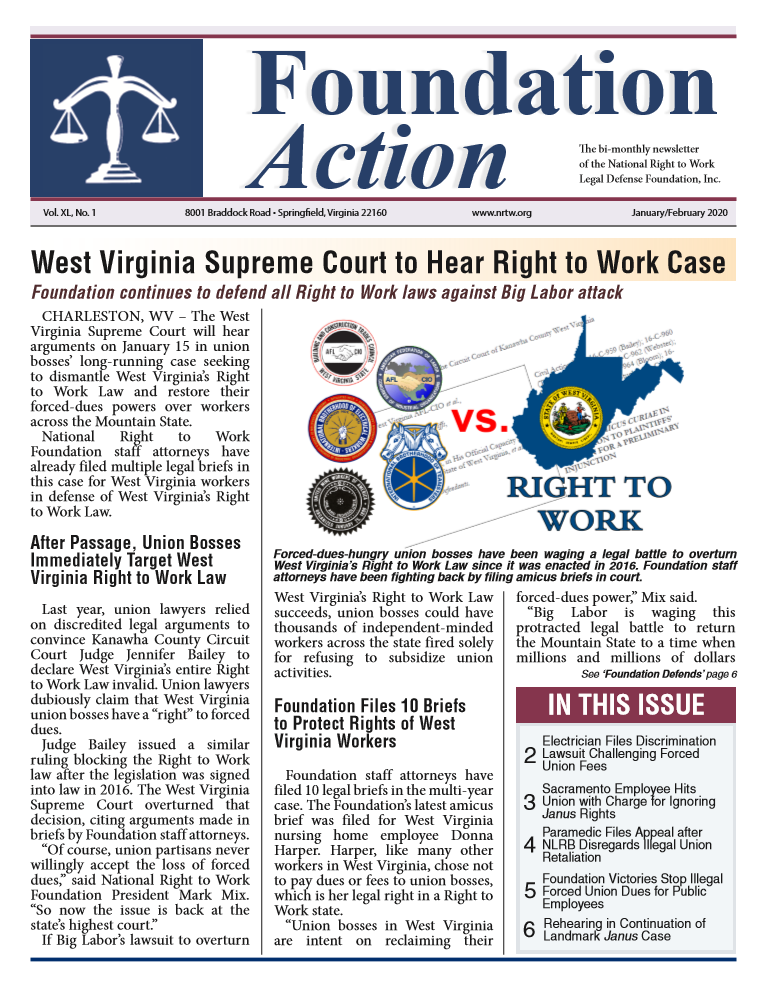
All articles from the January/February issue of Foundation Action are now on the website.
In this issue:
- West Virginia Supreme Court to Hear Right to Work Case
- Electrician Files Discrimination Lawsuit Challenging Forced Union Fees
- Sacramento Employee Hits Union with Charge for Ignoring Janus Rights
- Paramedic Files Appeal after NLRB Disregards Illegal Union Retaliation
- Foundation Victories Stop Illegal Forced Union Dues for Public Employees
- Rehearing in Continuation of Landmark Janus Case
Recent articles can be found here. To sign up for a free copy of the newsletter via mail please see the form at the bottom of the page.
Rehearing in Continuation of Landmark Janus Case
The following article is from the National Right to Work Legal Defense Foundation’s bi-monthly Foundation Action Newsletter, January/February 2020 edition. Foundation staff attorneys are currently asking the U.S. Supreme Court to review the continuation of Mark Janus’ case. To view other editions or to sign up for a free subscription, click here.
Union bosses refuse to return dues seized in violation of First Amendment

A favorable decision for Mark Janus at the Seventh Circuit could be the next step toward public employees getting back millions of dollars that were seized from them by union bosses in violation of their First Amendment rights.
WASHINGTON, D.C. – Mark Janus won a landmark victory for American workers in 2018 when the Supreme Court acknowledged in Janus v. American Federation of State, County, and Municipal Employees (AFSCME) Council 31 that requiring public sector workers to pay union fees as a condition of employment infringed their First Amendment rights.
However, the coffers of the AFSCME union bosses who once had monopoly bargaining power over Janus — and the coffers of countless other unions around the country — are still flush with dues money that was seized from employees without their “affirmative and knowing” consent as the decision requires.
National Right to Work Foundation staff attorneys who represent Janus, along with attorneys from the Illinois-based Liberty Justice Center, have filed a petition to the Seventh Circuit Court of Appeals for a rehearing en banc in the continuation of his case. Janus seeks a ruling that will make AFSCME union officials return thousands of dollars in dues that were taken from his paycheck in violation of Janus since March 23, 2013. If the rehearing is granted, Janus’ case will be heard before 12 judges of the Seventh Circuit.
A three-judge panel of the Seventh Circuit refused to remedy AFSCME bosses’ unconstitutional conduct last November despite the High Court’s noting in Janus that union officials have been “on notice” for years that mandatory fees likely would not comply with the heightened level of First Amendment scrutiny articulated in the 2012 Knox v. SEIU Supreme Court decision, also won by Foundation staff attorneys.
“Mark Janus is simply asking the Seventh Circuit to remedy the years of unconstitutional conduct AFSCME bosses have perpetrated at his and other public sector workers’ expense,” observed National Right to Work Foundation Vice President Patrick Semmens.
At stake for Mark Janus is over $3,000 of his money that was seized by union officials in violation of his First Amendment rights. But a ruling in his favor could have a nationwide impact, setting a federal precedent that would be cited in dozens of other cases seeking refunds of dues taken unlawfully by public sector union bosses. Foundation staff attorneys are currently litigating more than 30 Janus-related cases that collectively seek more than $120 million in refunds.





