
Four Colorado Safeway Workers Slam UFCW Union Officials With More Federal Charges for Illegal Strike Fines
Charge: UFCW Local 7 unlawfully subjected nonmember employees to ‘internal disciplinary’ fines for not abiding by a union boss-ordered strike
Denver, CO (February 23, 2026) – Four employees at three separate Safeway grocery stores located near Denver have filed federal charges with the National Labor Relations Board (NLRB) against the United Food and Commercial Workers (UFCW) Local 7 union.
The workers’ charges were filed with free legal aid from National Right to Work Foundation staff attorneys in response to union bosses illegally threatening the workers and their colleagues with fines for choosing to exercise their right to work despite a union boss-ordered strike action. The NLRB is the federal agency responsible for enforcing the National Labor Relations Act (NLRA) and adjudicating disputes between employers, unions, and individual employees.
Claire Jordan, who works at Safeway in Greeley, Rebecca White, who works at Safeway in Longmont, and Dustin Mattos and Rebecca Lawless-Mattos, who both work at a Lakewood Safeway location, are demanding that NLRB Region 27 investigate and prosecute UFCW Local 7 union bosses for violating their rights under the NLRA.
According to the charges, after the workers validly resigned their union membership in June 2025, union officials informed the workers around January 9, 2026 that they would be subject to “internal union charges…for, among other things, crossing the picket line while being a union member.”
The workers resigned their memberships in order to continue working after UFCW Local 7 union bosses ordered grocery workers at more than 40 Safeway stores and a distribution center in Colorado to strike in June 2025. Longstanding law says union bosses cannot impose “union discipline,” which frequently means four- or five-figure monetary fines, against workers who are not voluntary union members.
In addition to retaliating against nonmember workers, the charges say that UFCW Local 7 union officials have failed to comply with federal law by not providing the workers with the required financial disclosures under the Foundation-won Beck decision, which allows nonmember workers to withhold the portions of their forced dues that go to the UFCW’s political activities.
Colorado is one of the 24 states that lack Right to Work protections for workers, which allows UFCW union bosses to impose monopoly bargaining contracts that force employees to pay union fees as a condition of employment. By contrast, in Right to Work states like neighboring Arizona, Utah, Nebraska, Kansas, and Oklahoma, union membership and union financial support are strictly voluntary.
The Safeway strike order came months after UFCW Local 7 had similarly ordered a strike at 79 King Soopers grocery stores in February 2025. As happened following the Safeway strike, King Soopers employees also turned to the National Right to Work Foundation for assistance in filing charges against the UFCW, in response to union officials issuing illegal fine threats against nonmembers for exercising their right to work during a strike.
The Foundation has seen a growing number of workers seeking aid in cases involving illegal retaliation from UFCW union bosses. Foundation attorneys assisted nonmember King Soopers employees targeted following a 2022 strike, and have secured numerous victories against UFCW, including for illegal strike fine threats during a union-ordered strike against Stop & Shop stores in New England.
“Once again, UFCW Local 7 union bosses are turning to threats and intimidation tactics against workers who chose to rebuff union strike orders and work to support themselves and their families,” commented National Right to Work Foundation President Mark Mix. “The Foundation will continue to assist grocery workers defending themselves against these recidivist UFCW union bosses.”
Veolia Environmental Services Employee Slams Teamsters With Federal Charges for Illegal Termination Threats
Worker maintains that Teamsters Local 63 officials threatened to have her fired for not joining the union and refusing to pay for union politics
Colton, CA (February 2, 2026) – An employee of medical waste management firm Veolia Environmental Services has just hit Teamsters Local 63 union officials with federal charges, maintaining that union officials threatened to have her fired for refusing to join the union. The employee, Alexus Villanueva, also charges Teamsters bosses with unlawfully forcing her to pay full union dues, including dues for union political activities, via paycheck deduction.
Villanueva filed her charges at the National Labor Relations Board (NLRB) with free legal aid from National Right to Work Legal Defense Foundation staff attorneys.
The NLRB is the federal agency responsible for enforcing federal labor law in the private sector. Under federal labor law and Supreme Court decisions like NLRB v. General Motors, union officials cannot enforce contracts that mandate formal union membership as a condition of employment. Furthermore, the Foundation-won CWA v. Beck Supreme Court decision bars union bosses from compelling workers to pay for “nonchargeable” union expenses, like the union’s political or ideological doings.
California lacks Right to Work protections for its workers, meaning that union chiefs can force workers under their control to pay union dues or fees as a condition of keeping their jobs. In contrast, in Right to Work states like neighboring Nevada and Arizona, union membership and all union financial support are strictly voluntary for workers.
Teamsters Union Officials Blatantly Ignore Federal Labor Law
According to Villanueva’s charges, Teamsters Local 63 officials threatened to have her fired if she didn’t join the union and authorize the deduction of union dues from her paychecks. Federal law forbids union officials from requiring workers to pay union dues by direct deductions from their paychecks.
Villanueva’s charges also detail that Teamsters bosses violated other elements of the Beck decision, including by “fail[ing] to provide her with…a notice of the calculation of the amount of non-chargeable fees verified by an independent certified public accountant” and “an opportunity to challenge its calculation and have it reviewed by an impartial decisionmaker.”
Case Follows String of Actions by SoCal Workers Against Teamsters Local 63
In recent years, Foundation attorneys have helped numerous other workers in Southern California challenge Teamsters Local 63 union officials. In 2024, Dependable Highway Express driver John Cwiek slammed the union with charges after he faced retaliation for revealing publicly available data about Teamsters bosses’ salaries. Cwiek and his coworkers later sought a “decertification vote” with free Foundation aid and successfully forced the union out of their workplace. Foundation attorneys also aided Ozvaldo Gutierrez and his Los Angeles-based XPO Logistics colleagues in removing Teamsters Local 63 from power in 2021.
“Instead of seeking to win workers over voluntarily, Teamsters Local 63 union bosses continue to flout federal labor law in pursuit of more control and more dues money,” commented National Right to Work Foundation President Mark Mix. “But worker opposition to Teamsters control is not limited just to Southern California – recent NLRB statistics suggest that no union faces more employee-backed removal attempts than the Teamsters.
“While it’s especially heinous that Teamsters officials are attempting to get Ms. Villanueva fired for refusing to pay for union political activity, ultimately no worker should be forced to subsidize any part of union bosses’ agenda just to keep their job,” Mix added.
Electric Utility Worker Asks Trump NLRB to Prosecute IBEW’s Restrictive Policies That Compel Workers to Fund Union Politics
Electric utility worker asks NLRB General Counsel to seek Board ruling against union policies that force nonmembers to fund union political spending
Benson, MN (September 23, 2025) – Theresa Klassen, an employee of Agralite Electric Cooperative, is asking the National Labor Relations Board (NLRB) to expedite consideration of Big Labor schemes that force workers to pay dues for union political activities. Klassen has filed an appeal with the NLRB’s Acting General Counsel, asking him to issue a complaint in her case after an NLRB Regional Director let International Brotherhood of Electrical Workers (IBEW) union officials off the hook for violating her rights. Klassen is receiving free legal aid from National Right to Work Foundation staff attorneys.
Klassen originally filed charges against both the IBEW international union and IBEW Local 160 to defend her rights under Communications Workers of America v. Beck. In this Foundation-won landmark U.S. Supreme Court decision, the Court ruled that union officials cannot force workers who abstain from membership to pay dues for anything beyond the union’s monopoly bargaining functions – including politics.
Even though Klassen successfully resigned her union membership, union bosses continued to demand full dues payments from her – including dues for union political expenditures. When she invoked her Beck rights with assistance from Foundation staff attorneys, union bosses then claimed that she could only opt out of dues payments for politics within a narrow 30-day “window period” each year in the month of November.
Brief: IBEW Union Clearly Violating National Labor Relations Act
Klassen’s appeal argues that it would violate the National Labor Relations Act (NLRA) “for a union to demand payment for any dues beyond what Section 8(a)(3) requires unless that employee affirmatively consented to pay full union dues.” Under the Beck decision, Section 8(a)(3) only permits union bosses to demand dues for union expenses that are directly related to bargaining.
Now, Klassen is asking the NLRB to uphold this interpretation and end all opt-out requirements, so that union officials must obtain explicit permission from employees to take payments for non-bargaining-related functions, including union political and lobbying activities.
Klassen is also asking the NLRB to end window period practices for becoming Beck objectors, as they similarly violate the NLRA by preventing workers from exercising their rights. Window period restrictions on when employees can exercise their Beck rights allow union officials to extract money from workers after they’ve already objected to financially supporting union political activities.
“The IBEW should be respecting my rights, not throwing up roadblocks so they can continue to use my paycheck dollars to fund their own agenda,” said Klassen. “The NLRB needs to recognize that union officials are violating the law; otherwise, these rights are not rights at all.”
Union Officials Use Restrictive Policies to Consolidate Power
Because Minnesota lacks Right to Work protections for its private sector workers, IBEW union officials can impose contracts that force Klassen and her coworkers to pay union dues as a condition of keeping their jobs, though this amount is limited by the Beck decision. In contrast, in Minnesota’s neighboring Right to Work states, union officials cannot force workers to pay any dues or fees just to keep their jobs.
“Free association is a right of every American, including workers who don’t want to associate with a union,” commented National Right to Work Foundation President Mark Mix. “It’s telling that IBEW officials are using a legally suspect policy to make it needlessly difficult for workers to stop supporting the union’s political activities.
“While the NLRB General Counsel should urge the agency to address these illicit schemes swiftly, ultimately Minnesotans and all Americans deserve Right to Work protections, which would make all union financial support strictly voluntary,” Mix added.
IUOE Union Bosses Hit With Federal Charge for Illegal Termination
The following article is from the National Right to Work Legal Defense Foundation’s bi-monthly Foundation Action Newsletter, January/February 2024 edition. To view other editions of Foundation Action or to sign up for a free subscription, click here.
Longstanding law protects against mandatory dues deductions, formal union membership

Firestop inspector Alexandra Le isn’t going to let IUOE union bosses snuff out her livelihood over her refusal to join or support the union. She’s filed federal charges with Foundation aid.
PLEASANTON, CA – Sometimes, even the extraordinary power to demand payments from workers under threat of termination isn’t enough for union bosses, who frequently go beyond what is legal to coerce workers into membership and dues payment.
Alexandra Le, an employee of Construction Testing Services (CTS), found herself on the receiving end of such illegal demands from International Union of Operating Engineers (IUOE) officials in October. But Le is now fighting back, hitting IUOE bosses and her employer with federal charges at National Labor Relations Board (NLRB) Region 32 with free legal aid from the National Right to Work Foundation.
Union Misinformed Worker About Rights
Le’s charges state that IUOE bosses got her fired after she rebuffed their demands to formally join the union. Additionally, Le’s charges maintain that union officials unlawfully deducted union dues from her paycheck without her permission and failed to inform her of her right to pay reduced union dues as a non-member — a right secured by the Foundation-won CWA v. Beck Supreme Court victory.
Because California lacks Right to Work protections for its private sector workers, Le and her coworkers can be forced to pay some fees to the union to keep their jobs, even if they’ve abstained from formal union membership. However, as per Beck, in non-Right to Work states, union officials can’t force nonmember employees to pay for union expenses (such as union politics) that go beyond what the union claims goes to bargaining.
Other Supreme Court precedents require union bosses to seek workers’ express consent before deducting dues directly from their paychecks.
In Right to Work states, all union financial support is voluntary and the choice of each individual worker.
Employee Demands Federal Injunction to Reverse Illegal Union-Ordered Firing
“It’s outrageous that IUOE union officials believe they can get me fired simply because I don’t agree with their organization and don’t want to support or affiliate with them,” Le said. “IUOE union officials have been far more concerned with consolidating power in the workplace and collecting dues than caring about me and my coworkers, and I hope the NLRB will hold them responsible for their illegal actions.”
Le’s charge against the IUOE union states that, after she refused to affiliate with the union, IUOE bosses “caused Charging Party to be removed from the work schedule by her Employer as of October 2nd.” The NLRB v. General Motors Corp. U.S. Supreme Court decision protects the right of workers to refuse formal union membership, even in a non-Right to Work state.
As a remedy, the charge asks the NLRB Regional Director in Oakland to “invoke its authority under Section 10(j)” of the National Labor Relations Act (NLRA), which empowers the Board to seek an injunction from a federal court to stop IUOE and CTS management from committing the unfair labor practices.
Workers Need More Protections Against Union Boss Coercion
“Ms. Le’s case shows why Right to Work protections are important,” commented National Right to Work Foundation Vice President and Legal Director William Messenger.
“Even if IUOE union officials had followed federal labor law in this case, Ms. Le would still be forced to contribute to the activities of an organization she clearly doesn’t want to be part of.
“As Ms. Le’s case demonstrates, union bosses often value workers merely as sources of dues revenue and will go to extraordinary lengths to keep the money flowing,” Messenger added. “Workers deserve more protections against union boss coercion, not fewer.”
Connecticut Bus Driver Slams Teamsters Union with Federal Charges for Violating Beck Rights
Teamsters union officials illegally force school bus driver to pay for union political activities
New Milford, CT (March 30, 2023) – Connecticut school bus driver Mary Boland has filed federal charges against Teamsters Local 671 union after union officials violated her rights, as established under the Foundation-won U.S. Supreme Court Beck decision, by illegally charging her union dues in excess of what she must pay in order to keep her job. These charges were filed with the National Labor Relations Board (NLRB). Boland is being represented for free by National Right to Work Legal Defense Foundation staff attorneys.
On October 20, 2022, Mary Boland submitted a letter to Teamsters Local 671 exercising her rights to opt out of union membership and pay a reduced union fee. This forced union fee must be verified by an independent audit of union expenditures. Individuals who opt out of formal union membership cannot be fired from their job by refusing to pay for “non-chargeable” union expenditures, like member-only activities or union political and lobbying spending.
Due to Connecticut lacking Right to Work protections, workers who oppose union boss agendas can still be forced to pay union fees as a condition of their continued employment. However, under the Foundation-won 1988 Beck decision, union officials can never require non-members to fund activities not directly related to union monopoly bargaining. Beck has been interpreted by the lower courts, and the NLRB, to require that union officials provide certain union financial disclosures to justify the amount they claim a worker can be required to pay.
However, in a letter to Boland dated November 2, 2022, the union acknowledged she invoked her rights under Beck, but failed to actually reduce those fees or provide the required audit. Union officials have charged Boland full union dues as of the filing of the NLRB charge on March 17, 2023, and have never provided the required audit to justify any dues deductions.
“In their apparent greed to extract as much money as possible from unwilling workers, Teamsters bosses are blatantly disregarding longstanding Supreme Court precedent,” commented Mark Mix, President of the National Right to Work Foundation. “This case shows why Connecticut workers need the protection of a Right to Work law to make all union financial support strictly voluntary.”
“Had Right to Work protections been in place, Mary Boland and other Connecticut workers would have had the freedom to simply cut off all union dues,” Mix added. “Without these Right to Work Protections, however, workers find themselves having to tangle with union lawyers over what portion of union dues they can be legally fired for not paying.”
Northern PA Metal Worker Prevails in Federal Case Charging CWA Union with Illegal Dues Deductions
CWA officials also refused worker’s membership resignation and sought to force him to remain union steward
Galeton, PA (March 3, 2023) – Curtis Coates, an employee of metal corporation Catalus, has successfully forced Communications Workers of America (CWA) union officials to stop illegally seizing money from his paycheck for union politics and ideological causes. National Right to Work Legal Defense Foundation staff attorneys represented Coates for free before the National Labor Relations Board (NLRB).
Coates charged CWA union officials in May 2022 with unlawfully snubbing both his request to resign from his position as a union shop steward and his request to formally end his union membership. Full union dues deductions also continued to flow out of his paycheck even after his requests. Coates argued that CWA bosses violated his rights under the National Labor Relations Act (NLRA).
Because Pennsylvania lacks Right to Work protections for its private sector workers, unions can legally coerce workers into paying union fees just to keep their jobs even if they choose not to become union members. However, under the U.S. Supreme Court’s decision in CWA v. Beck, won by Foundation attorneys, this is limited to only the part of union dues that union officials claim goes toward a union’s core “representational” functions, and excludes deductions for union political or ideological activities. In contrast, in states with Right to Work protections, union membership and all union financial support are both strictly voluntary.
A Foundation-won settlement now requires CWA union officials to post a notice at Coates’ workplace declaring that they “will not fail and refuse to honor your request to resign your union membership,” and “will not fail and refuse to honor your request to resign your role as a union steward.” CWA union officials have also stopped siphoning money for union politics and ideological activities from Coates’ wages.
CWA Forced Dissenting Worker to Remain Shop Steward, Took Full Dues Illegally from Paycheck
According to his charge, Coates sent a message to CWA union officials on October 20, 2021, declaring that he was resigning from his position as shop steward and terminating his union membership. A union official rebuffed both of Coates’ requests the next day, insisting that he had to remain both a union member and a shop steward.
In December 2021, January 2022, and February 2022, Coates followed up with union officials several times via email and mail. He asked when union officials would cease taking dues money from his wages and what process he had to follow to revoke his dues deduction authorization.
Coates’ charge asserted that CWA union officials, by refusing his repeated requests to resign his union membership, violated his rights under Section 7 of the NLRA, which recognizes workers’ right to “refrain from any or all” union activities.
Foundation President: No Place for Compulsory Union Support in Federal Law
“CWA officials summarily denied Mr. Coates’ valid exercise of his right to refrain from union membership, unlawfully seized money for union politics, and even forced him to remain a union shop steward,” commented National Right to Work Foundation President Mark Mix. “The extreme aversion CWA union officials seem to have to any kind of dissociation with the union shows where their focus lies: maintaining forced worker subsidization of union activities and not on respecting workers’ individual rights.”
“Such union malfeasance is only buoyed by federal labor law, which permits states to deny Right to Work protections to private sector workers,” Mix added. “No American worker should be forced to fund any kind of unwanted union purpose as a condition of keeping his or her job, which is why securing Right to Work protections for all Americans is absolutely vital.”
IAM Union ‘Becks’ Down in Boeing Technician’s Case Over Unlawful Dues Deductions
The following article is from the National Right to Work Legal Defense Foundation’s bi-monthly Foundation Action Newsletter, September/October 2022 edition. To view other editions of Foundation Action or to sign up for a free subscription, click here.
IAM bosses charged arbitrary higher amount in violation of Foundation-won Beck precedent

IAM union bosses’ illegal fee scheme faced headwinds when Boeing technician Don Zueger defended his rights with Foundation legal aid – and won.
SEATTLE, WA – Boeing technician Don Zueger didn’t want to sacrifice a cent from his paycheck to subsidize the activities of International Association of Machinists (IAM) union bosses who currently maintain monopoly bargaining power in his workplace. But, because he works in non-Right to Work Washington State, he can be forced to pay some union fees just to keep his job.
When Zueger found out union officials were calculating his forced fees amount based on financial data from nine other IAM affiliates – not just data from his own district union – he knew something was amiss.
Zueger sought free legal representation from the National Right to Work Legal Defense Foundation and filed a federal lawsuit against the IAM union for violating his rights under the 1988 Foundation-won CWA v. Beck U.S. Supreme Court decision. In Beck, the Court ruled that union officials cannot charge full union dues to objecting private sector workers who have abstained from formal union membership, and can only charge them “fees” which exclude expenses for things like union political activities.
IAM Bosses Use Baseless ‘Formula’ to Seize Excessive Forced Union Fees
Zueger’s lawsuit pointed out that IAM officials’ puzzling scheme imposed a dues amount on him that exceeds the limit that Beck established. Now he has won a settlement that requires union officials to decrease his dues payments and return money illegally taken from his wages.
Washington State’s lack of Right to Work protections mean that union officials can legally demand Zueger pay the reduced Beck amount as a condition of staying employed. In Right to Work states, in contrast, union membership and all union financial support are strictly voluntary.
According to Zueger’s lawsuit, filed in the U.S. District Court for the Western District of Washington, he submitted a request to IAM union officials in February resigning his union membership and asking for his dues payments to be reduced as Beck requires.
Zueger’s lawsuit noted that IAM officials’ response to his Beck request claimed that, under IAM’s nationwide policy, the portion of union dues he must pay is based on averages of selected audits that in each case include nine other district IAM affiliates and nine other locals. Unsurprisingly, this policy resulted in IAM officials claiming Zueger is required to pay a greater sum than what would be required if union officials only used the audits for the district and local unions Zueger is forced to fund.
His lawsuit sought to force IAM union bosses to return all money demanded in violation of Beck and to properly reduce his future union payments in accordance with Beck.
Rather than attempt to defend their scheme to increase Zueger’s forced fee amount, IAM union chiefs quickly backed down and settled the case.
IAM union officials have now, as the settlement mandates, returned to Zueger the difference between the proper Beck dues amount and the illegal amount the union imposed on him. IAM bosses are also forbidden from demanding any money above the correctly calculated reduced Beck portion in the future, making the settlement a full vindication of Zueger’s Beck rights.
IAM Must Return Dues That Could Have Gone to Union Boss Political Agenda
Zueger’s settlement comes after union bosses spent near-record sums on politics during the 2020 election cycle, and as Foundation attorneys deal with a flurry of worker requests concerning illegal forced dues for politics. According to a report by the National Institute for Labor Relations Research (NILRR) released in 2021, public data on union expenses shows about $2 billion in political spending during the 2020 election cycle. Other estimates suggest the actual union spending on political and lobbying activities topped $12 billion during this cycle.
“It’s shameful that union officials continue to invent new ways to violate the decades-old Beck Supreme Court precedent and overcharge workers who clearly want nothing to do with union bosses and their agenda – a big concern as union politicking heats up in advance of midterm elections,” commented National Right to Work Foundation Vice President Patrick Semmens. “This scheme to artificially manipulate forced dues calculations is part of the IAM’s nationwide policy, and the Foundation stands ready to assist other workers around the country who are being subjected to this anti-Beck IAM scheme.”
Full Foundation Action May/June 2022 Newsletter Now Online
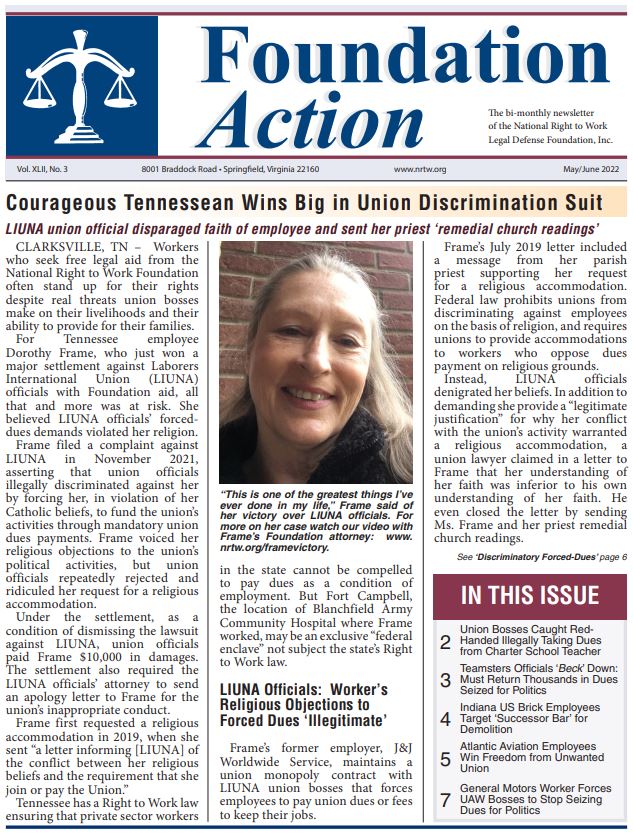
All articles from the May/June issue of Foundation Action are available on the website.
In this issue:
- Courageous Tennessean Wins Big in Union Discrimination Suit
- Union Bosses Caught Red-Handed Illegally Taking Dues from Charter School Teacher
- Teamsters Officials ‘Beck’ Down: Must Return Thousands in Dues Seized for Politics
- Indiana US Brick Employees Target ‘Successor Bar’ for Demolition
- Atlantic Aviation Employees Win Freedom from Unwanted Union
- General Motors Worker Forces UAW Bosses to Stop Seizing Dues for Politics
Recent articles can be found here. To sign up for a free copy of the newsletter via mail please see the form at the bottom of this page.





