
Alaska Governor Issues Executive Order to Enforce Janus Rights as Advocated by National Right to Work Foundation
Alaska Governor Mike Dunleavy recently issued an executive order to protect the First Amendment rights of all state employees under the Janus v. AFSCME decision won by the National Right to Work Legal Defense Foundation at the United States Supreme Court in June 2018.
Under the new rule, adopted following a formal opinion by Alaska Attorney General Kevin Clarkson, the state will deduct union fees only from the paychecks of employees who have filed a waiver with the state acknowledging their wishes to have union dues taken from their paychecks despite their right under Janus not to fund any union activities.
Tho order follows an op-ed for the Wall Street Journal by National Right to Work Foundation President Mark Mix and veteran Foundation staff attorney William Messenger (who argued the Janus case at the Supreme Court) which encouraged Gov. Dunleavy to take this proactive step to enforce the Janus decision in Alaska, and also urged elected officials in other states to follow Alaska’s example:
Politicians in state capitals where Big Labor has a stranglehold are resisting compliance with Janus. Faced with both government and union resistance, public employees have filed dozens of lawsuits seeking to stop unions from seizing money from their paychecks.
But not all elected officials are so beholden to union bosses. Some are willing to put employee freedom before the interests of union officials. Alaska started that process Tuesday when, at the request of Gov. Mike Dunleavy, Attorney General Kevin Clarkson issued a formal opinion delineating how the state must change its payroll process to comply with Janus by ensuring that employees “freely and knowingly consented to have dues deducted from their paychecks.” Alaska’s solution includes stopping dues deductions absent an annual renewal of the waiver.
Hundreds of millions of dollars are being taken out of workers’ paychecks each month without any evidence that they waived their First Amendment right not to fund union activities, including partisan electioneering. Other state officials, along with federal agencies, should follow Alaska’s example.
The complete op-ed is available online here.
Public sector workers can learn more about their First Amendment rights under the Janus decision by visiting MyJanusRights.org.
Labor Day Media Round Up: National Right to Work Commentaries Highlight Injustices of Forced Unionism
On Labor Day, the National Right to Work Foundation generated significant coverage in both national and local media outlets, especially on newspaper opinion pages. Foundation President Mark Mix wrote a number of pieces for outlets around the country highlighting the injustices of compulsory unionism and what can be done to protect workers freedom.
Mix wrote for USA Today that no American should be forced to pay union dues just to get or keep a job and highlighted the prevalence of compulsory unionism despite Right to Work laws gaining ground:
Twenty-seven states have now enacted and implemented right-to-work laws, with five joining in the last eight years.
And on June 27 of last year, the U.S Supreme Court handed down one of the most significant employee rights legal victories in the history of the right-to-work movement with the Janus decision, which ended the forced payment of union dues or fees for millions of government workers nationwide.
Unfortunately, there are more private sector American workers in the 23 non-right-to-work states and others in the railway and airline industries who still work under compulsory unionism.
Mix also wrote a column for the Detroit News arguing that no worker should ever have to fear union violence just because they disagree with union tactics or thuggish strong-arming:
Violence, the threat of violence and the wrongful non-violent use of fear and intimidation by union thugs should be illegal. No exceptions.
The spreading UAW corruption scandal shows that union bosses often act as though they are above the law.
For the Lexington Herald-Leader, Mix wrote about how Kentucky’s Right to Work law benefits the state, and why they need to protect it from the attacks of Democrat and gubernatorial candidate Attorney General Andy Beshear, who wants to give power back to union bosses should he be elected to replace Governor Matt Bevin a friend of Right to Work:
Beshear wants to return the Commonwealth of Kentucky to the days of workers being forced to hand over a portion of their hard-earned paychecks to the union boss elites to get or keep a job. Meanwhile, the Bevin Administration has spearheaded record economic growth after passing Right to Work here in Kentucky.
Even putting that enormous economic growth aside, the fact is that one candidate favors allowing Big Labor to extract money from workers’ paychecks, and the other candidate has worked tirelessly to protect Kentucky workers’ right to hold onto their paychecks without union boss interference.
And for the Las Vegas Review-Journal, Mark wrote how Right to Work laws have benefitted Nevada’s workers and families for more than half a century, causing noticeable effects for the state’s economy:
There is a reason Tesla’s Gigafactory is located in Nevada and not California. A nationwide 2017 survey of business leaders conducted by Chief Executive magazine found that, by a 2-to-1 margin, CEOs prefer adding jobs in right-to-work states over other states.
Business owners correctly view states that have passed right-to-work laws as being more welcoming and business-friendly than high-tax, forced-dues states such as California. That is why federal Bureau of Labor Statistics data show that from 2013-18, factory employment growth in Nevada was more than three times greater than in Western forced-union states such as Colorado, Oregon and Montana.
Just a few days after Labor Day, the Daily Caller published a timely op-ed from Mix regarding the Trump Administration’s rules to make it harder for union officials, like those implicated in the unfolding UAW scandal, to spend worker’s money on themselves or fuel their corruption:
At the end of May, the Trump Labor Department unveiled a rule that, as a contemporaneous news account filed by the Law360 legal news service explained, imposes “financial disclosure requirements for certain trusts that unions set up, scrutiny the agency says will ‘deter fraud and corruption.”
The proposed rule would reestablish the Form T-1, which until it was scuttled by union-label Obama administration bureaucrats in 2010 blocked officers of unions with $250,000 or more in annual revenue from using trusts supposedly created to benefit rank-and-file members to circumvent the federal reporting requirements for such unions that Congress instituted in the Labor-Management Reporting and Disclosure Act.
In addition, Mix wrote two op-eds, one for Right to Work states and the other for non-Right to Work states, which were sent out across the country and printed in local newspapers. They highlight the benefits of Right to Work laws and the problems that forced unionism causes.
Full Foundation Action July/August 2019 Newsletter Now Online
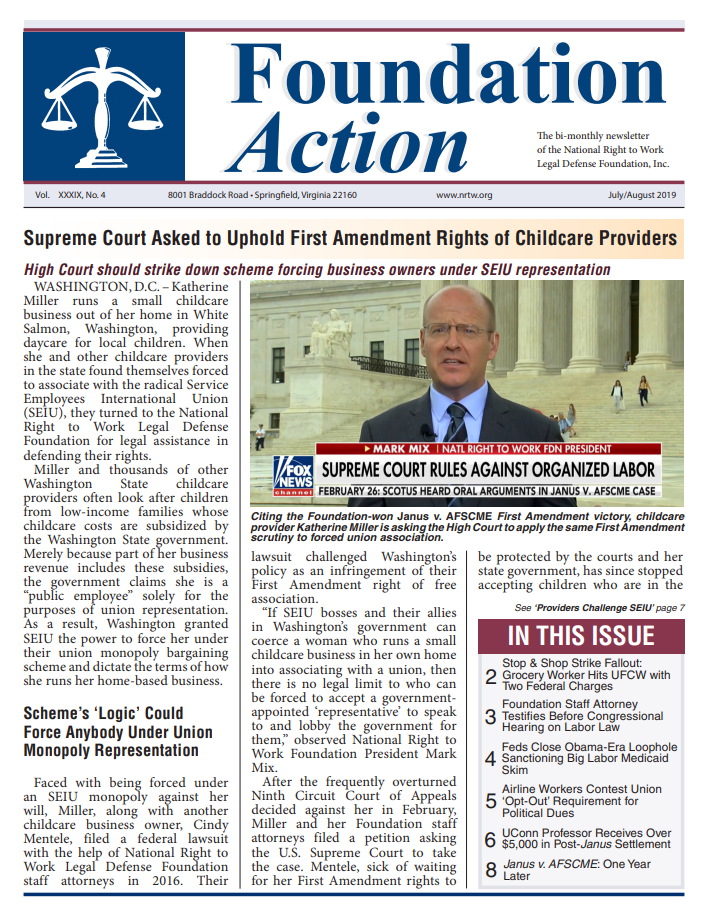
In this issue:
- Supreme Court Asked to Uphold First Amendment Rights of Childcare Providers
- Stop & Shop Strike Fallout: Grocery Worker Hits UFCW with Two Federal Charges
- Foundation Staff Attorney Testifies Before Congressional Hearing on Labor Law
- Feds Close Obama-Era Loophole Sanctioning Big Labor Medicaid Skim
- Airline Workers Contest Union ‘Opt-Out’ Requirement for Political Dues
- UConn Professor Receives Over $5,000 in Post-Janus Settlement
To view other editions or sign up for a free copy of the newsletter via mail, click here.
Wall Street Journal Highlights Foundation Litigation to Enforce Janus v. AFSCME
In June 2018, National Right to Work Foundation staff attorneys won the landmark Janus v. AFSMCE case at the U.S. Supreme Court. The Janus decision established that the First Amendment protects public-sector workers from being forced to pay dues or fees to a union against their wishes.
Union bosses have widely blocked public employees from exercising their Janus rights using a variety of coercive tactics, requiring Foundation staff attorneys to pursue dozens of follow-up cases to enforce Janus.
Recently The Wall Street Journal published an article highlighting this ongoing litigation and heavily cited veteran Foundation staff attorney Bill Messenger:
The opt-out window is a favorite post-Janus union tactic for retaining members. More than 40 lawsuits against these “escape period” requirements are pending across the country, according to Bill Messenger, an attorney with the National Right to Work Foundation who argued Mark Janus’s case at the Supreme Court. …
Mr. Messenger and lawyers at LJC argue that these opt-out window requirements flout the Janus ruling, which clarified that a worker must give affirmative consent to become a union member. Before Janus, they argue, workers couldn’t give free, knowledgeable consent because they faced an unconstitutional choice between being a member or an agency-fee payer. Unions are violating the free-speech rights of members like Ms. Callaghan, who joined before Janus, by forcing them to wait for opt-out windows to leave. …
More than 80 lawsuits are challenging union efforts to hang on to unwilling members. Often handled by nonprofits like the LJC and NRTW Foundation, these suits fall into four main camps: challenging opt-out window restrictions, seeking compensation for pre-Janus agency fees paid by nonmembers, fighting exclusive union representation, and extending Janus to the private sector. These cases aren’t litigating the merits of unions; they’re seeking to codify workers’ freedom to choose whether they want to be in one.
Read the complete column from The Wall Street Journal here.
Veteran Foundation Attorneys Highlight NLRB Victory for Workers Over UAW Union Bosses
Earlier this month, National Right to Work Foundation staff attorneys won a decision at the National Labor Relation Board (NLRB) for Johnson Controls Inc. employees seeking to remove the United Auto Worker (UAW) union from their workplace.
Foundation Vice President and Legal Director Raymond LaJeunesse and veteran Foundation staff attorney Glenn Taubman, who provided free legal aid to the workers, recently authored an article for the Federalist Society about the victory and how it advances the rights of workers seeking to free themselves from union monopoly ranks:
The main takeaways from this case are: 1) employers can lawfully withdraw recognition of a union when presented with objective evidence (like an employee signature petition) that the union has lost majority support, and they now face less legal jeopardy for honoring the wishes of their employees than they did under the prior regime; 2) secret ballot elections remain the favored method for determining employees’ representational desires, so if the union is “anticipatory” ousted based upon a majority employee petition but believes it actually possesses majority support, it cannot litigate its way back to power using the slow and prolonged unfair labor practice process, but must file for a secret ballot election; and 3) as noted in the dissenting opinion of Obama appointee Lauren McFerran, the Johnson Controls decision could open the door to periodic recertification elections for unions.
Many employee advocates have long urged that recertification elections are desirable. Unlike politicians who must automatically face periodic elections (a.k.a “recertifications”), current NLRB law “presumes” that unions retain majority status in perpetuity. Yet statistics show that 94% of unionized workers have never voted for the union representing their workplace. James Sherk, Union Members Never Voted for a Union, Heritage Foundation, August 30, 2016. If the NLRB adopts a recertification process, unions could not rely upon outdated doctrines granting them perpetual majority status, but would have to periodically prove their majority support. As National Right to Work Foundation attorneys have long argued, permanently encrusting a labor union on a bargaining unit, with no showing of current employee support, does not lead to workplace stability or protect employees’ right of free choice.
Read the rest here.
Learn more about the decision here.
Listen: Foundation Attorney Discusses Sweeping Worker Victory at NLRB
Veteran National Right to Work Foundation staff attorney Glenn Taubman appeared on a Federalist Society Teleforum call to discuss the sweeping NLRB decision in a nine-year-old-case brought by Rhode Island nurse Jeanette Geary.
Click here to listen to the discussion.
To learn more about the case, watch this update by Mark Mix, president of the National Right to Work Foundation.
News Release: NLRB Rules Union Officials Violated Federal Law by Forcing Nonmember Workers to Pay for Union Lobbying Activities
NLRB Decision: United Nurses & Allied Professionals (Kent Hospital)
2018: The Year of the Landmark Janus Victory
Of the over 250 cases litigated by National Right to Work Foundation Legal Defense Foundation staff attorneys in 2018, no case attracted more attention than Janus v. AFSCME, which resulted in a landmark victory at the U.S. Supreme Court on June 27, 2018.
Foundation staff attorney William Messenger argued before the High Court in February that civil servants like Illinois public employee Mark Janus could not legally be forced to subsidize union activities as a condition of working for the government. On June 27, the Supreme Court agreed, issuing a ruling that forcing any public school teacher, police officer, firefighter or any other public employee to fund a union violates the First Amendment.
News outlets across the country took notice of the important victory for Right to Work. Among the major outlets that covered this win were the Associated Press , USA Today, CNN, The New York Times, and many others. The Wall Street Journal profiled William Messenger, the Foundation staff attorney who successfully argued the Janus case at the Supreme Court.
One the day of the Janus ruling, Fox News interviewed National Right to Work President Mark Mix about the case live from the steps of the Supreme Court. “It’s a great day for individual employees, independent-minded employees, not only in Illinois but across the country,” Mix told host Bill Hemmer:
Since the Foundation-won Janus case, Foundation staff attorneys have already pursued 20 lawsuits to enforce the Janus decision across the country, with more requests for legal assistance pouring in from public employees every day.
One of these cases is Fischer v. NJEA, which is a class action lawsuit filed by two New Jersey teachers who were not allowed to cut off union dues because of an unlawful “window period” scheme. One of the teachers, Susan G. Fischer, explained the case during a television interview with NJTV.
The Foundation continues to receive requests for assistance from workers whose First Amendment rights are being violated by union bosses. To assist workers, the Foundation set up a special website for public employees seeking to exercise their rights: MyJanusRights.org
National Right to Work in the News: “It’s Labor Day, Not Union Day” Edition
On and around Labor Day, National Right to Work Legal Defense Foundation President Mark Mix was featured in news outlets nationwide, discussing worker freedom, the Janus case, and the Foundation’s work to defend employees’ legal rights and end the continuing injustice of compulsory unionism. Here is a selection of his op-eds which were published in dozens of news outlets coast-to-coast.
“On Labor Day, celebrate workers’ First Amendment rights under Janus” was published in the Washington Examiner:
This Labor Day, at least five million public sector workers across the country can celebrate having the freedom to choose whether or not a part of their paycheck goes toward supporting a labor union as a condition of their employment.
In the Janus v. AFSCME decision, the U.S. Supreme Court declared it unconstitutional to force government employees to pay union dues or fees to get or keep a job. Agreeing with the National Right to Work Foundation staff attorney who argued on behalf of Illinois state employee Mark Janus, the high court finally recognized that forcing workers to subsidize any union speech directed at the government violates the First Amendment.
Every public school teacher, police officer, firefighter, and civil servant in the nation now has the freedom to decide as an individual whether or not union officials deserve their financial support. This means government employees can withhold financial support from union officials that are corrupt or hold institutional interests that conflict with the individual’s personal views.
“It’s Labor Day, not Union Day,” which appeared in The Daily Caller and nearly 20 other outlets, reminded readers that Labor Day should not be hijacked by union officials seeking to expand their coercive power over workers:
This Labor Day, when most Americans pause to celebrate workers and their contributions to our nation, union bosses will again attempt to hijack the holiday to promote their agenda of coercive power over America’s workers.
Despite the union boss talking points, there is still much to celebrate this Labor Day. Workers coast to coast have made substantial gains for workplace freedom in recent months.
If union membership, representation, and dues payment were strictly voluntary, union officials would have to earn workers’ support, and officials would need to be accountable and responsive to the rank-and-file or else face a loss of revenue. Instead, workers pay billions each year to union bosses simply because they would lose their jobs if they did not.
Perhaps this Labor Day, union officials should take a step back and reexamine how reliant they are on government-granted compulsory powers…and how this causes millions of American workers to view them as out of touch with those they seek to “represent.”
Meanwhile a commentary in The Hill makes the point that voluntary, not coercive, unionism respects American values:
Americans regularly join and form clubs, civic associations, church groups, and countless other organizations that rely on little more than the enthusiasm and support of their members.
But one type of private organization doesn’t play by the same rules. Union officials can force private sector employees across the country to pay union dues and accept union officials’ monopoly bargaining privileges over wages and working conditions. This coercive power over employees, many of whom want nothing to do with a union, flies in the face of America’s traditions of voluntarism and free association.
Right to Work protections bring the spirit of voluntarism back to the American workplace. In Right to Work states, employees are still free to form, join, and pay dues to a union. However, no worker can be forced to join or pay dues against his or her will. Right to Work simply requires that unions start playing by the same rules as every other private organization.
“On Labor Day, consider injustice of forced union dues” was published by the Duluth News Tribune and by other outlets in states without Right to Work protections for workers:
As you shop for back-to-school supplies or food for a Labor Day cookout, consider this: The clerks, shelf stockers, truck drivers, and factory workers who make that possible all can be legally forced to pay money to a union or be fired.
Why? Because Minnesota is one of 23 forced-unionism states in America. In Minnesota, a union official can legally have a worker fired for not paying union dues or fees.
It is no surprise that a growing number of states are eager to cast off Big Labor’s chokehold, free their workforces, and realize the economic opportunity of right-to-work legislation. In recent years, five states, including Michigan and Wisconsin, joined the right-to-work ranks.
As you celebrate Labor Day, consider the benefits of right-to-work. Consider your neighbor that might land a newly created job. Consider the new manufacturing plant that might open its doors. Consider what you might do with an extra $2,200 of spending power in your pocket.
Newsmax published “Despite Janus Ruling, Public Sector Bargaining Still Erodes Democracy,” on another harmful facet of forced unionism– union monopoly bargaining powers that violate workers freedom of association:
In June, the National Right to Work Foundation-won Janus v. AFSCME U.S. Supreme Court decision ended the racket of public employees being forced to pay money to a union as a condition of working for their own government. Finally, every government worker will have the freedom to decide whether or not they want to financially support a union with a part of their paycheck.
Despite the end of mandatory union payments, public sector union officials continue to wield special government-granted monopoly bargaining powers that subvert representative government. Under laws enacted by the federal government and most states, union officials are given a special seat to determine policy despite being totally unaccountable to the citizenry.
Ending monopoly-bargaining powers for government workers protects the freedom of association of independent-minded public employees and ends the anti-democratic process whereby the voters’ elected representatives are required to cede power to special interest groups over the very issues we elect legislative bodies to decide.
Finally, outlets in Right to Work states, including the Detroit News, published a piece examining the benefits of Right to Work, which should be celebrated each Labor Day:
If you are reading this, chances are you are one of the millions of Americans living in one of 27 Right to Work states. You might not know it from Right to Work opponents’ rhetorical posturing, but Right to Work laws are simple and straightforward, not to mention popular.
A Right to Work law ensures that no employee can be forced to join or pay dues or fees to a union as a condition of employment. This leaves the decision of union membership and financial support where it belongs: with each individual worker.
The connection between Right to Work laws and better economic performance is not a surprise. Business experts consistently rank the presence of Right to Work laws as one of the most important factors companies consider when deciding where to expand or relocate their facilities, where they will create new jobs.
If you are still unsure where you stand on the Right to Work issue, ask yourself a simple question: Why should union officials not play by the same rules as every other private organization? A labor union that genuinely enjoys employee endorsement will continue to thrive with members’ voluntary support. A union that has alienated the rank-and-file or outlived its usefulness will need to adapt in order to survive.
Workplace choice, employee freedom, and better economic performance are part and parcel of the Right to Work package. What is not to like? This Labor Day, citizens of Right to Work states have much more to celebrate than a three-day weekend.
Statement on Proposed Rule to Cease Diversion of Medicaid Payments to Big Labor
The Centers for Medicare & Medicaid Services (CMS) proposed a rule to cease the diversion of Medicaid payments from providers into union dues. Their press release can be found here.
National Right to Work President Mark Mix issued the following statement in response:
“Today’s announcement by the Centers for Medicare and Medicaid Services is a vital first step in ending the illegal dues skim that diverts public funds away from the care of Medicaid recipients and into union officials’ coffers. For years, aided by a compliant Obama Administration, Big Labor has siphoned off hundreds of millions of tax dollars in violation of federal law, which is why this rulemaking is now needed make it clear that states cannot legally divert Medicaid funds into the bank accounts of politically-connected union bosses.”
Background:
The 2014 Foundation-won Harris v. Quinn Supreme Court decision found that it was unconstitutional for the state of Illinois to force home care providers paid through Medicaid programs to be forced to pay union fees. That case now continues as 80,000 providers seek the return of funds seized from them in violation of their First Amendment rights.
However, despite the Supreme Court ruling the dues skim has not stopped, which is why in 2017 the National Right to Work Foundation sent a letter to the Department of Health and Human Services, bringing their attention to this issue. Additionally, Foundation President Mix personally raised the issue with Trump Administration officials earlier this year.





