
Full Foundation Action September/October 2022 Newsletter Now Online
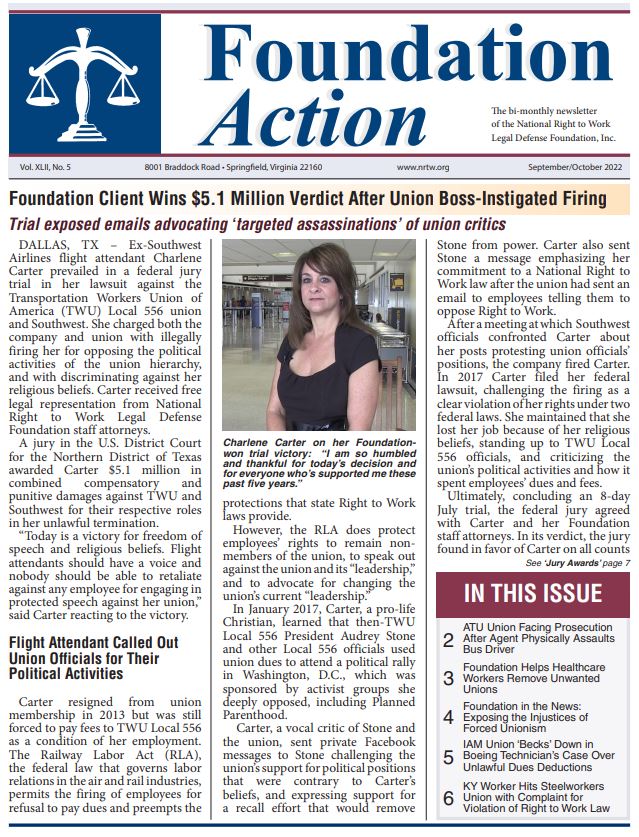
All articles from the September/October issue of Foundation Action are now on the website.
In this issue:
- Foundation Client Wins $5.1 Million Verdict After Union Boss-Instigated Firing
- ATU Union Facing Prosecution After Agent Physically Assaults Bus Driver
- Foundation Helps Healthcare Workers Remove Unwanted Unions
- Foundation in the News: Exposing the Injustices of Forced Unionism
- IAM Union ‘Becks’ Down in Boeing Technician’s Case Over Unlawful Dues Deductions
- Kentucky Worker Hits Steelworkers Union with Complaint for Violation of Right to Work Law
Recent articles can be found here. To sign up for a free copy of the newsletter via mail please see the form at the bottom of this page.
NLRB Blocks Attempt to Oust Union, Despite Unanimous Call for Union’s Removal
The following article is from the National Right to Work Legal Defense Foundation’s bi-monthly Foundation Action Newsletter, May/June 2021 edition. To view other editions of Foundation Action or to sign up for a free subscription, click here.
Every employee signed a petition for vote to remove Carpenters Union from their workplace
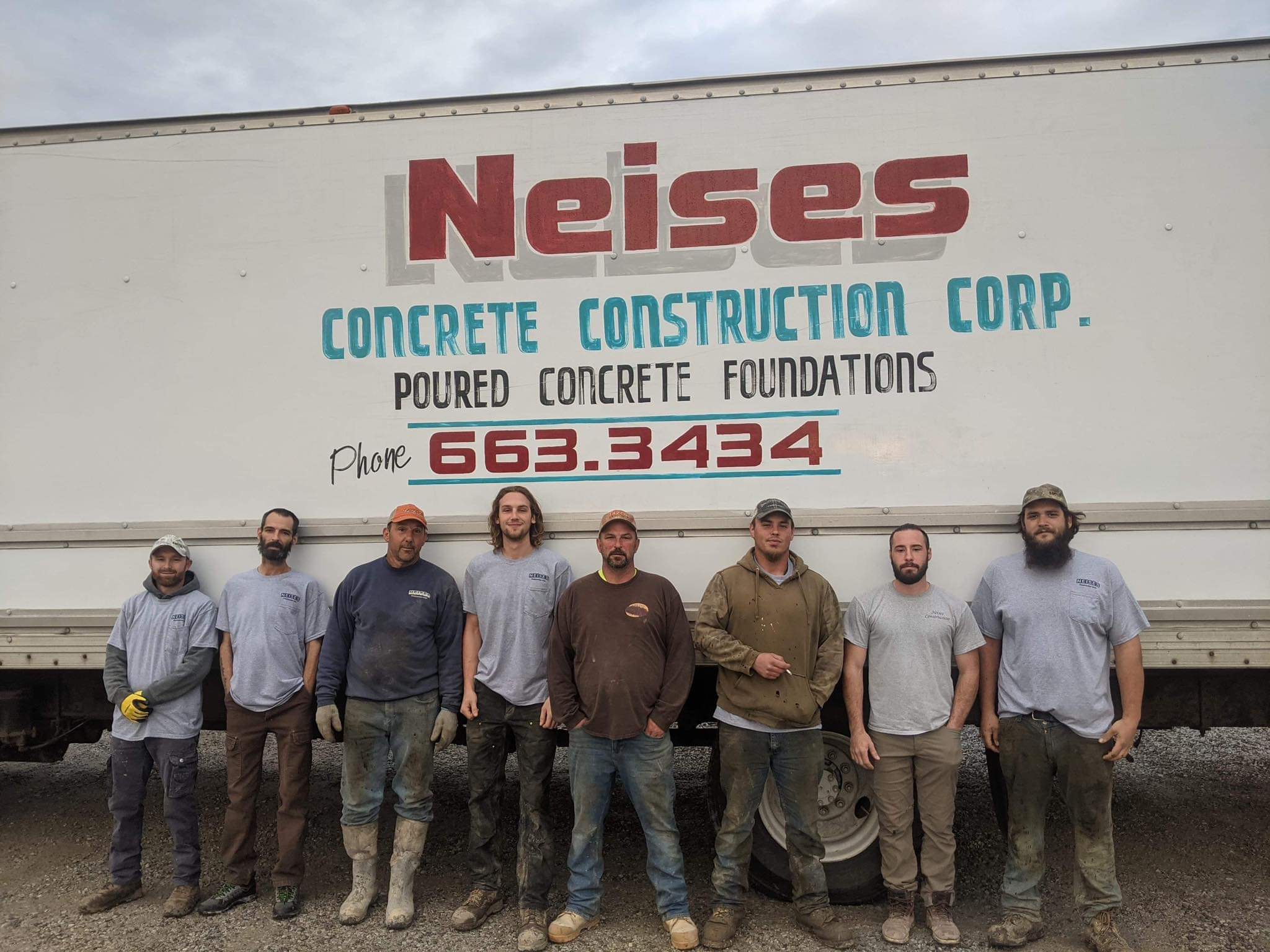
Foundation staff attorneys are defending Neises Concrete Construction Corp. workers’ unanimous call to free themselves from the coercive reign of IKORCC union bosses.
CROWN POINT, IN – Mike Halkias and his coworkers at Neises Construction Corp. in Crown Point, Indiana, are subject to monopoly “representation” by officials of the Indiana/Kentucky/Ohio Regional Council of Carpenters (IKORCC) union.
Every bargaining unit member exercised the right under Indiana’s Right to Work Law to decline formal union membership and to refuse to pay any union dues or fees, but union officials still have the authority under federal law to “negotiate” with Neises for the employees despite their objections to that representation.
NLRB Officials Snub Workers’ Unanimous Petition, Demand Union Bargaining
With free legal aid from the National Right to Work Legal Defense Foundation, Halkias submitted a decertification petition to Region 13 of the National Labor Relations Board (NLRB), signed by every member of his unit, to remove IKORCC union officials from their workplace.
Despite unanimous agreement by the unit’s workers to hold a vote to oust IKORCC bosses, NLRB Region 13 officials rejected the decertification petition. The Regional Director is demanding that the Indiana employer bargain with IKORCC, even though none of its employees want the union to “represent” them.
Union Bosses Won’t Give Up Monopoly Bargaining Power over Non-members
So far union officials have stymied the vote through “blocking charges,” unfair labor practice charges filed by union lawyers that, before they are resolved, prevent a vote from taking place. Union officials claim the vote cannot proceed until the company negotiates “in good faith” with the union.
That demand comes even though federal law makes it illegal for an employer to engage in bargaining with a union that it knows lacks the support of at least a bare majority of workers. The NLRB regional official’s order dismissing the employees’ petition did not even acknowledge that every employee in Mr. Halkias’ bargaining unit has shown a desire to be independent from the union by resigning union membership and asking for a decertification vote.
Foundation Attorneys Bring Fight to National Board
The Foundation staff attorneys who represent Halkias have appealed to the NLRB in Washington to overturn the rejection of the decertification petition and to allow the workers to vote so they can be rid of the union whose so-called “representation” they all oppose. “It is outrageous that in a workplace where every single worker wants nothing to do with a union, federal law still forces workers to accept the so-called ‘representation’ of union bosses,” said National Right to Work Foundation Vice President Patrick Semmens.
“The fact that this appeal is even necessary demonstrates how rigged federal law is against independent-minded workers who seek to exercise their right not to associate with a union.”
“This case is a reminder that, even in Right to Work states that protect workers from being forced to fund a union they don’t support, federal law still forces workers under union monopoly control even when those employees oppose the union and believe they would be better off without it.”
Oregon ABC Cameraman Wins Ruling Against Illegal Dues-Seizing NABET Bosses
The following article is from the National Right to Work Legal Defense Foundation’s bi-monthly Foundation Action Newsletter, March/April 2021 edition. To view other editions or to sign up for a free subscription, click here.
Administrative Law Judge orders union boss to refund all illegally taken money
He’s done playing games: After cameraman Jeremy Brown sought free legal aid from the Foundation, an NLRB Administrative Law Judge ruled against NABET bosses for violating his Beck rights for years.
PORTLAND, OR – Jeremy Brown, a “daily hire” cameraman for ABC who had worked on and off for the company since 1999, would not have thought that a new president taking over the National Association of Broadcast Employees and Technicians (NABET) Local 51 union would mean anything for him when he resumed work in 2016. After all, he had worked for ABC for nearly three years, and the union had never even contacted him and he had never joined the union.
Then, in 2019, he received a series of letters from the new union honcho, demanding he pay nearly $10,000 in initiation fees and so-called “back-agency dues.” Brown quickly obtained free legal aid from National Right to Work Legal Defense Foundation staff attorneys and asserted his rights under the Foundation-won CWA v. Beck Supreme Court decision.
Beck prevents private sector union bosses from forcing employees who have abstained from formal union membership to pay for anything unrelated to the union’s bargaining functions, such as political expenses. Moreover, it requires union officials to provide information on the union’s fee calculation and expenditures to non-members.
New NABET Chief Demanded Thousands, Then Snubbed Cameraman’s Beck Rights
Because Brown works primarily in non-Right to Work states, he can be legally forced as a condition of employment to pay some fees to union bosses.
After receiving the baffling, belated dues demands, Brown emailed the new union president, Carrie Biggs-Adams, asking for clarification. He also exercised his Beck rights by objecting “to the collection and expenditure by the union of a fee for any purpose other than” certain bargaining activities. Believing that he would be fired if he did not agree to pay union dues, he filled out a form authorizing NABET to take full dues from his paycheck, but did so under duress.
Biggs-Adams ignored several follow-ups by Brown. According to legal documents, she “believed Local 51 had no obligation to [reply to Brown] because Beck objections” are handled only by the union’s national headquarters under NABET rules. Even so, she never apprised Brown of NABET’s national mailing address, or provided him the dues reduction or any of the information mandated by Beck.
In December, Brown won a decision from a National Labor Relations Board (NLRB) Administrative Law Judge (ALJ) about the union’s Beck rights violations. The ALJ’s decision holds the NABET union violated Brown’s rights under the National Labor Relations Act (NLRA) through its officials’ omissions and the failure to reduce his dues.
The ALJ ordered NABET Local 51 to provide Brown with “a good faith determination of the reduced dues and fees objectors must pay,” and “reimburse Brown for all dues and fees collected” beyond what is required under Beck, with interest.
“While this decision vindicated Mr. Brown’s legal rights, it also demonstrates why every American worker deserves the protection of a Right to Work law to shield them from union boss threats to pay up or be fired,” commented National Right to Work Foundation Vice President Patrick Semmens.
Newark Courthouse Security Guards Win Settlement Forcing Union Bosses to Refund Illegal Dues and Stop Retaliatory Lawsuit
Union bosses filed collection suit illegally demanding dues payments from nonmember employee for period when there was no union contract in effect
Newark, NJ (December 11, 2019) – With free legal aid from the National Right to Work Legal Defense Foundation, Newark, New Jersey-based security guards Andrei Bobev and William Sona have won a settlement against United Government Security Officers of America (UGSOA) union bosses, whom they charged with illegally demanding union dues from them while there was no contract in effect between the employer and union. The settlement was approved by the National Labor Relations Board (NLRB) Region 22 in Newark.
As part of the settlement, UGSOA officials are required to refund to Sona and six coworkers more than $4,000 in dues and fees that were taken from them illegally, and notify Bobev that they will not continue a civil lawsuit they filed against him to force him to pay illegal union dues after he refused to do so. Bobev and Sona are not members of the UGSOA.
Bobev first sought the aid of Foundation staff attorneys after Paragon Systems took over the federal contract for security services at the U.S. Courthouse in Newark. USGOA bosses, who under the old contractor had monopoly bargaining power over the security guards at the courthouse, demanded that employees continue to pay them dues and fees even though a contract had not yet been finalized between the union and Paragon. Bobbev declined to pay the illegally-demanded dues, and filed federal charges with the NLRB against UGSOA officials with National Right to Work Foundation legal aid.
NLRB Region 22 officials dismissed Bobev’s charges, and UGSOA officials shortly after retaliated against him with a civil lawsuit in an attempt to force him into paying the illegal dues. However, the NLRB General Counsel in Washington reversed Region 22’s dismissal and instructed regional officials to prosecute Bobev’s charge.
Sona and other nonmembers were misled by union officials and started paying illegal dues and fees while there was no monopoly bargaining contract in effect between Paragon and the UGSOA union. With the current settlement, he and six of his fellow security guards will receive back all the money that they paid to UGSOA bosses during that period, plus interest.
UGSOA officials are also required by the settlement to post notices at union headquarters and at all of Paragon Systems’ Newark locations. The notices declare that union bosses “will not threaten to cause [the] employer to discharge [employees] for failure to pay dues and/or service fees” when there is no monopoly bargaining contract in effect, and “will not threaten to enforce [the union’s] by-laws and constitution against non-members by threatening to institute civil proceedings” to force them to pay dues or fees.
“Although this settlement finally provides Mr. Bobev, Mr. Sona, and their coworkers with remedies for illegal union boss actions, it is outrageous that UGSOA officials believed they could enforce their coercive bylaws on workers without having legal power over any one of them in the absence of a contract,” commented National Right to Work Foundation President Mark Mix. “A Right to Work law would stop coercive union boss activity in New Jersey by giving workers the right to voluntarily choose whether or not to join or financially support a union.”
Legal Victory: West Virginia Supreme Court Unanimously Upholds Right to Work
The following article is from the National Right to Work Legal Defense Foundation’s bi-monthly Foundation Action Newsletter, July/August 2020 edition. To view other editions or to sign up for a free subscription, click here.
Foundation attorneys filed 10 legal briefs defending Right to Work from union boss legal attack
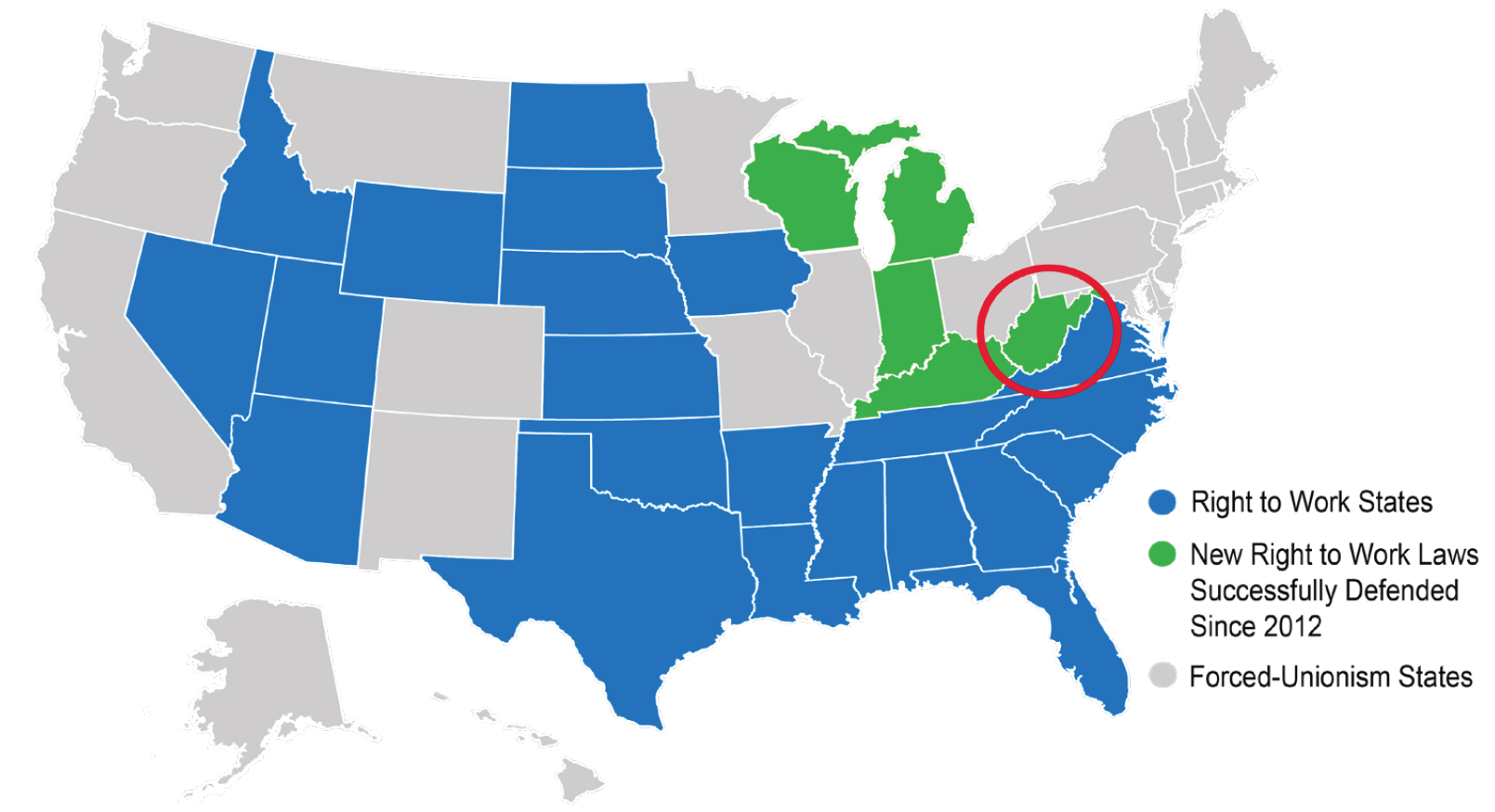
The Foundation added West Virginia to the list of states where it has successfully helped defend Right to Work since 2012. Now the state’s motto, “Montani Semper Liberi” (“Mountaineers are Always Free”) applies to the state’s workers.
CHARLESTON, WV – The West Virginia Supreme Court closed the book on a case brought by union lawyers seeking to overturn the state’s popular Right to Work Law, which protects Mountain State workers from being forced to pay dues or fees to a union as a condition of employment. Foundation staff attorneys filed 10 briefs in defense of Right to Work, including briefs submitted for pro-Right to Work employees who wanted the freedom to cut off financial support for unions in their workplace.
Ultimately, the West Virginia Supreme Court rejected outrageous arguments from union lawyers that union hierarchies have a legal “right” to a portion of a worker’s paycheck because that worker is also forced to accept their so-called “representation.” In their ruling, the justices repeatedly cited the landmark 2018 Foundation-won Janus v. AFSCME decision in which the U.S. Supreme Court ruled that requiring public sector employees to pay union dues as a condition of employment is a First Amendment violation.
In the decision, Justice Evan Jenkins wrote for the majority that West Virginia’s Right to Work Law “does not violate constitutional rights of association, property, or liberty” and that states are “expressly authorized under federal law” to prohibit union bosses from requiring dues or fees as a condition of employment. Justice Jenkins also maintained that Janus provides strong support for the law.
The West Virginia Legislature passed Right to Work over then-Governor Earl Ray Tomblin’s veto in February 2016, making West Virginia the 26th Right to Work state. The Foundation immediately offered free legal assistance to employees who had questions about exercising their rights.
Foundation Attorneys Spring into Action as Soon as Protections Enacted
The Foundation also created a special task force to defend the West Virginia law, which began applying to collective bargaining agreements that were entered into, modified, renewed or extended after July 1, 2016.
On June 27, 2016, lawyers for several state unions brought a case (later renamed West Virginia AFL-CIO, et al. v. Governor James C. Justice, et al.) in an attempt to overturn the popular law. Polling consistently shows that Americans overwhelmingly back Right to Work laws. A poll of union households even found that 80 percent of union members supported the Right to Work principle that union membership and dues payment should be voluntary and not required as a condition of employment.
Despite decades of precedent upholding such laws, Judge Jennifer Bailey of the Kanawha County Circuit Court issued a February 2017 order at the behest of union lawyers, granting a preliminary injunction that purported to block the law. The union lawyers’ primary arguments in this case for why the Right to Work protections for workers should be overturned had already been rejected by a Federal Court of Appeals and the Indiana Supreme Court. They also ran counter to nearly 70 years of legal precedent, including U.S. Supreme Court decisions, upholding the constitutionality of state Right to Work laws.
Foundation staff attorneys filed legal briefs for Reginald Gibbs, who worked as a lead slot machine technician with the Greenbrier Hotel in White Sulphur Springs, West Virginia, and Donna Harper, who worked as a laundry aide and nursing assistant at the Genesis HealthCare Tygart Center in Fairmont, West Virginia. Harper’s brief explained that because she had exercised her right under the Right to Work protections to refrain from subsidizing the Teamsters union at her workplace, killing those protections would result in her being fired.
Union Boss Attacks on Right to Work in Other States Successfully Turned Back
“The West Virginia Supreme Court’s unanimous decision to safeguard the right to freely choose whether or not one will financially support a union marks a great victory for Mountain State employees,” observed National Right to Work Foundation President Mark Mix. “Workers who disapprove of union boss activities can rest assured that they cannot be terminated for refusing to tender dues to a union, and those who want to support union activities may do so uninhibited.”
In addition to West Virginia, Foundation staff attorneys have successfully pursued legal action in recent years to defend and enforce new Right to Work laws in Indiana, Michigan, Wisconsin and Kentucky, all of which have passed Right to Work protections for employees since 2012.
Michigan Nurse Sues Teamsters for Violating Michigan’s Right to Work Law
The following article is from the National Right to Work Legal Defense Foundation’s bi-monthly Foundation Action Newsletter, March/April 2020 edition. To view other editions or to sign up for a free subscription, click here.
Lawsuit: Union bosses illegally ignored repeated requests to stop union dues deductions

Since former Michigan Gov. Rick Snyder signed Right to Work into law, Foundation staff attorneys have filed well over 100 cases for workers fighting forced unionism in the state.
FLINT, MI – Madrina Wells, a nurse at the Genesys Regional Medical Center, first tried to exercise her right to end all union dues deductions from her paycheck in December 2018, in accordance with Michigan’s Right to Work Law.
But, for well over a year now, the Teamsters union bosses at her workplace have continuously violated that right and kept requiring her to pay union fees. Finally, in December, she filed a lawsuit against them with free legal aid from National Right to Work Foundation staff attorneys.
Teamsters Officials Ignored Six Attempts by Nurse to Exercise Rights
According to the complaint filed in Genesee County Circuit Court, Wells resigned her union membership in February 2018 and requested that Teamsters officials cease all dues deductions from her paycheck in December of the same year.
Notwithstanding her request, Teamsters bosses sent her a letter in January 2019 demanding that she pay them non-member forced fees after she returned from a stint on medical leave, which she had begun in December 2018.
Though a reduced amount of union dues can be charged to private sector employees who abstain from formal union membership in non-Right to Work states, in Right to Work states like Michigan no public or private sector employee is required to pay any amount of union fees as a condition of employment.
Wells resumed work in July 2019, and sent a letter to Teamsters officials “renewing her objection” to tendering any dues or fees whatsoever to the Teamsters hierarchy. Teamsters bosses again rebuffed her request and subsequently demanded forced fees from Wells for July through December of 2019, all in clear violation of her rights.
Wells responded to each demand by reiterating her objection to the illegal fees, but submitted the fees demanded by Teamsters bosses under protest. Even so, Genesys Regional Medical Center not only deducted the Teamsters’ so-called “agency fee” from Wells’ paycheck in August 2019, but also seized the full amount of union dues from her paycheck in October.
Scores of Workers Turn to Foundation After Right to Work Enacted
Since Michigan’s Right to Work Law went into effect in 2013, Foundation staff attorneys have provided free legal aid to Wolverine State workers in over 120 cases.
In 2018, Foundation staff attorneys won a settlement for Port Huronarea public school employees Tammy Williams and Linda Gervais, ending dues demands made by the Michigan Education Association union (MEA) in violation of the Right to Work law. To date, as a result of that settlement, over 20 Wolverine State teachers have been freed from illegal dues demands.
“Once again Michigan union bosses have been caught shamelessly violating the Wolverine State’s Right to Work law,” commented National Right to Work Foundation Vice President Patrick Semmens. “Foundation staff attorneys will continue the fight until all Michigan workers can freely exercise their right not to fund unions they fundamentally disagree with.”
Milwaukee Worker Files Federal Charges Against Teamsters Union for Violating His Rights under State and Federal Law
NLRB Charge: Despite Right to Work law, union bosses coerced worker into becoming a union member and then blocked attempts to cut off dues payments
Milwaukee, WI (March 3, 2020) – With free legal aid from National Right to Work Legal Defense Foundation staff attorneys, an employee at a Milwaukee factory has filed federal charges against Teamsters “General” Local Union No. 200 for violating his rights under the National Labor Relations Act (NLRA) and Wisconsin’s Right to Work law.
Tyler Lewis, employed by Snap-on Logistics Company, filed an unfair labor practice charge with the National Labor Relations Board (NLRB) after union officials told him that he must become a union member and pay membership dues as a condition of employment in violation of longstanding federal law.
Teamsters union officials further refused to allow Lewis to stop union dues from being seized from his paycheck even after he learned of his rights and resigned his union membership in September 2019. Moreover, union officials continue to deduct dues from his paycheck and refuse to refund Lewis any of the dues unlawfully seized from him.
Forcing workers to pay union dues or fees as a condition of employment is prohibited under Wisconsin’s Right to Work law, which went into effect in March 2015. However, union officials continued to accept and retain union dues seized from Lewis because they claimed he could only cut off union dues deductions during a narrow union-created “window period.” Even as they made that claim, they failed to provide Lewis with specific dates when his request would be accepted under their rules.
As his charge details, the union monopoly bargaining agreement in Lewis’ workplace, which was signed after the state Right to Work law went into effect, contained language prohibited by the Right to Work law that workers must pay union dues or fees as a condition of employment. Moreover, even if the agreement was actually in place prior to the law’s effective date, Lewis’ Foundation-provided attorneys state in the filing that the passage of the Right to Work law invalidated the union’s claim that Lewis’ right to stop dues payments was limited to a brief union window period.
“Once again, Teamsters union bosses are using coercive tactics to force workers they claim to ‘represent’ to pay union dues and fees against their wishes,” said National Right to Work Foundation President Mark Mix. “Wisconsin’s Right to Work law should mean union membership and dues payment are strictly voluntary, but rather than respect workers’ rights and work to win their uncoerced support, union bosses are again attempting to trap workers in forced dues in violation of federal law.”
West Virginia Supreme Court Hears Right to Work Case
The following article is from the National Right to Work Legal Defense Foundation’s bi-monthly Foundation Action Newsletter, January/February 2020 edition. The West Virginia Supreme Court heard arguments in this case on January 15 and a decision is expected in the coming months. To view other editions or to sign up for a free subscription, click here.
Foundation continues to defend all Right to Work laws against Big Labor attack
Forced-dues-hungry union bosses have been waging a legal battle to overturn West Virginia’s Right to Work Law since it was enacted in 2016. Foundation staff attorneys have been fighting back by filing amicus briefs in court.
CHARLESTON, WV – The West Virginia Supreme Court will hear arguments on January 15 in union bosses’ long-running case seeking to dismantle West Virginia’s Right to Work Law and restore their forced-dues powers over workers across the Mountain State. National Right to Work Foundation staff attorneys have already filed multiple legal briefs in this case for West Virginia workers in defense of West Virginia’s Right to Work Law.
After Passage, Union Bosses Immediately Target West Virginia Right to Work Law
Last year, union lawyers relied on discredited legal arguments to convince Kanawha County Circuit Court Judge Jennifer Bailey to declare West Virginia’s entire Right to Work Law invalid. Union lawyers dubiously claim that West Virginia union bosses have a “right” to forced dues. Judge Bailey issued a similar ruling blocking the Right to Work law after the legislation was signed into law in 2016. The West Virginia Supreme Court overturned that decision, citing arguments made in briefs by Foundation staff attorneys. “Of course, union partisans never willingly accept the loss of forced dues,” said National Right to Work Foundation President Mark Mix. “So now the issue is back at the state’s highest court.” If Big Labor’s lawsuit to overturn
West Virginia’s Right to Work Law succeeds, union bosses could have thousands of independent-minded workers across the state fired solely for refusing to subsidize union activities.
Foundation Files 10 Briefs to Protect Rights of West Virginia Workers
Foundation staff attorneys have filed 10 legal briefs in the multi-year case. The Foundation’s latest amicus brief was filed for West Virginia nursing home employee Donna Harper. Harper, like many other workers in West Virginia, chose not to pay dues or fees to union bosses, which is her legal right in a Right to Work state.
“Union bosses in West Virginia are intent on reclaiming their forced-dues power,” Mix said. “Big Labor is waging this protracted legal battle to return the Mountain State to a time when millions and millions of dollars in workers’ money were seized by union bosses to fill Big Labor’s coffers with forced dues.”
This case is the latest legal battle in the Foundation’s long history of effectively defending Right to Work laws in state and federal court from spurious attacks by Big Labor. Although federal law specifically authorizes states to pass Right to Work laws to protect workers from union boss coercion, union lawyers have repeatedly challenged these laws in an attempt to keep siphoning union dues and fees from workers’ paychecks.
Foundation Has Successfully Defended State Right to Work Laws Nationwide
In addition to West Virginia, Foundation staff attorneys have successfully pursued legal action in recent years to defend and enforce new Right to Work laws in Indiana, Michigan, Wisconsin and Kentucky, all of which have passed Right to Work protections for employees in just the last seven years. In Michigan alone, Foundation staff attorneys have assisted employees in over 100 cases since Right to Work went into effect in early 2013.





