
Workers Who Voted Against Union Oppose Order Forcing Union on Them
The following article is from the National Right to Work Legal Defense Foundation’s bi-monthly Foundation Action Newsletter, November/December 2021 edition. To view other editions of Foundation Action or to sign up for a free subscription, click here.
Biden NLRB seeks to overturn vote of Red Rock Casino workers against Unite Here
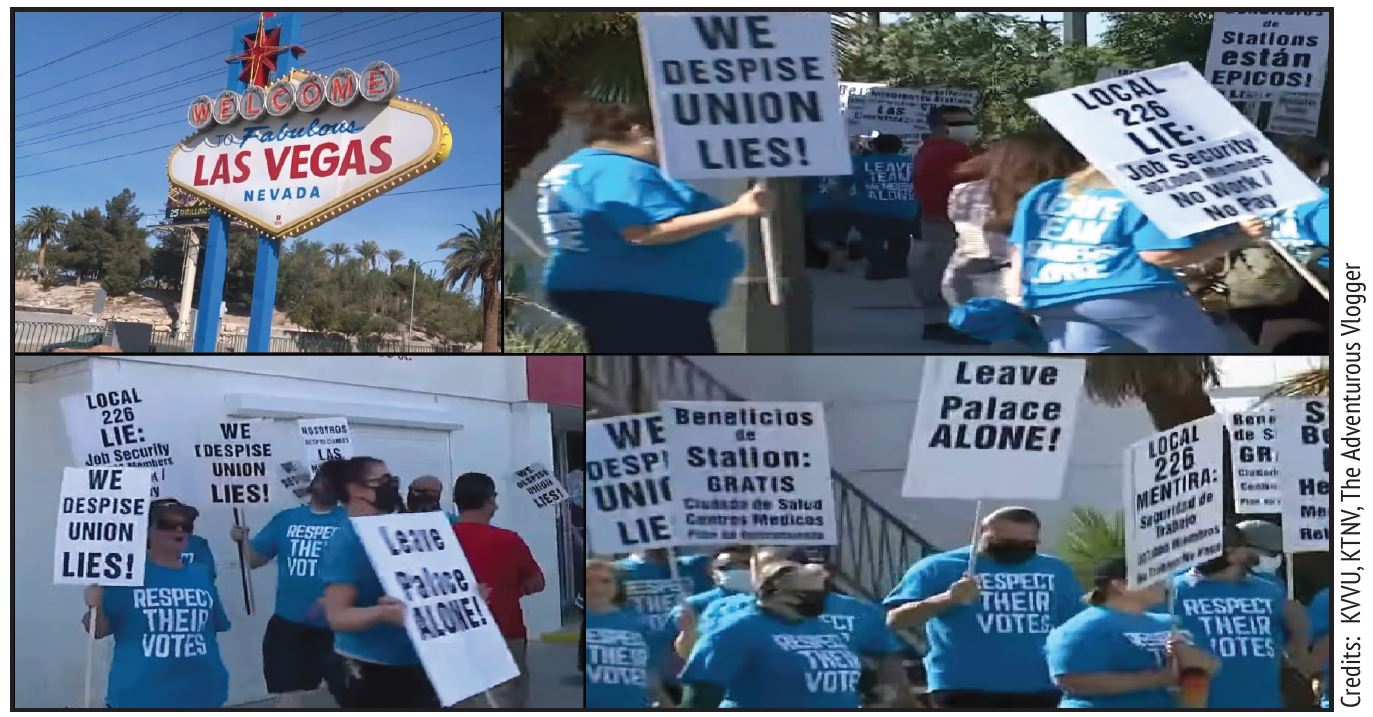
Red Rock Casino employees bearing the messages “We Despise Union Lies” and “Respect Their Votes” protested outside Culinary Union headquarters in Las Vegas after union bosses tried to block Red Rock Casino workers’ emphatic vote to remove the union.
LAS VEGAS, NV – A large majority of the workers at Red Rock Casino in Las Vegas, Nevada, voted “no” to unionization, but a federal district court judge later issued an order forcing their employer to bargain with union officials anyway.
The Casino appealed the judge’s order to the U.S. Court of Appeals for the Ninth Circuit. National Right to Work Legal Defense Foundation attorneys assisted Red Rock food service employee Raynell Teske for free in filing her legal brief at the Ninth Circuit, arguing the judge was wrong to impose a union monopoly on the workers after the union had already lost an election.
Judge Overrides Workers’ Election Choice
In December 2019, the National Labor Relations Board (NLRB) administered a secret-ballot election on whether to unionize Red Rock. A majority of those voting rejected union officials’ effort to become their monopoly bargaining “representatives.”
Nevertheless, NLRB Region 28 Director Cornele Overstreet sought a federal court injunction demanding the union be imposed over the workers’ objections. On July 20, 2021, notoriously partisan Judge Gloria Navarro, appointed by Barack Obama, granted the NLRB Director’s request. She fired off a rare “Gissel” order forcing Red Rock to bargain with union officials despite the employees’ vote against unionization. The judge based her order on union officials’ claim that a majority of workers had signed union authorization cards before the vote. Teske’s legal brief argues that those “card check” signatures are unreliable, and not reason enough to conclude the union ever had majority support. After all, the level of union support was tested by the secret-ballot election and the results were clear: union officials received only 40% support from the eligible employees’ votes. As the Supreme Court has long recognized, secret ballots are a far more reliable way of gauging worker support for a union, because workers are often pressured, harassed, or misled by union organizers into signing cards.
Union Handbook Admits: ‘Card Check’ Is Unreliable
Unions themselves know that “card check” signatures do not reliably indicate worker support. The AFL-CIO admitted in its 1989 organizing handbook that it needed at least 75% card check support before having even a 50-50 chance of winning a secret-ballot election. An earlier guidebook acknowledged that some workers sign cards just to “get the union off my back.” Teske’s brief argues the union’s possession of so-called “cards” does not give union officials permission to take over, especially after they lost a secret-ballot election.
Brief: A Judge’s Order Shouldn’t Overturn Workers’ Clear Choice
The Foundation-aided brief urges that the “Gissel” order be overturned and says that imposing the union’s monopoly power despite the workers’ vote against it treats workers “like children” who did not understand what they were doing when they voted against union affiliation.
“Ms. Teske and her coworkers chose to reject unionization at the ballot box, but Judge Navarro decided to use her power to overturn the election,” said National Right to Work Foundation Vice President and Legal Director Raymond LaJeunesse. “Time and time again, we see workers pressured, misled and even bribed to sign union cards, which is why ‘Card Check’ is widely accepted as unreliable, especially compared to an NLRB-supervised secret-ballot election.”
“The Court of Appeals should promptly overturn Judge Navarro’s coercive order, and restore the actual choice workers made at the ballot box. Federal judges and NLRB bureaucrats cannot be allowed to override workers’ choices,” added LaJeunesse.
Victory: CO Worker Wins Against Union Bosses Who Demanded Illegal $21,000 Fine
The following article is from the National Right to Work Legal Defense Foundation’s bi-monthly Foundation Action Newsletter, September/October 2021 edition. To view other editions of Foundation Action or to sign up for a free subscription, click here.
Union must back down after trying to punish worker who left union, found new job
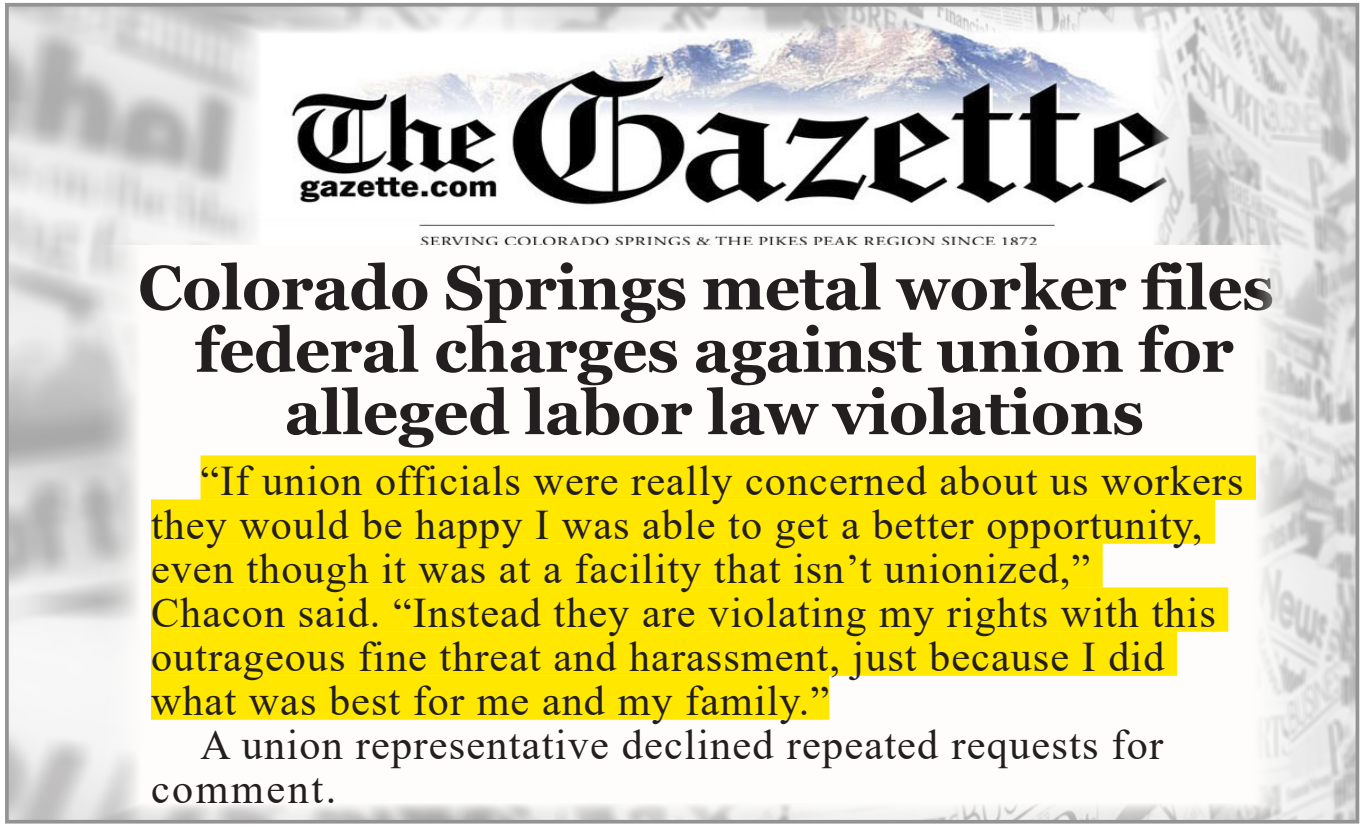
Foundation staff ensured Russell Chacon’s frustrations with Sheet Metal union bosses’ illegal fines were covered by the Colorado Springs Gazette. Shortly after the article appeared, Sheet Metal union officials backed down from their demand.
COLORADO SPRINGS, CO – Colorado metal worker Russell Chacon was angry when he received a letter from International Association of Sheet Metal, Air, Rail, and Transportation Workers (SMART) Local 9 union officials in May, demanding he pay $21,252 in disciplinary fines. Six months earlier he had resigned his union membership, and had left his job at Colorado Sheet Metal to work for Rocky Mechanical, an employer that isn’t under the control of Sheet Metal union bosses.
Union officials demanded Chacon fork over the ruinous sum to cover an alleged union “loss of funds” for a period through May 31, which included days that Chacon had not even worked yet.
Sheet Metal Union Officials Violated Established Law to Harass Worker
Chacon obtained free legal representation from National Right to Work Foundation staff attorneys and filed federal unfair labor practice charges against the Sheet Metal union at National Labor Relations Board (NLRB) Region 27 in Denver. He asserted that the fines were levied against him specifically in retaliation for his leaving the union and finding new work.
Soon after the Foundation-assisted charges, Sheet Metal union officials dropped the illegal fine demands, and are now forced by a settlement to inform workers that they will not subject them to internal union discipline if they exercise their right to end union membership.
Decades-old federal law prohibits union officials from forcing internal union discipline on workers who have resigned union membership, and from restricting the exercise of that basic right to refrain.
“If union officials were really concerned about us workers they would be happy I was able to get a better opportunity, even though it was at a facility that isn’t unionized,” Chacon told the Colorado Springs Gazette in May. “Instead they are violating my rights with this outrageous fine threat and harassment, just because I did what was best for me and my family.”
Although Sheet Metal union bosses informally rescinded their fine demands soon after Chacon filed his charge, NLRB Region 27 continued to investigate Chacon’s charge that union officials had instigated the discipline specifically in retaliation for his leaving the union.
Settlement Follows NLRB Finding Merit in Worker’s Charges of Retaliation
The NLRB found merit in Chacon’s claims of retaliation in July, forcing union officials to settle in order to avoid NLRB prosecution.
The settlement requires Sheet Metal union officials to post a notice at the union office stating that they “will not fail to inform or misinform you about the proper process for resigning your membership,” “will not fail to give effect to resignations of membership from the Union,” and “will not restrain and coerce you by instituting and prosecuting disciplinary proceedings and levying fines after failing to give effect to resignations.” The notice also confirms that Chacon is no longer subject to the fine demands.
“As the conclusion of this case shows, Sheet Metal union officials were caught red-handed violating workers’ most basic right to refrain from associating with an organization to which they don’t want to belong,” commented National Right to Work Foundation Vice President and Legal Director Raymond LaJeunesse. “Although we are pleased that Mr. Chacon is no longer saddled with an outrageous fine demand, unfortunately other Colorado workers can still be forced to pay dues to union bosses because The Centennial State lacks a Right to Work law.”
LaJeunesse continued, “Right to Work protections ensure that all union financial support is strictly voluntary, and that no worker can be fired just for refusal to pay dues to unwanted union bosses.”
NLRB Blocks Attempt to Oust Union, Despite Unanimous Call for Union’s Removal
The following article is from the National Right to Work Legal Defense Foundation’s bi-monthly Foundation Action Newsletter, May/June 2021 edition. To view other editions of Foundation Action or to sign up for a free subscription, click here.
Every employee signed a petition for vote to remove Carpenters Union from their workplace

Foundation staff attorneys are defending Neises Concrete Construction Corp. workers’ unanimous call to free themselves from the coercive reign of IKORCC union bosses.
CROWN POINT, IN – Mike Halkias and his coworkers at Neises Construction Corp. in Crown Point, Indiana, are subject to monopoly “representation” by officials of the Indiana/Kentucky/Ohio Regional Council of Carpenters (IKORCC) union.
Every bargaining unit member exercised the right under Indiana’s Right to Work Law to decline formal union membership and to refuse to pay any union dues or fees, but union officials still have the authority under federal law to “negotiate” with Neises for the employees despite their objections to that representation.
NLRB Officials Snub Workers’ Unanimous Petition, Demand Union Bargaining
With free legal aid from the National Right to Work Legal Defense Foundation, Halkias submitted a decertification petition to Region 13 of the National Labor Relations Board (NLRB), signed by every member of his unit, to remove IKORCC union officials from their workplace.
Despite unanimous agreement by the unit’s workers to hold a vote to oust IKORCC bosses, NLRB Region 13 officials rejected the decertification petition. The Regional Director is demanding that the Indiana employer bargain with IKORCC, even though none of its employees want the union to “represent” them.
Union Bosses Won’t Give Up Monopoly Bargaining Power over Non-members
So far union officials have stymied the vote through “blocking charges,” unfair labor practice charges filed by union lawyers that, before they are resolved, prevent a vote from taking place. Union officials claim the vote cannot proceed until the company negotiates “in good faith” with the union.
That demand comes even though federal law makes it illegal for an employer to engage in bargaining with a union that it knows lacks the support of at least a bare majority of workers. The NLRB regional official’s order dismissing the employees’ petition did not even acknowledge that every employee in Mr. Halkias’ bargaining unit has shown a desire to be independent from the union by resigning union membership and asking for a decertification vote.
Foundation Attorneys Bring Fight to National Board
The Foundation staff attorneys who represent Halkias have appealed to the NLRB in Washington to overturn the rejection of the decertification petition and to allow the workers to vote so they can be rid of the union whose so-called “representation” they all oppose. “It is outrageous that in a workplace where every single worker wants nothing to do with a union, federal law still forces workers to accept the so-called ‘representation’ of union bosses,” said National Right to Work Foundation Vice President Patrick Semmens.
“The fact that this appeal is even necessary demonstrates how rigged federal law is against independent-minded workers who seek to exercise their right not to associate with a union.”
“This case is a reminder that, even in Right to Work states that protect workers from being forced to fund a union they don’t support, federal law still forces workers under union monopoly control even when those employees oppose the union and believe they would be better off without it.”
Workers Nationwide Press NLRB to Scrap Policy Blocking Right to Vote Out Unions
The following article is from the National Right to Work Legal Defense Foundation’s bi-monthly Foundation Action Newsletter, March/April 2021 edition. To view other editions or to sign up for a free subscription, click here.
Foundation cases contend ‘contract bar’ must be eliminated to protect employee freedom
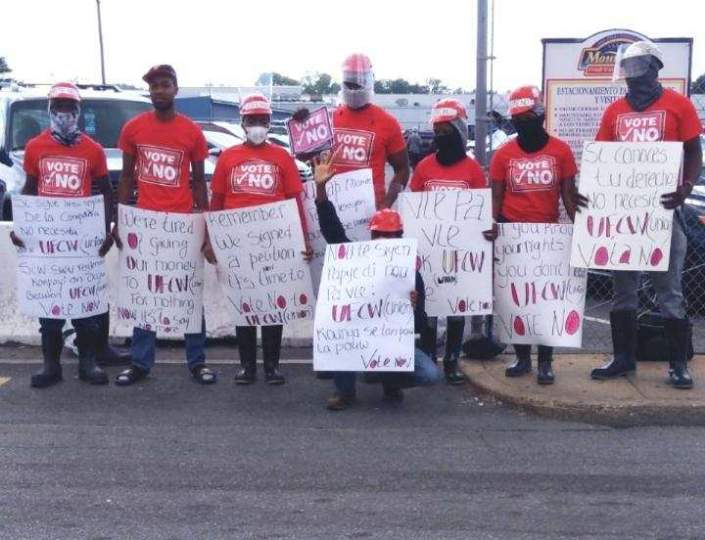
Foundation staff attorneys are assisting Delaware poultry workers in challenging UFCW bosses’ attempts to use the “contract bar” to trap them in union ranks.
WASHINGTON, DC – Foundation attorneys in January filed a Request for Review to the full National Labor Relations Board (NLRB) in Washington, D.C. The Request defends the right of Virginia Transdev workers to have a vote to remove unpopular Office and Professional Employees International Union (OPEIU) Local 2 bosses from power at their workplace.
The Transdev employees, who work at the Fairfax Connector bus service in Northern Virginia, now join Foundation-backed workers in Delaware and Puerto Rico, all of whom are urging the NLRB to eliminate the “contract bar.” That is a non-statutory NLRB policy which forbids employees from exercising their right to vote out an unpopular union in an NLRB-supervised “decertification election” for up to three years after their employer and union finalize a monopoly bargaining contract.
Foundation attorneys point out in each of these cases that the “contract bar” appears nowhere in the National Labor Relations Act (NLRA), the federal law the NLRB is charged with enforcing, and is merely the result of past union boss-friendly decisions by the Board. They also argue that the bar undermines workers’ basic right under the NLRA to remove unions that lack majority support.
“The ‘contract bar’ undermines the fundamental objective of federal labor law: Employee free choice. It makes rank-and-file employees prisoners of an unpopular union, with no way out for up to three years,” commented National Right Work Foundation President Mark Mix. “This inevitably creates an environment in which, as these employees can certainly attest, it’s impossible to hold self-serving union bosses accountable because workers are denied the right to vote them out.”
Unpopular OPEIU Bosses Went Behind Workers’ Backs to Sign Contract
The petitioner in the Transdev workers’ case, Amir Daoud, submitted a petition on November 10, 2020, signed by the necessary number of his coworkers to trigger a “decertification election” in his workplace. This was after news had gotten around that an OPEIU union agent had told some employees in October he had “negotiated a new agreement” with Transdev management and “‘intended’ to sign it without a ratification vote.” Workers had already voted down an earlier union boss-promoted monopoly bargaining contract in June.
Foundation attorneys filed a Request for Review, which notes that the union agent didn’t inform Daoud and his coworkers of when he planned to approve the new contract — until after Daoud filed the petition. The new contract was signed by union agents on October 30 and Transdev representatives on October 31.
NLRB Region 5 in Baltimore dismissed Daoud and his coworkers’ decertification petition on December 22, ruling that the “contract bar” applied because the employees’ petition was submitted just after the new contract was signed, even though the employees had no way of knowing whether or when that signing would occur.
This prompted Daoud to ask the NLRB in Washington to review the case. Because Daoud recently accepted a job with Transdev outside the OPEIU’s monopoly bargaining control, the Request for Review asks the NLRB to recognize his coworker Sheila Currie as the new petitioner to represent the interests of the workers who signed the decertification petition.
The Request exposes the arbitrariness of the “contract bar,” pointing out that the NLRB Regional Director applied it “merely because the Union ‘won the race’ and signed the contract ten days” before Daoud submitted the petition, even though the petition clearly demonstrated the employees’ interest in voting the union out.
VA and Puerto Rico Cases Follow Groundbreaking Effort by DE Poultry Workers
The Virginia Transdev employees, and a Puerto Rico armored transit guard who submitted a similar Request for Review on behalf of his coworkers with Foundation aid in January, are now battling the “contract bar” like Delaware Mountaire Farms poultry worker Oscar Cruz Sosa and his coworkers. For almost a year now, Cruz Sosa and his fellow employees have been fighting United Food and Commercial Workers (UFCW) union bosses’ attempts to use the “contract bar” to block their valid petition for a decertification vote. The Mountaire employees are now waiting for the NLRB to issue a ruling on their case.
In that case, UFCW officials claim that the “contract bar” should apply to bar any elections at Mountaire, despite an NLRB Regional Director’s decision allowing the vote because the union contract contains an invalid forced-dues clause.
When the UFCW bosses asked the full NLRB to review the Region’s order allowing the election, Cruz Sosa’s attorneys filed a brief urging that, if the Board granted review, it should use the opportunity to review the entire non-statutory “contract bar” policy. The Board is now doing just that. The UFCW union bosses are even arguing that the impounded ballots already cast by Mountaire workers should be destroyed, claiming the election should never have been held.
The Requests for Review submitted by Foundation staff attorneys for the Puerto Rico guard and Virginia Transdev employees each request that the NLRB should either grant review or least hold the case until a decision is issued in Cruz Sosa’s case.
Las Vegas Security Guards Win $4,200 in Case Challenging Illegal Dues Seizures
The following article is from the National Right to Work Legal Defense Foundation’s bi-monthly Foundation Action Newsletter, January/February 2021 edition. To view other editions or to sign up for a free subscription, click here.
SPFPA officials rushed monopoly bargaining contract in attempt to trap workers in forced dues

“You can stand up to the union and not fail and not have fear of retaliation,” security guard Justin Stephens told the Las Vegas Review-Journal about his and his coworkers’ victory.
LAS VEGAS, NV – Dozens of Las Vegas security guards employed by North American Security won a settlement last October against the Security, Police & Fire Professionals of America (SPFPA) union, which they had charged in April with illegally seizing dues from their paychecks. The guards received free legal aid from the National Right to Work Foundation.
SPFPA union officials must now refund more than $4,200 to the security guards, whose timely requests to resign from union membership and cease dues deductions were wrongfully rejected by union officials who hastily extended their monopoly bargaining agreement with the guards’ employer.
Union Officials Secretly Struck Contract after Guards Voiced Dissatisfaction
According to guard Justin Stephens’ April 2020 charge filed at Region 28 of the National Labor Relations Board (NLRB) in Phoenix, SPFPA officials extended the bargaining contract with North American Security on January 31, 2020. The extension occurred one day after Stephens and the vast majority of his fellow employees at the federal courthouse in Las Vegas sent letters to the union stating that they no longer wanted it as the monopoly bargaining agent in their workplace.
The charge explained that Stephens later submitted a batch of letters to SPFPA officials in which he and his fellow employees tried to exercise their rights to resign union membership and stop dues deductions from their paychecks. These letters were sent within what the employees believed to be the contract’s window for exercising their right to cut off dues payments.
However, the charge asserted, the union “did not acknowledge the timely revocation the employees made on the anniversary” of the contract, ostensibly because the union officials’ hurried contract extension eliminated any opportunity for employees to cut off union dues before the existing contract’s March 31 expiration.
SPFPA bosses kept collecting full union dues “from all non-member bargaining unit employees” in violation of their right under the National Labor Relations Act to refrain from union activities and support, according to the charge. Stephens’ charge also asserted that the union’s sudden extension of the monopoly bargaining contract after the workers notified the union about their opposition amounted to “an apparent attempt to avoid a decertification” vote to remove the union.
Because Nevada has enacted Right to Work protections for employees, union bosses are additionally forbidden by state law from requiring any employee to join or pay dues or fees to a union as a condition of employment.
The settlement requires SPFPA officials to process any timely resignations by security guards and notify North American Security to cease dues deductions from those whose resignations they have already processed.
Foundation Wins Refunds of Unlawful Dues Seized from Dozens of Guards
SPFPA bosses must also return all dues seized from Stephens’ and his coworkers’ paychecks in violation of their rights. In the future, the settlement stipulates, union officials must always “accept and timely process” resignations and requests to cut off dues.
“I want people to see this and see that it’s possible,” Stephens told the Las Vegas Review-Journal in a story about his case. “You can stand up to the union and not fail and not have fear of retaliation.”
“It’s good news that Mr. Stephens and his hardworking colleagues have gotten back dues that were illegally taken from them by SPFPA union bosses who have demonstrated they are more interested in stuffing their coffers with union dues than respecting the wishes of the rank-and-file workers they claim to ‘represent,’” commented National Right to Work Foundation Vice President and Legal Director Raymond LeJeunesse. “This type of legal trickery used by union bosses to stay in power despite the objections of most workers shows why the NLRB should eliminate its numerous policies that block workers from removing an unwanted union.”
“Ultimately, the root of this problem is the federal labor law which grants union bosses monopoly bargaining powers, allowing them to force their so-called ‘representation’ on workers who don’t want it and believe they would be better off without it,” added LaJeunesse.
“You can stand up to the union and not fail and not have fear of retaliation,” security guard Justin Stephens told the Las Vegas Review-Journal about his and his coworkers’ victory.
Right to Work-Flouting UAW Bosses Pay Back Thousands to MI Paramedics
The following article is from the National Right to Work Legal Defense Foundation’s bi-monthly Foundation Action Newsletter, July/August 2020 edition. To view other editions or to sign up for a free subscription, click here.
Settlements come in Foundation-supported cases as UAW top brass face massive corruption scandal

Joe Biden promises to increase UAW bosses’ coercive power over workers, even as the criminal probe engulfs the union’s upper echelon. Former UAW President Gary Jones’ house had already been raided by FBI agents when this photo was taken.
FLINT, MI – As a result of a settlement won in a National Right to Work Legal Defense Foundation-supported state court case against United Automobile Workers (UAW) Local 708 union bosses, Skylar Korinek, Donald McCarty and 261 other STAT Emergency Medical Services employees received $31,000 in damages. The lawsuit challenged the union’s and company’s violations of Michigan’s Right to Work Law. The settlement is in addition to $26,000 previously won for STAT employees in a separate federal administrative case brought by Foundation staff attorneys.
The victory comes as former UAW President Gary Jones becomes the latest top UAW official to plead guilty in a years-long federal investigation into racketeering and embezzlement among the UAW hierarchy. Court documents say that Jones and other UAW despots misspent millions in union money, much of it forced union dues, on lavish limousine lifestyles, including months-long Southern California luxury golf vacations complete with private villas, custom-made Napa wine and $60,000 in cigar-buying sprees.
Revelations Keep Coming in Sweeping Investigation of UAW Hierarchy
The expanding probe, which has involved FBI raids on UAW officials’ homes where stashes of pilfered cash and luxury items were discovered, has already resulted in the convictions of at least 14 people, including at least 11 UAW agents.
Jones’ guilty plea is expected to be part of a deal that will include his assistance in prosecuting his predecessor, former UAW President Dennis Williams. Further, according to The Detroit News, current UAW President Rory Gamble is under investigation for taking kickbacks from Detroit vendors after awarding them lucrative UAW merchandise contracts.
“The UAW scandal is yet another reminder that compulsory unionism breeds corruption. Even though Michigan’s Right to Work Law should protect workers from being forced to subsidize union boss activities, UAW bosses’ preferred operating model still is extorting workers to pay dues or be fired,” observed National Right to Work Foundation Vice President and Legal Director Raymond LaJeunesse. “Even in states like Michigan with Right to Work laws on the books, union bosses will attempt to force workers like Korinek and McCarty to pay dues. Only vigorous enforcement of Right to Work protections through the Foundation’s legal aid program stops them.”
Settlement Nixes Illegal Contract Clause Imposed by Union and Employer
The five-figure settlement won in the Foundation-supported state case supplements an earlier National Labor Relations Board (NLRB) settlement last year that secured Korinek, McCarty and 168 other STAT emergency workers $26,000 in refunds from UAW. That settlement stemmed from NLRB charges filed by Foundation staff attorneys for the two against UAW and STAT for deducting union dues from the workers’ paychecks without authorization.
The state class-action lawsuit for Korinek and McCarty also revealed that STAT and UAW officials had entered into a monopoly bargaining agreement in 2015 that contained a so-called “union security” agreement. That agreement required STAT employees to join and fund UAW or lose their jobs in violation of Michigan’s Right to Work Law, which protects workers from having to pay union dues or fees as a condition of employment. At that point, the law had been in effect for more than two years.
As part of the settlement approved on May 19, 2020, UAW officials and STAT agreed not to include an agreement that requires workers to join or financially support UAW in any monopoly bargaining contract for as long as Michigan’s Right to Work Law is in effect.
Since Michigan passed its Right to Work Law, which became effective in March 2013, Foundation staff attorneys have brought more than 120 enforcement cases for Michigan workers subjected to coercive union boss tactics.
Military Base Employee Charges Union Bosses with Religious Discrimination
Union officials interrogated employee about her beliefs instead of providing federally-mandated exemption

Dorothy Frame opposes funding the LIUNA union due to its stance on abortion. Instead of providing her an accommodation, union bosses questioned her religious beliefs.
CLARKSVILLE, TN – Dorothy Frame, a J&J Worldwide Service Employee, works at Fort Campbell, a military installation on the Kentucky-Tennessee border. In July 2019, she sent Laborers Local Union 576 (LIUNA) bosses at her workplace a letter requesting a “religious accommodation of her objection to joining or financially supporting the union.”
In her letter requesting the exemption in accordance with federal law regarding workplace discrimination, Frame explained that, as a Catholic, she opposes the union’s stance on abortion. Instead of providing her with an accommodation in accordance with federal law, LIUNA bosses rejected her request and demanded in a letter the following month that she “provide a theological defense.”
Now, with free legal aid from National Right to Work Legal Defense Foundation staff attorneys, she has filed a charge with the Equal Employment Opportunity Commission (EEOC) on the grounds that LIUNA officials illegally discriminated against her because of her religious beliefs.
EEOC Asked to Investigate Union Boss Religious Discrimination
Frame’s charge notes that under her Catholic faith she believes abortion is “the unjustified destruction of a human life,” a belief that is rooted in “her understanding of Catholic teaching, scripture, and God’s will.” Because of those sincere beliefs and her knowledge that the union “funds and supports abortion,” her charge states that for her “it would be sinful to join or financially support the union.”
Frame had been a LIUNA member for four years before requesting an accommodation. According to the charge, she converted to Catholicism in 2017 and discovered the conflict between her sincerely held religious beliefs and union officials’ position on abortion “shortly before she wrote her accommodation request.”
Although Kentucky and Tennessee both have Right to Work laws which ensure that union membership and financial support are strictly voluntary, Fort Campbell’s status as an “exclusive federal enclave” overrides those state laws. Thus, the monopoly bargaining contract between J&J Worldwide Service and the LIUNA union requires Frame to pay union dues or fees as a condition of employment.
Union Boss Questions Priest’s Letter Supporting Religious Accommodation Request
LIUNA bosses rebuffed Frame’s request in August 2019, sending her a letter in which a union lawyer told Frame she would need to “provide a theological defense” of her beliefs to meet LIUNA union officials’ supposed standard for a “legitimate justification” for her accommodation request. Frame then provided a letter from her parish priest supporting her religious opposition to abortion, but, according to her charge, “the Union lawyer rejected this evidence based on his supposedly superior religious views.”
Frame’s Foundation-provided attorney also provided evidence to LIUNA officials that abortion violates the teachings of the Catholic Church. But her charge notes that union officials never responded to this additional evidence and continued to take money from her paycheck in violation of her sincere religious beliefs. Her charge alleges this violates her rights under Title VII of the Civil Rights Act of 1964, which prohibits discriminating against an individual based on his or her religious beliefs. If the EEOC finds merit in her charges, Frame could be given a “right to sue” letter, which authorizes her to file a federal lawsuit against LIUNA officials to vindicate her rights.
Foundation staff attorneys regularly aid workers who have a religious objection to supporting a labor union. They recently helped Boston College electrician Ardeshir Ansari secure such an accommodation from his employer and the union, Service Employees’ International Union 32BJ.
“It is outrageous that LIUNA bosses are forcing Ms. Frame to choose between keeping her job and violating her sincere religious beliefs,” commented Raymond LaJeunesse, Vice President and Legal Director of the National Right to Work Foundation. “Although such religious discrimination is a blatant violation of federal law, union boss demands in this case serve as a reminder why no worker in America should be forced to subsidize union activities they oppose, no matter whether their opposition is religious-based or for any other reason.”
West Virginia Supreme Court Cites Foundation-Won Janus Case in Decision to Uphold Right to Work Law
In April the West Virginia Supreme Court upheld West Virginia’s Right to Work law, ending a multi-year union boss legal challenge.
National Right to Work Foundation Vice President and Legal Director Raymond LaJeunesse wrote an article for The Federalist Society analyzing the decision in the case: Morrisey v. West Virginia AFL-CIO. LaJeunesse just published piece highlights how the justices relied heavily on the Foundation-won Janus v. AFSCME U.S. Supreme Court decision to uphold the law protecting workers against being forced to subsidize union activities:
“Four of the five Justices concluded in Morrisey that the United States Supreme Court’s decision in Janus v. AFSCME, 138 S. Ct. 2448 (2018), required that result. Janus held that forcing nonmembers to pay union fees as a condition of public employment violates the First Amendment. As Justice Workman put it, concurring in the judgment of the Court in Morrisey, ‘there is no principled basis on which to conclude that under the legal analysis upon which Janus is based, a prohibition on the collection of agency fees is constitutional for public employees’ unions but unconstitutional for private employees’ unions.'”
Foundation staff attorneys filed 10 legal briefs in Morrisey in defense of West Virginia’s Right to Work law. Foundation President Mark Mix hailed the decision as a “a great victory for Mountain State employees.”
Since 2012, Foundation staff attorneys have defended and enforced five newly passed Right to Work in states including West Virginia.
Michigan Nurse Sues Teamsters for Violating Michigan’s Right to Work Law
The following article is from the National Right to Work Legal Defense Foundation’s bi-monthly Foundation Action Newsletter, March/April 2020 edition. To view other editions or to sign up for a free subscription, click here.
Lawsuit: Union bosses illegally ignored repeated requests to stop union dues deductions

Since former Michigan Gov. Rick Snyder signed Right to Work into law, Foundation staff attorneys have filed well over 100 cases for workers fighting forced unionism in the state.
FLINT, MI – Madrina Wells, a nurse at the Genesys Regional Medical Center, first tried to exercise her right to end all union dues deductions from her paycheck in December 2018, in accordance with Michigan’s Right to Work Law.
But, for well over a year now, the Teamsters union bosses at her workplace have continuously violated that right and kept requiring her to pay union fees. Finally, in December, she filed a lawsuit against them with free legal aid from National Right to Work Foundation staff attorneys.
Teamsters Officials Ignored Six Attempts by Nurse to Exercise Rights
According to the complaint filed in Genesee County Circuit Court, Wells resigned her union membership in February 2018 and requested that Teamsters officials cease all dues deductions from her paycheck in December of the same year.
Notwithstanding her request, Teamsters bosses sent her a letter in January 2019 demanding that she pay them non-member forced fees after she returned from a stint on medical leave, which she had begun in December 2018.
Though a reduced amount of union dues can be charged to private sector employees who abstain from formal union membership in non-Right to Work states, in Right to Work states like Michigan no public or private sector employee is required to pay any amount of union fees as a condition of employment.
Wells resumed work in July 2019, and sent a letter to Teamsters officials “renewing her objection” to tendering any dues or fees whatsoever to the Teamsters hierarchy. Teamsters bosses again rebuffed her request and subsequently demanded forced fees from Wells for July through December of 2019, all in clear violation of her rights.
Wells responded to each demand by reiterating her objection to the illegal fees, but submitted the fees demanded by Teamsters bosses under protest. Even so, Genesys Regional Medical Center not only deducted the Teamsters’ so-called “agency fee” from Wells’ paycheck in August 2019, but also seized the full amount of union dues from her paycheck in October.
Scores of Workers Turn to Foundation After Right to Work Enacted
Since Michigan’s Right to Work Law went into effect in 2013, Foundation staff attorneys have provided free legal aid to Wolverine State workers in over 120 cases.
In 2018, Foundation staff attorneys won a settlement for Port Huronarea public school employees Tammy Williams and Linda Gervais, ending dues demands made by the Michigan Education Association union (MEA) in violation of the Right to Work law. To date, as a result of that settlement, over 20 Wolverine State teachers have been freed from illegal dues demands.
“Once again Michigan union bosses have been caught shamelessly violating the Wolverine State’s Right to Work law,” commented National Right to Work Foundation Vice President Patrick Semmens. “Foundation staff attorneys will continue the fight until all Michigan workers can freely exercise their right not to fund unions they fundamentally disagree with.”
Foundation Defends Michigan Teacher from Union Boss Money Grab as Union Sues for Dues Teacher Never Owed
Foundation helps teacher respond to Michigan Education Association lawsuit seeking collection of ‘back dues’ from her after she resigned her union membership
Ann Arbor, MI (April 24, 2020) – With free legal aid from the National Right to Work Legal Defense Foundation, Ann Arbor-area teacher Deborah Wolter is defending herself against Michigan Educators Association (MEA) union lawyers who filed a lawsuit claiming she owes thousands of dollars in back dues, despite the fact that the purportedly owed dues are for a period after she resigned her union membership. Under Michigan’s Right to Work law, nonmembers cannot be required to make any payments of union dues or fees.
As her response to the union lawsuit notes, Wolter does not owe MEA any dues because she resigned her union membership in August 2014. Because MEA’s demands for dues violate Michigan’s Right to Work law, Wolter’s attorneys are fighting to dismiss the union’s false claims that she owes them anything.
MEA union lawyers are suing Wolter for not paying dues as a nonmember, while Wolter’s attorneys charge the union lawsuit violates Michigan’s Right to Work law—which protects nonmembers from being forced to pay union dues or fees and allows workers to cut off all dues payments after resigning their union membership.
Union lawyers further claim in their lawsuit that Wolter did not resign union membership before she stopped paying dues, despite Wolter’s August 2014 resignation. As her legal filings state, Wolter “terminated her membership in both law and fact,” and therefore does not owe MEA union bosses anything.
Last year, Foundation staff attorneys won a victory for two other teachers at Wolter’s school facing similar demands from officials of the Ann Arbor Education Association (AAEA), an MEA affiliate. In that case, the Michigan Court of Appeals ruled AAEA violated the rights of teachers Jeffrey Finnan and Cory Merante under Michigan’s Right to Work Law by demanding that they continue to pay union fees even though they had resigned their union membership.
Since Michigan passed its Right to Work law, which became effective in March 2013, Foundation staff attorneys have brought over 120 cases for Michigan workers subjected to coercive union boss tactics.
“It is despicable that Michigan union bosses yet again are demanding forced union dues in violation of Michigan’s Right to Work law,” commented National Right to Work Foundation President Mark Mix. “The National Right to Work Foundation is proud to stand with Michiganders who are exercising their rights under Michigan’s Right to Work law that makes union financial support strictly voluntary.”





