
AT&T-BellSouth Workers Challenge Union-Concocted ‘Window Period’ Restrictions on Ending Dues
The following article is from the National Right to Work Legal Defense Foundation’s bi-monthly Foundation Action Newsletter, May/June 2025 edition. To view other editions of Foundation Action or to sign up for a free subscription, click here.
CWA officials trap dissenting workers, but case asks NLRB to declare ‘window period’ restrictions illegal

Jennifer Abruzzo went straight from being a top CWA union lawyer to being General Counsel of the Biden NLRB. Though President Trump fired her, that doesn’t mean that workers don’t still have to battle the anti-freedom policies she advanced.
MIAMI, FL – In August 2024, Communications Workers of America (CWA) union bosses ordered thousands of AT&T employees across the Southeast to abandon their jobs and go on strike. Unsurprisingly, despite union officials’ propaganda surrounding the strike, many workers disagreed with the decision.
“CWA union officials ordered us to abandon our jobs when many of us just wanted to keep working and supporting ourselves and our families,” commented Amanda Marc, a Miami-based worker for AT&T-BellSouth. “That’s bad enough, but now they’re putting up all these roadblocks to try to prevent those of us who don’t like the union’s agenda from stopping our money from flowing to them.”
Marc is referring to a situation that South Florida AT&T-BellSouth workers have been increasingly dealing with in the aftermath of the strike, which came to an end in September 2024. With free legal aid from National Right to Work Legal Defense Foundation staff attorneys, Marc and her coworker Sofia Hernaiz filed unfair labor practice charges against CWA union officials, detailing that the union hierarchy has ignored their requests to cut off dues payments and has continued to siphon money from their paychecks illegally. Additional charges for other AT&T-BellSouth workers are also being filed.
Dues Kept Flowing to Union After Workers Requested Stop
Marc and Hernaiz’s charges point out that CWA officials are imposing a “window period” scheme on workers who want to end financial support, limiting to just ten days per year the time in which workers can demand that dues deductions cease from their paychecks.
“This kind of behavior makes me feel like they’re really just interested in having control over us and taking our money,” Marc added. Marc and Hernaiz filed their charges with the National Labor Relations Board (NLRB), the agency responsible for enforcing federal labor law.
Marc’s charge in particular challenges the practice of imposing “window periods” as violating the National Labor Relations Act (NLRA): While the NLRA unfortunately allows union officials to prevent a worker from revoking his or her dues authorization card for the first year after it is initially signed, Marc’s charge notes that any further restrictions are unlawful.
“The unions have no statutory license to create tricky and arbitrary ‘window periods’ to force unwilling employees to keep paying dues,” Marc’s charges say.
Because Marc, Hernaiz, and their colleagues work in the Right to Work state of Florida, CWA union bosses are forbidden from forcing workers to pay any union dues or fees as a condition of keeping their jobs, though CWA union officials are trying to limit the exercise of this freedom with their window period scheme. In states that lack Right to Work protections, in contrast, union officials can force employees to pay fees to the union or be terminated, meaning even perfect “compliance” with a union boss’s arbitrary window period restriction would not get a worker out of forced union payments.
Marc and Hernaiz’s charges state that they, and many of their coworkers, resigned their union memberships in August 2024, which was around when CWA union officials ordered AT&T-BellSouth workers out on the strike. Despite the women’s requests to end union membership and stop financial support for the union, the charges read, CWA agents never responded to their requests to stop dues deductions, and never even informed them of the window period dates in which they would consider their requests valid.
Even worse, Hernaiz details in her charge that union officials tried to subject her to internal union discipline for not participating in the strike. Under federal law, union bosses cannot impose union proceedings on workers who are not union members. Foundation attorneys are in the process of aiding other AT&T-BellSouth workers targeted by such illegal discipline.
No Legal Justification for ‘Window Periods,’ New NLRB Should Toss Policy
“Federal labor law is supposed to protect the right of workers to decide freely whether they want to join or financially support a union,” commented National Right to Work Foundation President Mark Mix. “So-called ‘window periods’ exist only to restrict this freedom just so union officials can continue to funnel dues money from workers’ pockets straight into union agendas.
“The NLRB under the new Administration should recognize that this practice contradicts both worker freedom and federal law, and end it accordingly,” Mix added.
Cincinnati-Area Kroger Worker Secures Victory Against Illegal Union Dues Deductions
The following article is from the National Right to Work Legal Defense Foundation’s bi-monthly Foundation Action Newsletter, May/June 2025 edition. To view other editions of Foundation Action or to sign up for a free subscription, click here.
After legal win, grocery employee based near Cincinnati finds job in nearby Right to Work Kentucky to escape forced dues

Northern Kentucky (foreground) might be just across the Ohio River from Cincinnati, OH, but the difference in worker freedom is stark. Without Right to Work, forced dues abuses are rampant compared to Right to Work Kentucky.
CINCINNATI, OH – In a win for employee freedom, James Carroll, a Kroger employee based near Cincinnati, has secured victory in his federal case against United Food and Commercial Workers (UFCW) Local 75 and Kroger. The win comes after Carroll challenged the union and his employer for unlawfully deducting union dues from his paycheck and threatening him with termination for refusing to sign an illegal dues deduction form.
Carroll, with free legal support from the National Right to Work Legal Defense Foundation, filed charges with the National Labor Relations Board (NLRB) Region 9 in Cincinnati. His case exposed the UFCW’s use of an unlawful “dual-purpose” membership form, which combines union membership and dues deduction authorization into a single signature. Under established Supreme Court legal precedents, workers have the right to refrain from formal union membership, and any dues deduction authorizations must be voluntary and separate from membership agreements.
In order to avoid further prosecution, Kroger and UFCW entered into a settlement that requires them to reimburse Carroll for the illegally seized dues and publicly post a notice informing other employees of their rights.
But Carroll didn’t stop there. To protect himself from future union coercion, he secured a transfer to a Kroger store in Right to Work Kentucky. Unlike Ohio, where workers can be forced to pay union fees even as non-members, Kentucky’s Right to Work law ensures that all union payments are voluntary, shielding Carroll from further threats that he pay up or face termination.
This case challenging the UFCW’s forced dues abuse of grocery employees isn’t an isolated incident. In 2023, Houston-area Kroger employee Jessica Haefner, also aided by Foundation attorneys, filed charges against UFCW for using a dual-purpose form and altering her response to falsely indicate consent for dues deductions.
More recently, in 2024, Portland grocery worker Reegin Schaffer won a case against UFCW after union officials ignored her resignation request during a strike and retaliated by attempting to fine her for working.
Another Worker Flees to the Freedom of Right to Work
“We are pleased with this legal win for Mr. Carroll, and that he is now completely free of union bosses’ forced-dues demands in Right to Work Kentucky,” commented National Right to Work Foundation Vice President and Legal Director William Messenger.
“Unfortunately most workers employed in forced dues states don’t have the option to commute to a job in a Right to Work state, which is why workers everywhere need the protection of Right to Work laws.”
More Minnesota Nurses Send MNA Union Bosses Packing
The following article is from the National Right to Work Legal Defense Foundation’s bi-monthly Foundation Action Newsletter, March/April 2025 edition. To view other editions of Foundation Action or to sign up for a free subscription, click here.
Politics-motivated union faces string of successful decertification votes in Minnesota

Brittany Burgess (front, center) and her coworkers at Mayo Clinic’s Mankato, Minnesota, branch sparked a wave of Foundation-backed efforts across Minnesota to declare independence from union bosses, with the most recent success in Fairmont, Minnesota.
FAIRMONT, MN – In 2022, then-President of the Minnesota Nurses Association (MNA) union Mary Turner expressed to the Minnesota Reformer her ambition to continue pushing the MNA’s political agenda in the Minnesota state legislature and eventually vie for the presidency of the National Nurses United (NNU) union, MNA’s parent.
The NNU is also known for its ardent political activity — in 2016, the union’s super PAC spent roughly $1 million on promoting self-proclaimed socialist Bernie Sanders for president.
When asked whether the union’s politics played a role in the fact hundreds of nurses, backed by the National Right to Work Foundation, had just voted MNA union bosses out of power at Mayo Clinic in Mankato, Minnesota, Turner had this to say: “They’re going to have to prove to us that they want the union because they lost it.”
Fast-forward to 2025, and the MNA’s obsession with politics hasn’t changed — and neither has nurses’ opposition to the alienating nature of the union. This January, with free Foundation legal aid, nurses at Mayo Clinic’s Fairmont, Minnesota, location voted by over 60% to remove MNA union officials from their facility.
“The MNA was a very divisive force in our workplace, and I think we’ll be able to better serve our patients and the community without the union,” commented nurse Jamie Campbell on the vote.
Foundation Backs Another Grassroots Effort to Nix MNA
Campbell kick-started the union removal effort by submitting a petition to the National Labor Relations Board (NLRB) in December 2024 requesting a union decertification vote.
The NLRB is the federal agency responsible for enforcing federal labor law, which includes administering elections to install (or “certify”) and remove (or “decertify”) unions. Campbell’s union decertification petition contained well over the number of employee signatures needed to trigger a decertification vote under NLRB rules.
Because Minnesota lacks Right to Work protections for its private sector workers, MNA union officials had the legal power to require all the Fairmont Mayo nurses to pay at least a portion of union dues as a condition of keeping their jobs. In contrast, in Right to Work jurisdictions, union membership and all union financial support are voluntary and the choice of each individual worker.
However, in both Right to Work and non-Right to Work states, union officials are able to impose one-size-fits-all contracts on all employees in a work unit, even those who voted against or otherwise oppose the union.
Fairmont Victory Follows Others in Mankato, St. James
The election took place in January, and within a week, the NLRB certified the nurses’ successful ouster of the union.
Since 2022, several sizable units of healthcare workers in Minnesota have sought out Foundation legal aid to obtain removal votes against the MNA and other unions, and have often been successful in freeing themselves. After Mankato Mayo Clinic nurses voted MNA out, nurses at Mayo’s St. James branch did the same with AFSCME Council 65 in August 2022. Support staff at the Mankato facility kicked out American Federation of State, County, and Municipal Employees (AFSCME) Local 1856 union officials in 2023.
“MNA union bosses’ influence and political connections did not shield them from suffering another defeat by rank-and-file nurses at the ballot box,” commented National Right to Work Foundation Vice President Patrick Semmens.
“Ironically, Minnesota’s lack of Right to Work protections — which are vociferously opposed by the MNA — likely removed an important accountability tool from the relationship between the MNA and the nurses they claim to ‘represent.’ It’s no surprise that union bosses who can force workers to pay union dues or fees on pain of termination wind up being far less effective and more out-of-touch than union officials who must earn the voluntary financial support of each worker.”
Full Foundation Action July/August Newsletter Now Online
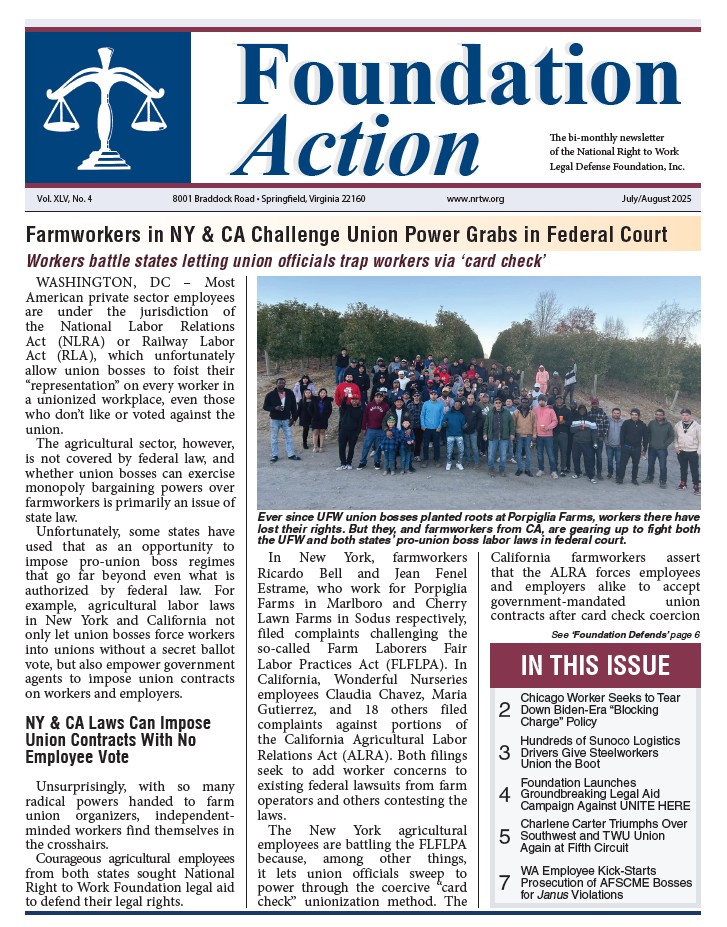
All articles from the July/August 2025 issue of Foundation Action are now online.
In this issue:
- Farmworkers in NY & CA Challenge Union Power Grabs in Federal Court
- Chicago Worker Seeks to Tear Down Biden-Era ‘Blocking Charge’ Policy
- Hundreds of Sunoco Logistics Drivers Give Steelworkers Union the Boot
- Foundation Launches Groundbreaking Legal Aid Campaign Against UNITE HERE
- Charlene Carter Triumphs Over Southwest and TWU Union Again at Fifth Circuit
- WA Employee Kick-Starts Prosecution of AFSCME Bosses for Janus Violations
Recent articles can be found here. To sign up for a free copy of the newsletter via mail please see the form at the bottom of the page.
St. Louis-Area Worker Battles Illegal Union Threats to Get Non-Members Fired
The following article is from the National Right to Work Legal Defense Foundation’s bi-monthly Foundation Action Newsletter, March/April 2025 edition. To view other editions of Foundation Action or to sign up for a free subscription, click here.
After divisive strike, IAM bosses demand non-members pay illegal ‘reinstatement fee’ to work

Robert Jacobs, an employee of power management company Eaton, filed federal charges showing IAM bosses clearly can’t manage their power: They are threatening union non-members with hundreds in illegal fees.
TROY, IL – “They’re threatening our jobs and livelihoods.”
This is how Robert Jacobs, an employee for power management company Eaton Corporation, described how International Association of Machinists (IAM) union bosses were treating him and his colleagues who dissented from the union’s agenda in an interview with the St. Louis Business Journal.
IAM officials ordered hundreds of Eaton employees at its St. Louis-area facility to strike in October 2024, which alienated many workers and made them question union bosses’ motives. Jacobs described seeing union agents take photos of his license plate during the strike and how he suspected union agents were following him home.
IAM Anti-Worker Activity Only Increased After Disruptive Strike Order
But for Jacobs and other workers, that was only the beginning of IAM’s coercive conduct. After the strike concluded, many Eaton employees chose to exercise their right to resign their union memberships. Even in states like Illinois that lack Right to Work protections, private sector workers are free to end their union memberships, even if union officials enforce a contract that requires non-members to pay some fees as a condition of employment.
Instead of respecting this right, IAM union officials began retaliating against those who wanted to cut ties with the union. With free legal assistance from the National Right to Work Foundation, Jacobs slammed the IAM with federal charges for threatening to get him and other employees who resigned union membership fired unless they pay hundreds in “reinstatement fees” concocted by the union. The National Labor Relations Board (NLRB) is now reviewing his charges.
“I and several of my colleagues don’t want to be part of the IAM union, but we are required by law to pay fees to union bosses just to keep our jobs,” commented Jacobs.
“That’s already something that we don’t want to do. But IAM officials are going even further and hitting us with hundreds of dollars in made-up fees just because we exercised our right to not be union members.”
IL Worker: Mandatory ‘Reinstatement Fee’ Not Permitted by Federal Law
Under federal labor law, which the NLRB is charged with enforcing, private sector employees have an absolute right to resign union membership. This right is codified in the National Labor Relations Act (NLRA), and was affirmed by landmark U.S. Supreme Court decisions such as General Motors v. NLRB.
Federal law further spells out that neither employers nor union officials can compel private sector workers to participate in union activities or refrain from such activities.
According to Jacobs’ federal charge, which was filed on the last day of 2024, “the Union is presently threatening Charging Party and [other employees who resigned from the union] with termination if they fail to pay a $306 ‘reinstatement fee’ by January 2025.” The charge argues that the IAM union is violating Eaton employees’ rights under Section 7 of the NLRA, which safeguards employees’ “right to refrain from any or all of ” union activities.
According to the Business Journal, IAM officials’ letter demanding this payment was what prompted him to contact Foundation attorneys. “[I]f you do not remit the total sum indicated in the enclosed letter within 30 days from receipt of this letter, the Union will be required to seek your termination from employment,” the letter read.
“Instead of seeking to win Eaton employees’ voluntary support, IAM union officials have decided to effectively extort the workers they claim to ‘represent,’” commented National Right to Work Foundation Vice President and Legal Director William Messenger. “Threatening to terminate workers if they don’t pay a fee which is apparently intended to punish those who don’t want union bosses speaking for them tarnishes employee rights and freedom.
“While we’re confident that Foundation attorneys will help Mr. Jacobs prevail in beating this illegal scheme, this case shows what self-interested union bosses will do to demand fealty from workers, and why all American workers deserve the Right to Work freedom to cut off financial support for such union hierarchies,” Messenger added
Michigan Security Guards Overwhelmingly Vote to End Union Bosses’ Forced-Dues Power
The following article is from the National Right to Work Legal Defense Foundation’s bi-monthly Foundation Action Newsletter, January/February 2025 edition. To view other editions of Foundation Action or to sign up for a free subscription, click here.
After Big Labor-backed Right to Work repeal, Michigan workers including security guards continue fighting forced dues

James Reamsma and his fellow security guards finally secured their right to stop their hard-earned money from going to UGSOA union bosses after a months-long legal battle. Such anti-forced-dues cases continue to increase in Michigan.
GRAND RAPIDS, MI – Ever since Michigan legislators repealed the state’s popular Right to Work law, Michigan employees have been turning to the National Right to Work Legal Defense Foundation to help them fight to protect themselves from union bosses’ forced-dues demands. In a long-running case, security guard James Reamsma and his colleagues at Triple Canopy Inc. not only ended union officials’ power to require union dues payments as a condition of employment, but also freed themselves of unwanted union ‘representation.’
With Foundation legal aid, the security guards organized a National Labor Relations Board (NLRB) “deauthorization election” to strip United Government Security Officers of America (UGSOA) Local 288 union officials of their power to compel union financial support.
Overwhelming Vote Against Forced Dues Triggers End of Unwanted ‘Representation’
Despite an overwhelming vote by participating workers against forced union dues, union lawyers’ delay tactics stalled final certification of the results until October. At that point, the dissenting security guards were officially free to cut off all union dues payments, as had been the case when Michigan’s Right to Work law was in place and all union financial support was strictly voluntary.
At that point, faced with the prospect that the vast majority of the guards would likely stop dues payments, UGSOA bosses announced they were ending their so-called “representation” at Triple Canopy. This means the security guards are now not only free of forced dues, but also of monopoly union representation they oppose.
“UGSOA union officials have threatened to have everyone who does not join the union fired,” Reamsma said soon after his case was filed. “Many of us are retired police officers, or military, working part time, supplementing our income by providing security for government buildings across Michigan. When Right to Work was in place, guards were never forced to join the union.”
In addition to the deauthorization petition, Reamsma filed unfair labor practice charges against UGSOA, citing illegal union dues demands. The charges note that union officials were violating his rights under the Foundation-won CWA v. Beck Supreme Court decision by denying Reamsma a required breakdown of how the forced-dues amount was calculated, and also by attempting to require that he let the union automatically deduct dues out of his paycheck. Those charges remain pending with the NLRB.
Despite a vast majority of Michiganders — including those in union households — expressing support for Right to Work, union boss partisans re-granted forced-dues powers to Michigan union officials in 2023.
Foundation attorneys filed more than twice the number of cases for Michigan workers in 2024 (the year the repeal went into effect) than through all of 2023. That increase includes a number of deauthorization cases. In states that lack Right to Work protections, like Michigan does currently, the only way that workers can end union bosses’ pay-up-or-be-fired dues demands is by voting as a majority against forced dues in a “deauthorization election” or by voting to remove the union completely.
Often workers may prefer to end union “representation” entirely, but union-backed NLRB rules severely limit when decertification votes can be held, including for up to three years when a forced-dues union contract is in place. As a result, workers often turn to deauthorization to cut off union dues payments in order to incentivize union bosses to leave completely, as happened with James Reamsma and his coworkers.
Fight Against Forced Dues in Michigan Continues
“Mr. Reamsma’s situation shows the kind of greedy gamesmanship union officials can engage in without Right to Work,” commented National Right to Work Foundation President Mark Mix.
“As soon as Reamsma and his coworkers had gone through the complex process of voting to strip them of their forced-dues power, union officials immediately fled the workplace — almost as if they were only there to collect dues from workers who had no choice but to pay up to avoid termination.
“While we are proud to assist Michigan workers in navigating these challenges, cases like these show why it was such a mistake to repeal Michigan’s popular Right to Work law to begin with,” added Mix.
Philly-Area Manufacturing Employees Triumph Over UAW Intimidation Campaign
The following article is from the National Right to Work Legal Defense Foundation’s bi-monthly Foundation Action Newsletter, January/February 2025 edition. To view other editions of Foundation Action or to sign up for a free subscription, click here.
UAW bosses now required to attend federal training after trying to fire non-striking workers
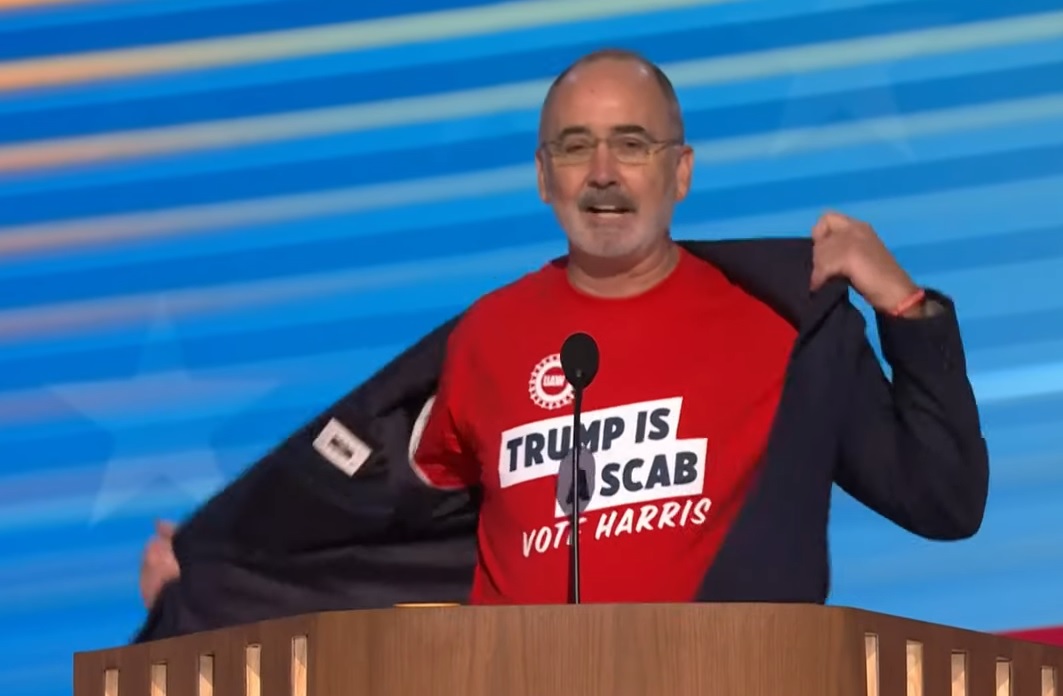
Despite an active federal corruption investigation, UAW President Shawn Fain and his underlings continue to push a radical political agenda using workers’ dues money while ignoring the rights of the rank-and-file employees union bosses claim to “represent.”
PHILADELPHIA, PA – It’s not particularly difficult to see why United Auto Workers (UAW) union officials are having trouble convincing workers that the union has their best interests in mind.
The union’s upper echelon is still reeling from a federal probe that hit about a dozen top union bosses with prison sentences for embezzling workers’ dues, and to this day it appears that UAW President Shawn Fain — a so-called “reformer” — is being scrutinized by federal monitors for manipulating his position to secure personal benefits.
But the corruption within the UAW goes far beyond the union’s top executives. Throughout 2024, National Right to Work Foundation-backed workers for auto accessory manufacturer Dometic fought illegal UAW demands that they strike or be fired.
UAW Union Used Mass Texts, Social Media to Bully Workers
In March 2024, seven Philadelphia-area Dometic employees filed unfair labor practice charges against the UAW Local 644 union, detailing that UAW bosses had ordered a strike and threatened to get fired anyone who decided to keep working.
Despite the employees’ resignation of their union memberships, UAW officials began internal proceedings against each of them soon after the strike began. Federal labor law forbids unions from imposing internal discipline on those who abstain from union membership.
The Dometic workers didn’t back down. With free Foundation legal aid, all the workers won settlements in October 2024 that fully vindicated their rights. UAW officials must now make postings correctly informing workers of their right to abstain from union activities, and the settlement even requires union chiefs to undergo mandatory training on the limits of “a union’s right to impose internal discipline,” among other topics.
As the workers’ legal battle dragged on, the Dometic workers continued to expose ugly details of the UAW’s intimidation campaign surrounding the strike. In April 2024, Dometic employee Mario Coccie filed a second round of charges against UAW Local 644 for a mass text message that threatened all Dometic employees — not just those who had filed charges against the union — with termination if they didn’t strike.
“The information in this text reveals union officials’ real intentions, which is to hurt anyone willing to stand up for themselves,” said Coccie at the time. “What is happening in this case is completely unjust.”
UAW officials also refused to respect Coccie and his coworkers’ rights under the Foundation-won CWA v. Beck Supreme Court decision, which prohibits union officials from requiring workers to pay for the union’s political expenditures just to keep their jobs. Because Pennsylvania lacks Right to Work protections for its private sector workers, UAW bosses can force workers to pay union fees as a condition of employment, but must abide by Beck.
Legal Privileges Enable UAW Corruption
In addition to the notice postings and required training, the Foundation-won settlement orders union officials to delete social media posts threatening workers who refused to strike.
“We’re proud to have helped Mario Coccie and his coworkers vindicate their rights,” commented National Right to Work Foundation Vice President Patrick Semmens. “But it has become all too clear that union corruption — which can take the form of anything from stealing millions in worker dues to intimidating workers to join a picket line — is only made easier when union bosses are granted more legal privileges.
“Policymakers need to protect workers’ freedom to cut off funding for union bosses who don’t serve their interests, and to fully abstain from union activities that individual employees do not see as in their own best interest,” Semmens added.
Massachusetts Trader Joe’s Employees Battle Divisive Union Organizing Campaign
Trader Joe’s workers demand vote to oust union, blast union bosses in Congress and media

Trader Joe’s employees Les Stratford (left) and Michael Alcorn want to restore the fun and independent work environment that existed in the store before union officials sowed discord.
HADLEY, MA – Union bosses and Big Labor-allied media cheered when the Hadley, MA, branch of supermarket chain Trader Joe’s became the first unionized location in the country in 2022. But what all their celebration concealed was the fact that union officials had swept to power at the location through a deeply deceptive campaign that demonized both the company and many employees. Now many of the Hadley-based Trader Joe’s employees are fighting to kick the union out.
“Officials of this union have sowed division and smeared both our workplace and anyone who dissents from the union’s agenda pretty much from the time the campaign began to unionize the store,” Trader Joe’s employee Les Stratford told Supermarket News about the situation.
Michael Alcorn, another Hadley Trader Joe’s worker who simply wanted to have a conversation with his coworkers about the ramifications of unionizing, said that union militants “weren’t going to have a meeting with us…immediately it was like ‘you either accept the union, or you don’t, and we’re not going to talk about it all together because if you don’t accept it, we don’t trust you.’”
Now, with free legal aid from the National Right to Work Foundation, Stratford, Alcorn, and many other Hadley Trader Joe’s employees are backing an effort to vote the union out of power at the store. Stratford in August submitted a union decertification petition asking the National Labor Relations Board (NLRB) to hold an election among his coworkers on whether to remove the union, which contained well over the support needed to trigger a decertification vote under NLRB rules.
Because Massachusetts lacks Right to Work protections for its private sector workers, the union has the legal privilege to enforce contracts that require Trader Joe’s employees to pay dues or fees as a condition of keeping their jobs.
In Right to Work states, in contrast, union membership and financial support are strictly voluntary. A vote by the majority of Hadley Trader Joe’s employees against the union would free them from both the union’s forced-dues and monopoly bargaining powers.
Trader Joe’s Employee Exposes Union Tactics on Capitol Hill
In May, Alcorn brought the concerns many of the Hadley Trader Joe’s employees had directly into the halls of Congress when he was called by the U.S. House Committee on Education and the Workforce to testify about coercive tactics union bosses use to gain power and stay in power.
In addition to describing the union’s vilification of any skeptical employee, he noted that union organizers tried to foist union control of the workplace through “card check” — a process that bypasses the NLRB’s secret ballot election system and lets union officials aggressively solicit “cards” that are later counted as votes for the union.
Union organizers also “made inaccurate and incomplete press releases, creating false narratives about our workplace to promote their own agenda and personal vendettas,” Alcorn said.
Workers Need More Freedom to Oust Abrasive Union Bosses
The Hadley Trader Joe’s workers’ efforts come as the Biden-Harris NLRB announced a final rule which will make it much harder for rank-and-file workers to exercise their right to vote out union officials they oppose. The final rule, among other things, lets union officials prevent decertification votes from going forward by filing unverified “blocking charges” alleging employer interference.
While the Trader Joe’s employees’ petition will be unaffected by the rule change, the new policy will likely quash or substantially delay similar efforts in the future. “The situation at the Hadley, MA, Trader Joe’s store shows exactly why workers’ right to vote to remove a union they oppose must be protected,” commented National Right to Work Foundation Legal Director and Vice President William Messenger.
“During a union campaign, union officials often employ aggressive tactics and ‘us vs. them’ or hate-the-boss rhetoric that cause division and prioritize union bosses’ agenda over workers’ freedoms and individual choices.
“That the Biden-Harris Administration stripped workers of what few rights they had to challenge union officials that perpetrate these acts shows they are on the side of Big Labor, not individual workers,” Messenger added.
Dartmouth, MIT, Vanderbilt Graduate Students Challenge Forced Unionism
The following article is from the National Right to Work Legal Defense Foundation’s bi-monthly Foundation Action Newsletter, January/February 2025 edition. To view other editions of Foundation Action or to sign up for a free subscription, click here.
Foundation-backed students defend rights as union bosses seek more power at universities

Ben Logsdon is a Ph.D. student in mathematics at Dartmouth College. But it doesn’t take a genius to realize that union officials’ refusals to accommodate his religious objections just don’t add up.
HANOVER, NH – Just weeks after National Right to Work Foundation staff attorneys triumphed in anti-discrimination cases for Jewish Massachusetts Institute of Technology (MIT) graduate students who sought to stop forced dues payments to a radically anti-Israel union, union officials began creating other problems for university students.
In nearby New Hampshire, Dartmouth graduate student Benjamin Logsdon sought free Foundation legal aid against Graduate Organized Laborers of Dartmouth (GOLD-UE) union officials. The GOLD union — which is an affiliate of the same United Electrical (UE) union involved in the Foundation’s MIT cases — is forcing Logsdon to accept the union’s monopoly “representation” powers against his will, even after he voiced his religious objections to the union’s radical stances on the conflict against Israel.
Grad Students Exposed to Union Coercion & Privacy Violations
Meanwhile, several graduate students at Vanderbilt University in Nashville, TN, are pushing back against an attempt by Vanderbilt Graduate Workers United (VGWU, an affiliate of United Auto Workers) union bosses to impose union control over them and their colleagues. Specifically, three students are seeking to intervene in a federal case in which VGWU union officials are illegally demanding the university hand over the students’ private information to aid in their unionization campaign. Foundation staff attorneys filed motions for intervention for these students in October 2024.
Foundation attorneys are arguing that union officials severely violate students’ rights in both of these cases. However, the reason that union officials are in power on college campuses at all traces back to flawed rulings from the National Labor Relations Board (NLRB) under both the Obama Administration and Biden Administration. These rulings subject graduate students to pro-Big Labor provisions of the National Labor Relations Act (NLRA), which create issues for students’ freedom both inside and outside the classroom.
Logsdon, a Christian Ph.D. student in mathematics at Dartmouth, slammed the GOLD union with federal anti-discrimination charges in September 2024 at the Equal Employment Opportunity Commission (EEOC). According to those charges, shortly after the GOLD union finalized its first monopoly bargaining contract with the Dartmouth administration, he sent a letter to United Electrical General Secretary-Treasurer Andrew Dinkelaker explaining that he objected to being affiliated with GOLD on religious grounds and needed an accommodation.
“I sought to be removed from the UE and GOLD-UE bargaining unit as a reasonable accommodation,” Logsdon’s Foundation-backed charges say.
Dinkelaker refused to offer Logsdon an accommodation that “satisf[ied] [his] religious conscience or beliefs,” according to the charges, which violated his rights under Title VII of the Civil Rights Act of 1964.
Courts have recognized a variety of Title VII religious accommodations over the years for men and women who have religious objections to union affiliation, including paying an amount equivalent to union dues to a charity instead of union bosses. However, Logsdon seeks a different accommodation: to remove himself from union bosses’ control entirely.
At Vanderbilt, three students who identify themselves in legal documents as “John Doe 1,” “John Doe 2,” and “Jane Doe 1” are contending in their Foundation-backed motions for intervention that the Family Educational Rights and Privacy Act (FERPA) forbids the Vanderbilt administration from disclosing their personal information to any third parties without their permission, including the VGWU union.
At the union’s behest, NLRB Region 10 has already hit the Vanderbilt administration with a pair of subpoenas demanding personal student info, while ignoring objections from several students expressing concern at the disclosure.
So far Vanderbilt has resisted the NLRB’s subpoenas, and fortunately a federal court has temporarily allowed the university to refuse to comply with them.
The Foundation-backed students’ motions to intervene argue that the subpoenas “are an attempt to violate FERPA’s protections, privileging union interests over the graduate students[’] privacy rights.” It also points out that FERPA allows students to seek “protective action” if a university receives a subpoena seeking their personal information, as in this case.
The Vanderbilt students and their Foundation attorneys are demanding an opportunity to properly defend their privacy interests under FERPA. Foundation attorneys have already filed Requests for Review asking the NLRB in Washington, DC, to weigh in on the matter.
Union Monopoly Power Has No Place at Universities
“Graduate students around the country are discovering that union bosses don’t respect their individual rights and would rather use students as pawns to force their demands on a university administration, or advance an extreme political agenda,” commented National Right to Work Foundation Vice President and Legal Director William Messenger.
“Union monopoly bargaining is a system particularly ill-suited to an academic environment. Indeed, it is wrong for anyone to have a union monopoly imposed on them against their will and then be forced to pay union dues under threat of termination.”
Hundreds of Northern Ohio Workers Vote Against Teamsters Union Boss Control
Toledo-area scrap metal employees and Wooster Frito-Lay warehouse workers get union ‘decertification votes’ certified over union bosses’ objections
Ohio (December 12, 2024) – Hundreds of employees from across Northern Ohio have voted in favor of removing Teamsters union control at their workplaces. The elections, both certified this month by the National Labor Relations Board (NLRB), occurred at Wooster, OH, Frito-Lay warehouses and scrap metal firm Omnisource’s Toledo, OH, facility, which are under the control of Teamsters Local 52 and Teamsters Local 20, respectively.
Frito-Lay employee Dusty Hinkle and Omnisource employee Daniel Caughhorn submitted petitions in October 2023 and August 2024 respectively, asking the NLRB to hold union decertification elections among their coworkers at their facilities. Hinkle and Caughhorn both received free legal aid in filing their petitions from the National Right to Work Legal Defense Foundation.
The NLRB is the federal agency responsible for enforcing federal labor law, which includes administering elections to install (or “certify”) and remove (or “decertify”) unions. Both Hinkle’s and Caughhorn’s petitions contained a sufficient number of signatures to trigger a vote under NLRB rules. Despite workers voting in both elections against Teamsters union control, Teamsters union officials filed objections against Frito-Lay and Omnisource management in an attempt to overturn the election results.
However, in both cases regional NLRB officials tossed the union objections and certified the workers’ votes. Barring an attempt by Teamsters Local 20 officials to file a Request for Review to the NLRB in Washington, DC, within the next few days, both the Omnisource and Frito-Lay employees – over 430 in total – will have cut all ties with the Teamsters unions.
Because Ohio lacks Right to Work protections for its private sector workers, Teamsters officials enforced contracts that required Hinkle, Caughhorn, and their colleagues to pay union dues or fees as a condition of keeping their jobs. In contrast, in Right to Work states, union membership and all union financial support are strictly voluntary. Now that the Frito-Lay and Omnisource employees have voted out the Teamsters, they are free both of union bosses’ forced-dues demands and their ability to impose one-size-fits-all contracts on the workplace.
Workers Across Country Reject Teamsters ‘Representation’ and Coercive Political Positions
Foundation attorneys have recently assisted a number of workers from across industries in obtaining votes to eject Teamsters union officials. Within the last two months, truck drivers from Georgia, California, Virginia, and New Jersey have successfully booted out Teamsters union officials or initiated removal efforts with Foundation aid.
Beyond Teamsters-controlled workplaces, NLRB data indicates an over 50% increase in the number of decertification petitions filed annually over the last four years. Despite that, Biden-Harris NLRB bureaucrats recently repealed key reforms (known collectively as the “Election Protection Rule”) that made it easier for workers to request decertification elections. Now, union officials have substantially more power to stop workers from even obtaining an election to remove a union, and can also stop workers from requesting decertification elections to challenge a union’s ascent to power via “card check,” an unsecure process that bypasses the traditional secret-ballot vote process.
“Teamsters union officials continue to lose support from the very workers they claim to ‘represent’, and these cases demonstrate yet again why every worker, in Ohio and nationwide, deserves the protection of a Right to Work law so they can decide for themselves whether or not to financially support union officials’ activities,” commented National Right to Work Foundation President Mark Mix. “While we’re glad these workers have succeeded in freeing themselves from unwanted unionization, it should not require months of litigation and overcoming attempts by union lawyers to overturn the workers’ votes.
“This case shows yet again that despite what local and national Teamsters union bosses claim, they don’t actually speak for the rank-and-file they claim to ‘represent’ and in fact have no qualms about attempting to disenfranchise those workers to trap them in union ranks they oppose,” added Mix.





