
National Right to Work Foundation Issues Special Legal Notice for State of Ohio Employees Freed from Illegal OCSEA Union Dues Scheme
Notice explains that workers under OCSEA union power can freely cut off union dues deductions, warns employees against signing away their rights
Columbus, OH (August 6, 2020) – National Right to Work Foundation staff attorneys today issued a special legal notice to State of Ohio employees regarding their First Amendment rights under the Janus v. AFSCME US Supreme Court case. The notice comes after an estimated 28,000 State of Ohio workers were freed of restrictions in exercising those rights as a result of a lawsuit against the Ohio Civil Service Employees Association (OCSEA, AFSCME Council 11) union brought by a group of State of Ohio employees with free legal representation from the National Right to Work Legal Defense Foundation.
The class-action lawsuit Allen v. AFSCME challenged OCSEA’s “maintenance of membership” policy that blocked workers from exercising their right to end union dues deductions except for a brief “escape period” once every three years at the expiration of the union monopoly bargaining contract.
Right to Work attorneys argued that the restriction was unconstitutional under the 2018 Janus v. AFSCME Supreme Court decision, which was argued and won by Foundation staff attorneys. In Janus, the Court struck down mandatory union fees for public sector workers as an infringement of their First Amendment rights. It also ruled that the government can only deduct union dues or fees with an individual’s affirmative consent, including a knowing waiver of their First Amendment right not to fund union activities.
As a result of this lawsuit’s settlement, union officials have given up their attempts to enforce the coercive policy based on union-designed “dues deduction” cards, which Foundation staff attorneys argued failed to meet the standard laid out in Janus. This means approximately 28,000 workers are now free to stop dues at any time.
The full notice is available at https://www.nrtw.org/ohio-janus/.
The notice explains the simple process by which state employees can exercise their right to end dues deductions, complete with sample resignation letters. It also warns employees that OCSEA union bosses may solicit them to sign new dues deduction forms which are not covered by the terms of the settlement. In light of that, the notice reminds workers that under Janus no State of Ohio worker can be forced to sign a union dues deduction form as a condition of employment, no matter what union agents may tell them.
“OCSEA intends to solicit employees to sign new membership and dues deduction cards that purport to restrict when employees can stop the deduction of union dues from their wages,” the notice reads.
“All State of Ohio public workers must be aware that they cannot be forced into abandoning their First Amendment right to refrain from subsidizing an unwanted union hierarchy just to keep their jobs,” commented National Right to Work Foundation President Mark Mix. “Any State of Ohio public servant who is falsely told that they must sign a union dues deduction form should contact the Foundation for free legal assistance in defending their Janus rights.”
The recent settlement is not the only time Ohio public employees have with National Right to Work Foundation legal aid successfully challenged union boss attempts to limit their rights.
Seven other Ohio public employees won the first-in-the-nation victory against unconstitutional “escape periods” with Foundation aid in January 2019, after they filed a class-action federal lawsuit challenging a similar policy created by AFSCME Council 8 bosses. They won a settlement ending the restrictions for themselves and their coworkers. That win was followed by two other Ohio public workers, Connie Pennington and Donna Fizer, successfully ending “escape period” restrictions with Foundation assistance in 2019.
Foundation Asks Supreme Court to Hear Janus Case Again, Seeking Return of Forced Fees
The following article is from the National Right to Work Legal Defense Foundation’s bi-monthly Foundation Action Newsletter, May/June 2020 edition. To view other editions or to sign up for a free subscription, click here.
Case could set precedent for hundreds of millions of dollars in refunds to Big Labor’s victims
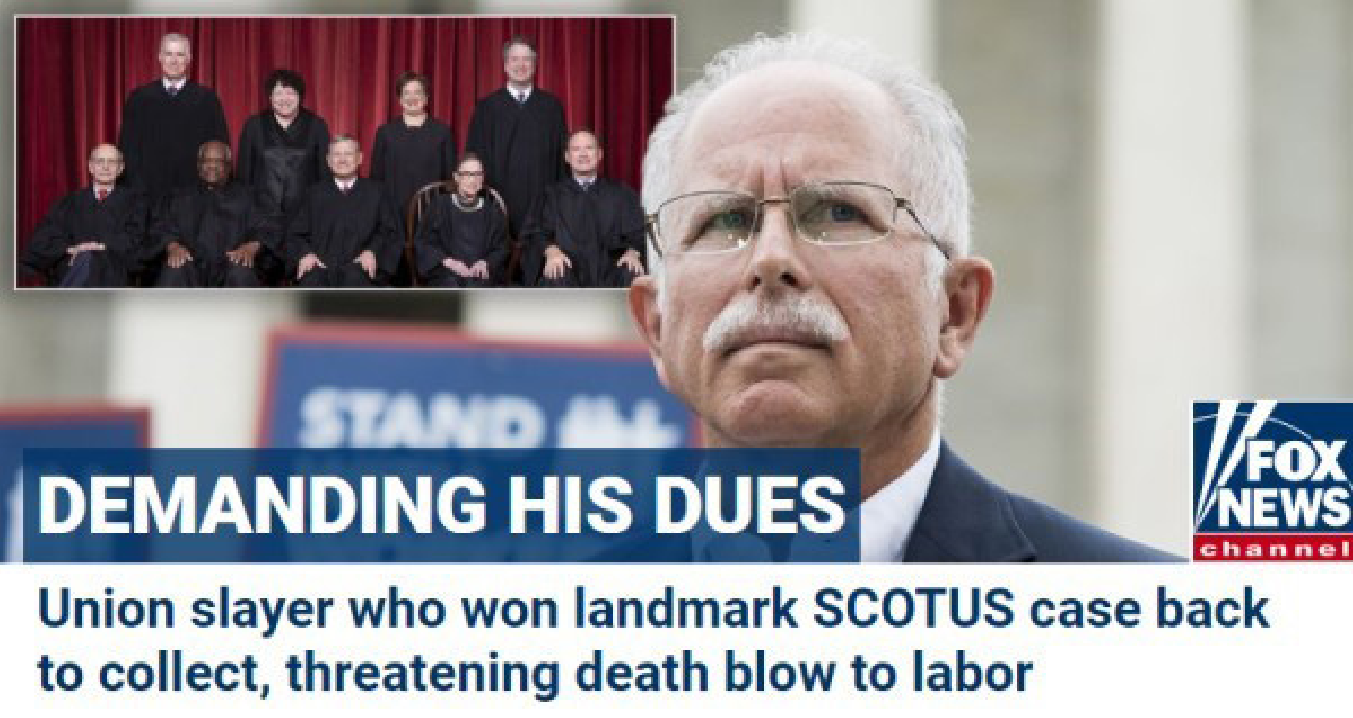
Mark Janus’ second Foundation-backed appeal to the Supreme Court landed the top spot on Fox News’ website. If Janus prevails again, hundreds of millions of dollars in unconstitutional union dues could be returned to public sector employees.
WASHINGTON, DC – Mark Janus is returning to the U.S. Supreme Court, this time asking the Justices to hear the continuation of Janus v. American Federation of State, County, and Municipal Employees (AFSCME), Council 31. Janus seeks repayment of the thousands of dollars in fees the union took from his paycheck in violation of his First Amendment rights. Another Supreme Court victory for Janus could set a precedent resulting in the return of hundreds of millions of dollars seized by union officials in violation of workers’ constitutional rights.
The original Janus v. AFSCME was argued successfully before the Supreme Court by veteran National Right to Work Foundation staff attorney William Messenger. In a landmark victory, the Court sided with Janus on June 27, 2018, and declared it illegal to force public employees to subsidize a union as a condition of employment. The Court recognized that compelling public workers to pay fees to a union violates their First Amendment rights.
Illinois Child Support Public Servant Intervenes in Lawsuit with Foundation Aid
As a result of Janus, more than five million public sector employees across the country are no longer required to pay union dues or fees to keep their jobs. However, Janus’ case continues as he seeks the return of the fees that AFSCME seized from his paycheck without his permission from June 27, 2018, to March 23, 2013, representing the two-year statute of limitations from the date his case started in March 2015 through the Supreme Court’s 2018 decision in his favor.
The Janus case began in February 2015, when then-newly elected Illinois Governor Bruce Rauner issued an executive order prohibiting state agencies from requiring employees who had abstained from formal union membership to pay union fees, based on a Right to Work Foundation U.S. Supreme Court victory in 2014 in another Illinois case. Rauner also filed a federal lawsuit seeking a declaratory judgment that forced union fees violate the First Amendment rights of public workers.
Staff attorneys from the Foundation, in partnership with the Illinois-based Liberty Justice Center, filed a motion for Mark Janus and two other plaintiffs to intervene in the case in March 2015, and have represented Janus ever since. The U.S. District Court for the Northern District of Illinois granted Janus’ motion to file a complaint in intervention, which allowed the suit to move forward even after the court ruled that Rauner lacked standing to pursue the lawsuit.
The Supreme Court permitted union bosses to impose forced union fees on public workers in the 1977 Abood v. Detroit Board of Education decision. However, before the Janus victory, Foundation staff attorneys secured several victories for workers which called the constitutionality of forced fees into question. In 2012, the court ruled in Knox v. SEIU that union officials must obtain affirmative consent from workers before using workers’ forced union fees for special assessments or risk infringing on their First Amendment rights. In 2014, the court ruled in Harris v. Quinn that requiring home healthcare providers who receive a subsidy from the government to pay union dues is a First Amendment violation.
Following Janus’ groundbreaking win at the Supreme Court in June 2018, Foundation attorneys continued his case in Illinois federal courts, arguing that the Supreme Court’s ruling is retroactive and that AFSCME should be required to return dues they seized unconstitutionally before the decision. In this and similar cases, union bosses have made a so-called “good faith” argument to defend their seizing of dues before Janus was issued. The U.S. Seventh Circuit Court of Appeals in Chicago ruled in 2019 that AFSCME could keep the unconstitutional dues, prompting Janus’ petition to the Supreme Court.
Hundreds of Millions of Dollars Potentially At Stake
“The Supreme Court agreed that the union taking money from non-members was wrong but the union still has the money it illegally garnished from my paycheck,” commented Janus. “It’s time for AFSCME to give me back the money they wrongfully took.”
Foundation staff attorneys are currently fighting for thousands of workers in about 20 cases which seek refunds of dues seized unconstitutionally before Janus was decided. While Janus is seeking the return of $3,000 of his own money, a favorable decision for him would set a precedent that could result in the return of over $120 million to public servants just in Foundation-backed cases. Other cases brought by workers could bring that total to hundreds of millions of dollars.
Workers Already Winning Refunds of Illegal Dues with Foundation Legal Aid
“The Supreme Court has already sided with the Foundation arguments for Mark Janus and ruled that forcing public employees to fund union activities violates the First Amendment,” said National Right to Work Foundation Vice President and Legal Director Raymond LaJeunesse. “The Supreme Court should take this case again to ensure that public sector union bosses are not permitted to profit from their widespread violation of workers’ First Amendment rights.”
Foundation staff attorneys in July 2018 secured the nation’s first-ever refund of dues seized unconstitutionally before Janus for Debora Nearman, an Oregon state wildlife employee. SEIU bosses were forced to settle and give back to Nearman over $3,000 in illegal fees they had seized from her over two years, during which they had sponsored an aggressive political campaign against her own husband, who ran successfully for the Oregon Legislature in 2016.
Wall Street Journal: Texas AG Seeks to Enforce Government Employees’ First Amendment Rights Under Janus v AFSCME
The Editorial Board at The Wall Street Journal published a column on May 31, 2020, detailing efforts in Texas to enforce the landmark Janus v AFSCME U.S. Supreme Court decision argued and won by National Right to Work Foundation staff attorneys:
The Attorney General of Texas, Ken Paxton, plans to release an advisory opinion soon that could help free public employees who are fed up with their union. In 2018 in Janus v. Afscme, the Supreme Court said that union fees couldn’t be deducted from the paycheck of a government worker who didn’t ‘affirmatively consent.’
“The question is what flows from this logic. Last fall Alaska Governor Michael Dunleavy, citing Janus, signed an order to let state workers quit the union anytime, instead of only during 10 enchanted days once each year. Union members also would have to refresh their consent forms periodically.
The move by Attorney General Paxton came after Foundation President Mark Mix and staff attorney William Messenger — who argued the Janus case at the Supreme Court — called on states like Texas to emulate Alaska. They wrote that “state officials, along with federal agencies, should follow Alaska’s example” in an op-ed for The Wall Street Journal last August.
In addition, Mix and Messenger highlighted how Janus requires that government workers must voluntarily waive their First Amendment rights before union dues or fees can be deducted from their paycheck through a voluntary waiver:
Fourteen months ago the Supreme Court held that the First Amendment protects government employees from being forced to subsidize unions. Janus v. Afscme affirmed that some five million state and local workers have the legal right to stop such payments.
Another aspect of Janus, however, has been overshadowed. The decision requires that the government obtain proof that workers voluntarily, knowingly and intelligently waived their First Amendment rights not to subsidize union speech before deducting union dues or fees from their paychecks. “To be effective, the waiver must be freely given and shown by ‘clear and compelling’ evidence,” Justice Samuel Alito wrote. “Unless employees clearly and affirmatively consent before any money is taken from them, this standard cannot be met.”
Yet the federal government and many states and localities continue to deduct union dues without evidence that workers waived their speech rights, usually based on pre-Janus authorization forms that come nowhere close to demonstrating a waiver. Labor Department figures suggest unconstitutional deductions could be coming out of the paychecks of as many as 7.2 million government employees nationwide. The fix is simple: Governments must cease transferring wages to unions until they amend their dues-deduction policies to comply with Janus.
Foundation Aids Workers Nationwide in Cases to Vindicate Janus Rights
The following article is from the National Right to Work Legal Defense Foundation’s bi-monthly Foundation Action Newsletter, March/April 2020 edition. To view other editions or to sign up for a free subscription, click here.
Workers seek rulings ordering union bosses to refund dues taken in violation of landmark decision

Connecticut public employees Kiernan Wholean (left) and James Grillo are fighting SEIU bosses at the Second Circuit Court of Appeals, demanding years of dues seized in violation of their Janus rights.
NEW YORK, NY – The Foundation’s victory at the Supreme Court in Janus v. AFSCME set a groundbreaking precedent. The High Court finally recognized that requiring public sector workers to pay union dues as a condition of employment violates their First Amendment rights, and that “affirmative and knowing” consent is required before deducting dues from any employee.
But union bosses from AFSCME and other public sector unions still refuse to relinquish dues money that they seized from employee paychecks without their consent before the Janus decision came down. While Mark Janus continues his case to get back seized dues, Foundation staff attorneys are also arguing in federal Courts of Appeals for other public servants from Connecticut and New Hampshire seeking the return of dues seized from thousands of workers in violation of the Janus precedent.
Connecticut, New Hampshire Public Workers Demand Refunds for Thousands
At the Second Circuit Court of Appeals, Connecticut Department of Energy and Environmental Protection (DEEP) employees Kiernan Wholean and James Grillo seek a ruling that will make Service Employees International Union (SEIU) Local 2001 bosses give back at least two years’ worth of fees exacted from their paychecks in violation of Janus, plus interest. Because their lawsuit is a class action, a favorable ruling could result in refunds for hundreds of Connecticut public employees.
At the First Circuit Court of Appeals, Foundation staff attorneys are litigating another class action lawsuit for New Hampshire public employees Patrick Doughty and Randy Severance. Doughty and Severance are asking the court to make New Hampshire SEIU bosses return three years of unconstitutionally seized fees, as permitted by the statute of limitations.
All four employees are not members of their respective SEIU local unions. In these and similar cases, union bosses have used a dubious “good faith” argument to defend their seizing of dues before Janus came down. Foundation staff attorney Jeffrey Jennings points out in his argument for Wholean and Grillo that, on top of the Janus ruling making those deductions illegal, union bosses certainly have “no reasonable grounds for believing [they] could keep their money” after the Janus decision.
In Connecticut, Foundation staff attorneys in 2019 successfully secured a refund of dues seized before Janus for UConn accounting professor Steven Utke, whom American Association of University Professors (AAUP) bosses targeted with illegal dues deductions since he was hired in 2015. When AAUP officials chose to settle the case in 2019 after Foundation staff attorneys filed a lawsuit, Utke received back over $5,000 in refunds.
“The Supreme Court was crystal clear in Janus: All union fees seized from a public worker without his or her consent violate the First Amendment,” observed National Right to Work Foundation President Mark Mix. “Despite that clarity, union hierarchies around the country are still flush with dues money that was seized in violation of public employees’ First Amendment rights.”
Since the Janus decision in 2018, Foundation attorneys have litigated more than 30 cases seeking to enforce and expand the Janus victory. Ten of those have already resulted in refunds of seized dues for employees, including Oregon wildlife employee Debora Nearman’s case, the first case in the nation to result in a refund of dues seized in violation of the Janus precedent. SEIU bosses were forced to settle and give back to Nearman nearly $3,000 in illegal fees they had seized from her over two years, during which they sponsored an aggressive political campaign against Nearman’s own husband, who ran successfully for the Oregon Legislature in 2016.
Rehearing in Continuation of Landmark Janus Case
The following article is from the National Right to Work Legal Defense Foundation’s bi-monthly Foundation Action Newsletter, January/February 2020 edition. Foundation staff attorneys are currently asking the U.S. Supreme Court to review the continuation of Mark Janus’ case. To view other editions or to sign up for a free subscription, click here.
Union bosses refuse to return dues seized in violation of First Amendment

A favorable decision for Mark Janus at the Seventh Circuit could be the next step toward public employees getting back millions of dollars that were seized from them by union bosses in violation of their First Amendment rights.
WASHINGTON, D.C. – Mark Janus won a landmark victory for American workers in 2018 when the Supreme Court acknowledged in Janus v. American Federation of State, County, and Municipal Employees (AFSCME) Council 31 that requiring public sector workers to pay union fees as a condition of employment infringed their First Amendment rights.
However, the coffers of the AFSCME union bosses who once had monopoly bargaining power over Janus — and the coffers of countless other unions around the country — are still flush with dues money that was seized from employees without their “affirmative and knowing” consent as the decision requires.
National Right to Work Foundation staff attorneys who represent Janus, along with attorneys from the Illinois-based Liberty Justice Center, have filed a petition to the Seventh Circuit Court of Appeals for a rehearing en banc in the continuation of his case. Janus seeks a ruling that will make AFSCME union officials return thousands of dollars in dues that were taken from his paycheck in violation of Janus since March 23, 2013. If the rehearing is granted, Janus’ case will be heard before 12 judges of the Seventh Circuit.
A three-judge panel of the Seventh Circuit refused to remedy AFSCME bosses’ unconstitutional conduct last November despite the High Court’s noting in Janus that union officials have been “on notice” for years that mandatory fees likely would not comply with the heightened level of First Amendment scrutiny articulated in the 2012 Knox v. SEIU Supreme Court decision, also won by Foundation staff attorneys.
“Mark Janus is simply asking the Seventh Circuit to remedy the years of unconstitutional conduct AFSCME bosses have perpetrated at his and other public sector workers’ expense,” observed National Right to Work Foundation Vice President Patrick Semmens.
At stake for Mark Janus is over $3,000 of his money that was seized by union officials in violation of his First Amendment rights. But a ruling in his favor could have a nationwide impact, setting a federal precedent that would be cited in dozens of other cases seeking refunds of dues taken unlawfully by public sector union bosses. Foundation staff attorneys are currently litigating more than 30 Janus-related cases that collectively seek more than $120 million in refunds.
Sacramento Employee Hits Union with Charge for Ignoring Janus Rights
The following article is from the National Right to Work Legal Defense Foundation’s bi-monthly Foundation Action Newsletter, January/February 2020 edition. To view other editions or to sign up for a free subscription, click here.
More than a year after Court decision, union bosses still tell workers forced fees are legal
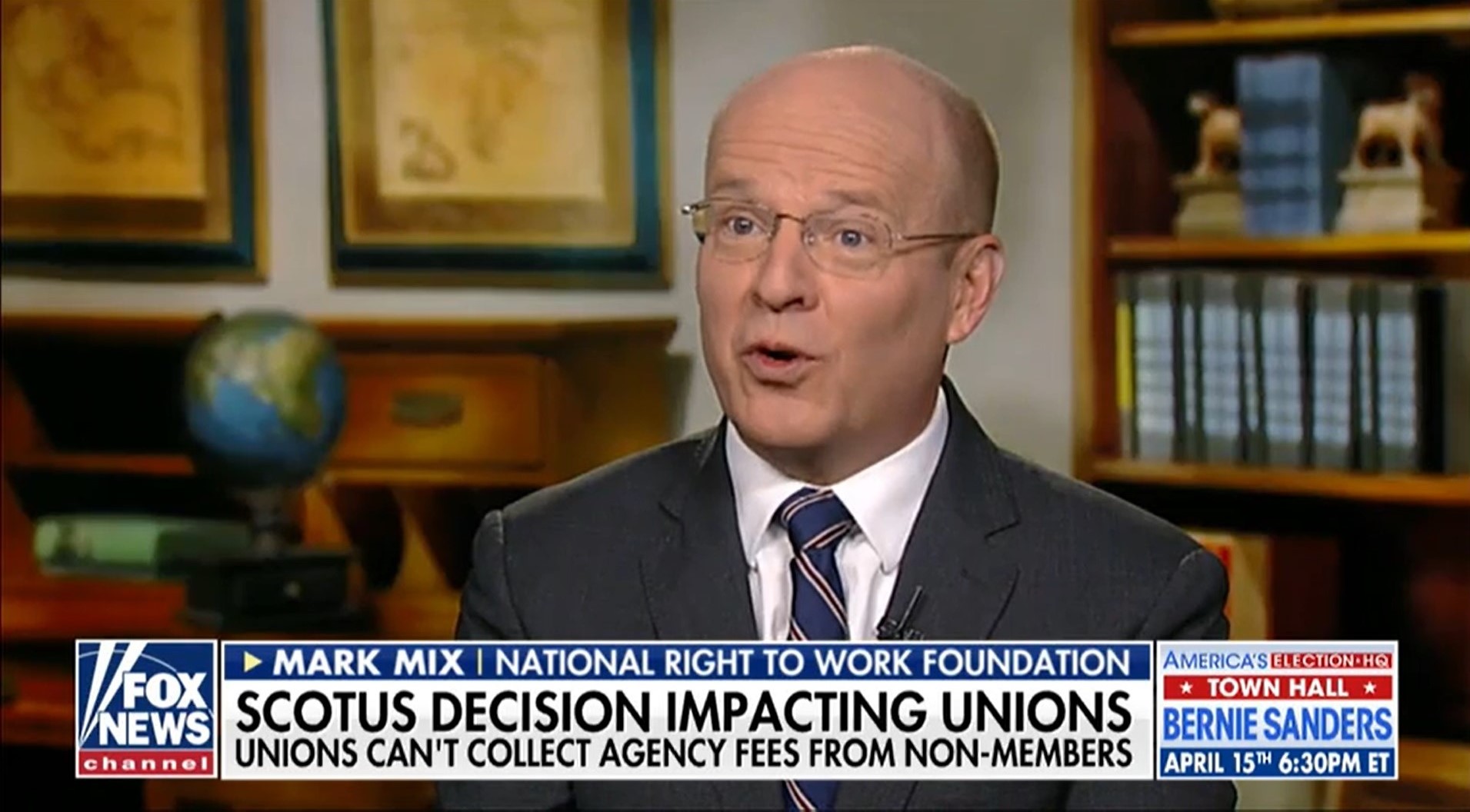
In the Foundation-won Janus v. AFSCME decision, the Supreme Court recognized the right of all American public sector workers to refrain from subsidizing unions, but California IUOE bosses are acting as if those rights don’t exist.
SACRAMENTO, CA – Ethan Morris works for Sacramento County as a wastewater treatment employee. With free legal aid from the National Right to Work Legal Defense Foundation, he has hit the International Union of Operating Engineers (IUOE) Stationary Engineers union bosses at his workplace with charges that their misstatements of his requirement to pay union fees breach California law by disregarding workers’ First Amendment rights under the Foundation-won Janus v. AFSCME Supreme Court decision.
California’s Public Employment Relations Board (PERB), the agency in charge of determining whether unions like IUOE have violated California’s public sector labor laws, will now investigate Morris’ charge.
California Union Bosses Blatantly Lie About Legality of Forced Dues
Morris has never been a member of IUOE Stationary Engineers. He recounts in his charge that he received a notice from an IUOE financial secretary in July 2019 which claimed that “employees who do not join the Union must pay a . . . fee” to the union as a condition of employment, and that these mandatory fees are “legal and enforceable in California” through direct deductions from non-member employees’ paychecks.
Morris’ charge says the union’s fee demands ignore government employees’ First Amendment rights under the 2018 Foundation-won Janus v. AFSCME Supreme Court decision. In Janus, a majority of the Court recognized that union dues or fees cannot be mandatory for public employees and may only be deducted from government workers’ paychecks if they have given “affirmative and knowing” waivers of their First Amendment right not to subsidize a union.
Morris maintains that by ignoring Janus, IUOE Stationary Engineers bosses infringed his rights under California’s Meyers-Milias-Brown Act (MMBA). That statute provides Golden State workers “the right to refuse to join or participate in the activities of employee organizations” and prohibits unions from “coerc[ing] or discriminat[ing] against” employees for exercising that right.
IUOE Officials Broke California Labor Law by Defying Janus
Morris demands that union officials rectify the situation by stopping the illegal fee demands and posting a PERB-approved notice informing his coworkers of their right to refrain from union activities and acknowledging that compulsory fee demands violate that right.
“Ethan Morris discovered his First Amendment Janus rights independently, and in doing so was able to catch IUOE Stationary Engineers bosses in a red-handed lie about the right of public sector workers in America to abstain from financially supporting a union,” observed National Right to Work Foundation President Mark Mix. “For every worker who rebuffs illegal union threats, there are almost certainly thousands of workers who unknowingly sign away their rights.
“State governments must step up and proactively protect employees’ Janus rights, including making sure that every worker knows those rights and not deducting any union dues or fees absent a worker’s knowing and voluntary waiver of his or her rights,” Mix added.
Taking the lead on protecting public workers’ Janus rights is Alaska, where last September Gov. Mike Dunleavy issued an executive order requiring all state agencies to stop the deduction of union dues from any worker who had not submitted a form affirmatively waiving his or her right under Janus not to fund any union activities.
Featured Article: “The Future Looks Bright for the Right to Work Movement”
The Regulatory Review has ranked the essay entitled “The Future Looks Bright for the Right to Work Movement” by National Right to Work Foundation Vice President and Legal Director Raymond J. LaJeunesse, Jr. as one of the publication’s top essays in 2019.
The essay highlights successes in the ongoing fight against forced unionism through legal and legislative reform:
Thomas Jefferson famously said that it is “sinful and tyrannical” for government “to compel a man to furnish contributions of money for the propagation of opinions which he disbelieves and abhors.” That principle is consistent with the guarantees of freedom of speech and association enshrined in the U.S. Constitution’s First Amendment. Yet, some federal and state labor laws in this country have long authorized requirements that workers pay union dues as a condition of employment, requirements known as the “union shop” or “agency shop.” Increasingly, however, legislatures and courts are recognizing that workers have a constitutional right to work without being forced to subsidize a union.
Among recent achievements for the Right to Work movement are five new state Right to Work laws passed since 2012 and the landmark Foundation-won Janus v. AFSCME Supreme Court decision in June 2018.
The complete essay is available to read online here.
Foundation Urges Federal and State Governments to Protect First Amendment Rights
The following article is from the National Right to Work Legal Defense Foundation’s bi-monthly Foundation Action Newsletter, November/December 2019 edition. To view other editions or to sign up for a free subscription, click here.
Alaska first state to require First Amendment Janus rights waiver before deducting union dues
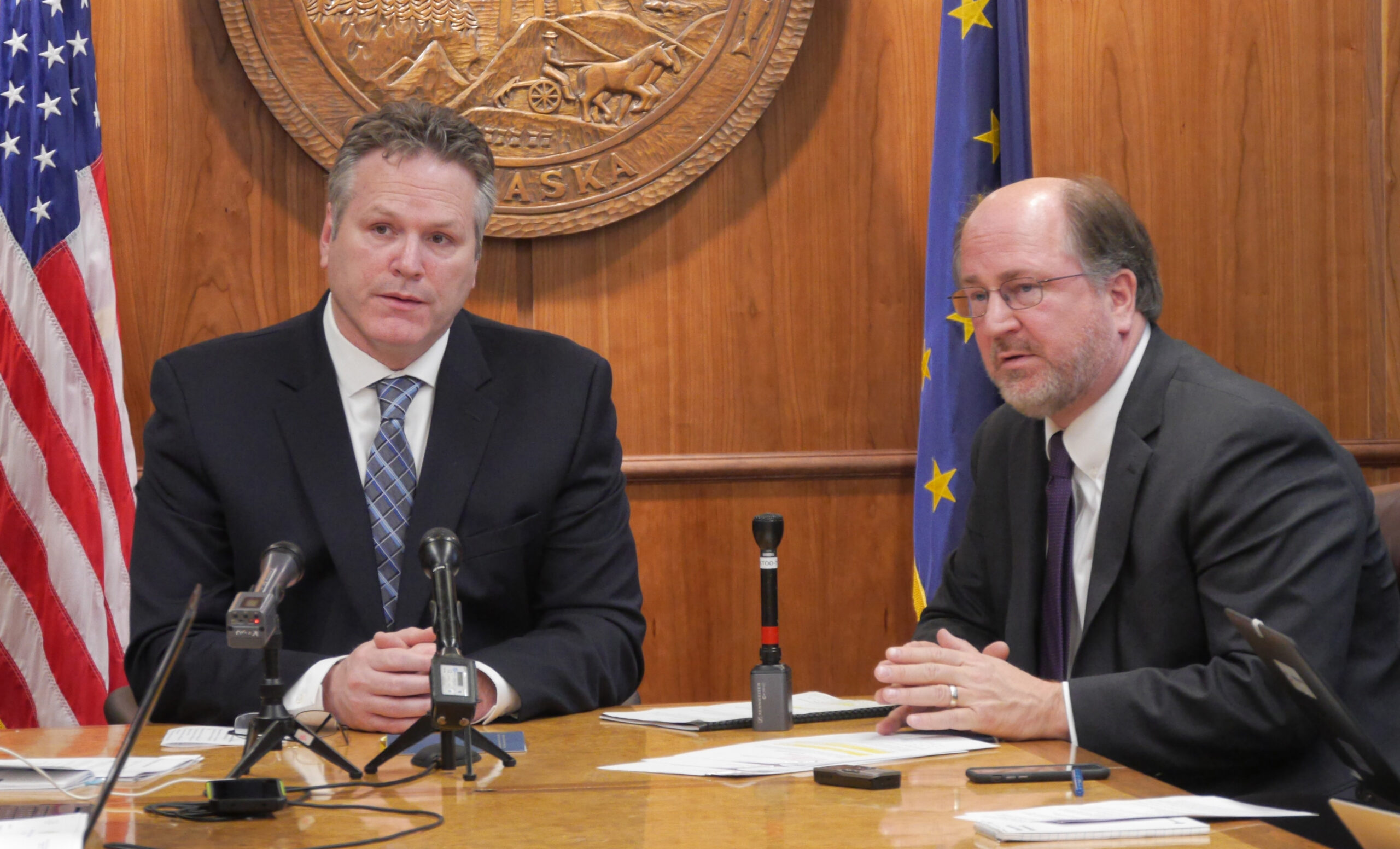 Alaska Gov. Mike Dunleavy (left), following an opinion from Attorney General Kevin Clarkson, ordered all Alaska state agencies to protect state employees’ First Amendment rights under Janus.
ANCHORAGE, AK – In late September, Alaska Governor Mike Dunleavy signed an executive order to protect the First Amendment rights of state employees established in last year’s Janus v. AFSCME Supreme Court decision. The order calls for the State of Alaska to stop deducting union dues from the paycheck of any worker who hasn’t filed a form with the state affirmatively waiving his or her First Amendment right under Janus not to fund any union activities.
The move follows a letter last year sent by National Right to Work Foundation Legal Director Raymond LaJeunesse to state comptrollers in Alaska and other states, urging them to modify dues deduction policies to comply with the Janus decision.
Foundation Comments Detail Need to End Dues Deductions Uncompliant with Janus
The Foundation also recently filed comments with the Federal Labor Relations Authority (FLRA) regarding the need for the federal government to take steps to protect the First Amendment rights of employees recognized in the Foundation-won Janus decision. The Foundation’s comments were submitted after the U.S. Office of Personnel Management (OPM) asked the FLRA to solicit public comments on how to proceed with union dues deductions in light of the Supreme Court’s Janus decision last year.
In that case, the High Court held that requiring public employees to pay union dues or fees without their consent violates the employees’ First Amendment rights “by compelling them to subsidize private speech on matters of substantial public concern.” Justice Samuel Alito’s opinion for the court further ruled that no union dues or fees could be taken from a public employee “unless the employee affirmatively consents to pay” using a “freely given” waiver of his or her First Amendment rights.
Consistent with that standard, the Foundation’s comments urge the FLRA to issue guidance to agencies that they “must cease deducting union dues from the wages of employees who signed a dues deduction form that does not satisfy the [Janus] standard.” According to Department of Labor statistics, nearly one million federal employees — 26.4% of all federal workers — are union members, many of them likely having dues deducted from their paychecks despite never having knowingly waived their First Amendment right not to subsidize union activities.
The Foundation comments make clear that these dues deductions should cease in the wake of Janus. To comply with Janus, workers wanting to voluntarily pay union dues can either provide the government with a valid waiver of their rights or pay dues on their own without using taxpayer-funded payroll systems to forward the money to union officials.
The Foundation’s comments to the FLRA further argue that, even where workers provide a valid authorization for dues deductions that meets the Janus standard, the government shouldn’t block them from revoking that authorization if the request is submitted at any time at least a year after the Janus-compliant authorization was obtained.
Foundation Comments Push to End Union-Created “Window Period” Scheme
Unfortunately, agencies and union officials often prohibit federal employees from stopping the seizure of union dues from their wages except during short annual escape periods. The comments filed by the National Right to Work Foundation say that this practice does not comply with Janus either.
“The Janus precedent is very clear about this: Without affirmative and knowing waivers from public workers, government entities cannot collect union dues without violating a worker’s First Amendment rights,” commented National Right to Work Foundation President Mark Mix.
“Currently, the government seizes union dues from almost one million federal employees in violation of the Janus decision’s First Amendment standard. Federal agencies are obligated to protect workers’ constitutional rights in this rulemaking process.”
Since the Janus decision last year, Foundation staff attorneys have been fighting to ensure public workers’ First Amendment rights are protected, litigating more than 30 cases in federal courts across the country to enforce the landmark ruling.
Foundation Winning Protections Against Forced Unionism at Trump NLRB
The following article is from the National Right to Work Legal Defense Foundation’s bi-monthly Foundation Action Newsletter, September/October 2019 edition. To view other editions or to sign up for a free subscription, click here.
Series of victories adds protections against illegal forced dues, being trapped in union ranks
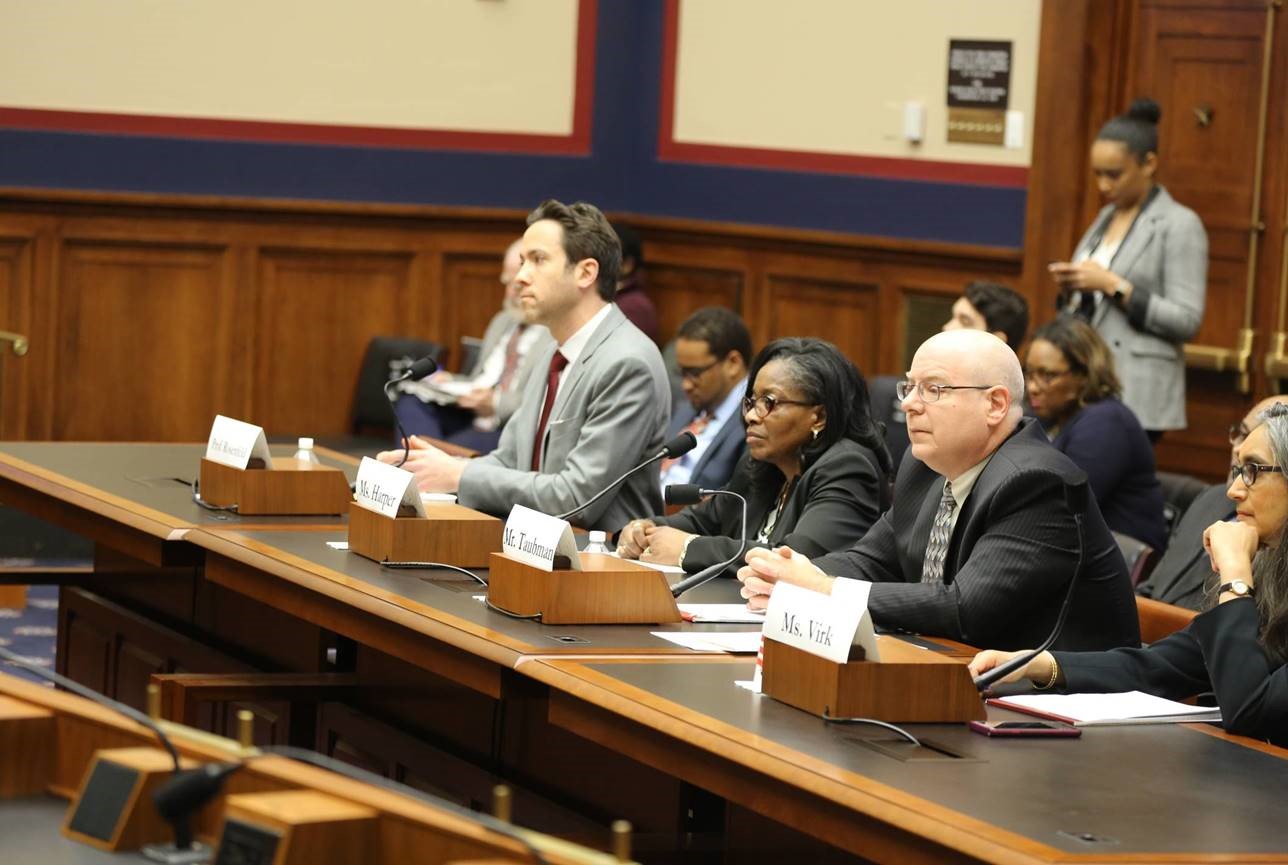
Staff attorney Glenn Taubman testified before Congress in July that existing NLRB rules wrongly favor union bosses over workers.
WASHINGTON, D.C. – In a series of recent victories, the National Labor Relations Board (NLRB) ruled in favor of workers challenging coercive union official practices, with free legal aid provided by the National Right to Work Foundation. The rulings are a stark departure from the Obama NLRB, which regularly stymied the rights of independent-minded employees opposed to associating with union bosses.
Foundation Wins Appeals in Dues Checkoff Cases
In separate cases brought by Foundation staff attorneys for Kacy Warner, a hospital worker, and Shelby Krocker, a Kroger grocery employee, the NLRB General Counsel ruled for the workers and ordered Regional Directors to prosecute union officials’ actions related to language in union dues checkoff forms.
The General Counsel’s decision to sustain Warner’s appeal concerning the checkoff authorized even more additions to the charges, saying the National Nurses Organizing Committee (NNOC) union violated the NLRA by “maintaining confusing and ambiguous dual-purpose authorization forms that unlawfully restrained employees in the exercise of their Section 7 rights.”
The General Counsel noted that the union’s forms failed to tell workers they can revoke authorizations for dues deductions after the union’s contract expires, failed to give workers adequate time to revoke authorizations, unlawfully required workers to use certified mail to send revocation requests, and failed to give “any indication to employees that payroll deduction authorization is voluntary.”
This came just a week after the General Counsel sustained another Foundation-led appeal for Krocker, who charged United Food and Commercial Workers (UFCW) union officials with illegally forcing her to sign a dues checkoff authorization. In both cases, the NLRB General Counsel authorized even more charges against union officials for misleading and confusing language regarding union dues deductions.
NLRB Regions Instructed to Prosecute Beck Violations
Also in July, the NLRB Division of Advice and General Counsel instructed regional directors to issue complaints against unions when union officials fail to inform employees of the amount of reduced union fees they can pay by objecting under the Communication Workers of America v. Beck U.S. Supreme Court decision.
The memos instruct NLRB Regional Directors to more stringently enforce workers’ Beck rights which protect workers from being forced to fund nonchargeable union activities such as union political activities. A memo issued to the Director of NLRB Region 32 read in part that “it is difficult for an employee to make an informed decision about whether to become a Beck objector without knowing the amount of savings that would result from the decision.”
“The Foundation is proud to have represented the California employee whose charge against the UFCW resulted in this Advice Memo, as well as necessitating this heightened disclosure standard by winning the Beck decision at the Supreme Court and the Penrod decision at the D.C. Circuit Court of Appeals,” National Right to Work Foundation Vice President and Legal Director Ray LaJeunesse said. Foundation staff attorneys are currently litigating several additional cases to secure and expand workers’ protections under Beck.
Ruling Aids Workers Trapped in Union Ranks They Oppose
In another Foundation victory for independent-minded workers in July, the NLRB issued a decision that limits union officials’ ability to game the NLRB system to trap workers in monopoly union ranks. The ruling allows employers to withdraw recognition from a union when a majority of its workers sign statements opposing unionization.
Foundation staff attorneys represented two workers, Brenda Lynch and Anna Marie Grant, who spearheaded the collection of signatures from a majority of workers opposed to union representation. Their employer complied with their wishes and sent the union bosses packing. After United Auto Workers (UAW) union officials sought to foist the union back onto the workers despite their clear opposition, Foundation staff attorneys persuaded the NLRB to uphold the UAW’s ouster.
“Instead of union lawyers playing legal games for months or even years to block the removal of a union that lacks majority support, the Board majority takes the common sense approach of asking union officials to prove their claim of support in a secret ballot vote of the workers,” said LaJeunesse.
Final Briefs Filed at Appeals Court in Continuation of Janus v. AFSCME
The following article is from the National Right to Work Legal Defense Foundation’s bi-monthly Foundation Action Newsletter, September/October 2019 edition. To view other editions or to sign up for a free subscription, click here.
Foundation seeks first-in-nation appellate court ruling to order non-member dues refunded
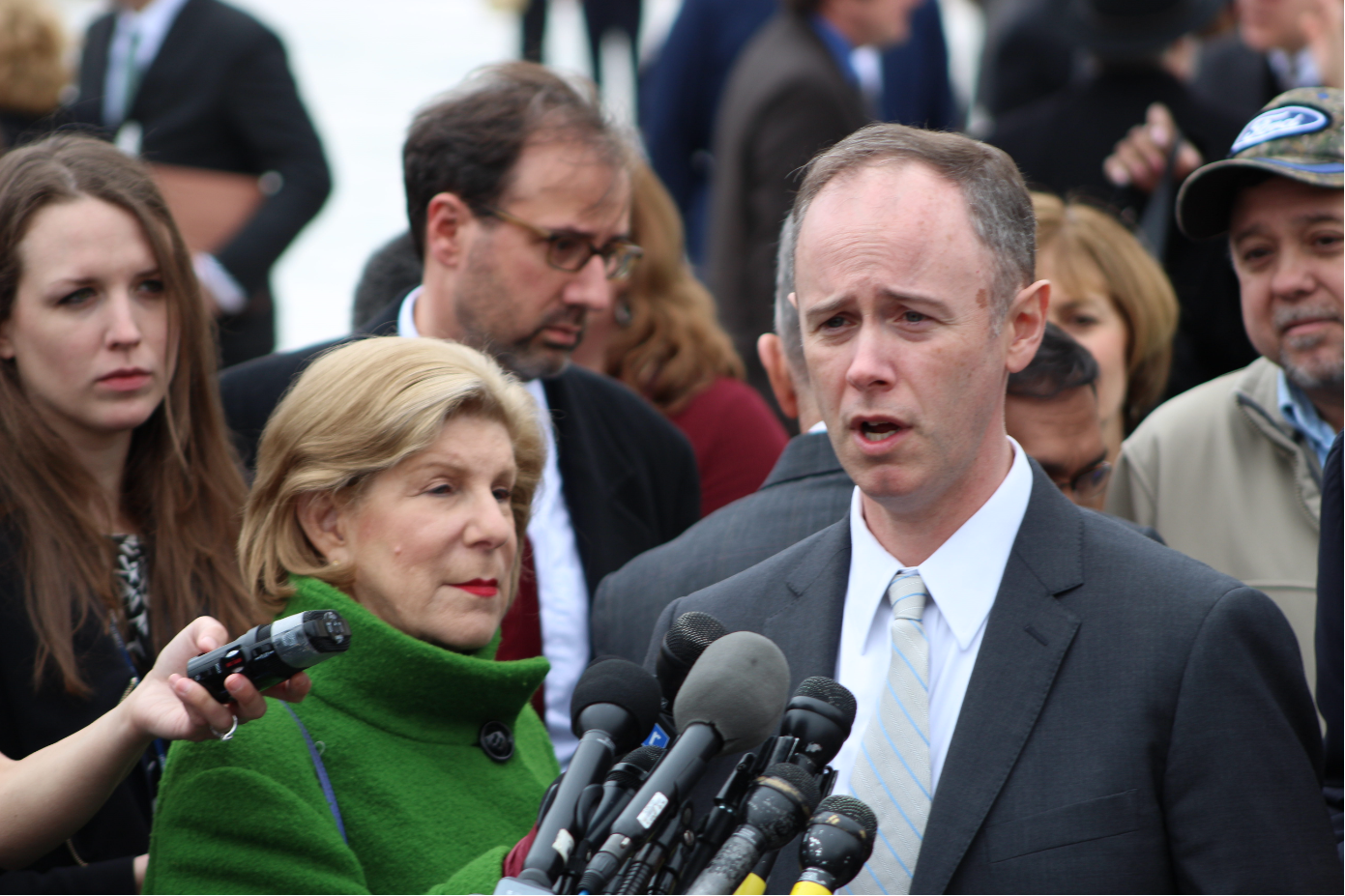
Veteran Foundation staff attorney William Messenger, seen here speaking to reporters after Supreme Court oral arguments in Janus, leads the Foundation’s Janus enforcement task force.
CHICAGO, IL – Although Janus v. AFSCME secured a landmark victory at the U.S. Supreme Court for government employees’ First Amendment rights, Mark Janus’ case is not over because AFSCME union bosses have refused to return the funds taken from him in violation of the First Amendment.
Janus’ attorneys from National Right to Work Foundation and Illinois-based Liberty Justice Center have completed briefing with the Seventh Circuit Court of Appeals on the issue of whether union officials can keep money they seized from non-members in violation of their constitutional rights. The case is likely to mark the first time an appellate court will rule on the issue, potentially establishing a precedent that could result in the return of hundreds of millions of dollars seized by union bosses in violation of the Janus precedent.
Janus Secured Workers’ First Amendment Rights
Mark Janus was an Illinois child support specialist whose case was successfully argued at the Supreme Court by National Right to Work Foundation staff attorney William Messenger.
The Supreme Court’s June 27, 2018, decision in Janus’ favor found that any union fees taken from workers like Mark Janus – who was not a member of AFSCME – without the workers’ affirmative and knowing consent violate the First Amendment. Justice Samuel Alito wrote for the majority that compulsory fees “[violate] the free speech rights of non-members by compelling them to subsidize private speech on matters of substantial public concern.”
The Supreme Court sent the case back to the lower courts to determine, among other things, whether Janus is entitled to all the union fees he was forced to pay since March 23, 2013.
Janus’ appeal comes after a district court judge ruled that union officials are not required to refund forced fees seized from non-member workers prior to the Janus decision.
“Just like a thief would not be allowed to keep the money he stole, union bosses must be forced to return funds unlawfully seized from workers,” said National Right to Work Foundation Vice President and Legal Director Ray LaJeunesse. “It would be a massive injustice to deny workers victimized by Big Labor the refunds to which the Supreme Court made clear they are entitled.”
Seventh Circuit Likely First Appeals Court to Rule on Non-member Refunds
Janus will likely be the first case in which an appellate court will evaluate the so-called “good faith” defense that union lawyers have asserted in response to worker lawsuits seeking refunds, arguing that union officials should be allowed to keep funds seized prior to the Janus decision.
This contention has generally succeeded in lower courts despite the Supreme Court asserting that union bosses have been “on notice” for years that mandatory fees likely would not comply with the heightened level of First Amendment scrutiny articulated in the Supreme Court’s earlier Knox v. SEIU decision, also won by Foundation staff attorneys.
Mark Janus is asking the Seventh Circuit to rule that he is entitled to refunds of approximately $3,000 in fees he was forced to pay since March 23, 2013, as the statute of limitations permits. In addition, the case has significant implications for dozens of other cases being litigated around the country for hundreds of thousands of other workers seeking the return of forced fees seized unlawfully by union officials.
Janus Refund Efforts Continue Nationwide
Foundation staff attorneys are currently litigating over a dozen such cases that collectively seek over $120 million in refunds for non-members forced to pay union fees before Janus. Other ongoing lawsuits and potential cases could result in half a billion dollars or more returned to government workers from union treasuries.
“The Janus case is a milestone of worker freedom, but union bosses continue to block workers from exercising their rights and deny workers refunds for dues and fees seized against their wishes,” said LaJeunesse. “We hope the Seventh Circuit Court of Appeals will follow the clear logic of the Supreme Court’s decision in Janus and establish that union bosses cannot profit from violating workers’ First Amendment rights.”





