
National Right to Work Foundation Files SCOTUS Brief Defending Alaska’s Protections Against Forced Union Dues
Alaska facing ASEA union lawsuit over arrangement which requires union bosses to obtain affirmative consent from employees before deducting dues
Washington, DC (September 29, 2023) – Today, the National Right to Work Legal Defense Foundation filed an amicus brief with the U.S. Supreme Court in the case Alaska v. Alaska State Employees Association. The brief supports the State of Alaska’s attempt to safeguard public sector workers’ First Amendment right to refrain from paying dues to a union they disapprove of. This right was first recognized in the Janus v. AFSCME Supreme Court decision, which was successfully argued at the High Court by Foundation Legal Director William Messenger.
In the 2018 Janus decision, the Supreme Court held that the First Amendment protects public sector employees from being forced to pay union dues as a condition of getting or keeping a job. The High Court further recognized that unions must obtain a worker’s freely given waiver of his or her Janus rights before deducting union dues or fees from his or her paycheck.
In an attempt to ensure his state wasn’t violating its employees’ constitutional rights, Alaska Gov. Mike Dunleavy issued an executive order to protect workers’ Janus rights: The order requires the state to obtain consent from workers each year to deduct union dues from their paychecks. This arrangement ensures that the “freely given consent” element of Janus is satisfied, while also preventing union bosses from continuing to deduct money from a worker’s wages based on a “yes” given years ago.
However, Alaska State Employees Association (ASEA) union bosses sued the State of Alaska over its Janus protections, and were able to get the state’s highest court to block the arrangement. Even worse, as Foundation staff attorneys point out in the amicus brief, “five Circuit Courts have now held that states and unions can constitutionally seize payments for union speech from dissenting employees without proof they waived their constitutional rights.”
Amicus Brief: Lower Courts and States Are Letting Unions Seize Dues Without Workers’ Consent
The Foundation’s amicus brief maintains that, after the Janus decision, at least seventeen states either “amended their dues deduction laws…to require government employers to enforce restrictions on when employees can stop payroll deductions of union dues,” or “enforced restrictions on stopping payroll deductions under preexisting state laws.” Both lead to unacceptable restraints on public sector workers’ Janus rights, the amicus brief argues.
The amicus brief further contends that lower courts, especially the Ninth Circuit, have misinterpreted Janus to not require public employers to notify public workers of their Janus rights before collecting dues, which dips below the “waiver” standard mandated by the decision. Additionally, the amicus brief points out that the Ninth Circuit has issued decisions that free public employers from any obligation to prove that union bosses obtained authentic consent from workers before dues are taken from their wages.
“Unless the Court grants review and breathes new life into Janus’ waiver requirement, unions and their government allies will continue to severely restrict the right of millions of employees to stop subsidizing union speech,” the amicus brief concludes. “The Court should not tolerate this resistance to its holding in Janus.”
“Public sector union bosses, who prize their own dues-funded political influence far above the individual rights of the employees they claim to ‘represent,’ have tried everything in their power to dodge the Janus ruling and keep siphoning money from workers,” commented National Right to Work Foundation Vice President Patrick Semmens. “The Supreme Court has an opportunity in the State of Alaska’s case to set the record straight and ensure that workers’ free association rights can’t simply be molded according to their own schemes.”
Former Connecticut State Trooper Wins Over $250,000 in Political Discrimination Suit
The following article is from the National Right to Work Legal Defense Foundation’s bi-monthly Foundation Action Newsletter, July/August 2023 edition. To view other editions of Foundation Action or to sign up for a free subscription, click here.
CSPU union upended trooper’s career after he refused to fund union politics

Joseph Mercer fought back with free Foundation legal aid when the CSPU union blocked his promotion because he challenged union political activities and told others about their rights.
HARTFORD, CT – In 2015, then-Connecticut State Trooper Joseph Mercer received a promotion to Operations Sergeant of the Emergency Services Unit, a position that gave him significant responsibility over emergency services training and field operations. Mercer gained this prestigious position through his seventeen years of experience as a trooper, which included a tense situation with an armed suspect barricaded in a hotel.
But behind the scenes, Mercer was a target of Connecticut State Police Union (CSPU) officials, who resented Mercer because of his resistance to funding union politics with his own money. After CSPU President Andrew Matthews filed two baseless grievances against Mercer, the Department of Emergency Services and Public Protection (DESPP) demoted him to a position that offered fewer overtime opportunities and involved less time in the field.
Mercer slammed CSPU and DESPP officials with a federal lawsuit in 2016 with free legal aid from the National Right to Work Foundation, accusing police union officials of retaliating against him for exercising his right to stop funding union politics.
This April, Foundation attorneys forced CSPU and DESPP to back down and settle the case. Both parties must now pay $260,500 as a condition of ending the suit.
CSPU Union President Targeted Dissident Trooper Immediately After Promotion
Just a month after Mercer received his promotion, CSPU President Matthews filed a grievance over Sergeant Mercer’s appointment.
Matthews’ grievance claimed that there had been no “selection process” to fill the position, despite the fact that none of Sergeant Mercer’s union-member predecessors had undergone any particular kind of selection process before they got the job. Matthews also filed a second baseless grievance, alleging Mercer had mismanaged the incident involving the armed suspect barricaded in a hotel. State police officials had never expressed dissatisfaction with how Mercer handled the situation.
In October 2015, after meeting in private with the union president, then-DESPP Commissioner Dora Schriro transferred Mercer out of his Operations Sergeant position to an administrative post. Prior to this demotion, Mercer had received no warnings, reprimands, or other disciplinary actions regarding the incident referenced in Matthews’ grievance. Mercer filed his lawsuit with Foundation aid in February 2016.
Mercer’s Foundation attorneys cranked up the heat on both the union and DESPP officials in May 2022, when a District Court judge ordered DESPP Commissioner James Rovella, who had replaced Schriro, to turn over additional documents that might provide insight into the circumstances surrounding Mercer’s firing.
Rather than follow through with the judge’s discovery order and continue the fight against Mercer, CSPU and DESPP reversed course and settled the case in April 2023. The settlement categorizes the vast majority of the $260,500 payout as “compensatory damages” due directly to Mercer.
Settlement Underscores Importance of Public Servants’ Janus Rights
“We are proud to have defended Sergeant Mercer’s rights and secured him a settlement that vindicates his free association,” commented National Right to Work Foundation Vice President and Legal Director William Messenger. “However, it’s disgraceful that CSPU union officials targeted Mercer, a dedicated public safety officer, with such a retribution scheme in the first place. Public servants should not have to endure multi-year lawsuits just so they can refrain from supporting union politics they oppose.”
“Situations like these demonstrate why the Foundation-won Janus v. AFSCME decision, which the U.S. Supreme Court decided while Mercer’s case was ongoing, is so important,” Messenger added. “As demonstrated in Mercer’s case, unelected union officials often wield their enormous clout over government to serve the union’s self interests over the public interest and employee interests. That’s why it’s vital that public employees can exercise their First Amendment Janus right to cut off all financial support for union officials this way.”
Foundation: Texas Taxpayers Shouldn’t Be Forced to Fund Union Activities
The following article is from the National Right to Work Legal Defense Foundation’s bi-monthly Foundation Action Newsletter, May/June 2023 edition. To view other editions of Foundation Action or to sign up for a free subscription, click here.
Brief says Janus explains why Texas Supreme Court must invalidate ‘official time’ scam
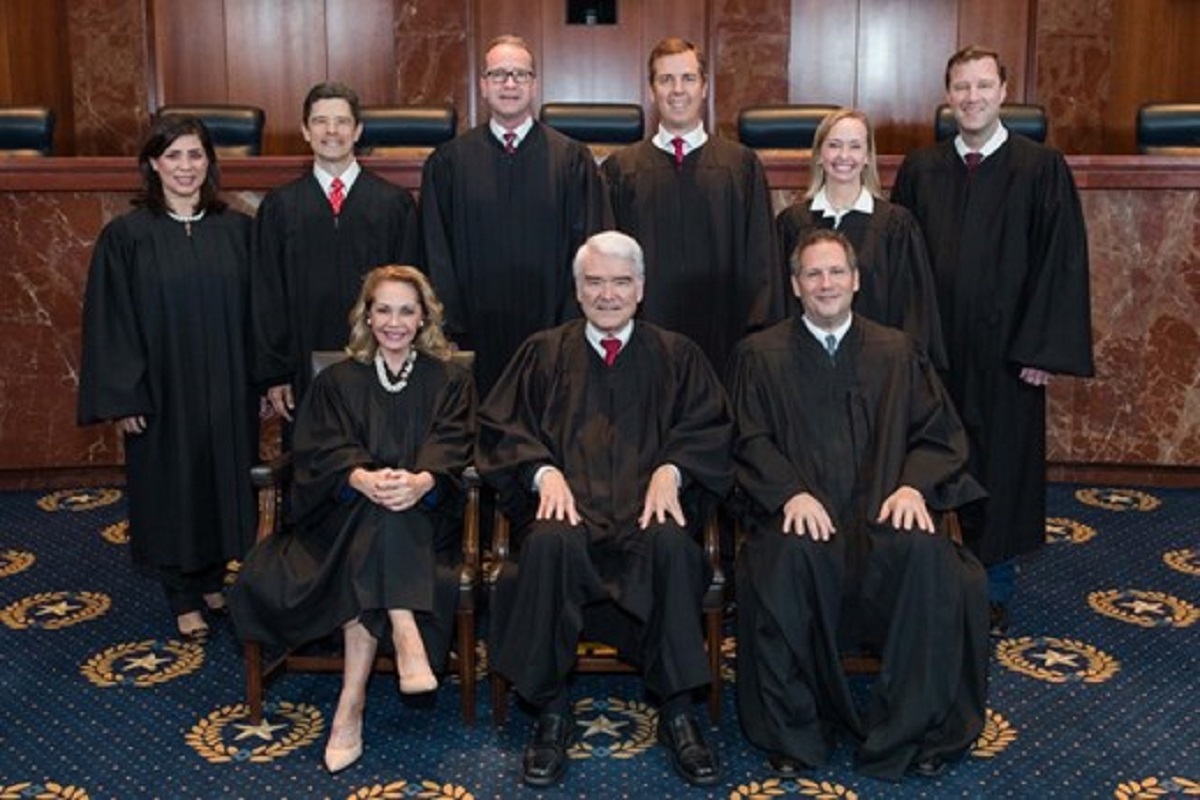
Don’t Mess with Taxes: The Foundation urged the Texas Supreme Court (above) in recent legal briefs to quash the City of Austin’s scheme funneling taxpayer money to union ideological activities.
AUSTIN, TX – Union officials spend billions of dollars to influence the political system every election cycle. This is why they are so desperate for forced-dues power — it gives them a guaranteed stream of revenue to sustain their agendas, regardless of whether workers support the union hierarchy’s aims.
But workers are increasingly taking advantage of their rights under Right to Work laws and the landmark National Right to Work Foundation-won Janus v. AFSCME U.S. Supreme Court decision to refrain from financially supporting union bosses of whom they do not approve.
Union bosses in Austin, TX, have apparently worked around this dilemma by shifting the burden for funding the union agenda to taxpayers. Through a so-called “official time” scheme, City of Austin employees who are union officials receive compensation from the public purse for conducting union business on the clock.
‘Official Time’ Boosts Inherently Political Government Union Agenda
Foundation attorneys recently filed a brief in the Texas Supreme Court case Roger Borgelt v. City of Austin, arguing that the Foundation-won Janus decision definitively shows why Austin’s scheme violates the Texas Constitution’s prohibitions against payouts of public funds to serve private interests (known as the “Gift Clauses”). The High Court ruled in Janus that forcing public sector workers to fund any union activities as a condition of employment violates the First Amendment, and that union dues can only be deducted from a public sector worker’s paycheck with his or her freely given consent.
An “official time” scheme, which instead forces taxpayers into funding those same union activities, “conflicts with the Supreme Court’s reasons for holding in Janus that it violates the First Amendment to require public employees to subsidize union activities,” says the Foundation’s brief.
The Foundation points out in its brief the Court’s Janus holding that all public sector union undertakings “constitute speech and petitioning on matters of political…concern,” and that by funneling taxpayer money into such speech “the City is effectively paying individuals to lobby the City for a private advocacy organization and its members.”
“The notion that this political advocacy predominantly serves a public purpose, as opposed to predominantly benefiting the private organization, is untenable,” the brief reads.
The brief also refutes an assertion from a lower Texas court that “official time” payments made by the city are actually part of union officials’ compensation for their normal job duties. This defies Janus’ reasoning that public employees who are also union officials “do not act as government agents pursuing their official job duties when they act as union officials.”
“For example, in granting paid leave to employee Bob Nicks to act as the Union’s president, the City is not paying Mr. Nicks for his services as a firefighter or as a public servant,” the brief explains. “The City is paying Mr. Nicks for his services as an agent of a private organization.”
The brief also reveals the disturbing implications of the union-backed argument that taxpayer subsidies for “official time” are needed to maintain harmonious relations between the city and the union: “If respondents contend that Union officials would disrupt City services if they did not receive [‘official time’], that would make the benefit akin to the City paying protection money” to union officials, reads the brief.
Union Bosses Should Not Get Public Funds to Pursue Union Interests
“The Texas Supreme Court should recognize that union officials are not entitled to a slice of taxpayer funds to ‘bargain’ against public interests,” commented National Right to Work Foundation Vice President and Legal Director Raymond LaJeunesse. “Texas’ Gift Clauses forbid the payout of public funds for activities that don’t have a tangible public benefit, and it’s hard to think of an arrangement that violates the Clauses more plainly than letting union bosses pursue private union business on the taxpayer dime.”
“Although Janus now protects public employees around the country from being forced to fund union activities and speech against their will, unfortunately many states and municipalities across the country permit union bosses to subsidize those same inherently political activities using direct payment of tax dollars,” LaJeunesse added.
“If union bosses cannot convince rank-and-file workers to voluntarily fund such activities as Janus requires, they should re-examine their priorities, not seek to force taxpayers to pay for what public employees will not.”
Video: The Anniversary of the Janus Supreme Court Victory and the Ongoing Fight for Worker Freedom
On the 5th Anniversary of the landmark First Amendment decision, Foundation President discusses Janus, the cases that led to the decision, and the path forward
Springfield, VA (June 27, 2023) – National Right to Work Legal Defense Foundation President Mark Mix released a video statement on the 5-year anniversary of the landmark Janus v. AFSCME U.S. Supreme Court decision. The case, which affirmed the First Amendment right of all public employees to get or keep a job without being forced to pay union dues or fees, was successfully argued at the Supreme Court by National Right to Work Foundation Legal Director William Messenger.
The Janus anniversary video is available here.
In the video, Mix discusses the cases that led to Janus, the importance of the 2018 decision, and next steps for the Foundation regarding workers’ freedom from coercive unionism. Mix notes in the statement that “while the Janus ruling is clear, unfortunately, though predictably, we’ve seen widespread attempts by government union bosses to subvert the ruling and implement schemes to block government employees from exercising their First Amendment rights. In response, Foundation staff attorneys have already filed over 50 cases to enforce the Janus decision, directly helping over 70,000 workers so far.”
He also looks at how Foundation is building on the 2018 Supreme Court victory: “Janus introduced a new wave of Foundation litigation enforcing the decision against union bosses who refuse to accept its limits, and launching new cases, like the Goldstein case, seeking to expand the First Amendment rights of workers opposed to forced unionization.”
Mix concludes by noting that Public employees or any worker who needs legal assistance in enforcing their rights against coercive unionism can contact the Foundation to request free legal aid: https://www.nrtw.org/free-legal-aid/.
CUNY Professors’ Lawsuit Challenging Forced Association with Antisemitism-Linked Union Continues at Second Circuit
City University professors challenge NY law that forces them to be represented by hostile union hierarchy
New York, NY (June 5, 2023) – Six City University of New York (CUNY) professors have taken their federal civil rights lawsuit against Professional Staff Congress (PSC) union officials to the Second Circuit Court of Appeals. The professors, Avraham Goldstein, Michael Goldstein, Frimette Kass-Shraibman, Mitchell Langbert, Jeffrey Lax, and Maria Pagano, charge PSC union bosses with violating the First Amendment by forcing them to accept the union’s monopoly control and “representation” – “representation” the professors not only oppose, but find extremely offensive and in contradiction to their personal beliefs.
The professors, five of whom are Jewish, are receiving free legal aid from the National Right to Work Foundation and The Fairness Center. They seek to overturn New York State’s “Taylor Law,” which grants public sector union bosses the power to speak and contract for workers, including those that want nothing to do with the union. In addition to opposing the union’s extreme ideology, the professors oppose being forced into a “bargaining unit” of instructional staff who share the union’s beliefs or have employment interests diverging from their own.
The professors’ opening brief at the Second Circuit argues that a lower court’s reliance on the U.S. Supreme Court’s 1984 decision in Minnesota State Board for Community Colleges v. Knight was misguided. Knight, the brief states, dealt primarily with public employees’ ability to participate in union meetings and not with the professors’ legal argument that being forced to accept the bargaining power and “representation” of union officials is a violation of First Amendment free association rights.
The brief also maintains that the Supreme Court in the 2018 Foundation-won Janus v. AFSCME Supreme Court decision acknowledged that public sector monopoly bargaining is “a significant impingement on associational freedoms.” Other Supreme Court decisions as early as 1944 also recognized problems with monopoly bargaining, the brief notes, including the Steele v. Louisville & Nashville Railway Co. decision, in which African-American railway workers challenged a rail union’s racially discriminatory hiring and promotion policies.
“If the First Amendment prohibits anything, it prohibits the government from dictating who speaks for citizens in their relations with the government,” reads the brief. “The State Appellees and CUNY thus necessarily infringe on the Professors’ speech and associational rights by forcing them to accept a hostile political group, which they view as anti-Semitic, as their exclusive agent for speaking and contracting with their government employer.”
Lawsuit: Professors Compelled to Associate with Union Even After Bullying and Threats
The professors’ original complaint recounted that several of the professors chose to dissociate from PSC based on a June 2021 union resolution that they viewed as “anti-Semitic, anti-Jewish, and anti-Israel,” and a host of other discriminatory actions perpetrated by union agents and adherents.
The complaint said Prof. Michael Goldstein “experienced anti-Semitic and anti-Zionist attacks from members of PSC, including what he sees as bullying, harassment, destruction of property, calls for him to be fired, organization of student attacks against him, and threats against him and his family.” Goldstein has needed a guard to accompany him on campus, the complaint noted.
Prof. Lax, the complaint explained, already received in a separate case a letter of determination from the Equal Employment Opportunity Commission (EEOC) “that CUNY and PSC leaders discriminated against him, retaliated against him, and subjected him to a hostile work environment on the basis of religion.” Prof. Lax “has felt marginalized and ostracized by PSC because the union has made it clear that Jews who support the Jewish homeland, the State of Israel, are not welcome,” said the complaint.
Suit Seeks Overturn of New York State Law Forcing Union Power on Professors & Damages
The lawsuit seeks to stop the defendants from “certifying or recognizing PSC, or any other union, as Plaintiffs’ exclusive representative without their consent” and “enforcing any provisions…that require Plaintiffs to provide financial support to PSC.” It also demands that the court declare “Section 204 of the Taylor Law…unconstitutional under the First Amendment to the United States Constitution to the extent that it requires or authorizes PSC to be Plaintiffs’ exclusive representative…”
“No American worker should be forced to associate with union officials and union members that openly denigrate their identities and deeply-held beliefs,” commented National Right to Work Foundation President Mark Mix. “Yet, New York State’s Taylor Law grants union officials the power to force dissenting workers under the ‘exclusive representation’ of a union hierarchy. As these CUNY professors have experienced, granting union officials the power to nullify public employees’ free association rights in this way breeds serious harm and discord among employees.”
“Not just in Janus v. AFSCME, but in decisions going back decades, the Supreme Court has questioned the constitutionality of union monopoly bargaining,” Mix added. “Federal courts must take action to ensure that government employees can freely exercise their right to dissociate from an unwanted union for religious, cultural, financial, or any other reasons.”
“Our clients want to vindicate their First Amendment rights and win their independence from a union they believe hates them,” commented Fairness Center President and General Counsel Nathan McGrath. “If successful, their lawsuit could transform the relationship between public-sector unions and employees in New York and, potentially, beyond.”
Connecticut State Trooper Wins $260,500 Settlement in Federal Lawsuit Against Police Union and Department Officials
Trooper was demoted after he abstained from funding union politics, CSPU union has now backed down and settled case
Hartford, CT (April 28, 2023) – Connecticut State Trooper Joseph Mercer has won a settlement in his federal civil rights lawsuit against the Connecticut State Police Union (CSPU) and Department of Emergency Services (DESPP) officials, in which he charged them with illegally demoting him for opposing union membership and politics. Mercer received free legal aid from staff attorneys at the National Right to Work Legal Defense Foundation.
Mercer’s suit began in 2016, when he accused the CSPU union, CSPU President Andrew Matthews, and DESPP Commissioner Dora Schriro of knocking him out of a prestigious Operations Sergeant position after he exercised his First Amendment rights to abstain from CSPU membership and not pay dues to support the union’s political activities. The department placed Mercer in a position that offered fewer overtime opportunities and involved less time in the field.
In August 2018, the U.S. District Court for the District of Connecticut denied motions to dismiss the case filed by CSPU and state officials, allowing the case to proceed. Pressure on defendants increased in May 2022, when the District Court ordered DESPP Commissioner James Rovella, who had replaced Schriro, to turn over additional discovery.
Now, CSPU and DEPP officials have backed down and settled the case. As part of the settlement, Mercer will receive more than two hundred thousand dollars from CSPU and DEPP.
Connecticut State Trooper Groundlessly Fired After Objecting to Union Politics
In May 2015, Sergeant Mercer was appointed Operations Sergeant of the Emergency Services Unit, a prestigious command position that entails significant responsibility for Emergency Services training and field operations. Although Sergeant Mercer had seventeen years of experience, in June 2015, CSPU President Matthews filed a grievance over Sergeant Mercer’s appointment.
Matthews’ grievance claimed that there had been no “selection process” to fill the position, despite the fact that none of Sergeant Mercer’s union-member predecessors had undergone any particular kind of selection process before they got the job.
Mathews filed a second baseless grievance, alleging Mercer had mismanaged an incident involving an armed suspect barricaded in a hotel. State police officials had never expressed dissatisfaction with how Mercer handled the situation.
In October 2015, after meeting in private with the union president, the then-Commissioner of the DESPP transferred Mercer out of his Operations Sergeant position to an administrative post. That new position gave Mercer substantially fewer opportunities to work in the field or to accrue overtime pay. Prior to this demotion, Mercer had received no warnings, reprimands, or other disciplinary actions regarding the incident referenced in Matthews’ grievance. Mercer filed his lawsuit with Foundation aid in February 2016.
Mercer’s Foundation-won settlement now requires CSPU and the State to pay $260,500.00.
Public Servants Have First Amendment Right to Stop Supporting Union Politicking
“We at the Foundation are proud to have defended Sergeant Mercer’s rights and secured him a settlement that vindicates his free association,” commented National Right to Work Foundation President Mark Mix. “However, it’s disgraceful that CSPU union officials targeted Mercer, a dedicated public safety officer, with such a vicious retribution scheme in the first place. Public servants should not have to endure multi-year lawsuits just so they can refrain from supporting union politics they oppose.”
“Situations like these demonstrate why the Foundation-won Janus v. AFSCME decision, which the U.S. Supreme Court decided while Mercer’s case was ongoing, is so important,” Mix added. “As was obvious in Mercer’s case, unelected public sector union bosses often wield their enormous clout over government to serve the union’s private interests over the public interest. That’s why it’s vital that public employees can exercise their First Amendment Janus right to cut off all financial support of union bosses who are contorting government in this way.”
Northwest Ohio Employees File Suit to Knock Down Another Janus Restriction
The following article is from the National Right to Work Legal Defense Foundation’s bi-monthly Foundation Action Newsletter, March/April 2023 edition. To view other editions of Foundation Action or to sign up for a free subscription, click here.
Foundation-aided Ohio workers have already won string of victories over union-imposed ‘escape periods’

From left: Penny Wilson, Theresa Fannin, and Kozait Elkhatib aren’t taking AFSCME union officials’ onerous First Amendment restrictions sitting down. With free Foundation legal aid, they will continue the fight to protect Janus in Ohio.
TOLEDO, OH – American Federation of State, County, and Municipal Employees (AFSCME) union bosses seem to have a knack for violating Ohio public workers’ First Amendment right to refrain from paying union dues.
Fortunately, National Right to Work Foundation staff attorneys are even more adept at forcing Ohio AFSCME bosses to back down from their unconstitutional dues schemes, and have led Ohio government workers to victory in several such cases.
The latest case in this saga comes from three Lucas County Job and Family Services (JFS) employees, who in December filed a federal civil rights lawsuit against the AFSCME Ohio Council 8 union and their employer for violating their constitutional rights.
Penny Wilson, Theresa Fannin, and Kozait Elkhatib’s lawsuit says AFSCME union officials illegally seized money from their paychecks in violation of their First Amendment rights as recognized in the landmark 2018 Foundation-won Janus v. AFSCME U.S. Supreme Court decision. The Ohio public employees are receiving free legal aid from the National Right to Work Foundation and the Ohio-based Buckeye Institute.
Union Officials Kept Employees in the Dark About Janus Freedoms
In Janus, the Court declared it a First Amendment violation to force public sector workers to pay union dues or fees as a condition of employment. The Court also ruled that union officials can only deduct money from the paycheck of a public sector employee who has voluntarily waived his or her Janus rights.
“Plaintiffs . . . file this suit to stop Lucas County JFS and AFSCME from seizing union payments from them without their consent and to receive compensation for violations of their First Amendment rights,” reads the workers’ complaint.
Officials from AFSCME Council 8 and Lucas County JFS enforce a policy which permits the direct deduction of union dues from employees’ paychecks. According to the policy, employees who wish to stop subsidizing the union have only a few days per year in which to do so — an “escape period” that effectively forbids the exercise of their First Amendment Janus rights for more than 90 percent of the year.
AFSCME union officials never informed Wilson, Fannin, and Elkhatib of this restriction. Union officials also never told the women that they had a First Amendment right under Janus to abstain from dues deductions, or that union dues could only be taken from them if they waived that right.
The employees discovered their Janus rights and attempted to exercise those rights twice by sending letters to AFSCME union officials stating that they were ending their union memberships and terminating dues deductions. AFSCME union officials denied all three women’s requests, stating that union dues deductions would continue because the letters missed the narrow “escape period” imposed by the union.
Wilson, Fannin, and Elkhatib’s lawsuit seeks to stop Lucas County JFS and AFSCME union officials from seizing dues from their paychecks. It also seeks a refund of all union dues taken from their wages without their consent.
Foundation Janus Victories Continue to Stack Up in Ohio
Independent-minded Ohio public employees are on a winning streak against AFSCME officials’ “escape period” arrangements. Foundation attorneys scored a significant victory for Ohio public servants’ Janus rights in a 2020 lawsuit against another Ohio AFSCME local (Council 11). Rather than face off against Foundation attorneys, those AFSCME union officials backed down and settled the case. As a result, Foundation attorneys freed almost 30,000 Ohio public employees from a “maintenance of membership” scheme that limited the exercise of Janus rights to roughly once every three years.
In fact, Wilson, Fannin, and Elkhatib’s suit isn’t the first time that Foundation attorneys have faced off against AFSCME Council 8 officials. In 2019, Foundation attorneys brought a similar First Amendment suit for seven Ohio employees that brought down another restrictive “escape period” enforced by Council 8 chiefs.
AFSCME Council 8 Officials Caught Red-Handed Again Violating First Amendment
“Even after abandoning other ‘escape period’ schemes to avoid facing Foundation staff attorneys in court, shameless AFSCME union officials continue to violate the Janus rights of the very employees they claim to ‘represent,’” commented National Right to Work Foundation Vice President Patrick Semmens.
“America’s public workers should not have to file federal lawsuits to protect their money and their First Amendment rights from the predations of public sector union officials.”
Full Foundation Action November/December 2022 Newsletter Now Online
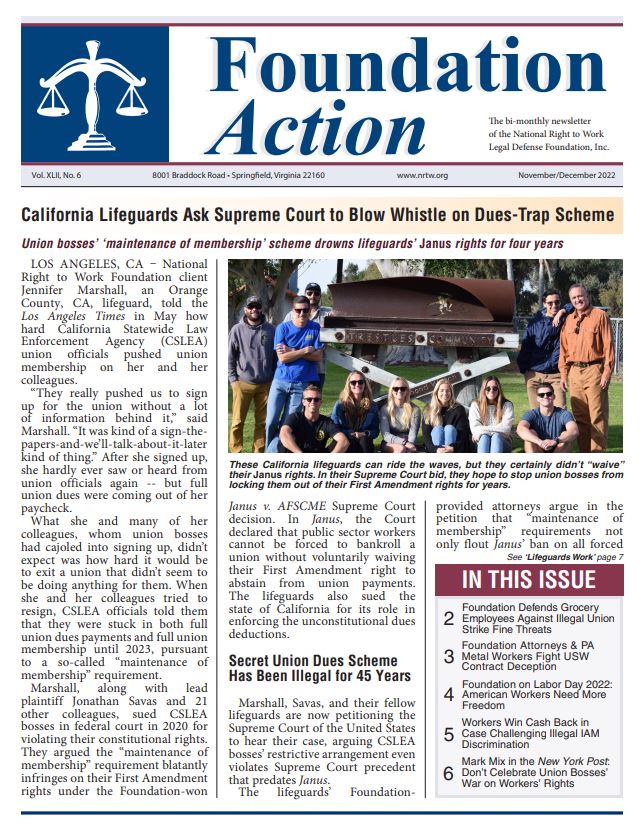
All articles from the November/December issue of Foundation Action are now on the website.
In this issue:
- South Jersey Bus Drivers Challenge Dues Trap Scheme in New Janus Lawsuit
- Slot Machine Technicians Appeal Outrageous Decision Denying Decertification Vote
- Worker Wins $18,000+ for Illegal Firing at IAM Union Bosses’ Behest
- Mark Mix in The Wall Street Journal: Jennifer Abruzzo’s Plan to Abolish Union Elections
- Flight Attendant Battling Religious Discrimination Beats Union Attempt to End Case
- Forced Dues For Politics: CWA Union Hit with Federal Charge by Pennsylvania Metal Worker
Recent articles can be found here. To sign up for a free copy of the newsletter via mail please see the form at the bottom of this page.
Foundation Brief to Court of Appeals: Lower Court’s Decision Conflicts with SCOTUS’ Janus Ruling
National Right to Work Foundation attorneys filed an amicus brief in Littler v. OAPSE with the Sixth Circuit Court of Appeals
Cincinnati, Ohio (April 6, 2023) – The National Right to Work Legal Defense Foundation filed an amicus brief with the Sixth Circuit Court of Appeals on April 5. The brief was filed in Littler v. OAPSE, brought by plaintiff Christina Littler. She attempted exercise her right to withdraw union membership and financial support, as recognized by the U.S. Supreme Court in the 2018 Janus v. AFSCME decision, only to be denied by union officials.
In the Foundation-won and argued Janus case, the Supreme Court recognized that the First Amendment protects government employees, like Littler, from being forced to fund union activities, and further that dues may only be deducted with the affirmative consent of an employee.
Littler is a school bus driver who, shortly after the Supreme Court issued its seminal decision in Janus, notified the Ohio Association of Public School Employees (OAPSE) that she resigned her union membership and revoked her dues deduction authorization. Rather than honor Littler’s timely request to stop paying union dues, union officials had her government employer continue to seize full dues from her paycheck. This prompted Littler to file a lawsuit to recover the dues OAPSE seized from her in violation of her First Amendment rights.
The U.S. District Court for the Southern District of Ohio, however, ruled the union was not liable for violating Littler’s constitutional rights. According to the court, the First Amendment did not apply to the union because the union supposedly did not engage in a state action when it caused a government employer to seize union dues from Littler’s wages.
The Foundation’s brief specifically counters this holding. The brief states “the lower court’s decision that a union does not violate the First Amendment when it has a government employer seize payments for union speech from a nonmember without her consent, because that union supposedly is not a state actor, conflicts with Janus and imperils employees’ right to not subsidize union speech that they oppose.”
The brief goes on to say that the “lower court has effectively given unions a free pass to infringe on employees’ speech rights under Janus without fear of liability” and that “it is important that the [Sixth Circuit] reverse the lower court’s erroneous state-action holding because it frees unions from constitutional constraints when they collaborate with government employers take union payments from employees.”
The case is one of many where union officials have sought to justify seizing dues from employees against their will. For example, in the Foundation-backed Savas case currently pending at the U.S. Supreme Court, Jonathan Savas and other California lifeguards are suing the California Statewide Law Enforcement Agency union for enforcing a “maintenance of membership” requirement that compel dissenting lifeguards to remain union members and to pay union dues for the four-year duration of the contract.
The U.S. Supreme Court recently scheduled the Savas petition for certiorari to be conferenced on April 21.
“While the Foundation is proud to assist workers in enforcing their constitutionally protected Janus rights, the increasing number of cases similar to Savas and Littler just highlight the lengths union bosses will go to in order to extract dues payments from workers against their will,” commented Mark Mix, President of the National Right to Work Legal Defense Foundation. “These cases show why it has become unfortunately necessary for the Supreme Court to again weigh in on this issue to disabuse union officials and lower courts of the notion that public employees’ First Amendment rights can be so callously ignored and restricted.”
Lucas County Employees Win Back Unconstitutionally Seized Money from AFSCME Union
Employees exercised constitutional right to stop funding union activities, but union-imposed restriction blocked exercise of right for over 90 percent of year
Toledo, OH (April 4, 2023) – Three Lucas County Job and Family Services (JFS) employees have emerged victorious in their federal civil rights lawsuit against the American Federation of State, County, and Municipal Employees (AFSCME) Ohio Council 8 union. The employees, Penny Wilson, Theresa Fannin, and Kozait Elkhatib, charged AFSCME union bosses in December 2022 with seizing money from their paychecks in violation of the First Amendment.
Wilson, Fannin, and Elkhatib received free legal assistance from the National Right to Work Legal Defense Foundation and The Buckeye Institute. They asserted their constitutional rights recognized in the landmark 2018 Foundation-won Janus v. AFSCME U.S. Supreme Court decision. In Janus, the Court declared it a First Amendment violation to force public sector workers to pay union dues or fees as a condition of employment. The Court also ruled that union officials can only deduct money from the paycheck of a public sector employee who has voluntarily waived his or her Janus rights.
Now, as part of a settlement, AFSCME Ohio Council 8 must return illegally seized money to each woman, and the union bosses are forbidden from having Lucas County deduct union dues from any of their paychecks going forward. The settlement fully vindicates the employees’ First Amendment Janus rights.
Lucas County Employees Weren’t Informed of First Amendment Right to Abstain from Union Dues
Officials from AFSCME Council 8 and Lucas County JFS enforced a policy against the women which permitted the taking of union dues directly from their wages. According to the policy, employees who wish to stop subsidizing the union have only a handful of days per year in which to do so – an “escape period” that effectively forbids the exercise of their First Amendment Janus rights for more than 90 percent of the year.
AFSCME union officials never informed Wilson, Fannin, and Elkhatib of this restriction. Union officials also never told the women that they had a First Amendment right under Janus to abstain from dues deductions, or that union dues could only be taken from them if they waived that right.
The employees discovered their Janus rights independently. Each attempted to exercise those rights twice by sending letters to AFSCME union officials stating that they were ending their union memberships and terminating dues deductions. AFSCME union officials denied all three women’s requests, stating that union dues deductions would continue because the letters missed the narrow “escape period” the union imposed.
“Plaintiffs did not knowingly, intelligently, or voluntarily waive their First Amendment rights…The restrictions on stopping government dues deductions…are unenforceable as against public policy because the restriction significantly impinges on employees’ First Amendment rights,” read the federal complaint.
Employees Often Must Seek Return of Dues Seized Without Consent
Wilson, Fannin, and Elkhatib’s win is the latest in a chain of successful Foundation-backed lawsuits defending Ohio public servants’ Janus rights. In 2020, for example, Foundation attorneys challenged a so-called “maintenance of membership” requirement that AFSCME Ohio Council 11 used to lock public employees out of their Janus rights for three years at a time. Rather than face off against Foundation attorneys, Council 11’s union officials backed down and settled the case. As a result, Foundation attorneys freed almost 30,000 Ohio public employees from the onerous arrangement.
“Once again Foundation-backed Ohio public employees have successfully defended their Janus rights against the schemes of AFSCME union officials, who were more concerned with accumulating dues money than respecting the First Amendment,” commented National Right to Work Foundation President Mark Mix. “America’s public workers should not have to file federal lawsuits to defend their Janus rights. Instead, before taking dues, union officials should inform workers about their Janus rights and honor those rights.”
“It’s heartening that the union has agreed to resolve this dispute by honoring their former members’ wishes; it’s disappointing that a lawsuit was required to reach that common-sense result,” said Jay R. Carson, senior litigator at The Buckeye Institute.





