
IBEW Local 16 Folds in Case Concerning Illegal $1.29 Million Retaliatory ‘Fine’ Threat Against Local Electrician
Union bosses imposed illegal limitations on resigning union membership, told electrician he would be fined for starting new business unless he signed with the union
Evansville, IN (September 30, 2025) – Brian Head, an Evansville-based electrician, has vindicated his federal labor rights against the International Brotherhood of Electrical Workers (IBEW) Local 16 union. Head filed federal charges after IBEW union officials threatened him with a $1.29 million internal disciplinary fine even though he had validly resigned his union membership. He filed the charges at the National Labor Relations Board (NLRB) with free legal aid from National Right to Work Foundation staff attorneys.
The settlement requires union officials to rescind all fines against Head, expunge all records of them, and refrain from interfering with workers who exercise their right to resign their union membership in the future. The union is also required to notify other workers of their legal right to resign their union membership without restriction, and be free of any attempt to impose internal union fines post-resignation.
Fine Threats Came After Electrician Refused to Hand Over Business to Union Power
The NLRB is the federal agency responsible for enforcing the National Labor Relations Act (NLRA) and adjudicating disputes between employers, unions, and individual employees. Head’s charges document that he had resigned his IBEW union membership on March 27, 2025, in a notarized letter that IBEW officials acknowledged receiving. However, the union’s reply letter claimed that “[i]t is a six-month process before the resignation is finally effective.”
The NLRA forbids restricting the right of workers to resign their union memberships. Section 7 of the NLRA enshrines workers’ right to refrain from union membership. Furthermore, union bosses cannot impose discipline or fines upon nonmember workers.
IBEW Local 16 union officials began retaliating against Head after he resigned his union membership and announced he was purchasing a non-union electrical firm. Head refused to sign an IBEW Letter of Assent, which would have likely forced his employees under union control without any kind of worker vote.
Following Head declining to hand over his business to a union he was no longer legally affiliated with, IBEW Local 16 officials sent Head correspondence on May 1 demanding he appear before a union tribunal. Head later received a letter from IBEW Local 16 bosses on June 9 finding him “guilty” of violating the union’s constitution and imposing a “$1.29 Million dollar fine” as a penalty.
Foundation-Won Settlement Forces IBEW to Inform Workers of Rights
An NLRB Regional Director reviewed Head’s charges against IBEW union officials’ overreach, and made a merit determination in his favor, finding that the IBEW Local 16 union officials violated Head’s rights under the NLRA. IBEW union officials quickly decided to back down and settle rather than go to trial against the NLRB and Head’s Foundation lawyers. In addition to expunging their million-dollar-plus retaliatory fine, the settlement details that IBEW bosses must stop informing workers that there are restrictions on the right to resign one’s union membership. Additionally, they must inform all their members of their rights under the NLRA, and post the settlement on the union’s website.
“The Foundation is pleased to have assisted Mr. Head as he challenged IBEW union bosses’ attempt to illegally extort him after he had followed all legal procedures necessary to break free from the union,” commented National Right to Work Foundation President Mark Mix. “IBEW union bosses’ use of strong-arm tactics demonstrates that they value maintaining control over Indiana electricians far above respecting those electricians’ individual rights.
“Whenever union bosses violate the rights of any American worker, Foundation attorneys are ready to assist in their defense,” Mix added.
Evansville Electrician Files Federal Charges Against IBEW Local 16 for Union Bosses’ $1.29 Million Retaliatory ‘Fine’
Electrician validly resigned union membership and left union to purchase a non-union electrical firm, but union used sham proceeding to levy massive fine
Evansville, IN (June 30, 2025) – Brian Head, an Evansville-based electrician, has just filed federal charges against the International Brotherhood of Electrical Workers (IBEW) Local 16 union for threatening him with a $1.29 million fine after he exercised his right to resign from the union. Head filed his charges at the National Labor Relations Board (NLRB) with free legal aid from National Right to Work Foundation staff attorneys.
IBEW Union Bosses Threaten Fake Limits on Membership Resignation, Bogus Discipline
Head’s charges to the NLRB, which is the agency responsible for enforcing federal labor law, report that he resigned his IBEW union membership on March 27, 2025, in a notarized letter that IBEW officials acknowledged in an April 3 reply letter. However, the reply letter claimed that “[i]t is a six-month process before the resignation is finally effective.”
Putting such restrictions on workers’ right to resign their union memberships has no basis in law. Section 7 of the National Labor Relations Act (NLRA) and U.S. Supreme Court decisions like Pattern Makers v. NLRB spell out that workers have a right to end union membership and union officials cannot require such membership as a condition of getting or keeping a job (though states that lack Right to Work laws like Indiana’s let union officials force workers to pay dues or be fired). Union officials also may not impose union discipline, like fines, on workers who aren’t members.
In the interim between the two letters, IBEW Local 16 pursued union discipline against Head for “purchas[ing] a non-union electrical contractor and…decid[ing] not to sign a Letter of Assent” that would have likely handed the business over to union control without any kind of worker vote. Notably, the union’s discipline took place after Head’s March 27 union resignation – meaning Head was legally beyond the union’s powers to impose any sort of internal punishment.
Union Letter Imposes Million-Dollar-Plus ‘Punishment’ on Electrician
Nevertheless, IBEW Local 16 officials sent Head correspondence on May 1 demanding he appear before a union tribunal. Head later received a letter from IBEW Local 16 bosses on June 9 finding him “guilty” of violating the union’s constitution and imposing a “$1.29 Million dollar fine” as a penalty.
“IBEW Local 16 union bosses’ imposition of this cruel million-dollar-plus ‘punishment’ on a rank-and-file worker shows that their real priority is maintaining cartel-like control over Indiana electricians – not standing up for workers’ rights or freedom,” commented National Right to Work Foundation President Mark Mix. “IBEW bosses have no legal grounds for this obscene exploitation. But as ridiculous as this situation is, it’s important to remember that union monopoly bargaining is still the law of the land in all 50 states – a power that allows overtly self-interested union bosses like IBEW officials to extend their so-called ‘representation’ over every worker in a unionized facility, no matter how strenuously any worker opposes the union.”
Penske Truck Leasing Workers Free of Unwelcome Union after Teamsters Sped Off to Avoid Vote
Employees who sought to end union ‘representation’ win a swift victory
BLOOMINGTON, IN (March 9, 2022) – Mechanics and customer service employees at Penske Truck Leasing in Bloomington, Indiana have won their effort to end Teamsters union control at their workplace. Rather than contest the workers’ decertification request in a secret ballot vote, International Brotherhood of Teamsters Local Union No. 135 officials have filed documents with the National Labor Relations Board (NLRB) ending their monopoly bargaining power over all workers at the Penske Truck Leasing facility in Bloomington.
Penske Truck Leasing employee Steven Stuttle and his colleagues received free legal assistance from National Right to Work Foundation staff attorneys in filing a petition for a vote to oust union officials. All but one Penske Truck Leasing employees in the bargaining unit signed the decertification petition, which was filed with the NLRB in February 2022.
“I never felt properly represented by our union. I prefer to have the ability to negotiate the value of my skills as an individual,” Stuttle remarked about the effort. “I very much appreciate the work done by National Right to Work, I could not have done it without them.”
Before an NLRB-supervised decertification election was scheduled, Teamsters officials issued a statement, disclaiming representation in an apparent attempt to spare themselves the embarrassment of an overwhelming vote by workers to reject the union’s so-called “representation.”
This is the latest in a recent series of successful worker efforts aided by National Right to Work Foundation staff attorneys. In just the past few weeks, Foundation staff attorneys aided Atlantic Aviation PNE, Inc. employees with filing their decertification petition and successfully defended Kansas City, Missouri hospital workers against an SEIU union attempt to overturn their vote to remove the union.
The Foundation has also fought to break down union boss-created legal barriers to unseating unwanted union officials. In 2020, following detailed formal comments submitted by Foundation attorneys, the NLRB adopted rules eviscerating union bosses’ ability to stop a decertification effort with “blocking charges,” i.e., accusations made against an employer that are often unverified and have no connection to workers’ desire to kick out unwanted union officials.
“Workers across the country are exercising their rights to remove unwanted unions and throwing off the yoke of coercive monopoly unionism,” remarked National Right to Work Foundation President Mark Mix. “No worker anywhere should be forced under the so-called ‘representation’ of a union they oppose, and Foundation staff attorneys stand ready to assist workers wanting to hold a decertification election to oust a union they oppose and believe they would be better off without.”
Full Foundation Action May/June 2022 Newsletter Now Online
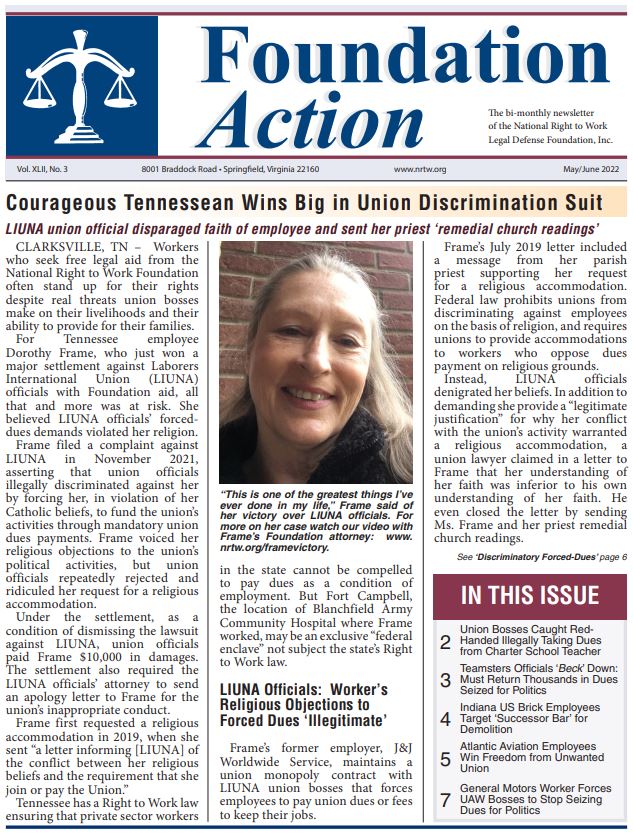
All articles from the May/June issue of Foundation Action are available on the website.
In this issue:
- Courageous Tennessean Wins Big in Union Discrimination Suit
- Union Bosses Caught Red-Handed Illegally Taking Dues from Charter School Teacher
- Teamsters Officials ‘Beck’ Down: Must Return Thousands in Dues Seized for Politics
- Indiana US Brick Employees Target ‘Successor Bar’ for Demolition
- Atlantic Aviation Employees Win Freedom from Unwanted Union
- General Motors Worker Forces UAW Bosses to Stop Seizing Dues for Politics
Recent articles can be found here. To sign up for a free copy of the newsletter via mail please see the form at the bottom of this page.
Indiana US Brick Employees Target ‘Successor Bar’ for Demolition
Over 70 percent of workers want Teamsters gone, but non-statutory policy prevents vote

Though Kerry Atkins and roughly 70 percent of his coworkers want to kick Teamsters bosses from their facility, the “successor bar” and other non-statutory “bars” could block a vote for years.
INDIANAPOLIS, IN – National Right to Work Foundation staff attorneys have made big strides in recent years for independent-minded workers who want to exercise their right to vote unpopular unions out of their workplaces.
The National Labor Relations Board’s (NLRB) adoption in 2020 of Foundation-backed reforms to the decertification process have made it significantly less difficult for workers to exercise their rights. But, there’s much more work to be done to eliminate contrived, union boss-friendly NLRB policies that stifle worker rights just so unwanted unions can stay entrenched.
Enter Kerry Atkins and his coworkers at US Brick in Mooresville, Indiana. With free Foundation legal aid they are fighting an NLRB policy called the “successor bar” that arbitrarily blocks employees’ right to vote out an unwanted union when management changes hands in a workplace.
Atkins filed a petition signed by his colleagues in December 2021, asking the NLRB to hold a vote on whether to decertify Teamsters Local 135 union officials. NLRB Regional Director Patricia Nachand ruled on February 9 that US Brick’s recent acquisition of the plant triggered the so-called “successor bar” and rendered the employee petition invalid.
NLRB-Invented Policy Traps Workers in Union They Strongly Oppose
Nachand blocked the vote even though, according to her own order, plant management has in its possession a parallel petition expressing disaffection with the Teamsters, which bears the signatures of about 70 percent of the employees.
The “successor bar” is a non-statutory policy invented by NLRB appointees that immunizes union officials from being voted out by employees for up to a year after management changes as a result of a sale, merger, or acquisition.
The National Labor Relations Act (NLRA), the federal law the NLRB is charged with enforcing, explicitly states that employees have a right to remove union monopoly “representation” they oppose. The “successor bar,” however, is found nowhere in the NLRA’s text.
The only “bar” to employees requesting a decertification election that is mentioned in the NLRA is a one-year restriction after employees certify a union in a secret-ballot vote. That the “successor bar” — which isn’t even in the NLRA — can stave off attempts to vote out a union for up to four years when combined with a “contract bar” makes it especially offensive to workers’ rights.
To make matters even worse, two different federal agencies — the NLRB and the Department of Justice — effectively worked together to impose the “successor bar” on Atkins and his coworkers. The Department of Justice in an antitrust complaint forced the former owner of the Mooresville brick facility to sell it to US Brick. The NLRB now says that event should be grounds for blocking the employees from ejecting a union they overwhelmingly oppose.
‘Successor Bar’ Disregards Desires and Experiences of Workers, Brief Says
Atkins’ Foundation attorneys have filed a Request for Review of Nachand’s order with the NLRB in Washington, D.C. It contends that the “successor bar” serves no purpose other than to block the will of rank-and-file employees, entrenching union bosses who ought to be accountable to the employees.
“The successor bar undermines the NLRA’s core purpose of employee free choice by disregarding employees’ actual desires and past experiences with their union representative,” the Request for Review argues.
Restriction Shows How NLRB-Invented Policies Stifle Individual Rights
“The NLRB-invented ‘successor bar’ is just one example of how the Board neglects its mandate to protect the rights of individual workers, including those opposed to forced union affiliation, just to protect union boss power,” observed National Right to Work Foundation Vice President Patrick Semmens. “The ‘successor bar’ not only overrides the statutory right of workers to vote out unions they oppose, but does so at the very moment when workers are most likely to reevaluate their union status: the turnover of the old management that perhaps was the reason for unionization in the first place.”
Sixteen States Back Foundation’s Petition to High Court in Chicago Educator Case
The following article is from the National Right to Work Legal Defense Foundation’s bi-monthly Foundation Action Newsletter, September/October 2021 edition. To view other editions of Foundation Action or to sign up for a free subscription, click here.
Amicus brief: Unions “refuse to stop collecting dues despite unequivocal employee demands”
“Janus has been ignored,” wrote sixteen attorneys general in their amicus brief supporting Ifeoma Nkemdi and Joanne Troesch’s petition pressing the Supreme Court to hear their case and declare “escape periods” a First Amendment violation.
WASHINGTON, DC – In July, sixteen attorneys general threw the support of their states behind Chicago Public Schools educators Ifeoma Nkemdi and Joanne Troesch, who are urging the U.S. Supreme Court to hear their case defending their First Amendment right to cut off union financial support as recognized in the Foundation-won Janus v. AFSCME decision.
In an amicus brief encouraging the High Court to hear the case, attorneys general from Alaska, Alabama, Arizona, Arkansas, Indiana, Kansas, Louisiana, Missouri, Montana, Nebraska, South Carolina, South Dakota, Tennessee, Texas, Utah, and West Virginia argue that “escape period” restrictions like the one that Chicago Teachers Union (CTU) bosses foisted on Troesch and Nkemdi are a widespread threat to public employees’ rights under the Janus Supreme Court decision.
In 2018, the Supreme Court ruled in Janus v. AFSCME that public employees’ First Amendment rights are violated when they are forced to fund a union as a condition of employment. The Court also held that union dues can only be taken from a public employee with an affirmative and knowing waiver of that employee’s First Amendment right not to pay.
Unions Are Seizing Money from ‘Tens of Thousands’ Unconstitutionally, Brief Says
The CTU-concocted “escape period” Nkemdi and Troesch are challenging blocks employees from exercising their First Amendment Janus right to end union financial support except during one month per year. The educators’ petition for writ of certiorari presses the High Court to hear their case to affirm that Janus does not permit union bosses to profit from schemes that constrict workers’ constitutional right to refrain from subsidizing a union.
The states’ amicus brief emphasizes how glaringly union officials have flouted Janus with restrictions, as well as how widespread the schemes are: “Janus has been ignored. Across the country public-sector unions have resisted Janus’s instructions and devised new ways to compel state employees to subsidize union speech. Unions place onerous terms on dues forms that prohibit state employees from opting out of paying dues except during narrow (and undisclosed) windows during the year.”
The brief continues: “Unions refuse to inform state employees that they have a First Amendment right not to pay union dues. And unions refuse to stop collecting dues despite unequivocal employee demands. The result is that tens of thousands of state employees across the country are having dues deducted to subsidize union speech without any evidence that they waived their First Amendment rights . . . .”
Nkemdi and Troesch’s case “implicates these precise concerns” and the Court must hear it, the brief maintains.
In addition to the states’ brief, policy groups Goldwater Institute, Cato Institute, Freedom Foundation, and Liberty Justice Center filed amicus briefs backing the case.
Justices May Already Be Showing Interest in Foundation-Backed Case
In late July, the Supreme Court ordered lawyers for CTU and the Chicago Board of Education to file a response brief to Troesch and Nkemdi’s petition, a signal that some Justices may be interested in taking up the case.
Also pending at the High Court is Foundation attorneys’ anti- “escape-period” case for Susan Fischer and Jeanette Speck, two New Jersey teachers. Both that case and Troesch and Nkemdi’s case are expected to be fully briefed in October, after which the Justices will decide whether to take them.
“As union bosses continue to use deceptive ‘escape period’ arrangements to keep worker money flowing unconstitutionally into their coffers, support continues to roll in from across the country for Troesch and Nkemdi, who are sticking up for independent-minded public servants who simply want to serve their communities without being forced to fund union activities,” observed National Right to Work Foundation President Mark Mix. “The High Court must weigh in to affirm that public workers’ First Amendment rights cannot be confined to union officials’ arbitrary schedules.”
NLRB Blocks Attempt to Oust Union, Despite Unanimous Call for Union’s Removal
The following article is from the National Right to Work Legal Defense Foundation’s bi-monthly Foundation Action Newsletter, May/June 2021 edition. To view other editions of Foundation Action or to sign up for a free subscription, click here.
Every employee signed a petition for vote to remove Carpenters Union from their workplace
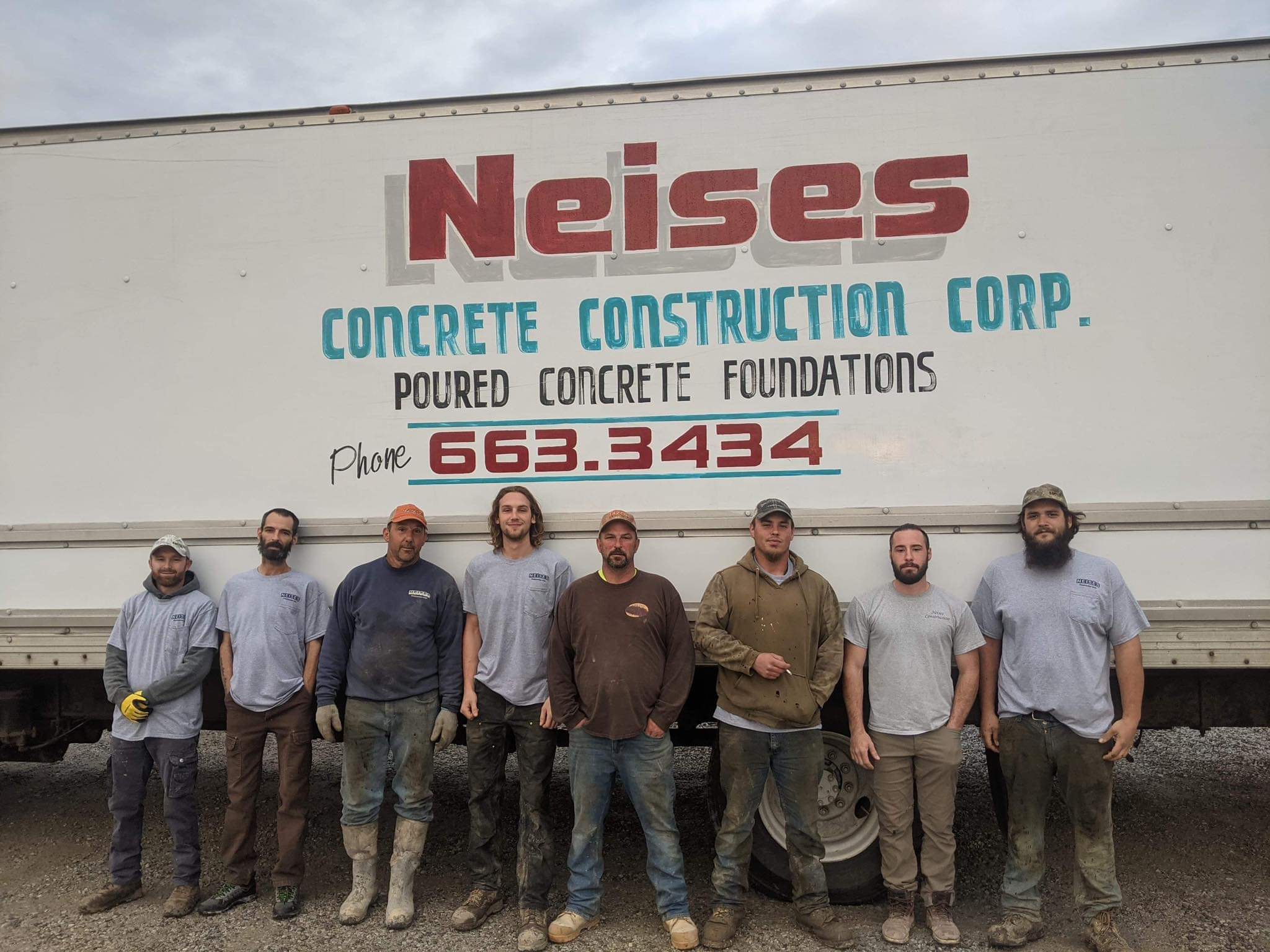
Foundation staff attorneys are defending Neises Concrete Construction Corp. workers’ unanimous call to free themselves from the coercive reign of IKORCC union bosses.
CROWN POINT, IN – Mike Halkias and his coworkers at Neises Construction Corp. in Crown Point, Indiana, are subject to monopoly “representation” by officials of the Indiana/Kentucky/Ohio Regional Council of Carpenters (IKORCC) union.
Every bargaining unit member exercised the right under Indiana’s Right to Work Law to decline formal union membership and to refuse to pay any union dues or fees, but union officials still have the authority under federal law to “negotiate” with Neises for the employees despite their objections to that representation.
NLRB Officials Snub Workers’ Unanimous Petition, Demand Union Bargaining
With free legal aid from the National Right to Work Legal Defense Foundation, Halkias submitted a decertification petition to Region 13 of the National Labor Relations Board (NLRB), signed by every member of his unit, to remove IKORCC union officials from their workplace.
Despite unanimous agreement by the unit’s workers to hold a vote to oust IKORCC bosses, NLRB Region 13 officials rejected the decertification petition. The Regional Director is demanding that the Indiana employer bargain with IKORCC, even though none of its employees want the union to “represent” them.
Union Bosses Won’t Give Up Monopoly Bargaining Power over Non-members
So far union officials have stymied the vote through “blocking charges,” unfair labor practice charges filed by union lawyers that, before they are resolved, prevent a vote from taking place. Union officials claim the vote cannot proceed until the company negotiates “in good faith” with the union.
That demand comes even though federal law makes it illegal for an employer to engage in bargaining with a union that it knows lacks the support of at least a bare majority of workers. The NLRB regional official’s order dismissing the employees’ petition did not even acknowledge that every employee in Mr. Halkias’ bargaining unit has shown a desire to be independent from the union by resigning union membership and asking for a decertification vote.
Foundation Attorneys Bring Fight to National Board
The Foundation staff attorneys who represent Halkias have appealed to the NLRB in Washington to overturn the rejection of the decertification petition and to allow the workers to vote so they can be rid of the union whose so-called “representation” they all oppose. “It is outrageous that in a workplace where every single worker wants nothing to do with a union, federal law still forces workers to accept the so-called ‘representation’ of union bosses,” said National Right to Work Foundation Vice President Patrick Semmens.
“The fact that this appeal is even necessary demonstrates how rigged federal law is against independent-minded workers who seek to exercise their right not to associate with a union.”
“This case is a reminder that, even in Right to Work states that protect workers from being forced to fund a union they don’t support, federal law still forces workers under union monopoly control even when those employees oppose the union and believe they would be better off without it.”
West Virginia Supreme Court Hears Right to Work Case
The following article is from the National Right to Work Legal Defense Foundation’s bi-monthly Foundation Action Newsletter, January/February 2020 edition. The West Virginia Supreme Court heard arguments in this case on January 15 and a decision is expected in the coming months. To view other editions or to sign up for a free subscription, click here.
Foundation continues to defend all Right to Work laws against Big Labor attack
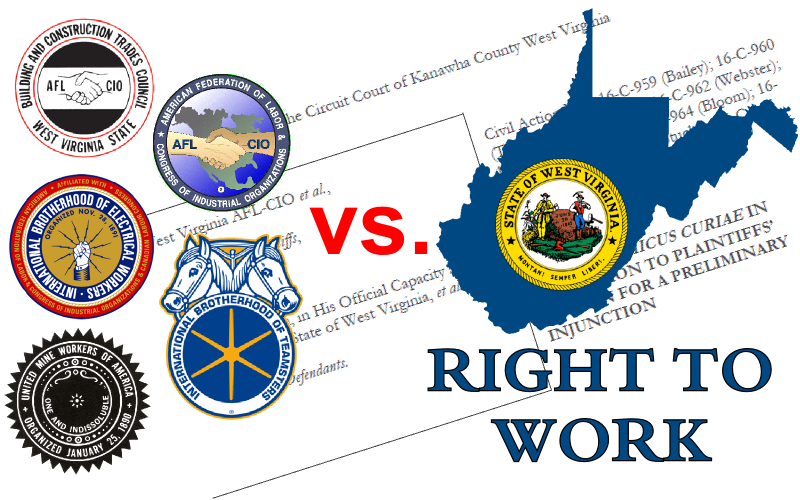
Forced-dues-hungry union bosses have been waging a legal battle to overturn West Virginia’s Right to Work Law since it was enacted in 2016. Foundation staff attorneys have been fighting back by filing amicus briefs in court.
CHARLESTON, WV – The West Virginia Supreme Court will hear arguments on January 15 in union bosses’ long-running case seeking to dismantle West Virginia’s Right to Work Law and restore their forced-dues powers over workers across the Mountain State. National Right to Work Foundation staff attorneys have already filed multiple legal briefs in this case for West Virginia workers in defense of West Virginia’s Right to Work Law.
After Passage, Union Bosses Immediately Target West Virginia Right to Work Law
Last year, union lawyers relied on discredited legal arguments to convince Kanawha County Circuit Court Judge Jennifer Bailey to declare West Virginia’s entire Right to Work Law invalid. Union lawyers dubiously claim that West Virginia union bosses have a “right” to forced dues. Judge Bailey issued a similar ruling blocking the Right to Work law after the legislation was signed into law in 2016. The West Virginia Supreme Court overturned that decision, citing arguments made in briefs by Foundation staff attorneys. “Of course, union partisans never willingly accept the loss of forced dues,” said National Right to Work Foundation President Mark Mix. “So now the issue is back at the state’s highest court.” If Big Labor’s lawsuit to overturn
West Virginia’s Right to Work Law succeeds, union bosses could have thousands of independent-minded workers across the state fired solely for refusing to subsidize union activities.
Foundation Files 10 Briefs to Protect Rights of West Virginia Workers
Foundation staff attorneys have filed 10 legal briefs in the multi-year case. The Foundation’s latest amicus brief was filed for West Virginia nursing home employee Donna Harper. Harper, like many other workers in West Virginia, chose not to pay dues or fees to union bosses, which is her legal right in a Right to Work state.
“Union bosses in West Virginia are intent on reclaiming their forced-dues power,” Mix said. “Big Labor is waging this protracted legal battle to return the Mountain State to a time when millions and millions of dollars in workers’ money were seized by union bosses to fill Big Labor’s coffers with forced dues.”
This case is the latest legal battle in the Foundation’s long history of effectively defending Right to Work laws in state and federal court from spurious attacks by Big Labor. Although federal law specifically authorizes states to pass Right to Work laws to protect workers from union boss coercion, union lawyers have repeatedly challenged these laws in an attempt to keep siphoning union dues and fees from workers’ paychecks.
Foundation Has Successfully Defended State Right to Work Laws Nationwide
In addition to West Virginia, Foundation staff attorneys have successfully pursued legal action in recent years to defend and enforce new Right to Work laws in Indiana, Michigan, Wisconsin and Kentucky, all of which have passed Right to Work protections for employees in just the last seven years. In Michigan alone, Foundation staff attorneys have assisted employees in over 100 cases since Right to Work went into effect in early 2013.
Indiana Worker Wins Settlement at Labor Board After Being Forced to Wear Union Regalia Despite Being Nonmember
Indianapolis automotive supplier employee was illegally required to be a walking billboard for a union he isn’t a member of and doesn’t support
Indianapolis, IN (January 14, 2019) – An employee of an automobile component plant in Indianapolis, Indiana has just won a settlement before the National Labor Relations Board (NLRB) after bringing federal charges against his employer for requiring employees to wear union logos on uniforms, whether or not the employees were union members.
With free legal aid from the National Right to Work Legal Defense Foundation, David Thomas filed an unfair labor practice charge with the NLRB against his employer, Faurecia. The charge was brought following a new policy adopted by the company requiring employees like Thomas to wear uniforms displaying the insignia of the International Brotherhood of Electrical Workers (IBEW) Local 1424.
Thomas, who chooses to exercise his rights under Indiana’s Right to Work law to refrain from union membership and dues, refused to wear the union regalia and at the behest of union officials was disciplined for refusing to wear the uniform promoting a union he opposes.
Under the National Labor Relations Act, employees are protected from being forced to associate with a union, making the company’s policy a clear violation of federal law.
The settlement reached between Thomas and company representatives requires Faurecia to rescind the uniform policy and expunge the verbal warning from Thomas’ employee records. A notice about the settlement and removal of the uniform policy will be posted for all of the company’s employees to see.
An additional charge against the uniform policy was filed by a second Faurecia employee at the same time as Thomas’ charge. This charge was settled privately in favor of the employee, who had been dismissed by the company for challenging the union logo policy.
“Federal law, along with Indiana’s Right to Work protections, clearly provides that forced union affiliation is a violation of workers’ legal rights,” said Mark Mix, President of the National Right to Work Legal Defense Foundation. “Independent workers should never be forced to be a walking billboard for a union they oppose, and this case makes it clear that such a policy is a violation of workers’ rights.”
Indiana Worker Hits Union Bosses with Federal Unfair Labor Practice Charges for Refusing to Follow the Law
Union Officials Seize Union Dues Despite Worker’s Resignation
Indianapolis, IN (March 17, 2017) – With free legal assistance from National Right to Work Foundation staff attorneys, an Indiana worker has filed federal unfair labor practice (ULP) charges against the International Brotherhood of Teamsters Union Local 135 for continuing to deduct dues from his paycheck despite his resignation from formal union membership and revocation of his dues check-off authorization.
The worker, Allen Sizemore, works at Builders First Source in the lumberyard. In December 2016, Sizemore resigned his formal union membership and revoked his dues check-off authorization within the “window period” permitted by the union. In spite of this, Teamsters union bosses continue to accept dues deducted from Sizemore’s paycheck in clear violation of the National Labor Relations Act (NLRA).
Recently, the same union, IBT Local 135, was hit with federal charges for a similar action against another worker, Daryl Mitchell, also at Builders First Source. Indiana’s Right to Work law clearly provides that a worker has the right to resign and stop paying forced dues to a labor union, as does the NLRA in Right to Work states.
National Right to Work Foundation President Mark Mix commented, “It is maddening that Indiana union officials continue to illegally seize forced dues from a hard-working Hoosier they claim to ‘represent.’ No worker should be forced to jump through all these hoops just to exercise their rights under the law.”
Indiana became the 23rd Right to Work state to end union officials’ power to have a worker fired solely for refusing to pay union dues or fees in early 2012. Since then Michigan (2012), Wisconsin (2015), West Virginia (2016), Kentucky (2017) and Missouri (2017) have joined the ranks of states with Right to Work protections.





