
Housekeeper Challenges Labor Board Double Standard Promoting ‘Card Check’
The following article is from the National Right to Work Legal Defense Foundation’s bi-monthly Foundation Action Newsletter, March/April 2019 edition. To view other editions or to sign up for a free subscription, click here.
Trump NLRB asked to enforce rule stopping companies from aiding union ‘card check’ drives
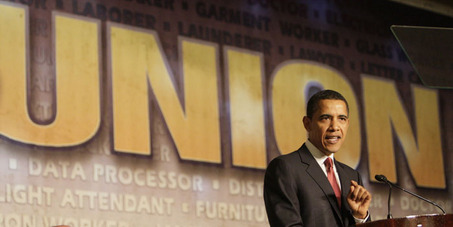
President Barack Obama’s NLRB pushed through Big Labor-friendly rules promoting coercive “card check” union organizing drives
Washington, D.C. – After UNITE HERE Local 8 union officials unionized Gladys Bryant’s workplace via a “card check” drive, the Seattle housekeeper couldn’t help but feel that her rights had been violated.
Union bosses had significant help from Bryant’s employer, Embassy Suites, to organize the employees – even a list of workers’ names and contact information. And when Bryant had sought to revoke her card asking for the union’s representation, a union organizer lied to her and her coworkers about the process, blocking Bryant from exercising her rights.
After the tainted “card check” drive resulted in UNITE HERE Local 8’s monopoly bargaining power over her and her colleagues, Bryant decided to challenge the union bosses and her employer over their coercive tactics.
She filed charges with free legal aid from Foundation staff attorneys. A National Labor Relations Board (NLRB) Regional Director dismissed her charges, but a Foundation staff attorney has filed an appeal with the NLRB General Counsel.
Bryant had been working at Embassy Suites in Seattle for a month before the company informed her and her colleagues that UNITE HERE Local 8 union officials would be organizing the workplace.
Union officials began conducting a “card check” drive, a coercive tactic that bypasses a secret ballot election. Embassy Suites actively promoted the drive, giving union organizers special access to the hotel to meet and solicit employees. The hotel even provided union bosses with a list of all employees’ names, jobs, and contact information to assist the union officials in collecting authorization cards from employees.
Although Bryant did at first sign a union authorization card, she and many of her colleagues reconsidered. When Bryant asked a union official how to revoke her card, the union official misled her and other employees that they had to appear in person at the union hall to revoke any previously signed cards.
Bryant made an appointment with the union official in an attempt to comply with the unlawful requirement. However, the union official did not show up. As a result, Bryant and her colleagues were unable to revoke their union authorization cards, which were then counted as “votes” toward unionization.
After Embassy Suites recognized UNITE HERE Local 8’s monopoly bargaining “representation” over employees, Bryant sought free legal aid from Foundation staff attorneys to file charges, arguing that the unionization violated the National Labor Relations Act (NLRA).
Bryant’s charges allege that Embassy Suites provided UNITE HERE’s organizing campaign with more than “ministerial aid.” The NLRB has long held that an employer taints employees’ efforts to remove a union if it gives the employees more than “ministerial aid,” such as providing a list of bargaining unit employees or use of company resources – as Embassy Suites gave union officials.
Foundation staff attorneys argue that the same “ministerial aid” standard must also apply when an employer aids union officials’ efforts to gain monopoly bargaining power over workers.
The Foundation staff attorney representing Bryant asks that the General Counsel issue a complaint on Bryant’s allegations to provide the Board with an opportunity to bring consistency to its “ministerial aid” standard
Bryant’s charges also argue that UNITE HERE violated the NLRA and fatally tainted its proof of employee support by misinforming employees that they could only revoke authorization cards by going in person to the union hall, blocking workers from exercising their rights. NLRB doctrine holds that, to revoke an authorization card, an employee must simply sign a document stating he or she does not support union representation.
Bryant and her coworkers had collected enough signatures for a decertification vote to remove the union. However, in a separate case covered in the January/February 2019 Foundation Action, the NLRB blocked their petition based on the “card check” recognition.
The block was due to Lamons Gasket, a 2011 Obama Board ruling barring decertification for one year after unionization via “card check.” Some Board members have noted in other recent cases that they would be willing to revisit the blocking charge policy in the future. “
“This case proves that not only are union bosses willing to manipulate and ignore the rights of the workers they claim they want to ‘represent,’ their coercion often goes unchecked because of double standards in how the NLRB interprets the law,” said National Right to Work Foundation Vice President Ray LaJeunesse. “What qualifies as ‘ministerial assistance and support’ under the National Labor Relations Act cannot depend on whether the employer is helping outside union organizers impose unionization on workers, or assisting workers in exercising their rights to remove an unwanted union. This case offers the Trump NLRB a chance to stand up for worker freedom and end a double standard that tips the scales in favor of forced unionism.”
Foundation Pushes for Rule Change to Stop Big Labor’s Illegal Medicaid Skim
The following article is from the National Right to Work Legal Defense Foundation’s bi-monthly Foundation Action Newsletter, September/October 2018 edition.
Union bosses have already diverted over $1 billion in Medicaid funds intended for caregivers

Pam Harris, a home health care provider for her son Josh, won the U.S. Supreme Court Harris v. Quinn decision with the help of Foundation staff attorneys. Although the High Court declared it unconstitutional to skim union dues from Medicaid funds, the skim continues.
WASHINGTON, DC – Each year, schemes enacted by ten states allow well over $100 million to be diverted from healthcare providers to union officials. By skimming money from Medicaid programs, union bosses flout federal law and a National Right to Work Foundation-won Supreme Court decision.
A rule proposed by the U.S. Centers for Medicare & Medicaid (CMS) would end the scheme. In August, the Foundation submitted formal comments to CMS supporting the agency’s proposal that would clarify that the diversion of Medicaid payments from providers to third parties, including unions, violates federal law.
In 2014, the Obama Administration promulgated a new regulation to give legal cover to ongoing schemes of the SEIU and other unions that siphoned money from Medicaid funds, violating the federal Medicaid statute that prohibits assigning benefits to third parties. Union officials have to-date skimmed over $1 billion in Medicaid funds intended for caregivers.
The Foundation’s comments call on CMS to halt the skim, urging the agency to repeal the Obama rule and replace it with clear language to give states notice that continuing to divert payments puts their Medicaid funding at risk.
“It is long past time for this outrageous exemption for union officials to be ended,” said Foundation Vice President and Legal Director Ray LaJeunesse. “The CMS should expeditiously issue a final rule to stop the illegal diversion of funds from Medicaid providers. Despite the wishes of the politicians whom they support, union officials are not exempt from federal law. All the current proposed rule change would do is close an illegal loophole the Obama Administration invented.”
Even as union officials circumvent the law through special privileges, the Foundation has fought to restore justice to the thousands of providers affected.
The 2014 Foundation-won Harris v. Quinn Supreme Court decision held that it is unconstitutional for states to force home care providers receiving Medicaid subsidies to pay union fees. The case continues, now designated as Riffey v. Rauner, as Foundation attorneys seek the return of over $30 million in funds seized from 80,000 providers in violation of their First Amendment rights.
Despite the Supreme Court ruling, the skim has not stopped. That is why in 2017 the Foundation sent a letter to the Department of Health and Human Services to bring its attention to the issue. Moreover, Foundation President Mark Mix personally raised the issue with Trump Administration officials at the White House earlier this year.
“Our National Right to Work Foundation-won 2014 Harris decision made it illegal for states to require providers pay fees to union officials, but the current scheme to deduct union fees from Medicaid payments is part of the union bosses’ attempts to undermine that ruling,” said LaJeunesse. “Nothing in the proposed CMS rule would stop providers from making truly voluntary dues payments to union officials by check or credit card each month. The rule would merely stop union bosses from using public payment systems to capture tax dollars intended for providers caring for those in need.”
Stop & Shop Employee Hits UFCW Union with Federal Charges for Illegal Threats, Slurs During Union-Ordered Strike
UFCW boss misinformed worker about his rights by claiming union membership was mandatory. Others retaliated with slurs and threats when worker defied strike
Quincy, MA (April 18, 2019) – A Massachusetts Stop & Shop employee filed federal unfair labor practice charges against United Food and Commercial Workers (UFCW) Local 1459 alleging that a top union official blatantly misinformed him by telling him that he could not resign his union membership and return to work during a union-ordered strike or he would be fired. The charge was filed with free legal aid from National Right to Work Legal Defense Foundation staff attorneys.
The charging employee has worked at Stop & Shop Supermarket Company since 2017. When he started the job, he became a member of UFCW Local 1459 as union officials led him to believe that union membership was a condition of employment.
Earlier in April, UFCW union officials ordered over 30,000 Shop & Stop grocery employees on strike in Massachusetts, Connecticut, and Rhode Island. The charging employee asked UFCW Local 1459 about his rights to continue working despite the union-ordered strike. In response, a top union official told him in writing that Stop & Shop is a “closed shop” and that he would lose his job if he resigned union membership and returned to work.
That threat contradicts federal law, which protects a worker’s right to resign his or her union membership at any time. Resignation protects a worker who wants to return to work despite a union strike. As a nonmember, he or she cannot legally be subjected to punitive union strike fines.
Additionally, when there is no union monopoly bargaining agreement in effect, as is the case for workplaces impacted by the UFCW’s strike against Stop & Shop, workers who resign from the union can immediately revoke any authorization for payment of union dues.
After being misled, the charging employee learned his rights and decided to return to work. His charges allege that since his return, he has been subjected to slurs based on sexual orientation, threats of violence, and other similar harassment by, or instigated by, UFCW Local 1459 union officials.
To combat the threats and violations of his rights, he sought free legal aid from Foundation staff attorneys. His charges state that the UFCW Local 1459 union official’s claim that he would be fired if he resigned union membership to return to work was “a blatant falsehood and misrepresentation of the law,” because employees have the right at any time to revoke their union memberships and resume work during a strike to support themselves and their families.
Moreover, under federal law unions must give workers clear notice of their right to refrain from union membership and pay reduced nonmember forced fees. The employee’s charges allege that union officials have never given him such notice. His charges also state that the union officials’ harassment in retaliation for his choice to return to work violates the union’s duty of fair representation.
“This worker is refusing to let union bosses bully him into submission through outright lies and threats simply because he has decided that continuing to work is in his best interest,” said Mark Mix, president of the National Right to Work Foundation. “As is unfortunately common when union bosses instigate a work stoppage, union officials are again violating the rights of the workers they claim to ‘represent.’”
“Foundation staff attorneys stand ready to assist other workers who run into union misinformation and threats when they choose to exercise their right to return to work,” added Mix.
The National Right to Work Foundation released a special legal notice informing Stop & Shop employees of their rights during the union-ordered strike. The notice can be found at: https://www.nrtw.org/special-notice-for-new-england-based-employees-of-shop-stop/.
Lawsuits Successfully Challenge Schemes to Block Workers’ Janus Rights
The following article is from the National Right to Work Legal Defense Foundation’s bi-monthly Foundation Action Newsletter, March/April 2019 edition. To view other editions or to sign up for a free subscription, click here.
Workers win first two settlements to end unconstitutional forced union dues seizures

Police clerk Sandra Anderson won a settlement against IBEW with help from Foundation staff attorneys, successfully challenging union bosses’ scheme to trap her into subsidizing a union.
BRAINERD, MN – The fight for public sector workers’ First Amendment rights took a huge step forward in the Foundation-won U.S. Supreme Court Janus v. AFSCME decision. However, across the country union bosses are attempting to limit when workers can exercise their First Amendment rights under Janus, to stop dues seizures through so-called “window period” policies.
In response, Foundation staff attorneys have filed many lawsuits for public employees challenging such schemes, which claim workers can be restricted from exercising their First Amendment rights under Janus outside brief union-created window periods. Such policies trap workers in forced dues against their will, which puts them at odds with the Janus ruling that any dues taken without workers’ consent violates their constitutional rights.
Two of those important lawsuits have ended in victories halting unions’ “window period” policies.
In 2004, when the City of Brainerd Police Department entered into a monopoly bargaining contract with International Brotherhood of Electrical Workers (IBEW) Local 31, clerk Sandra Anderson was told she must either join the union and pay dues or pay compulsory union fees as a non-member. Faced with being forced to fund the union either way, Anderson joined the union, signing a form authorizing the deduction of union dues from her paycheck.
Then, Anderson heard about the Janus ruling, argued and won by Foundation staff attorneys at the Supreme Court. Soon after, Anderson emailed an IBEW official and Brainerd representatives demanding that both parties stop collecting dues from her wages in accordance with Janus. However, IBEW officials claimed that Anderson could only stop dues payments during either a 10-day window prior to the expiration of the monopoly bargaining contract, or a 10-day window prior to the anniversary date of her dues deduction authorization.
Anderson came to the Foundation for help in filing a lawsuit challenging the “window period” policy as unconstitutional, because the policy limits when she can exercise her First Amendment rights under Janus, and allows IBEW Local 31 union officials to collect union dues without her affirmative consent.
In December 2018, IBEW union officials decided they wanted the case to go away, so they settled. Under the settlement, IBEW has refunded to Anderson all union dues they unconstitutionally collected from her after she notified the City of Brainerd and IBEW Local 31 that she no longer consented to financially supporting the union. IBEW officials have also acknowledged Anderson’s request to withdraw her union membership, and will not seek or accept union dues from her again unless she affirmatively chooses to become a union member.
Shortly after Anderson’s victory, a group of Ohio public sector employees freed themselves and thousands of their colleagues from another “window period” scheme that violated their rights.
Seven Buckeye State civil servants attempted to resign their union membership in American Federation of State, County and Municipal Employees (AFSCME) Ohio Council 8 and stop paying union dues after the Janus decision. However, AFSCME officials continued to deduct dues, citing a union policy restricting revocation of dues deduction to a narrow 15-day window prior to the expiration of a monopoly bargaining contract once every three years
The workers came to Foundation staff attorneys to file a class action lawsuit challenging the “window period” scheme. Rather than face Foundation attorneys in court, AFSCME Council 8 union officials settled the lawsuit.
Under the settlement agreement, AFSCME Council 8 stopped enforcing the existing policy restricting workers under their “representation” – as many as 30,000 individuals – from exercising their Janus rights. Additionally, union officials refunded to the plaintiffs all union dues they unconstitutionally collected after the plaintiffs notified union officials that they no longer consented to financially supporting the union.
Union officials were also required to identify any other workers whose rights were blocked by the scheme, honor their requests to resign and stop paying union dues, and refund the dues seized from them under the scheme.
“These seven workers bravely challenged the union bosses’ ‘window period’ scheme, and protected not only their rights but also the rights of tens of thousands of their colleagues,” said National Right to Work Foundation President Mark Mix. “Our first-in-the-nation victories enforcing workers’ rights under Janus should be precursors of many cases that result in union bosses dropping their illegal restrictions on workers seeking to exercise their rights secured in the Foundation’s JanusSupreme Court victory.”
UAW Bosses Back Down, Will Refund $26,000 in Forced Union Dues Seized after Right to Work Law Was in Effect
United Autoworkers union and company settle case brought by workers challenging union dues and fees taken without workers’ authorization
Detroit, MI (April 8, 2019) – Unfair labor practice charges brought by National Right to Work Legal Defense Foundation staff attorneys for two Michigan medical emergency transportation workers against their employer and United Autoworkers (UAW) Local 708 have ended in settlements.
The settlements return to 170 workers more than $26,000 in union dues that were deducted from their paychecks without their authorization in violation of the National Labor Relations Act (NLRA), which protects employees’ right to refrain from union activities, and Michigan’s popular Right to Work law, which ended any requirement that workers must pay union dues or fees as a condition of employment.
Skyler Korinek and Donald McCarty both work for STAT Emergency Medical Services. Neither Korinek nor McCarty had ever given STAT authorization to deduct union dues or fees from their paychecks for UAW Local 708. Nevertheless, since they were hired union officials have demanded and accepted union dues that STAT automatically withdrew from the workers’ paychecks.
Both Korinek and McCarty sent a letter to STAT notifying it that deducting union dues or fees from their paychecks without authorization was illegal. The workers’ letters requested copies of any dues check-off authorization and revoked any authorization if it existed. However, STAT ignored their requests and continued to seize union dues against their wishes, and union officials continued to accept those dues.
The workers sought free legal aid from National Right to Work Foundation staff attorneys, who assisted them in filing unfair labor practice charges at the National Labor Relations Board (NLRB). Rather than face Foundation staff attorneys in an NLRB hearing, union officials and STAT settled the cases.
UAW Local 708 officials will refund all forced union dues or fees seized from any STAT employee without their authorization since December 27, 2017, an amount that totals more than $26,000. Additionally, STAT will post notices informing employees that the company will not provide unlawful support to UAW Local 708 by deducting union dues without an employee’s authorization. Union officials will also post notices stating that UAW Local 708 will not accept any union dues deducted without an employee’s authorization.
In addition to the now-settled NLRB charges, Foundation staff attorneys helped Korinek and McCarty file a federal class action complaint challenging the seizure of forced union dues as a violation of Michigan’s Right to Work law. That case is still ongoing.
“These workers bravely challenged egregious attempts to satiate union bosses’ greed with a cut of their hard-earned paychecks,” said National Right to Work Foundation President Mark Mix. “Despite the many existing protections, including Michigan’s Right to Work law, Michigan union bosses will disrespect the rights of the workers they claim to ‘represent’ to keep Big Labor’s forced-dues coffers full. Independent-minded workers must keep fighting against coercion, and Foundation staff attorneys will continue to provide free legal assistance to any employee facing compulsory unionism’s abuses.”
Since Right to Work legislation was signed into state law in December 2012, Foundation staff attorneys have litigated more than 100 cases in Michigan combating compulsory unionism.
Full Foundation Action January/February 2019 Newsletter Now Online
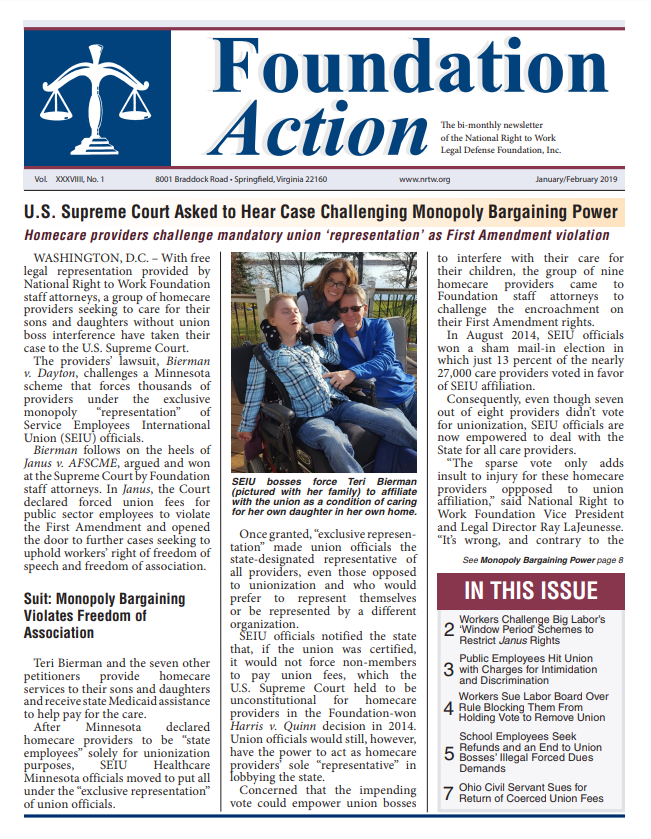
All articles from the January/February 2019 edition of Foundation Action are now on the website.
In this issue:
- U.S. Supreme Court Asked to Hear Case Challenging Monopoly Bargaining Power
- Workers Challenge Big Labor’s ‘Window Period’ Schemes to Restrict Janus Rights
- Public Employees Hit Union with Charges for Intimidation and Discrimination
- Workers Sue Labor Board Over Rule Blocking Them From Holding Vote to Remove Union
- School Employees Seek Refunds and an End to Union Bosses’ Illegal Forced-Dues Demands
- Ohio Civil Servant Sues for Return of Coerced Union Fees
To view other editions or sign up for a free copy of the newsletter via mail, click here.
Mark Janus Asks Appeals Court to Order Refund of Forced Union Fees Outlawed by U.S. Supreme Court
Janus v. AFSCME case continues after union officials refuse to return forced fees ruled unconstitutional in landmark decision
Chicago, IL (March 27, 2019) – Attorneys for Mark Janus, plaintiff in the landmark U.S. Supreme Court case Janus v. AFSCME, have asked a federal appeals court to order a refund union fees he was forced to pay while he worked for Illinois state government.
Janus worked for Illinois state government as a child support specialist from 2007 to 2018. Although he was not a union member, Janus was forced to pay thousands of dollars in “agency fees” to AFSCME, the government union at his workplace. With the help of attorneys from the National Right to Work Legal Defense Foundation and the Liberty Justice Center, Janus challenged the practice of mandatory union fees in federal court, and won.
On June 27, 2018, the U.S. Supreme Court ruled that government workers cannot be required to pay union fees as a condition of working in public service, finding that mandatory union “agency fees” are unconstitutional. The Supreme Court sent the case back to the District Court to determine, among other things, whether Janus is entitled to the approximately $3,000 in fees he was forced to pay since March 23, 2013.
“The Supreme Court held that it is unconstitutional to take union fees from public employees without their consent,” said Jeffrey Schwab, senior attorney at Liberty Justice Center. “Mark, and other public employees like him, were harmed when unions unconstitutionally took their money. They are entitled to have that money returned.”
In addition to striking down the practice of mandatory union fees, the Court ruled that the First Amendment is violated when any union dues or fees are taken from public employees without their affirmative consent and knowing waiver of their First Amendment right not to financially support a labor union.
“As this case shows, even after a clear ruling by the Supreme Court that forced union dues violate the First Amendment, union bosses continue to use every trick in the book to keep the funds they seized in violation of the rights of the very workers they claim to represent,” said Mark Mix, president of the National Right to Work Foundation. “It has been clear ever since the 2012 Knox v. SEIU decision that the Supreme Court was poised to rule that mandatory union payments violate the constitutional rights of public employees like Mark Janus, and it would be a massive injustice to deny the victims of that scheme the refunds to which the Supreme Court’s ruling makes it clear they are entitled.”
Janus’s appeal comes after a district court judge ruled earlier this month that union officials are not required to refund forced fees seized from nonmember workers before the Janus decision.
The Foundation has created a special website, MyJanusRights.org, to assist public employees in exercising their rights under Janus, which was successfully argued by National Right to Work Foundation staff attorney William Messenger.
National Right to Work Foundation Staff Attorney Testifies at House Committee Hearing on Labor Law Reform
Testimony: Current labor law promotes forced unionism and is ‘antithetical to American values of free speech and free association’
Washington, D.C. (March 26, 2019) – A National Right to Work Legal Defense Foundation staff attorney will testify at a U.S. House of Representatives committee hearing today, urging reform of current labor law that hinders American workers from exercising their rights under the U.S. Constitution and the National Labor Relations Act (NLRA).
Veteran Foundation staff attorney Glenn M. Taubman, who has represented hundreds of workers in cases before the NLRB and in federal court, will speak to the House of Representatives Committee on Education and Labor Subcommittee on Health, Employment, Labor, and Pensions at its hearing on “The Need for Labor Law Reform.”
Taubman points out that, under current labor law, millions of private sector workers are forced to accept representation from a labor union, a private organization, whether or not they agree with the union and want its representation. Additionally, many workers are forced to subsidize a union under threat of losing their jobs.
In his statement, Taubman brings up several problems with current labor law that violate workers’ rights. He points out that “current law makes it easier for employees to form and join a union than it is for those same employees to decertify the union,” describing the plethora of red tape designed to block employees from removing a union the representation of which they no longer want.
He argues that forced dues and monopoly bargaining, also known as “exclusive representation,” violate workers’ rights to free speech and free association by forcing them to be represented by and pay fees to a private organization. Even in states with Right to Work legislation, which protects employees’ right to choose whether or not to subsidize a union, union officials impose obstacles to prevent employees from changing their minds and stop paying union dues.
Despite the Foundation-won U.S. Supreme Court Beck decision that provides some protection for workers against being charged for political and certain other union expenditures, union officials have continued to collect forced dues for political activity. Taubman provided free legal aid to nurse Jeanette Geary in her landmark case, in which the NLRB ruled earlier this month (nine years after Geary first filed her case) that union officials can never charge nonmembers for lobbying expenses.
Additionally, Taubman urges reform of the standards for financial transparency as to how union dues are spent, citing recent examples of corruption and abuse of union funds. He also suggests the passage of several pieces of legislation to safeguard workers from compulsory unionism’s abuses, including the National Right to Work Act, which would give individual workers the freedom to decide whether or not to fund union officials’ activities.
“Changes to current labor law are long overdue, but the House Committee majority’s push to make it easier for workers to be forced into union ranks would move the law in the wrong direction,” commented Mark Mix, president of the National Right to Work Foundation. “No American worker should be forced to surrender their workplace voice to a private organization, let alone be compelled to give chunks of their paychecks to union bosses for their unwanted so-called representation.”
“Reforms to federal labor laws are certainly long overdue, but what is needed is a reorientation towards voluntary unionism,” added Mix. “For inspiration, Congress should familiarize themselves with the voluntary principles promoted by AFL-CIO founder Samuel Gompers, who observed that compulsory systems are a menace to workers’ rights, welfare, and liberty.”





