
Foundation Demands Recusal of Former SEIU Lawyers Appointed to Labor Board
The following article is from the National Right to Work Legal Defense Foundation’s bi-monthly Foundation Action Newsletter, November/December 2021 edition. To view other editions of Foundation Action or to sign up for a free subscription, click here.
Biden NLRB appointees have blatant conflicts of interest in case brought by SEIU officials
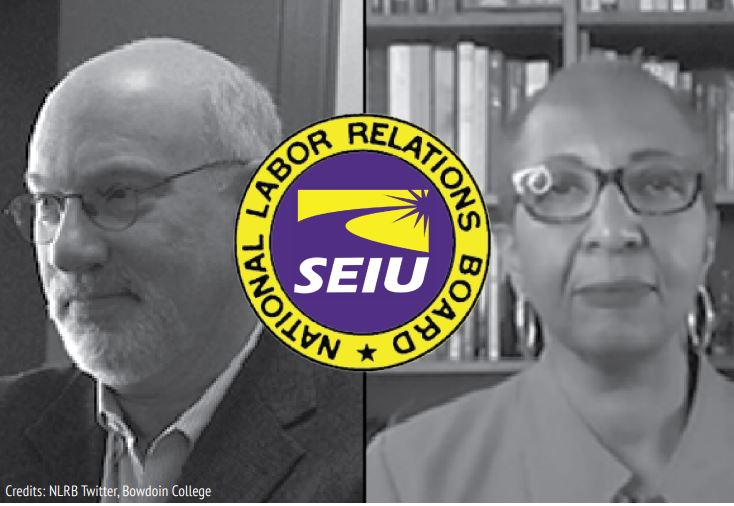
Foundation attorneys demand that the NLRB IG stop David Prouty (left) and Gwynne Wilcox, fresh off tenures as high-ranking SEIU lawyers, from derailing efforts to ensure workers can resist union influence they oppose.
WASHINGTON, DC – The National Right to Work Legal Defense Foundation submitted a letter to the National Labor Relations Board (NLRB) Inspector General (IG) and chief ethics officer, urging them to remove NLRB members David Prouty and Gwynne Wilcox from involvement in an ongoing federal case and any cases brought by Foundation-assisted workers against Service Employees International Union (SEIU) affiliates.
Prouty and Wilcox were both appointed to the Board by President Biden. Prior to their appointment, both were lawyers for influential SEIU affiliates. The NLRB members, including Prouty and Wilcox, are currently being sued by the SEIU in federal court over a rule finalized by the Trump NLRB. That rule clarified that a company that does not exercise direct control over employee wages and working conditions cannot be charged with unfair labor practices committed by its related entities, such as franchisees.
Union officials want to change that so-called “joint employer” standard to launch top-down organizing campaigns to target workers for monopoly unionization. During such campaigns, union officials often attack companies in the press and through coordinated litigation in order to get employer assistance in imposing unionization on workers, including by bypassing the secret ballot vote process for unionization.
Workers Regularly Charge SEIU Union Affiliates with Rights Violations
The letter from Foundation President Mark Mix points out Prouty and Wilcox’s recusal is of particular interest to the Foundation because “Foundation Staff Attorneys frequently provide free legal representation to employees involved in litigation before the National Labor Relations Board against SEIU or its affiliates,” and that the same considerations “should mandate the recusal of Member Wilcox and Member Prouty in those cases as well.”
Each year, Foundation staff attorneys handle more than 100 cases brought for workers at the NLRB challenging union violations of workers’ rights. SEIU affiliates are among the most often cited in those cases for violating federal law. Just since 2018, Foundation attorneys have assisted workers in 67 cases against SEIU affiliates, over half of which have been at the NLRB.
The letter also asks that the NLRB IG “apply the same level of vigor in examining their conflicts as he did in matters involving former Board Member William J. Emanuel.” Although the NLRB finalized its “joint employer” standard through the rulemaking process, an earlier 2017 case decision that would have adopted the same standard was gutted because the NLRB IG ruled that then-Member Emanuel should have recused himself.
The Foundation’s letter details Member Prouty’s history as General Counsel of SEIU Local 32BJ, a powerful SEIU affiliate. It further points out that Member Prouty “played a key role in opposing the Board’s final rule on joint employment,” personally signing comments against the rule, which is further evidence of his specific conflict of interest in the pending case.
Letter: Ex-SEIU Board Member Even Headed Up Group at ‘Core’ of Litigation
Member Wilcox’s conflicts go even deeper, according to the Foundation’s letter. It notes that Member Wilcox was at the forefront of a union campaign that openly opposed the NLRB’s “joint employer rule,” a campaign that is “specifically named as interested in, and a core part of, the Litigation” against that rule.
The Biden Administration has gone above and beyond in its efforts to entrench union boss influence at the NLRB. Just minutes after being inaugurated, President Biden took the unprecedented step of firing then-NLRB General Counsel Peter Robb, who still had 11 months left on his Senate-confirmed term. Robb had aggressively supported cases in which workers sought to free themselves from coercive union boss-created schemes.
Foundation Also Calls Out NLRB General Counsel
Robb’s replacement, Biden appointed Jennifer Abruzzo, is a former Communications Workers of America (CWA) union lawyer who, Freedom of Information Act (FOIA) records requests from the Foundation revealed, was half of a two-person Biden NLRB transition team that engineered Robb’s first-of-its-kind ouster.
In a separate letter, Foundation staff attorneys have demanded Abruzzo’s recusal from an ongoing NLRB case brought by an ABC cameraman against a CWA affiliate.
The letter points out that, while at the CWA International as special counsel, Abruzzo was responsible for the very legal policies that CWA affiliates are bound to follow, including the one challenged by the worker’s Foundation-provided attorneys in the case.
“The Biden Administration has already displayed some of the most biased and politically motivated behavior at the NLRB since the agency’s inception, all in an attempt to unfairly rig the system to favor Biden’s union boss political allies over protecting workers’ individual rights,” commented National Right to Work Foundation President Mark Mix. “If Prouty and Wilcox’s obvious conflicts of interest are unaddressed in this case, the message from the Board will be clear that ethics policies and recusal rules no longer apply now that pro-union boss Biden appointees are in power.”
Conagra Brands Workers Seek to Remove Unwanted UFCW Union Officials from their Workplace
Workers file decertification petition with Labor Board to oust United Food & Commercial Worker union
St. Elmo, IL (April 14, 2022) – Production and maintenance employees at Conagra Brands in St. Elmo, Illinois, have filed a petition seeking the removal of United Food & Commercial Workers (UFCW) Local 881 from their workplace. The workers’ petition was filed on April 6, 2022, at National Labor Relations Board (NLRB) Region 14 based in St. Louis, Missouri, with free legal representation from National Right to Work Legal Defense Foundation staff attorneys.
Michelle Brockett, a long time Conagra employee, filed the decertification petition for her co-workers, supported by the signatures she collected to trigger a NLRB-conducted secret ballot vote whether to remove the union. The workers have asked the NLRB to schedule an in-person secret ballot election on April 26 and 27.
Under federal law, when at least 30% of workers in a bargaining unit sign a petition seeking the removal of union officials’ monopoly bargaining powers, an NLRB-conducted secret ballot vote to remove the union is triggered. If a majority of workers casting valid ballots do not vote for the union, the union is stripped of its government-granted monopoly “representation” powers. Those powers let union officials impose contracts on all workers in the workplace, even workers who are not union members and oppose the union. In Illinois, which lacks Right to Work protections that make union financial support strictly voluntary, union officials use their monopoly powers to mandate that all workers pay money to the union or else be fired.
National Right to Work Foundation staff attorneys have recently assisted workers in numerous successful decertification efforts across the nation, including for workers in Illinois, Oklahoma, and Delaware. Foundation-backed reforms to the rules for decertification elections that the NLRB adopted in 2020 have curtailed union officials’ abuse of so-called “blocking charges” used to delay or block workers from exercising their right to decertify a union. Such charges are often based on unproven allegations made against an employer, completely unrelated to workers’ desire to free themselves of the union.
In a previous decertification petition filed against UFCW Local 881 in 2019, prior to the blocking charges reform, union officials used tactics to attempt to block a vote from taking place for Pinncacle Foods Group, ultimately resulting in a delay of the vote for seven months. Although on appeal to NLRB in Washington, D.C., the workers won the ruling that finally let the vote occur, the unjustified delay contributed to union officials prevailing over the workers’ original decertification attempt.
“Thanks to Foundation-backed reforms, UFCW union officials have a much harder time using blocking charges to hinder the rights of workers, so the NLRB should promptly schedule an election for workers at Conagra Brands,” commented National Right to Work Foundation President Mark Mix. “No matter the outcome of this decertification vote, the many workers at Conagra who are opposed to the union should never have been required to fund the activities of union officials with whom they want nothing to do, which is why Illinois workers deserve the protection of a Right to Work law that makes union financial support strictly voluntary.”
Case Closed: Nurse Prevails in 11-Year Legal Fight Over Forced Dues
The following article is from the National Right to Work Legal Defense Foundation’s bi-monthly Foundation Action Newsletter, January/February 2022 edition. To view other editions of Foundation Action or to sign up for a free subscription, click here.
100 Rhode Island hospital employees win refund of dues illegally seized for union lobbying

After over a decade of battling power-hungry UNAP union bosses in court, Jeanette Geary has secured not only refunds of dues seized for union politics, but a First Circuit decision clarifying non-members can never be charged for union lobbying.
WARWICK, RI – Jeanette Geary finally achieved a total victory in her 11-year legal battle against union bosses. She and 99 other current and former nurses at Kent Hospital in Rhode Island received refunds of forced dues that were illegally used to support union lobbying in state legislatures. Foundation attorneys represented Geary throughout her fight.
Geary’s journey began when she grew frustrated with United Nurses and Allied Professionals (UNAP) union bosses in her workplace. “I realized what the union was doing,” Geary explained. “The union leadership had no interest in nurses or our professional work. Their only interest was collection of dues and fees.”
Geary resigned her union membership, but union dues were still extracted from her paycheck because Rhode Island is a forced unionism state that lacks Right to Work protections. However, thanks to the Foundation-won CWA v. Beck Supreme Court decision, nonmember workers can only be forced to pay fees for union activities “germane” to union monopoly bargaining. They cannot be forced to pay the portion of dues that funds activities like union lobbying.
Nurse Harassed for Standing Up to Union Bosses
Geary demanded a breakdown of the union’s expenditures, but union bosses refused to give her a legally required independent auditor’s verification of how they calculated non-members’ reduced forced fees. Like many who speak up against union bosses, Geary became a target for union harassment. “They laughed at me. They had their workplace reps ridicule me on the job and tell me I could file grievances that would be thrown away and said so with a big smile,” Geary recalled.
In 2009, Geary filed federal charges against union officials. The trial revealed UNAP officials were charging non-member nurses for lobbying in state legislatures. Despite the Supreme Court’s clear mandate in Beck that non-members’ money could not be used to fund political causes, union lawyers argued the lobbying was “germane” to the union’s monopoly bargaining.
Thanks to delays caused by President Obama’s illegal recess appointments to the National Labor Relations Board (NLRB), Geary had to file two petitions with the U.S.
Court of Appeals in Washington, D.C., and didn’t get a final NLRB ruling for nearly a decade. Finally, in March 2019, the NLRB ruled 3-1 that union officials cannot charge non-members for lobbying of any kind. It also ruled that union officials must provide independent verification that the union expenses they force non-members to pay have been audited.
Union Bosses Ridiculously Claimed Some Union Lobbying Wasn’t Political
Union officials still wouldn’t abandon their argument that nonmembers could be forced to pay for some union lobbying as a condition of employment. Union lawyers appealed the NLRB’s decision to the U.S. Court of Appeals for the First Circuit. A three-judge panel that included retired Supreme Court Justice David Souter ruled unanimously in Geary’s favor, saying “we see no convincing argument that legislative lobbying is not a ‘political’ activity.”
Union officials made a last-ditch attempt to overturn the decision, requesting an en banc hearing by the entire Court of Appeals, but that request was denied. In September 2021, union bosses finally paid back, with interest, thousands of dollars taken from Geary and 99 other current and former Kent Hospital nurses who were not union members but were charged for the union’s lobbying, bringing the decade-long case to a close.
“Jeanette Geary faced workplace ridicule for her decision to stand up to union bosses, yet she persevered for eleven years,” said National Right to Work Foundation Vice President and Legal Director Raymond LaJeunesse. “In the process, she won important legal precedents that will protect thousands of other workers from having their money illegally used to fund union politics.”
Worker Wins Almost $17,000 in Federal Case Against IAM Union Officials for Illegal Firing
IAM officials had Robert Basil Buick GMC illegally terminate employee when he exercised right not to join the union and pay full dues
Buffalo, NY (March 30, 2022) – Following the filing of federal charges by car dealership employee Remmington Duk against International Association of Mechanics (IAM) Lodge 447, union officials have backed down and agreed to pay Mr. Duk $16,916.
The charges, filed with free legal aid from the National Right to Work Foundation, came after Mr. Duk was fired from his job at Robert Basil Buick GMC at the behest of IAM agents who had illegally threatened to have him fired because he exercised his right not to be a union member.
Mr. Duk’s charge against the union was filed on January 31, 2022, with the National Labor Relations Board (NLRB), the federal agency responsible for enforcing the National Labor Relations Act and adjudicating disputes among private sector employers, unions, and individual employees. The charge stated that on October 7, 2021, an IAM official demanded Mr. Duk sign paperwork authorizing union membership, threatening that he would be fired if he declined. Mr. Duk refused to sign and Robert Basil Buick GMC then terminated him on October 12, 2021.
Because New York lacks Right to Work protections for private sector employees, unions can force individuals to pay up to 100% of union dues as a condition of keeping their jobs. However, formal union membership cannot be required, nor can payment of the part of dues used for expenditures like union political activities. In contrast, in the 27 states with Right to Work protections, union membership and financial support are strictly voluntary.
To make Mr. Duk’s federal unfair labor practice charge go away, the IAM union will pay him $16,916, post a notice in his workplace which will stay up for 60 days informing other workers of their right not to be union members, and agree to inform future new employees of that right. The check the union will write reflects the amount of money Mr. Duk would have earned through the present time had he not been fired.
Although the NLRB has signed off on the settlement agreement between Mr. Duk and union officials, an additional charge against Robert Basil Buick GMC for its role in the illegal termination remains under investigation by the NRLB.
“Once again, Foundation staff attorneys have caught union officials red-handed violating the rights of the very workers they claim to ‘represent,’” commented National Right to Work Foundation President Mark Mix. “Mr. Duk was brave to stand up to the union’s unlawful threats even though it meant losing his job, but his case highlights how workers’ less knowledgeable of their legal rights are susceptible to blatantly illegal tactics from power hungry union bosses.”
“The IAM union bosses’ willingness to violate longstanding law shows why all workers, including those in the Empire State, need the protection of a Right to Work law,” Mix added.
Dry Fork Station Workers File Petition to Remove IBEW Union from Their Workplace
Decertification election will allow plant workers to vote to free themselves from unwanted union “representation”
Gillette, WY (March 23, 2022) – David Lausen, an employee at Dry Fork Station in Gillette, Wyoming, owned by Basin Electric Power Cooperative, filed a petition with the National Labor Relations Board (NLRB) seeking removal of Local No. 415 of the International Brotherhood of Electrical Workers (IBEW) from his workplace. National Right to Work Legal Defense Foundation staff attorneys are providing Lausen free legal representation in the decertification petition proceedings.
Under federal law when at least 30% of workers in a bargaining unit sign a petition seeking a vote on removal of union officials’ monopoly bargaining powers it triggers an NLRB-conducted secret ballot vote. With Foundation attorneys’ assistance, Mr. Lausen filed the decertification petition on March 16, 2022, after the prior union contract expired.
Wyoming is a Right to Work state, meaning workers cannot legally be required to join or pay dues or fees to a union as a condition of keeping their jobs. However, even in Right to Work states, union officials who have obtained monopoly bargaining control in a workplace are granted by federal law the power to impose one-size-fits-all union contracts on all workers, including those who opt out of union membership and would prefer to negotiate their own terms of employment.
National Right to Work Foundation legal aid has recently assisted workers in numerous successful decertification efforts across the nation, including for workers in Kansas, Illinois, Massachusetts, and Delaware. Foundation-advocated reforms to the rules for decertification elections that the NLRB adopted in 2020 have curtailed union officials’ abuse of so-called “blocking charges.” Such charges containing unproven allegations against an employer, often completely unrelated to workers’ desire to free themselves of a union, were used to delay or block workers from exercising their right to decertify the union.
“The NLRB should schedule a decertification vote for these workers without delay,” National Right to Work Legal Defense Foundation President Mark Mix said. “Workers everywhere should know they can turn to the Foundation for free legal aid to help enforce their right to free themselves from unwanted union so-called ‘representation.’”
Victory: CO Worker Wins Against Union Bosses Who Demanded Illegal $21,000 Fine
The following article is from the National Right to Work Legal Defense Foundation’s bi-monthly Foundation Action Newsletter, September/October 2021 edition. To view other editions of Foundation Action or to sign up for a free subscription, click here.
Union must back down after trying to punish worker who left union, found new job
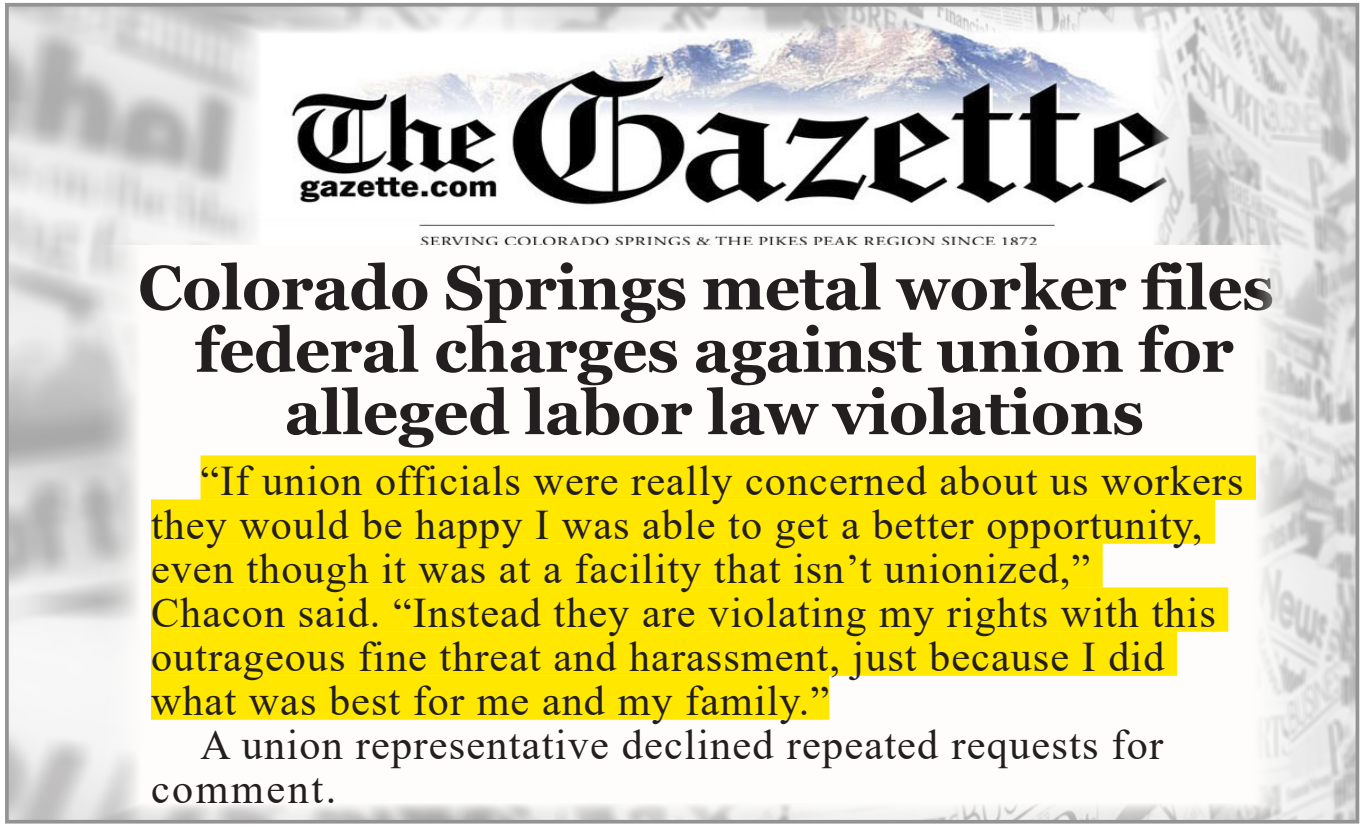
Foundation staff ensured Russell Chacon’s frustrations with Sheet Metal union bosses’ illegal fines were covered by the Colorado Springs Gazette. Shortly after the article appeared, Sheet Metal union officials backed down from their demand.
COLORADO SPRINGS, CO – Colorado metal worker Russell Chacon was angry when he received a letter from International Association of Sheet Metal, Air, Rail, and Transportation Workers (SMART) Local 9 union officials in May, demanding he pay $21,252 in disciplinary fines. Six months earlier he had resigned his union membership, and had left his job at Colorado Sheet Metal to work for Rocky Mechanical, an employer that isn’t under the control of Sheet Metal union bosses.
Union officials demanded Chacon fork over the ruinous sum to cover an alleged union “loss of funds” for a period through May 31, which included days that Chacon had not even worked yet.
Sheet Metal Union Officials Violated Established Law to Harass Worker
Chacon obtained free legal representation from National Right to Work Foundation staff attorneys and filed federal unfair labor practice charges against the Sheet Metal union at National Labor Relations Board (NLRB) Region 27 in Denver. He asserted that the fines were levied against him specifically in retaliation for his leaving the union and finding new work.
Soon after the Foundation-assisted charges, Sheet Metal union officials dropped the illegal fine demands, and are now forced by a settlement to inform workers that they will not subject them to internal union discipline if they exercise their right to end union membership.
Decades-old federal law prohibits union officials from forcing internal union discipline on workers who have resigned union membership, and from restricting the exercise of that basic right to refrain.
“If union officials were really concerned about us workers they would be happy I was able to get a better opportunity, even though it was at a facility that isn’t unionized,” Chacon told the Colorado Springs Gazette in May. “Instead they are violating my rights with this outrageous fine threat and harassment, just because I did what was best for me and my family.”
Although Sheet Metal union bosses informally rescinded their fine demands soon after Chacon filed his charge, NLRB Region 27 continued to investigate Chacon’s charge that union officials had instigated the discipline specifically in retaliation for his leaving the union.
Settlement Follows NLRB Finding Merit in Worker’s Charges of Retaliation
The NLRB found merit in Chacon’s claims of retaliation in July, forcing union officials to settle in order to avoid NLRB prosecution.
The settlement requires Sheet Metal union officials to post a notice at the union office stating that they “will not fail to inform or misinform you about the proper process for resigning your membership,” “will not fail to give effect to resignations of membership from the Union,” and “will not restrain and coerce you by instituting and prosecuting disciplinary proceedings and levying fines after failing to give effect to resignations.” The notice also confirms that Chacon is no longer subject to the fine demands.
“As the conclusion of this case shows, Sheet Metal union officials were caught red-handed violating workers’ most basic right to refrain from associating with an organization to which they don’t want to belong,” commented National Right to Work Foundation Vice President and Legal Director Raymond LaJeunesse. “Although we are pleased that Mr. Chacon is no longer saddled with an outrageous fine demand, unfortunately other Colorado workers can still be forced to pay dues to union bosses because The Centennial State lacks a Right to Work law.”
LaJeunesse continued, “Right to Work protections ensure that all union financial support is strictly voluntary, and that no worker can be fired just for refusal to pay dues to unwanted union bosses.”
Labor Board Rejects Biden Appointee’s Attempt to Scuttle Case Against Union
The following article is from the National Right to Work Legal Defense Foundation’s bi-monthly Foundation Action Newsletter, July/August 2021 edition. To view other editions of Foundation Action or to sign up for a free subscription, click here.
Texas nurse challenges concealment of secret union-employer deal which stifles decertification

With Foundation legal aid, Texas nurse Marissa Zamora shut down NLRB “Acting” General Counsel Ohr’s attempt to block her case.
WASHINGTON, DC – The National Labor Relations Board (NLRB) recently rejected a move by NLRB Acting General Counsel Peter Ohr to prematurely end Texas nurse Marissa Zamora’s case before the Board could rule. The case challenges National Nurses Organizing Committee (NNOC) union officials’ refusal to disclose a secret agreement they signed with the parent company of her hospital that limits Zamora’s ability to remove the union from her workplace.
Ohr is a career NLRB bureaucrat, who was installed as General Counsel by President Biden this January after Biden made the unprecedented move of removing Trump-appointed NLRB General Counsel Peter Robb before his Senate-confirmed four-year term expired. Ohr filed a motion in February seeking unilaterally to send Zamora’s complaint back to the NLRB’s Fort Worth regional office to be dismissed — after Zamora’s case had already been fully briefed at the full Board in Washington.
Zamora is represented for free by National Right to Work Foundation staff attorneys, who in March opposed Ohr’s attempted maneuver. Their brief argued that snuffing
the case out now would jeopardize the NLRB’s power to decide cases involving violations of federal labor law, and also contended that Ohr lacked any authority to make his motion because of Biden’s illegal ouster of Robb. In a May decision, the NLRB agreed with Zamora’s Foundation staff attorneys that the case should continue, observing that the matter “has been fully litigated, and the controversy at issue, which remains active, is ripe for Board adjudication.” The case began when Zamora demanded a copy of the secret so-called “neutrality agreement.” Such agreements are deals between union officials and employers — usually without the knowledge of employees in a workplace — that seek to assist the union in gaining monopoly bargaining powers over rank-and-file workers.
NNOC Agents Shrouded, Lied About Deal Which Stymied Info about Decertification
“The Board correctly rejected Peter Ohr’s attempt to scuttle this case so he could let union officials off scot-free despite their secret backroom deal to undermine the rights of nurses like Marissa Zamora who are subjected to unwanted union representation,” National Right to Work Foundation President Mark Mix said about the decision to let the case move forward. These controversial top-down organizing deals frequently contain provisions that require employers to silence opposition to unionization, hand over workers’ personal information for coercive “card check” drives that bypass the protections of a secret-ballot election, provide union organizers with preferential access to the workplace and even ensure employers will help stifle workers’ efforts to decertify, i.e. remove, the union.
In Zamora’s case, she began circulating fliers and other materials in June 2018 to educate her coworkers on how they could obtain a vote to decertify the union. Legal documents she filed in her case explain that union agents “repeatedly ripp[ed] down her fliers” and that hospital officials referenced a secret agreement with the union when they denied “her access to post material on protected bulletin boards, where her material would be shielded from vandalism.”
Zamora subsequently asked both NNOC and hospital officials to show her any “neutrality agreement” that might have triggered those efforts to block her and her coworkers’ rights. All her requests were denied, and NNOC even denied that such an agreement exists. This was despite statements by hospital agents to her that indicated a “neutrality agreement” was indeed in effect.
Trump-Appointed NLRB GC Robb Backed Nurse’s Case Until Unprecedented Firing
Zamora filed federal unfair labor practice charges at the NLRB, challenging NNOC bosses’ refusal to disclose the secret agreement. Then- NLRB General Counsel Robb issued a complaint supporting the claims in Zamora’s charges.
Nevertheless, a Labor Board Administrative Law Judge (ALJ) dismissed the complaint Robb issued, even revoking subpoenas that would have compelled NNOC union bosses to reveal the covert deal.
Zamora challenged the ALJ’s dismissal, filing exceptions at the full Board in Washington. Briefs she filed supporting those exceptions pointed out that, during a two-day trial, it came out that the “neutrality agreement” existed, but it was a closely guarded secret between the hospital and union officials “to be kept strictly confidential from employees and all third parties.” Robb also submitted exceptions buttressing Zamora’s exceptions.
Robb’s pro-employee decisions preceded Ohr’s controversial installation by Biden in January, and Ohr’s subsequent attempt to remand or dismiss the case, which the NLRB has now rejected.
“The Board should now promptly rule for Ms. Zamora on the merits of the case so union bosses cannot keep secret pacts with employers to the detriment of rank-and-file employees’ protected rights,” Mix said.
Opposition Filed to Judge’s Order Imposing Culinary Union on Workers who Rejected Union in Secret Ballot Vote
Red Rock Casino workers vote against unionization, but nearly 2 years later judge ordered employer to bargain with union officials
Las Vegas, NV (August 24, 2021) – A large majority of the workers at Red Rock Casino in Las Vegas, Nevada voted “no” to unionization, but a federal district court judge is forcing their employer to bargain with union officials anyway.
The Casino is appealing the judge’s order at the U.S. Court of Appeals for the Ninth Circuit. Now Red Rock employee Raynell Teske has filed an amicus brief arguing the judge was wrong to impose the union on the workers, given the rejection of the union in the election. National Right to Work Legal Defense Foundation attorneys assisted Teske for free in filing the amicus brief with the appellate court.
In December 2019, the National Labor Relations Board held a secret ballot election whether to unionize Red Rock. A sizable majority of those voting rejected union officials’ effort to become their monopoly bargaining representatives. Despite that vote, NLRB Region 28 Director Cornele Overstreet filed a federal court injunction action seeking to have the union imposed over the workers’ objections.
On July 20, 2021, Judge Gloria Navarro agreed with the NLRB Director’s request, and issued a “Gissel” order forcing Red Rock to bargain with union officials despite the employees’ vote against unionization. The judge said the order was justified because, prior to the vote, union officials claimed that a majority of workers had signed union authorization cards.
Teske’s amicus brief argues those “card check” signatures are unreliable, and not reason enough to conclude the union ever had majority support. She contends the level of union support was tested fairly by the secret-ballot election, in which workers voted 627-534 against unionization. Secret ballots are a far more reliable way of gauging worker support for a union, because workers are often pressured, harassed, or misled by union organizers into signing cards.
Unions themselves know that “card check” signatures do not indicate solid worker support. The AFL-CIO admitted in its 1989 organizing handbook that it needed at least 75% card check support before having even a 50-50 chance of winning a secret ballot election. An earlier guidebook acknowledged that some workers sign cards just to “get the union off my back.”
Teske’s brief argues the union’s possession of so-called “cards” is an insufficient legal basis for imposing unionization, especially after a secret ballot election in which the union lost. It agrees with the employer that the “Gissel” order should be overturned, and that Teske and her coworkers should not be subjected to monopoly bargaining by a union they rejected in an NLRB-supervised secret ballot election.
This is not the only case in which union bosses are battling casino employees in court. Red Rock’s parent company, Station Casinos, also owns Palms Casino in Las Vegas, where employees filed a petition to decertify union officials in March, 2021. Union lawyers blocked the petition with a slew of charges that were accepted by NLRB bureaucrats as reason to block the workers’ petition. The Palms Casino worker represented by National Right to Work Foundation attorneys who filed the petition is appealing the decision to block the vote he requested.
“Ms. Teske and her coworkers had good reasons to reject the union. It is outrageous that the judge’s order imposing unwanted unionization brushes aside the workers’ contrary preference clearly demonstrated in the secret ballot vote,” said National Right to Work Legal Defense Foundation President Mark Mix. “There have been countless examples of workers being pressured, misled and even bribed to sign union cards, which is why ‘Card Check’ is widely accepted as unreliable, especially compared to an NLRB-supervised secret ballot election.”
“If federal labor law is to be about defending the rights and freedoms of rank-and-file workers, then the Court of Appeals should promptly overturn Judge Navarro’s order substituting the wishes of NLRB bureaucrats for the actual choice workers made at the ballot box,” added Mix.
Teamsters Union Charged with Illegally Threatening UPS Worker: ‘Join Union or Be Fired’
The following article is from the National Right to Work Legal Defense Foundation’s bi-monthly Foundation Action Newsletter, May/June 2021 edition. To view other editions of Foundation Action or to sign up for a free subscription, click here.
Teamsters official falsely claimed worker could be fired if he did not join and pay full dues

UPS worker Kamil Fraczek refused to kowtow to Teamsters officials’ threats in his workplace when they untruthfully told him that he had to formally join the union and pay dues just to keep working.
QUEENS, NY – With free legal aid from the National Right to Work Legal Defense Foundation, New York City UPS warehouse worker Kamil Fraczek has filed a National Labor Relations Board (NLRB) charge against Teamsters Local 804. The charge came after a Teamsters union official made repeated threats to his job and lied about his legal rights.
Union Official Refused to Respect Worker’s Rights under Beck Decision
When Fraczek began working at the warehouse full-time, a Teamsters representative tried to mislead him by telling Fraczek he must become a union member and sign documents authorizing dues deductions from his paycheck. Fraczek specifically asked about other options, but the union representative told him that if he did not sign the forms, Teamsters officials would ask UPS to fire him.
Because New York is a forced-unionism state that doesn’t protect workers with a Right to Work law, Fraczek can be required to pay some union fees as a condition of his job.
However, under long-standing federal law, workers cannot be required to become formal union members nor can they be required to pay full union dues even in non- Right to Work states. Under the Supreme Court’s 1988 CWA v. Beck decision, won by National Right to Work Legal Defense Foundation attorneys, no private sector worker can be compelled to financially support union activities unrelated to bargaining.
Union Misinformation Continues Even after Employee Demanded Rights
Expenses which can’t be charged to non-members under Beck include political expenditures and members-only activities.
Knowing his actual rights, Fraczek returned to the Teamsters official asking to be recognized as a non-member and Beck objector. He provided a letter to the representative stating his intention to pay only reduced fees and declining union membership.
As the unfair labor practice charge states, instead of accepting Fraczek’s request, the Teamsters official doubled down on his prior illegal threats. He demanded that Fraczek pay full dues and sign membership documents or face termination.
“Local 804’s agent has repeatedly tried to mislead Mr. Fraczek about his rights and has invoked the Union’s power to get him fired, all in an effort to coerce Mr. Fraczek into signing the membership and dues deduction authorization form . . .”
– Fraczek’s NLRB Charge
The official falsely claimed that only supervisors can opt out of the union, and that the federal laws protecting workers from funding union political activities only apply in Right to Work states, not in forced-unionism states like New York.
In response, Fraczek’s Foundation staff attorneys filed an NLRB charge asserting his right to pay reduced fees under Beck and not to join the union.
Teamsters Union Hit with Federal Charges for Illegal- Dues Demands
According to the charge, “Local 804’s agent has repeatedly tried to mislead Mr. Fraczek about his rights and has invoked the Union’s power to get him fired, all in an effort to coerce Mr. Fraczek into signing the membership and dues deduction authorization form…”
“Union officials are perfectly willing to tell outright lies to independent-minded workers who object to union membership,” said National Right to Work Foundation President Mark Mix. “Union bosses blatantly ignore the law just to protect their forced-dues revenue stream, and it is workers like Mr. Fraczek who pay the price.”
Multiple Units Oust Teamsters Bosses Thanks to Foundation-Backed NLRB Rule
The following article is from the National Right to Work Legal Defense Foundation’s bi-monthly Foundation Action Newsletter, May/June 2021 edition. To view other editions of Foundation Action or to sign up for a free subscription, click here.
Unpopular Teamsters officials voted out of California, New Jersey workplaces
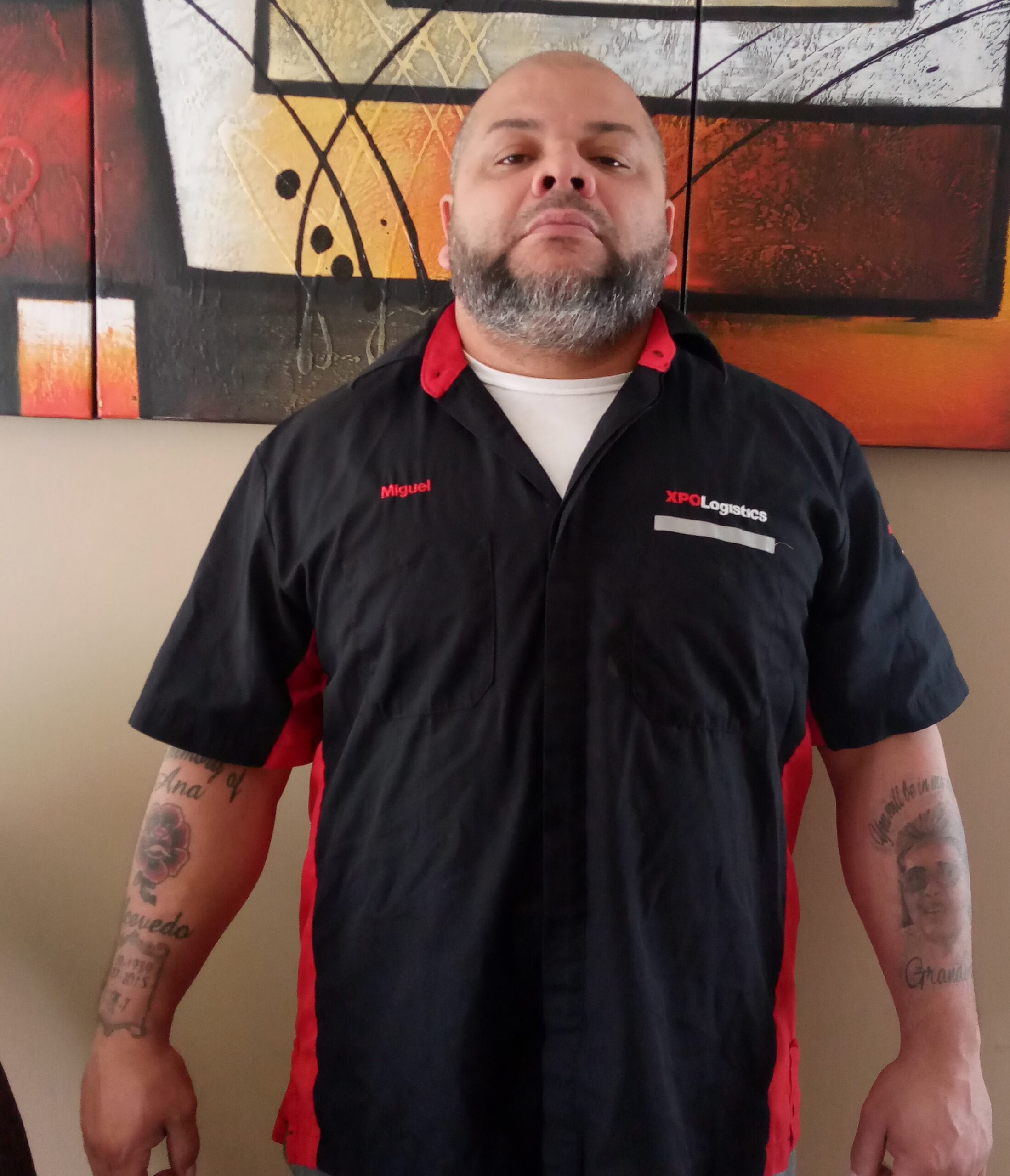
Reforms urged by Foundation staff attorneys eased Miguel Valle and his coworkers’ near-unanimous effort to vote out unpopular Teamsters officials, who tried to use “blocking charges,” ultimately to no avail.
WASHINGTON, DC – Workers in California and New Jersey who were previously subject to Teamsters bosses’ monopoly bargaining authority have freed themselves from unwanted union control.
The workers received free legal aid from Foundation staff attorneys, and benefited from rule changes at the National Labor Relations Board (NLRB) in Washington pushed for by the Foundation.
In California, Eliseo Haro, an employee at Los Angeles-based KWK Trucking, Inc., submitted a decertification petition with the NLRB because he and his coworkers were being ignored by Teamsters bosses. As Haro puts it, “The union never came in to talk to us, or negotiate a contract, or represent us. They disappeared.”
Haro’s petition was signed by nearly 80 percent of the workers in the 119-employee bargaining unit and called for an NLRB-supervised decertification election, in which KWK employees could vote out the unpopular union officials.
Rather than face an overwhelming defeat in the decertification election, Teamsters bosses chose to walk away. The union disclaimed interest in the unit, and NLRB Region 21 revoked Local 986’s certification as the workers’ monopoly bargaining agent.
New Jersey Decertification Effort Succeeds Despite Union Stall Tactics
In Cinnaminson, New Jersey, Teamsters officials did not immediately leave when a decertification petition was filed by Miguel Valle and his coworkers at a branch of XPO Logistics. Instead, Teamsters lawyers used nearly two months of unnecessary court proceedings to delay the election.
They demanded the vote be held in person at the Teamsters union hall. Foundation attorneys argued that the union lawyers’ requests were merely an effort to delay the vote. Ultimately, as expected, the NLRB’s Regional Director ruled that the election would be conducted by mail.
When Valle and his coworkers finally had their election, they voted 16-2 to remove Teamsters bosses from their workplace.
Foundation-Backed Rule Changes Reduce Needless Election Delays
For workers, just getting a decertification election is often difficult. In some cases, union bosses have created multi-year delays to stymie decertification efforts, trapping workers under union monopoly “representation” and often forced-dues payments they oppose, while they wait for a vote.
Union officials frequently attempt to delay or block decertification votes by filing “blocking charges,” unfair labor practice charges that can be used to hold up an election, even when they have nothing to do with the employees’ dissatisfaction with the union.
Union officials’ ability to use this tactic to block or delay votes has been limited by recent NLRB rulemaking, finalized in 2020. Under the NLRB’s new policy, which draws on comments filed by the National Right to Work Foundation, union charges cannot indefinitely stall employee votes, and in most instances votes occur without delay.
Additionally, as the Foundation advocated in its comments, instead of ballots being impounded for months or even years while “blocking charges” are resolved, the NLRB modified its original proposed rule so that in most cases ballots are tallied and the results are announced after employees vote.
“Union bosses can stick around for years, even when they face overwhelming opposition from rank-and-file workers, because of the legal barriers that protect union officials from decertification votes,” said National Right to Work Foundation Vice President and Legal Director Raymond LaJeunesse.
“Thanks to Foundation-backed reforms to the NLRB’s ‘blocking charge’ policy, union officials’ ability to trap workers in union ranks through legal trickery despite overwhelming opposition has been significantly curtailed.”





