
National Right to Work Foundation Issues Notice to University of California Graduate Students Amid UAW Strike Orders
Foundation informs students of right to resign union membership and complete academic responsibilities despite politicized union strike command
California (May 21, 2024) – The National Right to Work Legal Defense Foundation has released a special legal notice to graduate students, teaching assistants, and researchers across the University of California system. The notice comes as officials of the United Auto Workers (UAW) union have ordered a strike at UC Santa Cruz over the university’s position on the Israel-Hamas conflict and related campus protests.
Union officials have indicated that similar strike orders could soon be in effect at other UC system schools and that the union’s strike authorization means these orders could be in effect until June 30. The notice provides legal information to the roughly 50,000 unionized students, a small fraction of which voted to approve the strike action.
The full notice is available at www.nrtw.org/UCstrike.
The Foundation’s legal notice informs UC graduate students of their right to resign union membership and resume their academic responsibilities. “This situation raises serious concerns for graduate students who believe there is much to lose from a union ordered strike,” the notice says. “Seven UC undergraduate campuses have exams scheduled for the second week of June, meaning the strike order is likely to cause major disruptions.”
“The Foundation wants you to learn about your legal rights from independent sources,” says the notice. “You should not rely on what self-interested union officials tell you.”
UC Graduate Students Must Resign Union Membership Before Returning to Work
The notice explains that, under California public sector labor law, graduate students who wish to resume working during the strike should resign their union memberships at least one day before returning to work if they want to avoid union discipline. “Union officials can (and often do) levy thousands of dollars in fines against union members who work during a strike,” reads the notice. “So, if you are currently a member, resigning your membership before you work during a strike is the most effective way to avoid union fines and other discipline.”
Links to sample union resignation letters and the Foundation’s page for requesting free legal aid are provided.
Janus Supreme Court Decision Also Protects Students’ Right to Stop Dues Payments to UAW
UC graduate students, who are considered “public employees” for the purposes of unionization, also have a First Amendment right to cut off dues deductions to the UAW as per the Foundation-won Janus v. AFSCME Supreme Court decision, the notice says. “[U]nion officials can only deduct union dues from a person’s paycheck if that person has affirmatively consented to pay,” the notice details, while also explaining that union officials sometimes try to limit when employees can stop union dues and that Foundation attorneys can provide legal aid if students encounter any difficulties in that regard.
The notice concludes by explaining that UC graduate students have a right to petition for a vote to end the UAW’s monopoly bargaining power, with a link to more information on California’s public sector law regarding union “decertification elections.”
“There is good reason to believe that this UAW boss-ordered strike may violate California law, but because that is still being determined, it is important that student ‘employees’ impacted by the strike know their legal rights to protect themselves against union retribution if they exercise their right not to join the strike action,” commented National Right to Work Foundation President Mark Mix. “University of California graduate students may oppose this strike simply because they want to complete their end-of-semester responsibilities efficiently and without disruption, notwithstanding the UAW’s combative reaction to controversial and divisive protests.
“Graduate students’ ability to complete their work can’t be stripped away by UAW union officials’ eagerness to make a political statement, and Foundation attorneys stand ready to defend these students’ right to work independently of union strike diktats,” added Mix.
Full Foundation Action September/October 2023 Newsletter Now Online
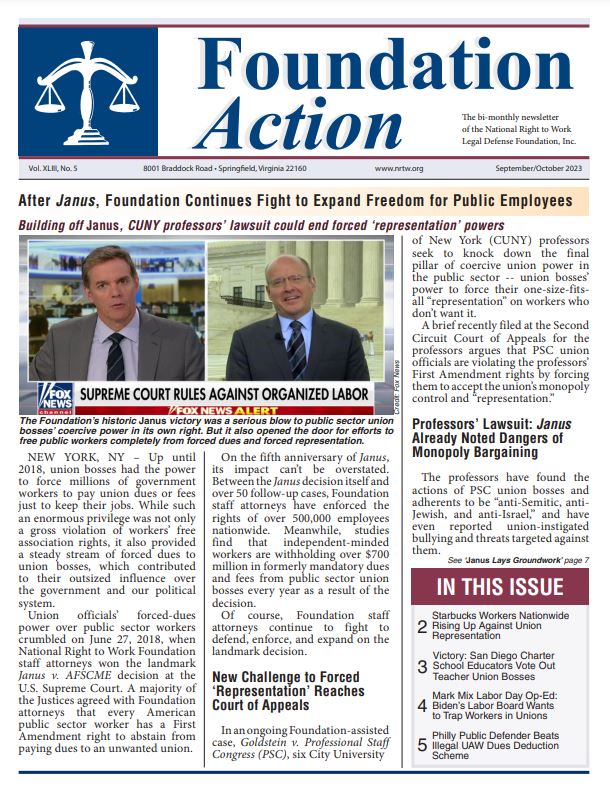 All articles from the September/October issue of Foundation Action are now online.
In this issue:
- After Janus, Foundation Continues Fight to Expand Freedom for Public Employees
- Starbucks Workers Nationwide Rising Up Against Union Representation
- Victory: San Diego Charter School Educators Vote Out Teacher Union Bosses
- Mark Mix Labor Day Op-Ed: Biden’s Labor Board Wants to Trap Workers in Unions
- Philly Public Defender Beats Illegal UAW Dues Deduction Scheme
Recent articles can be found here. To sign up for a free copy of the newsletter via mail please see the form at the bottom of this page.
Right to Work Foundation Brief: 2018 Janus Decision Means Union “Release Time” Violates AZ Constitution’s Gift Clause
Brief supports challenge pending at Arizona Supreme Court against Phoenix’s scheme to subsidize inherently political union activities with tax dollars
Phoenix, AZ (December 14, 2023) – The National Right to Work Foundation has just filed an amicus brief in Mark Gilmore v. Kate Gallego, a case currently pending before the Arizona Supreme Court. In the case, Phoenix city employees Mark Gilmore and Mark Harder are suing Phoenix Mayor Kate Gallego for engaging in a scheme that redirects taxpayer funds intended for public employees’ compensation toward political advocacy conducted by American Federation of State, County and Municipal Employees (AFSCME) Field II agents on so-called “release time.”
Specifically, the plaintiffs’ lawsuit argues the Arizona Constitution prohibits the use of taxpayer dollars to fund four full-time positions for union officials for the purpose of conducting union business, in addition to a bank of over 3,000 paid hours to be used by other union officials for union purposes, and multiple other perks for union agents.
The Foundation’s brief argues that the release time scheme violates Arizona’s Gift Clause, which forbids government transactions that bestow benefits on private entities while serving no public purpose. The brief points out that the U.S. Supreme Court’s ruling in the Foundation-won Janus v. AFSCME case demonstrates that, under the First Amendment, all government union activities are a form of lobbying designed to influence public policy for the benefit of the union. That means taxpayer subsidies of such activities inherently violate the Arizona Constitution’s Gift Clause.
Brief: “Release Time” Funnels Tax Dollars Unconstitutionally to Union Bosses
The policies unions lobby for “often are matters of substantial public concern, such as how much money the government expends on wages and benefits,” the brief reads. “With its release time policy, the City is effectively paying individuals to lobby the City for a private advocacy organization and its members. The notion that this political advocacy serves a public purpose is untenable.”
In the Janus decision, the U.S. Supreme Court ruled that forcing public sector workers to fund any union activities as a condition of employment constitutes forced political speech barred by the First Amendment.
The Foundation’s brief also deconstructs a proposition that the City of Phoenix’s ability to impose one-size-fits-all union contracts on entire swaths of employees somehow counts as a “public benefit” that the City receives in exchange for enforcing the release time scheme. Foundation attorneys instead argue that the municipal labor code already imposes this obligation on both the union and the City, and thus isn’t a benefit that union bosses are giving the City.
“Given the code already requires the City and AFSCME to impose uniform terms of employment on unit employees, union member and nonmember alike, it necessarily follows that the City did not need to provide AFSCME agents with release time to comply with its pre-existing legal obligations,” the brief contends.
“Union bosses, who will often screech about ‘corporate welfare,’ are more than happy to arrange so-called ‘release time’ schemes in which taxpayer dollars are funneled toward supporting their massive lobbying efforts,” stated National Right to Work Foundation President Mark Mix. “Janus made it plain and simple that compelling public sector employees to fund union activities constitutes forced political speech, and the Arizona Supreme Court has an obligation to declare unlawful compulsion foisted on taxpayers.”
After Janus, Foundation Continues Fight to Expand Freedom for Public Employees
The following article is from the National Right to Work Legal Defense Foundation’s bi-monthly Foundation Action Newsletter, September/October 2023 edition. To view other editions of Foundation Action or to sign up for a free subscription, click here.
Building off Janus, CUNY professors’ lawsuit could end forced ‘representation’ powers
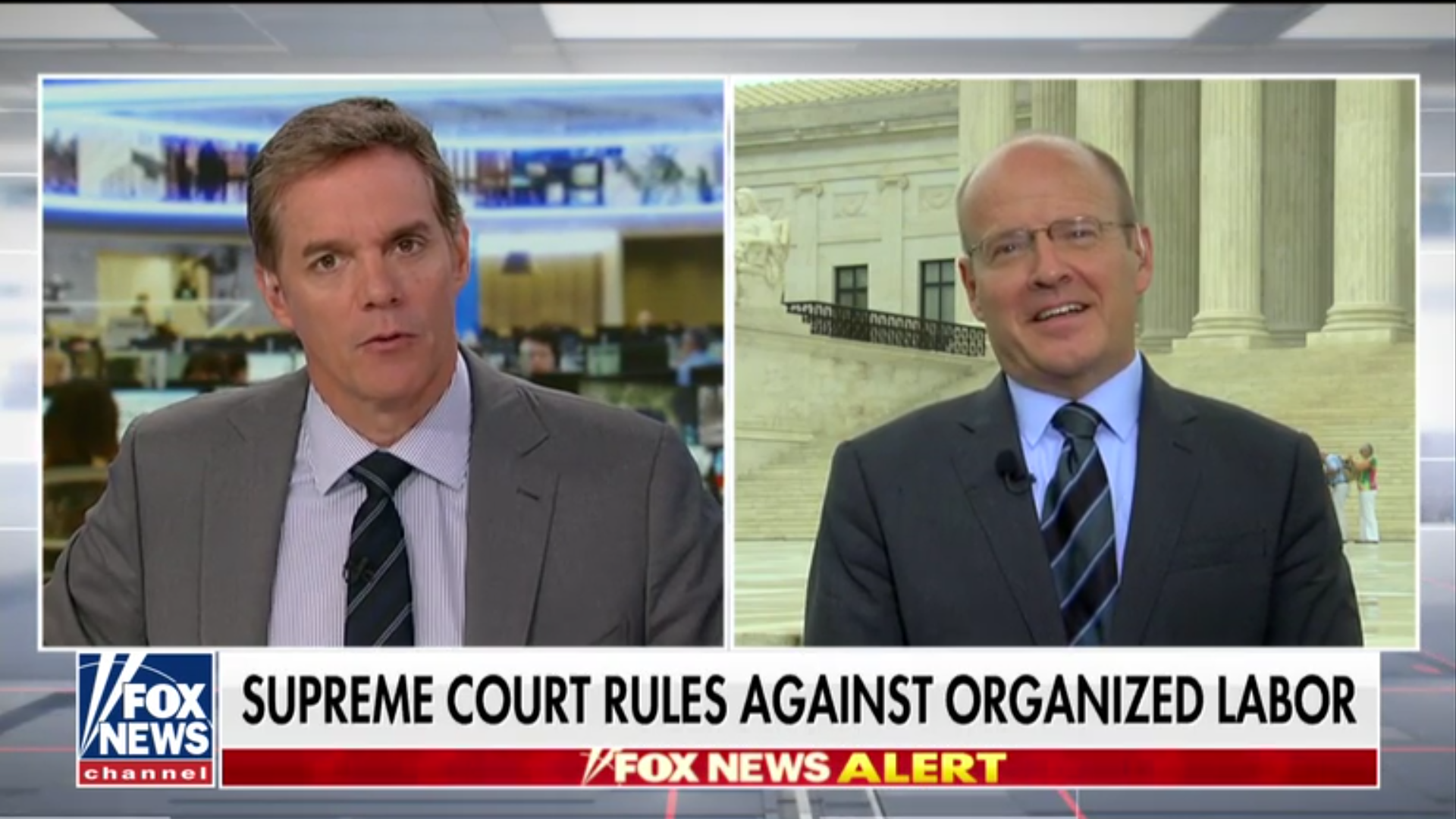
The Foundation’s historic Janus victory was a serious blow to public sector union bosses’ coercive power in its own right. But it also opened the door for efforts to free public workers completely from forced dues and forced representation.
NEW YORK, NY – Up until 2018, union bosses had the power to force millions of government workers to pay union dues or fees just to keep their jobs. While such an enormous privilege was not only a gross violation of workers’ free association rights, it also provided a steady stream of forced dues to union bosses, which contributed to their outsized influence over the government and our political system.
Union officials’ forced-dues power over public sector workers crumbled on June 27, 2018, when National Right to Work Foundation staff attorneys won the landmark Janus v. AFSCME decision at the U.S. Supreme Court. A majority of the Justices agreed with Foundation attorneys that every American public sector worker has a First Amendment right to abstain from paying dues to an unwanted union.
On the fifth anniversary of Janus, its impact can’t be overstated. Between the Janus decision itself and over 50 follow-up cases, Foundation staff attorneys have enforced the rights of over 500,000 employees nationwide. Meanwhile, studies find that independent-minded workers are withholding over $700 million in formerly mandatory dues and fees from public sector union bosses every year as a result of the decision.
Of course, Foundation staff attorneys continue to fight to defend, enforce, and expand on the landmark decision.
New Challenge to Forced ‘Representation’ Reaches Court of Appeals
In an ongoing Foundation-assisted case, Goldstein v. Professional Staff Congress (PSC), six City University of New York (CUNY) professors seek to knock down the final pillar of coercive union power in the public sector — union bosses’ power to force their one-size-fits=all “representation” on workers who don’t want it.
A brief recently filed at the Second Circuit Court of Appeals for the professors argues that PSC union officials are violating the professors’ First Amendment rights by forcing them to accept the union’s monopoly control and “representation.”
Professors’ Lawsuit: Janus Already Noted Dangers of Monopoly Bargaining
The professors have found the actions of PSC union bosses and adherents to be “anti-Semitic, anti-Jewish, and anti-Israel,” and have even reported union-instigated bullying and threats targeted against them.
The professors’ opening brief at the Second Circuit maintains that the Supreme Court already acknowledged in the Janus decision that public sector monopoly bargaining is “a significant impingement on associational freedoms,” and argues that New York State’s Taylor Law authorizes such bargaining in violation of workers’ rights.
“If the First Amendment prohibits anything, it prohibits the government from dictating who speaks for citizens in their relations with the government,” reads the brief.
The case, which will likely head to the U.S. Supreme Court no matter how the Circuit Court rules, could set a nationwide precedent forbidding public sector monopoly bargaining, just as Janus prohibits forced dues in all public sector workplaces. The combination of both Foundation-won precedents would guard public workers nationwide from both forced dues and forced representation.
Foundation Brief Defends State Law to Fortify Janus
The Janus victory also motivated freedom-loving state legislators to take extra measures to ensure workers’ First Amendment rights under Janus are being enforced.
In Indiana, a reform now forbids public employers from using taxpayer-funded government payroll systems to deduct union dues without a worker’s explicit consent. Public employers must obtain yearly consent from workers who wish to have union dues taken from their paychecks, and must also ensure that workers have notice of their constitutional right not to fund union activities. Unsurprisingly, dues-hungry Anderson Federation of Teachers (AFT) union officials sued the state to block these commonsense protections.
Foundation attorneys joined the fight recently to defend Indiana’s laws. A Foundation brief in the Seventh Circuit Court of Appeals urges the court to overturn a lower court’s injunction of these reforms, citing Seventh Circuit precedent.
Foundation attorneys helped successfully defend a similar law in West Virginia in 2021, which the West Virginia Supreme Court upheld on the basis that union bosses “have no constitutional entitlement to employees’ money or to the employer’s administration of union dues deduction schemes.”
Federal Courts Must End Union Monopolies
“Janus was a great triumph for American public workers’ freedom, but it was only a step toward the ultimate goal of freeing public workers from all unwanted union coercion,” commented National Right to Work Foundation Vice President Patrick Semmens. “No American worker should be forced to associate with union officials and union members that openly oppose their interests, including through attacks on their culture and religion as the plaintiffs in Goldstein have harrowingly experienced.”
“It’s encouraging to see that states like Indiana have stepped up to protect workers’ Janus rights,” Semmens added. “But ultimately, after recognizing in Janus and older precedents that union monopoly bargaining abridges workers’ free association rights, it’s high time for federal courts to end this enormous government-granted power for union bosses once and for all.”
Foundation Defends Michigan Workers with Forced Dues Looming
The following article is from the National Right to Work Legal Defense Foundation’s bi-monthly Foundation Action Newsletter, July/August 2023 edition. To view other editions of Foundation Action or to sign up for a free subscription, click here.
With Right to Work repeal law passed, workers seek to escape mandatory payments

Michigan legislators’ unpopular decision to repeal the state’s Right to Work law helped prompt Mary Soltysiak and her coworkers’ move to vote out the IAM union.
LANSING, MI – Despite poll after poll showing 70 percent of Michiganders wanted Michigan’s decade-old Right to Work law left in place, Gov. Gretchen Whitmer and union cronies in the Michigan Legislature voted to strip Wolverine State workers of their right to refrain from funding unwanted union bosses in March. In response, the Foundation sprang into action, issuing a Special Legal Notice to Michigan workers advising them of their legal options as the state transitions to a forced-dues regime. The notice reminded workers that, despite what union bosses may claim, the state’s Right to Work law remains in effect until 90 days after the legislative session ends later this year — and also what they can do in advance of forced dues being legal again. Unsurprisingly, given Right to Work’s popularity even among union households, Michigan workers are stepping up and taking action to defend their rights against coercive unionism.
Michigan Workers Battle Forced-Dues Schemes Ahead of Repeal
For example, Foundation attorneys are currently assisting Grand Rapids-area Kroger employee Roger Cornett’s challenge to an illegal dues scheme perpetrated by United Food and Commercial Workers (UFCW) union officials. Cornett hit UFCW bosses with federal charges this May, accusing them of ignoring a letter in which he exercised his right to cut off dues deductions from his paycheck. Cornett’s charges also maintained that UFCW bosses sought to seize money from him using a form that blatantly violates existing federal law. Cornett’s charge says the form is illegal because of its “dual purpose” nature, meaning just one signature confusingly locks a worker into both membership and dues deductions. Federal law requires any authorization for union dues deductions to be voluntary and separate from a union membership application. UFCW bosses’ contempt for longstanding federal protections in Cornett’s case likely indicates how aggressively union officials will pursue forced dues under a non-Right to Work regime. The Foundation’s legal notice also counsels workers that they can avoid forced-dues arrangements entirely by petitioning the NLRB to hold “decertification elections” at their workplaces, in which workers can vote unpopular unions out.
Legal Notice Counsels Workers of Right to Vote Out Unwanted Unions
Mary Soltysiak, who opposes forced dues, heard news of the upcoming repeal and filed a petition to decertify the International Association of Machinists and Aerospace Workers (IAM) District Lodge 60/Local Lodge 475 union with free legal aid from Foundation staff attorneys. Soltysiak and her colleagues work at Terryberry, a manufacturing firm in Grand Rapids, MI.
Soltysiak stated that she and some of her colleagues “contacted [a Foundation attorney] and filled out paperwork to get out of paying union dues around the year 2018 because of the Right to Work . . . law.”
“The union has done nothing but hurt my paycheck and my vacation hours,” Soltysiak added.
Soltysiak and her coworkers achieved victory this May, when the NLRB certified their majority vote ousting the IAM union. Hopefully, their success portends the future success of the growing number of workers in Michigan and across the country looking to decertify the unions in their workplaces.
Foundation Also Defending Public Sector Right to Work Protections
As noted in the Foundation’s legal notice, the Michigan Right to Work repeal does not affect public sector Michigan employees. Under the Foundation-won Janus v. AFSCME Supreme Court decision, no public worker in America can be forced to subsidize a union as a condition of employment. But, as the repeal is looming, Michigan public sector union officials are nonetheless seeking to undermine public employees’ freedom to refrain from union support through so-called “fee-for-grievance” schemes.
This April, the Foundation submitted a brief in the Michigan Supreme Court case Technical, Professional and Officeworkers Association of Michigan (TPOAM) v. Renner, in which TPOAM officials are trying to enforce a “fee-for-grievance” policy against Saginaw County employee Daniel Renner. Under it, union bosses strip nonmember public employees of any power to file grievances themselves, and instead mandate that they pay fees sometimes exceeding yearly union dues to use the union’s grievance system.
Michigan legislators’ unpopular decision to repeal the state’s Right to Work law helped prompt Mary Soltysiak and her coworkers’ move to vote out the IAM union.
In the brief, Foundation staff attorneys refute the union’s claims for this newfound power, stating that “fee-for-grievance” schemes were never authorized by the Michigan Legislature and are inconsistent with federal law.
Foundation Attorneys Will Defend Worker Freedom in Michigan
“Michigan union officials and their allies in the state legislature have contempt for workers’ individual rights that knows no bounds,” commented National Right to Work Foundation Vice President and Legal Director William Messenger. “That was made clear by the repeal of the popular Right to Work law, and the attempt to undermine Right to Work protections for public sector employees which are safeguarded by the First Amendment under the Foundation’s Janus U.S. Supreme Court victory.”
“Michigan workers have a long road ahead to restore their rights against union coercion, but Foundation attorneys are fighting alongside these workers, and will continue to fight until no Michigan worker can be forced to pay union bosses they disapprove of just to keep a job,” Messenger added.
Former Connecticut State Trooper Wins Over $250,000 in Political Discrimination Suit
The following article is from the National Right to Work Legal Defense Foundation’s bi-monthly Foundation Action Newsletter, July/August 2023 edition. To view other editions of Foundation Action or to sign up for a free subscription, click here.
CSPU union upended trooper’s career after he refused to fund union politics

Joseph Mercer fought back with free Foundation legal aid when the CSPU union blocked his promotion because he challenged union political activities and told others about their rights.
HARTFORD, CT – In 2015, then-Connecticut State Trooper Joseph Mercer received a promotion to Operations Sergeant of the Emergency Services Unit, a position that gave him significant responsibility over emergency services training and field operations. Mercer gained this prestigious position through his seventeen years of experience as a trooper, which included a tense situation with an armed suspect barricaded in a hotel.
But behind the scenes, Mercer was a target of Connecticut State Police Union (CSPU) officials, who resented Mercer because of his resistance to funding union politics with his own money. After CSPU President Andrew Matthews filed two baseless grievances against Mercer, the Department of Emergency Services and Public Protection (DESPP) demoted him to a position that offered fewer overtime opportunities and involved less time in the field.
Mercer slammed CSPU and DESPP officials with a federal lawsuit in 2016 with free legal aid from the National Right to Work Foundation, accusing police union officials of retaliating against him for exercising his right to stop funding union politics.
This April, Foundation attorneys forced CSPU and DESPP to back down and settle the case. Both parties must now pay $260,500 as a condition of ending the suit.
CSPU Union President Targeted Dissident Trooper Immediately After Promotion
Just a month after Mercer received his promotion, CSPU President Matthews filed a grievance over Sergeant Mercer’s appointment.
Matthews’ grievance claimed that there had been no “selection process” to fill the position, despite the fact that none of Sergeant Mercer’s union-member predecessors had undergone any particular kind of selection process before they got the job. Matthews also filed a second baseless grievance, alleging Mercer had mismanaged the incident involving the armed suspect barricaded in a hotel. State police officials had never expressed dissatisfaction with how Mercer handled the situation.
In October 2015, after meeting in private with the union president, then-DESPP Commissioner Dora Schriro transferred Mercer out of his Operations Sergeant position to an administrative post. Prior to this demotion, Mercer had received no warnings, reprimands, or other disciplinary actions regarding the incident referenced in Matthews’ grievance. Mercer filed his lawsuit with Foundation aid in February 2016.
Mercer’s Foundation attorneys cranked up the heat on both the union and DESPP officials in May 2022, when a District Court judge ordered DESPP Commissioner James Rovella, who had replaced Schriro, to turn over additional documents that might provide insight into the circumstances surrounding Mercer’s firing.
Rather than follow through with the judge’s discovery order and continue the fight against Mercer, CSPU and DESPP reversed course and settled the case in April 2023. The settlement categorizes the vast majority of the $260,500 payout as “compensatory damages” due directly to Mercer.
Settlement Underscores Importance of Public Servants’ Janus Rights
“We are proud to have defended Sergeant Mercer’s rights and secured him a settlement that vindicates his free association,” commented National Right to Work Foundation Vice President and Legal Director William Messenger. “However, it’s disgraceful that CSPU union officials targeted Mercer, a dedicated public safety officer, with such a retribution scheme in the first place. Public servants should not have to endure multi-year lawsuits just so they can refrain from supporting union politics they oppose.”
“Situations like these demonstrate why the Foundation-won Janus v. AFSCME decision, which the U.S. Supreme Court decided while Mercer’s case was ongoing, is so important,” Messenger added. “As demonstrated in Mercer’s case, unelected union officials often wield their enormous clout over government to serve the union’s self interests over the public interest and employee interests. That’s why it’s vital that public employees can exercise their First Amendment Janus right to cut off all financial support for union officials this way.”
Foundation: Texas Taxpayers Shouldn’t Be Forced to Fund Union Activities
The following article is from the National Right to Work Legal Defense Foundation’s bi-monthly Foundation Action Newsletter, May/June 2023 edition. To view other editions of Foundation Action or to sign up for a free subscription, click here.
Brief says Janus explains why Texas Supreme Court must invalidate ‘official time’ scam
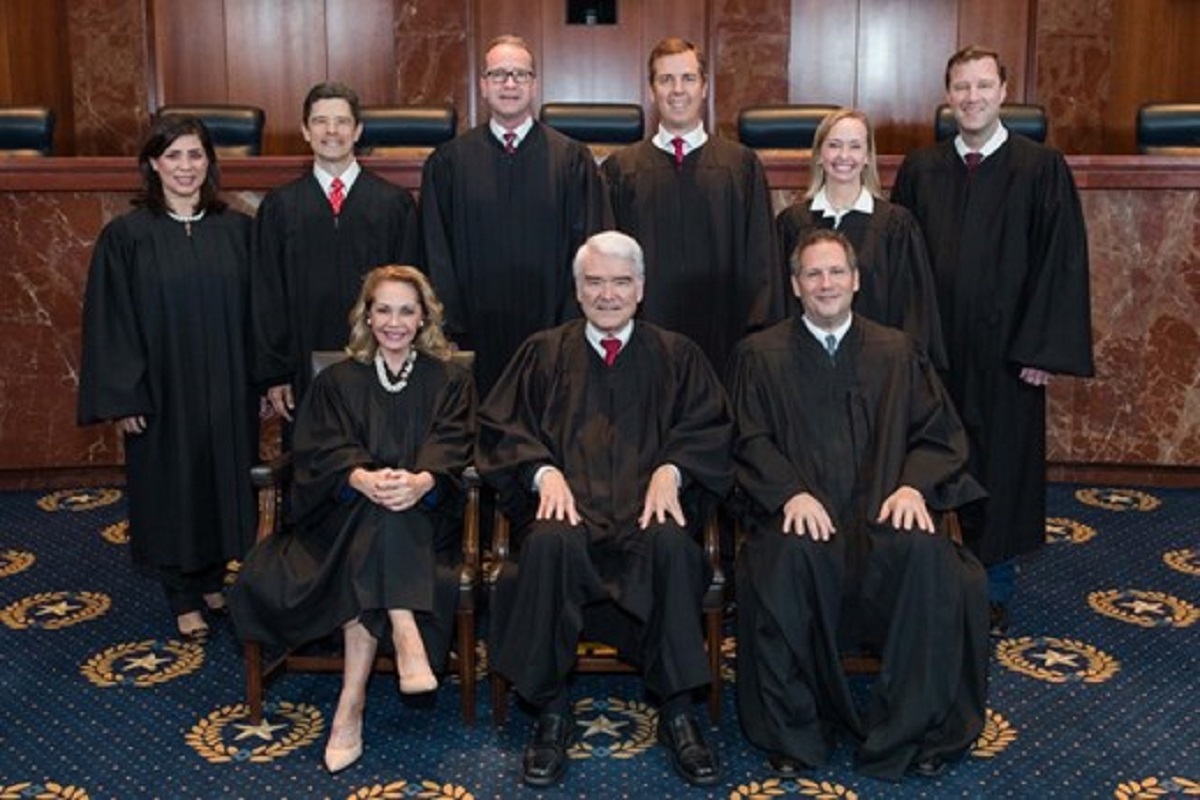
Don’t Mess with Taxes: The Foundation urged the Texas Supreme Court (above) in recent legal briefs to quash the City of Austin’s scheme funneling taxpayer money to union ideological activities.
AUSTIN, TX – Union officials spend billions of dollars to influence the political system every election cycle. This is why they are so desperate for forced-dues power — it gives them a guaranteed stream of revenue to sustain their agendas, regardless of whether workers support the union hierarchy’s aims.
But workers are increasingly taking advantage of their rights under Right to Work laws and the landmark National Right to Work Foundation-won Janus v. AFSCME U.S. Supreme Court decision to refrain from financially supporting union bosses of whom they do not approve.
Union bosses in Austin, TX, have apparently worked around this dilemma by shifting the burden for funding the union agenda to taxpayers. Through a so-called “official time” scheme, City of Austin employees who are union officials receive compensation from the public purse for conducting union business on the clock.
‘Official Time’ Boosts Inherently Political Government Union Agenda
Foundation attorneys recently filed a brief in the Texas Supreme Court case Roger Borgelt v. City of Austin, arguing that the Foundation-won Janus decision definitively shows why Austin’s scheme violates the Texas Constitution’s prohibitions against payouts of public funds to serve private interests (known as the “Gift Clauses”). The High Court ruled in Janus that forcing public sector workers to fund any union activities as a condition of employment violates the First Amendment, and that union dues can only be deducted from a public sector worker’s paycheck with his or her freely given consent.
An “official time” scheme, which instead forces taxpayers into funding those same union activities, “conflicts with the Supreme Court’s reasons for holding in Janus that it violates the First Amendment to require public employees to subsidize union activities,” says the Foundation’s brief.
The Foundation points out in its brief the Court’s Janus holding that all public sector union undertakings “constitute speech and petitioning on matters of political…concern,” and that by funneling taxpayer money into such speech “the City is effectively paying individuals to lobby the City for a private advocacy organization and its members.”
“The notion that this political advocacy predominantly serves a public purpose, as opposed to predominantly benefiting the private organization, is untenable,” the brief reads.
The brief also refutes an assertion from a lower Texas court that “official time” payments made by the city are actually part of union officials’ compensation for their normal job duties. This defies Janus’ reasoning that public employees who are also union officials “do not act as government agents pursuing their official job duties when they act as union officials.”
“For example, in granting paid leave to employee Bob Nicks to act as the Union’s president, the City is not paying Mr. Nicks for his services as a firefighter or as a public servant,” the brief explains. “The City is paying Mr. Nicks for his services as an agent of a private organization.”
The brief also reveals the disturbing implications of the union-backed argument that taxpayer subsidies for “official time” are needed to maintain harmonious relations between the city and the union: “If respondents contend that Union officials would disrupt City services if they did not receive [‘official time’], that would make the benefit akin to the City paying protection money” to union officials, reads the brief.
Union Bosses Should Not Get Public Funds to Pursue Union Interests
“The Texas Supreme Court should recognize that union officials are not entitled to a slice of taxpayer funds to ‘bargain’ against public interests,” commented National Right to Work Foundation Vice President and Legal Director Raymond LaJeunesse. “Texas’ Gift Clauses forbid the payout of public funds for activities that don’t have a tangible public benefit, and it’s hard to think of an arrangement that violates the Clauses more plainly than letting union bosses pursue private union business on the taxpayer dime.”
“Although Janus now protects public employees around the country from being forced to fund union activities and speech against their will, unfortunately many states and municipalities across the country permit union bosses to subsidize those same inherently political activities using direct payment of tax dollars,” LaJeunesse added.
“If union bosses cannot convince rank-and-file workers to voluntarily fund such activities as Janus requires, they should re-examine their priorities, not seek to force taxpayers to pay for what public employees will not.”
Full Foundation Action March/April 2023 Newsletter Now Online
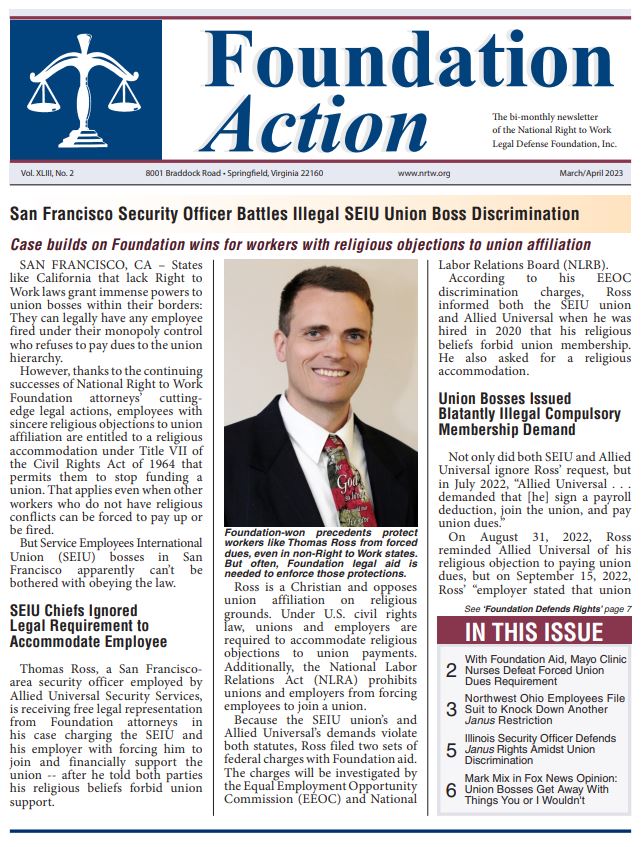
All articles from the March/April issue of Foundation Action are now on the website.
In this issue:
- San Francisco Security Officer Battles Illegal SEIU Union Boss Discrimination
- With Foundation Aid, Mayo Clinic Nurses Defeat Forced Union Dues Requirement
- Northwest Ohio Employees File Suit to Knock Down Another Janus Restriction
- Illinois Security Officer Defends Janus Rights Amidst Union Discrimination
- Mark Mix’s Fox News Op-Ed: “Union bosses get away with things you or I wouldn’t. Supreme Court should roll back special privileges”
Recent articles can be found here. To sign up for a free copy of the newsletter via mail please see the form at the bottom of this page.
Illinois Security Officer Defends Janus Rights Amidst Union Discrimination
The following article is from the National Right to Work Legal Defense Foundation’s bi-monthly Foundation Action Newsletter, March/April 2023 edition. To view other editions of Foundation Action or to sign up for a free subscription, click here.
Union officials sought to coerce membership by preventing non-members from defending their jobs
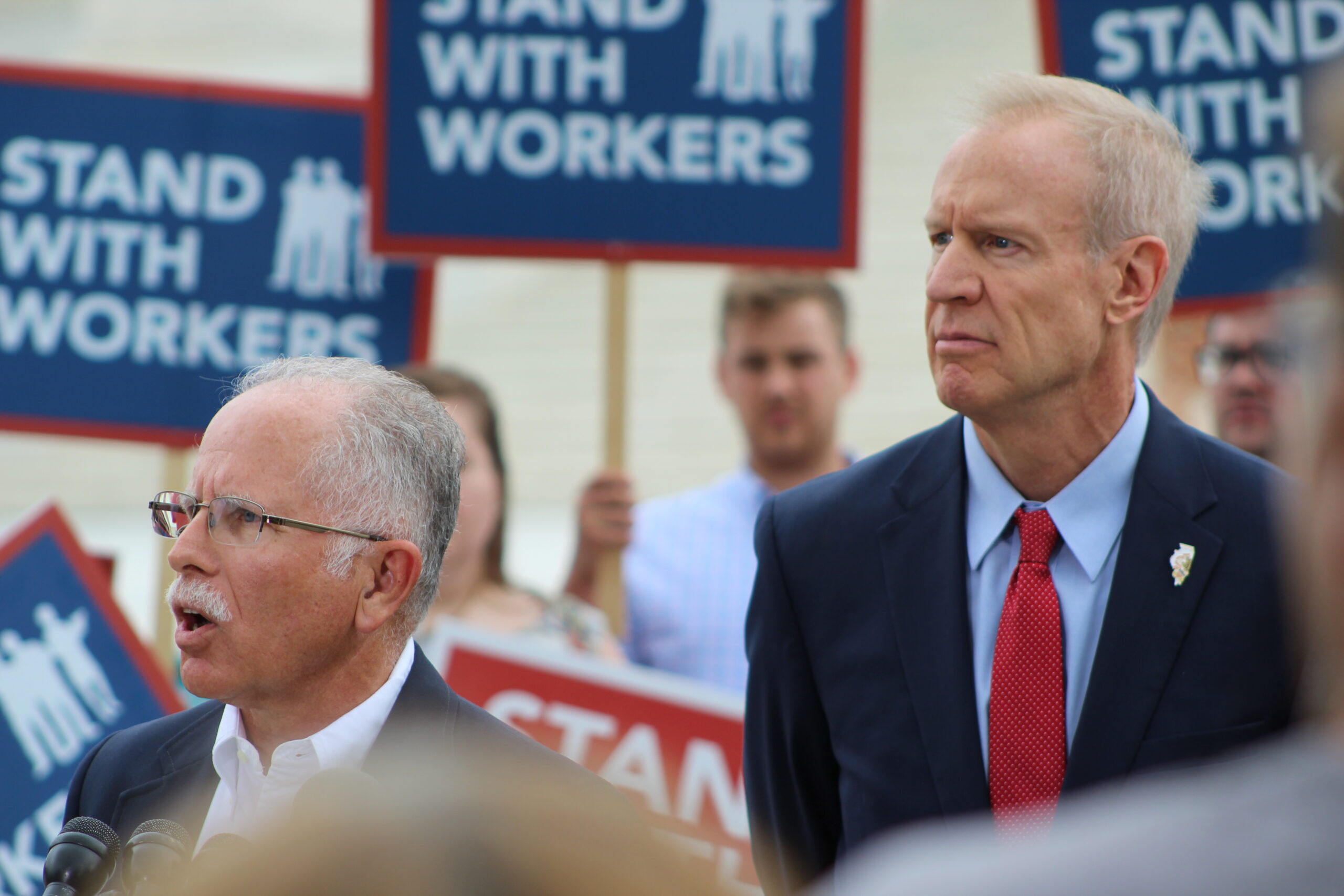
Foundation attorneys aided Illinois public employee Mark Janus with former Illinois Governor Bruce Rauner (right) in his landmark First Amendment victory. But Foundation attorneys often must fight to enforce Janus rights, as in Chris Logan’s case.
CHICAGO, IL – The National Right to Work Foundation’s landmark Supreme Court victory in Janus v. AFSCME was a milestone for public sector workers. For the first time, the Court recognized that every American public sector worker had the constitutional right to cut off dues to a union they oppose.
Even with this important First Amendment protection, however, union bosses unfortunately still wield an enormous amount of power over workers who have ended their affiliation with the union. Because of laws that authorize monopoly union “representation” in the public sector, union officials still have significant control over independent-minded employees’ working conditions, pay, benefits, and more.
City of Chicago aviation security officer Chris Logan discovered just how painful Illinois Council of Police (ICOP) union bosses could make life for him after he exercised his Janus rights. In 2020, following a dispute about his job performance, Logan took action to protect his job under the terms of his employment contract, only to have union bosses exploit the opportunity to attack Logan. The union would not allow Logan to file a grievance to protect his job unless he joined the union.
Officer Challenges Discriminatory Grievance Scheme with Foundation Aid
“ICOP union officials basically tried to force me to join and pay dues to the union by making it impossible for me to defend my job otherwise,” commented Logan. “I exercised my Janus rights and left the union because I didn’t think that ICOP officials were good ‘representatives’ of me or my coworkers.”
“Instead of trying to win back my support voluntarily, union bosses used their power to deprive me of all options when I tried to defend my job — I couldn’t even file or arbitrate a grievance myself,” Logan added. “In my mind, that simply confirms I made the right decision when I left this union.”
However, with free legal representation from National Right to Work Legal Defense Foundation staff attorneys, Logan won a decision from the Illinois Labor Relations Board (ILRB) in late 2022 that decisively declared ICOP officials’ “members only” grievance scheme illegally discriminatory against non-members.
Logan first exercised his Janus rights in October 2019, telling the union by letter that he no longer wished to pay union dues. Throughout 2020, Logan faced allegations about his job — possibly instigated by union militants. Per the union monopoly agreement he was subjected to, he tried to get union officials to fulfill their role, as monopoly “representatives” of the workplace, to file grievances challenging the City of Chicago’s disciplinary actions against him.
Union officials who maintain “monopoly bargaining power” in a workplace can legally impose their control over every worker, even those who have disaffiliated with the union. Because of this privilege, however, they are also legally obligated not to discriminate against non-members when it comes to grievances or other matters. However, as Logan discovered, union officials regularly ignore this “duty of fair representation.”
Union Officials Completely Ignored ‘Fair Representation’ Legal Obligation
ICOP union officials summarily rejected all of Logan’s requests to file grievances, and even told him that he could not file grievances himself. At one point, after an ICOP union official sent Logan an email falsely claiming the union had no legal obligation to participate because Logan had exercised his Janus rights, the ICOP lawyer chimed in to tell Logan, “I concur. Good luck.” The union stated it would not file grievances for Logan simply because he was a non-member.
Logan filed unfair labor practice charges against ICOP and the City of Chicago in August 2020, maintaining that the union’s actions were illegal. An ILRB Administrative Law Judge agreed with Logan’s charges in May 2022, declaring that ICOP “violated [Illinois labor law] when its agents restrained or coerced the Charging Party in the exercise of rights . . . by threatening to deny the Charging Party equal representation in the disciplinary and grievance matters.” The ILRB later adopted this ruling, leading to Logan’s Foundation-won victory when union officials did not attempt to appeal the decision to Illinois state court.
Monopoly Bargaining Powers Open Door to Corruption
“Union bosses maintain unilateral control over workers under a ‘monopoly bargaining’ regime,” commented National Right to Work Foundation Vice President and Legal Director Raymond LaJeunesse. “For public sector workers across the country, Janus is the only check they can use against this power, and even then they could face retaliation for doing so.”
“Cases like Mr. Logan’s, where union bosses used their bargaining powers to discriminate against a worker who exercised Janus rights, ought to make our elected leaders reconsider how much privilege our laws grant unions,” LaJeunesse added.





