
What is a Right to Work law?
A Right to Work law guarantees that no person can be compelled, as a condition of employment, to join or not to join, nor to pay dues to a labor union.
For more, read our Frequently Asked Questions page.
Janus v. AFSCME Update: Brief Filed at Seventh Circuit Court of Appeals
Today the National Right to Work Foundation along with the Liberty Justice Center, filed a brief on behalf of Illinois Government employees in the case Janus v. AFSCME. The case challenges the constitutionality of government union officials forced-dues privileges. The workers, all employed by the State of Illinois are currently required to pay union dues or fees to a union as a condition of their employment.
The case has the potential to go to the Supreme Court and answer the questions that the deadlocked Friedrichs case did not.
A District Judge recently dismissed the case back and the two employees, who are receiving free legal assistance from staff attorneys with the National Right to Work Foundation and the Illinois Policy Institute’s Liberty Justice Center, filed an appeal of that dismissal in October.
National Right to Work Foundation Mark Mix was recently interviewed on The Illinois News Network about the case. Here are some of his comments.
“We think with the right justice, we could actually get a national right-to-work law for all government employees, thanks to the outcome of this past election.”
Mix said it could take a couple of months for a high court nominee to get approved by the U.S. Senate, but the Janus v. AFSCME case could get in front of the high court shortly thereafter.
The question is simple, Mix said: Is work that government employee unions do political in nature?
“They’re trying to advocate for certain government actions, and they’re trying to convince governments to do certain things with their resources, i.e. taxpayers’ resources, and so in that sense, it’s political speech,” Mix said.
“And if it’s political speech, it’s going to be protected by the First Amendment,” Mix said. “And if it’s protected by the First Amendment, then a worker can’t be compelled to pay anything to have someone, quote/unquote speak on their behalf.”
Mix said Illinois’ now $130 billion unfunded pension liability is the poster child of union power run amok, leaving taxpayers and government employees paying a huge price.
“And probably the biggest price will be paid by government employees who have done their job and probably are going to feel like they’ve been cheated when these pension problems really, really raise their heads, which I think they will sooner rather than later, unfortunately,” Mix said.
To see the full interview please click here. To view a copy of the brief please click here.
Special Notice for SEPTA Employees Represented by the Transportation Workers Union (TWU)
Special Notice for SEPTA Employees Represented by the Transportation Workers Union (TWU) Officials of the Transportation Workers Union (TWU) have ordered SEPTA employees out on strike.
The situation raises serious concerns for employees who believe there is much to lose
from a union-ordered strike.
Employees have the right under state and federal labor law to rebuff union officials’ strike
demands, but it is important for you to get informed before you do so.
IF YOU WOULD LIKE TO WORK DURING A STRIKE READ ALL OF
THIS SPECIAL NOTICE BEFORE RETURNING TO WORK – IT MIGHT
SAVE YOU THOUSANDS OF DOLLARS!
Union officials have a decades long history of disciplining, fining and abusing workers
who do not kow-tow to their dictates.
For this reason, many SEPTA employees may want to contact the National Right to Work
Legal Defense Foundation to learn how they can avoid fines and other vicious union discipline
for continuing to report to work to support themselves and their families. Much of the important
information about your rights can be found on our website here.
The Foundation wants you to learn about your legal rights from independent sources. You
should not rely on what self-interested union officials tell you. For over four decades, Foundation
attorneys have worked in the courts to protect and expand the rights of individual employees in
situations such as strikes. It is the nation’s premier organization exclusively dedicated to
providing free legal assistance to employee victims of forced unionism abuse.
SEPTA employees should know they have the following rights:
1) You have the right to resign your membership in the union. If you don’t support this union,
you can send the union a letter resigning your membership.
2) You have the right to go to work even if the union bosses order a strike. Union officials can
(and often do) levy onerous monetary fines against union members who work during a strike. So,
you should seriously consider resigning your union membership BEFORE you return to work
during a strike, which is the only way to avoid these ruinous union fines and discipline. See
Union Discipline and Employee Rights. Your resignation letter must be postmarked THE DAY
BEFORE you return to work, or hand delivered BEFORE you actually return to work.
3) You have the right to become an “objector” and pay only reduced fees instead of full
membership dues. If you become an objector, you will not be forced to pay for the TWU union’s
far-left political and social agenda.
4) You also have the right to revoke your dues check-off and stop allowing the union hierarchy
to automatically collect money from your paycheck every week while no contract is in effect.
You can send letters to the union and your employer revoking your authorization to have union
dues deducted from your paycheck.
5) If you wish to eject an unaccountable union hierarchy from your workplace, you have the
right to sign a decertification petition to obtain a secret ballot election to do so. See
Decertification Election.
Here is a sample letter for employees who wish to resign their union membership and become
objectors.
NOTE: While not legally required, it is a better practice to send your letter to the union by
certified mail, return receipt requested, and save a copy of your letter and the return receipt to
prove delivery. If you hand deliver a letter, make sure that you have a reliable witness to the
delivery. In our experience, angry and dishonest union officials often pretend they did not
actually receive resignations and initiate discipline against non-striking workers anyway
Video: How UAW Big 3 Autoworkers Can Exercise Right to Work, Stop all Union Dues and Fees
When the UAW’s monopoly bargaining contract with the Big 3 automakers expires on September 14, 2015, workers in Indiana, Michigan, and Wisconsin will be able to exercise their Right to Work for the first time. Workers who want to resign from the union and stop all dues and fees may watch the video below for a detailed explanation of the steps workers must take.
The NRTW Foundation’s statement also provides important information and the special legal notice provides a sample resignation letter that workers may use. If any worker has trouble exercising their rights he or she may contact the Foundation and request free legal assistance here.
National Right to Work Reacts to Obama Labor Board’s Latest Scheme to Undermine Right to Work Laws
In response to the National Labor Relations Board (NLRB) taking a step on April 15, 2015, towards allowing union officials to force nonmember workers in Right to Work states to pay fees for union contract grievance-processing, Mark Mix, president of the National Right to Work Foundation, issued the following statement:
As Right to Work expands across the country, it is unfortunately not surprising that the Obama NLRB is now actively working to undermine the 25 state Right to Work laws. Its “call for briefs” signals this NLRB’s intention to reverse 60 years of Board precedent to give union bosses an unprecedented tool to eviscerate employees’ Right to Work protections.
The fact is that union officials choose monopoly bargaining control over all workers in a workplace even though they are free to instead negotiate a members-only contract. And union officials continue to do so because they enjoy and often depend on the power derived from that monopoly. The monopoly union contract and any grievance over its enforcement is the direct result of union bosses’ decision to impose their so-called “representation” on independent-minded employees who, because of their status as nonmembers, have lost all ability to influence the contents of the union contract that controls the outcome of any grievance.
The real solution would be to strip union officials of their monopoly bargaining powers that let them impose unwanted “representation” on unwilling workers, but as long as union bosses are empowered to force nonmembers under their contacts, Right to Work laws should continue to protect workers from being forced to subsidize that unwanted union boss monopoly representation, including through the union-imposed grievance process.
Three Years Later, Workers Ask for Secret Ballot Vote After Obama Labor Board Kills Card Check Protections

Three Years Later, Workers Ask for Secret Ballot Vote After Obama Labor Board Kills Card Check Protections
NLRB’s ruling removing workers’ protection against card check unionization exposed as a farce
Houston, TX (August 12, 2014) – Three years after the National Labor Relations Board (NLRB) eliminated workers’ right to challenge union card check recognition with a secret ballot vote, the very workers involved in that case have petitioned for an election to remove the unwanted union from their workplace.
In 2007, National Right to Work Foundation staff attorneys secured a new NLRB precedent in Dana Corp. which held that workers may collect signatures to request a secret ballot election during a 45-day window period following notice that their employer has recognized a union based on a card check organizing drive. The ruling was intended to counteract coercive practices frequently associated with card checks, which allow organizers to bully or mislead employees into signing cards that count as “votes” toward unionization.
In 2011, the Obama NLRB overturned the Dana precedent in Lamons Gasket.
National Right to Work Deeply Saddened By News of Fallen Alaska State Troopers
Last week, two Alaska State Troopers, Patrick Scott Johnson and Gabriel Rich, were killed in the line of duty while conducting an investigation in Tanana, Alaska.
In addition to serving his community as a state trooper, Johnson was one of the five National Right to Work Foundation-assisted Alaska state troopers seeking to defend and expand the workplace rights of public servants in Alaska and across the country.
The Right to Work family is deeply saddened to hear the terrible news and sends condolences to the families of both troopers.
Know Your Rights: Michigan’s Right to Work Law
In December 2012, Michigan became the nation’s 24th state to pass Right to Work protections for its workers. On March 28, 2013, Michigan’s private sector and public sector Right to Work laws went into effect and Michigan workers finally have Right to Work protections.
If you are a private sector worker in Michigan and you want to know more about your rights under Michigan’s new Right to Work law, click here. If you are a public sector worker, click here.
Recent media reports suggest that union bosses are attempting to skirt Michigan’s Right to Work law any way they can. The Wall Street Journal even reported that a Michigan teacher union boss sent out a memo stating union officials should consider suing union members who exercise their Right to Work and refrain from union membership and dues payments.
Fortunately, the National Right to Work Foundation has of a special task force committed to defending Michigan workers who seek to exercise their rights under the state’s newly-enacted Right to Work law. If you, or someone you know, needs legal assistance, please contact the National Right to Work Foundation by calling toll free 1-800-336-3600 or by clicking here.
NLRB Watch: Breakdown of Cases Invalidated By Noel Canning Decision
Foundation staff attorney, Ave Maria law professor, and former National Labor Relations Board (NLRB) Member John Raudabaugh has published his latest installment to the Foundation’s "NLRB Watch" blog feature.
In "NLRB Watch" #8, titled "What the Noel Canning Decision Means for NLRB Cases," Raudabaugh charts what cases may be subject to challenge in the wake of the U.S. Court of Appeals for the District of Columbia’s ruling last month invalidating President Barack Obama’s controversial purported "recess appointments" to the Board. The court held President Obama could not constitutionality make those appointments without U.S. Senate confirmation because the Senate was not in recess. National Right to Work Foundation staff attorneys filed an amicus curiae brief jointly with the Landmark Legal Foundation in the case.
As a result of the court’s ruling, since at least January 3, 2012, the Board has lacked a quorum as required by a U.S. Supreme Court precedent established in 2010, thus invalidating the Board’s rulings since that time. Click here to see a chart displaying the many cases invalidated by the court’s decision in Noel Canning.
Click here to read other posts located at the "NLRB Watch" page. And be sure to follow the National Right to Work Foundation on Facebook and Twitter to get alerts on new "NLRB Watch" posts!
Union Thuggery Watch: Bizarre new photos expose Steelworker union intimidation during West VA strike
 In an ongoing case involving four West Virginia Constellium Rolled Products workers who continued to work during last fall’s Steelworker union-instigated strike against the company, recently-obtained photos portray the union militants’ intimidation of those workers.
Union militants put up an outhouse featuring a creepy hanging doll’s head and posted signs publicizing the names, addresses, and phone numbers of the workers who continued to work during the strike.
The four workers resigned their union membership in the United Steelworkers (USW) Local 5668 union before they continued to work during the strike. Under federal law, workers who refrain from union membership are exempt from the union’s constitution and bylaws and thus cannot be disciplined for continuing to work during a union boss-ordered strike.
After the strike concluded, the workers received threatening letters from USW Local 5668 union officials stating that the union hierarchy intends to levy retaliatory strike fines against the workers at "the maximum penalty allowed." Union officials also stated that the workers will be placed "at the bottom of the seniority list," which is a clear violation of federal labor law.
With free legal assistance from National Right to Work Foundation staff attorneys, the four workers filed federal charges against the USW Local 5668 union with the National Labor Relations Board (NLRB) last month.
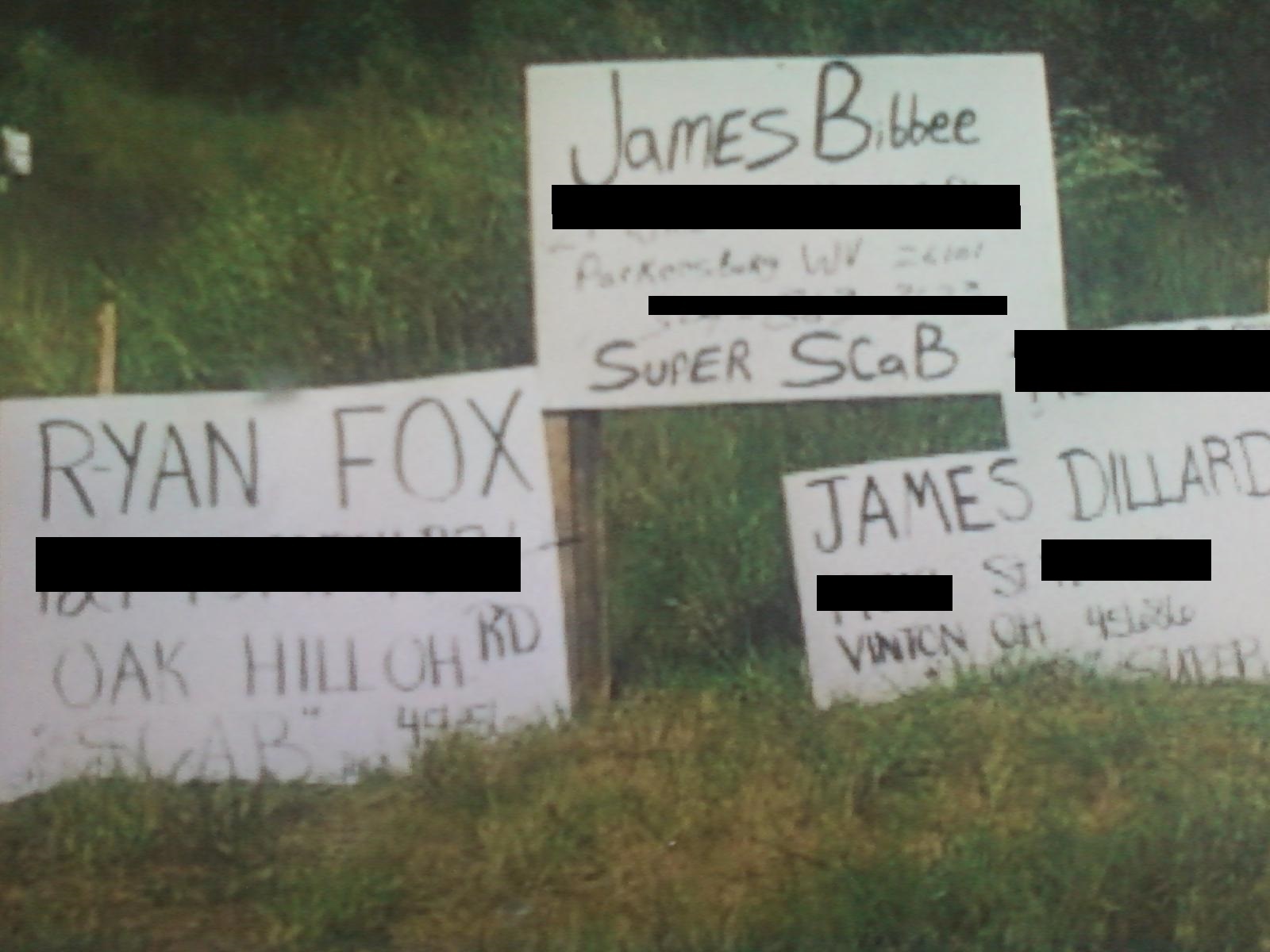
If you or someone you know has been harassed, intimidated, or threatened by a union, please contact the National Right to Work Foundation at 1-800-336-3600, via email, or by clicking here.





