
Full Foundation Action September/October 2022 Newsletter Now Online
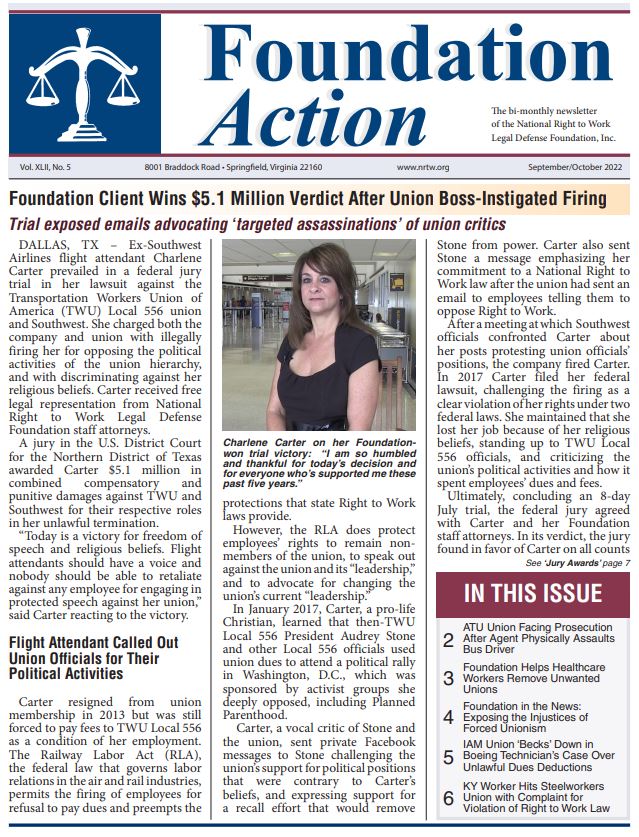
All articles from the September/October issue of Foundation Action are now on the website.
In this issue:
- Foundation Client Wins $5.1 Million Verdict After Union Boss-Instigated Firing
- ATU Union Facing Prosecution After Agent Physically Assaults Bus Driver
- Foundation Helps Healthcare Workers Remove Unwanted Unions
- Foundation in the News: Exposing the Injustices of Forced Unionism
- IAM Union ‘Becks’ Down in Boeing Technician’s Case Over Unlawful Dues Deductions
- Kentucky Worker Hits Steelworkers Union with Complaint for Violation of Right to Work Law
Recent articles can be found here. To sign up for a free copy of the newsletter via mail please see the form at the bottom of this page.
IAM Union ‘Becks’ Down in Boeing Technician’s Case Over Unlawful Dues Deductions
The following article is from the National Right to Work Legal Defense Foundation’s bi-monthly Foundation Action Newsletter, September/October 2022 edition. To view other editions of Foundation Action or to sign up for a free subscription, click here.
IAM bosses charged arbitrary higher amount in violation of Foundation-won Beck precedent

IAM union bosses’ illegal fee scheme faced headwinds when Boeing technician Don Zueger defended his rights with Foundation legal aid – and won.
SEATTLE, WA – Boeing technician Don Zueger didn’t want to sacrifice a cent from his paycheck to subsidize the activities of International Association of Machinists (IAM) union bosses who currently maintain monopoly bargaining power in his workplace. But, because he works in non-Right to Work Washington State, he can be forced to pay some union fees just to keep his job.
When Zueger found out union officials were calculating his forced fees amount based on financial data from nine other IAM affiliates – not just data from his own district union – he knew something was amiss.
Zueger sought free legal representation from the National Right to Work Legal Defense Foundation and filed a federal lawsuit against the IAM union for violating his rights under the 1988 Foundation-won CWA v. Beck U.S. Supreme Court decision. In Beck, the Court ruled that union officials cannot charge full union dues to objecting private sector workers who have abstained from formal union membership, and can only charge them “fees” which exclude expenses for things like union political activities.
IAM Bosses Use Baseless ‘Formula’ to Seize Excessive Forced Union Fees
Zueger’s lawsuit pointed out that IAM officials’ puzzling scheme imposed a dues amount on him that exceeds the limit that Beck established. Now he has won a settlement that requires union officials to decrease his dues payments and return money illegally taken from his wages.
Washington State’s lack of Right to Work protections mean that union officials can legally demand Zueger pay the reduced Beck amount as a condition of staying employed. In Right to Work states, in contrast, union membership and all union financial support are strictly voluntary.
According to Zueger’s lawsuit, filed in the U.S. District Court for the Western District of Washington, he submitted a request to IAM union officials in February resigning his union membership and asking for his dues payments to be reduced as Beck requires.
Zueger’s lawsuit noted that IAM officials’ response to his Beck request claimed that, under IAM’s nationwide policy, the portion of union dues he must pay is based on averages of selected audits that in each case include nine other district IAM affiliates and nine other locals. Unsurprisingly, this policy resulted in IAM officials claiming Zueger is required to pay a greater sum than what would be required if union officials only used the audits for the district and local unions Zueger is forced to fund.
His lawsuit sought to force IAM union bosses to return all money demanded in violation of Beck and to properly reduce his future union payments in accordance with Beck.
Rather than attempt to defend their scheme to increase Zueger’s forced fee amount, IAM union chiefs quickly backed down and settled the case.
IAM union officials have now, as the settlement mandates, returned to Zueger the difference between the proper Beck dues amount and the illegal amount the union imposed on him. IAM bosses are also forbidden from demanding any money above the correctly calculated reduced Beck portion in the future, making the settlement a full vindication of Zueger’s Beck rights.
IAM Must Return Dues That Could Have Gone to Union Boss Political Agenda
Zueger’s settlement comes after union bosses spent near-record sums on politics during the 2020 election cycle, and as Foundation attorneys deal with a flurry of worker requests concerning illegal forced dues for politics. According to a report by the National Institute for Labor Relations Research (NILRR) released in 2021, public data on union expenses shows about $2 billion in political spending during the 2020 election cycle. Other estimates suggest the actual union spending on political and lobbying activities topped $12 billion during this cycle.
“It’s shameful that union officials continue to invent new ways to violate the decades-old Beck Supreme Court precedent and overcharge workers who clearly want nothing to do with union bosses and their agenda – a big concern as union politicking heats up in advance of midterm elections,” commented National Right to Work Foundation Vice President Patrick Semmens. “This scheme to artificially manipulate forced dues calculations is part of the IAM’s nationwide policy, and the Foundation stands ready to assist other workers around the country who are being subjected to this anti-Beck IAM scheme.”
Las Vegas Police Officer Urges Supreme Court to Hear Case Battling Union’s Unconstitutional Dues Scheme
LVMPD officer argues union officials seized her money in violation of First Amendment through restrictive arrangement to which she never consented
Washington, DC (November 21, 2022) – Las Vegas police officer Melodie DePierro has submitted a petition asking the United States Supreme Court to hear her lawsuit defending her First Amendment right to abstain from paying dues to a union she does not support. DePierro is receiving free legal representation from National Right to Work Legal Defense Foundation staff attorneys.
DePierro, a Las Vegas Metropolitan Police Department (LVMPD) officer, contends in the lawsuit that officials of the Las Vegas Police Protective Association (PPA) union seized dues money from her paycheck in violation of her First Amendment rights pursuant to a so-called “window period” specified in the union contract. PPA officials’ “window period” scheme prohibits police officers from opting out of union financial support for over 90% of the year. DePierro never consented to – nor was ever informed of – this limitation.
DePierro seeks to enforce her First Amendment rights recognized by the Supreme Court in the landmark 2018 Janus v. AFSCME case, which was argued and won by Foundation attorneys. The Justices ruled in Janus that forcing public sector workers to subsidize an unwanted union as a condition of employment violates the First Amendment. They also held that union officials can only deduct dues from a public sector employee who has affirmatively waived his or her Janus rights.
“[I]f employee consent is not required, governments and unions can, and will…devise and enforce onerous restrictions on when employees can stop subsidizing union speech,” reads the brief.
PPA Union Officials Imposed on Officer Contract Provision She Never Knew About
According to DePierro’s original complaint, she began working for LVMPD in 2006 and voluntarily joined the PPA union at that time. However, in 2006 the union monopoly bargaining contract permitted employees to terminate dues deductions at any time.
In January 2020, she first tried to exercise her Janus rights, sending letters to both union officials and the LVMPD stating that she was resigning her membership. The letters demanded a stop to union dues being taken from her paycheck.
Her complaint reported that union and police department agents rejected that request because of the union-imposed “window period” restriction previously unknown to DePierro that purportedly limits when employees can exercise their Janus rights. As her brief notes, that “window period” restriction was added in the 2019 monopoly bargaining contract between union officials and the police department, despite the fact Janus had already been decided by then.
DePierro never agreed to such a restriction on the exercise of her First Amendment rights, but union agents nonetheless rebuffed her again when she renewed her demand to stop dues deductions in February 2020. When she filed her lawsuit, full union dues were still coming out of her paycheck.
DePierro’s Supreme Court petition argues that, because union officials kept seizing money from her wages under the guise of the “window period,” and never sought her consent to the restriction, they violated the First Amendment. As per Janus, union officials must obtain a worker’s waiver of their Janus rights before deducting dues or fees from their pay. DePierro asks the High Court to declare the “window period” scheme unconstitutional, forbid PPA and LVMPD from further enforcing it, and order PPA and LVMPD to refund with interest all dues unlawfully withheld from her pay since she tried to stop the deductions.
“This Court’s review is urgently needed because the Ninth Circuit’s decision is allowing governments and unions to unilaterally decide when and how to restrict employees’ right to refrain from subsidizing union speech—without the need to secure their affirmative consent to the restriction,” asserts the brief.
Officer Joins California Lifeguards in Asking Justices to Uphold Janus Ruling
DePierro’s petition comes as 21 Foundation-represented Southern California lifeguards are also urging the Supreme Court to hear their case challenging an anti-Janus dues scheme concocted by California Statewide Law Enforcement Agency (CSLEA) union officials. That scheme has trapped the lifeguards in union membership and full dues deductions until 2023, despite each of the lifeguards exercising his or her Janus right to abstain from union membership and union financial support.
As in DePierro’s case, the lifeguards were not explicitly informed of the so-called “maintenance of membership” restriction which now confines them in membership and full dues payment. Moreover, union officials never obtained voluntary waivers of Janus rights from any of the lifeguards before subjecting them to this scheme.
“Janus’ First Amendment protections are meant to ensure that workers are not being forced to subsidize union bosses of whom they disapprove, whether based on union officials’ ineffectiveness, political activities, divisive conduct in the workplace, or any other reason,” commented National Right to Work Foundation President Mark Mix. “Union officials’ defense of schemes that siphon money out of unwilling workers’ paychecks sends a clear message that they value dues revenue over the constitutional rights of the workers they claim to ‘represent.’”
“Two parties, here the union and police department, cannot enter into an agreement to restrict the First Amendment rights of an American citizen, yet that is exactly what has happened here to Officer DePierro,” Mix added. “The Supreme Court must defend Janus rights against such obvious violations, and ensure that these unconstitutional schemes are not allowed to stand.”
Forced Dues For Politics: CWA Union Hit with Federal Charge by Pennsylvania Metal Worker
The following article is from the National Right to Work Legal Defense Foundation’s bi-monthly Foundation Action Newsletter, July/August 2022 edition. To view other editions of Foundation Action or to sign up for a free subscription, click here.
CWA officials defied decades of law by rejecting worker’s resignation
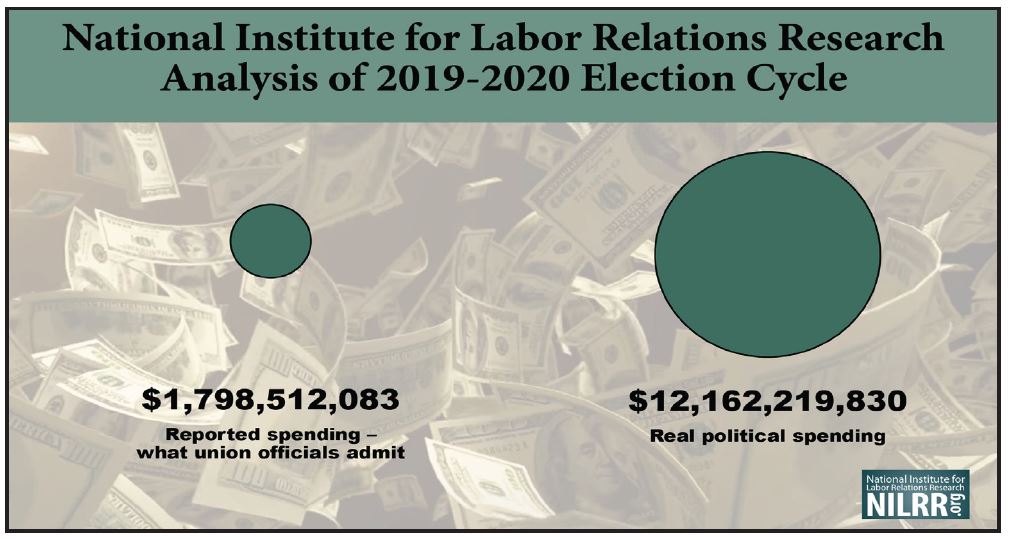
Coates’ case challenging illegal seizure of forced dues for politics comes after one analysis found that union officials likely spent over $12 billion on political activities during the 2019-2020 election cycle, far more than union officials publicly admit.
GALETON, PA – An employee of metal corporation Catalus hit a Communications Workers of America (CWA) union local this May with federal charges for illegally seizing full union dues from his paycheck, including dues for politics. Curtis Coates, a metal worker for Catalus, is receiving free legal aid from the National Right to Work Legal Defense Foundation.
Foundation attorneys filed Mr. Coates’ charges with National Labor Relations Board (NLRB) Region 6 in Pittsburgh, Pennsylvania. The Region is now investigating the charges.
CWA Union Officials Continue to Collect Dues from Worker, Despite Lack of Authorization
On October 20, 2021, Mr. Coates sent a message to CWA union officials declaring that he was resigning from his position as shop steward and terminating his union membership.
Because no union monopoly contract was in effect, under longstanding law, Coates should have been able to immediately cut all financial support for the CWA union which he no longer supports. The charges say a union official rebuffed both of Mr. Coates’ requests the next day, insisting that he had to remain both a union member and a shop steward.
From December 2021 to February 2022, Mr. Coates followed up with union officials several times via email and mail. He repeatedly asked when union officials would cease taking dues money from his paychecks and what process he had to follow to revoke his dues deduction authorization to stop money from being seized from his paychecks.
“To date, the Union has not responded . . . and dues and contributions continue to be deducted from his wages,” the charge reads. Because Pennsylvania currently lacks a Right to Work law, union officials can legally force employees to pay some union fees just to keep their jobs. However, those forced fees cannot be demanded when no union contract is in effect.
Further, even in states without Right to Work protections full union membership cannot be required. Additionally, under the U.S. Supreme Court’s decision in CWA v. Beck (1988), won by Foundation attorneys, forced fees are limited to only the part of union dues that union officials claim goes toward a union’s core “representational” functions and cannot be collected for other activities like union politics and lobbying.
Conflict of Interest: NLRB General Counsel is a Former CWA Union Official
Currently, the NLRB General Counsel is former CWA attorney Jennifer Abruzzo, who has expressed support for a number of policies which give union officials greater power to force workers into dues-paying union ranks, even without a vote. Foundation attorneys requested last year that Abruzzo recuse herself from a case involving an Oregon ABC cameraman who accused another CWA local of demanding illegal dues from him, including dues for politics.
Coates’ case represents another potential conflict of interest for Abruzzo, who has repeatedly sided with union officials against the rights of workers opposed to union affiliation.
“Mr. Coates’ right to refrain from funding union activities is being ignored by CWA union officials as they continue to unlawfully seize full union dues, which includes money used for union political activities,” commented National Right to Work Foundation Vice President Patrick Semmens. “This case shows why Pennsylvania workers need the protection of a Right to Work law to make all union payments strictly voluntary: So union bosses cannot so brazenly collect money to which they are not entitled under longstanding federal law.”
“Further, Mr. Coates’ case demonstrates the obvious conflict of interest that exists as Abruzzo, a former CWA lawyer, is charged with enforcing workers’ rights violated by her former CWA union colleagues,” Semmens added.
Full Foundation Action July/August 2022 Newsletter Now Online
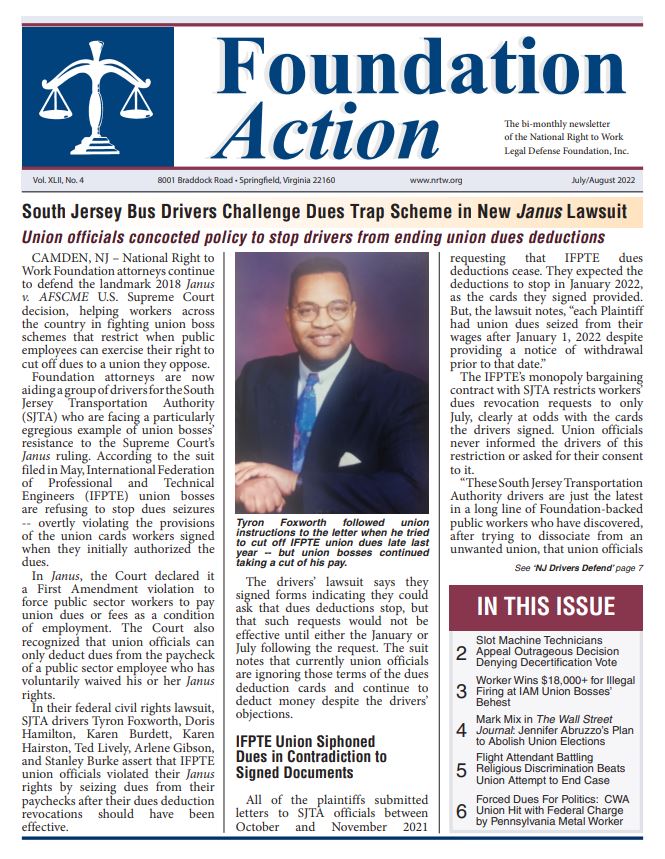
All articles from the July/August issue of Foundation Action are now on the website.
In this issue:
- South Jersey Bus Drivers Challenge Dues Trap Scheme in New Janus Lawsuit
- Slot Machine Technicians Appeal Outrageous Decision Denying Decertification Vote
- Worker Wins $18,000+ for Illegal Firing at IAM Union Bosses’ Behest
- Mark Mix in The Wall Street Journal: Jennifer Abruzzo’s Plan to Abolish Union Elections
- Flight Attendant Battling Religious Discrimination Beats Union Attempt to End Case
- Forced Dues For Politics: CWA Union Hit with Federal Charge by Pennsylvania Metal Worker
Recent articles can be found here. To sign up for a free copy of the newsletter via mail please see the form at the bottom of this page.
Foundation Client Wins $5.1 Million Verdict After Union Boss-Instigated Firing
The following article is from the National Right to Work Legal Defense Foundation’s bi-monthly Foundation Action Newsletter, July/August 2022 edition. To view other editions of Foundation Action or to sign up for a free subscription, click here.
Trial exposed emails advocating ‘targeted assassinations’ of union critics

Charlene Carter on her Foundation-won trial victory: “I am so humbled and thankful for today’s decision and for everyone who’s supported me these past five years.”
DALLAS, TX – Ex-Southwest Airlines flight attendant Charlene Carter prevailed in a federal jury trial in her lawsuit against the Transportation Workers Union of America (TWU) Local 556 union and Southwest. She charged both the company and union with illegally firing her for opposing the political activities of the union hierarchy, and with discriminating against her religious beliefs. Carter received free legal representation from National Right to Work Legal Defense Foundation staff attorneys.
A jury in the U.S. District Court for the Northern District of Texas awarded Carter $5.1 million in combined compensatory and punitive damages against TWU and Southwest for their respective roles in her unlawful termination.
“Today is a victory for freedom of speech and religious beliefs. Flight attendants should have a voice and nobody should be able to retaliate against any employee for engaging in protected speech against her union,” said Carter reacting to the victory.
Flight Attendant Called Out Union Officials for Their Political Activities
Carter resigned from union membership in 2013 but was still forced to pay fees to TWU Local 556 as a condition of her employment. The Railway Labor Act (RLA), the federal law that governs labor relations in the air and rail industries, permits the firing of employees for refusal to pay dues and preempts the protections that state Right to Work laws provide.
However, the RLA does protect employees’ rights to remain non-members of the union, to speak out against the union and its “leadership,” and to advocate for changing the union’s current “leadership.”
In January 2017, Carter, a pro-life Christian, learned that then-TWU Local 556 President Audrey Stone and other Local 556 officials used union dues to attend a political rally in Washington, D.C., which was sponsored by activist groups she deeply opposed, including Planned Parenthood.
Carter, a vocal critic of Stone and the union, sent private Facebook messages to Stone challenging the union’s support for political positions that were contrary to Carter’s beliefs, and expressing support for a recall effort that would remove Stone from power. Carter also sent Stone a message emphasizing her commitment to a National Right to Work law after the union had sent an email to employees telling them to oppose Right to Work.
After a meeting at which Southwest officials confronted Carter about her posts protesting union officials’ positions, the company fired Carter. In 2017 Carter filed her federal lawsuit, challenging the firing as a clear violation of her rights under two federal laws. She maintained that she lost her job because of her religious beliefs, standing up to TWU Local 556 officials, and criticizing the union’s political activities and how it spent employees’ dues and fees.
Ultimately, concluding an 8-day July trial, the federal jury agreed with Carter and her Foundation staff attorneys. In its verdict, the jury found in favor of Carter on all counts of the lawsuit, while awarding Carter $950,000 in damages against the TWU union local and more than $4 million in damages against Southwest.
Union Zealot Advocated ‘Targeted Assassinations” of Union Dissidents
In email communications unearthed and introduced at trial by Foundation staff attorneys, TWU union militants advocated for “targeted assassinations” of union dissidents and mocked Carter for being unable to stop her money from going toward union-backed causes she opposed.
Carter’s Foundation-backed lawsuit also revealed ugly examples of the hostility TWU officials and activists had for workers like Carter who spoke out against the incumbent union hierarchy. Foundation staff attorneys are preparing to counter already-announced appeals by both Southwest and TWU.
“This long-awaited verdict vindicates Ms. Carter’s fundamental right to dissent from the causes and ideas that TWU union officials support while forcing workers to bankroll that agenda,” commented National Right to Work Foundation President Mark Mix. “Verdicts like this show not only that one brave worker standing up to union bullies can make a difference, but also send a message to union bosses that their unlawful tactics will not go unpunished or unchallenged.”
Casino Worker Challenges Order Installing Unwanted Union via ‘Card Check’
The following article is from the National Right to Work Legal Defense Foundation’s bi-monthly Foundation Action Newsletter, March/April 2022 edition. To view other editions of Foundation Action or to sign up for a free subscription, click here.
Ninth circuit panel signals willingness to end precedent allowing for imposition of union

NLRB officials stacked the deck against rank-and-file Red Rock Casino employees by imposing an unpopular union on them despite worker objections.
LAS VEGAS, NV – A large majority of the workers at Red Rock Casino in Las Vegas, Nevada voted “no” to unionization, but a federal district court judge ordered their employer to bargain with union officials anyway. Casino officials appealed, and Red Rock employee Raynell Teske supported their efforts to overturn the judge’s coercive order that overrides the choice workers made at the ballot box.
With free Foundation legal aid, Teske filed a brief arguing that the district judge had no reason to impose a union onto workers who had already soundly voted to reject it. A Ninth Circuit panel denied the initial appeal, but issued an unusual concurring opinion in which all three judges said they disagreed with that outcome, but were bound by Ninth Circuit precedent to uphold the district judge’s order.
Binding precedent can only be overturned through an en banc hearing before a larger Ninth Circuit panel. Red Rock lawyers filed for an en banc rehearing of their appeal. The court then ordered National Labor Relations Board (NLRB) lawyers defending the order to respond, another signal the judges may be willing to overturn this ridiculous precedent and rule in the workers’ favor. Teske filed a second amicus brief, urging the court to hear the case en banc.
Judge Overrides Workers’ Vote Against Union ‘Representation’
The situation at Red Rock began in December 2019, when the NLRB held a secret-ballot election on whether to unionize the Casino’s workers. Employees rejected union officials’ effort to become their monopoly bargaining “representatives” in an NLRB-supervised vote by a nearly 100-vote margin. Despite that outcome, NLRB Region 28 Director Cornele Overstreet sought a federal court injunction imposing the union over the workers’ objections.
On July 20, 2021, District Judge Gloria Navarro agreed with the NLRB Director’s request, and ordered Red Rock to bargain with union officials despite the employees’ vote against unionization. The judge said the order was justified because union officials claimed that, before the vote, a majority of workers had signed union authorization cards.
Teske’s amicus briefs argue those “Card Check” signatures don’t prove that union officials ever had majority support. She contends the level of union support was tested fairly by the secret-ballot election, in which workers voted 627-534 against unionization.
Her briefs point out that the NLRB and federal courts have long recognized that secret ballots are a more reliable way of gauging worker support for a union, because workers are often pressured, harassed, or misled by union organizers into signing cards.
Union officials know that Card Check signatures do not indicate solid worker support. The AFL-CIO admitted in its internal organizing handbook that it needed at least 75% Card Check support before having even a 50-50 chance of winning a secret-ballot election. Union bosses prefer Card Check unionization because they can more easily take control of workplaces where they lack popular support, and partisan NLRB appointees now are working to grant their wish.
Partisan NLRB Pushes Unreliable ‘Card Check’
Past legislative attempts to enact Card Check unionization, including the so-called “PRO Act,” pending in the U.S. Senate right now, faced bipartisan opposition. However, NLRB General Counsel Jennifer Abruzzo, a former high-ranking union lawyer, believes she can implement Card Check without congressional approval. Abruzzo has expressed interest in resurrecting a decades-old NLRB doctrine that allows unions to sue employers to try to force them to automatically bargain whenever the union possesses a pile of untested union cards.
“There is no reason why district court judges or NLRB bureaucrats should be able to override workers’ choice at the ballot box,” said National Right to Work Foundation Vice President Patrick Semmens. “A favorable ruling for Raynell Teske and her colleagues could provide legal ammunition for future workers if the NLRB tries to force them to accept union officials for whom they never even had a chance to vote.”
Case Closed: Nurse Prevails in 11-Year Legal Fight Over Forced Dues
The following article is from the National Right to Work Legal Defense Foundation’s bi-monthly Foundation Action Newsletter, January/February 2022 edition. To view other editions of Foundation Action or to sign up for a free subscription, click here.
100 Rhode Island hospital employees win refund of dues illegally seized for union lobbying

After over a decade of battling power-hungry UNAP union bosses in court, Jeanette Geary has secured not only refunds of dues seized for union politics, but a First Circuit decision clarifying non-members can never be charged for union lobbying.
WARWICK, RI – Jeanette Geary finally achieved a total victory in her 11-year legal battle against union bosses. She and 99 other current and former nurses at Kent Hospital in Rhode Island received refunds of forced dues that were illegally used to support union lobbying in state legislatures. Foundation attorneys represented Geary throughout her fight.
Geary’s journey began when she grew frustrated with United Nurses and Allied Professionals (UNAP) union bosses in her workplace. “I realized what the union was doing,” Geary explained. “The union leadership had no interest in nurses or our professional work. Their only interest was collection of dues and fees.”
Geary resigned her union membership, but union dues were still extracted from her paycheck because Rhode Island is a forced unionism state that lacks Right to Work protections. However, thanks to the Foundation-won CWA v. Beck Supreme Court decision, nonmember workers can only be forced to pay fees for union activities “germane” to union monopoly bargaining. They cannot be forced to pay the portion of dues that funds activities like union lobbying.
Nurse Harassed for Standing Up to Union Bosses
Geary demanded a breakdown of the union’s expenditures, but union bosses refused to give her a legally required independent auditor’s verification of how they calculated non-members’ reduced forced fees. Like many who speak up against union bosses, Geary became a target for union harassment. “They laughed at me. They had their workplace reps ridicule me on the job and tell me I could file grievances that would be thrown away and said so with a big smile,” Geary recalled.
In 2009, Geary filed federal charges against union officials. The trial revealed UNAP officials were charging non-member nurses for lobbying in state legislatures. Despite the Supreme Court’s clear mandate in Beck that non-members’ money could not be used to fund political causes, union lawyers argued the lobbying was “germane” to the union’s monopoly bargaining.
Thanks to delays caused by President Obama’s illegal recess appointments to the National Labor Relations Board (NLRB), Geary had to file two petitions with the U.S.
Court of Appeals in Washington, D.C., and didn’t get a final NLRB ruling for nearly a decade. Finally, in March 2019, the NLRB ruled 3-1 that union officials cannot charge non-members for lobbying of any kind. It also ruled that union officials must provide independent verification that the union expenses they force non-members to pay have been audited.
Union Bosses Ridiculously Claimed Some Union Lobbying Wasn’t Political
Union officials still wouldn’t abandon their argument that nonmembers could be forced to pay for some union lobbying as a condition of employment. Union lawyers appealed the NLRB’s decision to the U.S. Court of Appeals for the First Circuit. A three-judge panel that included retired Supreme Court Justice David Souter ruled unanimously in Geary’s favor, saying “we see no convincing argument that legislative lobbying is not a ‘political’ activity.”
Union officials made a last-ditch attempt to overturn the decision, requesting an en banc hearing by the entire Court of Appeals, but that request was denied. In September 2021, union bosses finally paid back, with interest, thousands of dollars taken from Geary and 99 other current and former Kent Hospital nurses who were not union members but were charged for the union’s lobbying, bringing the decade-long case to a close.
“Jeanette Geary faced workplace ridicule for her decision to stand up to union bosses, yet she persevered for eleven years,” said National Right to Work Foundation Vice President and Legal Director Raymond LaJeunesse. “In the process, she won important legal precedents that will protect thousands of other workers from having their money illegally used to fund union politics.”
West Coast Workers Press High Court to Scrutinize Anti-Janus ‘Escape Periods’
The following article is from the National Right to Work Legal Defense Foundation’s bi-monthly Foundation Action Newsletter, January/February 2022 edition. To view other editions of Foundation Action or to sign up for a free subscription, click here.
Alaska, California, and Oregon public employees join battle defending First Amendment rights
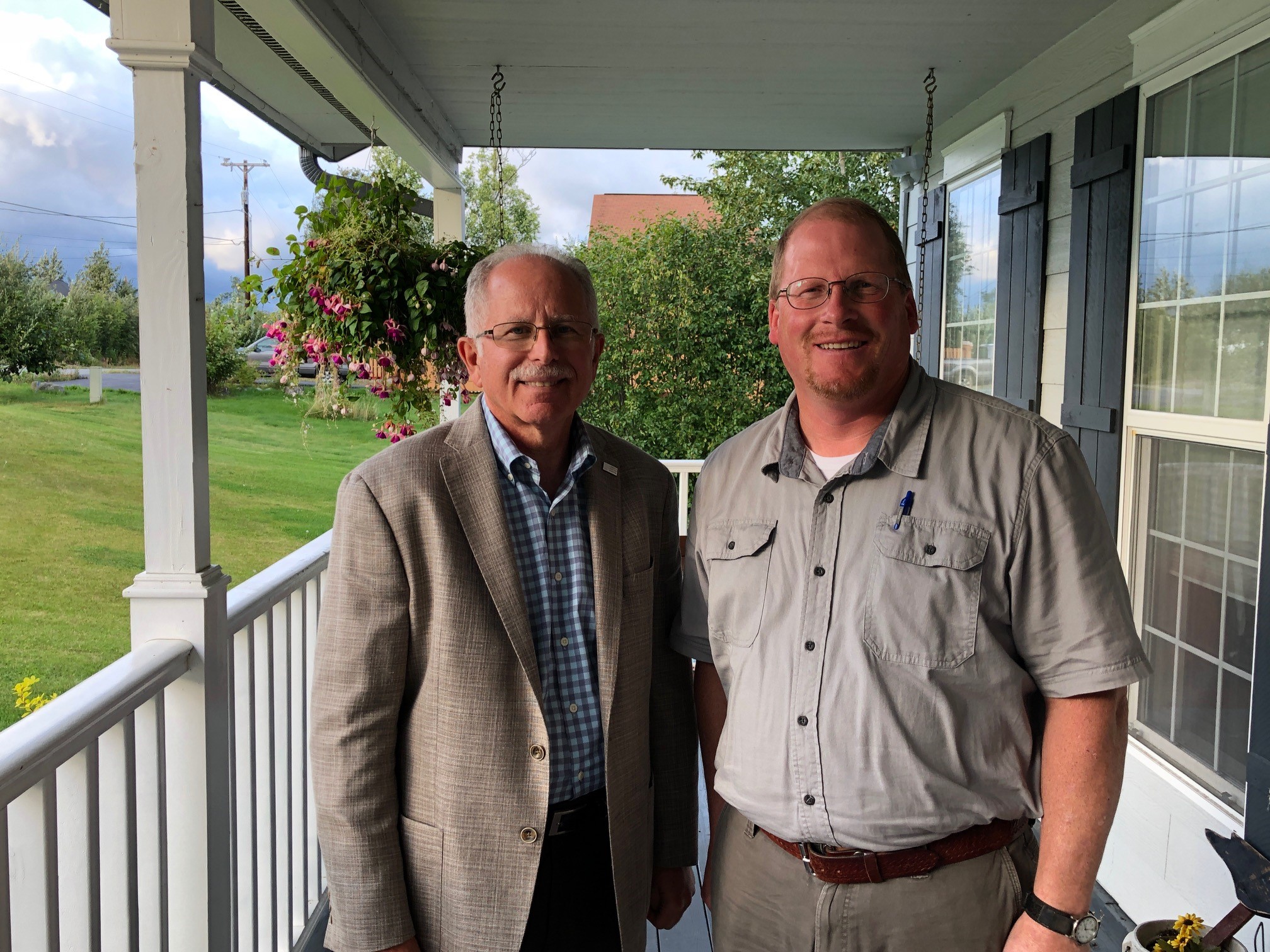
Alaska Vocational Instructor Chris Woods (right), seen here with original Janus plaintiff Mark Janus, is fighting with Foundation aid for a Supreme Court ruling that spells out that “escape periods” violate the First Amendment.
WASHINGTON, DC – National Right to Work Foundation-backed public employees across the country continue their endeavors to win a U.S. Supreme Court ruling striking down limitations on the First Amendment right not to financially support union activities.
Most recently, Foundation staff attorneys in October filed two petitions asking the Court to hear several cases from rank-and-file government employees in Alaska, Oregon, and California. All of the lawsuits fight union-created schemes that violate public workers’ First Amendment rights by limiting when they can cut off financial support to unions of which they disapprove.
One petition covers four lawsuits from California and Oregon public employees against various unions, and the other petition covers the cases of Alaska Vocational Instructor Christopher Woods and of two other Alaska government workers. Both Alaska suits were filed against the Alaska State Employee Association (ASEA) union. In the Foundation-won 2018 Janus v. AFSCME Supreme Court decision, the Justices recognized that the First Amendment protects public sector workers from being forced to pay union dues or fees. The Justices further ruled that a public worker’s affirmative waiver of that right is needed before any union payments are deducted from his or her paycheck.
Agreeing with contentions presented in oral arguments by veteran National Right to Work Foundation staff attorney William Messenger for Mark Janus, the Supreme Court reasoned that, because all public sector union activities involve dealing with government, forcing any public worker into funding union activities against his or her will counts as forced political speech forbidden by the First Amendment.
Workers Appeal Ninth Circuit Decisions Sparing Restrictive Union Schemes
Each of the cases brought before the Court now challenges a union boss-created “escape-period” scheme. “Escape periods” limit to just a few days every year the time when public servants can exercise their Janus right to end union dues deductions. Often, public workers whom union officials never informed about their Janus rights try to cut off support to an unwanted union, only to be told by union officials that, per the “escape period,” they must endure additional months or even years of union dues being siphoned from their paychecks.
Despite the High Court’s unequivocal ruling in Janus that dues can’t be taken from public workers without a freely given waiver of these rights, the Ninth Circuit Court of Appeals let “escape periods” survive in each of these cases.
The majority of these cases are class-action lawsuits, and thus seek to reclaim for both petitioners and their coworkers money union bosses seized from their paychecks after they resigned union membership and tried to exercise Janus rights.
AGs from Alaska and 15 Other States Aid Worker Fight Against ‘Escape Periods’
Even though the Alaska employees’ case names the State of Alaska a defendant for its role in enforcing “escape periods,” the state government’s top lawyer — Attorney General Treg Taylor — filed a brief backing the employees’ opposition to the restrictive schemes.
The State of Alaska, “although appearing as a respondent here, urges the Court to grant the petition to protect the First Amendment rights of government employees in Alaska and throughout the country,” the brief says. Taylor is also defending an Alaska executive order forbidding “escape periods,” which is currently enjoined in state court.
Additionally, West Virginia Attorney General Patrick Morrisey and attorneys general from 14 other states submitted an amicus brief in late November throwing the weight of their states behind the Alaska workers.
“All over the country, American public workers are making it clear that they will not stand by while union bosses and their allies in government play deceptive games with their First Amendment Janus rights, just so they can fill union coffers with more money from dissenting workers,” commented National Right to Work Foundation President Mark Mix.
“This message should now be overwhelmingly evident to the Supreme Court, which has an opportunity to rectify lower courts’ gross misinterpretations of Janus, and clarify that public workers’ First Amendment rights can’t be limited to arbitrary windows created by union bosses or their political allies designed to undermine workers’ rights recognized in the Janus decision.”
Foundation Demands Recusal of Former SEIU Lawyers Appointed to Labor Board
The following article is from the National Right to Work Legal Defense Foundation’s bi-monthly Foundation Action Newsletter, November/December 2021 edition. To view other editions of Foundation Action or to sign up for a free subscription, click here.
Biden NLRB appointees have blatant conflicts of interest in case brought by SEIU officials
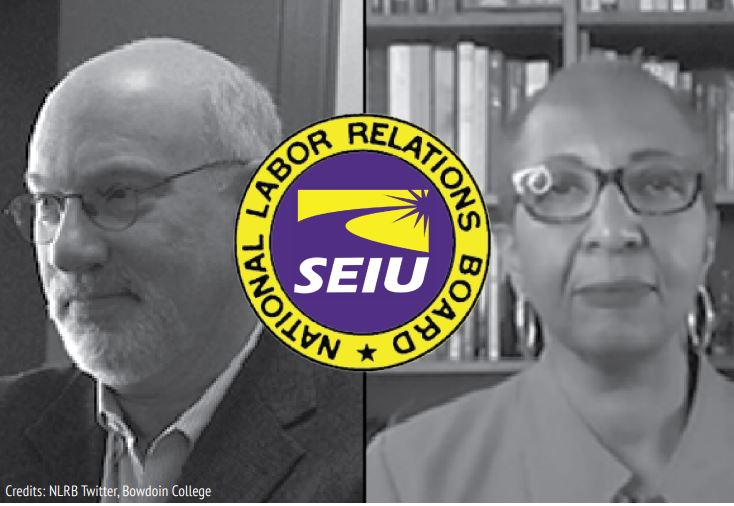
Foundation attorneys demand that the NLRB IG stop David Prouty (left) and Gwynne Wilcox, fresh off tenures as high-ranking SEIU lawyers, from derailing efforts to ensure workers can resist union influence they oppose.
WASHINGTON, DC – The National Right to Work Legal Defense Foundation submitted a letter to the National Labor Relations Board (NLRB) Inspector General (IG) and chief ethics officer, urging them to remove NLRB members David Prouty and Gwynne Wilcox from involvement in an ongoing federal case and any cases brought by Foundation-assisted workers against Service Employees International Union (SEIU) affiliates.
Prouty and Wilcox were both appointed to the Board by President Biden. Prior to their appointment, both were lawyers for influential SEIU affiliates. The NLRB members, including Prouty and Wilcox, are currently being sued by the SEIU in federal court over a rule finalized by the Trump NLRB. That rule clarified that a company that does not exercise direct control over employee wages and working conditions cannot be charged with unfair labor practices committed by its related entities, such as franchisees.
Union officials want to change that so-called “joint employer” standard to launch top-down organizing campaigns to target workers for monopoly unionization. During such campaigns, union officials often attack companies in the press and through coordinated litigation in order to get employer assistance in imposing unionization on workers, including by bypassing the secret ballot vote process for unionization.
Workers Regularly Charge SEIU Union Affiliates with Rights Violations
The letter from Foundation President Mark Mix points out Prouty and Wilcox’s recusal is of particular interest to the Foundation because “Foundation Staff Attorneys frequently provide free legal representation to employees involved in litigation before the National Labor Relations Board against SEIU or its affiliates,” and that the same considerations “should mandate the recusal of Member Wilcox and Member Prouty in those cases as well.”
Each year, Foundation staff attorneys handle more than 100 cases brought for workers at the NLRB challenging union violations of workers’ rights. SEIU affiliates are among the most often cited in those cases for violating federal law. Just since 2018, Foundation attorneys have assisted workers in 67 cases against SEIU affiliates, over half of which have been at the NLRB.
The letter also asks that the NLRB IG “apply the same level of vigor in examining their conflicts as he did in matters involving former Board Member William J. Emanuel.” Although the NLRB finalized its “joint employer” standard through the rulemaking process, an earlier 2017 case decision that would have adopted the same standard was gutted because the NLRB IG ruled that then-Member Emanuel should have recused himself.
The Foundation’s letter details Member Prouty’s history as General Counsel of SEIU Local 32BJ, a powerful SEIU affiliate. It further points out that Member Prouty “played a key role in opposing the Board’s final rule on joint employment,” personally signing comments against the rule, which is further evidence of his specific conflict of interest in the pending case.
Letter: Ex-SEIU Board Member Even Headed Up Group at ‘Core’ of Litigation
Member Wilcox’s conflicts go even deeper, according to the Foundation’s letter. It notes that Member Wilcox was at the forefront of a union campaign that openly opposed the NLRB’s “joint employer rule,” a campaign that is “specifically named as interested in, and a core part of, the Litigation” against that rule.
The Biden Administration has gone above and beyond in its efforts to entrench union boss influence at the NLRB. Just minutes after being inaugurated, President Biden took the unprecedented step of firing then-NLRB General Counsel Peter Robb, who still had 11 months left on his Senate-confirmed term. Robb had aggressively supported cases in which workers sought to free themselves from coercive union boss-created schemes.
Foundation Also Calls Out NLRB General Counsel
Robb’s replacement, Biden appointed Jennifer Abruzzo, is a former Communications Workers of America (CWA) union lawyer who, Freedom of Information Act (FOIA) records requests from the Foundation revealed, was half of a two-person Biden NLRB transition team that engineered Robb’s first-of-its-kind ouster.
In a separate letter, Foundation staff attorneys have demanded Abruzzo’s recusal from an ongoing NLRB case brought by an ABC cameraman against a CWA affiliate.
The letter points out that, while at the CWA International as special counsel, Abruzzo was responsible for the very legal policies that CWA affiliates are bound to follow, including the one challenged by the worker’s Foundation-provided attorneys in the case.
“The Biden Administration has already displayed some of the most biased and politically motivated behavior at the NLRB since the agency’s inception, all in an attempt to unfairly rig the system to favor Biden’s union boss political allies over protecting workers’ individual rights,” commented National Right to Work Foundation President Mark Mix. “If Prouty and Wilcox’s obvious conflicts of interest are unaddressed in this case, the message from the Board will be clear that ethics policies and recusal rules no longer apply now that pro-union boss Biden appointees are in power.”





