
Full Foundation Action May/June 2022 Newsletter Now Online
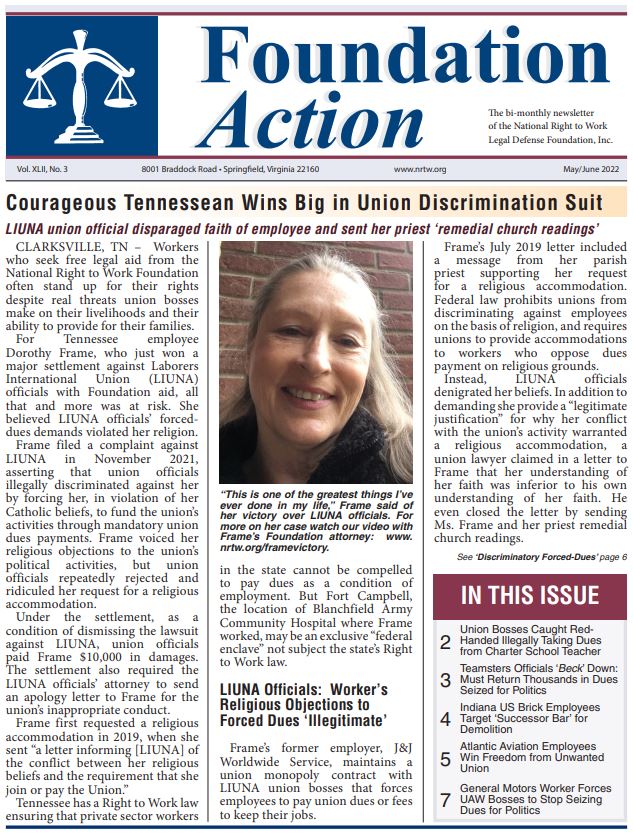
All articles from the May/June issue of Foundation Action are available on the website.
In this issue:
- Courageous Tennessean Wins Big in Union Discrimination Suit
- Union Bosses Caught Red-Handed Illegally Taking Dues from Charter School Teacher
- Teamsters Officials ‘Beck’ Down: Must Return Thousands in Dues Seized for Politics
- Indiana US Brick Employees Target ‘Successor Bar’ for Demolition
- Atlantic Aviation Employees Win Freedom from Unwanted Union
- General Motors Worker Forces UAW Bosses to Stop Seizing Dues for Politics
Recent articles can be found here. To sign up for a free copy of the newsletter via mail please see the form at the bottom of this page.
Foundation Helps Healthcare Workers Remove Unwanted Unions
The following article is from the National Right to Work Legal Defense Foundation’s bi-monthly Foundation Action Newsletter, September/October 2022 edition. To view other editions of Foundation Action or to sign up for a free subscription, click here.
Evidence of union boss “serious financial malpractice” exposed as workers seek to vote out SEIU

Nurse Brittany Burgess (front, center) led her fellow Mayo Clinic nurses in decertifying the Minnesota Nurses Association (MNA) union. She’s “extremely grateful” for Foundation support.
DETROIT, MI – Workers across America are increasingly fed up with union bosses’ self-serving so-called “representation.” National Right to Work Foundation legal aid requests are spiking from workers seeking assistance in filing decertification petitions to end union monopoly bargaining control in their workplaces. In 2021 alone, Foundation attorneys provided legal assistance in 54 National Labor Relations Board (NLRB) decertification efforts, which together sought to end union boss control of more than 7,000 workers.
This increased demand has continued in 2022, with healthcare workers in particular seeking the Foundation’s legal aid in exercising their legal right to free themselves from union ranks. In one such ongoing case, Foundation staff attorneys assisted Crystal Harper, an employee at Detroit’s Sinai-Grace Hospital, who along with coworkers battled to oust SEIU Healthcare Michigan union officials.
Harper’s initial petition was rejected after an NLRB regional official dubiously dismissed the petition on the grounds that “Midnight, February 8th” in the union monopoly contract was actually unambiguously a reference to the minute after 11:59 p.m. on May 7. This questionable interpretation of union officials’ sloppily written contract meant that the petition filed on the 8th was actually late under the controversial NLRB-created “contract bar” policy.
Undeterred, that decision was appealed and a second petition for a decertification vote was filed in May after the contract bar had expired and a vote was scheduled. Meanwhile, “substantiated allegations of serious financial malpractice” have come to light involving the SEIU local that were so glaring even SEIU International President Mary Kay Henry couldn’t ignore them, as she was pushed to use the SEIU’s “trusteeship” procedures to oust local officials and take full control of the local.
As a result, in June, Foundation President Mark Mix formally asked the Department of Labor and Department of Justice to investigate the serious allegations of financial and other wrongdoing by SEIU local officials. The letter calling for the federal investigation noted that “any internal SEIU International investigation will be insufficient [given the] long history of union officials attempting to ignore or downplay corruption in their own ranks.”
Foundation Counters Union Legal Tricks to Block Vote
Elsewhere in Michigan, lab technicians at Ascension Providence Rochester Hospital have finally won their effort to be free of unwanted so-called “representation” by union officials of the Office and Professional Employees International Union (OPEIU) Local 40.
During the protracted process, Foundation staff attorneys successfully fought off OPEIU union lawyers’ efforts to block the vote which cited the pending sale of the facility by Ascension to LabCorp as grounds for rejecting the workers’ request for an election. Union lawyers had urged the NLRB regional office to block a vote whether to remove the union on the grounds of an upcoming “cessation of operations” by the employer, a policy previously applied only to certification elections.
In briefs to the NLRB, Foundation staff attorneys countered that union attempts to block the vote were unjustified as a matter of law. Foundation attorneys also noted that the attempt to block the vote was likely a cynical attempt to keep power over the bargaining unit. If the sale ultimately went through, the union would have likely sought to block a decertification vote citing the NLRB-created “successor bar” that insulates union officials from decertification votes after a workplace’s change in ownership.
The Board ultimately rejected the union lawyers’ arguments and scheduled a decertification vote by mail-in ballot. However, rather than go forward with a vote they seemingly knew they were going to lose, OPEIU officials instead disclaimed interest in the unit, finally giving the workers the freedom from unwanted union representation they sought.
Meanwhile in Minnesota, multiple groups of healthcare workers are seeking decertification votes with Foundation legal aid. At the Mayo Clinic Health System in Mankato, Minnesota, approximately 500 nurses filed a petition for a vote to remove the Minnesota Nurses Association (MNA) union, while two separate units of Cuyuna of the lawsuit, Regional Medical Center healthcare workers located at facilities in Crosby, Baxter, Longville, and Breezy Point, Minnesota, filed for decertification votes to free themselves from the SEIU.
Hundreds of Minnesota Nurses Petition to Be Union Free
“I’m extremely grateful to have the free legal assistance of the National Right to Work Foundation in fighting for our right to hold a vote to remove the union,” commented Mayo Clinic Mankato nurse Brittany Burgess. “I can’t wait until the day when we are all finally free of the MNA.”
One likely reason for the increased decertification activity is Foundation-advocated reforms that were adopted by the NLRB in 2020 to curtail union officials’ abuse of so-called “blocking charges,” which they use to delay or block workers from exercising their right to decertify a union. However, with the Biden-appointed NLRB majority recently announcing it was starting rulemaking to overturn those reforms, Foundation staff attorneys are now gearing up to challenge the Biden Board’s attempt to give union bosses more power to trap workers in union ranks they oppose.
“Foundation staff attorneys will continue to assist workers in exercising their rights under federal law to hold decertification elections to remove so-called ‘representation’ opposed by most workers,” commented National Right to Work Foundation Vice President and Legal Director Raymond LaJeunesse. “The Biden NLRB is clearly prioritizing union boss power to the detriment of the rights of rank-and-file workers. Look no further than the fact that just as the Board seeks to expand the ability of union officials to impose unionization on workers through coercive ‘Card Checks’ without even secret-ballot votes, it simultaneously plans to make it easier for union lawyers to block workers from holding votes to remove a union.”
Indiana US Brick Employees Target ‘Successor Bar’ for Demolition
Over 70 percent of workers want Teamsters gone, but non-statutory policy prevents vote

Though Kerry Atkins and roughly 70 percent of his coworkers want to kick Teamsters bosses from their facility, the “successor bar” and other non-statutory “bars” could block a vote for years.
INDIANAPOLIS, IN – National Right to Work Foundation staff attorneys have made big strides in recent years for independent-minded workers who want to exercise their right to vote unpopular unions out of their workplaces.
The National Labor Relations Board’s (NLRB) adoption in 2020 of Foundation-backed reforms to the decertification process have made it significantly less difficult for workers to exercise their rights. But, there’s much more work to be done to eliminate contrived, union boss-friendly NLRB policies that stifle worker rights just so unwanted unions can stay entrenched.
Enter Kerry Atkins and his coworkers at US Brick in Mooresville, Indiana. With free Foundation legal aid they are fighting an NLRB policy called the “successor bar” that arbitrarily blocks employees’ right to vote out an unwanted union when management changes hands in a workplace.
Atkins filed a petition signed by his colleagues in December 2021, asking the NLRB to hold a vote on whether to decertify Teamsters Local 135 union officials. NLRB Regional Director Patricia Nachand ruled on February 9 that US Brick’s recent acquisition of the plant triggered the so-called “successor bar” and rendered the employee petition invalid.
NLRB-Invented Policy Traps Workers in Union They Strongly Oppose
Nachand blocked the vote even though, according to her own order, plant management has in its possession a parallel petition expressing disaffection with the Teamsters, which bears the signatures of about 70 percent of the employees.
The “successor bar” is a non-statutory policy invented by NLRB appointees that immunizes union officials from being voted out by employees for up to a year after management changes as a result of a sale, merger, or acquisition.
The National Labor Relations Act (NLRA), the federal law the NLRB is charged with enforcing, explicitly states that employees have a right to remove union monopoly “representation” they oppose. The “successor bar,” however, is found nowhere in the NLRA’s text.
The only “bar” to employees requesting a decertification election that is mentioned in the NLRA is a one-year restriction after employees certify a union in a secret-ballot vote. That the “successor bar” — which isn’t even in the NLRA — can stave off attempts to vote out a union for up to four years when combined with a “contract bar” makes it especially offensive to workers’ rights.
To make matters even worse, two different federal agencies — the NLRB and the Department of Justice — effectively worked together to impose the “successor bar” on Atkins and his coworkers. The Department of Justice in an antitrust complaint forced the former owner of the Mooresville brick facility to sell it to US Brick. The NLRB now says that event should be grounds for blocking the employees from ejecting a union they overwhelmingly oppose.
‘Successor Bar’ Disregards Desires and Experiences of Workers, Brief Says
Atkins’ Foundation attorneys have filed a Request for Review of Nachand’s order with the NLRB in Washington, D.C. It contends that the “successor bar” serves no purpose other than to block the will of rank-and-file employees, entrenching union bosses who ought to be accountable to the employees.
“The successor bar undermines the NLRA’s core purpose of employee free choice by disregarding employees’ actual desires and past experiences with their union representative,” the Request for Review argues.
Restriction Shows How NLRB-Invented Policies Stifle Individual Rights
“The NLRB-invented ‘successor bar’ is just one example of how the Board neglects its mandate to protect the rights of individual workers, including those opposed to forced union affiliation, just to protect union boss power,” observed National Right to Work Foundation Vice President Patrick Semmens. “The ‘successor bar’ not only overrides the statutory right of workers to vote out unions they oppose, but does so at the very moment when workers are most likely to reevaluate their union status: the turnover of the old management that perhaps was the reason for unionization in the first place.”





