
Multiple Units Oust Teamsters Bosses Thanks to Foundation-Backed NLRB Rule
The following article is from the National Right to Work Legal Defense Foundation’s bi-monthly Foundation Action Newsletter, May/June 2021 edition. To view other editions of Foundation Action or to sign up for a free subscription, click here.
Unpopular Teamsters officials voted out of California, New Jersey workplaces
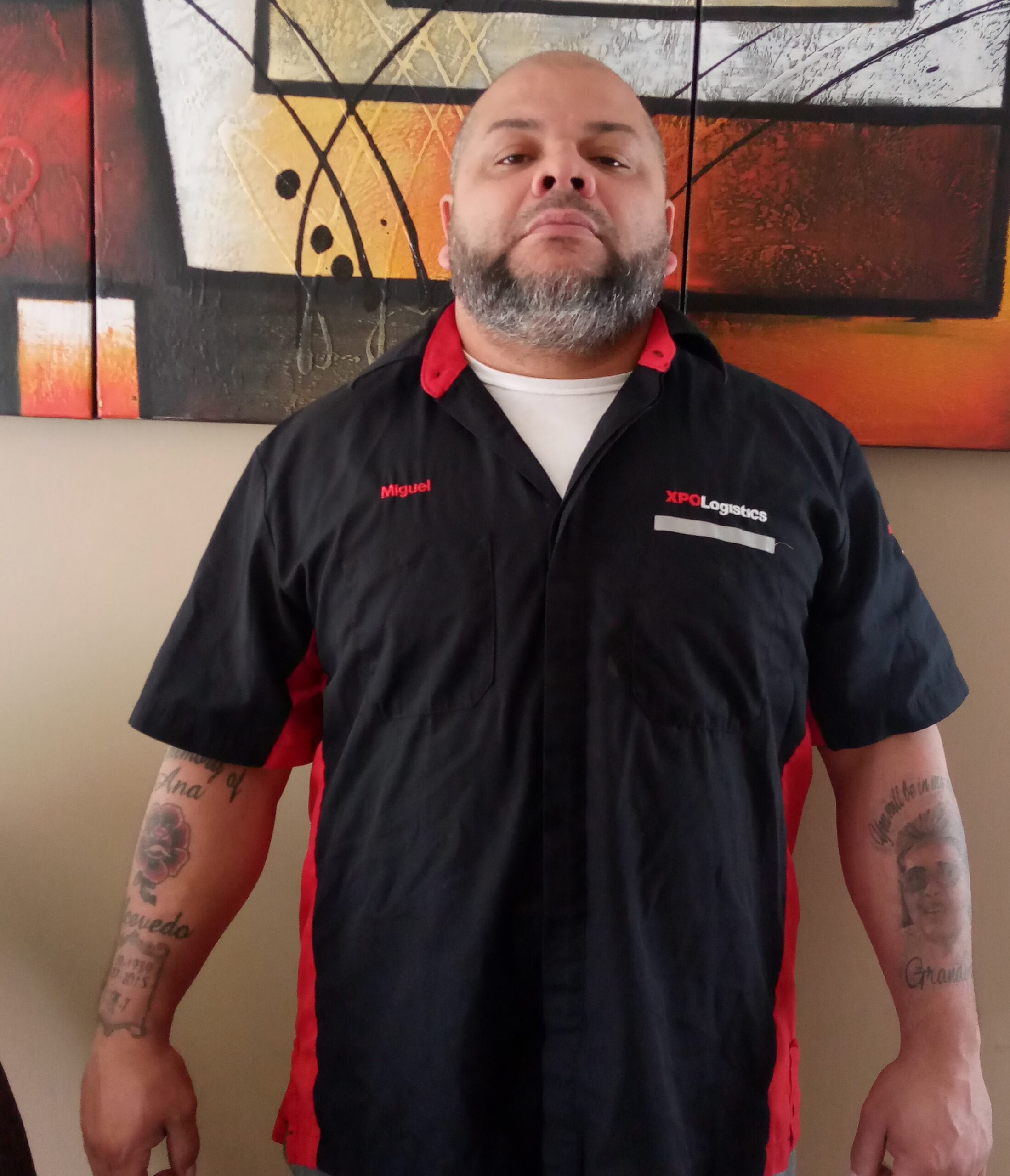
Reforms urged by Foundation staff attorneys eased Miguel Valle and his coworkers’ near-unanimous effort to vote out unpopular Teamsters officials, who tried to use “blocking charges,” ultimately to no avail.
WASHINGTON, DC – Workers in California and New Jersey who were previously subject to Teamsters bosses’ monopoly bargaining authority have freed themselves from unwanted union control.
The workers received free legal aid from Foundation staff attorneys, and benefited from rule changes at the National Labor Relations Board (NLRB) in Washington pushed for by the Foundation.
In California, Eliseo Haro, an employee at Los Angeles-based KWK Trucking, Inc., submitted a decertification petition with the NLRB because he and his coworkers were being ignored by Teamsters bosses. As Haro puts it, “The union never came in to talk to us, or negotiate a contract, or represent us. They disappeared.”
Haro’s petition was signed by nearly 80 percent of the workers in the 119-employee bargaining unit and called for an NLRB-supervised decertification election, in which KWK employees could vote out the unpopular union officials.
Rather than face an overwhelming defeat in the decertification election, Teamsters bosses chose to walk away. The union disclaimed interest in the unit, and NLRB Region 21 revoked Local 986’s certification as the workers’ monopoly bargaining agent.
New Jersey Decertification Effort Succeeds Despite Union Stall Tactics
In Cinnaminson, New Jersey, Teamsters officials did not immediately leave when a decertification petition was filed by Miguel Valle and his coworkers at a branch of XPO Logistics. Instead, Teamsters lawyers used nearly two months of unnecessary court proceedings to delay the election.
They demanded the vote be held in person at the Teamsters union hall. Foundation attorneys argued that the union lawyers’ requests were merely an effort to delay the vote. Ultimately, as expected, the NLRB’s Regional Director ruled that the election would be conducted by mail.
When Valle and his coworkers finally had their election, they voted 16-2 to remove Teamsters bosses from their workplace.
Foundation-Backed Rule Changes Reduce Needless Election Delays
For workers, just getting a decertification election is often difficult. In some cases, union bosses have created multi-year delays to stymie decertification efforts, trapping workers under union monopoly “representation” and often forced-dues payments they oppose, while they wait for a vote.
Union officials frequently attempt to delay or block decertification votes by filing “blocking charges,” unfair labor practice charges that can be used to hold up an election, even when they have nothing to do with the employees’ dissatisfaction with the union.
Union officials’ ability to use this tactic to block or delay votes has been limited by recent NLRB rulemaking, finalized in 2020. Under the NLRB’s new policy, which draws on comments filed by the National Right to Work Foundation, union charges cannot indefinitely stall employee votes, and in most instances votes occur without delay.
Additionally, as the Foundation advocated in its comments, instead of ballots being impounded for months or even years while “blocking charges” are resolved, the NLRB modified its original proposed rule so that in most cases ballots are tallied and the results are announced after employees vote.
“Union bosses can stick around for years, even when they face overwhelming opposition from rank-and-file workers, because of the legal barriers that protect union officials from decertification votes,” said National Right to Work Foundation Vice President and Legal Director Raymond LaJeunesse.
“Thanks to Foundation-backed reforms to the NLRB’s ‘blocking charge’ policy, union officials’ ability to trap workers in union ranks through legal trickery despite overwhelming opposition has been significantly curtailed.”
Push to Remove UFCW Union Could End Pro-Union Boss “Contract Bar” Policy
The following article is from the National Right to Work Legal Defense Foundation’s bi-monthly Foundation Action Newsletter, September/October 2020 edition. To view other editions or to sign up for a free subscription, click here.
Non-statutory NLRB policy hinders workers’ right to vote out an unwanted union
 Employees at the Selbyville, DE, Mountaire Farms plant rally to vote out unpopular UFCW honchos from their workplace, as union lawyers scramble to block the workers’ votes from being counted.
WASHINGTON, DC – The National Labor Relations Board (NLRB) has announced that it will review the so-called “contract bar” doctrine, which prevents employees from exercising their right to vote an unpopular union out of their workplace for up to three years if union officials and their employer have finalized a monopoly bargaining contract.
This is the latest development in a case by a Selbyville, Delaware-based Mountaire Farms poultry employee, Oscar Cruz Sosa, against the United Food and Commercial Workers (UFCW) Local 27 union. Cruz Sosa submitted a petition in February for a vote on whether Local 27 should be removed as monopoly bargaining agent in his workplace. The petition was signed by hundreds of his coworkers, more than the percentage required to trigger such a vote.
Worker Obtains Foundation Help after Union Attempts to Block Vote
After he submitted the petition, UFCW bosses immediately claimed that the “contract bar” should block Cruz Sosa and his coworkers from even having an election, because the monopoly bargaining agreement between Mountaire and the union had been signed less than three years earlier.
Cruz Sosa then obtained free legal assistance from National Right to Work Foundation staff attorneys in defending his and his coworkers’ right to vote. With Foundation aid, he also hit UFCW agents with federal unfair labor practice charges for imposing an illegal forced-dues clause on the workplace and threatening him after he submitted the petition.
When the NLRB Regional Director in Baltimore heard the election case, he ruled that the union contract contains an unlawful forced-dues clause that mandates workers immediately pay union dues upon hiring or be fired. Under NLRB precedent, an illegal forced-dues clause means the “contract bar” cannot apply, allowing the vote to proceed.
UFCW’s Desperate Attempt to Block Vote Triggers NLRB Review of “Contract Bar”
Despite the longstanding precedent supporting the Regional Director’s ruling, UFCW union lawyers filed a Request for Review, asking the full NLRB to reverse the Regional Director and halt the election.
In response, Cruz Sosa’s Foundation staff attorneys opposed the union’s efforts to block the vote. They also argued that, if the Board were to grant the union’s Request for Review, it should also reconsider the entire “contract bar” policy, which has no statutory basis in the NLRA. The Foundation’s legal brief noted that the “contract bar” runs counter to the rights of workers under the NLRA, which explicitly include the right to vote out a union a majority of workers oppose.
Just hours after the voting process in the decertification election had begun, the NLRB issued its order granting the union’s Request for Review, while also accepting the Foundation’s request to reconsider the entire “contract bar” doctrine. The order noted “that it is appropriate for the Board to undertake in this case a general review of its ‘contract bar’ doctrine.”
Given the precedential import of this case, the NLRB solicited amicus briefs on whether the “contract bar” should be allowed to stand. UFCW officials, still desperate to throw a wrench in Cruz Sosa and his coworkers’ effort to vote them out, demanded that the NLRB rescind its request for amicus briefs in the case, but that effort was quickly rebuffed.
“We urge the NLRB to swiftly overturn this outrageous non-statutory policy, which lets union bosses undermine for up to three years the free choice of workers that is supposed to be at the center of federal labor law,” commented National Right to Work Foundation Vice President and Legal Director Raymond LaJeunesse. “The very premise of the NLRB-created ‘contract bar,’ that union bosses should be insulated from worker decertification efforts, is completely backwards.”
LaJeunesse added: “Union officials across the country use all types of tactics to get workers into unions but rely on government power and legal tricks to prevent them from getting out.”
Military Base Employee Charges Union Bosses with Religious Discrimination
Union officials interrogated employee about her beliefs instead of providing federally-mandated exemption

Dorothy Frame opposes funding the LIUNA union due to its stance on abortion. Instead of providing her an accommodation, union bosses questioned her religious beliefs.
CLARKSVILLE, TN – Dorothy Frame, a J&J Worldwide Service Employee, works at Fort Campbell, a military installation on the Kentucky-Tennessee border. In July 2019, she sent Laborers Local Union 576 (LIUNA) bosses at her workplace a letter requesting a “religious accommodation of her objection to joining or financially supporting the union.”
In her letter requesting the exemption in accordance with federal law regarding workplace discrimination, Frame explained that, as a Catholic, she opposes the union’s stance on abortion. Instead of providing her with an accommodation in accordance with federal law, LIUNA bosses rejected her request and demanded in a letter the following month that she “provide a theological defense.”
Now, with free legal aid from National Right to Work Legal Defense Foundation staff attorneys, she has filed a charge with the Equal Employment Opportunity Commission (EEOC) on the grounds that LIUNA officials illegally discriminated against her because of her religious beliefs.
EEOC Asked to Investigate Union Boss Religious Discrimination
Frame’s charge notes that under her Catholic faith she believes abortion is “the unjustified destruction of a human life,” a belief that is rooted in “her understanding of Catholic teaching, scripture, and God’s will.” Because of those sincere beliefs and her knowledge that the union “funds and supports abortion,” her charge states that for her “it would be sinful to join or financially support the union.”
Frame had been a LIUNA member for four years before requesting an accommodation. According to the charge, she converted to Catholicism in 2017 and discovered the conflict between her sincerely held religious beliefs and union officials’ position on abortion “shortly before she wrote her accommodation request.”
Although Kentucky and Tennessee both have Right to Work laws which ensure that union membership and financial support are strictly voluntary, Fort Campbell’s status as an “exclusive federal enclave” overrides those state laws. Thus, the monopoly bargaining contract between J&J Worldwide Service and the LIUNA union requires Frame to pay union dues or fees as a condition of employment.
Union Boss Questions Priest’s Letter Supporting Religious Accommodation Request
LIUNA bosses rebuffed Frame’s request in August 2019, sending her a letter in which a union lawyer told Frame she would need to “provide a theological defense” of her beliefs to meet LIUNA union officials’ supposed standard for a “legitimate justification” for her accommodation request. Frame then provided a letter from her parish priest supporting her religious opposition to abortion, but, according to her charge, “the Union lawyer rejected this evidence based on his supposedly superior religious views.”
Frame’s Foundation-provided attorney also provided evidence to LIUNA officials that abortion violates the teachings of the Catholic Church. But her charge notes that union officials never responded to this additional evidence and continued to take money from her paycheck in violation of her sincere religious beliefs. Her charge alleges this violates her rights under Title VII of the Civil Rights Act of 1964, which prohibits discriminating against an individual based on his or her religious beliefs. If the EEOC finds merit in her charges, Frame could be given a “right to sue” letter, which authorizes her to file a federal lawsuit against LIUNA officials to vindicate her rights.
Foundation staff attorneys regularly aid workers who have a religious objection to supporting a labor union. They recently helped Boston College electrician Ardeshir Ansari secure such an accommodation from his employer and the union, Service Employees’ International Union 32BJ.
“It is outrageous that LIUNA bosses are forcing Ms. Frame to choose between keeping her job and violating her sincere religious beliefs,” commented Raymond LaJeunesse, Vice President and Legal Director of the National Right to Work Foundation. “Although such religious discrimination is a blatant violation of federal law, union boss demands in this case serve as a reminder why no worker in America should be forced to subsidize union activities they oppose, no matter whether their opposition is religious-based or for any other reason.”
Foundation Asks Supreme Court to Hear Janus Case Again, Seeking Return of Forced Fees
The following article is from the National Right to Work Legal Defense Foundation’s bi-monthly Foundation Action Newsletter, May/June 2020 edition. To view other editions or to sign up for a free subscription, click here.
Case could set precedent for hundreds of millions of dollars in refunds to Big Labor’s victims
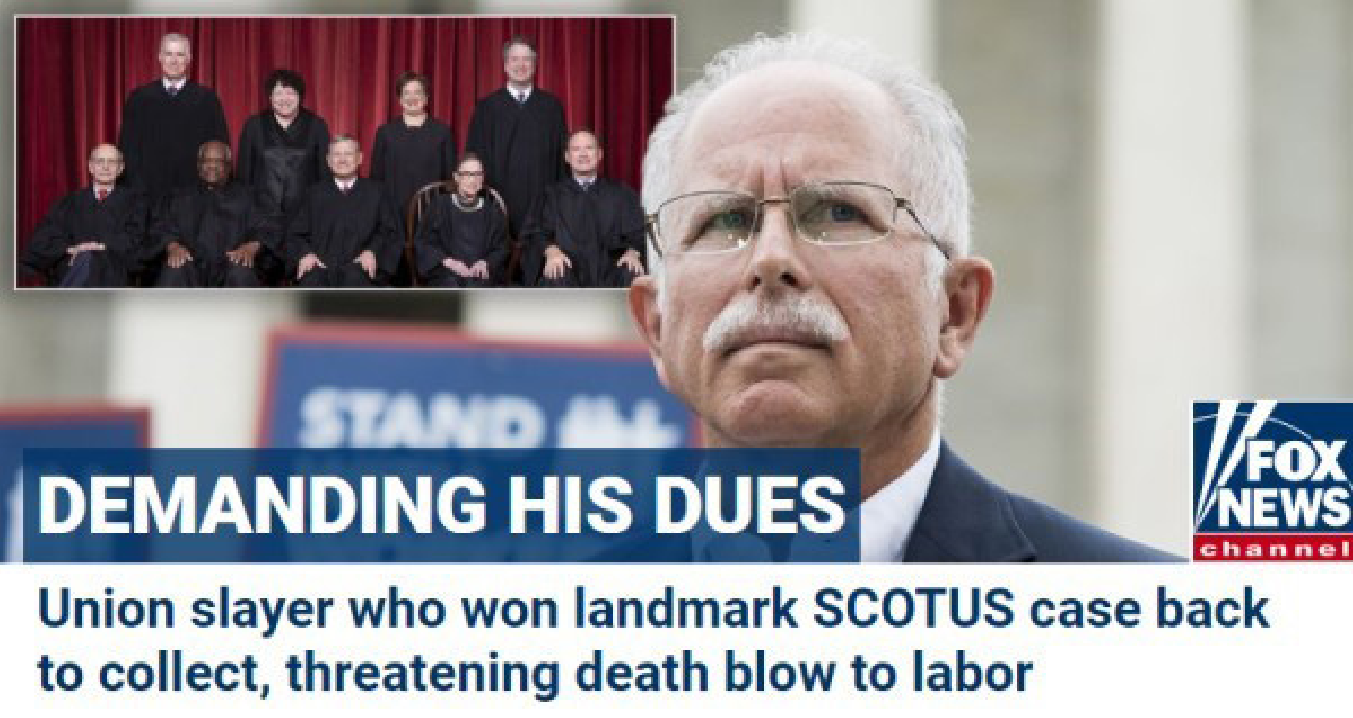
Mark Janus’ second Foundation-backed appeal to the Supreme Court landed the top spot on Fox News’ website. If Janus prevails again, hundreds of millions of dollars in unconstitutional union dues could be returned to public sector employees.
WASHINGTON, DC – Mark Janus is returning to the U.S. Supreme Court, this time asking the Justices to hear the continuation of Janus v. American Federation of State, County, and Municipal Employees (AFSCME), Council 31. Janus seeks repayment of the thousands of dollars in fees the union took from his paycheck in violation of his First Amendment rights. Another Supreme Court victory for Janus could set a precedent resulting in the return of hundreds of millions of dollars seized by union officials in violation of workers’ constitutional rights.
The original Janus v. AFSCME was argued successfully before the Supreme Court by veteran National Right to Work Foundation staff attorney William Messenger. In a landmark victory, the Court sided with Janus on June 27, 2018, and declared it illegal to force public employees to subsidize a union as a condition of employment. The Court recognized that compelling public workers to pay fees to a union violates their First Amendment rights.
Illinois Child Support Public Servant Intervenes in Lawsuit with Foundation Aid
As a result of Janus, more than five million public sector employees across the country are no longer required to pay union dues or fees to keep their jobs. However, Janus’ case continues as he seeks the return of the fees that AFSCME seized from his paycheck without his permission from June 27, 2018, to March 23, 2013, representing the two-year statute of limitations from the date his case started in March 2015 through the Supreme Court’s 2018 decision in his favor.
The Janus case began in February 2015, when then-newly elected Illinois Governor Bruce Rauner issued an executive order prohibiting state agencies from requiring employees who had abstained from formal union membership to pay union fees, based on a Right to Work Foundation U.S. Supreme Court victory in 2014 in another Illinois case. Rauner also filed a federal lawsuit seeking a declaratory judgment that forced union fees violate the First Amendment rights of public workers.
Staff attorneys from the Foundation, in partnership with the Illinois-based Liberty Justice Center, filed a motion for Mark Janus and two other plaintiffs to intervene in the case in March 2015, and have represented Janus ever since. The U.S. District Court for the Northern District of Illinois granted Janus’ motion to file a complaint in intervention, which allowed the suit to move forward even after the court ruled that Rauner lacked standing to pursue the lawsuit.
The Supreme Court permitted union bosses to impose forced union fees on public workers in the 1977 Abood v. Detroit Board of Education decision. However, before the Janus victory, Foundation staff attorneys secured several victories for workers which called the constitutionality of forced fees into question. In 2012, the court ruled in Knox v. SEIU that union officials must obtain affirmative consent from workers before using workers’ forced union fees for special assessments or risk infringing on their First Amendment rights. In 2014, the court ruled in Harris v. Quinn that requiring home healthcare providers who receive a subsidy from the government to pay union dues is a First Amendment violation.
Following Janus’ groundbreaking win at the Supreme Court in June 2018, Foundation attorneys continued his case in Illinois federal courts, arguing that the Supreme Court’s ruling is retroactive and that AFSCME should be required to return dues they seized unconstitutionally before the decision. In this and similar cases, union bosses have made a so-called “good faith” argument to defend their seizing of dues before Janus was issued. The U.S. Seventh Circuit Court of Appeals in Chicago ruled in 2019 that AFSCME could keep the unconstitutional dues, prompting Janus’ petition to the Supreme Court.
Hundreds of Millions of Dollars Potentially At Stake
“The Supreme Court agreed that the union taking money from non-members was wrong but the union still has the money it illegally garnished from my paycheck,” commented Janus. “It’s time for AFSCME to give me back the money they wrongfully took.”
Foundation staff attorneys are currently fighting for thousands of workers in about 20 cases which seek refunds of dues seized unconstitutionally before Janus was decided. While Janus is seeking the return of $3,000 of his own money, a favorable decision for him would set a precedent that could result in the return of over $120 million to public servants just in Foundation-backed cases. Other cases brought by workers could bring that total to hundreds of millions of dollars.
Workers Already Winning Refunds of Illegal Dues with Foundation Legal Aid
“The Supreme Court has already sided with the Foundation arguments for Mark Janus and ruled that forcing public employees to fund union activities violates the First Amendment,” said National Right to Work Foundation Vice President and Legal Director Raymond LaJeunesse. “The Supreme Court should take this case again to ensure that public sector union bosses are not permitted to profit from their widespread violation of workers’ First Amendment rights.”
Foundation staff attorneys in July 2018 secured the nation’s first-ever refund of dues seized unconstitutionally before Janus for Debora Nearman, an Oregon state wildlife employee. SEIU bosses were forced to settle and give back to Nearman over $3,000 in illegal fees they had seized from her over two years, during which they had sponsored an aggressive political campaign against her own husband, who ran successfully for the Oregon Legislature in 2016.
West Virginia Supreme Court Cites Foundation-Won Janus Case in Decision to Uphold Right to Work Law
In April the West Virginia Supreme Court upheld West Virginia’s Right to Work law, ending a multi-year union boss legal challenge.
National Right to Work Foundation Vice President and Legal Director Raymond LaJeunesse wrote an article for The Federalist Society analyzing the decision in the case: Morrisey v. West Virginia AFL-CIO. LaJeunesse just published piece highlights how the justices relied heavily on the Foundation-won Janus v. AFSCME U.S. Supreme Court decision to uphold the law protecting workers against being forced to subsidize union activities:
“Four of the five Justices concluded in Morrisey that the United States Supreme Court’s decision in Janus v. AFSCME, 138 S. Ct. 2448 (2018), required that result. Janus held that forcing nonmembers to pay union fees as a condition of public employment violates the First Amendment. As Justice Workman put it, concurring in the judgment of the Court in Morrisey, ‘there is no principled basis on which to conclude that under the legal analysis upon which Janus is based, a prohibition on the collection of agency fees is constitutional for public employees’ unions but unconstitutional for private employees’ unions.'”
Foundation staff attorneys filed 10 legal briefs in Morrisey in defense of West Virginia’s Right to Work law. Foundation President Mark Mix hailed the decision as a “a great victory for Mountain State employees.”
Since 2012, Foundation staff attorneys have defended and enforced five newly passed Right to Work in states including West Virginia.
Electrician Files Discrimination Lawsuit Challenging Forced Union Fees
The following article is from the National Right to Work Legal Defense Foundation’s bi-monthly Foundation Action Newsletter, January/February 2020 edition. To view other editions or to sign up for a free subscription, click here.
Boston College and SEIU officials ignored reasonable request to accommodate religious beliefs
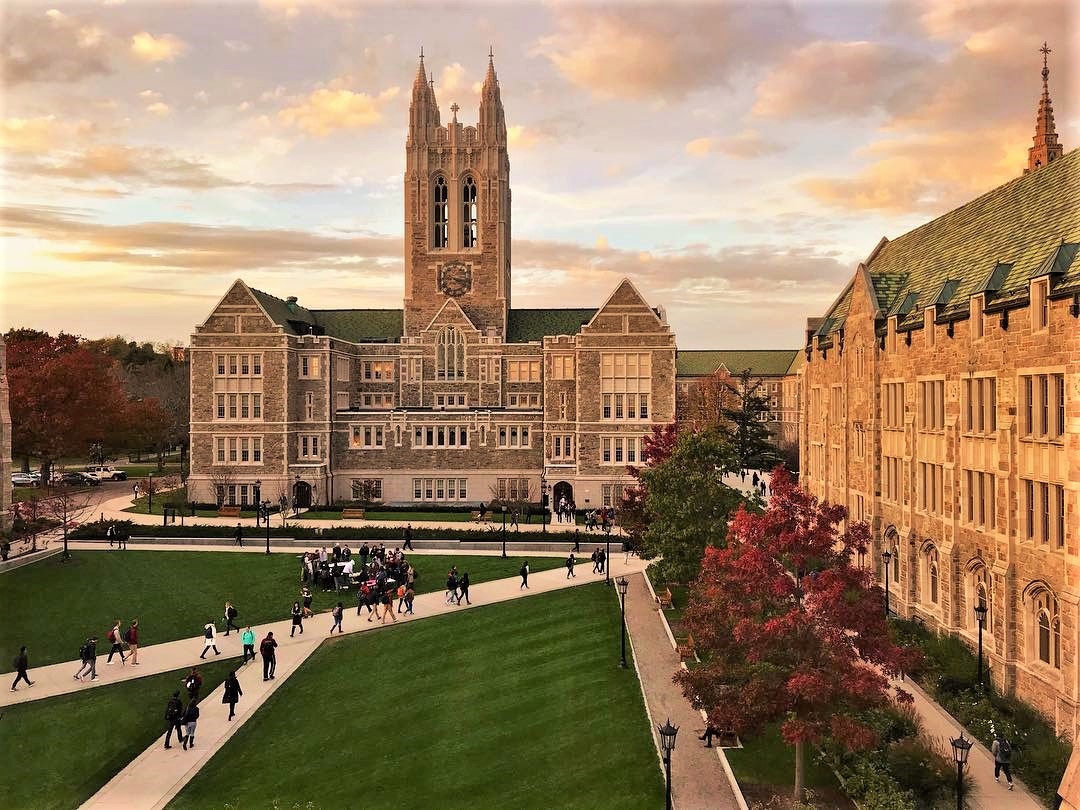 Boston College officials seized union fees from electrician Ardeshir Ansari’s paycheck at the behest of SEIU bosses, even after he had informed them that such fees violate his religious beliefs.
BOSTON, MA – In November, National Right to Work Foundation staff attorneys filed a federal Title VII religious discrimination lawsuit for a Boston College electrician whose rights were violated by the Service Employees International Union (SEIU) in illegally demanding union fees. The lawsuit also names his employer, Boston College, for its role in the discrimination.
Ardeshir Ansari objects to supporting the union based on deeply held religious beliefs. Under the local SEIU’s monopoly bargaining agreement at Boston College, however, he was told that he must join or financially support the SEIU or be fired. To avoid being fired, Ansari unwillingly paid fees to the union in violation of his sincere religious beliefs.
On October 1, 2018, Ansari sent a letter to Boston College and the SEIU, informing them his religious beliefs conflict with joining or financially supporting the union. He asked that his union fees be diverted to charity instead of being sent to the union, an established remedy for such a conflict.
Instead of responding, the college continued to take a cut of his paycheck and send it to SEIU officials in violation of his sincerely held religious beliefs.
In response, Ansari filed charges with the Equal Employment Opportunity Commission (EEOC) against college and union officials. The EEOC then determined that both Boston College and the SEIU had violated Title VII.
Last September, the EEOC gave Ansari a right-to-sue letter, which authorized him to file a lawsuit under Title VII of the Civil Rights Act of 1964. That federal law prohibits employers and unions from discriminating against an individual based on his or her religious beliefs.
In November, Foundation staff attorneys filed a lawsuit for Ansari against Boston College and the SEIU for illegally discriminating against him by failing to reasonably accommodate his religious beliefs, violating his rights under Title VII.
The lawsuit demands that college and SEIU local officials pay all fees deducted from Ansari’s paycheck to a charity mutually agreed upon and seeks damages for the emotional distress he suffered while his rights were violated for more than a year.
EEOC Found Religious Discrimination by SEIU
Moreover, the Title VII lawsuit asks the court to prevent the college from continuing to discriminate against his religious beliefs and that the union be required to inform workers that those with religious objections to the payment of union fees are entitled by law to pay those fees to a charity instead.
“Workers with sincere religious objections to joining or funding a union are legally protected from being forced to violate their conscience,” said National Right to Work Foundation Vice President and Legal Director Ray LaJeunesse. “No one should ever be forced to choose between keeping a job to provide for their family and violating their deeply held religious beliefs by supporting a union.”
“Right to Work laws protect workers like Mr. Ansari from this kind of discrimination. Under those laws, workers can stop paying union fees and resign union membership for any reason and thus avoid illegal religious discrimination,” added LaJeunesse.
Featured Article: “The Future Looks Bright for the Right to Work Movement”
The Regulatory Review has ranked the essay entitled “The Future Looks Bright for the Right to Work Movement” by National Right to Work Foundation Vice President and Legal Director Raymond J. LaJeunesse, Jr. as one of the publication’s top essays in 2019.
The essay highlights successes in the ongoing fight against forced unionism through legal and legislative reform:
Thomas Jefferson famously said that it is “sinful and tyrannical” for government “to compel a man to furnish contributions of money for the propagation of opinions which he disbelieves and abhors.” That principle is consistent with the guarantees of freedom of speech and association enshrined in the U.S. Constitution’s First Amendment. Yet, some federal and state labor laws in this country have long authorized requirements that workers pay union dues as a condition of employment, requirements known as the “union shop” or “agency shop.” Increasingly, however, legislatures and courts are recognizing that workers have a constitutional right to work without being forced to subsidize a union.
Among recent achievements for the Right to Work movement are five new state Right to Work laws passed since 2012 and the landmark Foundation-won Janus v. AFSCME Supreme Court decision in June 2018.
The complete essay is available to read online here.
Foundation Urges Federal and State Governments to Protect First Amendment Rights
The following article is from the National Right to Work Legal Defense Foundation’s bi-monthly Foundation Action Newsletter, November/December 2019 edition. To view other editions or to sign up for a free subscription, click here.
Alaska first state to require First Amendment Janus rights waiver before deducting union dues
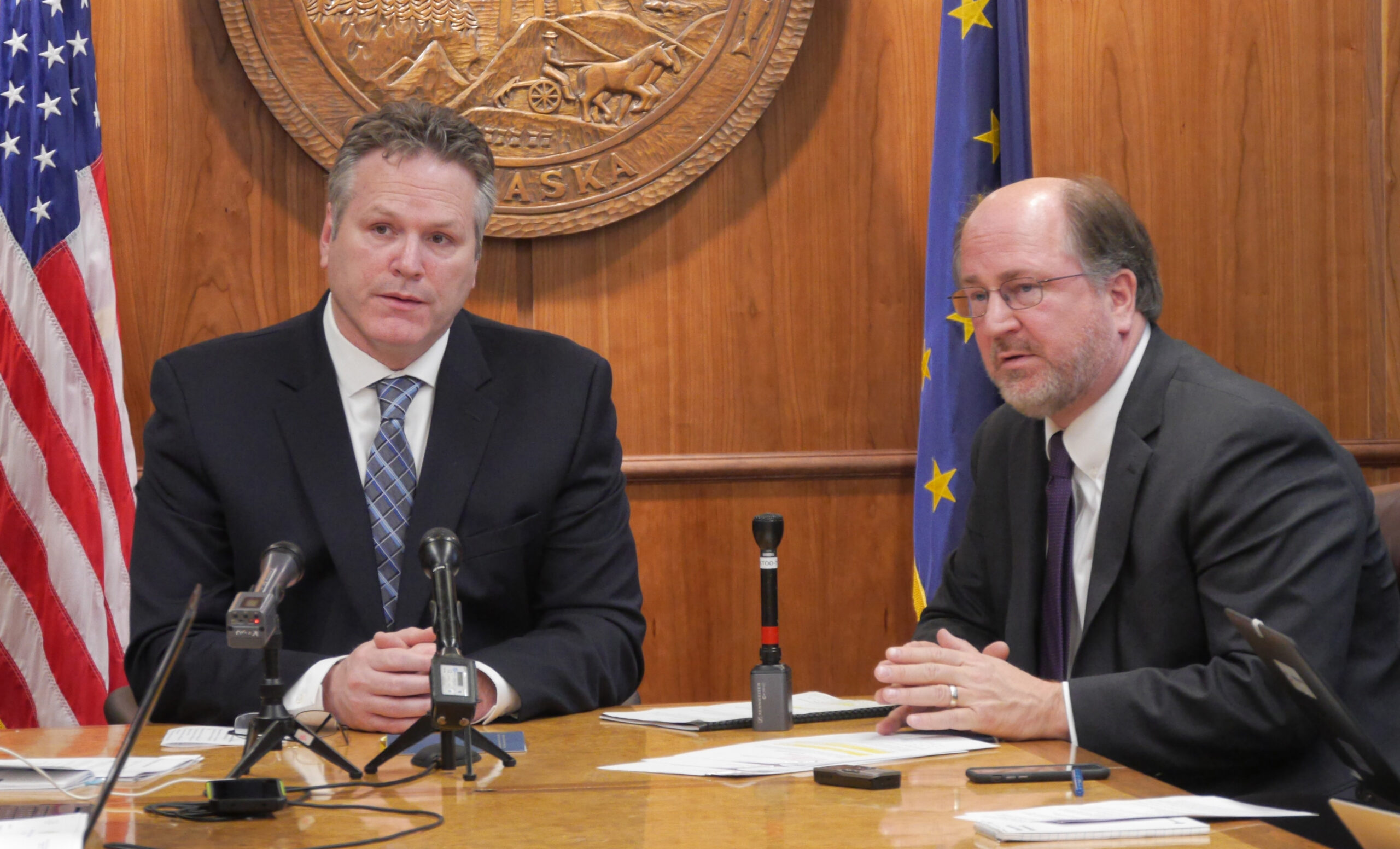 Alaska Gov. Mike Dunleavy (left), following an opinion from Attorney General Kevin Clarkson, ordered all Alaska state agencies to protect state employees’ First Amendment rights under Janus.
ANCHORAGE, AK – In late September, Alaska Governor Mike Dunleavy signed an executive order to protect the First Amendment rights of state employees established in last year’s Janus v. AFSCME Supreme Court decision. The order calls for the State of Alaska to stop deducting union dues from the paycheck of any worker who hasn’t filed a form with the state affirmatively waiving his or her First Amendment right under Janus not to fund any union activities.
The move follows a letter last year sent by National Right to Work Foundation Legal Director Raymond LaJeunesse to state comptrollers in Alaska and other states, urging them to modify dues deduction policies to comply with the Janus decision.
Foundation Comments Detail Need to End Dues Deductions Uncompliant with Janus
The Foundation also recently filed comments with the Federal Labor Relations Authority (FLRA) regarding the need for the federal government to take steps to protect the First Amendment rights of employees recognized in the Foundation-won Janus decision. The Foundation’s comments were submitted after the U.S. Office of Personnel Management (OPM) asked the FLRA to solicit public comments on how to proceed with union dues deductions in light of the Supreme Court’s Janus decision last year.
In that case, the High Court held that requiring public employees to pay union dues or fees without their consent violates the employees’ First Amendment rights “by compelling them to subsidize private speech on matters of substantial public concern.” Justice Samuel Alito’s opinion for the court further ruled that no union dues or fees could be taken from a public employee “unless the employee affirmatively consents to pay” using a “freely given” waiver of his or her First Amendment rights.
Consistent with that standard, the Foundation’s comments urge the FLRA to issue guidance to agencies that they “must cease deducting union dues from the wages of employees who signed a dues deduction form that does not satisfy the [Janus] standard.” According to Department of Labor statistics, nearly one million federal employees — 26.4% of all federal workers — are union members, many of them likely having dues deducted from their paychecks despite never having knowingly waived their First Amendment right not to subsidize union activities.
The Foundation comments make clear that these dues deductions should cease in the wake of Janus. To comply with Janus, workers wanting to voluntarily pay union dues can either provide the government with a valid waiver of their rights or pay dues on their own without using taxpayer-funded payroll systems to forward the money to union officials.
The Foundation’s comments to the FLRA further argue that, even where workers provide a valid authorization for dues deductions that meets the Janus standard, the government shouldn’t block them from revoking that authorization if the request is submitted at any time at least a year after the Janus-compliant authorization was obtained.
Foundation Comments Push to End Union-Created “Window Period” Scheme
Unfortunately, agencies and union officials often prohibit federal employees from stopping the seizure of union dues from their wages except during short annual escape periods. The comments filed by the National Right to Work Foundation say that this practice does not comply with Janus either.
“The Janus precedent is very clear about this: Without affirmative and knowing waivers from public workers, government entities cannot collect union dues without violating a worker’s First Amendment rights,” commented National Right to Work Foundation President Mark Mix.
“Currently, the government seizes union dues from almost one million federal employees in violation of the Janus decision’s First Amendment standard. Federal agencies are obligated to protect workers’ constitutional rights in this rulemaking process.”
Since the Janus decision last year, Foundation staff attorneys have been fighting to ensure public workers’ First Amendment rights are protected, litigating more than 30 cases in federal courts across the country to enforce the landmark ruling.
Veteran Foundation Attorneys Highlight NLRB Victory for Workers Over UAW Union Bosses
Earlier this month, National Right to Work Foundation staff attorneys won a decision at the National Labor Relation Board (NLRB) for Johnson Controls Inc. employees seeking to remove the United Auto Worker (UAW) union from their workplace.
Foundation Vice President and Legal Director Raymond LaJeunesse and veteran Foundation staff attorney Glenn Taubman, who provided free legal aid to the workers, recently authored an article for the Federalist Society about the victory and how it advances the rights of workers seeking to free themselves from union monopoly ranks:
The main takeaways from this case are: 1) employers can lawfully withdraw recognition of a union when presented with objective evidence (like an employee signature petition) that the union has lost majority support, and they now face less legal jeopardy for honoring the wishes of their employees than they did under the prior regime; 2) secret ballot elections remain the favored method for determining employees’ representational desires, so if the union is “anticipatory” ousted based upon a majority employee petition but believes it actually possesses majority support, it cannot litigate its way back to power using the slow and prolonged unfair labor practice process, but must file for a secret ballot election; and 3) as noted in the dissenting opinion of Obama appointee Lauren McFerran, the Johnson Controls decision could open the door to periodic recertification elections for unions.
Many employee advocates have long urged that recertification elections are desirable. Unlike politicians who must automatically face periodic elections (a.k.a “recertifications”), current NLRB law “presumes” that unions retain majority status in perpetuity. Yet statistics show that 94% of unionized workers have never voted for the union representing their workplace. James Sherk, Union Members Never Voted for a Union, Heritage Foundation, August 30, 2016. If the NLRB adopts a recertification process, unions could not rely upon outdated doctrines granting them perpetual majority status, but would have to periodically prove their majority support. As National Right to Work Foundation attorneys have long argued, permanently encrusting a labor union on a bargaining unit, with no showing of current employee support, does not lead to workplace stability or protect employees’ right of free choice.
Read the rest here.
Learn more about the decision here.





