
Foundation Urges Federal and State Governments to Protect First Amendment Rights
The following article is from the National Right to Work Legal Defense Foundation’s bi-monthly Foundation Action Newsletter, November/December 2019 edition. To view other editions or to sign up for a free subscription, click here.
Alaska first state to require First Amendment Janus rights waiver before deducting union dues
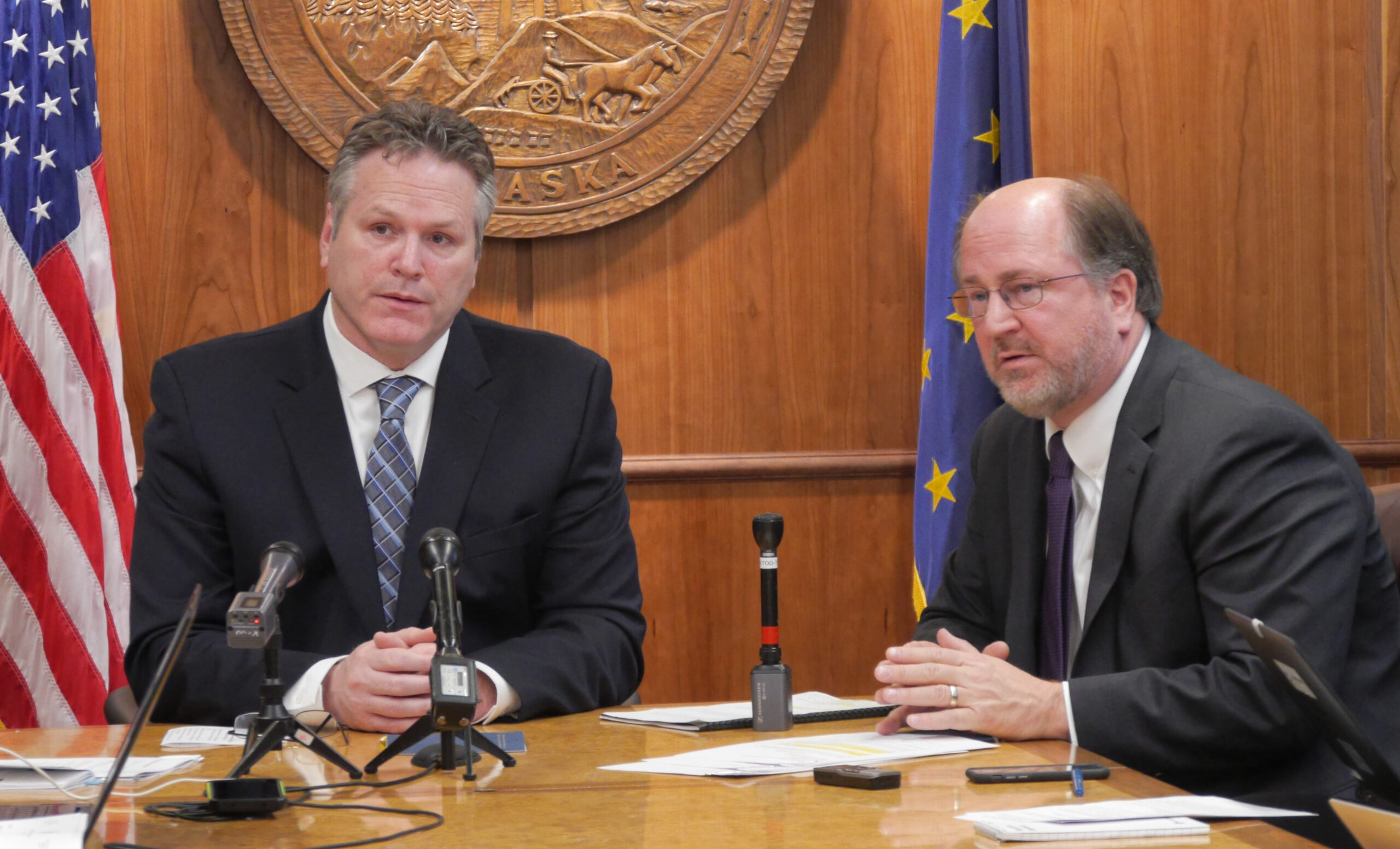 Alaska Gov. Mike Dunleavy (left), following an opinion from Attorney General Kevin Clarkson, ordered all Alaska state agencies to protect state employees’ First Amendment rights under Janus.
ANCHORAGE, AK – In late September, Alaska Governor Mike Dunleavy signed an executive order to protect the First Amendment rights of state employees established in last year’s Janus v. AFSCME Supreme Court decision. The order calls for the State of Alaska to stop deducting union dues from the paycheck of any worker who hasn’t filed a form with the state affirmatively waiving his or her First Amendment right under Janus not to fund any union activities.
The move follows a letter last year sent by National Right to Work Foundation Legal Director Raymond LaJeunesse to state comptrollers in Alaska and other states, urging them to modify dues deduction policies to comply with the Janus decision.
Foundation Comments Detail Need to End Dues Deductions Uncompliant with Janus
The Foundation also recently filed comments with the Federal Labor Relations Authority (FLRA) regarding the need for the federal government to take steps to protect the First Amendment rights of employees recognized in the Foundation-won Janus decision. The Foundation’s comments were submitted after the U.S. Office of Personnel Management (OPM) asked the FLRA to solicit public comments on how to proceed with union dues deductions in light of the Supreme Court’s Janus decision last year.
In that case, the High Court held that requiring public employees to pay union dues or fees without their consent violates the employees’ First Amendment rights “by compelling them to subsidize private speech on matters of substantial public concern.” Justice Samuel Alito’s opinion for the court further ruled that no union dues or fees could be taken from a public employee “unless the employee affirmatively consents to pay” using a “freely given” waiver of his or her First Amendment rights.
Consistent with that standard, the Foundation’s comments urge the FLRA to issue guidance to agencies that they “must cease deducting union dues from the wages of employees who signed a dues deduction form that does not satisfy the [Janus] standard.” According to Department of Labor statistics, nearly one million federal employees — 26.4% of all federal workers — are union members, many of them likely having dues deducted from their paychecks despite never having knowingly waived their First Amendment right not to subsidize union activities.
The Foundation comments make clear that these dues deductions should cease in the wake of Janus. To comply with Janus, workers wanting to voluntarily pay union dues can either provide the government with a valid waiver of their rights or pay dues on their own without using taxpayer-funded payroll systems to forward the money to union officials.
The Foundation’s comments to the FLRA further argue that, even where workers provide a valid authorization for dues deductions that meets the Janus standard, the government shouldn’t block them from revoking that authorization if the request is submitted at any time at least a year after the Janus-compliant authorization was obtained.
Foundation Comments Push to End Union-Created “Window Period” Scheme
Unfortunately, agencies and union officials often prohibit federal employees from stopping the seizure of union dues from their wages except during short annual escape periods. The comments filed by the National Right to Work Foundation say that this practice does not comply with Janus either.
“The Janus precedent is very clear about this: Without affirmative and knowing waivers from public workers, government entities cannot collect union dues without violating a worker’s First Amendment rights,” commented National Right to Work Foundation President Mark Mix.
“Currently, the government seizes union dues from almost one million federal employees in violation of the Janus decision’s First Amendment standard. Federal agencies are obligated to protect workers’ constitutional rights in this rulemaking process.”
Since the Janus decision last year, Foundation staff attorneys have been fighting to ensure public workers’ First Amendment rights are protected, litigating more than 30 cases in federal courts across the country to enforce the landmark ruling.
Healthcare Worker Sues Teamsters Union and Healthcare Facility for Violating West Virginia Right to Work Law
Former Tygart Center employee says union officials and employer violated her legal rights by demanding she join the union and pay union dues and fees to keep her job
Fairmont, WV (December 24, 2019) – With free legal aid from the National Right to Work Legal Defense Foundation, healthcare worker Donna Harper filed a lawsuit against Teamsters Local 175 and the Tygart Center for violating her rights under the State of West Virginia’s Right to Work law.
West Virginia’s Right to Work law prohibits requiring workers to pay union dues or fees just to get or keep a job. In defiance of West Virginia’s Right to Work law, Tygart Center and Teamsters union officials entered into a collective bargaining agreement that required employees to pay union dues and fees as a condition of employment.
When Harper was hired, Tygart Center officials informed Harper that she must become a union member and pay union dues as a condition of employment in violation of her legal rights. Tygart Center officials deducted full union membership dues and fees from Harper’s paycheck and remitted this money to Teamsters union officials.
In March 2019, Harper successfully exercised her legal rights by resigning her union membership. Even then union officials continued taking union dues from her paycheck. Union officials also never fully refunded the union dues unlawfully seized from her wages.
Foundation staff attorneys filed the suit against the Tygart Center and the Teamsters union for Harper in Marion County Circuit Court. Harper worked at the Tygart Center from February 2018 until September 2019 as a Laundry Aide and as a Certified Nursing Assistant.
Foundation staff attorneys also filed an amicus brief for Harper with the West Virginia Supreme Court defending the state Right to Work law against a protracted lawsuit brought by several unions seeking to overturn the law and restore union officials’ power to have workers fired for refusing to pay union dues or fees. That case is scheduled for oral arguments in the Supreme Court on January 15. That court has already rejected the unions’ arguments once, overturning a preliminary injunction against the Right to Work law.
“Teamsters union bosses demonstrated a blatant disregard for the law by illegally demanding Ms. Harper and her coworkers pay union dues and fees just to get or keep their jobs,” said National Right to Work Foundation President Mark Mix. “Contrary to Big Labor’s wishes, West Virginia’s Right to Work law is in full effect, meaning all union dues for workers covered by the law must be completely voluntary.”
National Right to Work Foundation In the Wall Street Journal: “Trapped by the Teamsters”
Recently the Wall Street Journal published a piece by National Right to Work Legal Defense Foundation President Mark Mix titled “Trapped by the Teamsters.”
The op-ed describes the numerous NLRB policies, doctrines and “bars” workers across the country face when merely attempting to hold a vote to oust Teamsters bosses and other union officials as their monopoly bargaining so-called “representative.” The article illustrates these coercive policies through recent examples faced by workers who have turned to the Foundation for free legal aid:
A majority of workers at a Wisconsin trucking company experienced this over the past two years. First, they were blocked from removing their union by the so-called voluntary-recognition bar. This stops workers from decertifying a union for up to a year after the union is installed through “card check”—a procedure that avoids the need for a secret ballot and makes workers vulnerable to union intimidation.
Then, after waiting a year for that bar to expire, the Wisconsin workers found they had been merged by Teamsters officials into a multicompany nationwide bargaining unit of about 24,000 workers. Suddenly the petition to oust the local union was 7,000 signatures short—for a workplace with fewer than 10 union workers. Last month the NLRB declined the Wisconsin workers’ appeal, though a majority of voting board members signaled they would revisit the “merger doctrine” policy in the future.
Other workers face other hurdles: The “settlement bar” blocks a decertification vote because of an NLRB settlement to which the workers weren’t a party; the “successor bar” blocks a vote for up to a year after a company is acquired; the “contract bar” blocks a vote for up to three years after a union contract is forged; and a “blocking charge” blocks a vote while union allegations against a company are pending. None of these are required by law.
The NLRB is addressing the voluntary-recognition bar and blocking charges through the current rule-making process, but the other policies are similarly destructive of workers’ legal right to vote out a union that lacks majority backing. Congress should act to protect workers from being trapped in union ranks they oppose, but in the meantime the NLRB has the authority to eliminate these barriers.
Union officials unable to win the support of a majority of the workers they purport to represent shouldn’t maintain power solely because of bureaucratic rules. Instead, whenever enough workers file a petition to remove a union they oppose, the NLRB should simply let them vote.
Read the whole piece here.
Alaska School Bus Drivers Win Three Year Battle to Kick Unpopular Teamsters Union Bosses Out of Their Workplace
Multi-year legal fight to remove union opposed by majority of workers shows need for reform of NLRB rules that allow unions to block workers’ from holding decertification votes
Anchorage, AK (December 9, 2019) – A group of Alaskan school bus drivers have just prevailed in their years-long effort to remove an unpopular Teamsters union from their workplace. The union’s ouster comes after National Right to Work Legal Defense Foundation staff attorneys provided free legal aid to Elizabeth Chase, the bus driver leading the charge to hold a decertification election so workers could vote out the union.
After workers sought for almost three years to remove the union, Teamsters Local 959 union officials finally stopped fighting the workers’ efforts by filing a disclaimer of interest with the National Labor Relations Board (NLRB) Region 19 in Seattle. The disclaimer came after the Region dismissed the union’s latest unfair labor practice charge following Chase’s fifth request for review to the full NLRB in Washington, DC, contesting the Regional Director’s continued block of a decertification vote at the behest of Teamsters bosses.
Chase is an employee of Apple Bus Company near Anchorage, Alaska. In July 2017, she submitted a decertification petition to NLRB Region 19 asking for a secret ballot election to remove the Teamsters as the monopoly bargaining representative in her workplace. Under the National Labor Relations Act (NLRA), if a decertification petition garners signatures from at least 30 percent of the employees in a bargaining unit, the NLRB is supposed to conduct a secret-ballot election to determine whether a majority of the employees wish to decertify the union. Chase’s initial petition was signed by more than 50 percent of the workers in the bargaining unit, far more than necessary to trigger a decertification vote.
The NLRB Regional Director blocked the decertification vote later that year, citing the Obama Labor Board-backed “successor bar,” which prohibits workers from removing an unwanted union simply because the ownership of an employer has changed hands. That “successor bar” is not mandated by the NLRA, which the NLRB is charged with enforcing.
Despite that setback, Chase and her coworkers continued their efforts to remove the Teamsters from their workplace, filing another decertification petition in 2018. This time, Teamsters officials moved to prevent the vote by filing successive “blocking charges” with the Regional Director, alleging unfair labor practices by Apple Bus. The Regional Director repeatedly allowed union officials to block a vote despite Chase’s pointing out that the Region failed to “explain specifically what causal connection(s) exist” between the petition and the union bosses’ allegations that made it necessary to stop the vote. All told, Chase requested five times that the full NLRB in Washington, DC, reverse the Regional Director’s decisions and let the vote proceed.
The NLRA, the federal law that the NLRB is tasked with enforcing, grants all workers the right to remove an unpopular union. Most restrictions manipulated by union bosses to halt decertification votes (such as the “successor bar” and “blocking charges”) are not established in its text but have been read into it by Big Labor-friendly Board Members under the Clinton and Obama administrations. Foundation staff attorneys have been fighting for workers for decades to eliminate these unfair, non-statutory limitations on workers’ rights to hold a vote to remove a union that has lost most workers’ support.
The NLRB is currently accepting comments on reforming the “blocking charge” doctrine and another non-statutory bar to decertification elections, the “voluntary recognition” bar. In comments to the Labor Board, Chase’s Apple Bus coworker Donald Johnson blasted the union’s ability to game the NLRB’s system to delay a decertification vote for years as “the most unfair and anti-democratic event I have been involved with in my entire life.” The window for submitting comments to the NLRB ends on January 9, 2020. Foundation attorneys have prepared comments they will file urging the Board to end both the “blocking charge” policy and “voluntary recognition” bar.
“The NLRB is tasked with protecting the right of employees to remove a union that is opposed by a majority of workers, but as this case shows us that right is undermined by non-statutory NLRB policies that allow workers to be trapped in union ranks for years at a time without even a decertification vote,” observed National Right to Work Foundation President Mark Mix. “Though Ms. Chase and her coworkers are finally free from the coercive reign of a plainly unpopular Teamsters union, the NLRB must act quickly to roll back the undemocratic election bars and blocking charge policies that undermined their rights for almost three years.”
General Motors Employee Hits UAW Union Bosses with Federal Unfair Labor Practice Charge for Illegal Discrimination
Charge: UAW officials illegally discriminated against nonmember worker causing GM to block possible promotion
Lansing, MI (September 18, 2019) – General Motors (GM) employee Joseph Small has filed an unfair labor practice charge against the United Auto Worker (UAW) Local 652 union with free legal aid from the National Right to Work Legal Defense Foundation.
According to the charge filed with the National Labor Relations Board (NLRB) by National Right to Work Foundation staff attorneys, union officials interfered in the interview and hiring process for an opening at GM for which Small had applied. Union officials later admitted the position went to a union member instead of Small because Small had exercised his legal right to refrain from union membership and from paying union dues.
This discrimination against Small by UAW union officials violates his legal rights under the National Labor Relations Act (NLRA). The NLRA outlaws discrimination by union officials against workers who elect to refrain from union activity. Small exercised his rights under Michigan’s Right to Work law, which not only allows workers to decline union membership but allows workers to stop any payment of union dues or fees as a condition of employment.
The unfair labor practice charge by Small comes as UAW officials have ordered a nationwide strike against GM affecting over 40,000 workers. The Foundation has issued a special notice to GM employees informing them about how to exercise their legal rights to refrain from participating in the strike and return to work.
The notice can be found here: www.nrtw.org/UAW-GM
Meanwhile, UAW officials have been caught up in an expanding corruption and embezzlement scandal that has resulted in numerous indictments, with the FBI reportedly recently raiding the home of current UAW President Gary Jones just weeks ago. In a separate case brought Foundation staff attorneys, the NLRB issued a decision earlier this month holding that UAW officials illegally seized dues from a Ford Motors employee’s paycheck while ordering the union to return the funds.
“UAW union officials continue to show a willingness to break the law, even violating the rights of the very workers they claim to represent,” said National Right to Work Foundation President Mark Mix. “Whether it be federal corruption prosecutions or unfair labor practice charges at the NLRB, UAW bosses must be held accountable when they break the law.”
Labor Day Media Round Up: National Right to Work Commentaries Highlight Injustices of Forced Unionism
On Labor Day, the National Right to Work Foundation generated significant coverage in both national and local media outlets, especially on newspaper opinion pages. Foundation President Mark Mix wrote a number of pieces for outlets around the country highlighting the injustices of compulsory unionism and what can be done to protect workers freedom.
Mix wrote for USA Today that no American should be forced to pay union dues just to get or keep a job and highlighted the prevalence of compulsory unionism despite Right to Work laws gaining ground:
Twenty-seven states have now enacted and implemented right-to-work laws, with five joining in the last eight years.
And on June 27 of last year, the U.S Supreme Court handed down one of the most significant employee rights legal victories in the history of the right-to-work movement with the Janus decision, which ended the forced payment of union dues or fees for millions of government workers nationwide.
Unfortunately, there are more private sector American workers in the 23 non-right-to-work states and others in the railway and airline industries who still work under compulsory unionism.
Mix also wrote a column for the Detroit News arguing that no worker should ever have to fear union violence just because they disagree with union tactics or thuggish strong-arming:
Violence, the threat of violence and the wrongful non-violent use of fear and intimidation by union thugs should be illegal. No exceptions.
The spreading UAW corruption scandal shows that union bosses often act as though they are above the law.
For the Lexington Herald-Leader, Mix wrote about how Kentucky’s Right to Work law benefits the state, and why they need to protect it from the attacks of Democrat and gubernatorial candidate Attorney General Andy Beshear, who wants to give power back to union bosses should he be elected to replace Governor Matt Bevin a friend of Right to Work:
Beshear wants to return the Commonwealth of Kentucky to the days of workers being forced to hand over a portion of their hard-earned paychecks to the union boss elites to get or keep a job. Meanwhile, the Bevin Administration has spearheaded record economic growth after passing Right to Work here in Kentucky.
Even putting that enormous economic growth aside, the fact is that one candidate favors allowing Big Labor to extract money from workers’ paychecks, and the other candidate has worked tirelessly to protect Kentucky workers’ right to hold onto their paychecks without union boss interference.
And for the Las Vegas Review-Journal, Mark wrote how Right to Work laws have benefitted Nevada’s workers and families for more than half a century, causing noticeable effects for the state’s economy:
There is a reason Tesla’s Gigafactory is located in Nevada and not California. A nationwide 2017 survey of business leaders conducted by Chief Executive magazine found that, by a 2-to-1 margin, CEOs prefer adding jobs in right-to-work states over other states.
Business owners correctly view states that have passed right-to-work laws as being more welcoming and business-friendly than high-tax, forced-dues states such as California. That is why federal Bureau of Labor Statistics data show that from 2013-18, factory employment growth in Nevada was more than three times greater than in Western forced-union states such as Colorado, Oregon and Montana.
Just a few days after Labor Day, the Daily Caller published a timely op-ed from Mix regarding the Trump Administration’s rules to make it harder for union officials, like those implicated in the unfolding UAW scandal, to spend worker’s money on themselves or fuel their corruption:
At the end of May, the Trump Labor Department unveiled a rule that, as a contemporaneous news account filed by the Law360 legal news service explained, imposes “financial disclosure requirements for certain trusts that unions set up, scrutiny the agency says will ‘deter fraud and corruption.”
The proposed rule would reestablish the Form T-1, which until it was scuttled by union-label Obama administration bureaucrats in 2010 blocked officers of unions with $250,000 or more in annual revenue from using trusts supposedly created to benefit rank-and-file members to circumvent the federal reporting requirements for such unions that Congress instituted in the Labor-Management Reporting and Disclosure Act.
In addition, Mix wrote two op-eds, one for Right to Work states and the other for non-Right to Work states, which were sent out across the country and printed in local newspapers. They highlight the benefits of Right to Work laws and the problems that forced unionism causes.
Labor Board Rules UAW Violated Ford Worker’s Legal Rights by Unlawfully Accepting Union Dues Deducted from Paycheck
NLRB orders union officials to reimburse funds seized after employee resigned his union membership and revoked authorization to deduct any further dues
Washington, D.C. (September 4, 2019) – Ford Motor Company employee Lloyd Stoner won an important legal victory at the National Labor Relations Board (NLRB) with free litigation aid from National Right to Work Legal Defense Foundation staff attorneys after union officials violated his legal rights.
An NLRB three-member panel unanimously affirmed a ruling by an administrative law judge that United Automobile Workers (UAW) Local 600 union officials violated Stoner’s rights under the National Labor Relations Act (NLRA). The NLRB ordered the Dearborn, Michigan-based union local officials to reimburse Stoner for union dues unlawfully deducted from his paycheck after he attempt to exercise his legal right to revoke his dues checkoff authorization.
Administrative Law Judge Michael A. Rosas ruled in February that UAW Local 600 engaged in unfair labor practices under the NLRA by accepting union dues deducted from Stoner’s wages for two-and-a-half months after he resigned union membership and revoked his authorization to deduct dues. The union also failed to refund any of the dues taken without Stoner’s consent for nearly five months after his revocation.
Stoner had already won a favorable settlement in January from the Ford Motor Company, which was charged for deducting the unauthorized dues from his paycheck.
In addition to refunding dues unlawfully deducted from Stoner’s paycheck, the NLRB ordered union officials to honor any requests of employees to resign from membership and revoke their dues checkoff authorizations. UAW union officials must refrain from coercing workers from exercising their rights under the National Labor Relations Act (NLRA), the Board added.
“By standing up for his rights, Lloyd Stoner has won a clear victory for himself and his colleagues against abusive union practices,” said National Right to Work Foundation President Mark Mix. “The Board is absolutely right that union bosses cannot keep accepting money deducted from a worker’s paycheck even after an employee resigns his union membership and tells the union he no longer wishes to pay dues.”
“It is outrageous that union officials thought they could get away with an obvious violation of the National Labor Relations Act,” Mix added. “Scandal ridden UAW bosses may claim to represent rank-and-file workers, but their actions repeatedly show they are really just out for power and money.”
National Mediation Board Issues Foundation-Advocated ‘Commonsense Reform’ to Union Decertification Rules
Today the National Mediation Board (NMB) issued its final rule simplifying the process workers under the Railway Labor Act can use to decertify a union they oppose. National Right to Work Legal Defense Foundation President Mark Mix issued the following comment regarding the rule change:
At long last the National Mediation Board is providing airline and railroad workers covered by the Railway Labor Act a straightforward way to remove unwanted union “representation” through a decertification vote.
The previous system – where workers had to create a “straw man” union just to challenge an incumbent union – only served to stymie workers’ rights and demonstrated the historic bias of the NMB in favor of compulsory unionism. In fact, it wasn’t until the Foundation-won case of Russell v. NMB in 1983 that workers even had an established legal right to throw off their union “representative,” albeit only through the unnecessarily complicated strawman system which is now finally being replaced with a simplified process to allow workers to exercise that right.
The Foundation has long advocated this type of change in the union decertification process and we are pleased the NMB has – as we called upon it to do in comments filed earlier this year – finally made this commonsense reform.
The full rule can be read here.
In April the Foundation submitted formal comments during the NMB’s rulemaking procedure. Those comments can be read here.





