
NJ, NY Sanitation Workers Vote Overwhelmingly to Flush Unwanted Teamsters Union
Mr. John Operations employees voted 30-10 to oust union officials from workplace in Labor Board decertification election
Newark, NJ (March 22, 2022) – Mr. John Operations employee David Keen and his coworkers have overwhelmingly voted to free themselves from unwanted union monopoly “representation.” After the employees filed a request for a National Labor Relations Board (NLRB) decertification election to end the union’s monopoly bargaining powers over workers at three locations of Mr. John Operations, a division of Russell Reid Waste Hauling and Disposal, the workers voted 30-10 to remove Teamsters Local 560.
Mr. Keen received free legal assistance from National Right to Work Legal Defense Foundation staff attorneys in filing the workers’ petition on January 14th for a vote to oust union officials. The petition was signed by a majority of employees who work for Mr. John Operations, which triggered an NLRB-supervised mail-ballot “decertification” election for workers at the company’s locations in Jackson, New Jersey, Depford, New Jersey and Lindenhurst, New York.
Ballots were sent to workers on February 15, with ballots due back to the NLRB Region 22 based in Newark by March 8. The NLRB tallied the votes on March 21 and determined that a strong majority opposed Teamsters union officials’ so-called “representation.”
Three ballots were challenged during the NLRB count. However, those are not enough to impact the result. When the results are officially certified, Teamsters union officials will formally be stripped of their power to impose monopoly union “representation” on workers in the three workplaces.
“We had our fingers crossed and are finally glad to be free from Teamsters union,” Mr. Keen said. “This victory couldn’t have been done without the support of our attorneys at the National Right to Work Foundation.”
This is the latest in a series of successful worker efforts to oust unwanted union officials aided by National Right to Work Foundation staff attorneys. In just the past few weeks, Foundation staff attorneys aided Penske Truck Leasing employees in Bloomington, Indiana, with filing their decertification petition, after which the union walked away; and they successfully defended Kansas City, Missouri hospital workers against an SEIU union attempt to overturn their vote to remove the union in their hospital.
The Foundation has also fought to break down union boss-created legal barriers to unseating unwanted union officials. In 2020, following detailed formal comments submitted by Foundation attorneys, the NLRB adopted rules eviscerating union bosses’ ability to stop a decertification effort with “blocking charges,” i.e., accusations made against an employer that are often unverified and have no connection to workers’ desire to kick out unwanted union officials.
“The Foundation is pleased to have helped the workers at Mr. John’s exercise their right to dispose of a union they clearly want nothing to do with,” commented National Right to Work Foundation President Mark Mix. “Foundation staff attorneys will continue to assist workers in challenging union boss monopoly power until the day when no worker in America is stuck in union ranks they oppose.”
Penske Truck Leasing Workers Free of Unwelcome Union after Teamsters Sped Off to Avoid Vote
Employees who sought to end union ‘representation’ win a swift victory
BLOOMINGTON, IN (March 9, 2022) – Mechanics and customer service employees at Penske Truck Leasing in Bloomington, Indiana have won their effort to end Teamsters union control at their workplace. Rather than contest the workers’ decertification request in a secret ballot vote, International Brotherhood of Teamsters Local Union No. 135 officials have filed documents with the National Labor Relations Board (NLRB) ending their monopoly bargaining power over all workers at the Penske Truck Leasing facility in Bloomington.
Penske Truck Leasing employee Steven Stuttle and his colleagues received free legal assistance from National Right to Work Foundation staff attorneys in filing a petition for a vote to oust union officials. All but one Penske Truck Leasing employees in the bargaining unit signed the decertification petition, which was filed with the NLRB in February 2022.
“I never felt properly represented by our union. I prefer to have the ability to negotiate the value of my skills as an individual,” Stuttle remarked about the effort. “I very much appreciate the work done by National Right to Work, I could not have done it without them.”
Before an NLRB-supervised decertification election was scheduled, Teamsters officials issued a statement, disclaiming representation in an apparent attempt to spare themselves the embarrassment of an overwhelming vote by workers to reject the union’s so-called “representation.”
This is the latest in a recent series of successful worker efforts aided by National Right to Work Foundation staff attorneys. In just the past few weeks, Foundation staff attorneys aided Atlantic Aviation PNE, Inc. employees with filing their decertification petition and successfully defended Kansas City, Missouri hospital workers against an SEIU union attempt to overturn their vote to remove the union.
The Foundation has also fought to break down union boss-created legal barriers to unseating unwanted union officials. In 2020, following detailed formal comments submitted by Foundation attorneys, the NLRB adopted rules eviscerating union bosses’ ability to stop a decertification effort with “blocking charges,” i.e., accusations made against an employer that are often unverified and have no connection to workers’ desire to kick out unwanted union officials.
“Workers across the country are exercising their rights to remove unwanted unions and throwing off the yoke of coercive monopoly unionism,” remarked National Right to Work Foundation President Mark Mix. “No worker anywhere should be forced under the so-called ‘representation’ of a union they oppose, and Foundation staff attorneys stand ready to assist workers wanting to hold a decertification election to oust a union they oppose and believe they would be better off without.”
Atlantic Aviation Employees Free from Unwanted Union after IAM Flies Away to Avoid Vote
Philadelphia Northeast Airport workers had filed for vote to remove unpopular union from workplace
Philadephia, PA (March 7, 2022) – Atlantic Aviation PNE, Inc. employee Tiffany Lipyanic and her coworkers have won their effort to free themselves from unwanted union monopoly “representation.” After the employees filed a request for a National Labor Relations Board (NLRB) decertification election to end the union’s monopoly bargaining powers over all workers at the Atlantic Aviation facility at Philadelphia Northeast Airport, International Association of Machinists (IAM) union officials abandoned their “representation” rather than face an overwhelming vote against the union.
Lipyanic and her colleagues received free legal assistance from National Right to Work Foundation staff attorneys in filing their petition for a vote to oust union officials on February 15th. The petition was signed by 11 of 16 line service and customer service representatives who work for Atlantic Aviation at the Philadelphia Northeast Airport, more than twice the number needed to trigger an NLRB-supervised “decertification” secret-ballot election, after which union officials lose monopoly bargaining power if a majority of workers vote to remove them.
Rather than proceed to a vote, International Association of Machinists and Aerospace Workers Air Transport District Lodge 142 and Local Lodge 1776 officials filed documents with the National Labor Relations Board (NLRB) disclaiming their monopoly bargaining powers on February 28.
“After trying to work with union officials for years, it became apparent our pleas fell on deaf ears. We were paying union officials and got nothing in return, so we’re glad to finally be free of them,” Lipyanic commented. “Having the National Right to Work Foundation’s assistance gave us confidence in our journey to finally free ourselves from union bureaucrats that took our money and disregarded us at every turn.”
This is the latest in a series of successful worker efforts to oust unwanted union officials aided by National Right to Work Foundation staff attorneys. In just the past few weeks, Foundation staff attorneys aided Penske Truck Leasing employees in Bloomington, Indiana, with filing their decertification petition, after which the union walked away, and successfully defended Kansas City, Missouri hospital workers against an SEIU union attempt to overturn their vote to remove the union in their hospital.
The Foundation has also fought to break down union boss-created legal barriers to unseating unwanted union officials. In 2020, following detailed formal comments submitted by Foundation attorneys, the NLRB adopted rules eviscerating union bosses’ ability to stop a decertification effort with “blocking charges,” i.e., accusations made against an employer that are often unverified and have no connection to workers’ desire to kick out unwanted union officials.
“The Foundation is happy to have helped the workers at Atlantic Aviation to exercise their right to free themselves of a union they oppose. But to better protect all workers’ freedom of association, Pennsylvania needs a Right to Work law on the books,” commented National Right to Work Foundation President Mark Mix.
“Under the protection of a Right to Work law each individual worker can decide whether or not to join or financially support a labor union, instead of current law which empowers union bosses to use their monopoly bargaining status to force workers to pay up or be fired,” Mix added.
Foundation on Labor Day 2021
The following article is from the National Right to Work Legal Defense Foundation’s bi-monthly Foundation Action Newsletter, November/December 2021 edition. To view other editions of Foundation Action or to sign up for a free subscription, click here.
Union Boss Coercion Hurts Workers
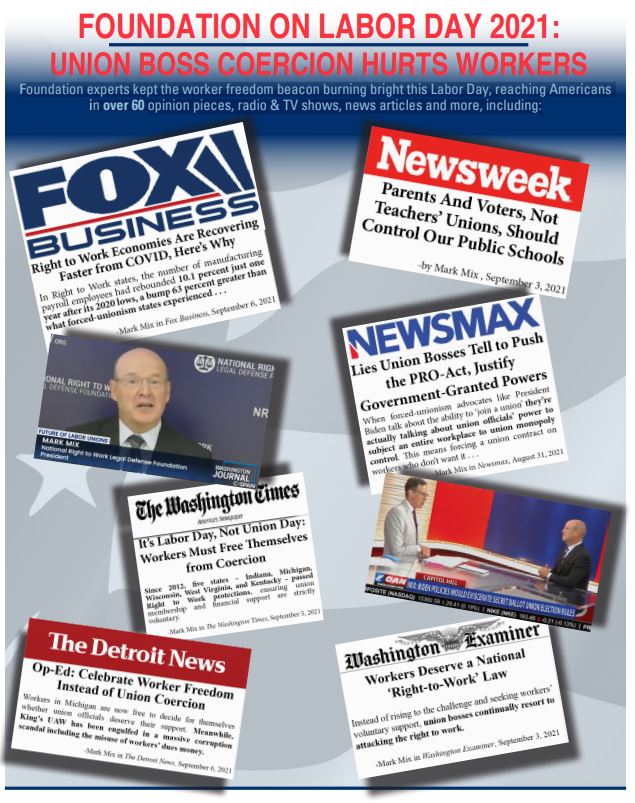
Foundation experts kept the worker freedom beacon burning bright this Labor Day, reaching Americans in over 60 opinion pieces, radio & TV shows, news articles and more, including:
Worker Advocate Files Brief Defending North Carolina Law to Strengthen Farm Workers’ Right to Work Protections
National Right to Work Foundation Legal Brief Counters Farm Union Bosses’ Case Seeking Power to Impose Union, Top Down, via Lawsuits
Richmond, VA (February 24, 2022) – The National Right to Work Legal Defense Foundation has filed an amicus curiae brief with the United States Fourth Circuit Court of Appeals in Farm Workers Organizing Committee v. Joshua Stein. This is a federal case brought by union officials seeking the power to impose monopoly union power and union dues deductions on agricultural workers and employers.
The brief defends a 2017 North Carolina law that bolsters farm workers’ Right to Work protections under the state’s longstanding and popular law. The 2017 law was passed to protect workers from having union monopoly representation foisted on them as a result of union-instigated lawsuits. The 2017 North Carolina law protects workers from union monopoly representation, the law also prevents union bosses from gaining the power to have union dues automatically deducted from agricultural workers’ paychecks.
Although they are private sector employees, agricultural workers are not covered by the National Relations Labor Act, which covers most private sector employees across the country. The Foundation brief argues this gives North Carolina the legal authority to prohibit union dues payroll deductions as a means of strengthening the existing protections of the state’s Right to Work law, which applies to agricultural workers in addition to those under NLRB jurisdiction.
The brief cites the fact that the Fourth Circuit Court of Appeals specifically rejected the argument that union officials have a right to payroll deduction in South Carolina Education Association v. Campbell. It also points out that the U.S. Supreme Court rejected union arguments that they had a right to payroll deductions for union political activities in Ysursa v. Pocatello Education Association.
The Foundation brief notes the Farm Labor Organizing Committee (FLOC) has “no more constitutional entitlement to have agricultural employers collect money for it than FLOC has a constitutional entitlement to having the state act as its collection agent.”
The Foundation brief further notes it is “well-established that prohibitions on collective bargaining do not infringe on union constitutional rights because unions have no constitutional entitlement to act as a monopoly bargaining representative.” It follows that North Carolina is well within its authority to protect workers and employers from being subjected to such monopoly “representation” through the misuse of litigation designed to sweep farmworkers under union control.
“Apparently union bosses have become so accustomed to their government-granted monopoly bargaining powers that they believe, incredibly, that the United States Constitution entitles them to impose monopoly unionization on workers unilaterally,” said National Right to Work Foundation President Mark Mix. “Although farm workers, like others, can of course associate with a union if they choose, FLOC union bosses should not be able to abuse the legal process to impose unionization on employees against their will.”
“It is entirely appropriate for North Carolina to protect agricultural workers against having a union imposed on them against their will,” added Mix. “Union association must be fully voluntary, not the result of backroom dealing in lawsuits by union officials designed to force a union on workers from the top down.”
Sixteen States Back Foundation’s Petition to High Court in Chicago Educator Case
The following article is from the National Right to Work Legal Defense Foundation’s bi-monthly Foundation Action Newsletter, September/October 2021 edition. To view other editions of Foundation Action or to sign up for a free subscription, click here.
Amicus brief: Unions “refuse to stop collecting dues despite unequivocal employee demands”
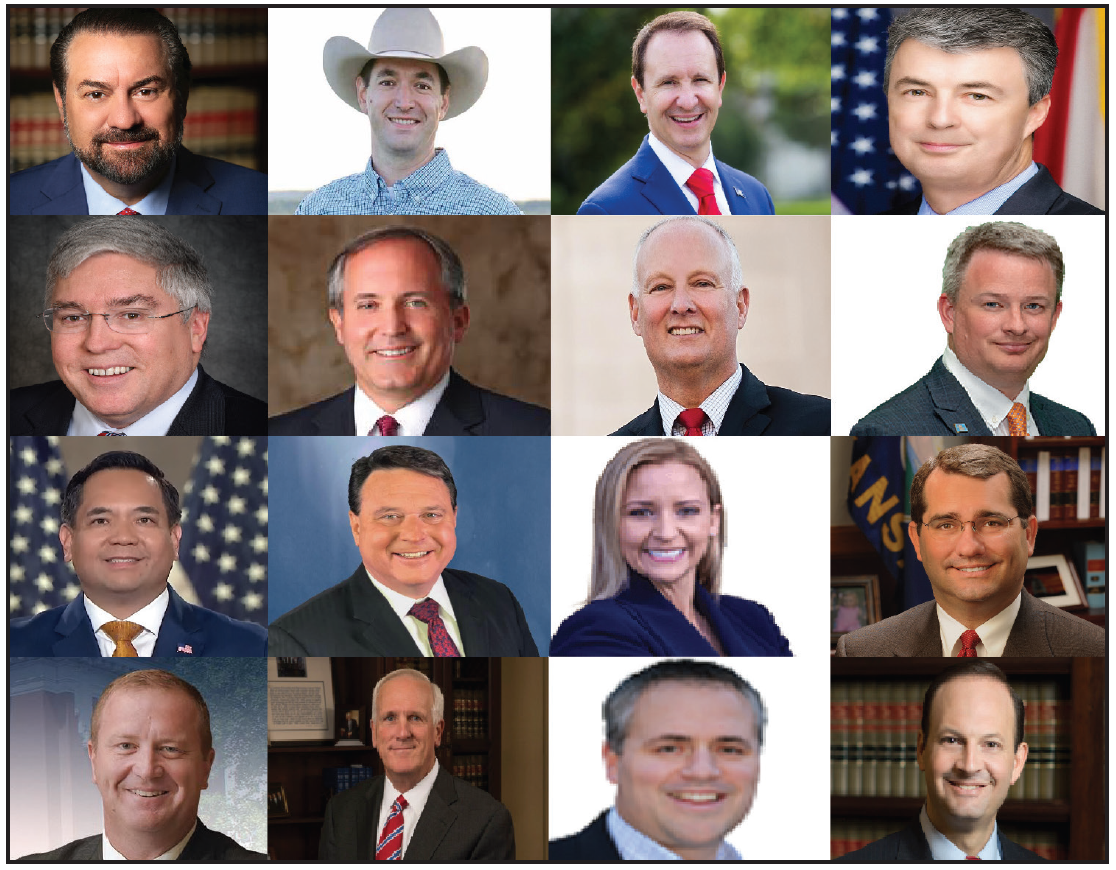
“Janus has been ignored,” wrote sixteen attorneys general in their amicus brief supporting Ifeoma Nkemdi and Joanne Troesch’s petition pressing the Supreme Court to hear their case and declare “escape periods” a First Amendment violation.
WASHINGTON, DC – In July, sixteen attorneys general threw the support of their states behind Chicago Public Schools educators Ifeoma Nkemdi and Joanne Troesch, who are urging the U.S. Supreme Court to hear their case defending their First Amendment right to cut off union financial support as recognized in the Foundation-won Janus v. AFSCME decision.
In an amicus brief encouraging the High Court to hear the case, attorneys general from Alaska, Alabama, Arizona, Arkansas, Indiana, Kansas, Louisiana, Missouri, Montana, Nebraska, South Carolina, South Dakota, Tennessee, Texas, Utah, and West Virginia argue that “escape period” restrictions like the one that Chicago Teachers Union (CTU) bosses foisted on Troesch and Nkemdi are a widespread threat to public employees’ rights under the Janus Supreme Court decision.
In 2018, the Supreme Court ruled in Janus v. AFSCME that public employees’ First Amendment rights are violated when they are forced to fund a union as a condition of employment. The Court also held that union dues can only be taken from a public employee with an affirmative and knowing waiver of that employee’s First Amendment right not to pay.
Unions Are Seizing Money from ‘Tens of Thousands’ Unconstitutionally, Brief Says
The CTU-concocted “escape period” Nkemdi and Troesch are challenging blocks employees from exercising their First Amendment Janus right to end union financial support except during one month per year. The educators’ petition for writ of certiorari presses the High Court to hear their case to affirm that Janus does not permit union bosses to profit from schemes that constrict workers’ constitutional right to refrain from subsidizing a union.
The states’ amicus brief emphasizes how glaringly union officials have flouted Janus with restrictions, as well as how widespread the schemes are: “Janus has been ignored. Across the country public-sector unions have resisted Janus’s instructions and devised new ways to compel state employees to subsidize union speech. Unions place onerous terms on dues forms that prohibit state employees from opting out of paying dues except during narrow (and undisclosed) windows during the year.”
The brief continues: “Unions refuse to inform state employees that they have a First Amendment right not to pay union dues. And unions refuse to stop collecting dues despite unequivocal employee demands. The result is that tens of thousands of state employees across the country are having dues deducted to subsidize union speech without any evidence that they waived their First Amendment rights . . . .”
Nkemdi and Troesch’s case “implicates these precise concerns” and the Court must hear it, the brief maintains.
In addition to the states’ brief, policy groups Goldwater Institute, Cato Institute, Freedom Foundation, and Liberty Justice Center filed amicus briefs backing the case.
Justices May Already Be Showing Interest in Foundation-Backed Case
In late July, the Supreme Court ordered lawyers for CTU and the Chicago Board of Education to file a response brief to Troesch and Nkemdi’s petition, a signal that some Justices may be interested in taking up the case.
Also pending at the High Court is Foundation attorneys’ anti- “escape-period” case for Susan Fischer and Jeanette Speck, two New Jersey teachers. Both that case and Troesch and Nkemdi’s case are expected to be fully briefed in October, after which the Justices will decide whether to take them.
“As union bosses continue to use deceptive ‘escape period’ arrangements to keep worker money flowing unconstitutionally into their coffers, support continues to roll in from across the country for Troesch and Nkemdi, who are sticking up for independent-minded public servants who simply want to serve their communities without being forced to fund union activities,” observed National Right to Work Foundation President Mark Mix. “The High Court must weigh in to affirm that public workers’ First Amendment rights cannot be confined to union officials’ arbitrary schedules.”
Labor Board Rejects Biden Appointee’s Attempt to Scuttle Case Against Union
The following article is from the National Right to Work Legal Defense Foundation’s bi-monthly Foundation Action Newsletter, July/August 2021 edition. To view other editions of Foundation Action or to sign up for a free subscription, click here.
Texas nurse challenges concealment of secret union-employer deal which stifles decertification

With Foundation legal aid, Texas nurse Marissa Zamora shut down NLRB “Acting” General Counsel Ohr’s attempt to block her case.
WASHINGTON, DC – The National Labor Relations Board (NLRB) recently rejected a move by NLRB Acting General Counsel Peter Ohr to prematurely end Texas nurse Marissa Zamora’s case before the Board could rule. The case challenges National Nurses Organizing Committee (NNOC) union officials’ refusal to disclose a secret agreement they signed with the parent company of her hospital that limits Zamora’s ability to remove the union from her workplace.
Ohr is a career NLRB bureaucrat, who was installed as General Counsel by President Biden this January after Biden made the unprecedented move of removing Trump-appointed NLRB General Counsel Peter Robb before his Senate-confirmed four-year term expired. Ohr filed a motion in February seeking unilaterally to send Zamora’s complaint back to the NLRB’s Fort Worth regional office to be dismissed — after Zamora’s case had already been fully briefed at the full Board in Washington.
Zamora is represented for free by National Right to Work Foundation staff attorneys, who in March opposed Ohr’s attempted maneuver. Their brief argued that snuffing
the case out now would jeopardize the NLRB’s power to decide cases involving violations of federal labor law, and also contended that Ohr lacked any authority to make his motion because of Biden’s illegal ouster of Robb. In a May decision, the NLRB agreed with Zamora’s Foundation staff attorneys that the case should continue, observing that the matter “has been fully litigated, and the controversy at issue, which remains active, is ripe for Board adjudication.” The case began when Zamora demanded a copy of the secret so-called “neutrality agreement.” Such agreements are deals between union officials and employers — usually without the knowledge of employees in a workplace — that seek to assist the union in gaining monopoly bargaining powers over rank-and-file workers.
NNOC Agents Shrouded, Lied About Deal Which Stymied Info about Decertification
“The Board correctly rejected Peter Ohr’s attempt to scuttle this case so he could let union officials off scot-free despite their secret backroom deal to undermine the rights of nurses like Marissa Zamora who are subjected to unwanted union representation,” National Right to Work Foundation President Mark Mix said about the decision to let the case move forward. These controversial top-down organizing deals frequently contain provisions that require employers to silence opposition to unionization, hand over workers’ personal information for coercive “card check” drives that bypass the protections of a secret-ballot election, provide union organizers with preferential access to the workplace and even ensure employers will help stifle workers’ efforts to decertify, i.e. remove, the union.
In Zamora’s case, she began circulating fliers and other materials in June 2018 to educate her coworkers on how they could obtain a vote to decertify the union. Legal documents she filed in her case explain that union agents “repeatedly ripp[ed] down her fliers” and that hospital officials referenced a secret agreement with the union when they denied “her access to post material on protected bulletin boards, where her material would be shielded from vandalism.”
Zamora subsequently asked both NNOC and hospital officials to show her any “neutrality agreement” that might have triggered those efforts to block her and her coworkers’ rights. All her requests were denied, and NNOC even denied that such an agreement exists. This was despite statements by hospital agents to her that indicated a “neutrality agreement” was indeed in effect.
Trump-Appointed NLRB GC Robb Backed Nurse’s Case Until Unprecedented Firing
Zamora filed federal unfair labor practice charges at the NLRB, challenging NNOC bosses’ refusal to disclose the secret agreement. Then- NLRB General Counsel Robb issued a complaint supporting the claims in Zamora’s charges.
Nevertheless, a Labor Board Administrative Law Judge (ALJ) dismissed the complaint Robb issued, even revoking subpoenas that would have compelled NNOC union bosses to reveal the covert deal.
Zamora challenged the ALJ’s dismissal, filing exceptions at the full Board in Washington. Briefs she filed supporting those exceptions pointed out that, during a two-day trial, it came out that the “neutrality agreement” existed, but it was a closely guarded secret between the hospital and union officials “to be kept strictly confidential from employees and all third parties.” Robb also submitted exceptions buttressing Zamora’s exceptions.
Robb’s pro-employee decisions preceded Ohr’s controversial installation by Biden in January, and Ohr’s subsequent attempt to remand or dismiss the case, which the NLRB has now rejected.
“The Board should now promptly rule for Ms. Zamora on the merits of the case so union bosses cannot keep secret pacts with employers to the detriment of rank-and-file employees’ protected rights,” Mix said.
Cuyahoga County Probation Officer Hits Union with Federal Lawsuit for Years of Unconstitutional Dues Seizures
Union officials took full union dues from nonmember officer without consent, then ignored requests to return illegally-seized money
Cleveland, OH (August 25, 2021) – Cuyahoga County probation officer Kimberlee Warren is suing the Fraternal Order of Police (FOP) union in her workplace, charging union officials with breaching her First Amendment right as a public employee to refuse to support union activities. She is receiving free legal representation from National Right to Work Legal Defense Foundation staff attorneys, in partnership with attorneys with the Ohio-based Buckeye Institute.
Foundation staff attorneys contend that FOP union officials ignored her constitutional rights recognized in the landmark 2018 Janus v. AFSCME U.S. Supreme Court decision, which was argued and won by Right to Work Foundation staff attorneys.
In Janus, the Justices declared it a First Amendment violation to force any public sector employee to pay union dues or fees as a condition of keeping his or her job. The Court also ruled that public employers and unions cannot take union dues or fees from a public sector employee unless they obtain that employee’s affirmative consent.
The federal lawsuit says that Warren was not a member of the FOP union before the Janus decision in June 2018, but FOP union bosses collected union dues from her wages without her consent. According to the complaint, this continued until around December 2020, when Warren notified union officials that they were violating her First Amendment rights by taking the money and demanded that the union stop the coerced deductions and return all money that they had taken from her paycheck since the Janus decision.
When the deductions ended, FOP chiefs refused to give back the money that they had already seized from Warren in violation of her First Amendment rights. They claimed the deductions had appeared on her check stub and thus any responsibility to cease the deductions fell on her – even though to her knowledge they had never obtained permission to opt her into membership or to take cash from her paycheck in the first place.
According to the lawsuit, Warren also asked FOP bosses to provide any dues deduction authorization document she might have signed. FOP officials rebuffed this request as well.
The High Court ruled in Janus that, because all activities public sector unions undertake involve lobbying the government and thus are political speech, forcing a public employee to pay any union dues or fees as a condition of keeping his or her job is forced political speech the First Amendment forbids.
Union bosses were permitted by state law before the Janus ruling to seize from nonmember workers’ paychecks only the part of dues they claimed went toward “representational” activities. FOP union officials took this amount from Warren prior to Janus. However, they furtively designated her as a member following the decision, and began taking full dues, deducting even more money from her wages than they did before Janus despite the complete lack of any consent.
Warren is now suing the FOP union in the U.S. District Court for the Northern District of Ohio. Her lawsuit seeks the return of all dues that FOP union officials garnished from her paycheck since the Janus decision was handed down. It also seeks punitive damages because FOP showed “reckless, callous” indifference toward her First Amendment rights by snubbing her refund requests.
Warren’s lawsuit comes as other Foundation-backed lawsuits for employees defending their First Amendment Janus rights seek writs of certiorari from the Supreme Court. This includes cases brought for Chicago and New Jersey public educators which challenge “window periods” that severely limit when they and their fellow educators can exercise their First Amendment right to stop union dues deductions, sometimes to periods as short as ten days per year. In a California federal court, Foundation staff attorneys are also aiding a University of California Irvine lab assistant in fighting an anti-Janus state law that gives union bosses full control over whether employers can stop sending an employee’s money to the union after that employee exercises his or her Janus rights.
“All over the country, union officials are stopping at nothing to ensure they can continue ignoring workers’ First Amendment Janus rights and continue siphoning money from the paychecks of dissenting employees,” commented National Right to Work Foundation President Mark Mix. “After Janus was handed down, FOP union officials in Warren’s workplace could have come to her to attempt to get her to support the union voluntarily, but tellingly instead they began surreptitiously siphoning full dues out of her paycheck without her consent in direct contravention of the Supreme Court.”
“Despite her repeated requests, FOP bosses have continued to trample Warren’s Janus rights, and Foundation staff attorneys are fighting to stop this gross injustice against her and punish FOP bosses for their brazen behavior,” Mix added.
Opposition Filed to Judge’s Order Imposing Culinary Union on Workers who Rejected Union in Secret Ballot Vote
Red Rock Casino workers vote against unionization, but nearly 2 years later judge ordered employer to bargain with union officials
Las Vegas, NV (August 24, 2021) – A large majority of the workers at Red Rock Casino in Las Vegas, Nevada voted “no” to unionization, but a federal district court judge is forcing their employer to bargain with union officials anyway.
The Casino is appealing the judge’s order at the U.S. Court of Appeals for the Ninth Circuit. Now Red Rock employee Raynell Teske has filed an amicus brief arguing the judge was wrong to impose the union on the workers, given the rejection of the union in the election. National Right to Work Legal Defense Foundation attorneys assisted Teske for free in filing the amicus brief with the appellate court.
In December 2019, the National Labor Relations Board held a secret ballot election whether to unionize Red Rock. A sizable majority of those voting rejected union officials’ effort to become their monopoly bargaining representatives. Despite that vote, NLRB Region 28 Director Cornele Overstreet filed a federal court injunction action seeking to have the union imposed over the workers’ objections.
On July 20, 2021, Judge Gloria Navarro agreed with the NLRB Director’s request, and issued a “Gissel” order forcing Red Rock to bargain with union officials despite the employees’ vote against unionization. The judge said the order was justified because, prior to the vote, union officials claimed that a majority of workers had signed union authorization cards.
Teske’s amicus brief argues those “card check” signatures are unreliable, and not reason enough to conclude the union ever had majority support. She contends the level of union support was tested fairly by the secret-ballot election, in which workers voted 627-534 against unionization. Secret ballots are a far more reliable way of gauging worker support for a union, because workers are often pressured, harassed, or misled by union organizers into signing cards.
Unions themselves know that “card check” signatures do not indicate solid worker support. The AFL-CIO admitted in its 1989 organizing handbook that it needed at least 75% card check support before having even a 50-50 chance of winning a secret ballot election. An earlier guidebook acknowledged that some workers sign cards just to “get the union off my back.”
Teske’s brief argues the union’s possession of so-called “cards” is an insufficient legal basis for imposing unionization, especially after a secret ballot election in which the union lost. It agrees with the employer that the “Gissel” order should be overturned, and that Teske and her coworkers should not be subjected to monopoly bargaining by a union they rejected in an NLRB-supervised secret ballot election.
This is not the only case in which union bosses are battling casino employees in court. Red Rock’s parent company, Station Casinos, also owns Palms Casino in Las Vegas, where employees filed a petition to decertify union officials in March, 2021. Union lawyers blocked the petition with a slew of charges that were accepted by NLRB bureaucrats as reason to block the workers’ petition. The Palms Casino worker represented by National Right to Work Foundation attorneys who filed the petition is appealing the decision to block the vote he requested.
“Ms. Teske and her coworkers had good reasons to reject the union. It is outrageous that the judge’s order imposing unwanted unionization brushes aside the workers’ contrary preference clearly demonstrated in the secret ballot vote,” said National Right to Work Legal Defense Foundation President Mark Mix. “There have been countless examples of workers being pressured, misled and even bribed to sign union cards, which is why ‘Card Check’ is widely accepted as unreliable, especially compared to an NLRB-supervised secret ballot election.”
“If federal labor law is to be about defending the rights and freedoms of rank-and-file workers, then the Court of Appeals should promptly overturn Judge Navarro’s order substituting the wishes of NLRB bureaucrats for the actual choice workers made at the ballot box,” added Mix.
Teamsters Union Charged with Illegally Threatening UPS Worker: ‘Join Union or Be Fired’
The following article is from the National Right to Work Legal Defense Foundation’s bi-monthly Foundation Action Newsletter, May/June 2021 edition. To view other editions of Foundation Action or to sign up for a free subscription, click here.
Teamsters official falsely claimed worker could be fired if he did not join and pay full dues

UPS worker Kamil Fraczek refused to kowtow to Teamsters officials’ threats in his workplace when they untruthfully told him that he had to formally join the union and pay dues just to keep working.
QUEENS, NY – With free legal aid from the National Right to Work Legal Defense Foundation, New York City UPS warehouse worker Kamil Fraczek has filed a National Labor Relations Board (NLRB) charge against Teamsters Local 804. The charge came after a Teamsters union official made repeated threats to his job and lied about his legal rights.
Union Official Refused to Respect Worker’s Rights under Beck Decision
When Fraczek began working at the warehouse full-time, a Teamsters representative tried to mislead him by telling Fraczek he must become a union member and sign documents authorizing dues deductions from his paycheck. Fraczek specifically asked about other options, but the union representative told him that if he did not sign the forms, Teamsters officials would ask UPS to fire him.
Because New York is a forced-unionism state that doesn’t protect workers with a Right to Work law, Fraczek can be required to pay some union fees as a condition of his job.
However, under long-standing federal law, workers cannot be required to become formal union members nor can they be required to pay full union dues even in non- Right to Work states. Under the Supreme Court’s 1988 CWA v. Beck decision, won by National Right to Work Legal Defense Foundation attorneys, no private sector worker can be compelled to financially support union activities unrelated to bargaining.
Union Misinformation Continues Even after Employee Demanded Rights
Expenses which can’t be charged to non-members under Beck include political expenditures and members-only activities.
Knowing his actual rights, Fraczek returned to the Teamsters official asking to be recognized as a non-member and Beck objector. He provided a letter to the representative stating his intention to pay only reduced fees and declining union membership.
As the unfair labor practice charge states, instead of accepting Fraczek’s request, the Teamsters official doubled down on his prior illegal threats. He demanded that Fraczek pay full dues and sign membership documents or face termination.
“Local 804’s agent has repeatedly tried to mislead Mr. Fraczek about his rights and has invoked the Union’s power to get him fired, all in an effort to coerce Mr. Fraczek into signing the membership and dues deduction authorization form . . .”
– Fraczek’s NLRB Charge
The official falsely claimed that only supervisors can opt out of the union, and that the federal laws protecting workers from funding union political activities only apply in Right to Work states, not in forced-unionism states like New York.
In response, Fraczek’s Foundation staff attorneys filed an NLRB charge asserting his right to pay reduced fees under Beck and not to join the union.
Teamsters Union Hit with Federal Charges for Illegal- Dues Demands
According to the charge, “Local 804’s agent has repeatedly tried to mislead Mr. Fraczek about his rights and has invoked the Union’s power to get him fired, all in an effort to coerce Mr. Fraczek into signing the membership and dues deduction authorization form…”
“Union officials are perfectly willing to tell outright lies to independent-minded workers who object to union membership,” said National Right to Work Foundation President Mark Mix. “Union bosses blatantly ignore the law just to protect their forced-dues revenue stream, and it is workers like Mr. Fraczek who pay the price.”





