
Worker Wins Additional $1,500 from Car Dealership in Federal Case for Illegal Firing at IAM Union Bosses’ Behest
IAM officials already paid nearly $17,000 for union role in Robert Basil Buick GMC employee’s illegal termination for refusal to join union and pay full dues
Buffalo, NY (May 9, 2022) – In March 2022, after car dealership employee Remmington Duk filed federal charges against International Association of Machinists and Aerospace Workers Automotive (IAM) Lodge 447, union officials agreed to pay him $16,916. Mr. Duk now has also won a settlement from Robert Basil Buick GMC for $1,500 for firing him at the IAM union officials’ behest because he exercised his right not to be a union member. Both unfair labor practice charges were filed for Mr. Duk with free legal aid from National Right to Work Foundation attorneys.
Mr. Duk’s charges were filed on January 31, 2022, with the National Labor Relations Board (NLRB), the federal agency that enforces the National Labor Relations Act and adjudicates disputes among private sector employers, unions, and individual employees. The charges recited that on October 7, 2021, an IAM official demanded that Mr. Duk sign paperwork authorizing union membership, threatening that he would be fired if he declined. Mr. Duk refused to sign and Robert Basil Buick GMC then terminated him on October 12, 2021.
Because New York lacks Right to Work protections for private sector employees, unions can force them to pay union fees as a condition of keeping their jobs. However, under Communications Workers v. Beck, a U.S. Supreme Court decision won by Foundation staff attorneys, formal union membership cannot be required, nor can payment of the part of dues used for non-bargaining expenditures like union political activities. In contrast, in the 27 states with Right to Work protections, union membership and financial support are strictly voluntary.
To make Mr. Duk’s federal unfair labor practice charge go away, the IAM union not only paid him $16,916, but also posted a notice in his workplace for a 60 day period informing other workers of their right not to be union members, and agreed to inform future new employees of that right. A similar notice will be posted by Mr. Duk’s employer, per the new settlement’s terms.
“National Right to Work attorneys will continue to defend workers who are threatened by union officials for exercising their rights,” commented National Right to Work Foundation President Mark Mix. “Employers who carry out unlawful orders at the bidding of union officials will similarly be held accountable by Foundation attorneys providing free legal representation to the victims of such schemes.”
“Ultimately, this case shows why New York workers need the protection of a Right to Work law to make all union payments strictly voluntary,” Mix added.
UC Irvine Lab Assistant Beats CWA Bosses in Suit Fighting Anti-Janus Schemes
The following article is from the National Right to Work Legal Defense Foundation’s bi-monthly Foundation Action Newsletter, January/February 2022 edition. To view other editions of Foundation Action or to sign up for a free subscription, click here.
Settlement secures full dues refund, ends phony photo ID restriction on Janus rights
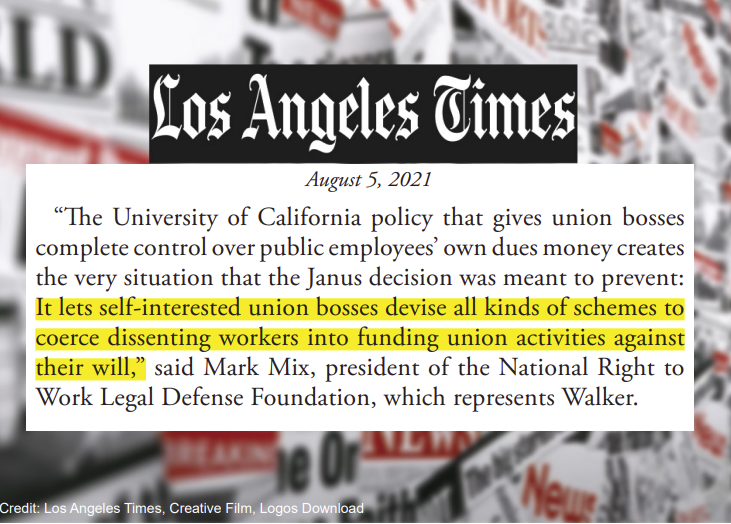
Foundation President Mark Mix was quoted in a Los Angeles Times report on the filing of Amber Walker’s lawsuit, emphasizing how UC’s pro-union boss policies were designed to infringe on workers’ right to decide freely on union support.
IRVINE, CA – Just a few months after University of California Irvine lab assistant Amber Walker slammed them with a federal lawsuit, University Professional and Technical Employees (UPTE-CWA) union officials have already backed off of defending schemes created to stop university employees from exercising their First Amendment right to stop union dues takings.
In November, National Right to Work Foundation staff attorneys won a settlement against UPTE officials requiring them to abandon their arrangement that required employees to provide a photo ID just to cut off unwanted union financial support. The settlement also made UPTE officials return to Walker dues they had seized from her wages under the scheme.
The lawsuit, filed by Foundation staff attorneys in August, challenged the use of a California statute that makes public employers completely subservient to union officials on dues issues. Union officials set up a system to stymie public employees’ right to stop dues payments that, according to Walker’s lawsuit, violated both due process and the First Amendment.
Lawsuit: Union Bosses Layered Two Schemes to Block Janus Rights
Walker sought to safeguard her First Amendment rights recognized by the U.S. Supreme Court in the landmark Foundation-won Janus v. AFSCME decision. In Janus, the Court declared that forcing public sector workers to fund unions as a condition of employment violates the First Amendment. The Justices also ruled that union dues can only be taken from a public employee with an affirmative and knowing waiver of that employee’s First Amendment right not to pay.
“Before pursuing a lawsuit against UPTE, I tried to voice my concerns to many different officials in the union organization,” Walker told a Los Angeles Times reporter. “Many just ignored my plea and one official even raised their voice and rudely hung up the phone in my face . . . I believe it should not have taken a lawsuit to make UPTE respect my constitutional rights.”
Walker’s lawsuit explained that she sent UPTE union bosses a letter in January 2021 exercising her right to end her union membership and all union dues deductions from her wages. Walker submitted this message within a short union created “escape period” imposed to limit when workers can revoke dues deductions. The union bosses still rebuffed her request, telling her she needed to mail them a copy of a photo ID to effectuate her revocation. The photo ID requirement, clearly adopted to frustrate workers’ attempts to exercise their constitutional rights, is mentioned nowhere on the dues deduction card Walker had signed to initiate dues payments.
By the time UPTE officials had informed Walker that her request to cut off dues was rejected for lack of photo ID, the “window period” they enforce had already elapsed. Had Walker not filed a lawsuit with free Foundation legal aid, UPTE officials likely would have continued siphoning money from her paycheck for at least another year until the arrival of the next “window period.”
Rather than face Foundation staff attorneys in court, UPTE bosses backed down and chose to settle the lawsuit. The settlement requires UPTE officials to stop taking money from Walker’s paycheck and to refund any deductions they took after her initial attempt to exercise her Janus rights. They must also desist from enforcing the photo ID requirement.
The Foundation is aiding other public sector workers across the country in defending their First Amendment right to refuse union financial support.
Fight to Eliminate Pernicious Restrictions on Janus Continues at High Court
In October, Foundation staff attorneys filed two joint petitions urging the Supreme Court to take cases brought for Alaska, Oregon, and California public servants who are battling restrictive “escape period” schemes union bosses manipulated to stop them from opting out of supporting unwanted union activities (See Page 2).
“We at the Foundation are glad to have helped Ms. Walker reclaim dues that were illegally siphoned from her wages by UPTE union bosses, but hardworking public servants like Ms. Walker should not be forced to file federal lawsuits just to exercise their basic First Amendment rights of free association,” commented National Right to Work Foundation Vice President Patrick Semmens. “The fact that UPTE bosses backed so quickly off defending their own suspect behavior indicates that they apparently knew their schemes would not stand up to any serious constitutional scrutiny.”
Wesley Manor Workers Vote Overwhelmingly to Remove Unwanted AFSCME Union Officials from their Workplace
Workers free from unwanted union “representation” as Labor Board certifies decertification vote to toss union bosses
Frankfort, IN (April 19, 2022) – Healthcare workers at the Wesley Manor BHI retirement community in Frankfort, Indiana have won a decertification vote, and successfully removed the American Federation of State, County and Municipal Employees (AFSCME) Local 962 union from their workplace. The workers’ decertification petition was filed with the National Labor Relations Board (NLRB) Region 25 office in Indianapolis, IN with free legal representation from National Right to Work Legal Defense Foundation staff attorneys.
The petition was filed by Robin Davis, an employee of Wesley Manor BHI. The request seeking to end AFSCME union officials’ monopoly bargaining powers at BHI was signed by about 50% of the workers in the bargaining unit, well over the legally required 30% needed to trigger an NLRB-conducted secret ballot vote whether to remove the union. The final decertification vote was 27-16 in favor of removing AFSCME union officials from the workplace. The vote was then certified by the NLRB after union officials’ time for filing objections to the election expired.
Indiana is a Right to Work state, meaning workers cannot legally be required to join or pay dues or fees to a union as a condition of keeping their jobs. However, even in Right to Work states, union officials who have obtained monopoly bargaining control in a workplace are granted the power impose one-size-fits-all union contracts on all workers, including those who opt out of union membership and would prefer to negotiate their own terms of employment.
National Right to Work Foundation staff attorneys have recently assisted workers in numerous successful decertification efforts across the nation, including for workers in Illinois, Oklahoma, and Delaware. Foundation-backed reforms to the rules for decertification elections that the NLRB adopted in 2020 have curtailed union officials’ abuse of so-called “blocking charges” used to delay or block workers from exercising their right to decertify a union. Such charges are often based on unproven allegations made against an employer, completely unrelated to workers’ desire to free themselves of the union.
“The Foundation is happy to have helped the workers at Wesley Manor to exercise their right to free themselves of a union they oppose,” commented National Right to Work Foundation President Mark Mix. “No worker anywhere should be forced under the so-called ‘representation’ of a union they oppose, and Foundation staff attorneys stand ready to assist other workers wanting to hold a decertification election to oust a union they oppose and believe they would be better off without.”
Conagra Brands Workers Seek to Remove Unwanted UFCW Union Officials from their Workplace
Workers file decertification petition with Labor Board to oust United Food & Commercial Worker union
St. Elmo, IL (April 14, 2022) – Production and maintenance employees at Conagra Brands in St. Elmo, Illinois, have filed a petition seeking the removal of United Food & Commercial Workers (UFCW) Local 881 from their workplace. The workers’ petition was filed on April 6, 2022, at National Labor Relations Board (NLRB) Region 14 based in St. Louis, Missouri, with free legal representation from National Right to Work Legal Defense Foundation staff attorneys.
Michelle Brockett, a long time Conagra employee, filed the decertification petition for her co-workers, supported by the signatures she collected to trigger a NLRB-conducted secret ballot vote whether to remove the union. The workers have asked the NLRB to schedule an in-person secret ballot election on April 26 and 27.
Under federal law, when at least 30% of workers in a bargaining unit sign a petition seeking the removal of union officials’ monopoly bargaining powers, an NLRB-conducted secret ballot vote to remove the union is triggered. If a majority of workers casting valid ballots do not vote for the union, the union is stripped of its government-granted monopoly “representation” powers. Those powers let union officials impose contracts on all workers in the workplace, even workers who are not union members and oppose the union. In Illinois, which lacks Right to Work protections that make union financial support strictly voluntary, union officials use their monopoly powers to mandate that all workers pay money to the union or else be fired.
National Right to Work Foundation staff attorneys have recently assisted workers in numerous successful decertification efforts across the nation, including for workers in Illinois, Oklahoma, and Delaware. Foundation-backed reforms to the rules for decertification elections that the NLRB adopted in 2020 have curtailed union officials’ abuse of so-called “blocking charges” used to delay or block workers from exercising their right to decertify a union. Such charges are often based on unproven allegations made against an employer, completely unrelated to workers’ desire to free themselves of the union.
In a previous decertification petition filed against UFCW Local 881 in 2019, prior to the blocking charges reform, union officials used tactics to attempt to block a vote from taking place for Pinncacle Foods Group, ultimately resulting in a delay of the vote for seven months. Although on appeal to NLRB in Washington, D.C., the workers won the ruling that finally let the vote occur, the unjustified delay contributed to union officials prevailing over the workers’ original decertification attempt.
“Thanks to Foundation-backed reforms, UFCW union officials have a much harder time using blocking charges to hinder the rights of workers, so the NLRB should promptly schedule an election for workers at Conagra Brands,” commented National Right to Work Foundation President Mark Mix. “No matter the outcome of this decertification vote, the many workers at Conagra who are opposed to the union should never have been required to fund the activities of union officials with whom they want nothing to do, which is why Illinois workers deserve the protection of a Right to Work law that makes union financial support strictly voluntary.”
Case Closed: Nurse Prevails in 11-Year Legal Fight Over Forced Dues
The following article is from the National Right to Work Legal Defense Foundation’s bi-monthly Foundation Action Newsletter, January/February 2022 edition. To view other editions of Foundation Action or to sign up for a free subscription, click here.
100 Rhode Island hospital employees win refund of dues illegally seized for union lobbying

After over a decade of battling power-hungry UNAP union bosses in court, Jeanette Geary has secured not only refunds of dues seized for union politics, but a First Circuit decision clarifying non-members can never be charged for union lobbying.
WARWICK, RI – Jeanette Geary finally achieved a total victory in her 11-year legal battle against union bosses. She and 99 other current and former nurses at Kent Hospital in Rhode Island received refunds of forced dues that were illegally used to support union lobbying in state legislatures. Foundation attorneys represented Geary throughout her fight.
Geary’s journey began when she grew frustrated with United Nurses and Allied Professionals (UNAP) union bosses in her workplace. “I realized what the union was doing,” Geary explained. “The union leadership had no interest in nurses or our professional work. Their only interest was collection of dues and fees.”
Geary resigned her union membership, but union dues were still extracted from her paycheck because Rhode Island is a forced unionism state that lacks Right to Work protections. However, thanks to the Foundation-won CWA v. Beck Supreme Court decision, nonmember workers can only be forced to pay fees for union activities “germane” to union monopoly bargaining. They cannot be forced to pay the portion of dues that funds activities like union lobbying.
Nurse Harassed for Standing Up to Union Bosses
Geary demanded a breakdown of the union’s expenditures, but union bosses refused to give her a legally required independent auditor’s verification of how they calculated non-members’ reduced forced fees. Like many who speak up against union bosses, Geary became a target for union harassment. “They laughed at me. They had their workplace reps ridicule me on the job and tell me I could file grievances that would be thrown away and said so with a big smile,” Geary recalled.
In 2009, Geary filed federal charges against union officials. The trial revealed UNAP officials were charging non-member nurses for lobbying in state legislatures. Despite the Supreme Court’s clear mandate in Beck that non-members’ money could not be used to fund political causes, union lawyers argued the lobbying was “germane” to the union’s monopoly bargaining.
Thanks to delays caused by President Obama’s illegal recess appointments to the National Labor Relations Board (NLRB), Geary had to file two petitions with the U.S.
Court of Appeals in Washington, D.C., and didn’t get a final NLRB ruling for nearly a decade. Finally, in March 2019, the NLRB ruled 3-1 that union officials cannot charge non-members for lobbying of any kind. It also ruled that union officials must provide independent verification that the union expenses they force non-members to pay have been audited.
Union Bosses Ridiculously Claimed Some Union Lobbying Wasn’t Political
Union officials still wouldn’t abandon their argument that nonmembers could be forced to pay for some union lobbying as a condition of employment. Union lawyers appealed the NLRB’s decision to the U.S. Court of Appeals for the First Circuit. A three-judge panel that included retired Supreme Court Justice David Souter ruled unanimously in Geary’s favor, saying “we see no convincing argument that legislative lobbying is not a ‘political’ activity.”
Union officials made a last-ditch attempt to overturn the decision, requesting an en banc hearing by the entire Court of Appeals, but that request was denied. In September 2021, union bosses finally paid back, with interest, thousands of dollars taken from Geary and 99 other current and former Kent Hospital nurses who were not union members but were charged for the union’s lobbying, bringing the decade-long case to a close.
“Jeanette Geary faced workplace ridicule for her decision to stand up to union bosses, yet she persevered for eleven years,” said National Right to Work Foundation Vice President and Legal Director Raymond LaJeunesse. “In the process, she won important legal precedents that will protect thousands of other workers from having their money illegally used to fund union politics.”
Kentucky Worker Hits Teamsters Union Bosses with Federal Charges for Illegally Seizing Union Dues
Georgia Pacific worker sent multiple letters to stop all payments as allowed by Right to Work law, but Teamsters continued dues collections
Lexington, KY (April 7, 2022) – Pam Ankeny, an employee in the printing department for Georgia Pacific, has filed federal unfair labor practice charges against the International Brotherhood of Teamsters Local 651 union. Ankeny’s charges, which were filed with free legal aid from the National Right to Work Foundation, say that Teamsters union bosses illegally collected union dues after she submitted two letters of revocation.
In July of 2021, Ankeny submitted a resignation and dues check-off revocation letter to union officials. The union responded two weeks later by claiming that Ankeny had missed her “window period” for dues check-off revocation.
In response, Ankeny submitted a second letter in August again reiterating her resignation and check-off revocation. She further requested a copy of the authorization union officials were using to block her request. The union acknowledged that Ankeny’s letter constituted a valid check-off revocation and indicated it would stop dues deductions. However, it failed to provide Ankeny with the requested authorization.
Despite the union acknowledging her valid August 2021 check-off revocation, beginning in January 2022 dues deductions resumed without Ankeny’s authorization and have continued as of the filing of her charges. In addition to the charge against the union, a charge was filed against Georgia Pacific for making the illegal dues deductions.
The charges allege that both practices are unlawful under Section 7 of the National Labor Relations Act (NLRA), which safeguards private sector employees’ right to abstain from any or all union activities. Further, in the 27 states with Right to Work protections, including Kentucky, union membership and dues payments are strictly voluntary.
“While Kentucky’s Right to Work law protects workers from being fired for refusing to pay union dues or fees, unless workers are vigilant, unscrupulous union bosses will still attempt to stuff their pockets with illegal forced dues,” commented National Right to Work Foundation President Mark Mix. “Any worker subjected to illegal union dues seizures should not hesitate to reach out to the National Right to Work Foundation for free assistance in exercising their legal rights to cut off dues payments.”
National Right to Work Foundation in the Detroit News: Big Labor’s Latest Attack on Michigan Right to Work
A recent op-ed from National Right to Work Foundation President Mark Mix in the Detroit News discusses union bosses never-ending attempts to overturn or undermine Michigan’s Right To Work protections for workers.
The article explains how union officials wield their monopoly power against workers in the union-controlled “grievance process” and why the Foundation recently filed an amicus brief in a case currently at the Michigan Supreme Court in which union officials are attempting to circumvent Right to Work:
Courts have long recognized that, in unionized workplaces, union kingpins effectively own the process through which workplace grievances regarding alleged misapplications or misinterpretations of company policies are handled.
Five-and-a-half decades ago, U.S. Supreme Court Justice William Brennan’s majority opinion in NLRB v. Allis Chalmers bluntly acknowledged that America’s national labor policy “extinguishes the individual employee’s power to order his own relations with his employer,” while “clothing” union bosses with monopoly-bargaining power.
And Justice Thurgood Marshall’s 1975 Emporium Capwell opinion resoundingly affirmed that a union controls all grievances under “exclusive” union bargaining, notwithstanding any employee attempts to redress grievances independently.
Their ironclad control over employee grievances is undoubtedly a boon for union bosses. Two current federal lawsuits filed by Michigan workers against United Auto Workers union bosses and Fiat Chrysler executives vividly illustrate why.
In one of these cases, 42 current and former employees of FCA (now known as Stellantis) charge that they were cheated out of wages and benefits they were promised by UAW bosses when their pay was cut from $28 an hour to $16 an hour after they switched from part-time to full-time jobs.
When the workers complained about the pay cut, local UAW bosses allegedly promised to file grievances on their behalf — but never did.
In the other case, 47 current and former engineers allege that FCA violated the union contract when it transferred them from a facility in Auburn Hills to another one in Trenton. Grievances they filed regarding the matter were mishandled or withdrawn without explanation by the UAW brass.
As outrageous as UAW bosses’ failure to follow up adequately on workers’ grievances in these two cases may seem to ordinary citizens, the fact is that federal law permits union bosses with monopoly-bargaining power to refuse to advance workers’ legitimate grievances simply because they don’t think it’s in the interest of the union to do so.
[…]
But even this extraordinarily privileged status isn’t enough to satisfy government union officials in Michigan. In Technical, Professional, and Officeworkers Association of MI v. Daniel Renner, a case now pending before the Michigan Supreme Court, they are brazenly contending they may vindictively refuse to process the grievances of union nonmembers to punish them for not joining and bankrolling the union, even when the union contract prohibits the individual employee from filing grievances on his or her own behalf.
Though union lawyers’ outrageous claims in Renner’s case have already been rejected at the Michigan Employment Relations Commission and at the State of Michigan Court of Appeals, there is no guarantee they will be dismissed by the Michigan Supreme Court.
That’s why the National Right to Work Legal Defense Foundation filed a brief Friday in the case defending Daniel Renner’s rights under Michigan’s right-to-work law.
The Michigan Supreme Court must reject this cynical attack on Wolverine State workers’ legal protections against being forced to fund a union they disapprove of.
Read the entire article on the Detroit News website.
More details on the case and the Foundation’s brief can be found here. Read the brief here (PDF).
National Right to Work Foundation Issues Special Legal Notice for California Grocery Workers Impacted by UFCW Strike Threat
Strike would affect over 47,000 workers at Albertsons, Vons, Pavilions, and Ralphs, but employees have right to rebuff union boss strike demand
Los Angeles, CA (March 31, 2022) – Today, the National Right to Work Legal Defense Foundation issued a special legal notice for workers potentially affected by a strike being threatened by United Food and Commercial Workers (UFCW) union officials at Albertsons, Vons, Pavilions, and Ralphs grocery store locations in Southern California.
According to news reports, the UFCW is preparing to order a strike against Albertsons, Vons, Pavilions, and Ralphs grocery stores, impacting over 47,000 employees. The Foundation’s legal notice informs these affected workers of the rights union officials often hide, including that the workers have the right to continue to work to support their families.
Importantly, the notice gives workers who want to exercise their right to work information on how to avoid fines and punishment that would likely be imposed by union officials.
“The situation raises serious concerns for employees who believe there is much to lose from a union-ordered strike,” the legal notice reads. “That is why workers confronted with strike demands frequently contact the Foundation to learn how they can avoid fines and other union imposed discipline for working during a strike to support themselves and their families.”
The Foundation’s special legal notice highlights workers’ rights to resign union membership and to revoke their union dues check-offs. The notice also provides helpful information for removing unaccountable union officials from a workplace by using a decertification petition to obtain a secret ballot vote whether to remove the union.
The National Right to Work Foundation is the nation’s premier organization exclusively dedicated to providing free legal assistance to employee victims of forced unionism abuse. The full notice can be found at https://www.nrtw.org/ufcw-ca/
“Despite what union officials may tell workers or try to pressure them into doing, workers always have the right to continue to work during a strike. However to do so, there are important steps they should follow to defend themselves from vindictive union retaliation,” National Right to Work Foundation President Mark Mix said. “For decades, the Foundation has provided free legal aid to workers to protect them from Big Labor’s coercive tactics, which are especially common during union boss-instigated strikes.”
Dry Fork Station Workers File Petition to Remove IBEW Union from Their Workplace
Decertification election will allow plant workers to vote to free themselves from unwanted union “representation”
Gillette, WY (March 23, 2022) – David Lausen, an employee at Dry Fork Station in Gillette, Wyoming, owned by Basin Electric Power Cooperative, filed a petition with the National Labor Relations Board (NLRB) seeking removal of Local No. 415 of the International Brotherhood of Electrical Workers (IBEW) from his workplace. National Right to Work Legal Defense Foundation staff attorneys are providing Lausen free legal representation in the decertification petition proceedings.
Under federal law when at least 30% of workers in a bargaining unit sign a petition seeking a vote on removal of union officials’ monopoly bargaining powers it triggers an NLRB-conducted secret ballot vote. With Foundation attorneys’ assistance, Mr. Lausen filed the decertification petition on March 16, 2022, after the prior union contract expired.
Wyoming is a Right to Work state, meaning workers cannot legally be required to join or pay dues or fees to a union as a condition of keeping their jobs. However, even in Right to Work states, union officials who have obtained monopoly bargaining control in a workplace are granted by federal law the power to impose one-size-fits-all union contracts on all workers, including those who opt out of union membership and would prefer to negotiate their own terms of employment.
National Right to Work Foundation legal aid has recently assisted workers in numerous successful decertification efforts across the nation, including for workers in Kansas, Illinois, Massachusetts, and Delaware. Foundation-advocated reforms to the rules for decertification elections that the NLRB adopted in 2020 have curtailed union officials’ abuse of so-called “blocking charges.” Such charges containing unproven allegations against an employer, often completely unrelated to workers’ desire to free themselves of a union, were used to delay or block workers from exercising their right to decertify the union.
“The NLRB should schedule a decertification vote for these workers without delay,” National Right to Work Legal Defense Foundation President Mark Mix said. “Workers everywhere should know they can turn to the Foundation for free legal aid to help enforce their right to free themselves from unwanted union so-called ‘representation.’”





