
Full Foundation Action March/April Newsletter Now Online

All articles from the March/April 2025 issue of Foundation Action are now online.
In this issue:
- Following Foundation Legal Arguments, Trump Fires Biden-Appointed NLRB Bureaucrats
- Hundreds of OH Workers Exit Teamsters as Union Bosses’ Amazon ‘Strike’ Stunt Flounders
- DOJ Attorney Battles Biden Admin Union Power Grab Over Justice Department
- St. Louis-Area Worker Battles Illegal Union Threats to Get Non-Members Fired
- More Minnesota Nurses Send MNA Union Bosses Packing
- Vanderbilt Grad Students Free From Aggressive UAW Campaign
Recent articles can be found here. To sign up for a free copy of the newsletter via mail please see the form at the bottom of the page.
Vanderbilt Grad Students Free From Aggressive UAW Campaign
The following article is from the National Right to Work Legal Defense Foundation’s bi-monthly Foundation Action Newsletter, March/April 2025 edition. To view other editions of Foundation Action or to sign up for a free subscription, click here.
Foundation-assisted students challenged union-backed NLRB demand for private info

Notorious UAW President Shawn Fain saw his union rebuffed by many Vanderbilt students concerned about the union’s intrusive organizing methods. Facing legal and political headwinds, UAW bosses dropped their campaign.
NASHVILLE, TN – Union monopoly bargaining creates barriers to freedom for people across the country. It requires workers to accept self-motivated union bosses as their sole “voice” on issues in their workplace. But, in the private sector, it’s unfortunately the law of the land.
That’s not as clear when it comes to colleges and universities. Although the National Labor Relations Board (NLRB) under President Obama upended existing precedent to dubiously let union officials impose monopoly arrangements on graduate students — a ruling continued by the Biden NLRB — the Family Educational Rights and Privacy Act (FERPA) generally bans universities from sharing student information without student permission. This puts FERPA and federal labor law at odds, as such information is something employers are required by the NLRB to produce during a unionization campaign.
After the United Auto Workers (UAW) union launched a campaign in late 2024 to sweep Vanderbilt University’s graduate students under their monopoly power, NLRB officials required the college to fork over the info of thousands of students. But three courageous students stood up with free legal aid from the National Right to Work Legal Defense Foundation, arguing that disclosure without any procedure violated their privacy rights under FERPA.
Now, union officials have backed down and withdrawn the entire union campaign at the college. The three students and others are free from being forced into UAW union monopoly ranks and from the disclosure of their FERPA-protected information.
“The withdrawal of UAW organizers’ petition seeking a vote to unionize us against our will is a welcome victory for us in our defense of our rights and the rights of our fellow graduate students,” commented one of the Foundation-assisted Vanderbilt graduate students, identified as Jane Doe 1 in legal filings to protect her identity.
Students: FERPA Lets Us Protect Private Info From Unionization Scheme
The students’ effort to protect their privacy began in October 2024, when two students identified in filings as John Doe 1 and John Doe 2 moved to intervene in the NLRB case. They argued that FERPA’s language permits students to seek “protective action” if a university receives a subpoena seeking their personal information, as Vanderbilt had from the NLRB. A regional NLRB official denied their motion to intervene. Foundation attorneys submitted an emergency appeal for John Doe 1 and John Doe 2 to the NLRB in Washington, DC, emphasizing that the students needed an opportunity to “address the serious privacy issues raised by the Region’s subpoena.”
Foundation attorneys additionally filed an updated motion to intervene that included Jane Doe 1 as another student seeking to intervene in the case. Several other graduate students also submitted less-formal objections urging the agency not to enforce a subpoena divulging their private information. The District Court for the Middle District of Tennessee issued a ruling on November 22, 2024, temporarily releasing Vanderbilt from its obligation to comply with the NLRB subpoenas. A few weeks later, UAW union officials announced they were withdrawing their petition to unionize Vanderbilt graduate students, meaning the subpoenas seeking student information are effectively null and void.
Foundation Fights Union Malfeasance at Colleges Nationwide
Meanwhile, Foundation attorneys are assisting graduate students at Dartmouth and MIT with fighting attempts by United Electrical (UE)- affiliated unions to demand dues payments from students against their will and in violation of their rights. Kara Rzasa, a Dartmouth graduate student, and Michael Fernandez, an MIT graduate student, have each hit UE local and national affiliates with charges for illegal polices UE officials are utilizing nationwide when demanding forced dues payments.
“While we’re happy that the private information of Vanderbilt grad students is now secure, it’s clearer than ever that the biased NLRB decisions granting union bosses the ability to foist union monopolies over graduate students were wrong,” commented National Right to Work Foundation Vice President and Legal Director William Messenger. “In Foundation cases, we’ve seen union bosses put students’ academic freedom, religious freedom, and privacy protections all at risk, which is why the new appointees to the NLRB need to clarify that students are off-limits to union monopoly power schemes.”
Full Foundation Action July/August Newsletter Now Online
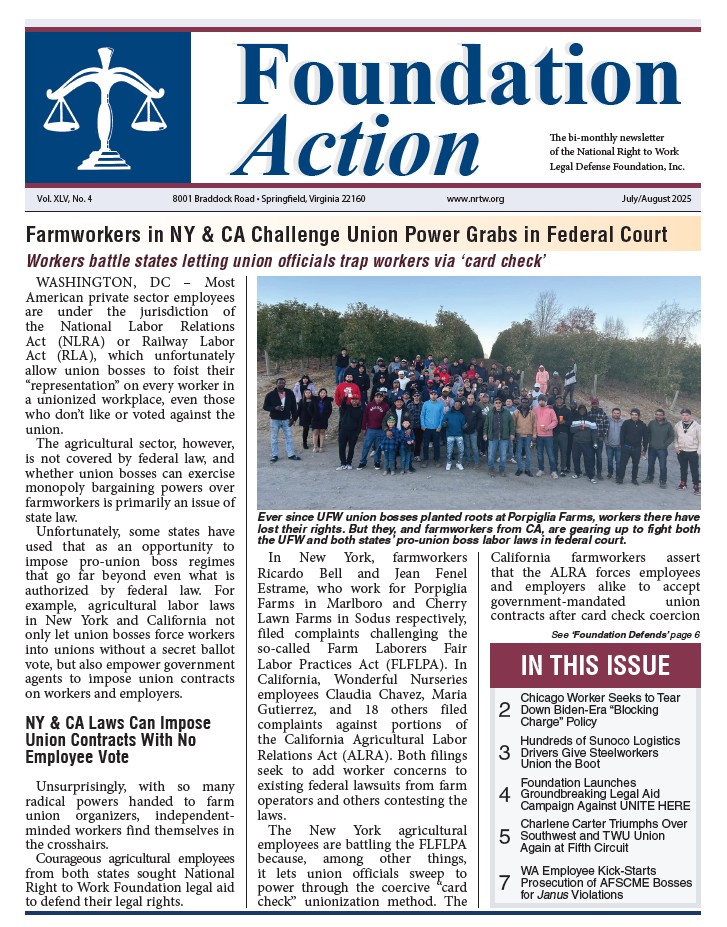
All articles from the July/August 2025 issue of Foundation Action are now online.
In this issue:
- Farmworkers in NY & CA Challenge Union Power Grabs in Federal Court
- Chicago Worker Seeks to Tear Down Biden-Era ‘Blocking Charge’ Policy
- Hundreds of Sunoco Logistics Drivers Give Steelworkers Union the Boot
- Foundation Launches Groundbreaking Legal Aid Campaign Against UNITE HERE
- Charlene Carter Triumphs Over Southwest and TWU Union Again at Fifth Circuit
- WA Employee Kick-Starts Prosecution of AFSCME Bosses for Janus Violations
Recent articles can be found here. To sign up for a free copy of the newsletter via mail please see the form at the bottom of the page.
Hundreds of OH Workers Exit Teamsters as Union Bosses’ Amazon ‘Strike’ Stunt Flounders
The following article is from the National Right to Work Legal Defense Foundation’s bi-monthly Foundation Action Newsletter, March/April 2025 edition. To view other editions of Foundation Action or to sign up for a free subscription, click here.
Teamsters O’Brien tried to take away Christmas cheer, but couldn’t take away Ohio workers’ freedom

Daniel Caughhorn led a scrappy group of his coworkers in voting Teamsters bosses out of their workplace, a scrap metal processing facility in Toledo, OH. They also beat back union bosses’ attempts to overturn their vote.
WASHINGTON, DC – This past December, Teamsters President Sean O’Brien announced the “largest-ever strike against Amazon,” claiming that thousands of workers would heed his strike order, abandon their delivery vehicles and hit the picket lines. O’Brien threatened that Christmas gifts would be delayed unless his demands were met.
Those who took O’Brien’s rhetoric at face value would have thought he was a veritable Grinch stealing Christmas (even though he tried to explain it was Amazon’s fault that the strike had to occur). But even reporting from pro-Big Labor outlets soon revealed that the order was more story than substance: According to Labor Notes, only about 600 employees obeyed the strike order despite Teamsters honchos claiming to “represent” some 7,000 to 10,000 Amazon employees.
Even the small number who did cease work on O’Brien’s command are arguably not employees of Amazon, and likely aren’t under Teamsters control at all: They work primarily for independent contractors that carry out some delivery functions for Amazon. Even if O’Brien’s dubious theory claiming he had control over those delivery drivers was correct, it would have only affected 10 out of the roughly 110 Amazon centers nationwide. Still, National Right to Work Foundation staff attorneys put a special legal notice out to delivery drivers nationwide informing them of their rights if they were illegally coerced to strike.
Workers Defeat Cynical Attempt by Teamsters to Overturn Vote
The December 2024 Teamsters “strike” against Amazon may go down in history as a strained publicity stunt. But the more significant Teamsters news that month was that hundreds of Foundation-backed workers across Northern Ohio took real action by voting to free themselves from unwanted Teamsters officials’ so-called “representation.”
Dusty Hinkle, an employee for Frito-Lay’s plant in Wooster, OH, and Daniel Caughhorn, a worker at scrap metal firm Omnisource’s facility in Toledo, OH, paved the way to freedom for their coworkers by submitting petitions asking the National Labor Relations Board (NLRB) to hold votes among their coworkers to remove or “decertify” Teamsters unions at their facilities. They submitted these in October and August 2024, respectively, with free Foundation legal assistance.
Because Ohio lacks Right to Work protections for its private sector workers, Teamsters officials enforced contracts that required Hinkle, Caughhorn, and their colleagues to pay union dues or fees as a condition of keeping their jobs. In contrast, in Right to Work states, union membership and all union financial support are strictly voluntary.
The NLRB, the federal agency that enforces federal labor law, administered decertification votes at Hinkle’s and Caughhorn’s workplaces after finding that both petitions contained enough employee signatures to trigger a vote under agency rules. Even though clear majorities of workers voted against Teamsters union control in both votes, Teamsters union officials filed objections alleging misconduct by Frito-Lay and Omnisource management in an attempt to overturn the election results.
However, in both cases regional NLRB officials tossed the union objections and certified the workers’ votes. The Omnisource and Frito-Lay employees — over 430 in total — thereby cut all ties with the Teamsters unions. Now both sets of employees are free both of union bosses’ forced-dues demands and their ability to impose one-size-fits-all contracts on the workplace.
In the final months of 2024, Foundation attorneys assisted a number of other workers from across industries with efforts to remove unwanted Teamsters officials. From just October to December 2024, truck drivers from Georgia, California, Virginia, and New Jersey successfully booted out Teamsters union officials or initiated removal efforts with Foundation aid. These cases came despite increasingly hostile rulemaking from the outgoing Biden Administration’s NLRB bureaucrats in 2024, which undid key Foundation-backed reforms that made it easier for workers to request decertification elections.
Teamsters Schemes to Steal Christmas and Workers’ Rights Both Failed
“Sean O’Brien’s Christmas publicity stunt might have made him seem like an attempted stealer of gifts and holiday cheer, but these two Foundation cases from Ohio demonstrate what Teamsters bosses really are: stealers of workers’ rights and freedom,” commented National Right to Work Foundation Vice President Patrick Semmens.
“That Teamsters officials in both these cases attempted to disenfranchise workers who opposed them shows why workers are turning against their power-hungry tactics, and why American workers deserve the Right to Work choice to withhold financial support from union officials who aren’t serving their interests.”
Foundation-Backed Starbucks Baristas Support Trump’s Firing of Biden NLRB Member
The following article is from the National Right to Work Legal Defense Foundation’s bi-monthly Foundation Action Newsletter, May/June 2025 edition. To view other editions of Foundation Action or to sign up for a free subscription, click here.
Starbucks employees’ challenge to agency power boosted by firing of Biden Board Member
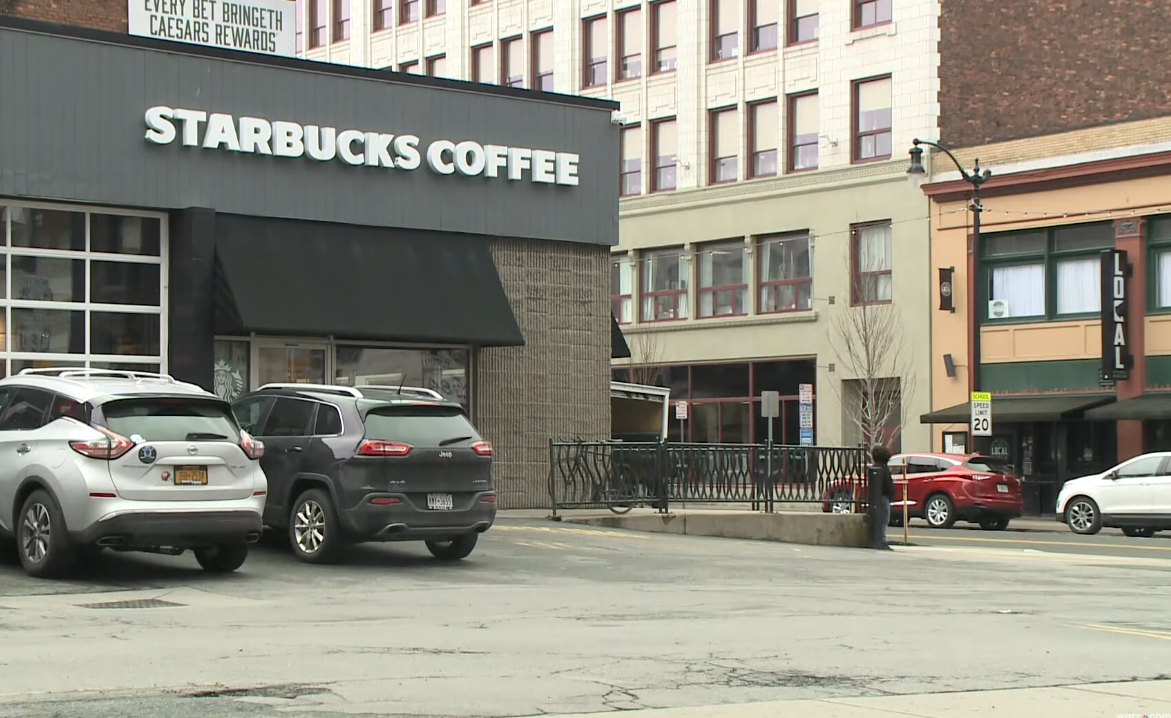
It may not look like much, but this Starbucks store in downtown Buffalo, NY, is the place where barista Ariana Cortes started her trailblazing legal battle against both the SBWU union and a hostile NLRB bureaucracy.
WASHINGTON, DC – President Trump isn’t the only person seeking reform in the federal government. Several National Right to Work Foundation-backed workers have advanced lawsuits in federal courts challenging the constitutionality of a federal agency.
Two upstate New York Starbucks baristas (Ariana Cortes and Logan Karam), represented by Foundation staff attorneys, filed the first case in the nation challenging NLRB members’ removal protections. Their case advanced a revolutionary argument that the National Labor Relations Act’s (NLRA) removal protections for NLRB members — which protect them from presidential removal during their entire terms except in very rare cases — let them exercise executive power in violation of separation of powers doctrines in Article II of the Constitution.
This power is plain to see — unelected NLRB members have the power to decide who can vote in union elections, adjudicate disputes between employers and unions, impose one-size-fits-all union “representation” on employees who don’t want it, and much more. Showdown Over Removal of Biden Appointee Headed for SCOTUS President Trump utilized the same arguments when he announced he was ousting Biden-appointed NLRB member Gwynne Wilcox (a former SEIU union lawyer) for issuing radical decisions that “vastly exceeded the bounds” of federal law.
Wilcox’s lawyers sued Trump over the removal, arguing — wrongly — that NLRB members’ removal protections are valid and prevent the President from doing virtually anything to stop NLRB members who have gone rogue. The case between President Trump and Gwynne Wilcox has now joined Cortes and Karam’s suit in being considered by the D.C. Circuit Court of Appeals.
As this issue goes to print, the Supreme Court has ordered Wilcox off the NLRB while it decides whether Wilcox should remain off the NLRB while the case is ongoing. Foundation attorneys submitted a legal brief on behalf of Cortes and Karam backing the President’s contentions. Cortes and Karam’s brief focuses on how the Board’s powers to enforce federal labor law, lack of technical expertise, and the partisan nature of its membership are not characteristics of a federal agency where removal protections might be appropriate under Supreme Court caselaw.
The brief also argues that reinstating Wilcox would cause chaos because it would let her participate in deciding cases before the NLRB while her continued presence on the Board is still the subject of litigation.
“Cortes and Karam have a vital interest in the outcome of this case, and not only because it concerns the constitutionality of [NLRB member removal protections],” the brief says. “Cortes and Karam do not want an individual the President properly removed from the Board because of her unsound rulings — Gwynne Wilcox — to decide their pending NLRB cases.”
Because of the weighty constitutional matters at stake, many have already predicted that this question will likely receive final consideration from the U.S. Supreme Court. Cortes and Karam’s lawsuit is fully briefed at the D.C. Circuit Court, and a hearing is scheduled for May. Their case was spurred by NLRB bureaucrats’ decision to block the baristas and their coworkers from exercising their right to vote to decertify (or remove) Starbucks Workers United (SBWU) union officials.
NLRB Region 3 rejected petitions in which a sufficient number of coworkers from both Cortes’ and Karam’s upstate New York Starbucks locations requested such elections. Regional NLRB officials cited unfair labor practice accusations made by SBWU union officials against the Starbucks Corporation as the reason for barring the votes. Notably, there was no established link between these allegations and the employees’ decertification requests.
Starbucks Baristas’ Battle Promotes Liberty for Workers Across Country
“Ms. Cortes and Mr. Karam spoke up on behalf of untold numbers of independent-minded workers nationwide when they filed their federal lawsuit challenging the NLRB’s constitutionality,” commented National Right to Work Foundation Vice President Patrick Semmens.
“The NLRB regularly stops workers from exercising their rights to push back against union influence for any reason union bosses dream up. Board members’ ability to do this without fearing any accountability to the elected President has effectively turned the agency into a fourth branch of government.
“We hope the Starbucks baristas’ lawsuit, boosted by the President’s efforts to reform the government, eventually results in lasting change to the Board that protects worker freedom,” Semmens added.
Dartmouth, MIT, Vanderbilt Graduate Students Challenge Forced Unionism
The following article is from the National Right to Work Legal Defense Foundation’s bi-monthly Foundation Action Newsletter, January/February 2025 edition. To view other editions of Foundation Action or to sign up for a free subscription, click here.
Foundation-backed students defend rights as union bosses seek more power at universities

Ben Logsdon is a Ph.D. student in mathematics at Dartmouth College. But it doesn’t take a genius to realize that union officials’ refusals to accommodate his religious objections just don’t add up.
HANOVER, NH – Just weeks after National Right to Work Foundation staff attorneys triumphed in anti-discrimination cases for Jewish Massachusetts Institute of Technology (MIT) graduate students who sought to stop forced dues payments to a radically anti-Israel union, union officials began creating other problems for university students.
In nearby New Hampshire, Dartmouth graduate student Benjamin Logsdon sought free Foundation legal aid against Graduate Organized Laborers of Dartmouth (GOLD-UE) union officials. The GOLD union — which is an affiliate of the same United Electrical (UE) union involved in the Foundation’s MIT cases — is forcing Logsdon to accept the union’s monopoly “representation” powers against his will, even after he voiced his religious objections to the union’s radical stances on the conflict against Israel.
Grad Students Exposed to Union Coercion & Privacy Violations
Meanwhile, several graduate students at Vanderbilt University in Nashville, TN, are pushing back against an attempt by Vanderbilt Graduate Workers United (VGWU, an affiliate of United Auto Workers) union bosses to impose union control over them and their colleagues. Specifically, three students are seeking to intervene in a federal case in which VGWU union officials are illegally demanding the university hand over the students’ private information to aid in their unionization campaign. Foundation staff attorneys filed motions for intervention for these students in October 2024.
Foundation attorneys are arguing that union officials severely violate students’ rights in both of these cases. However, the reason that union officials are in power on college campuses at all traces back to flawed rulings from the National Labor Relations Board (NLRB) under both the Obama Administration and Biden Administration. These rulings subject graduate students to pro-Big Labor provisions of the National Labor Relations Act (NLRA), which create issues for students’ freedom both inside and outside the classroom.
Logsdon, a Christian Ph.D. student in mathematics at Dartmouth, slammed the GOLD union with federal anti-discrimination charges in September 2024 at the Equal Employment Opportunity Commission (EEOC). According to those charges, shortly after the GOLD union finalized its first monopoly bargaining contract with the Dartmouth administration, he sent a letter to United Electrical General Secretary-Treasurer Andrew Dinkelaker explaining that he objected to being affiliated with GOLD on religious grounds and needed an accommodation.
“I sought to be removed from the UE and GOLD-UE bargaining unit as a reasonable accommodation,” Logsdon’s Foundation-backed charges say.
Dinkelaker refused to offer Logsdon an accommodation that “satisf[ied] [his] religious conscience or beliefs,” according to the charges, which violated his rights under Title VII of the Civil Rights Act of 1964.
Courts have recognized a variety of Title VII religious accommodations over the years for men and women who have religious objections to union affiliation, including paying an amount equivalent to union dues to a charity instead of union bosses. However, Logsdon seeks a different accommodation: to remove himself from union bosses’ control entirely.
At Vanderbilt, three students who identify themselves in legal documents as “John Doe 1,” “John Doe 2,” and “Jane Doe 1” are contending in their Foundation-backed motions for intervention that the Family Educational Rights and Privacy Act (FERPA) forbids the Vanderbilt administration from disclosing their personal information to any third parties without their permission, including the VGWU union.
At the union’s behest, NLRB Region 10 has already hit the Vanderbilt administration with a pair of subpoenas demanding personal student info, while ignoring objections from several students expressing concern at the disclosure.
So far Vanderbilt has resisted the NLRB’s subpoenas, and fortunately a federal court has temporarily allowed the university to refuse to comply with them.
The Foundation-backed students’ motions to intervene argue that the subpoenas “are an attempt to violate FERPA’s protections, privileging union interests over the graduate students[’] privacy rights.” It also points out that FERPA allows students to seek “protective action” if a university receives a subpoena seeking their personal information, as in this case.
The Vanderbilt students and their Foundation attorneys are demanding an opportunity to properly defend their privacy interests under FERPA. Foundation attorneys have already filed Requests for Review asking the NLRB in Washington, DC, to weigh in on the matter.
Union Monopoly Power Has No Place at Universities
“Graduate students around the country are discovering that union bosses don’t respect their individual rights and would rather use students as pawns to force their demands on a university administration, or advance an extreme political agenda,” commented National Right to Work Foundation Vice President and Legal Director William Messenger.
“Union monopoly bargaining is a system particularly ill-suited to an academic environment. Indeed, it is wrong for anyone to have a union monopoly imposed on them against their will and then be forced to pay union dues under threat of termination.”
MIT Graduate Students Defeat Discriminatory Dues Demands From Radical Campus Union
The following article is from the National Right to Work Legal Defense Foundation’s bi-monthly Foundation Action Newsletter, November/December 2024 edition. To view other editions of Foundation Action or to sign up for a free subscription, click here.
Union must cease forced dues, inform thousands of MIT graduate students of right to defund union politics
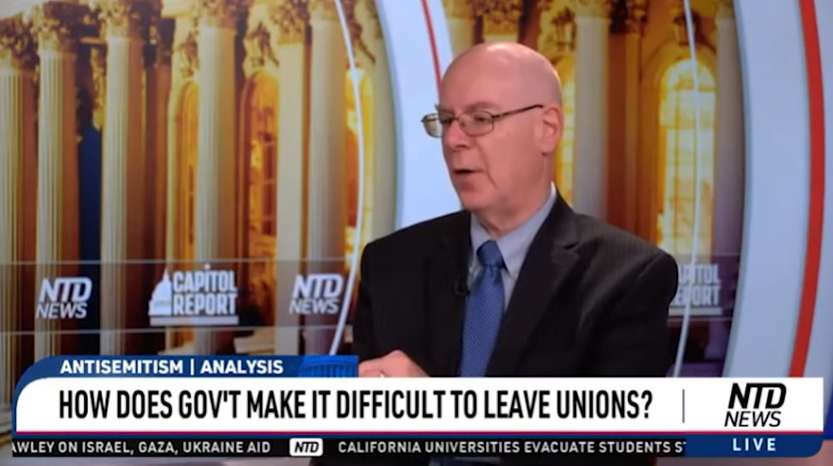
Foundation staff attorney Glenn Taubman, who aided the MIT graduate students in their legal victory, told NTD News his phone is “ringing off the hook” because university students and faculty nationwide are seeking ways to defund radical campus unions.
BOSTON, MA – “Jewish graduate students are a minority at MIT. We can’t remove the [Graduate Student Union (GSU)] or disabuse it of its antisemitism. But we also can’t support an organization that actively works toward the eradication of the Jewish homeland, where I have family living now.”
These were the words MIT Ph.D. student Will Sussman used to describe his, and other graduate students’, battle against radical union bosses at his campus, both in a Wall Street Journal op-ed and in June testimony before the U.S. House Committee on Education and the Workforce. GSU union officials gained the legal privilege to force MIT graduate students to pay dues or lose their academic work thanks to biased rulings by the National Labor Relations Board (NLRB) under both President Biden and President Obama. Since then, they’ve wasted no time in forcing even Jewish students with strong objections to the union’s anti-Israel agitating to fund their activities.
Students Battle Anti-Israel Sentiment Boosted by GSU Union Bosses
However, with free legal aid from National Right to Work Foundation staff attorneys, Sussman and his fellow Jewish graduate students Joshua Fried, Akiva Gordon, Adina Bechhofer, and Tamar Kadosh Zhitomirsky fought back against the GSU’s discriminatory dues demands. They each filed federal charges at the Equal Employment Opportunity Commission (EEOC), charging the GSU with denying them religious accommodations required by Title VII of the Civil Rights Act of 1964. Now they’ve won full accommodations that allow them to cut off all financial support for the union.
Separately, Foundation attorneys also filed federal unfair labor practice charges at the NLRB for Katerina Boukin, who objected on political grounds to the GSU’s ideological activity. Boukin sought to exercise her rights under the Foundation-won Communications Workers of America v. Beck Supreme Court decision, which lets workers who abstain from union membership opt-out of paying for the union’s political expenses.
In the wake of the October 7, 2023, attacks on Israel, Sussman and his fellow students experienced a massive wave of anti-Israel sentiment on MIT campus, including from GSU union chiefs.
“The blood had not yet dried when my colleagues at MIT declared, ‘Victory is Ours,’” related Sussman at a congressional hearing on anti- Semitism in unions. “The full-time GSU staff organizer told NBC10 Boston, ‘Those who rebel against oppression cannot be blamed for rebelling against that repression.’”
GSU Union Backed Off Unlawful Demands After Foundation Intervention
Sussman, Fried, Gordon, Bechhofer, and Zhitomirsky each requested in early 2024 that GSU union officials provide them with religious accommodations to paying union dues based on their objections to union officials’ extremist beliefs. Under federal law, such accommodations vary, but often take the form of letting the objector divert the dues from the offensive union to a 501(c)(3) charity instead. The GSU union’s brazen response was that “no principles, teachings or tenets of Judaism prohibit membership in or the payment of dues or fees to a labor union” and that no religious conflict existed because one of the founders of GSU’s parent union was himself Jewish.
The GSU union backed down after Foundation staff attorneys filed EEOC anti-discrimination charges in response to the lack of accommodation. The students have secured full religious accommodations and will pay money to charities of their choice, despite initial pushback from union bosses. The charities include American Friends of Magen David Adom and American Friends of Leket.
Katerina Boukin’s NLRB case was spurred by her disagreements with the union’s political stances on Israel. She stated that she was deeply offended by GSU’s “opposition to Israel and promotion of Leninist- Marxist global revolution” and that “[t]he GSU’s political agenda has nothing to do with my research as a graduate student at MIT, or the relationships I have with my professors and the university administration.”
“[Y]et outrageously they demand I fund their radical ideology,” Boukin said.
Foundation-Won Settlement Informs Students They Can Defund ‘Marxist’ Union
Foundation attorneys won a settlement for Boukin that not only returned illegally-seized dues to Boukin, but also required GSU bosses to inform the entire MIT graduate student body of their rights to invoke the Beck decision.
GSU bosses were forced to declare by email that they will not restrict the ability of those who resign their union memberships to cut off dues payments for political expenses and pay a reduced amount to the union. This email notice went out to approximately 3,000 MIT students.
Legal Protections Should Protect Employees’ Right to Object on Any Grounds
“The Foundation-backed MIT graduate students who fought these legal battles have earned well-deserved victories. But defending basic free association rights shouldn’t require such complicated litigation,” commented National Right to Work Foundation President Mark Mix.
“This ordeal at MIT should remind lawmakers that all Americans should have a right to protect their money from going to union bosses they don’t support, whether those objections are based on religion, politics, or any other reason.”
IBEW Union Bosses Back Down after Attempting to Trap Chicago 911 Operator in Forced Dues in Violation of First Amendment
Facing state prosecution for violating City employee’s rights under 2018 Janus US Supreme Court ruling, IBEW stops dues seizure & issues refund
Chicago, IL (July 1, 2024) –Rhonda Younkins, a 911 operator employed by the City of Chicago, has just prevailed in her months long legal effort to exercise her right under the First Amendment to stop all union dues payments to IBEW Local 21 union officials. Younkins had repeatedly attempted to end dues payments, as is her right under the 2018 Janus v. AFSCME Supreme Court decision, only to have IBEW union officials ignore her or make other demands.
After Ms. Younkins’ requests to stop dues were repeatedly rebuffed by union officials, she contacted the National Right to Work Legal Defense Foundation, whose attorneys won and argued the Janus case at the U.S. Supreme Court. Foundation staff attorneys filed charges against IBEW Local 21 on Ms. Younkins behalf at the Illinois Labor Relations Board (ILRB), which oversees labor law for government employees in Illinois.
When it became clear that ILRB officials would be issuing a complaint against IBEW 21 for violating Younkins’ legal rights, union officials backed down by agreeing to stop dues collections. They also agreed to refund past dues.
“I decided to leave IBEW 21 because for some time now I believed that IBEW 21 was not acting in the best interest of its members,” stated Younkins. “Be it a new job title that senior employees were deliberately misinformed about, to breach of contract on my employer’s part, to having to navigate the police and court alone after being threatened at work, IBEW 21 was either ineffective or absent.”
Regarding her extended legal ordeal to force union officials to respect her legal rights, Younkins commented: “Verbal communication is ill advised when dealing with IBEW 21’s [officials], it’s best to get everything in writing, even then you may still get double talk and word salad. Faith and trust in IBEW 21 were lost a long time ago.”
Younkins’ long sought victory occurred just as the 6th anniversary of the Janus v. AFSCME Supreme Court victory approached. That case, won by the National Right to Work Legal Defense Foundation staff attorneys in June 2018, affirmed that public employees like Younkins have a First Amendment right not to fund union activities.
Prior to Janus, millions of government workers in Illinois and elsewhere were required as a condition of employment to pay dues or fees to union officials. Immediately after the ruling, an estimated 450,000 public employees immediately stopped payment to unions, and since then Foundation-backed litigation has helped defend the rights of tens of thousands of other government employees.
“Six years ago, the Janus U.S. Supreme Court landmark victory affirmed the rights of public employees like Rhonda Younkins to funding the activities of union officials they oppose,” stated Foundation President Mark Mix. “Unfortunately, this situation demonstrates how union officials continue to resist Janus and refuse to accept that individual public employees are now free to decide whether or not a union boss deserves their financial support.”
“It shouldn’t take months of back and forth, not to mention a state labor board charge, just to force union officials to comply with the First Amendment,” added Mix. “This case against the IBEW shows why our Foundation exists, and we encourage others seeking to exercise their Janus rights to contact Foundation staff attorneys for free legal aid right away.”
Healthcare Workers at HRI Hospital Win Campaign to Remove Unwanted SEIU Union Bosses
SEIU 1199 officials concede defeat after a majority of employees sign petition backing Federal Labor Board-run decertification election
Brookline, MA (June 24, 2024) – Employees at HRI Hospital, Inc in Brookline, MA have won their freedom from Service Employees International Union (SEIU) Local 1199, which also calls itself the “United Healthcare Workers” union. HRI Hospital employee Veronica Kpodo filed a petition on behalf of a majority of the 100 healthcare workers seeking a vote to remove the union. The decertification petition was filed with free legal aid from the National Right to Work Legal Defense Foundation.
Kpodo filed the petition on June 17 with the National Labor Relations Board (NLRB), the federal agency responsible for enforcing federal labor law, which includes administering elections to install (or “certify”) and remove (or “decertify”) unions. Kpodo’s petition contained support from a majority of employees in the bargaining unit made up of registered nurses, mental health workers, unit secretaries, dietary, utility servers, and switchboard workers.
Rather than contest the election, which had the backing of a majority of employees who would have been eligible to vote, SEIU union officials conceded defeat days after the decertification petition was filed by announcing their intention to disclaim recognition. Soon after, on June 24, 2024, the NLRB officially recognized that the SEIU was no longer the monopoly bargaining representative of the employees, meaning Kpodo and her colleagues had won their campaign to remove the union.
Massachusetts is not a Right to Work state, meaning that union officials have the power to force employees, like those at HRI Hospital, to pay fees to a union as a condition of keeping their jobs. In contrast, in Right to Work states union membership and financial support are strictly voluntary.
However, even in Right to Work states, federal law grants union officials the power to impose their “representation” on all workers in a unit, even those who oppose the union or voted against its presence. To end that forced representation, workers can choose to exercise their right under federal law to decertify a union they oppose.
“We are glad to hear these employees successfully exercises their right to cut ties with unwanted SEIU union bosses,” said National Right to Work Foundation President Mark Mix. “Obviously SEIU officials saw the writing on the wall, which is why they quickly conceded defeat and walked away.”
“This is just the latest example of the growing demand among workers across the country for Foundation assistance in exercising their legal rights to remove unwanted unions from the workplace,” added Mix. “We encourage other workers who want to learn about their workplace rights, including the right to decertify an unwanted union, to contact the Foundation for free legal information and assistance.”





