
Milwaukee Worker Files Federal Charges Against Teamsters Union for Violating His Rights under State and Federal Law
NLRB Charge: Despite Right to Work law, union bosses coerced worker into becoming a union member and then blocked attempts to cut off dues payments
Milwaukee, WI (March 3, 2020) – With free legal aid from National Right to Work Legal Defense Foundation staff attorneys, an employee at a Milwaukee factory has filed federal charges against Teamsters “General” Local Union No. 200 for violating his rights under the National Labor Relations Act (NLRA) and Wisconsin’s Right to Work law.
Tyler Lewis, employed by Snap-on Logistics Company, filed an unfair labor practice charge with the National Labor Relations Board (NLRB) after union officials told him that he must become a union member and pay membership dues as a condition of employment in violation of longstanding federal law.
Teamsters union officials further refused to allow Lewis to stop union dues from being seized from his paycheck even after he learned of his rights and resigned his union membership in September 2019. Moreover, union officials continue to deduct dues from his paycheck and refuse to refund Lewis any of the dues unlawfully seized from him.
Forcing workers to pay union dues or fees as a condition of employment is prohibited under Wisconsin’s Right to Work law, which went into effect in March 2015. However, union officials continued to accept and retain union dues seized from Lewis because they claimed he could only cut off union dues deductions during a narrow union-created “window period.” Even as they made that claim, they failed to provide Lewis with specific dates when his request would be accepted under their rules.
As his charge details, the union monopoly bargaining agreement in Lewis’ workplace, which was signed after the state Right to Work law went into effect, contained language prohibited by the Right to Work law that workers must pay union dues or fees as a condition of employment. Moreover, even if the agreement was actually in place prior to the law’s effective date, Lewis’ Foundation-provided attorneys state in the filing that the passage of the Right to Work law invalidated the union’s claim that Lewis’ right to stop dues payments was limited to a brief union window period.
“Once again, Teamsters union bosses are using coercive tactics to force workers they claim to ‘represent’ to pay union dues and fees against their wishes,” said National Right to Work Foundation President Mark Mix. “Wisconsin’s Right to Work law should mean union membership and dues payment are strictly voluntary, but rather than respect workers’ rights and work to win their uncoerced support, union bosses are again attempting to trap workers in forced dues in violation of federal law.”
West Virginia Supreme Court Hears Right to Work Case
The following article is from the National Right to Work Legal Defense Foundation’s bi-monthly Foundation Action Newsletter, January/February 2020 edition. The West Virginia Supreme Court heard arguments in this case on January 15 and a decision is expected in the coming months. To view other editions or to sign up for a free subscription, click here.
Foundation continues to defend all Right to Work laws against Big Labor attack
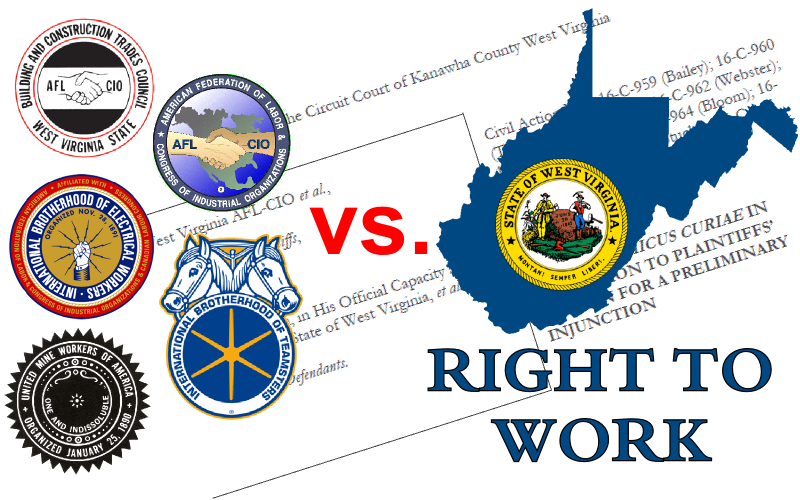
Forced-dues-hungry union bosses have been waging a legal battle to overturn West Virginia’s Right to Work Law since it was enacted in 2016. Foundation staff attorneys have been fighting back by filing amicus briefs in court.
CHARLESTON, WV – The West Virginia Supreme Court will hear arguments on January 15 in union bosses’ long-running case seeking to dismantle West Virginia’s Right to Work Law and restore their forced-dues powers over workers across the Mountain State. National Right to Work Foundation staff attorneys have already filed multiple legal briefs in this case for West Virginia workers in defense of West Virginia’s Right to Work Law.
After Passage, Union Bosses Immediately Target West Virginia Right to Work Law
Last year, union lawyers relied on discredited legal arguments to convince Kanawha County Circuit Court Judge Jennifer Bailey to declare West Virginia’s entire Right to Work Law invalid. Union lawyers dubiously claim that West Virginia union bosses have a “right” to forced dues. Judge Bailey issued a similar ruling blocking the Right to Work law after the legislation was signed into law in 2016. The West Virginia Supreme Court overturned that decision, citing arguments made in briefs by Foundation staff attorneys. “Of course, union partisans never willingly accept the loss of forced dues,” said National Right to Work Foundation President Mark Mix. “So now the issue is back at the state’s highest court.” If Big Labor’s lawsuit to overturn
West Virginia’s Right to Work Law succeeds, union bosses could have thousands of independent-minded workers across the state fired solely for refusing to subsidize union activities.
Foundation Files 10 Briefs to Protect Rights of West Virginia Workers
Foundation staff attorneys have filed 10 legal briefs in the multi-year case. The Foundation’s latest amicus brief was filed for West Virginia nursing home employee Donna Harper. Harper, like many other workers in West Virginia, chose not to pay dues or fees to union bosses, which is her legal right in a Right to Work state.
“Union bosses in West Virginia are intent on reclaiming their forced-dues power,” Mix said. “Big Labor is waging this protracted legal battle to return the Mountain State to a time when millions and millions of dollars in workers’ money were seized by union bosses to fill Big Labor’s coffers with forced dues.”
This case is the latest legal battle in the Foundation’s long history of effectively defending Right to Work laws in state and federal court from spurious attacks by Big Labor. Although federal law specifically authorizes states to pass Right to Work laws to protect workers from union boss coercion, union lawyers have repeatedly challenged these laws in an attempt to keep siphoning union dues and fees from workers’ paychecks.
Foundation Has Successfully Defended State Right to Work Laws Nationwide
In addition to West Virginia, Foundation staff attorneys have successfully pursued legal action in recent years to defend and enforce new Right to Work laws in Indiana, Michigan, Wisconsin and Kentucky, all of which have passed Right to Work protections for employees in just the last seven years. In Michigan alone, Foundation staff attorneys have assisted employees in over 100 cases since Right to Work went into effect in early 2013.
Electrician Files Discrimination Lawsuit Challenging Forced Union Fees
The following article is from the National Right to Work Legal Defense Foundation’s bi-monthly Foundation Action Newsletter, January/February 2020 edition. To view other editions or to sign up for a free subscription, click here.
Boston College and SEIU officials ignored reasonable request to accommodate religious beliefs
 Boston College officials seized union fees from electrician Ardeshir Ansari’s paycheck at the behest of SEIU bosses, even after he had informed them that such fees violate his religious beliefs.
BOSTON, MA – In November, National Right to Work Foundation staff attorneys filed a federal Title VII religious discrimination lawsuit for a Boston College electrician whose rights were violated by the Service Employees International Union (SEIU) in illegally demanding union fees. The lawsuit also names his employer, Boston College, for its role in the discrimination.
Ardeshir Ansari objects to supporting the union based on deeply held religious beliefs. Under the local SEIU’s monopoly bargaining agreement at Boston College, however, he was told that he must join or financially support the SEIU or be fired. To avoid being fired, Ansari unwillingly paid fees to the union in violation of his sincere religious beliefs.
On October 1, 2018, Ansari sent a letter to Boston College and the SEIU, informing them his religious beliefs conflict with joining or financially supporting the union. He asked that his union fees be diverted to charity instead of being sent to the union, an established remedy for such a conflict.
Instead of responding, the college continued to take a cut of his paycheck and send it to SEIU officials in violation of his sincerely held religious beliefs.
In response, Ansari filed charges with the Equal Employment Opportunity Commission (EEOC) against college and union officials. The EEOC then determined that both Boston College and the SEIU had violated Title VII.
Last September, the EEOC gave Ansari a right-to-sue letter, which authorized him to file a lawsuit under Title VII of the Civil Rights Act of 1964. That federal law prohibits employers and unions from discriminating against an individual based on his or her religious beliefs.
In November, Foundation staff attorneys filed a lawsuit for Ansari against Boston College and the SEIU for illegally discriminating against him by failing to reasonably accommodate his religious beliefs, violating his rights under Title VII.
The lawsuit demands that college and SEIU local officials pay all fees deducted from Ansari’s paycheck to a charity mutually agreed upon and seeks damages for the emotional distress he suffered while his rights were violated for more than a year.
EEOC Found Religious Discrimination by SEIU
Moreover, the Title VII lawsuit asks the court to prevent the college from continuing to discriminate against his religious beliefs and that the union be required to inform workers that those with religious objections to the payment of union fees are entitled by law to pay those fees to a charity instead.
“Workers with sincere religious objections to joining or funding a union are legally protected from being forced to violate their conscience,” said National Right to Work Foundation Vice President and Legal Director Ray LaJeunesse. “No one should ever be forced to choose between keeping a job to provide for their family and violating their deeply held religious beliefs by supporting a union.”
“Right to Work laws protect workers like Mr. Ansari from this kind of discrimination. Under those laws, workers can stop paying union fees and resign union membership for any reason and thus avoid illegal religious discrimination,” added LaJeunesse.
Missouri Workers File New Lawsuit to Defend Right to Work Law From Deceptive Repeal Petition
Union officials seek to continue their forced dues powers over Missouri workers through misleading ballot questions
Jefferson City, MO (April 11, 2017) – With free legal aid from National Right to Work Foundation staff attorneys three Missouri workers have filed a legal challenge against an AFL-CIO proposed petition that could repeal Missouri’s new Right to Work law and strip away Right to Work protections from them and hundreds of thousands of other Missouri workers. The plaintiffs, police officers Roger Stickler and Michael Briggs, and nurse Mary Hill, are opposed to mandatory union payments. Each has experienced forced unionism abuses in the past, and could again without the protection of a Missouri Right to Work law. Their lawsuit challenges the deceptive ballot language proposed to overturn the law.
Mike Louis, President of the Missouri AFL-CIO has submitted a repeal petition to the Missouri Secretary of State’s office, seeking to delay the enforcement of the recently passed Right to Work bill and submit the issue to the general election ballot in 2018. This petition has been approved by MO Sec. State Jay Ashcroft, and would appear on the 2018 ballot if union organizers obtain a sufficient number of signatures. The workers’ lawsuit challenges the proposed summary statement language as deceptive to voters.
“Once again, rather than be upfront with the Missouri citizens about their intention of restoring their forced unionism powers to have a worker fired for refusing to tender union dues or fees, Missouri union officials are pushing deceptive ballot language,” said Mark Mix, president of the National Right to Work Foundation. “Right to Work is popular with the people of the state, so Big Labor is hoping to mislead voters into undoing the protections Right to Work provides workers.”
This is not the first legal challenge National Right to Work Foundation staff attorneys have filed for workers who back Missouri’s Right to Work law that will make union membership and dues payment strictly voluntary. Before the Right to Work bill was signed into law on February 6, AFL-CIO top boss Louis also submitted ten state constitutional amendments to kill the law and give forced unionism state constitutional protection.
Those ten amendments were sent to the desk of former Missouri Secretary of State Kander who approved them just hours before vacating his office. These same three workers sued to challenge the deceptive language that Kander approved. On March 24, the Cole County Circuit Court judge ruled that the ballot language was “unfair and insufficient,” and rewrote the language that will appear on the ballot in 2018 if union bosses collect enough signatures. The unions have appealed the ruling, and National Right to Work Foundation staff attorneys are continuing to defend against the appeal to protect the lower court ruling.
Labor Board to Prosecute Flying Food Group for Illegally Firing Worker for Opposition to Union Dues
Worker was fired for seeking to end the forced unionism clause at his workplace and informing co-workers of their rights not to fund union political spending
Los Angeles, CA (April 10, 2017) – The National Labor Relations Board (NLRB) has issued a complaint against Flying Food Group for illegally firing a worker as retribution for distributing a deauthorization petition that would remove the forced unionism clause in its union contract and informing co-workers of their right not to pay for union activities unrelated to bargaining. The complaint was issued after NLRB investigators found merit to charges filed against the Flying Food Group by National Right to Work Legal Defense Foundation staff attorneys for the worker, Douglas Cisneros.
Both activities are protected under the National Labor Relations Act (NLRA) even in states lacking Right to Work protections like California. The company has a nationwide agreement with the union that puts its employees under union control.
Cisneros, worked as a cook for the company. In July 2016, he began to circulate a deauthorization petition among his co-workers. If it garners enough signatures a deauthorization petition results in a vote to remove the forced unionism clause in the contract that requires workers to pay fees to United Here Local 11 as a condition of their employment.
Cisneros also circulated information to his coworkers about their rights under the Foundation-won Communications Workers v. Beck United States Supreme Court case. Under Beck, workers have the right to opt out of paying full union dues that include union political lobbying and spending. After learning that Cisneros was exercising these legal rights, company officials terminated his employment on August 16, 2016, falsely claiming that he violated company rules against “engaging in rude or disorderly conduct.”
The NLRB complaint seeks an order requiring Flying Food Group to post notices in Spanish in addition to English and to reinstate Cisneros and reimburse him for back pay resulting from his illegal firing. A hearing is scheduled for June 20, 2017, before NLRB Region 31 in Los Angeles.
“It is outrageous Mr. Cisneros was fired simply for informing his co-workers of their rights and attempting to end union bosses’ power to require him and his coworkers to pay union dues as a condition of keeping their jobs,” commented Mark Mix, President of the National Right to Work Foundation. “This case highlights why Californian workers need Right to Work protections that would ensure that union membership and dues payment is strictly voluntary.”
Verizon Workers Hit CWA Union Officials with Charges for Retaliation for Working During Strike
SPFPA union officials continued to collect dues over workers’ objections despite majority vote by employees that ended mandatory payments
New York, NY (April 3, 2017) – Four Brooklyn Verizon employees have filed federal unfair labor practice (ULP) charges against the Communications Workers of America (CWA) union for violating federal labor law after the employees exercised their right to resign their union memberships during a high-profile strike in May 2016. The charges were filed with free legal assistance provided by National Right to Work Legal Defense Foundation staff attorneys.
In April 2016, CWA union officials announced a coordinated work stoppage at Verizon facilities and ordered workers up and down the East Coast, from Massachusetts to Virginia, to abandon their jobs. CWA Local 1109, which is the subject of the ULP charges, participated in the multi-state strike.
Soon after CWA union officials ordered the strike, the four workers who filed the charges chose to resign from the union and returned to work. Under federal law, workers cannot be compelled to join a union-boss ordered strike. However, under a 1972 National Labor Relations Board (NLRB) ruling, to protect themselves from internal union discipline they must resign their formal union membership before to returning to work, as each of these workers did.
On March 16, 2017, these workers were notified by CWA officials that they were being tried by the union on internal charges of violating the union’s constitution, despite the fact that these workers were not union members when they returned to work and thus are protected by federal law. These four workers turned to the Foundation for assistance, and filed ULP charges with the NLRB.
The union has notified the workers that an internal tribunal, which has no legal jurisdiction over the workers, is scheduled for April 16.
“Once again union officers are blatantly violating the rights of the very workers they claim to represent,” said Mark Mix, President of the National Right to Work Foundation. “It is outrageous that union officials are resorting to this type of retaliation to ‘punish’ workers who chose to return to work in order to provide for themselves and their families.”
“The Foundation has successfully defended a number of Verizon workers in the New York area who were also threatened with sham trials and five-figure illegal fines, and we are eager to assist these and any other workers in defending their workplace rights,” added Mix.
In 2016, Foundation staff attorneys defended eleven Verizon workers from retaliation by CWA and IBEW union officials after the same April 2016 East Coast strike. Seven of the workers were fined up to $14,000 each for exercising their federally protected rights. The remaining four were threatened by union bosses with “union discipline” that would have resulted in similar fines. In all eleven cases, union officials were forced to settle with the workers with all of the illegal strike fines and threats rescinded.
Federal Settlement Forces Union Officials to Refund $20,000 After Illegally Seizing Union Dues from Workers
SPFPA union officials continued to collect dues over workers’ objections despite majority vote by employees that ended mandatory payments
Washington, DC (April 3, 2017) – With free legal assistance from National Right to Work Foundation staff attorneys, two Washington D.C. area workers have won a federal settlement from International Union of Security, Police and Fire Professionals of America (SPFPA) union officials. The settlement dictates that union officials pay back approximately $20,000 in illegally seized dues, with interest.
The two workers, Troy Golson and Yasir Maatoug, work as security guards in the Ronald Reagan Building in downtown Washington, D.C. In November 2015, employees in their company, Coastal International Security, won a deauthorization election against the SPFPA union. A deauthorization election can be called by employees to negate the forced-unionism clause that allows union bosses to have a worker fired for refusing to pay the union dues or fees.
After the successful deauthorization vote, more than 30 Coastal employees sent union officials a dues check-off revocation letter, which legally stops the collection of forced union dues from their paychecks. However, union officials ignored some of the letters and continued seizing dues from many employees’ paychecks, erroneously claiming workers could not stop payment except in a union-determined “window period.”
Under current National Labor Relations Board law, workers who win a deauthorization election have the right to halt automatic deductions from their paychecks immediately simply by sending the union a revocation letter.
The settlement also allows for other workers to receive refunds for illegally seized dues if they can show that they revoked their dues check-off following the deauthorization election in November of 2015. Furthermore, union officials must post and e-mail a notice stating that they “will not collect dues from bargaining unit employees who have revoked their authorizations for payroll deduction of union dues or fees following the deauthorization of the union security clause.”
“This case epitomizes the lengths to which union officials will go to collect every last cent of forced dues they can, even in violation of longstanding law,” said Mark Mix, President of the National Right to Work Foundation. “Even after a majority of the very workers the union claims to ‘represent’ voted to strip union officials of their forced dues powers, SPFPA union officials continued to illegally seize thousands of dollars in forced dues from them. This case shows why every worker in America should have Right to Work protections that ensure that union membership and payment of union fees are strictly voluntary.”





