
Wall Street Journal: Texas AG Seeks to Enforce Government Employees’ First Amendment Rights Under Janus v AFSCME
The Editorial Board at The Wall Street Journal published a column on May 31, 2020, detailing efforts in Texas to enforce the landmark Janus v AFSCME U.S. Supreme Court decision argued and won by National Right to Work Foundation staff attorneys:
The Attorney General of Texas, Ken Paxton, plans to release an advisory opinion soon that could help free public employees who are fed up with their union. In 2018 in Janus v. Afscme, the Supreme Court said that union fees couldn’t be deducted from the paycheck of a government worker who didn’t ‘affirmatively consent.’
“The question is what flows from this logic. Last fall Alaska Governor Michael Dunleavy, citing Janus, signed an order to let state workers quit the union anytime, instead of only during 10 enchanted days once each year. Union members also would have to refresh their consent forms periodically.
The move by Attorney General Paxton came after Foundation President Mark Mix and staff attorney William Messenger — who argued the Janus case at the Supreme Court — called on states like Texas to emulate Alaska. They wrote that “state officials, along with federal agencies, should follow Alaska’s example” in an op-ed for The Wall Street Journal last August.
In addition, Mix and Messenger highlighted how Janus requires that government workers must voluntarily waive their First Amendment rights before union dues or fees can be deducted from their paycheck through a voluntary waiver:
Fourteen months ago the Supreme Court held that the First Amendment protects government employees from being forced to subsidize unions. Janus v. Afscme affirmed that some five million state and local workers have the legal right to stop such payments.
Another aspect of Janus, however, has been overshadowed. The decision requires that the government obtain proof that workers voluntarily, knowingly and intelligently waived their First Amendment rights not to subsidize union speech before deducting union dues or fees from their paychecks. “To be effective, the waiver must be freely given and shown by ‘clear and compelling’ evidence,” Justice Samuel Alito wrote. “Unless employees clearly and affirmatively consent before any money is taken from them, this standard cannot be met.”
Yet the federal government and many states and localities continue to deduct union dues without evidence that workers waived their speech rights, usually based on pre-Janus authorization forms that come nowhere close to demonstrating a waiver. Labor Department figures suggest unconstitutional deductions could be coming out of the paychecks of as many as 7.2 million government employees nationwide. The fix is simple: Governments must cease transferring wages to unions until they amend their dues-deduction policies to comply with Janus.
Milwaukee Worker Wins Refund of Union Dues in Settlement of Case Against Teamsters Union
Teamsters Local 200 union officials agree to repay money siphoned from factory workers’ pay after he exercised rights under Wisconsin Right to Work law
Milwaukee, WI (April 27, 2020) – With free legal aid from the National Right to Work Legal Defense Foundation, an employee at a Milwaukee factory has secured a settlement with Teamsters “General” Local Union No. 200. Union officials denied his right under Wisconsin’s Right to Work law and the National Labor Relations Act to cut off union financial support.
Under the terms of the settlement, Teamsters Local 200 officials will repay Tyler Lewis union dues, plus interest, seized from his paycheck after he resigned his union membership and revoked his dues deduction authorization (“checkoff”).
Lewis works for Snap-on Logistics Company. After he was hired, a union official told him that he must become a union member and sign a checkoff authorizing the deduction of union dues from his paycheck. That union demand violated longstanding law going back to 1963.
In September 2019, Lewis resigned from the union and revoked his checkoff. Local 200 union officials refused to honor Lewis’s request to stop union dues deductions and continued to deduct them from his paycheck, despite Wisconsin’s Right to Work law making union payments strictly voluntary.
Consequently, Lewis filed an unfair labor charge with the National Labor Relations Board with the help of National Right to Work Foundation staff attorneys. The favorable settlement for Lewis resolves his charge.
“This settlement for Mr. Lewis is yet another victory for the rights of all Wisconsin workers, although it should not take federal labor charges for union bosses to acknowledge the basic rights of employees in the Badger State,” said National Right to Work Foundation President Mark Mix. “Clearly Wisconsin’s Right to Work law mandates that union membership and dues payment must be strictly voluntary, but union bosses regularly attempt to trap workers in forced fee ‘agreements,’ rather than respect workers’ rights and vie to win their uncoerced support.”
“This case demonstrates, yet again, why Teamsters union bosses have a well-earned reputation for using coercive tactics against workers who refuse to toe the union line,” Mix added.
Milwaukee Worker Files Federal Charges Against Teamsters Union for Violating His Rights under State and Federal Law
NLRB Charge: Despite Right to Work law, union bosses coerced worker into becoming a union member and then blocked attempts to cut off dues payments
Milwaukee, WI (March 3, 2020) – With free legal aid from National Right to Work Legal Defense Foundation staff attorneys, an employee at a Milwaukee factory has filed federal charges against Teamsters “General” Local Union No. 200 for violating his rights under the National Labor Relations Act (NLRA) and Wisconsin’s Right to Work law.
Tyler Lewis, employed by Snap-on Logistics Company, filed an unfair labor practice charge with the National Labor Relations Board (NLRB) after union officials told him that he must become a union member and pay membership dues as a condition of employment in violation of longstanding federal law.
Teamsters union officials further refused to allow Lewis to stop union dues from being seized from his paycheck even after he learned of his rights and resigned his union membership in September 2019. Moreover, union officials continue to deduct dues from his paycheck and refuse to refund Lewis any of the dues unlawfully seized from him.
Forcing workers to pay union dues or fees as a condition of employment is prohibited under Wisconsin’s Right to Work law, which went into effect in March 2015. However, union officials continued to accept and retain union dues seized from Lewis because they claimed he could only cut off union dues deductions during a narrow union-created “window period.” Even as they made that claim, they failed to provide Lewis with specific dates when his request would be accepted under their rules.
As his charge details, the union monopoly bargaining agreement in Lewis’ workplace, which was signed after the state Right to Work law went into effect, contained language prohibited by the Right to Work law that workers must pay union dues or fees as a condition of employment. Moreover, even if the agreement was actually in place prior to the law’s effective date, Lewis’ Foundation-provided attorneys state in the filing that the passage of the Right to Work law invalidated the union’s claim that Lewis’ right to stop dues payments was limited to a brief union window period.
“Once again, Teamsters union bosses are using coercive tactics to force workers they claim to ‘represent’ to pay union dues and fees against their wishes,” said National Right to Work Foundation President Mark Mix. “Wisconsin’s Right to Work law should mean union membership and dues payment are strictly voluntary, but rather than respect workers’ rights and work to win their uncoerced support, union bosses are again attempting to trap workers in forced dues in violation of federal law.”
West Virginia Supreme Court Hears Right to Work Case
The following article is from the National Right to Work Legal Defense Foundation’s bi-monthly Foundation Action Newsletter, January/February 2020 edition. The West Virginia Supreme Court heard arguments in this case on January 15 and a decision is expected in the coming months. To view other editions or to sign up for a free subscription, click here.
Foundation continues to defend all Right to Work laws against Big Labor attack
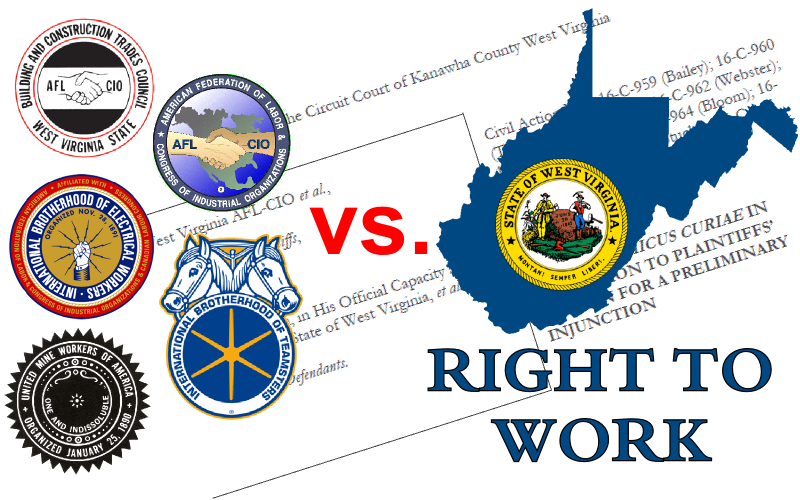
Forced-dues-hungry union bosses have been waging a legal battle to overturn West Virginia’s Right to Work Law since it was enacted in 2016. Foundation staff attorneys have been fighting back by filing amicus briefs in court.
CHARLESTON, WV – The West Virginia Supreme Court will hear arguments on January 15 in union bosses’ long-running case seeking to dismantle West Virginia’s Right to Work Law and restore their forced-dues powers over workers across the Mountain State. National Right to Work Foundation staff attorneys have already filed multiple legal briefs in this case for West Virginia workers in defense of West Virginia’s Right to Work Law.
After Passage, Union Bosses Immediately Target West Virginia Right to Work Law
Last year, union lawyers relied on discredited legal arguments to convince Kanawha County Circuit Court Judge Jennifer Bailey to declare West Virginia’s entire Right to Work Law invalid. Union lawyers dubiously claim that West Virginia union bosses have a “right” to forced dues. Judge Bailey issued a similar ruling blocking the Right to Work law after the legislation was signed into law in 2016. The West Virginia Supreme Court overturned that decision, citing arguments made in briefs by Foundation staff attorneys. “Of course, union partisans never willingly accept the loss of forced dues,” said National Right to Work Foundation President Mark Mix. “So now the issue is back at the state’s highest court.” If Big Labor’s lawsuit to overturn
West Virginia’s Right to Work Law succeeds, union bosses could have thousands of independent-minded workers across the state fired solely for refusing to subsidize union activities.
Foundation Files 10 Briefs to Protect Rights of West Virginia Workers
Foundation staff attorneys have filed 10 legal briefs in the multi-year case. The Foundation’s latest amicus brief was filed for West Virginia nursing home employee Donna Harper. Harper, like many other workers in West Virginia, chose not to pay dues or fees to union bosses, which is her legal right in a Right to Work state.
“Union bosses in West Virginia are intent on reclaiming their forced-dues power,” Mix said. “Big Labor is waging this protracted legal battle to return the Mountain State to a time when millions and millions of dollars in workers’ money were seized by union bosses to fill Big Labor’s coffers with forced dues.”
This case is the latest legal battle in the Foundation’s long history of effectively defending Right to Work laws in state and federal court from spurious attacks by Big Labor. Although federal law specifically authorizes states to pass Right to Work laws to protect workers from union boss coercion, union lawyers have repeatedly challenged these laws in an attempt to keep siphoning union dues and fees from workers’ paychecks.
Foundation Has Successfully Defended State Right to Work Laws Nationwide
In addition to West Virginia, Foundation staff attorneys have successfully pursued legal action in recent years to defend and enforce new Right to Work laws in Indiana, Michigan, Wisconsin and Kentucky, all of which have passed Right to Work protections for employees in just the last seven years. In Michigan alone, Foundation staff attorneys have assisted employees in over 100 cases since Right to Work went into effect in early 2013.
SAG-AFTRA Union Officials Slammed with Federal Labor Charges After Threatening Unlawful Union ‘Discipline’ against 12-Year-Old Girl
Union officials violate girl’s legal rights by initiating proceedings against her for filming a nonunion commercial, even though she was not a union member
Los Angeles, CA (January 28, 2020) – With free legal aid from National Right to Work Legal Defense Foundation staff attorneys, 12-year-old actress Aundrea Smith filed unfair labor practice charges against the Screen Actors Guild – American Federation of Television and Radio Artists (SAG-AFTRA) union for violating her legal rights under federal labor law.
Smith filed charges with the National Labor Relations Board (NLRB) after union officials initiated internal union proceedings and threatened to impose union “discipline” – likely a fine – on Smith for filming a nonunion commercial, even though she was not a union member at the time. The National Labor Relations Act (NLRA) prohibits union officials from imposing union “discipline” on nonmembers.
Smith did join SAG-AFTRA in April 2019, one month after filming the commercial, but subsequently resigned her union membership upon learning of her rights under the NLRA in August 2019. The NLRA provides that an individual cannot be forced to join a union just to get or keep a job and guarantees individuals the absolute right to resign their union membership whenever they choose.
Earlier this month, Communication Workers of America (CWA) union officials were forced to settle a similar case with Florida worker Jared Brewer, who is employed by AT&T. Union officials refused to acknowledge Brewer’s union membership resignation while on military leave. Then union officials unlawfully attempted to impose union “discipline” on Brewer for returning to work during a work stoppage, even though he had already resigned as a union member.
“The NLRB must intervene to halt this blatant and unlawful abuse of power by SAG-AFTRA union officials against this young actress,” said National Right to Work Foundation President Mark Mix. “We’re proud to stand with Aundrea who is standing up for her rights against this shameful bullying by union bosses.”
AT&T Employee Wins Settlement from CWA Union after Facing Union Retaliation for Exercising Legal Rights
Union officials refused to allow worker to resign his union membership while on military leave and attempted to fine him in violation of federal labor law
Jacksonville, FL (January 24, 2020) – AT&T employee Jared Brewer has won a favorable settlement from Communication Workers of America (CWA) Local 3106 union with free legal aid from the National Right to Work Legal Defense Foundation after union officials violated his legal rights under federal law.
To end the case, union officials rescinded their threat to subject Brewer to internal union “discipline” and fine him for exercising his legal rights under the National Labor Relations Act (NLRA). They also were required to notify other workers of their legal rights by posting notices on the union’s bulletin boards at 22 AT&T Jacksonville facilities.
Brewer was on military leave when union officials called a strike in August 2019. He sent an email to them in which he resigned his union membership. Even though the NLRA guarantees employees the right to resign their union membership at any time, union officials refused to honor Brewer’s request. One union representative falsely claimed that his resignation letter was “untimely.”
After sending a certified letter containing the same resignation language, Brewer returned to work. Despite his resignation, union officials told Brewer in an October letter that they were bringing charges against him in an internal union “trial” for working during the union-initiated work stoppage. Brewer did not attend the November 7 “trial” because he had already resigned his union membership and, therefore, could not legally be subject to union disciplinary procedures.
Union officials notified Brewer on November 15 that the union found him guilty at its “trial” and imposed a monetary fine of more. They threatened him with legal action if he did not pay the fine within 21 days.
In response, Brewer filed an unfair labor practice charge with the National Labor Relations Board with free legal aid from Foundation staff attorneys. Brewer charged that union officials violated his legal rights under the NLRA by disciplining and fining him as a nonmember, and by denying his resignation. Union officials are prohibited from requiring formal union membership as a condition of employment by both Florida’s Right to Work law and the NLRA, and under the NLRA workers are free to resign their union membership at any time.
Brewer’s unfair labor practice charges drove union officials to settle. This requires union officials to honor Brewer’s resignation and rescind the fine and union “discipline” against him. Union officials also must post for 60 days in its union hall and numerous AT&T facilities a notice in which the union promises not to “restrain or coerce” workers from exercising their legal rights to resign and work during strikes.
“Faced with legal action from National Right to Work Foundation staff attorneys, CWA union officials backed down from their blatant violations of longstanding labor law and were forced to settle with Mr. Brewer,” said National Right to Work Foundation President Mark Mix. “Federal labor law is crystal clear: Workers have an absolute right to resign their union membership if they choose, and once a worker has exercised that right they cannot be subject to fines levied by any internal union boss kangaroo court.”
Healthcare Worker Sues Teamsters Union and Healthcare Facility for Violating West Virginia Right to Work Law
Former Tygart Center employee says union officials and employer violated her legal rights by demanding she join the union and pay union dues and fees to keep her job
Fairmont, WV (December 24, 2019) – With free legal aid from the National Right to Work Legal Defense Foundation, healthcare worker Donna Harper filed a lawsuit against Teamsters Local 175 and the Tygart Center for violating her rights under the State of West Virginia’s Right to Work law.
West Virginia’s Right to Work law prohibits requiring workers to pay union dues or fees just to get or keep a job. In defiance of West Virginia’s Right to Work law, Tygart Center and Teamsters union officials entered into a collective bargaining agreement that required employees to pay union dues and fees as a condition of employment.
When Harper was hired, Tygart Center officials informed Harper that she must become a union member and pay union dues as a condition of employment in violation of her legal rights. Tygart Center officials deducted full union membership dues and fees from Harper’s paycheck and remitted this money to Teamsters union officials.
In March 2019, Harper successfully exercised her legal rights by resigning her union membership. Even then union officials continued taking union dues from her paycheck. Union officials also never fully refunded the union dues unlawfully seized from her wages.
Foundation staff attorneys filed the suit against the Tygart Center and the Teamsters union for Harper in Marion County Circuit Court. Harper worked at the Tygart Center from February 2018 until September 2019 as a Laundry Aide and as a Certified Nursing Assistant.
Foundation staff attorneys also filed an amicus brief for Harper with the West Virginia Supreme Court defending the state Right to Work law against a protracted lawsuit brought by several unions seeking to overturn the law and restore union officials’ power to have workers fired for refusing to pay union dues or fees. That case is scheduled for oral arguments in the Supreme Court on January 15. That court has already rejected the unions’ arguments once, overturning a preliminary injunction against the Right to Work law.
“Teamsters union bosses demonstrated a blatant disregard for the law by illegally demanding Ms. Harper and her coworkers pay union dues and fees just to get or keep their jobs,” said National Right to Work Foundation President Mark Mix. “Contrary to Big Labor’s wishes, West Virginia’s Right to Work law is in full effect, meaning all union dues for workers covered by the law must be completely voluntary.”
Foundation Urges Federal and State Governments to Protect First Amendment Rights
The following article is from the National Right to Work Legal Defense Foundation’s bi-monthly Foundation Action Newsletter, November/December 2019 edition. To view other editions or to sign up for a free subscription, click here.
Alaska first state to require First Amendment Janus rights waiver before deducting union dues
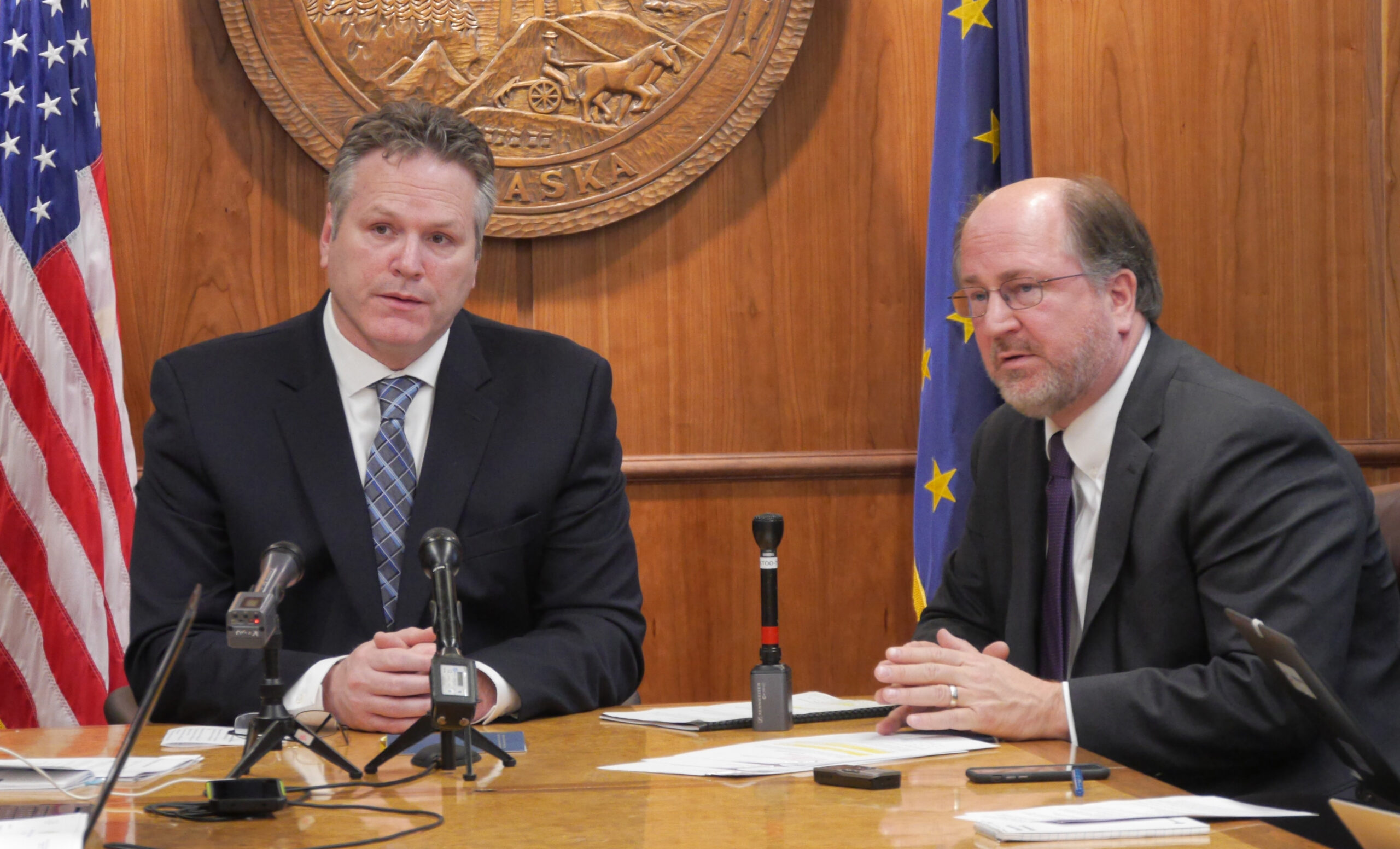 Alaska Gov. Mike Dunleavy (left), following an opinion from Attorney General Kevin Clarkson, ordered all Alaska state agencies to protect state employees’ First Amendment rights under Janus.
ANCHORAGE, AK – In late September, Alaska Governor Mike Dunleavy signed an executive order to protect the First Amendment rights of state employees established in last year’s Janus v. AFSCME Supreme Court decision. The order calls for the State of Alaska to stop deducting union dues from the paycheck of any worker who hasn’t filed a form with the state affirmatively waiving his or her First Amendment right under Janus not to fund any union activities.
The move follows a letter last year sent by National Right to Work Foundation Legal Director Raymond LaJeunesse to state comptrollers in Alaska and other states, urging them to modify dues deduction policies to comply with the Janus decision.
Foundation Comments Detail Need to End Dues Deductions Uncompliant with Janus
The Foundation also recently filed comments with the Federal Labor Relations Authority (FLRA) regarding the need for the federal government to take steps to protect the First Amendment rights of employees recognized in the Foundation-won Janus decision. The Foundation’s comments were submitted after the U.S. Office of Personnel Management (OPM) asked the FLRA to solicit public comments on how to proceed with union dues deductions in light of the Supreme Court’s Janus decision last year.
In that case, the High Court held that requiring public employees to pay union dues or fees without their consent violates the employees’ First Amendment rights “by compelling them to subsidize private speech on matters of substantial public concern.” Justice Samuel Alito’s opinion for the court further ruled that no union dues or fees could be taken from a public employee “unless the employee affirmatively consents to pay” using a “freely given” waiver of his or her First Amendment rights.
Consistent with that standard, the Foundation’s comments urge the FLRA to issue guidance to agencies that they “must cease deducting union dues from the wages of employees who signed a dues deduction form that does not satisfy the [Janus] standard.” According to Department of Labor statistics, nearly one million federal employees — 26.4% of all federal workers — are union members, many of them likely having dues deducted from their paychecks despite never having knowingly waived their First Amendment right not to subsidize union activities.
The Foundation comments make clear that these dues deductions should cease in the wake of Janus. To comply with Janus, workers wanting to voluntarily pay union dues can either provide the government with a valid waiver of their rights or pay dues on their own without using taxpayer-funded payroll systems to forward the money to union officials.
The Foundation’s comments to the FLRA further argue that, even where workers provide a valid authorization for dues deductions that meets the Janus standard, the government shouldn’t block them from revoking that authorization if the request is submitted at any time at least a year after the Janus-compliant authorization was obtained.
Foundation Comments Push to End Union-Created “Window Period” Scheme
Unfortunately, agencies and union officials often prohibit federal employees from stopping the seizure of union dues from their wages except during short annual escape periods. The comments filed by the National Right to Work Foundation say that this practice does not comply with Janus either.
“The Janus precedent is very clear about this: Without affirmative and knowing waivers from public workers, government entities cannot collect union dues without violating a worker’s First Amendment rights,” commented National Right to Work Foundation President Mark Mix.
“Currently, the government seizes union dues from almost one million federal employees in violation of the Janus decision’s First Amendment standard. Federal agencies are obligated to protect workers’ constitutional rights in this rulemaking process.”
Since the Janus decision last year, Foundation staff attorneys have been fighting to ensure public workers’ First Amendment rights are protected, litigating more than 30 cases in federal courts across the country to enforce the landmark ruling.
National Right to Work Foundation In the Wall Street Journal: “Trapped by the Teamsters”
Recently the Wall Street Journal published a piece by National Right to Work Legal Defense Foundation President Mark Mix titled “Trapped by the Teamsters.”
The op-ed describes the numerous NLRB policies, doctrines and “bars” workers across the country face when merely attempting to hold a vote to oust Teamsters bosses and other union officials as their monopoly bargaining so-called “representative.” The article illustrates these coercive policies through recent examples faced by workers who have turned to the Foundation for free legal aid:
A majority of workers at a Wisconsin trucking company experienced this over the past two years. First, they were blocked from removing their union by the so-called voluntary-recognition bar. This stops workers from decertifying a union for up to a year after the union is installed through “card check”—a procedure that avoids the need for a secret ballot and makes workers vulnerable to union intimidation.
Then, after waiting a year for that bar to expire, the Wisconsin workers found they had been merged by Teamsters officials into a multicompany nationwide bargaining unit of about 24,000 workers. Suddenly the petition to oust the local union was 7,000 signatures short—for a workplace with fewer than 10 union workers. Last month the NLRB declined the Wisconsin workers’ appeal, though a majority of voting board members signaled they would revisit the “merger doctrine” policy in the future.
Other workers face other hurdles: The “settlement bar” blocks a decertification vote because of an NLRB settlement to which the workers weren’t a party; the “successor bar” blocks a vote for up to a year after a company is acquired; the “contract bar” blocks a vote for up to three years after a union contract is forged; and a “blocking charge” blocks a vote while union allegations against a company are pending. None of these are required by law.
The NLRB is addressing the voluntary-recognition bar and blocking charges through the current rule-making process, but the other policies are similarly destructive of workers’ legal right to vote out a union that lacks majority backing. Congress should act to protect workers from being trapped in union ranks they oppose, but in the meantime the NLRB has the authority to eliminate these barriers.
Union officials unable to win the support of a majority of the workers they purport to represent shouldn’t maintain power solely because of bureaucratic rules. Instead, whenever enough workers file a petition to remove a union they oppose, the NLRB should simply let them vote.
Read the whole piece here.





