
Northern KY Worker Asks State Official to Prosecute Steelworkers Union for Violating Kentucky Right to Work Law
Union bosses illegally force workers to join and financially support union despite 2017 law making union support strictly voluntary
Frankfort, KY (June 30, 2022) – An Erlanger, KY-based employee of paper bag manufacturer Duro Hilex Poly is asking the Kentucky Education and Labor Cabinet Secretary to prosecute the United Steelworkers (USW) Local 832 union and the company for violating Kentucky’s Right to Work law. The complaint notes that Local 832 officials are illegally demanding both union membership and full dues payment from workers as a condition of staying employed, a clear violation of the Commonwealth’s Right to Work law that makes union membership and financial support strictly voluntary.
The employee, Melva Hernandez, is receiving free legal aid from the National Right to Work Legal Defense Foundation. She maintains that the company deducted dues money illegally from her paycheck for the union as the result of a forced unionism contract provision that cannot lawfully be enforced in Kentucky. Because the dues seizures and other conduct the union perpetrated are also illegal under federal law, she has also filed federal unfair labor practice charges at National Labor Relations Board (NLRB) Region 9 in Cincinnati.
In Kentucky and 26 other states with Right to Work protections, union membership and union financial support are strictly voluntary and the choice of each individual worker. Private-sector workers employed in states lacking such protections must rely on federal labor law, which authorizes union officials in non-Right to Work states to demand some union “fees” from workers under their control as a condition of employment. Kentucky enacted Right to Work in 2017, one of five states to pass a Right to Work law since 2012.
Even though federal law permits compulsory union “fees” in non-Right to Work states, it prohibits compulsory union membership and requires union officials to obtain written consent from a worker before deducting union dues or fees directly from his or her paychecks.
Union Officials Forced Duro Employee into Membership & Dues Payment, Sought to Ban Speech Critical of Union
Hernandez has worked at Duro Hilex Poly since 2011 and maintains that she was “forced to become and remain a member of the union and pay dues as a condition of employment,” despite never signing any document authorizing dues payment.
Her complaint to the Kentucky Labor Cabinet recounts that she first submitted a letter to union officials in August 2021 exercising her right to end her union membership and all dues deductions to the union. A union agent rejected her request, alleging that it would only be accepted within a so-called “escape period” created by union officials.
The complaint says Hernandez resubmitted her request in April 2022 on a date falling within the “escape period,” only to be redirected by union agents to USW Local 832 President Tara Purnhagen.
After Hernandez tendered her resignation to Purnhagen, “Ms. Purnhagen scolded and harassed me, accusing me of trying to convince my fellow co-workers to drop their union memberships,” Hernandez’s complaint says. Purnhagen also forbade Hernandez from discussing with her coworkers reasons to refrain from union membership.
“As of today’s filing, the company and the union have not reimbursed me for the money seized in union dues in violation of Kentucky law,” the complaint says.
Hernandez points out in the complaint “These acts violate [Kentucky’s Right to Work law] because it is unlawful to require employees, as a condition of employment, to become or remain members of a labor organization or to pay any money to a labor organization as a condition of employment.” Her federal charges argue that union officials’ actions also infringe on her rights under Section 7 of the National Labor Relations Act (NLRA), which protects the right of workers to abstain from union activities if they choose, and not be retaliated against by union officials for exercising or advocating that right.
Current Gubernatorial Administration in Kentucky Has Deep Ties to Big Labor
The Kentucky Labor Cabinet Secretary is responsible under state law for investigating and prosecuting violations of Kentucky’s Right to Work protections. However, the current secretary, Jamie Link, was appointed by Gov. Andy Beshear, a noted opponent of Right to Work protections. Union bosses helped propel the Beshear Administration to power with well over $1 million last election cycle. It remains to be seen whether Link will carry out his duty to enforce the Right to Work law.
“Steelworkers union officials behave as if Kentucky’s Right to Work protections don’t exist, enforcing contracts that blatantly contradict the law and demanding years of illegal dues from rank-and-file workers like Ms. Hernandez in clear violation of their rights,” commented National Right to Work Foundation President Mark Mix. “Secretary Link must prosecute this rank disregard for worker freedom and demonstrate that nobody is above the law, including politically-connected union bosses.”
Kentucky Worker Hits Teamsters Union Bosses with Federal Charges for Illegally Seizing Union Dues
Georgia Pacific worker sent multiple letters to stop all payments as allowed by Right to Work law, but Teamsters continued dues collections
Lexington, KY (April 7, 2022) – Pam Ankeny, an employee in the printing department for Georgia Pacific, has filed federal unfair labor practice charges against the International Brotherhood of Teamsters Local 651 union. Ankeny’s charges, which were filed with free legal aid from the National Right to Work Foundation, say that Teamsters union bosses illegally collected union dues after she submitted two letters of revocation.
In July of 2021, Ankeny submitted a resignation and dues check-off revocation letter to union officials. The union responded two weeks later by claiming that Ankeny had missed her “window period” for dues check-off revocation.
In response, Ankeny submitted a second letter in August again reiterating her resignation and check-off revocation. She further requested a copy of the authorization union officials were using to block her request. The union acknowledged that Ankeny’s letter constituted a valid check-off revocation and indicated it would stop dues deductions. However, it failed to provide Ankeny with the requested authorization.
Despite the union acknowledging her valid August 2021 check-off revocation, beginning in January 2022 dues deductions resumed without Ankeny’s authorization and have continued as of the filing of her charges. In addition to the charge against the union, a charge was filed against Georgia Pacific for making the illegal dues deductions.
The charges allege that both practices are unlawful under Section 7 of the National Labor Relations Act (NLRA), which safeguards private sector employees’ right to abstain from any or all union activities. Further, in the 27 states with Right to Work protections, including Kentucky, union membership and dues payments are strictly voluntary.
“While Kentucky’s Right to Work law protects workers from being fired for refusing to pay union dues or fees, unless workers are vigilant, unscrupulous union bosses will still attempt to stuff their pockets with illegal forced dues,” commented National Right to Work Foundation President Mark Mix. “Any worker subjected to illegal union dues seizures should not hesitate to reach out to the National Right to Work Foundation for free assistance in exercising their legal rights to cut off dues payments.”
Military Base Employee Charges Union Bosses with Religious Discrimination
Union officials interrogated employee about her beliefs instead of providing federally-mandated exemption

Dorothy Frame opposes funding the LIUNA union due to its stance on abortion. Instead of providing her an accommodation, union bosses questioned her religious beliefs.
CLARKSVILLE, TN – Dorothy Frame, a J&J Worldwide Service Employee, works at Fort Campbell, a military installation on the Kentucky-Tennessee border. In July 2019, she sent Laborers Local Union 576 (LIUNA) bosses at her workplace a letter requesting a “religious accommodation of her objection to joining or financially supporting the union.”
In her letter requesting the exemption in accordance with federal law regarding workplace discrimination, Frame explained that, as a Catholic, she opposes the union’s stance on abortion. Instead of providing her with an accommodation in accordance with federal law, LIUNA bosses rejected her request and demanded in a letter the following month that she “provide a theological defense.”
Now, with free legal aid from National Right to Work Legal Defense Foundation staff attorneys, she has filed a charge with the Equal Employment Opportunity Commission (EEOC) on the grounds that LIUNA officials illegally discriminated against her because of her religious beliefs.
EEOC Asked to Investigate Union Boss Religious Discrimination
Frame’s charge notes that under her Catholic faith she believes abortion is “the unjustified destruction of a human life,” a belief that is rooted in “her understanding of Catholic teaching, scripture, and God’s will.” Because of those sincere beliefs and her knowledge that the union “funds and supports abortion,” her charge states that for her “it would be sinful to join or financially support the union.”
Frame had been a LIUNA member for four years before requesting an accommodation. According to the charge, she converted to Catholicism in 2017 and discovered the conflict between her sincerely held religious beliefs and union officials’ position on abortion “shortly before she wrote her accommodation request.”
Although Kentucky and Tennessee both have Right to Work laws which ensure that union membership and financial support are strictly voluntary, Fort Campbell’s status as an “exclusive federal enclave” overrides those state laws. Thus, the monopoly bargaining contract between J&J Worldwide Service and the LIUNA union requires Frame to pay union dues or fees as a condition of employment.
Union Boss Questions Priest’s Letter Supporting Religious Accommodation Request
LIUNA bosses rebuffed Frame’s request in August 2019, sending her a letter in which a union lawyer told Frame she would need to “provide a theological defense” of her beliefs to meet LIUNA union officials’ supposed standard for a “legitimate justification” for her accommodation request. Frame then provided a letter from her parish priest supporting her religious opposition to abortion, but, according to her charge, “the Union lawyer rejected this evidence based on his supposedly superior religious views.”
Frame’s Foundation-provided attorney also provided evidence to LIUNA officials that abortion violates the teachings of the Catholic Church. But her charge notes that union officials never responded to this additional evidence and continued to take money from her paycheck in violation of her sincere religious beliefs. Her charge alleges this violates her rights under Title VII of the Civil Rights Act of 1964, which prohibits discriminating against an individual based on his or her religious beliefs. If the EEOC finds merit in her charges, Frame could be given a “right to sue” letter, which authorizes her to file a federal lawsuit against LIUNA officials to vindicate her rights.
Foundation staff attorneys regularly aid workers who have a religious objection to supporting a labor union. They recently helped Boston College electrician Ardeshir Ansari secure such an accommodation from his employer and the union, Service Employees’ International Union 32BJ.
“It is outrageous that LIUNA bosses are forcing Ms. Frame to choose between keeping her job and violating her sincere religious beliefs,” commented Raymond LaJeunesse, Vice President and Legal Director of the National Right to Work Foundation. “Although such religious discrimination is a blatant violation of federal law, union boss demands in this case serve as a reminder why no worker in America should be forced to subsidize union activities they oppose, no matter whether their opposition is religious-based or for any other reason.”
West Virginia Supreme Court Hears Right to Work Case
The following article is from the National Right to Work Legal Defense Foundation’s bi-monthly Foundation Action Newsletter, January/February 2020 edition. The West Virginia Supreme Court heard arguments in this case on January 15 and a decision is expected in the coming months. To view other editions or to sign up for a free subscription, click here.
Foundation continues to defend all Right to Work laws against Big Labor attack
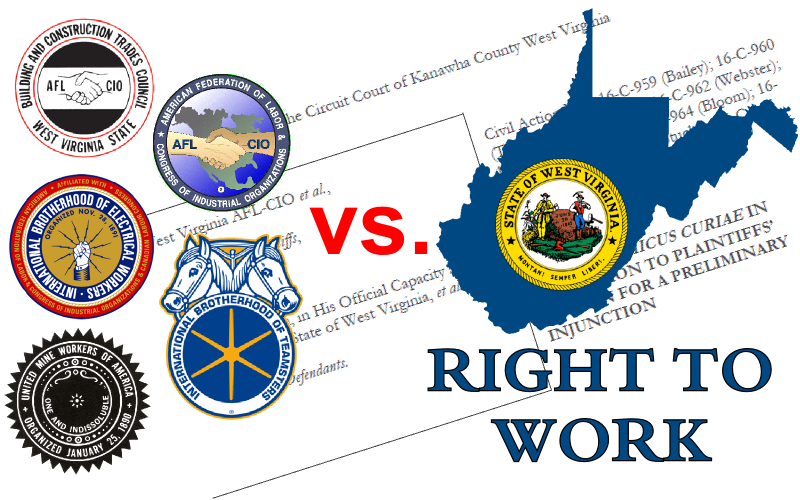
Forced-dues-hungry union bosses have been waging a legal battle to overturn West Virginia’s Right to Work Law since it was enacted in 2016. Foundation staff attorneys have been fighting back by filing amicus briefs in court.
CHARLESTON, WV – The West Virginia Supreme Court will hear arguments on January 15 in union bosses’ long-running case seeking to dismantle West Virginia’s Right to Work Law and restore their forced-dues powers over workers across the Mountain State. National Right to Work Foundation staff attorneys have already filed multiple legal briefs in this case for West Virginia workers in defense of West Virginia’s Right to Work Law.
After Passage, Union Bosses Immediately Target West Virginia Right to Work Law
Last year, union lawyers relied on discredited legal arguments to convince Kanawha County Circuit Court Judge Jennifer Bailey to declare West Virginia’s entire Right to Work Law invalid. Union lawyers dubiously claim that West Virginia union bosses have a “right” to forced dues. Judge Bailey issued a similar ruling blocking the Right to Work law after the legislation was signed into law in 2016. The West Virginia Supreme Court overturned that decision, citing arguments made in briefs by Foundation staff attorneys. “Of course, union partisans never willingly accept the loss of forced dues,” said National Right to Work Foundation President Mark Mix. “So now the issue is back at the state’s highest court.” If Big Labor’s lawsuit to overturn
West Virginia’s Right to Work Law succeeds, union bosses could have thousands of independent-minded workers across the state fired solely for refusing to subsidize union activities.
Foundation Files 10 Briefs to Protect Rights of West Virginia Workers
Foundation staff attorneys have filed 10 legal briefs in the multi-year case. The Foundation’s latest amicus brief was filed for West Virginia nursing home employee Donna Harper. Harper, like many other workers in West Virginia, chose not to pay dues or fees to union bosses, which is her legal right in a Right to Work state.
“Union bosses in West Virginia are intent on reclaiming their forced-dues power,” Mix said. “Big Labor is waging this protracted legal battle to return the Mountain State to a time when millions and millions of dollars in workers’ money were seized by union bosses to fill Big Labor’s coffers with forced dues.”
This case is the latest legal battle in the Foundation’s long history of effectively defending Right to Work laws in state and federal court from spurious attacks by Big Labor. Although federal law specifically authorizes states to pass Right to Work laws to protect workers from union boss coercion, union lawyers have repeatedly challenged these laws in an attempt to keep siphoning union dues and fees from workers’ paychecks.
Foundation Has Successfully Defended State Right to Work Laws Nationwide
In addition to West Virginia, Foundation staff attorneys have successfully pursued legal action in recent years to defend and enforce new Right to Work laws in Indiana, Michigan, Wisconsin and Kentucky, all of which have passed Right to Work protections for employees in just the last seven years. In Michigan alone, Foundation staff attorneys have assisted employees in over 100 cases since Right to Work went into effect in early 2013.
Labor Day Media Round Up: National Right to Work Commentaries Highlight Injustices of Forced Unionism
On Labor Day, the National Right to Work Foundation generated significant coverage in both national and local media outlets, especially on newspaper opinion pages. Foundation President Mark Mix wrote a number of pieces for outlets around the country highlighting the injustices of compulsory unionism and what can be done to protect workers freedom.
Mix wrote for USA Today that no American should be forced to pay union dues just to get or keep a job and highlighted the prevalence of compulsory unionism despite Right to Work laws gaining ground:
Twenty-seven states have now enacted and implemented right-to-work laws, with five joining in the last eight years.
And on June 27 of last year, the U.S Supreme Court handed down one of the most significant employee rights legal victories in the history of the right-to-work movement with the Janus decision, which ended the forced payment of union dues or fees for millions of government workers nationwide.
Unfortunately, there are more private sector American workers in the 23 non-right-to-work states and others in the railway and airline industries who still work under compulsory unionism.
Mix also wrote a column for the Detroit News arguing that no worker should ever have to fear union violence just because they disagree with union tactics or thuggish strong-arming:
Violence, the threat of violence and the wrongful non-violent use of fear and intimidation by union thugs should be illegal. No exceptions.
The spreading UAW corruption scandal shows that union bosses often act as though they are above the law.
For the Lexington Herald-Leader, Mix wrote about how Kentucky’s Right to Work law benefits the state, and why they need to protect it from the attacks of Democrat and gubernatorial candidate Attorney General Andy Beshear, who wants to give power back to union bosses should he be elected to replace Governor Matt Bevin a friend of Right to Work:
Beshear wants to return the Commonwealth of Kentucky to the days of workers being forced to hand over a portion of their hard-earned paychecks to the union boss elites to get or keep a job. Meanwhile, the Bevin Administration has spearheaded record economic growth after passing Right to Work here in Kentucky.
Even putting that enormous economic growth aside, the fact is that one candidate favors allowing Big Labor to extract money from workers’ paychecks, and the other candidate has worked tirelessly to protect Kentucky workers’ right to hold onto their paychecks without union boss interference.
And for the Las Vegas Review-Journal, Mark wrote how Right to Work laws have benefitted Nevada’s workers and families for more than half a century, causing noticeable effects for the state’s economy:
There is a reason Tesla’s Gigafactory is located in Nevada and not California. A nationwide 2017 survey of business leaders conducted by Chief Executive magazine found that, by a 2-to-1 margin, CEOs prefer adding jobs in right-to-work states over other states.
Business owners correctly view states that have passed right-to-work laws as being more welcoming and business-friendly than high-tax, forced-dues states such as California. That is why federal Bureau of Labor Statistics data show that from 2013-18, factory employment growth in Nevada was more than three times greater than in Western forced-union states such as Colorado, Oregon and Montana.
Just a few days after Labor Day, the Daily Caller published a timely op-ed from Mix regarding the Trump Administration’s rules to make it harder for union officials, like those implicated in the unfolding UAW scandal, to spend worker’s money on themselves or fuel their corruption:
At the end of May, the Trump Labor Department unveiled a rule that, as a contemporaneous news account filed by the Law360 legal news service explained, imposes “financial disclosure requirements for certain trusts that unions set up, scrutiny the agency says will ‘deter fraud and corruption.”
The proposed rule would reestablish the Form T-1, which until it was scuttled by union-label Obama administration bureaucrats in 2010 blocked officers of unions with $250,000 or more in annual revenue from using trusts supposedly created to benefit rank-and-file members to circumvent the federal reporting requirements for such unions that Congress instituted in the Labor-Management Reporting and Disclosure Act.
In addition, Mix wrote two op-eds, one for Right to Work states and the other for non-Right to Work states, which were sent out across the country and printed in local newspapers. They highlight the benefits of Right to Work laws and the problems that forced unionism causes.
Foundation Releases Special Notice For Kentucky Workers
Special Notice Informs Employees of Their Newly-Won Rights
Springfield, VA (January 18, 2017) – Today the National Right to Work Foundation released a Special Legal Notice for workers in the Commonwealth of Kentucky, informing them of their rights under the nation’s most recently passed State Right to Work law. Kentucky’s Right to Work law allows workers to cease being a member of the union and stop paying any dues, fees, or other financial support to an unwanted union.
The Kentucky Right to Work law applies to collective bargaining contracts entered into, extended, or renewed on or after January 7, 2017. If you are subject to a contract in effect before January 7, 2017, you can be compelled to either pay union dues as a union member or fees as a nonmember until that contract expires or is renewed or extended. Even if you are subject to a contract in effect before January 7, 2017, nonmembers have the right to object to a portion of those fees and pay reduced fees until the Right to Work law is effective for you. For more information on the law and the new protections for Kentucky workers, please click here.
National Right to Work Foundation Launches Kentucky Task Force to Defend and Enforce New Right to Work Law
Foundation staff attorneys will provide free legal aid to Bluegrass State workers seeking to exercise new Right to Work protections
Springfield, VA (January 10, 2017) – The National Right to Work Legal Defense Foundation announced today the creation of a special task force to defend and enforce Kentucky’s newly-passed Right to Work law. Foundation staff attorneys will offer free legal advice and aid to Bluegrass State workers seeking to exercise their rights to refrain from union membership and union dues payment, guaranteed by the Right to Work law.
On Saturday January 7, Kentucky Governor Matt Bevin signed into law Right to Work legislation, thereby making Kentucky the nation’s newest and 27th Right to Work state.
The National Right to Work Legal Defense Foundation has a long history of assisting employees seeking to exercise their Right to Work rights, most recently under Right to Work provisions enacted in West Virginia, Wisconsin, and Michigan.
Foundation staff attorneys are prepared to defend the Kentucky Right to Work law from any spurious legal challenges brought by union officials. Big Labor, unwilling to give up their forced-dues powers, routinely challenges Right to Work laws in courts despite the fact that Right to Work laws have repeatedly been upheld.
Unfortunately, union officials also often try to stymie independent-minded workers who seek to exercise their rights under Right to Work laws. Any Kentucky worker who has questions about his or her rights, or encounters any resistance or abuse while trying to exercise his or her workplace rights, is encouraged to contact Foundation staff attorneys for free legal aid.
“It’s not enough to enact Right to Work protections; they must be vigorously defended and enforced,” said Mark Mix, president of the National Right to Work Foundation. Union bosses will go to great lengths to keep workers in their forced-dues grasp. The National Right to Work Foundation will fight to make sure that every Kentuckian’s Right to Work is protected, because no worker should ever be forced to pay union dues or fees just to get or keep a job.”
Staff attorneys are preparing a special legal notice to be released in the coming days to inform all Kentucky workers of their new workplace rights. In addition to its Kentucky task force, the Foundation is also currently active in defending state Right to Work laws in Wisconsin, West Virginia, and Idaho against union lawsuits.
Affected employees are encouraged to call the Foundation’s legal hotline toll-free at 1-800-336-3600 or contact the Foundation online at www.nrtw.org to request free legal assistance or to learn more about their new rights.
Kentucky Workers Move to Defend Bluegrass State Right to Work Law
National Right to Work Foundation staff attorneys help Kentucky workers defend law to ensure union membership and dues payment remain voluntary
Frankfort, KY (June 29, 2017) – With free legal representation from National Right to Work Legal Defense Foundation staff attorneys, a group of Kentucky workers has filed a motion to intervene in the recently filed union-backed lawsuit attacking Kentucky’s new Right to Work law.
These pro-Right to Work Kentuckians wish to intervene to defend the law because their rights are at stake as workers’ who could be forced to pay union dues or fees without the protections of the Right to Work law which was signed into law in January. In addition to protecting workers freedom of choice when it comes to financial support for union activities, the law has been cited as a reason for historic levels of investment and job creation in the Commonwealth in the months since its passage.
The workers have chosen to intervene to support the law because they believe that it is their right to be free from compulsory unionism, and as workers currently employed in Kentucky, they may suffer from direct harm if union lawyers win their case. In the workers’ motion, National Right to Work Foundation staff attorneys argue that various union claims to overturn the Right to Work law have been correctly rejected by courts in other states.
Although the State of Kentucky is already defending the law in the case, the motion notes that these workers have a special interest in defending Right to Work and their attorneys can offer legal arguments distinct from those raised by state lawyers.
“Big Labor’s newest attack on the Right to Work comes in a state where there is dramatic support for the measure, and where the citizens are already starting to see the benefit of living in a Right to Work state,” said Mark Mix, President of the National Right to Work Foundation. “That’s why we’re committed to defending the rights of workers against any attempt to block or overturn Kentucky’s law making union membership and dues payment strictly voluntary.”
“Big Labor lawyers have been working overtime in recent years, unsuccessfully attempting to slow the spread of Right to Work and restore union bosses’ forced-dues powers,” continued Mix. “If union bosses spent more time making workers want to join a union voluntarily instead of seeking legal loopholes to keep them trapped into paying dues, maybe they wouldn’t fear the choice that Right to Work provides workers so much.”
Kentucky Workers Win Motion to Intervene to Defend Bluegrass State Right to Work Law
National Right to Work Foundation staff attorneys help Kentucky workers defend law to ensure union membership and dues payment remain voluntary
Frankfort, KY (July 26, 2017) – With free legal representation from National Right to Work Legal Defense Foundation staff attorneys, a group of Kentucky workers have won a motion to intervene in the recently filed Big Labor-backed lawsuit attacking Kentucky’s new Right to Work law.
“This ruling ensures that Kentucky workers, whose rights are protected by Kentucky’s new Right to Work law, can participate in the defense of the law,” said Patrick Semmens, Vice President of the National Right to Work Legal Defense Foundation. “Kentucky union bosses are offering spurious legal arguments in an attempt to restore their power to have workers fired for refusing to pay part of their hard-earned paycheck to a union they don’t support, and this ruling ensures that the Court will hear from pro-Right to Work Kentucky employees.”
For more information please refer to our June 29, 2017 press release on the motion to intervene.





