
University of California Workers Challenge Restrictions on Janus Rights
The following article is from the National Right to Work Legal Defense Foundation’s bi-monthly Foundation Action Newsletter, May/June 2020 edition. To view other editions or to sign up for a free subscription, click here.
Class-action lawsuit targets state and union for illegally blocking dues revocations
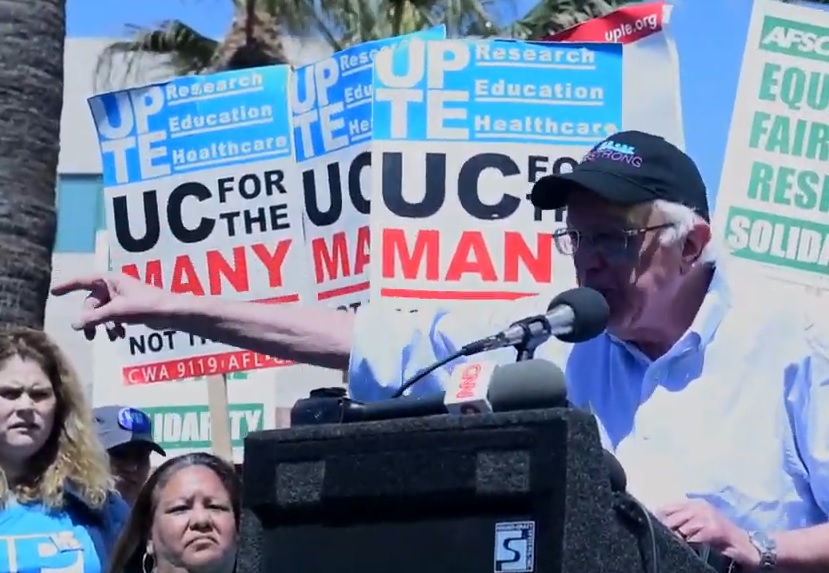
Former presidential candidate and self-described socialist Bernie Sanders gained the endorsement of UPTE union bosses, who are saddling employees with arbitrary restrictions on their First Amendment rights.
SAN DIEGO, CA – In March, UC San Diego Health Service Desk Analysts Pablo Labarrere and Sam Doroudi filed a federal class-action lawsuit against the University Professional and Technical Employees (UPTE) union and the University of California for seizing dues from their paychecks in violation of their First Amendment rights.
With free legal aid from National Right to Work Legal Defense Foundation staff attorneys, Labarrere and Doroudi contend that the dues seized from them and their colleagues are unconstitutional under the 2018 Foundation-won Janus v. AFSCME Supreme Court decision. In Janus, the Court ruled that deducting union dues from any public sector worker’s paycheck without his or her affirmative and knowing consent breaches the First Amendment of the U.S. Constitution.
The class-action lawsuit names University of California President Janet Napolitano as a defendant for the university system’s role in perpetrating this scheme. It also names California Attorney General Xavier Becerra as a defendant for the state’s enforcement of the illegal union dues policy.
UPTE Bosses Enforce Phony Restrictions on Janus Rights
According to the lawsuit, UC San Diego Health officials made all new employees “believe that it was a condition of employment to either join the union as full members or pay forced fees as non-members” during a mandatory orientation session. New employees were given and told to sign “dues deduction authorization cards” which provided that union officials would continuously collect dues from each employee’s paycheck unless a revocation letter was sent in a 30-day window before the annual anniversary of signing the card.
According to the lawsuit, the authorization cards did not explain, as Janus requires, that public sector employees “have a First Amendment right not to subsidize the union and its speech” and that signing the card would waive those rights. Labarrere and Doroudi eventually discovered their First Amendment Janus rights independently and sent letters to UPTE officials in December 2019 demanding that dues deductions be cut off. UPTE agents rejected both requests and continued to seize dues from Labarrere’s and Doroudi’s paychecks, ostensibly because they did not submit their requests within the “escape period” created by the union bosses.
The lawsuit contends that UPTE bosses are violating Labarrere’s and Doroudi’s First Amendment Janus rights by continuing to take dues from their paychecks without ever having received their “affirmative authorization and knowing waiver” of those rights. It also argues that the 30-day “escape period” illegally restricts Labarrere and Doroudi in the exercise of their Janus rights.
The class-action lawsuit additionally seeks to stop UPTE bosses and the University of California system from enforcing the scheme against any other workers, and require UPTE officials to return all dues and fees to any employees in the workplace that had their First Amendment rights violated because of the policy.
Workers Continue to Abolish “Escape Periods” With Foundation Legal Aid
Since the Janus decision, Foundation staff attorneys have litigated at least 14 cases around the country for thousands of workers whose First Amendment Janus rights have been infringed upon with union-created “escape periods.” Six of these cases have already been settled favorably for the plaintiff employees, providing relief and refunds for them and hundreds of their coworkers, while eliminating the restrictions for tens of thousands more.
In one of those cases, Michael McCain, a math professor at a community college in Ventura County, California, fought an illegal “escape period” foisted on his workplace by American Federation of Teachers (AFT) union officials, by filing a federal lawsuit in the District Court for the Central District of California. Ultimately, instead of facing Foundation staff attorneys in court, AFT officials settled the case and paid refunds to all workers who had dues seized because of the illegal policy.
“The Supreme Court made it absolutely clear in Janus that union officials violate public workers’ First Amendment rights when they seize union dues without their consent,” observed National Right to Work Foundation Vice President Patrick Semmens. “Yet over a year and a half after the decision, California union bosses — with the assistance of state officials — continue to subject the state’s public servants to schemes that violate these rights, all to fill union coffers with more illegal dues.”
Foundation Case Featured in the Wall Street Journal: “Chicago’s Union Pickpockets”
The Wall Street Journal published an editorial in Tuesday’s paper detailing how two teachers are suing the Chicago Teachers Union (CTU) with free legal aid from the National Right to Work Foundation, because union officials are forcing workers to pay dues in violation of their rights as recognized in the Foundation’s Janus v. AFSCME Supreme Court victory.
The editorial quotes one of the two teachers represented by Foundation staff attorneys and shows how CTU and the Chicago School Board continued to take money from them in violation of their First Amendment rights:
When the CTU went on strike last fall, Joanne Troesch and Ifeoma Nkemdi didn’t want to stop teaching. Ms. Nkemdi says her second graders are “incredible, highly intelligent young people” but “already disenfranchised,” so “I didn’t feel they needed to be away from school, period. . . . Time away was going to be detrimental.”
Both teachers quit the union, and in late October asked Chicago Public Schools to stop deducting dues from their paychecks. But even after receiving notice, the union continued to pilfer $35.71 from Ms. Troesch and $59.51 from Ms. Nkemdi every two weeks. The CTU claims members may revoke permission for dues deductions only during the month of August, and anyone who leaves after that must pay until the next escape window.
The editorial also cites Foundation attorney Bill Messenger on such union-created “escape window” schemes:
As of May 1, there were some 89 active lawsuits nationwide challenging similar union “escape windows” or the forced collection of dues, says Bill Messenger, the National Right to Work Legal Defense Foundation lawyer who argued Janus. He represents the two teachers.
The editorial concludes that federal courts need to enforce the Janus decision against these “escape window” schemes:
[CTU’s top lawyer] says the union operates “stringently within the letter of the law.” The union’s escape-window shenanigans show otherwise. Federal courts need to enforce Janus or it will have no meaning.
Sacramento Employee Hits Union with Charge for Ignoring Janus Rights
The following article is from the National Right to Work Legal Defense Foundation’s bi-monthly Foundation Action Newsletter, January/February 2020 edition. To view other editions or to sign up for a free subscription, click here.
More than a year after Court decision, union bosses still tell workers forced fees are legal
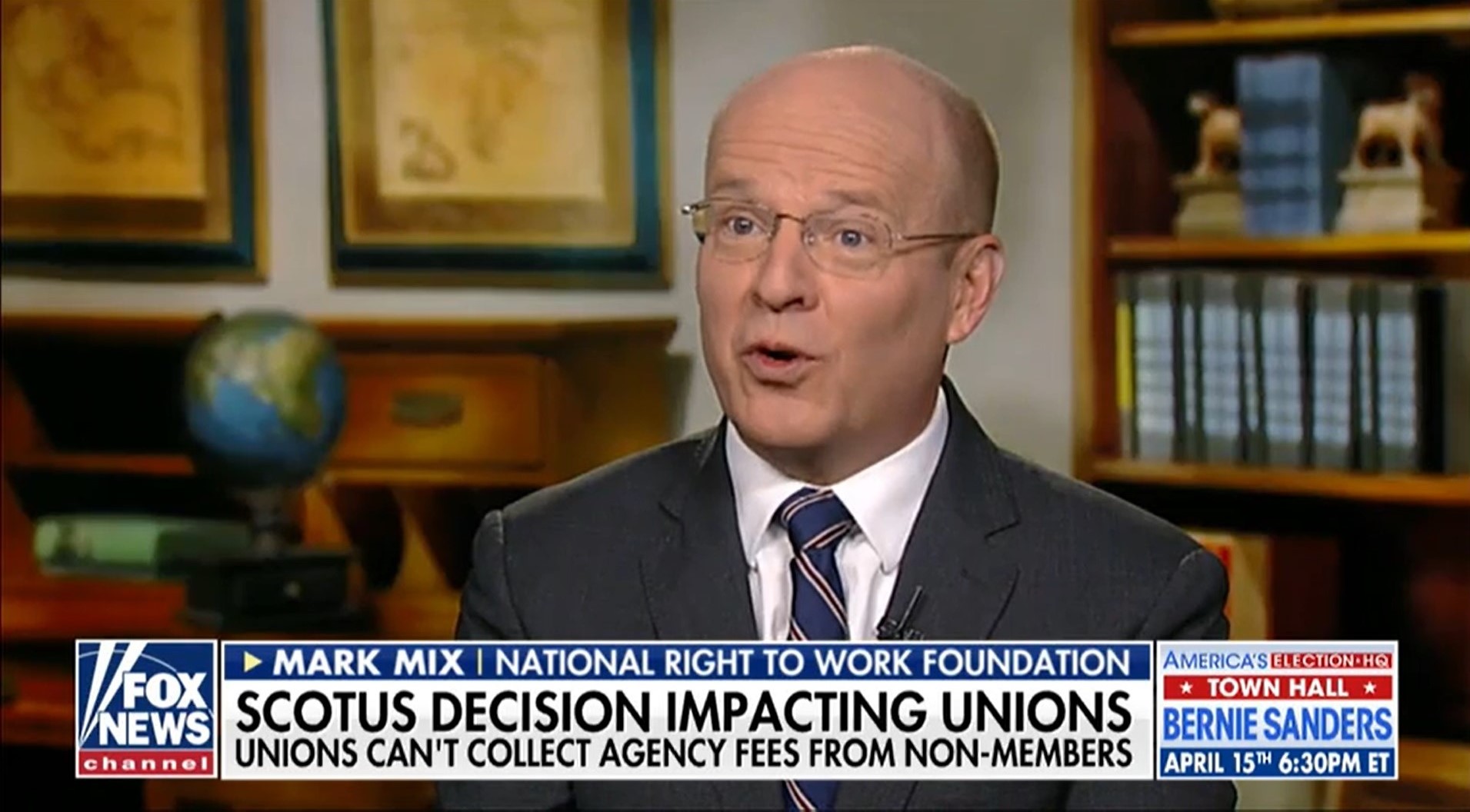
In the Foundation-won Janus v. AFSCME decision, the Supreme Court recognized the right of all American public sector workers to refrain from subsidizing unions, but California IUOE bosses are acting as if those rights don’t exist.
SACRAMENTO, CA – Ethan Morris works for Sacramento County as a wastewater treatment employee. With free legal aid from the National Right to Work Legal Defense Foundation, he has hit the International Union of Operating Engineers (IUOE) Stationary Engineers union bosses at his workplace with charges that their misstatements of his requirement to pay union fees breach California law by disregarding workers’ First Amendment rights under the Foundation-won Janus v. AFSCME Supreme Court decision.
California’s Public Employment Relations Board (PERB), the agency in charge of determining whether unions like IUOE have violated California’s public sector labor laws, will now investigate Morris’ charge.
California Union Bosses Blatantly Lie About Legality of Forced Dues
Morris has never been a member of IUOE Stationary Engineers. He recounts in his charge that he received a notice from an IUOE financial secretary in July 2019 which claimed that “employees who do not join the Union must pay a . . . fee” to the union as a condition of employment, and that these mandatory fees are “legal and enforceable in California” through direct deductions from non-member employees’ paychecks.
Morris’ charge says the union’s fee demands ignore government employees’ First Amendment rights under the 2018 Foundation-won Janus v. AFSCME Supreme Court decision. In Janus, a majority of the Court recognized that union dues or fees cannot be mandatory for public employees and may only be deducted from government workers’ paychecks if they have given “affirmative and knowing” waivers of their First Amendment right not to subsidize a union.
Morris maintains that by ignoring Janus, IUOE Stationary Engineers bosses infringed his rights under California’s Meyers-Milias-Brown Act (MMBA). That statute provides Golden State workers “the right to refuse to join or participate in the activities of employee organizations” and prohibits unions from “coerc[ing] or discriminat[ing] against” employees for exercising that right.
IUOE Officials Broke California Labor Law by Defying Janus
Morris demands that union officials rectify the situation by stopping the illegal fee demands and posting a PERB-approved notice informing his coworkers of their right to refrain from union activities and acknowledging that compulsory fee demands violate that right.
“Ethan Morris discovered his First Amendment Janus rights independently, and in doing so was able to catch IUOE Stationary Engineers bosses in a red-handed lie about the right of public sector workers in America to abstain from financially supporting a union,” observed National Right to Work Foundation President Mark Mix. “For every worker who rebuffs illegal union threats, there are almost certainly thousands of workers who unknowingly sign away their rights.
“State governments must step up and proactively protect employees’ Janus rights, including making sure that every worker knows those rights and not deducting any union dues or fees absent a worker’s knowing and voluntary waiver of his or her rights,” Mix added.
Taking the lead on protecting public workers’ Janus rights is Alaska, where last September Gov. Mike Dunleavy issued an executive order requiring all state agencies to stop the deduction of union dues from any worker who had not submitted a form affirmatively waiving his or her right under Janus not to fund any union activities.
Foundation Wins Settlement in Case Challenging CWA Union Scheme to Block New Mexico State Employees from Exercising Janus Rights
Union officials to pay back more than $16,000 illegally seized from workers’ paychecks and remove union-imposed restrictions on cutting off dues payments
Albuquerque, N.M. (October 21, 2019) — National Right to Work Legal Defense Foundation staff attorneys have won a settlement in a case to protect New Mexico state employees’ rights as recognized in the U.S. Supreme Court’s Janus v. AFSCME decision last year.
As the result of a federal civil rights lawsuit filed against the Communication Workers of America (CWA) union, CWA union officials will refund thousands of dollars taken from state employees and eliminate a union policy that blocked workers from opting out of paying dues. The settlement agreement, executed last Thursday, resolved the class-action lawsuit filed in December by New Mexico Department of Information Technology (DoIT) employee David McCutcheon against CWA union Local 7076 and New Mexico’s State Personnel Director Pamela D. Coleman.
As part of the settlement, the union officials will remove the union-created “escape period” which limited when workers could revoke their dues authorization. The union will also pay back fully, plus interest, all dues taken from McCutcheon and others who had attempted to exercise their First Amendment rights under Janus, but were blocked from doing so because of the “escape period” restrictions.
“Local 7076 and CWA will not enter into any [union contract] with the State of New Mexico that restricts to a yearly window period the time when a bargaining unit member may revoke a previously authorized dues deduction authorization,” the settlement reads.
All told, CWA union officials will refund more than $15,000 taken from 67 state employees, plus an additional $1,000 paid to McCutcheon for dues taken before Janus. The settlement became final today when District Court Judge Martha Vazquez approved a joint motion to dismiss the lawsuit.
McCutcheon works as an IT technician at New Mexico’s DoIT and was forced to pay union dues as a member before the Janus ruling last summer. After the Foundation-won victory, McCutcheon attempted to end the dues payments only to be told he could only do so during a brief two-week period in December.
Public sector union bosses across the country have attempted to enforce such schemes to block workers from exercising their Janus rights, resulting in over a dozen cases brought with National Right to Work Foundation legal aid. In addition to McCutcheon’s lawsuit, union officials in Minnesota, Ohio and California have also rescinded such policies rather than litigate against Foundation staff attorneys in federal court.
“Respecting workers’ Janus rights is not optional, it’s the law. Public sector workers’ First Amendment rights cannot be limited to just a few days a year,” said National Right to Work Foundation President Mark Mix. “These union boss created ‘window periods’ clearly infringe on workers’ rights and are being struck down in lawsuits coast-to-coast brought with Foundation legal aid.”
UConn Professor Receives Over $5,000 in Post-Janus Settlement
The following article is from the National Right to Work Legal Defense Foundation’s bi-monthly Foundation Action Newsletter, July/August 2019 edition. To view other editions or to sign up for a free subscription, click here.
Foundation-backed rule clarification takes aim at SEIU’s illicit $100 million per year money grab

Rather than face Foundation staff attorneys in court, union bosses refunded the forced dues seized from UConn professor Steven Utke in violation of his First Amendment rights.
STORRS, CT – Steven Utke, an accounting professor at the University of Connecticut, has received a settlement for $5,251.48 from American Association of University Professors (AAUP) union officials in his action, claiming the AAUP seized union dues in violation of his First Amendment rights. National Right to Work Foundation staff attorneys forced AAUP to settle after filing a federal lawsuit for Utke.
The case joins other Foundation-won settlements for workers who were forced to pay union fees in violation of their First Amendment rights. Despite those victories, Foundation staff attorneys continue to litigate about 30 other cases, seeking to enforce various aspects of the Foundation’s 2018 Janus v. AFSCME U.S. Supreme Court victory, with more being added every month as workers contact the Foundation seeking to exercise their Janus rights.
Utke started teaching at the University of Connecticut in 2015, and exercised his right to refrain from membership in the AAUP from the beginning of his employment. However, because Connecticut lacks a Right to Work law making union financial support strictly voluntary, AAUP officials began deducting union fees immediately from Utke’s paycheck despite the fact he was not a member.
When the Supreme Court ruled in Janus that requiring public sector workers to pay any union dues or fees as a condition of employment is a breach of the First Amendment, AAUP stopped the compulsory fee deductions. However, AAUP officials did not return the forced fees seized in violation of the First Amendment from the professor prior to the June 2018 Supreme Court decision.
Utke reached out to the National Right to Work Foundation for free legal aid, and on January 14, 2019 Foundation staff attorneys filed a lawsuit for Utke in federal court to force the union officials to refund the money they seized from him without his consent.
In April, rather than face Foundation staff attorneys in federal court, AAUP backed down and settled the case. Now, as stipulated by the terms of the settlement, AAUP officials have paid Utke more than the union fees seized in violation of his rights from 2015 to 2018.
Also as part of the settlement, they are required not to collect any dues or fees from Utke’s future wages, unless he affirmatively chooses to become a member of AAUP and authorizes such deductions.
“Steven Utke’s victory represents yet another landmark in the fight to enforce the Janus decision, but with dozens of additional Janus enforcement cases still pending, much work remains to force Big Labor to comply with the Supreme Court’s decision,” observed National Right to Work Foundation Vice President and Legal Director Ray LaJeunesse. “Foundation staff attorneys will not rest until every worker in America is free to exercise the right to decide whether or not to fund union activities.”
California Teacher Union Bosses Back Down, Settle Lawsuit Filed by Community College Professor for First Amendment Janus Violations
Union officials to issue refunds, drop policy blocking professors from exercising First Amendment right to stop subsidizing union activities
Los Angeles, CA (July 24, 2019) – A math professor from the Ventura County Community College District (VCCCD) has just finalized a settlement with American Federation of Teachers (AFT) union officials in his class-action lawsuit to enforce the 2018 Janus v. AFSCME U.S. Supreme Court decision. The lawsuit was filed for the professor in the U.S. District Court for the Central District of California with free legal aid from the National Right to Work Legal Defense Foundation.
The victory will result in refunds of dues seized from the professor and others who attempted to exercise their right to stop union payments under the Janus decision. Additionally, the settlement forces AFT union officials to drop their policy used to block the educators from exercising their Janus rights except for a brief union-determined annual escape period.
Professor Michael McCain had been paying union dues as a member of AFT since 2005, but attempted to exercise his First Amendment right to resign his membership and cut off dues in August 2018 shortly after the Janus ruling came down. Janus, which was argued and won by Foundation staff attorneys in the U.S. Supreme Court last year, struck down compulsory union fees for all public sector employees, and instead held that affirmative employee consent is required to obtain union fees from any worker.
According to the lawsuit, the AFT and VCCCD did not honor McCain’s resignation and continued to deduct dues from his paycheck, enforcing a strict “window period” policy which severely limits the time period in which a member can resign. The lawsuit also noted that McCain’s individual dues authorization card made no mention of this rule.
McCain’s attorneys argued that the AFT’s restrictive policy constituted a “violation of [his] First Amendment right not to subsidize union activity without [his] affirmative consent and known waiver of that…right, as recognized by the U.S. Supreme Court in Janus v. AFSCME.” It requested refunds for him and other similarly situated teachers in the VCCCD of “dues deducted…without their affirmative and knowing consent.”
Rather than face Foundation attorneys and the Janus precedent in court, VCCCD and AFT officials settled the case. The union will now “fully and unconditionally” refund to McCain and other teachers who requested to stop paying union dues since Janus was decided all the dues illegally taken since the dates of their requests, plus interest. AFT and VCCCD also promised not to “adopt any policy that restricts to a yearly window period the time” when an employee can revoke his or her dues authorization.
“Michael McCain joins the ranks of educators and other government employees across the country who have successfully fought for and defended their First Amendment rights under Janus from union boss schemes like annual ‘escape periods,’ which serve no purpose other than to continue the flow of illegal dues into union coffers,” said National Right to Work President Mark Mix. “All American workers deserve the freedom that Janus promises, and Foundation attorneys will keep fighting for them in the dozens of cases already filed and many more if necessary.”
Ohio Public Employee Files Appeal in Class-Action Lawsuit Seeking Return of Forced Union Fees Seized in Violation of First Amendment
Lawsuit seeks refunds of forced union fees seized from nonmembers by AFSCME union bosses before Supreme Court’s Janus v. AFSCME decision
Columbus, Ohio (July 25, 2019) – Today, National Right to Work Legal Defense Foundation staff attorneys filed an appeal in the class-action lawsuit against an Ohio affiliate of the American Federation of State County and Municipal Employees (AFSCME) union brought by Ohio Department of Taxation employee Nathaniel Ogle. The suit seeks the return of back dues seized by AFSCME union bosses before the Supreme Court’s 2018 Foundation-won Janus decision.
Ogle’s Foundation-provided attorneys filed the appeal to the U.S. Sixth Circuit Court of Appeals in his lawsuit against the Ohio Civil Service Employees Association (OCSEA) union seeking the return of forced fees seized in recent years from potentially thousands of state employees who were not union members but forced to subsidize union activities in violation of their First Amendment rights. The OCSEA has monopoly bargaining power over more than 30,000 Ohio government employees.
On July 17, a federal district court granted union officials’ motion to dismiss the case despite acknowledging that “It is undisputed that OCSEA’s prior practice of collecting mandatory fair share fees violated Ogle’s First Amendment rights.”
In Janus, the Supreme Court not only struck down forced dues for public employees but made it clear that any dues taken without a government employee’s explicit consent violate the First Amendment.
Ogle’s appeal is one of several to have reached a federal court of appeals challenging the so-called “good faith” defense that union lawyers have asserted in response to worker petitions for refunds, arguing that union officials should be allowed to keep funds seized prior to the Janus decision. The Supreme Court never suggested that Janus only requires prospective relief for affected workers. Indeed, the High Court has noted in Janus that union officials have been “on notice” for years that mandatory fees likely would not comply with the High Court’s heightened level of First Amendment scrutiny articulated in the 2012 Knox v. SEIU Supreme Court decision, won by National Right to Work Foundation staff attorneys.
“This case and dozens of others filed by Foundation staff attorneys to enforce the Supreme Court’s Janus decision demonstrate that union bosses will never willingly respect the rights of workers who are opposed to union affiliation and dues payments,” National Right to Work President Mark Mix said. “In this case and others being litigated with Foundation legal aid, workers seek the return of just a few years’ worth of unconstitutionally seized forced union fees as the statutes of limitations permit, which represents just a fraction of the fees union bosses have illegally collected from workers for decades.”
Check out the lead article in the January/February 2017 Foundation Action Newsletter “Foundation Cases Poised to Challenge Forced Dues at Supreme Court”
Foundation Cases Poised to Challenge Forced Dues at Supreme Court
Cases to overturn forced dues could quickly reach Supreme Court with new Trump Justice
To read the rest of the January/February 2017 issue, please click here.
Washington, D.C. – Over the past few months, Foundation staff attorneys have been busy litigating hundreds of cases on the behalf of independent-minded workers across the country. Two of those cases have the potential to reach the Supreme Court this year and answer the unresolved questions left in the wake of the 4-4 split in the Fredrichs v. California Teachers Association.
One of those cases, Janus v. AFSCME, stems from an executive order from Illinois Governor Bruce Rauner that placed any union fees that nonunion members were forced to pay into an escrow account until the constitutionality of those fees was resolved. Governor Rauner subsequently filed a lawsuit in U.S. District Court for the Northern District of Illinois and argued that collecting forced dues or fees from state employees as a condition of employment violated the First Amendment of the Constitution.
Foundation staff attorneys then filed a motion to intervene as plaintiffs for Mark Janus and other state employees who are forced to pay union fees as a condition of employment. A Judge eventually ruled that Governor Rauner did not have standing in court but let the Foundation-represented employees continue to challenge the constitutionality of forced fees.
After the Supreme Court reached a 4-4 deadlock in a similar case earlier this year, Friedrichs v. CTA, a District Judge ruled against Janus and the other state employees. Foundation attorneys immediately filed an appeal to the Seventh Circuit Court of Appeals and are awaiting a decision. It is possible that a petition for a writ of certiorari could be filed with the Supreme Court later this year.
The second case, Serna v. Transportation Workers Union (TWA), is a class-action lawsuit brought by several American Eagle Airlines and Southwest Airlines employees U.S. District Court for the Northern District of Texas was pending with the Supreme Court as this issue of Foundation Action went to press. That suit challenges the constitutionality of the Railway Labor Act’s sanction of agreements that require compulsory union fees as a condition of employment.
Even though these employees work in the private sector, the Supreme Court has previously ruled that because the Railway Labor Act (RLA) effectively mandates forced fees for railway and airline workers, it effectively fosters the same Constitutional issues as were raised for government employees in Friedrichs. Therefore, success in Serna on the First Amendment claims against forced dues would effectively overturn forced dues for public sector workers.
After the Fifth Circuit Court of Appeals ruled against the airline employees citing the Friedrichs deadlock, Foundation staff attorneys filed a petition for a writ of certiorari with the Supreme Court. The Court was scheduled to consider the petition on January 6 and a decision whether to take the case or not could follow shortly after, or the Justices may decide to hold the case in light of the potential for a 4-4 tie until a ninth Justice is seated.
“Both of these cases have the potential to answer the ultimate question that was left unresolved by Friedrichs and that is whether or not it is constitutional to force workers to pay union bosses tribute to get or keep a job,” National Right to Work Foundation President Mark Mix said.
In addition to Serna and Janus, National Right to Work Foundation staff attorneys have two additional cases working their way through the courts – one on behalf of university professors in Massachusetts and one for school employees in Kentucky – that directly challenge the constitutionality of mandatory union dues. More cases directly challenging the constitutionality of government-mandated forced union dues are expected to be filed by Foundation staff attorneys in 2017.
National Right to Work Foundation Staff Attorney Argues Case Before 7th Circuit Court of Appeals Challenging Forced Union Dues
Janus v. AFSCME could be next U.S. Supreme Court case to decide constitutionality of mandatory union fees for public employees
Chicago, IL (March 1, 2017) – On Wednesday, the U.S. Court of Appeals for the Seventh Circuit will hear oral arguments in Janus v. AFSCME, a case challenging mandatory union fees paid by government workers in Illinois. This case builds on recent Supreme Court decisions Knox v. SEIU (2012) and Harris v. Quinn (2014), both of which were won by National Right to Work Legal Defense Foundation staff attorneys.
In Janus, the plaintiffs are two Illinois government employees who are represented by staff attorneys from the National Right to Work Legal Defense Foundation and the Liberty Justice Center.
Under Illinois law, union officials are empowered to require government employees to pay money to a union as a condition of employment. Although state employees aren’t forced to be full-fledged union members, they are required to pay mandatory dues or fees to a union or be fired. This lawsuit seeks to end that practice on the grounds that these fees violate the plaintiffs’ First Amendment rights.
A victory for the Janus plaintiffs would impact millions of government employees who currently can be fired for refusing to pay dues or fees to union officials. The National Right to Work Foundation currently has seven cases across the country on behalf of public employees seeking a ruling that mandatory union fees violate the First Amendment, with Janus most likely to reach the U.S. Supreme Court first.
In 2016, because of the untimely death of Justice Antonin Scalia, the High Court split 4-4 in Friedrichs v. California Teachers Association, a case that would have also ended forced dues for public employees. A new justice will be the deciding vote should Janus or another case presenting the issue be taken up by the Supreme Court.
National Right to Work Foundation President Mark Mix commented, “Hopefully the Seventh Circuit will rule quickly so the case can go to the Supreme Court, which should uphold the First Amendment by ending the injustice of forcing public employees to pay tribute to union bosses as a condition of working for their own government.”
Illinois State Employee Asks U.S. Supreme Court to Hear First Amendment Challenge to Mandatory Union Fees
Janus v. AFSCME could free all government workers in the U.S. from being forced to pay union fees as a condition of employment
Washington, D.C. (June 6, 2017) – Today, the U.S. Supreme Court will be asked to hear a case that could free government workers from being forced to pay union dues or fees as a condition of employment.
Forcing government employees to pay money to union officials to keep their jobs violates the First Amendment, argues plaintiff Mark Janus in the case Janus v. AFSCME. Janus is a child support specialist from Illinois, whose lawsuit was brought by attorneys from the National Right to Work Legal Defense Foundation and the Liberty Justice Center.
The request for the U.S. Supreme Court to hear this case follows a March ruling by the U.S. Court of Appeals for the 7th Circuit, which upheld forced dues and fees based on the Supreme Court’s 1977 Abood v. Detroit Board of Education decision. The plaintiffs in Janus v. AFSCME argue that Abood was wrongly decided and should be overturned, especially in light of subsequent U.S. Supreme Court rulings that have applied strict scrutiny to mandatory union fees. A copy of the petition is available here.
Mark Mix, president of the National Right to Work Legal Defense Foundation, issued the following statement about the case:
“For too long, millions of workers across the nation have been forced to pay dues and fees into union coffers as a condition of working for their own government. Requiring public servants to subsidize union officials’ speech is incompatible with the First Amendment. This petition asks the Supreme Court to take up this case and revisit a nearly half-century-old mistake that led to an anomaly in First Amendment jurisprudence. By applying the principles the Court laid out in two recent cases brought for workers by National Right to Work Legal Defense Foundation staff attorneys – Knox and Harris – the Court can end the injustice of public sector forced dues by the end of next term.”
Jacob Huebert, senior attorney at the Liberty Justice Center, described what is at stake in the Janus case:
“People shouldn’t be forced to surrender their First Amendment right to decide for themselves what organizations they will and won’t support just because they decide to work for the state, their local government or a public school. This case gives the Supreme Court an opportunity to restore to millions of American workers the right to choose whether to support a union with their money.”
Mark Janus works for the Illinois Department of Healthcare and Family Services and is forced to send part of his paycheck to AFSCME. He said, explaining why he brought the case:
“I went into this line of work because I care about kids. But just because I care about kids doesn’t mean I also want to support a government union. Unfortunately, I have no choice. To keep my job at the state, I have to pay monthly fees to the American Federation of State, County and Municipal Employees, a public employee union that claims to ‘represent’ me. I’m filing this case on behalf of all government employees who want to serve their community or their state without having to pay a union first.”
In addition to Janus v. AFSCME, six other ongoing cases brought by workers with free legal assistance from the National Right to Work Legal Defense Foundation are challenging public sector forced dues. These cases represent the full spectrum of public employees, including teachers in Pennsylvania, school aides in Kentucky, university professors in Massachusetts, medical center technicians in California, school electricians in New York and state troopers in Connecticut.
Janus’ case is the first of that group to reach the Supreme Court. The case is on track for the Supreme Court to decide whether to hear it at its first conference of the term beginning in the fall. If four justices agree, the Supreme Court could announce soon after its September 25 conference that it will hear the case.
Background: Janus v. AFSCME’s journey to the Supreme Court
The case now called Janus v. AFSCME began on February 9, 2015. Illinois Gov. Bruce Rauner issued an executive order prohibiting state agencies from requiring nonmember state employees to pay union fees, and directed that instead any such fees deducted be put in escrow pending the resolution of litigation.
On the same day, Rauner filed a federal lawsuit in the U.S. District Court for the Northern District of Illinois against the collection of forced fees from state employees, asking for a declaratory judgment that the forced fee provisions violate the First Amendment and that his executive order was valid.
On March 23, 2015, staff attorneys from the National Right to Work Legal Defense Foundation and the Liberty Justice Center filed a motion for Mark Janus to intervene in the case. Janus’s complaint requested not only a declaratory judgment but also an injunction and damages from the unions for the compelled fees.
Although the court then ruled that Rauner did not have standing necessary to pursue his lawsuit, the challenge continued because the judge granted Janus’ motion to intervene. The case was renamed Janus v. AFSCME. On July 2, 2015, the Illinois Attorney General asked the district court to stay the case pending the Supreme Court’s decision in a case with similar constitutional issues at stake, Friedrichs v. California Teachers Association. The district court granted a stay on July 8, 2015.
According to most legal observers, the Supreme Court appeared ready to rule for the teacher plaintiffs in Friedrichs and declare that forced union fees for public sector workers violate the First Amendment. However, after Justice Antonin Scalia’s death in February 2016, the court ultimately deadlocked 4-4 on Friedrichs. Soon after, a district court judge dismissed Janus, allowing the case to be appealed to the 7th Circuit.
The appeal was filed in October 2016, and oral argument was held on March 1, 2017. On March 21, the 7th Circuit upheld the district court’s decision, ruling that the Abood v. Detroit Board of Education precedent applied to Janus v. AFSCME. That expected decision by the 7th Circuit allowed Janus’ attorneys to file a certiorari petition with the U.S. Supreme Court.
Recent Supreme Court victories set stage for Janus case
Janus follows a series of decisions that demonstrate a willingness by the Supreme Court to reconsider the constitutionality of forced union fees. In 1977, in Abood, the High Court had held that although union officials could not constitutionally spend objectors’ funds for some political and ideological activities, unions could require fees to subsidize collective bargaining and contract administration with government employers.
In the 2012 Knox v. SEIU case, brought by National Right to Work Legal Defense Foundation staff attorneys, the Supreme Court began to question Abood’s underpinnings. The Court there held that union officials must obtain affirmative consent from workers before using workers’ forced union fees for special assessments or dues increases that include union politicking.
In the opinion Justice Samuel Alito authored, the door was left open to challenge all forced union fees as a violation of the First Amendment. Alito wrote, “By allowing unions to collect any fees from nonmembers and by permitting unions to use opt-out rather than opt-in schemes when annual dues are billed, our cases have substantially impinged upon the First Amendment rights of nonmembers.” Additionally he said, “Unions have no constitutional entitlement to the fees of nonmember-employees.”
Two years later, the Foundation assisted a group of Illinois home care providers, including Pam Harris, a mother taking care of her disabled son, in challenging a state scheme authorizing Service Employees International Union officials to require the providers to pay union dues or fees. National Right to Work Legal Defense Foundation attorneys took the case to the Supreme Court, which held that the forced dues requirement violated the First Amendment. The Liberty Justice Center filed an amicus brief in support of Pam Harris and the other plaintiffs with the Supreme Court.
In its Harris ruling, the Court heavily criticized the reasoning of Abood and refused to extend Abood to the “new situation” before it, “[b]ecause of Abood’s questionable foundations, and because the personal assistants are quite different from full-fledged public employees.” The decision held Illinois’ scheme unconstitutional and cracked the door even further open for the Court to revisit Abood and the constitutionality of forced union fees. Justice Alito wrote for the Court, “Except perhaps in the rarest of circumstances, no person in this country may be compelled to subsidize speech by a third party that he or she does not wish to support.”
Last year, it appeared that the Supreme Court was ready to strike down forced union fees for public sector workers for good in the Friedrichs v. California Teachers Association case. The case was brought by Rebecca Friedrichs and eight other teachers who argued that Abood should be overturned because the forced collection of union fees is a violation of the First Amendment. In that case, attorneys for the Liberty Justice Center filed an amicus brief for Mark Janus and National Right to Work Legal Defense Foundation staff attorneys filed a separate amicus brief. Both asked that the High Court strike down compulsory union fees for public employees as a violation of the First Amendment.
Most legal observers agreed that Scalia was set to cast the deciding fifth vote in favor of the plaintiffs. However, his death just weeks before the case was to be decided resulted in a deadlocked court and left Abood in place for the time being. Now, Janus provides another vehicle for the Supreme Court to revisit the constitutionality of compelled union fees for public employees.





