
Case Closed: Nurse Prevails in 11-Year Legal Fight Over Forced Dues
The following article is from the National Right to Work Legal Defense Foundation’s bi-monthly Foundation Action Newsletter, January/February 2022 edition. To view other editions of Foundation Action or to sign up for a free subscription, click here.
100 Rhode Island hospital employees win refund of dues illegally seized for union lobbying

After over a decade of battling power-hungry UNAP union bosses in court, Jeanette Geary has secured not only refunds of dues seized for union politics, but a First Circuit decision clarifying non-members can never be charged for union lobbying.
WARWICK, RI – Jeanette Geary finally achieved a total victory in her 11-year legal battle against union bosses. She and 99 other current and former nurses at Kent Hospital in Rhode Island received refunds of forced dues that were illegally used to support union lobbying in state legislatures. Foundation attorneys represented Geary throughout her fight.
Geary’s journey began when she grew frustrated with United Nurses and Allied Professionals (UNAP) union bosses in her workplace. “I realized what the union was doing,” Geary explained. “The union leadership had no interest in nurses or our professional work. Their only interest was collection of dues and fees.”
Geary resigned her union membership, but union dues were still extracted from her paycheck because Rhode Island is a forced unionism state that lacks Right to Work protections. However, thanks to the Foundation-won CWA v. Beck Supreme Court decision, nonmember workers can only be forced to pay fees for union activities “germane” to union monopoly bargaining. They cannot be forced to pay the portion of dues that funds activities like union lobbying.
Nurse Harassed for Standing Up to Union Bosses
Geary demanded a breakdown of the union’s expenditures, but union bosses refused to give her a legally required independent auditor’s verification of how they calculated non-members’ reduced forced fees. Like many who speak up against union bosses, Geary became a target for union harassment. “They laughed at me. They had their workplace reps ridicule me on the job and tell me I could file grievances that would be thrown away and said so with a big smile,” Geary recalled.
In 2009, Geary filed federal charges against union officials. The trial revealed UNAP officials were charging non-member nurses for lobbying in state legislatures. Despite the Supreme Court’s clear mandate in Beck that non-members’ money could not be used to fund political causes, union lawyers argued the lobbying was “germane” to the union’s monopoly bargaining.
Thanks to delays caused by President Obama’s illegal recess appointments to the National Labor Relations Board (NLRB), Geary had to file two petitions with the U.S.
Court of Appeals in Washington, D.C., and didn’t get a final NLRB ruling for nearly a decade. Finally, in March 2019, the NLRB ruled 3-1 that union officials cannot charge non-members for lobbying of any kind. It also ruled that union officials must provide independent verification that the union expenses they force non-members to pay have been audited.
Union Bosses Ridiculously Claimed Some Union Lobbying Wasn’t Political
Union officials still wouldn’t abandon their argument that nonmembers could be forced to pay for some union lobbying as a condition of employment. Union lawyers appealed the NLRB’s decision to the U.S. Court of Appeals for the First Circuit. A three-judge panel that included retired Supreme Court Justice David Souter ruled unanimously in Geary’s favor, saying “we see no convincing argument that legislative lobbying is not a ‘political’ activity.”
Union officials made a last-ditch attempt to overturn the decision, requesting an en banc hearing by the entire Court of Appeals, but that request was denied. In September 2021, union bosses finally paid back, with interest, thousands of dollars taken from Geary and 99 other current and former Kent Hospital nurses who were not union members but were charged for the union’s lobbying, bringing the decade-long case to a close.
“Jeanette Geary faced workplace ridicule for her decision to stand up to union bosses, yet she persevered for eleven years,” said National Right to Work Foundation Vice President and Legal Director Raymond LaJeunesse. “In the process, she won important legal precedents that will protect thousands of other workers from having their money illegally used to fund union politics.”
Workers Who Voted Against Union Oppose Order Forcing Union on Them
The following article is from the National Right to Work Legal Defense Foundation’s bi-monthly Foundation Action Newsletter, November/December 2021 edition. To view other editions of Foundation Action or to sign up for a free subscription, click here.
Biden NLRB seeks to overturn vote of Red Rock Casino workers against Unite Here
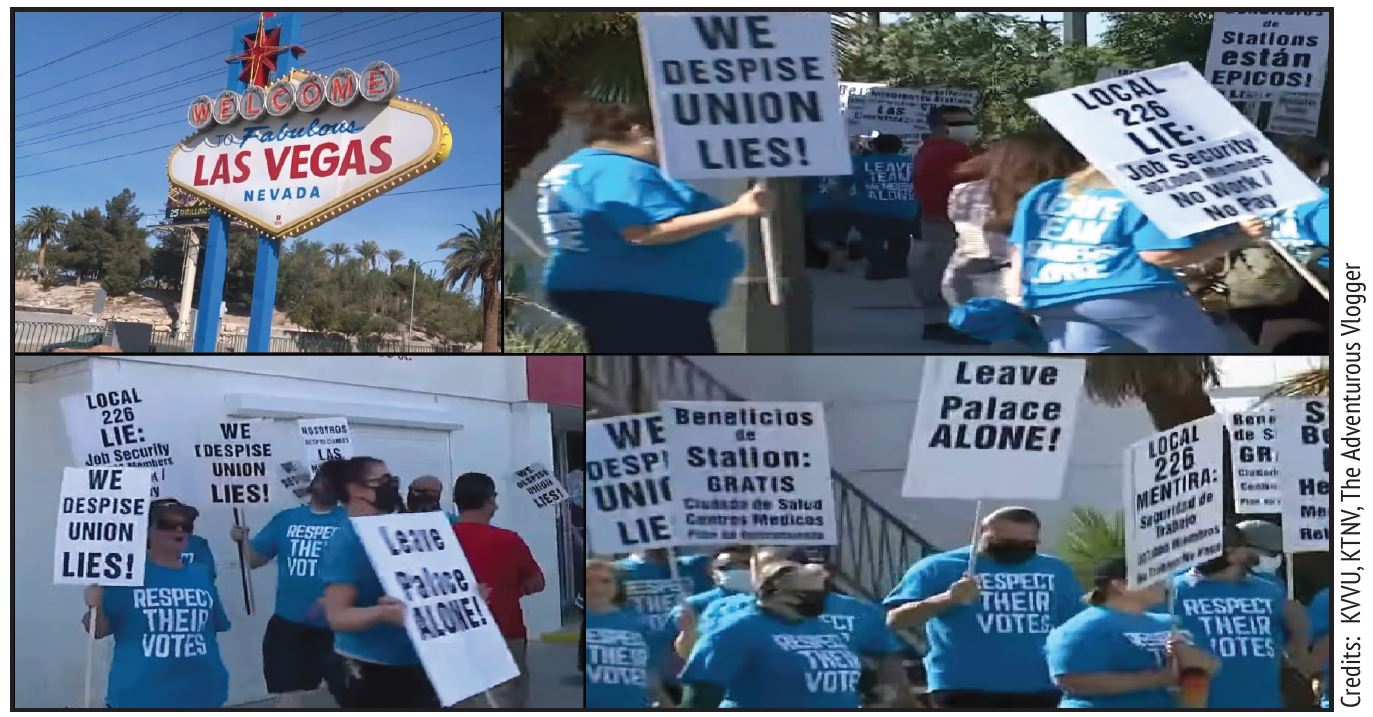
Red Rock Casino employees bearing the messages “We Despise Union Lies” and “Respect Their Votes” protested outside Culinary Union headquarters in Las Vegas after union bosses tried to block Red Rock Casino workers’ emphatic vote to remove the union.
LAS VEGAS, NV – A large majority of the workers at Red Rock Casino in Las Vegas, Nevada, voted “no” to unionization, but a federal district court judge later issued an order forcing their employer to bargain with union officials anyway.
The Casino appealed the judge’s order to the U.S. Court of Appeals for the Ninth Circuit. National Right to Work Legal Defense Foundation attorneys assisted Red Rock food service employee Raynell Teske for free in filing her legal brief at the Ninth Circuit, arguing the judge was wrong to impose a union monopoly on the workers after the union had already lost an election.
Judge Overrides Workers’ Election Choice
In December 2019, the National Labor Relations Board (NLRB) administered a secret-ballot election on whether to unionize Red Rock. A majority of those voting rejected union officials’ effort to become their monopoly bargaining “representatives.”
Nevertheless, NLRB Region 28 Director Cornele Overstreet sought a federal court injunction demanding the union be imposed over the workers’ objections. On July 20, 2021, notoriously partisan Judge Gloria Navarro, appointed by Barack Obama, granted the NLRB Director’s request. She fired off a rare “Gissel” order forcing Red Rock to bargain with union officials despite the employees’ vote against unionization. The judge based her order on union officials’ claim that a majority of workers had signed union authorization cards before the vote. Teske’s legal brief argues that those “card check” signatures are unreliable, and not reason enough to conclude the union ever had majority support. After all, the level of union support was tested by the secret-ballot election and the results were clear: union officials received only 40% support from the eligible employees’ votes. As the Supreme Court has long recognized, secret ballots are a far more reliable way of gauging worker support for a union, because workers are often pressured, harassed, or misled by union organizers into signing cards.
Union Handbook Admits: ‘Card Check’ Is Unreliable
Unions themselves know that “card check” signatures do not reliably indicate worker support. The AFL-CIO admitted in its 1989 organizing handbook that it needed at least 75% card check support before having even a 50-50 chance of winning a secret-ballot election. An earlier guidebook acknowledged that some workers sign cards just to “get the union off my back.” Teske’s brief argues the union’s possession of so-called “cards” does not give union officials permission to take over, especially after they lost a secret-ballot election.
Brief: A Judge’s Order Shouldn’t Overturn Workers’ Clear Choice
The Foundation-aided brief urges that the “Gissel” order be overturned and says that imposing the union’s monopoly power despite the workers’ vote against it treats workers “like children” who did not understand what they were doing when they voted against union affiliation.
“Ms. Teske and her coworkers chose to reject unionization at the ballot box, but Judge Navarro decided to use her power to overturn the election,” said National Right to Work Foundation Vice President and Legal Director Raymond LaJeunesse. “Time and time again, we see workers pressured, misled and even bribed to sign union cards, which is why ‘Card Check’ is widely accepted as unreliable, especially compared to an NLRB-supervised secret-ballot election.”
“The Court of Appeals should promptly overturn Judge Navarro’s coercive order, and restore the actual choice workers made at the ballot box. Federal judges and NLRB bureaucrats cannot be allowed to override workers’ choices,” added LaJeunesse.
Foundation Opposes Biden Rule to ‘Authorize’ Illegal Union Skim of Medicaid Funds
The following article is from the National Right to Work Legal Defense Foundation’s bi-monthly Foundation Action Newsletter, November/December 2021 edition. To view other editions of Foundation Action or to sign up for a free subscription, click here.
Comments: Federal law prohibits diverting Medicaid funds away from homecare providers

Harris v. Quinn plaintiff Susie Watts (left) said her victory against forced dues for homecare providers was really a win for her disabled daughter Libby: “It’s not even about me as a homecare provider…They’re her benefits that are being siphoned off.”
WASHINGTON, DC – The National Right to Work Foundation filed formal comments with the Centers for Medicaid and Medicare Services (CMS), a division of the Department of Health and Human Services, asking the agency to reject an attempt to authorize state officials to redirect Medicaid funds into union coffers.
The Biden Administration’s pending proposal would overturn a 2018 Foundation-backed rule that confirmed that federal law prohibits union officials from skimming union dues payments from Medicaid funds intended for those who provide home-based assistance to people with disabilities. The Foundation’s comments argue that the Trump-era rule simply ensured that Medicaid regulations conformed to long-standing statutory law, and that the federal statute governing Medicaid prohibits diverting payments to any third parties, including unions and union PACs.
Under Obama, Union Bosses Cashed Out at Expense of Medicaid Recipients
The comments also detail the Obama Administration’s role in permitting union officials to violate the law, explaining that a special exemption created in 2014 by the Administration gave union officials legal cover to siphon upwards of $1 billion from Medicaid payments.
Union officials, especially at the Service Employees International Union (SEIU), have long used deceptive and even unconstitutional tactics to divert taxpayer-funded Medicaid payments into union coffers. Before the Supreme Court’s ruling in the Foundation-won 2014 Harris v. Quinn decision, homecare providers in over a dozen states were required to fund union activities. State governments automatically deducted fees from providers’ Medicaid payments even though such union dues diversions violated federal law regarding Medicaid funds. In Harris, the court held that mandatory union payments violate the First Amendment rights of homecare workers who do not wish to support union activities. Even after the Harris decision was issued, union officials continued seizing money from hundreds of thousands of providers across the country under cover of the Obama-era rule creating an exception to the prohibition against skimming Medicaid funds. Union officials used numerous underhanded tactics to keep the dues skim going, including, according to providers’ reports, claiming the dues payments were mandatory, blocking or ignoring requests to stop the deductions, and even forging signatures to authorize them.
Unlawful System Exists to Subsidize Union Politics
“[Home and Community Based Service] Medicaid payments are supposed to pay for care for the severely disabled,” the Foundation’s comments state. “Diverting these payments to third-party special interests to subsidize their political agendas, lobbying and recruitment campaigns is as unconscionable as it is unlawful” under the federal law governing Medicaid.
“What you’re seeing is a misuse of Medicaid funds being steered away from paying for care to disabled people and being used for politics,” Foundation staff attorney William Messenger, who argued Harris, told The Washington Free Beacon in its report about the Foundation’s comments. “They set up an entire system to pressure Medicaid providers to assign a portion of their Medicaid funds over to” union officials and their political action committees.
Under the 2018 rule, union officials may still collect payments from caregivers who voluntarily support union activities, but cannot use taxpayer-funded government payment systems to deduct the dues from Medicaid payouts. Voluntary union supporters could still personally make payments just as millions of Americans make regular payments to private businesses or other organizations.
“The Biden Administration’s plan to reauthorize the Medicaid union dues skim is a cynical ploy to allow their political allies to divert funds that federal law makes clear should be going to help those who are homebound or have significant disabilities,” observed National Right to Work Foundation Vice President Patrick Semmens. “Homecare providers’ own free choice should determine whether union bosses receive their support, not politically motivated, federally imposed special exemptions.”
University of California Lab Assistant Challenges California’s Anti-Janus Law
The following article is from the National Right to Work Legal Defense Foundation’s bi-monthly Foundation Action Newsletter, September/October 2021 edition. To view other editions of Foundation Action or to sign up for a free subscription, click here.
Employee wanted to stop dues but law let union bosses demand photo ID
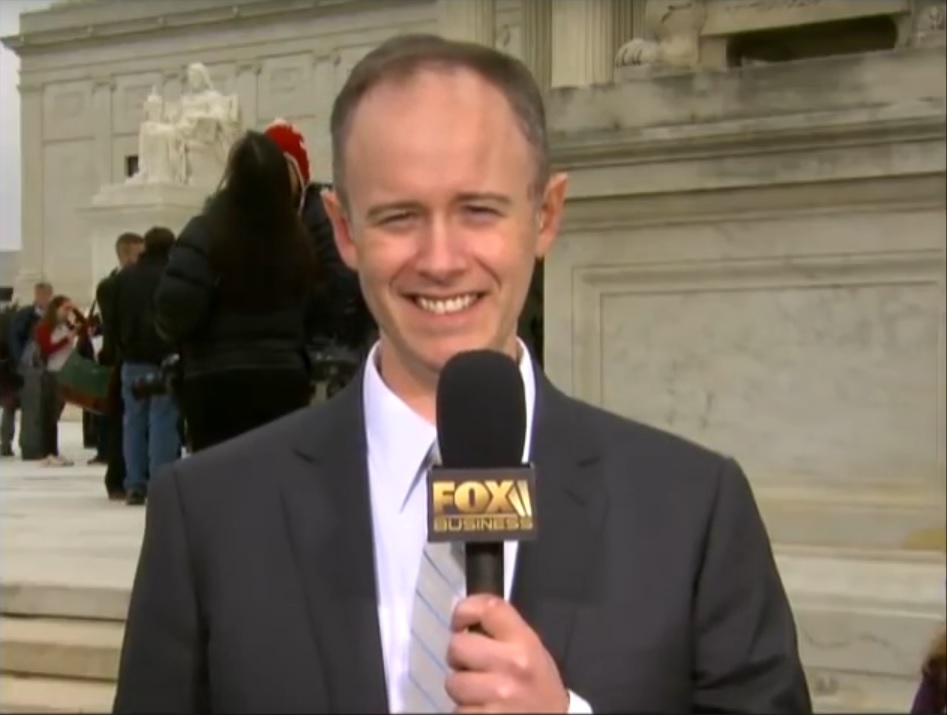
Foundation staff attorney William Messenger scored a huge win for worker freedom in Janus. He’s now on Amber Walker’s legal team.
IRVINE, CA – California has long been at the forefront when it comes to promoting forced union dues. So when it became clear the Supreme Court would likely side with National Right to Work Foundation staff attorneys in the 2018 Janus v. AFSCME case, union boss allies in the California legislature quickly got to work passing laws to undermine public employees’ First Amendment rights. Among the most pernicious of the series of California’s anti-Janus laws is one that gives government union bosses unilateral control over which workers have dues money seized from their paychecks, even over the objections of those workers.
Now, with free legal representation from National Right to Work Foundation staff attorneys, University of California Irvine lab assistant Amber Walker is challenging the law in the U.S. District Court for the Central District of California, suing both the University of California system and University Professional and Technical Employees (Communications Workers of America, UPTE-CWA 9119) union officials.
Her case contends that the California statute, which makes public employers completely subservient to union officials on dues issues, let union bosses demand she provide a photo ID just to exercise her First Amendment right to stop union financial support. Her Foundation-provided staff attorneys argue that the California statute violates both due process and First Amendment guarantees.
In the Foundation-argued Janus v. AFSCME Supreme Court case, the Court declared that forcing public sector workers to fund unions as a condition of employment violates the First Amendment. The Justices also ruled that union dues can only be taken from a public employee with an affirmative and knowing waiver of that employee’s First Amendment right not to pay.
“The University is leaving me helpless against these union officials who just seem to want to take my money despite the fact that I clearly don’t want to be part of the union,” Walker told a Los Angeles Times reporter. “The Janus decision said that I should have a choice when it comes to supporting a union, but UPTE has been denying me my rights and the university is letting the union get away with it.”
Statute Prevents Workers from Telling University Admin to Stop Illegal Takings
Walker’s lawsuit explains that she sent CWA union bosses a letter in June 2021 exercising her right to end her union membership and all union dues deductions from her wages. Although Walker submitted this message within a short annual “escape period” that CWA officials impose to limit when workers can revoke dues deductions, they still rebuffed her request, telling her she needed to mail them a copy of a photo ID to effectuate her revocation.
The photo ID requirement, seemingly adopted purely to frustrate workers’ attempts to exercise their constitutional rights, is mentioned nowhere on the dues deduction card Walker had previously signed to initiate dues payments.
Lawsuit: Union Officials Should Not Control Workers’ First Amendment Rights
UC Irvine and CWA officials are still seizing cash from Walker’s paycheck, and will likely continue to do so for at least another year as the CWA’s arbitrary and short annual “window period” elapsed by the time CWA officials notified Walker that her attempt to stop dues was rejected for lack of photo ID.
The university administration can’t stop dues payments for Walker because of the California statute that gives union officials total control over union dues deductions.
Foundation staff attorneys state in Walker’s complaint that, because of the California statute, CWA officials were able to trample Walker’s desire to keep her own money and were allowed to infringe on her First Amendment Janus rights.
Walker seeks refunds of the dues taken from her and other university workers under CWA’s photo ID scheme. She also seeks to stop the State of California from enforcing the state law outsourcing the process for stopping and starting union dues deductions to self-interested union officials.
UPTE Bosses Designed Scheme Knowing CA Law Would Protect Them
“California CWA union bosses clearly value illegally filling their coffers with Ms. Walker’s money over respecting her First Amendment and due process rights,” commented National Right to Work Foundation Vice President and Legal Director Raymond LaJeunesse. “They created this photo ID requirement out of thin air to block workers from exercising their Janus rights, safe in the knowledge that California’s union dues policies would stifle any chance a public worker has of getting his or her employer to stop seizing dues money for the union.”
“By giving union bosses total control over how and when workers can exercise their First Amendment Janus right to stop dues payments, California is allowing the fox to guard the henhouse to the detriment of public employees’ constitutional rights,” added LaJeunesse.
NLRB Keeps Union Bosses in Power Despite Unanimous Opposition
The following article is from the National Right to Work Legal Defense Foundation’s bi-monthly Foundation Action Newsletter, September/October 2021 edition. To view other editions of Foundation Action or to sign up for a free subscription, click here.
Labor Board seeks to force company to “bargain” with union opposed by all workers

Foundation attorneys argued that NLRB bureaucrats are treating Neises Concrete Construction Corp. workers like “children” and not “freethinking individuals” by forcing them under the control of an IKORCC union none of them support.
WASHINGTON, DC – The National Labor Relations Board (NLRB) refused to overturn a decision that blocked an employee’s decertification petition and allowed union bosses to remain in power at a workplace despite no employee support for the union.
After a regional NLRB official declined to allow the vote to go forward, Neises Construction Company employee Mike Halkias challenged the ruling blocking his unanimous petition for a vote to remove the union with free legal aid from the National Right to Work Legal Defense Foundation. In July, the Labor Board in Washington, DC, upheld NLRB Region 13’s decision to dismiss the unanimous decertification petition.
The petition was filed by workers at Neises Construction Company in Crown Point, Indiana. None are members of the Indiana/Kentucky/ Ohio Regional Council of Carpenters union (IKORCC), but federal law allows IKORCC union bosses to act as the workers’ “exclusive bargaining representative.”
Pro-Forced-Unionism Ruling Treats Workers Like ‘Children’
Though the petition had support from every member of the bargaining unit, the NLRB regional office rejected the petition, pointing to ongoing litigation between IKORCC and Neises over negotiations for the workers’ contract.
Before it will give workers a chance to remove union bosses, the NLRB said, unbelievably, that Neises must bargain with IKORCC officials for a union monopoly contract, even though no Neises employee supports the union or wants it to bargain for them. The Region used the union’s active legal dispute with the employer to justify dismissing the workers’ petition for a decertification vote.
Foundation attorneys argued in their appeal to the full NLRB that the employer’s dispute with IKORCC bosses should not take away the workers’ right to remove the unwanted union. As the appeal stated, “Halkias and his fellow employees are not children, but freethinking individuals who have the right to dislike the union for a host of reasons having nothing to do with Neises or the Union’s unproven, unadjudicated allegations.”
NLRB Outrageously Kills Worker Effort to Remove Unwanted Union Bosses
The appeal implored the Board to, at the very least, investigate whether the alleged employer wrongdoing had diminished the employees’ ability to make an informed choice about union boss “representation.”
Instead, the Board denied the workers’ appeal, accepting the Region and union officials’ reasoning that the pending employer charges should block the workers’ request for a vote. The workers at Neises remain under union “representation” they unanimously oppose. Foundation attorneys argued that NLRB bureaucrats are treating Neises Concrete Construction Corp. workers like “children” and not “freethinking individuals” by forcing them under the control of an IKORCC union none of them support.
“It is beyond outrageous that federal law lets union bosses force workers to accept unions’ so-called ‘representation’ against their will — even when workers unanimously oppose the union,” said National Right to Work Legal Defense Foundation Vice President Patrick Semmens. “Federal law purports to protect workers’ ‘freedom of association’ and to ensure union representation ‘is of their own choosing,’ however, as this case demonstrates, the NLRB frequently protects union boss power to the detriment of workers’ freedom.”
“This outcome shows how federal labor law is broken,” added Semmens. “These workers simply want a vote to remove a union they oppose, yet the NLRB response is not only to block any such vote but also to seek to force their employer to bargain further with a union supported by precisely zero rank-and-file workers.
Victory: CO Worker Wins Against Union Bosses Who Demanded Illegal $21,000 Fine
The following article is from the National Right to Work Legal Defense Foundation’s bi-monthly Foundation Action Newsletter, September/October 2021 edition. To view other editions of Foundation Action or to sign up for a free subscription, click here.
Union must back down after trying to punish worker who left union, found new job
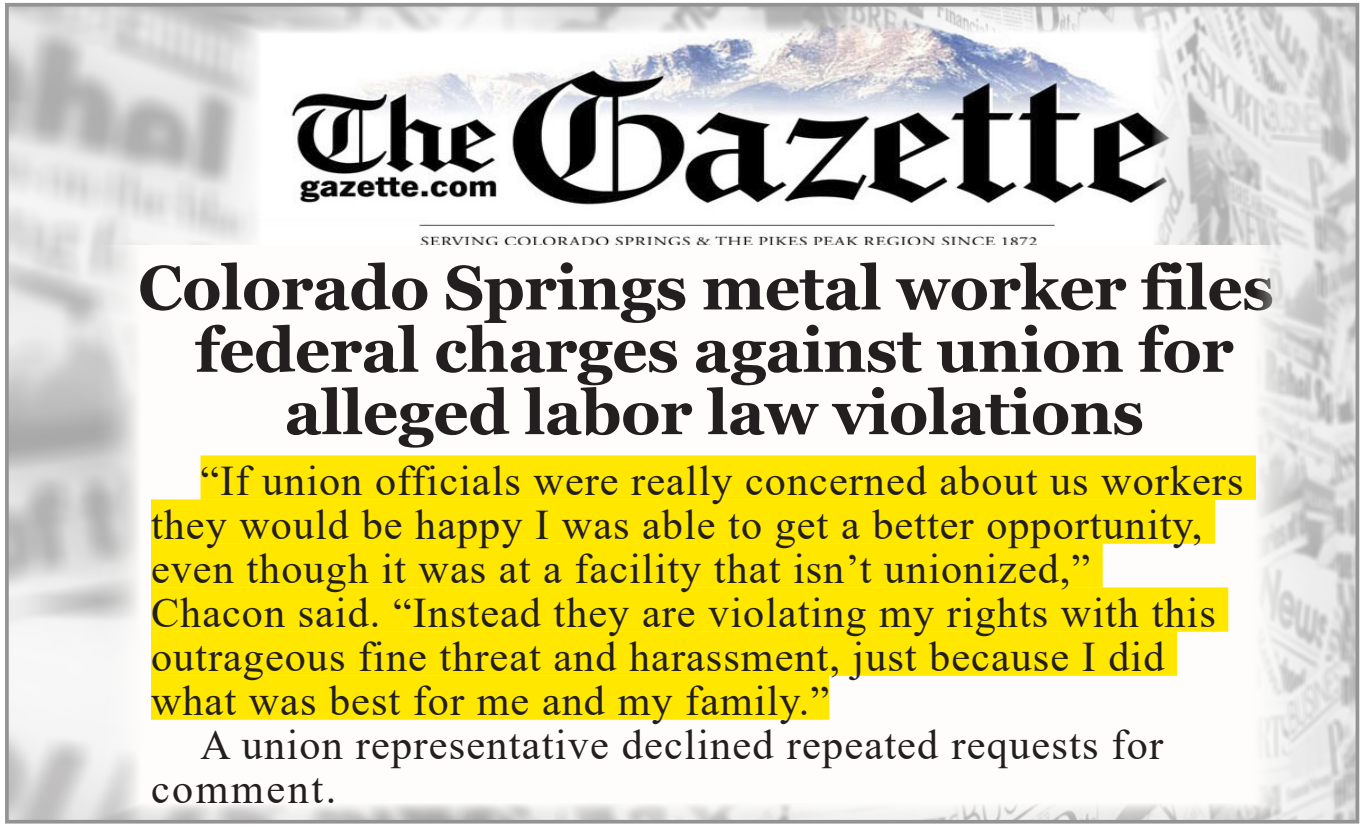
Foundation staff ensured Russell Chacon’s frustrations with Sheet Metal union bosses’ illegal fines were covered by the Colorado Springs Gazette. Shortly after the article appeared, Sheet Metal union officials backed down from their demand.
COLORADO SPRINGS, CO – Colorado metal worker Russell Chacon was angry when he received a letter from International Association of Sheet Metal, Air, Rail, and Transportation Workers (SMART) Local 9 union officials in May, demanding he pay $21,252 in disciplinary fines. Six months earlier he had resigned his union membership, and had left his job at Colorado Sheet Metal to work for Rocky Mechanical, an employer that isn’t under the control of Sheet Metal union bosses.
Union officials demanded Chacon fork over the ruinous sum to cover an alleged union “loss of funds” for a period through May 31, which included days that Chacon had not even worked yet.
Sheet Metal Union Officials Violated Established Law to Harass Worker
Chacon obtained free legal representation from National Right to Work Foundation staff attorneys and filed federal unfair labor practice charges against the Sheet Metal union at National Labor Relations Board (NLRB) Region 27 in Denver. He asserted that the fines were levied against him specifically in retaliation for his leaving the union and finding new work.
Soon after the Foundation-assisted charges, Sheet Metal union officials dropped the illegal fine demands, and are now forced by a settlement to inform workers that they will not subject them to internal union discipline if they exercise their right to end union membership.
Decades-old federal law prohibits union officials from forcing internal union discipline on workers who have resigned union membership, and from restricting the exercise of that basic right to refrain.
“If union officials were really concerned about us workers they would be happy I was able to get a better opportunity, even though it was at a facility that isn’t unionized,” Chacon told the Colorado Springs Gazette in May. “Instead they are violating my rights with this outrageous fine threat and harassment, just because I did what was best for me and my family.”
Although Sheet Metal union bosses informally rescinded their fine demands soon after Chacon filed his charge, NLRB Region 27 continued to investigate Chacon’s charge that union officials had instigated the discipline specifically in retaliation for his leaving the union.
Settlement Follows NLRB Finding Merit in Worker’s Charges of Retaliation
The NLRB found merit in Chacon’s claims of retaliation in July, forcing union officials to settle in order to avoid NLRB prosecution.
The settlement requires Sheet Metal union officials to post a notice at the union office stating that they “will not fail to inform or misinform you about the proper process for resigning your membership,” “will not fail to give effect to resignations of membership from the Union,” and “will not restrain and coerce you by instituting and prosecuting disciplinary proceedings and levying fines after failing to give effect to resignations.” The notice also confirms that Chacon is no longer subject to the fine demands.
“As the conclusion of this case shows, Sheet Metal union officials were caught red-handed violating workers’ most basic right to refrain from associating with an organization to which they don’t want to belong,” commented National Right to Work Foundation Vice President and Legal Director Raymond LaJeunesse. “Although we are pleased that Mr. Chacon is no longer saddled with an outrageous fine demand, unfortunately other Colorado workers can still be forced to pay dues to union bosses because The Centennial State lacks a Right to Work law.”
LaJeunesse continued, “Right to Work protections ensure that all union financial support is strictly voluntary, and that no worker can be fired just for refusal to pay dues to unwanted union bosses.”
Sixteen States Back Foundation’s Petition to High Court in Chicago Educator Case
The following article is from the National Right to Work Legal Defense Foundation’s bi-monthly Foundation Action Newsletter, September/October 2021 edition. To view other editions of Foundation Action or to sign up for a free subscription, click here.
Amicus brief: Unions “refuse to stop collecting dues despite unequivocal employee demands”
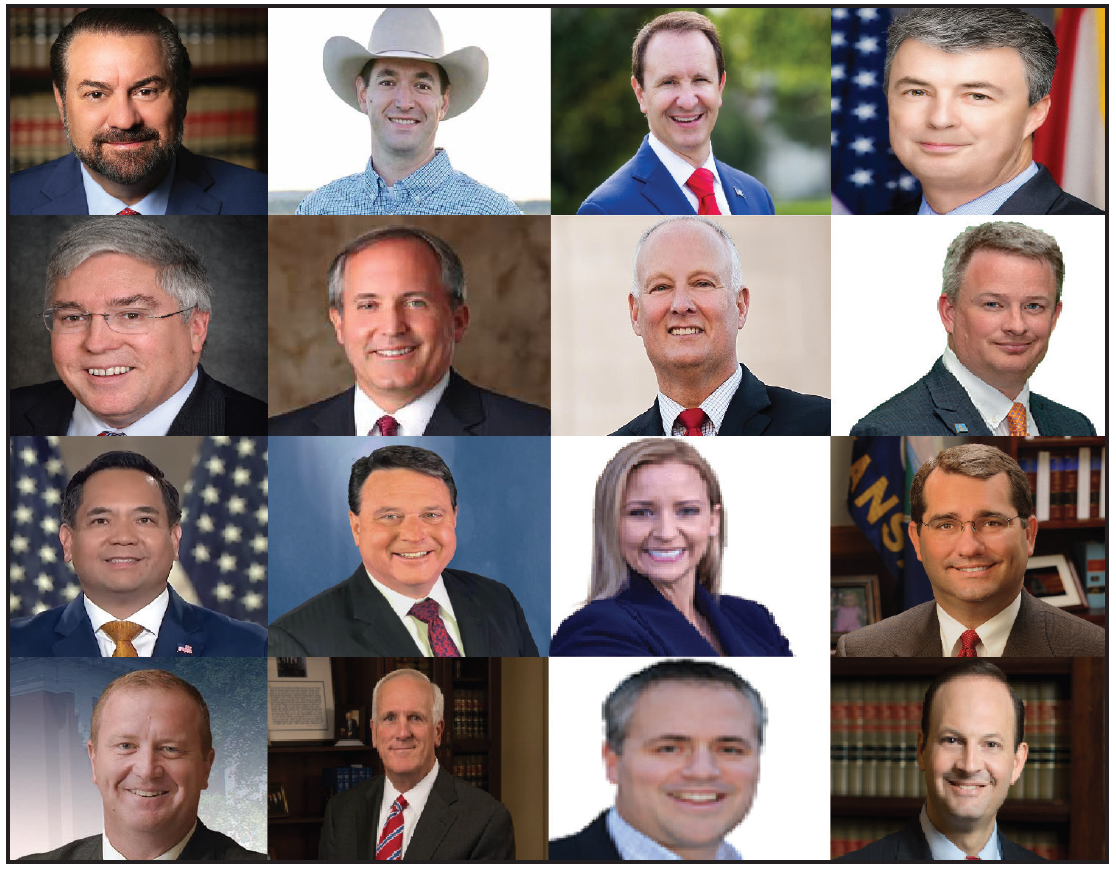
“Janus has been ignored,” wrote sixteen attorneys general in their amicus brief supporting Ifeoma Nkemdi and Joanne Troesch’s petition pressing the Supreme Court to hear their case and declare “escape periods” a First Amendment violation.
WASHINGTON, DC – In July, sixteen attorneys general threw the support of their states behind Chicago Public Schools educators Ifeoma Nkemdi and Joanne Troesch, who are urging the U.S. Supreme Court to hear their case defending their First Amendment right to cut off union financial support as recognized in the Foundation-won Janus v. AFSCME decision.
In an amicus brief encouraging the High Court to hear the case, attorneys general from Alaska, Alabama, Arizona, Arkansas, Indiana, Kansas, Louisiana, Missouri, Montana, Nebraska, South Carolina, South Dakota, Tennessee, Texas, Utah, and West Virginia argue that “escape period” restrictions like the one that Chicago Teachers Union (CTU) bosses foisted on Troesch and Nkemdi are a widespread threat to public employees’ rights under the Janus Supreme Court decision.
In 2018, the Supreme Court ruled in Janus v. AFSCME that public employees’ First Amendment rights are violated when they are forced to fund a union as a condition of employment. The Court also held that union dues can only be taken from a public employee with an affirmative and knowing waiver of that employee’s First Amendment right not to pay.
Unions Are Seizing Money from ‘Tens of Thousands’ Unconstitutionally, Brief Says
The CTU-concocted “escape period” Nkemdi and Troesch are challenging blocks employees from exercising their First Amendment Janus right to end union financial support except during one month per year. The educators’ petition for writ of certiorari presses the High Court to hear their case to affirm that Janus does not permit union bosses to profit from schemes that constrict workers’ constitutional right to refrain from subsidizing a union.
The states’ amicus brief emphasizes how glaringly union officials have flouted Janus with restrictions, as well as how widespread the schemes are: “Janus has been ignored. Across the country public-sector unions have resisted Janus’s instructions and devised new ways to compel state employees to subsidize union speech. Unions place onerous terms on dues forms that prohibit state employees from opting out of paying dues except during narrow (and undisclosed) windows during the year.”
The brief continues: “Unions refuse to inform state employees that they have a First Amendment right not to pay union dues. And unions refuse to stop collecting dues despite unequivocal employee demands. The result is that tens of thousands of state employees across the country are having dues deducted to subsidize union speech without any evidence that they waived their First Amendment rights . . . .”
Nkemdi and Troesch’s case “implicates these precise concerns” and the Court must hear it, the brief maintains.
In addition to the states’ brief, policy groups Goldwater Institute, Cato Institute, Freedom Foundation, and Liberty Justice Center filed amicus briefs backing the case.
Justices May Already Be Showing Interest in Foundation-Backed Case
In late July, the Supreme Court ordered lawyers for CTU and the Chicago Board of Education to file a response brief to Troesch and Nkemdi’s petition, a signal that some Justices may be interested in taking up the case.
Also pending at the High Court is Foundation attorneys’ anti- “escape-period” case for Susan Fischer and Jeanette Speck, two New Jersey teachers. Both that case and Troesch and Nkemdi’s case are expected to be fully briefed in October, after which the Justices will decide whether to take them.
“As union bosses continue to use deceptive ‘escape period’ arrangements to keep worker money flowing unconstitutionally into their coffers, support continues to roll in from across the country for Troesch and Nkemdi, who are sticking up for independent-minded public servants who simply want to serve their communities without being forced to fund union activities,” observed National Right to Work Foundation President Mark Mix. “The High Court must weigh in to affirm that public workers’ First Amendment rights cannot be confined to union officials’ arbitrary schedules.”
Labor Board Rejects Biden Appointee’s Attempt to Scuttle Case Against Union
The following article is from the National Right to Work Legal Defense Foundation’s bi-monthly Foundation Action Newsletter, July/August 2021 edition. To view other editions of Foundation Action or to sign up for a free subscription, click here.
Texas nurse challenges concealment of secret union-employer deal which stifles decertification

With Foundation legal aid, Texas nurse Marissa Zamora shut down NLRB “Acting” General Counsel Ohr’s attempt to block her case.
WASHINGTON, DC – The National Labor Relations Board (NLRB) recently rejected a move by NLRB Acting General Counsel Peter Ohr to prematurely end Texas nurse Marissa Zamora’s case before the Board could rule. The case challenges National Nurses Organizing Committee (NNOC) union officials’ refusal to disclose a secret agreement they signed with the parent company of her hospital that limits Zamora’s ability to remove the union from her workplace.
Ohr is a career NLRB bureaucrat, who was installed as General Counsel by President Biden this January after Biden made the unprecedented move of removing Trump-appointed NLRB General Counsel Peter Robb before his Senate-confirmed four-year term expired. Ohr filed a motion in February seeking unilaterally to send Zamora’s complaint back to the NLRB’s Fort Worth regional office to be dismissed — after Zamora’s case had already been fully briefed at the full Board in Washington.
Zamora is represented for free by National Right to Work Foundation staff attorneys, who in March opposed Ohr’s attempted maneuver. Their brief argued that snuffing
the case out now would jeopardize the NLRB’s power to decide cases involving violations of federal labor law, and also contended that Ohr lacked any authority to make his motion because of Biden’s illegal ouster of Robb. In a May decision, the NLRB agreed with Zamora’s Foundation staff attorneys that the case should continue, observing that the matter “has been fully litigated, and the controversy at issue, which remains active, is ripe for Board adjudication.” The case began when Zamora demanded a copy of the secret so-called “neutrality agreement.” Such agreements are deals between union officials and employers — usually without the knowledge of employees in a workplace — that seek to assist the union in gaining monopoly bargaining powers over rank-and-file workers.
NNOC Agents Shrouded, Lied About Deal Which Stymied Info about Decertification
“The Board correctly rejected Peter Ohr’s attempt to scuttle this case so he could let union officials off scot-free despite their secret backroom deal to undermine the rights of nurses like Marissa Zamora who are subjected to unwanted union representation,” National Right to Work Foundation President Mark Mix said about the decision to let the case move forward. These controversial top-down organizing deals frequently contain provisions that require employers to silence opposition to unionization, hand over workers’ personal information for coercive “card check” drives that bypass the protections of a secret-ballot election, provide union organizers with preferential access to the workplace and even ensure employers will help stifle workers’ efforts to decertify, i.e. remove, the union.
In Zamora’s case, she began circulating fliers and other materials in June 2018 to educate her coworkers on how they could obtain a vote to decertify the union. Legal documents she filed in her case explain that union agents “repeatedly ripp[ed] down her fliers” and that hospital officials referenced a secret agreement with the union when they denied “her access to post material on protected bulletin boards, where her material would be shielded from vandalism.”
Zamora subsequently asked both NNOC and hospital officials to show her any “neutrality agreement” that might have triggered those efforts to block her and her coworkers’ rights. All her requests were denied, and NNOC even denied that such an agreement exists. This was despite statements by hospital agents to her that indicated a “neutrality agreement” was indeed in effect.
Trump-Appointed NLRB GC Robb Backed Nurse’s Case Until Unprecedented Firing
Zamora filed federal unfair labor practice charges at the NLRB, challenging NNOC bosses’ refusal to disclose the secret agreement. Then- NLRB General Counsel Robb issued a complaint supporting the claims in Zamora’s charges.
Nevertheless, a Labor Board Administrative Law Judge (ALJ) dismissed the complaint Robb issued, even revoking subpoenas that would have compelled NNOC union bosses to reveal the covert deal.
Zamora challenged the ALJ’s dismissal, filing exceptions at the full Board in Washington. Briefs she filed supporting those exceptions pointed out that, during a two-day trial, it came out that the “neutrality agreement” existed, but it was a closely guarded secret between the hospital and union officials “to be kept strictly confidential from employees and all third parties.” Robb also submitted exceptions buttressing Zamora’s exceptions.
Robb’s pro-employee decisions preceded Ohr’s controversial installation by Biden in January, and Ohr’s subsequent attempt to remand or dismiss the case, which the NLRB has now rejected.
“The Board should now promptly rule for Ms. Zamora on the merits of the case so union bosses cannot keep secret pacts with employers to the detriment of rank-and-file employees’ protected rights,” Mix said.
TX Airline Employee Urges High Court to Take Up Forced-Dues-for-Politics Challenge
The following article is from the National Right to Work Legal Defense Foundation’s bi-monthly Foundation Action Newsletter, July/August 2021 edition. To view other editions of Foundation Action or to sign up for a free subscription, click here.
IAM bosses automatically seize money for politics if workers miss tiny ‘escape window’ to opt out

IAM officials left Arthur Baisley just a small annual “escape window” to opt out of automatic dues deductions taken for union politics. Will the High Court hear his case against this scheme?
WASHINGTON, DC – Arthur Baisley, a United Airlines employee in Texas, filed a petition for writ of certiorari asking the U.S. Supreme Court to hear his case in which he is battling International Association of Machinists (IAM) union bosses. They are seizing dues for union political expenditures from him and his coworkers in violation of the First Amendment and the Railway Labor Act (RLA).
Baisley filed the cert petition this May with free legal aid from the National Right to Work Foundation. Baisley’s lawsuit challenges a union requirement that employees who choose not to join the union must opt out of funding the union’s political and ideological activities during a brief annual “escape window,” or else have money automatically seized from their paychecks for those purposes against their will.
Worker Contends Janus Standard Should Nullify ‘Opt-Out’ Language
Baisley’s attorneys argue the “opt-out” arrangement violates workers’ rights found in the RLA, and the First Amendment under the standard laid out in the landmark 2018 Supreme Court Janus v. AFSCME decision, won by Foundation staff attorneys. The RLA is a federal law that governs labor relations in the railway and airline industries.
In Janus, the High Court ruled that no public worker can be coerced into paying union dues or fees as a condition of getting or keeping a job. The Court also held that union dues or fees can only be deducted from a public employee’s paycheck with his or her affirmative consent and a knowing waiver of his or her constitutional right not to pay.
Baisley’s staff attorneys extend this logic and argue that, under Janus and other Supreme Court precedents, union bosses infringe on the First Amendment rights of private sector employees under the RLA by forcing them to pay for union boss political or ideological activities without their consent. The union boss “opt-out” scheme offends this principle by forcing workers to object to dues for politics within a small “escape window” and seizing those dues as a condition of employment if they don’t opt out.
IAM Officials’ Scheme Seizes Forced-Dues-for-Politics from Non-Members
Baisley is not a member of the IAM, but is still forced to pay some union fees despite being based in the Right to Work state of Texas. The RLA preempts state Right to Work protections which make union membership and all union financial support strictly voluntary. However, under long-standing law established in Foundation-supported cases, even without Right to Work protections non-members cannot, as a condition of keeping their jobs, be required to pay fees for anything beyond the union’s expenses directly related to bargaining.
Baisley’s petition details the convoluted union boss-created process that workers must navigate just to prevent money from being taken from their paychecks in violation of their First Amendment rights. In Baisley’s situation, even though he sent a letter to IAM agents in November 2018 objecting to funding all union political activities, union officials only accepted his objection for 2019, and told Baisley he had to renew his objection the next year or else be charged full union dues.
IAM Union Officials Contravened Both Janus and Long-Standing Federal Law
In addition to running afoul of the Janus First Amendment standard, Foundation staff attorneys also assert that the complicated “opt-out” scheme contravenes the RLA, which protects the right of employees under its jurisdiction to “join, organize, or assist in organizing” a union of their choice, as well as the right to abstain from all union activities.
“The sordid goal of these kinds of union ‘opt-out’ requirements is clear: trap unsuspecting workers into subsidizing union bosses’ radical political agenda without their consent and in violation of their rights,” said National Right to Work Foundation Vice President Patrick Semmens. “The Supreme Court ruled in the Foundation-won Janus case that union officials must first seek the affirmative approval of public sector workers before charging them for union politics, and this case simply seeks to ensure that Mr. Baisley and all employees subject to the RLA enjoy those same basic protections.”
NLRB Blocks Attempt to Oust Union, Despite Unanimous Call for Union’s Removal
The following article is from the National Right to Work Legal Defense Foundation’s bi-monthly Foundation Action Newsletter, May/June 2021 edition. To view other editions of Foundation Action or to sign up for a free subscription, click here.
Every employee signed a petition for vote to remove Carpenters Union from their workplace

Foundation staff attorneys are defending Neises Concrete Construction Corp. workers’ unanimous call to free themselves from the coercive reign of IKORCC union bosses.
CROWN POINT, IN – Mike Halkias and his coworkers at Neises Construction Corp. in Crown Point, Indiana, are subject to monopoly “representation” by officials of the Indiana/Kentucky/Ohio Regional Council of Carpenters (IKORCC) union.
Every bargaining unit member exercised the right under Indiana’s Right to Work Law to decline formal union membership and to refuse to pay any union dues or fees, but union officials still have the authority under federal law to “negotiate” with Neises for the employees despite their objections to that representation.
NLRB Officials Snub Workers’ Unanimous Petition, Demand Union Bargaining
With free legal aid from the National Right to Work Legal Defense Foundation, Halkias submitted a decertification petition to Region 13 of the National Labor Relations Board (NLRB), signed by every member of his unit, to remove IKORCC union officials from their workplace.
Despite unanimous agreement by the unit’s workers to hold a vote to oust IKORCC bosses, NLRB Region 13 officials rejected the decertification petition. The Regional Director is demanding that the Indiana employer bargain with IKORCC, even though none of its employees want the union to “represent” them.
Union Bosses Won’t Give Up Monopoly Bargaining Power over Non-members
So far union officials have stymied the vote through “blocking charges,” unfair labor practice charges filed by union lawyers that, before they are resolved, prevent a vote from taking place. Union officials claim the vote cannot proceed until the company negotiates “in good faith” with the union.
That demand comes even though federal law makes it illegal for an employer to engage in bargaining with a union that it knows lacks the support of at least a bare majority of workers. The NLRB regional official’s order dismissing the employees’ petition did not even acknowledge that every employee in Mr. Halkias’ bargaining unit has shown a desire to be independent from the union by resigning union membership and asking for a decertification vote.
Foundation Attorneys Bring Fight to National Board
The Foundation staff attorneys who represent Halkias have appealed to the NLRB in Washington to overturn the rejection of the decertification petition and to allow the workers to vote so they can be rid of the union whose so-called “representation” they all oppose. “It is outrageous that in a workplace where every single worker wants nothing to do with a union, federal law still forces workers to accept the so-called ‘representation’ of union bosses,” said National Right to Work Foundation Vice President Patrick Semmens.
“The fact that this appeal is even necessary demonstrates how rigged federal law is against independent-minded workers who seek to exercise their right not to associate with a union.”
“This case is a reminder that, even in Right to Work states that protect workers from being forced to fund a union they don’t support, federal law still forces workers under union monopoly control even when those employees oppose the union and believe they would be better off without it.”





