
Full Foundation Action November/December Newsletter Now Online
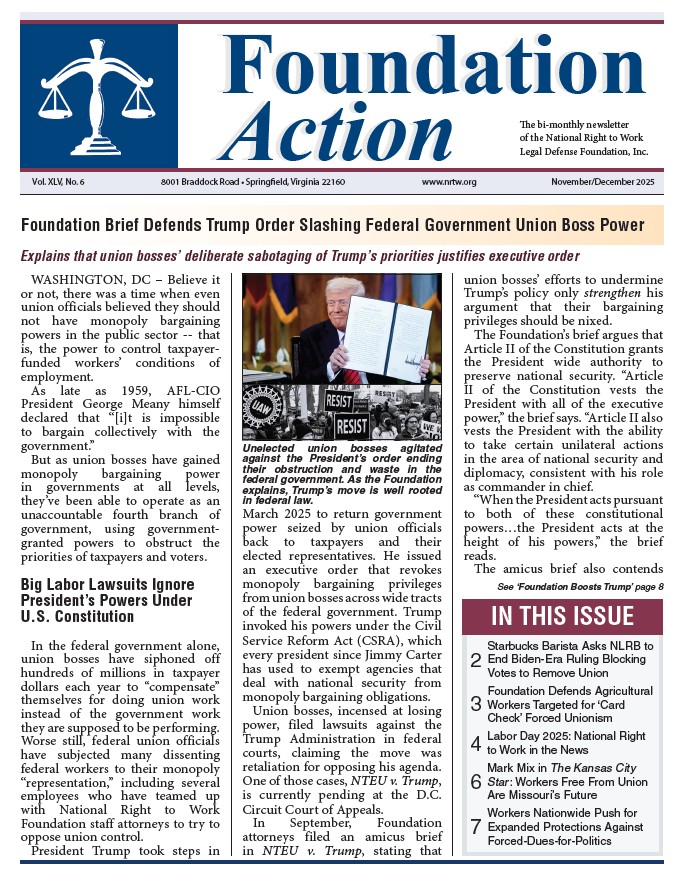
All articles from the November/December 2025 issue of Foundation Action are now online.
In this issue:
- Foundation Brief Defends Trump Order Slashing Federal Government Union Boss Power
- Starbucks Barista Asks NLRB to End Biden-Era Ruling Blocking Votes to Remove Union
- Labor Day 2025: National Right to Work in the News
- Dispensary employees free from a union are the future for Missouri
- Workers Nationwide Push for Expanded Protections Against Forced-Dues-for-Politics
Recent articles can be found here. To sign up for a free copy of the newsletter via mail please see the form at the bottom of the page.
Public Servants Across Country Stand Strong in Defending Janus Rights
The following article is from the National Right to Work Legal Defense Foundation’s bi-monthly Foundation Action Newsletter, January/February 2026 edition. To view other editions of Foundation Action or to sign up for a free subscription, click here.
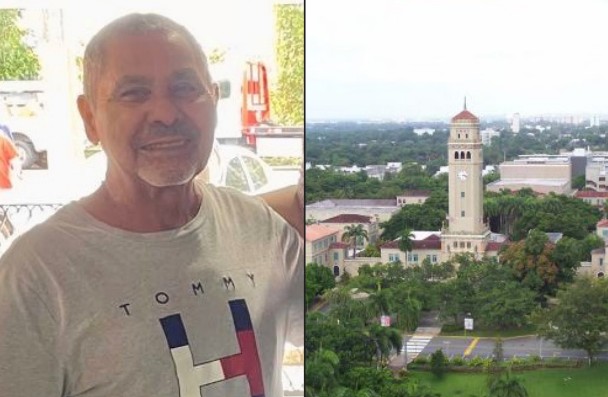
Jose Ramos, a University of Puerto Rico maintenance employee, isn’t going to let union bosses maintain their flimsy defense that they are entitled to keep his hard-earned money in violation of the First Amendment.
As 2025 waned, National Right to Work Foundation staff attorneys brought their expertise to bear as government employees in Washington State and Puerto Rico continued legal battles to get back money that union bosses never should have seized from their paychecks.
These workers are invoking their rights under the Foundation-won Janus v. AFSCME decision, which the Supreme Court handed down in 2018. In Janus, the Justices ruled that all American public sector workers have a First Amendment right to abstain from paying dues to union officials they don’t support.
Despite Janus’ commonsense protections, many union bosses, intent on keeping their coffers stocked with dues money seized from unwilling public employees, are still trying to skirt the Court’s ruling.
AFSCME Bosses Refuse to Return Illegally-Seized Money to Worker
That includes AFSCME union officials in Washington State, whom City of Everett employee Xenia Davidsen is fighting at the Washington State Public Employment Relations Commission (PERC). Davidsen charged AFSCME chiefs with accepting money that City officials had illicitly funneled from her paycheck to the union.
Davidsen had requested dues deductions to stop in 2024 in accordance with Janus, but City officials failed to monitor the email address through which AFSCME directed the City to stop the deductions. This incompetence led to the City seizing dues money from Davidsen at least 12 times without her authorization — and AFSCME union officials have stubbornly refused to admit they must post a notice stating they were wrong to accept the deductions.
“On none of those… instances did the Union stop to question why it was accepting dues that it knew were unauthorized to it,” argue Foundation attorneys in Davidsen’s latest brief before the PERC.
Meanwhile, Foundation attorneys also defended the Janus rights of two groups of Puerto Rico public employees in oral arguments before the First Circuit Court of Appeals last October.
Foundation Challenges Puerto Rico Court’s Refusal to Nix Anti-Janus Statute
In one case, Cruz v. UIA, Puerto Rico Aqueduct and Sewer Authority (PRASA) employee Reynaldo Cruz is trying to reclaim union dues money that officials of the Authentic Independent Union of Water and Sewer Authority Employees (UIA) took in violation of his First Amendment rights.
Cruz’s lawsuit challenges both union bosses’ demands that he pay union dues or lose his job, as well as the Puerto Rico territorial laws that allow such unconstitutional demands. Though UIA union bosses claim they have already deposited the illegally-seized money with a lower federal court, that court confusingly declined to issue a ruling that legally entitles Cruz to collect the funds.
During oral arguments, Cruz’s legal team argued that this legal sleight-of-hand created “a roadmap for civil rights defendants to violate civil rights plaintiffs’ rights.”
Foundation Won’t Let Union Bosses & Bureaucrats Ignore Janus
Also argued before the First Circuit at the end of 2025 was Ramos v. Delgado, in which Foundation attorneys represent Jose Ramos and other University of Puerto Rico maintenance employees who had dues illegally deducted from their paychecks for years.
Ramos and his colleagues are seeking refunds of all dues taken unlawfully since the Janus decision. Puerto Rico continues to be a hotbed for union violations of the Janus decision, but luckily, workers continue to stand up with Foundation legal aid.
Most recently, public employee Luis Rigau filed a federal lawsuit to challenge the Puerto Rico Industrial Commission (PRIC) union’s blatantly illegal reinstatement of automatic forced-dues deductions against nonmembers.
“Despite Janus’ clear constitutional command, union bosses, legislators, and public officials are still trying to do legal gymnastics to end-run the decision,” commented National Right to Work Foundation Vice President and Legal Director William Messenger.
“All public sector workers deserve the free choice that Janus secures, and Foundation attorneys will continue to back them in their court battles for freedom.”
Full Foundation Action September/October Newsletter Now Online
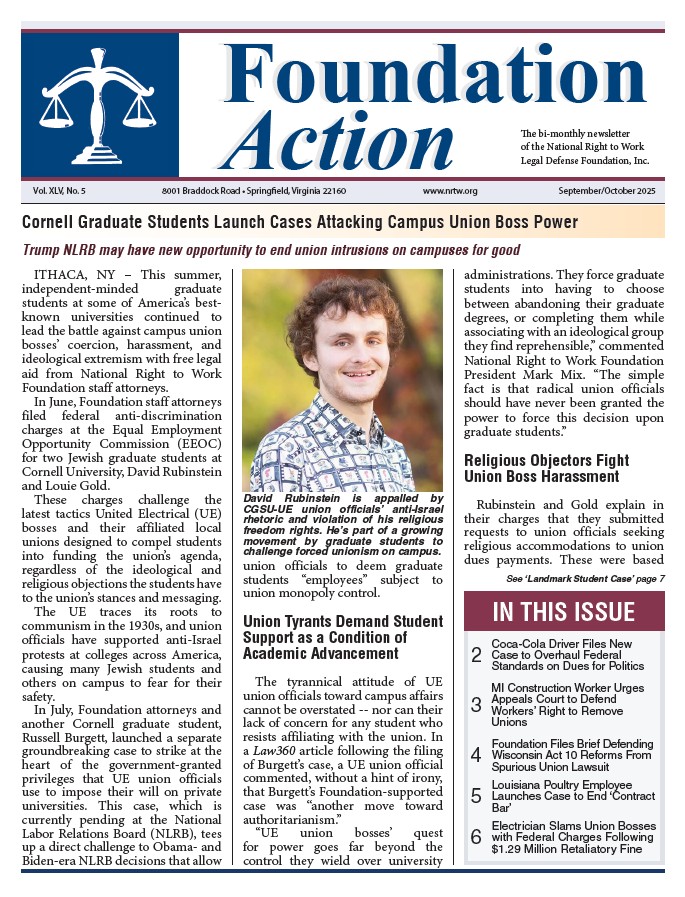
All articles from the September/October issue of Foundation Action are now online.
In this issue:
- Cornell Graduate Students Launch Cases Attacking Campus Union Boss Power
- Coca-Cola Driver Files New Case to Overhaul Federal Standards on Dues for Politics
- MI Construction Worker Urges Appeals Court to Defend Workers’ Right to Remove Unions
- Foundation Files Brief Defending Wisconsin Act 10 Reforms From Spurious Union Lawsuit
- Louisiana Poultry Employee Launches Case to End ‘Contract Bar’
- Electrician Slams Union Bosses with Federal Charges Following $1.29 Million Retaliatory Fine
- Join Today to End Forced Unionism in the Workplace
Recent articles can be found here. To sign up for a free copy of the newsletter via mail please see the form at the bottom of the page.
AT&T-BellSouth Workers Challenge Union-Concocted ‘Window Period’ Restrictions on Ending Dues
The following article is from the National Right to Work Legal Defense Foundation’s bi-monthly Foundation Action Newsletter, May/June 2025 edition. To view other editions of Foundation Action or to sign up for a free subscription, click here.
CWA officials trap dissenting workers, but case asks NLRB to declare ‘window period’ restrictions illegal

Jennifer Abruzzo went straight from being a top CWA union lawyer to being General Counsel of the Biden NLRB. Though President Trump fired her, that doesn’t mean that workers don’t still have to battle the anti-freedom policies she advanced.
MIAMI, FL – In August 2024, Communications Workers of America (CWA) union bosses ordered thousands of AT&T employees across the Southeast to abandon their jobs and go on strike. Unsurprisingly, despite union officials’ propaganda surrounding the strike, many workers disagreed with the decision.
“CWA union officials ordered us to abandon our jobs when many of us just wanted to keep working and supporting ourselves and our families,” commented Amanda Marc, a Miami-based worker for AT&T-BellSouth. “That’s bad enough, but now they’re putting up all these roadblocks to try to prevent those of us who don’t like the union’s agenda from stopping our money from flowing to them.”
Marc is referring to a situation that South Florida AT&T-BellSouth workers have been increasingly dealing with in the aftermath of the strike, which came to an end in September 2024. With free legal aid from National Right to Work Legal Defense Foundation staff attorneys, Marc and her coworker Sofia Hernaiz filed unfair labor practice charges against CWA union officials, detailing that the union hierarchy has ignored their requests to cut off dues payments and has continued to siphon money from their paychecks illegally. Additional charges for other AT&T-BellSouth workers are also being filed.
Dues Kept Flowing to Union After Workers Requested Stop
Marc and Hernaiz’s charges point out that CWA officials are imposing a “window period” scheme on workers who want to end financial support, limiting to just ten days per year the time in which workers can demand that dues deductions cease from their paychecks.
“This kind of behavior makes me feel like they’re really just interested in having control over us and taking our money,” Marc added. Marc and Hernaiz filed their charges with the National Labor Relations Board (NLRB), the agency responsible for enforcing federal labor law.
Marc’s charge in particular challenges the practice of imposing “window periods” as violating the National Labor Relations Act (NLRA): While the NLRA unfortunately allows union officials to prevent a worker from revoking his or her dues authorization card for the first year after it is initially signed, Marc’s charge notes that any further restrictions are unlawful.
“The unions have no statutory license to create tricky and arbitrary ‘window periods’ to force unwilling employees to keep paying dues,” Marc’s charges say.
Because Marc, Hernaiz, and their colleagues work in the Right to Work state of Florida, CWA union bosses are forbidden from forcing workers to pay any union dues or fees as a condition of keeping their jobs, though CWA union officials are trying to limit the exercise of this freedom with their window period scheme. In states that lack Right to Work protections, in contrast, union officials can force employees to pay fees to the union or be terminated, meaning even perfect “compliance” with a union boss’s arbitrary window period restriction would not get a worker out of forced union payments.
Marc and Hernaiz’s charges state that they, and many of their coworkers, resigned their union memberships in August 2024, which was around when CWA union officials ordered AT&T-BellSouth workers out on the strike. Despite the women’s requests to end union membership and stop financial support for the union, the charges read, CWA agents never responded to their requests to stop dues deductions, and never even informed them of the window period dates in which they would consider their requests valid.
Even worse, Hernaiz details in her charge that union officials tried to subject her to internal union discipline for not participating in the strike. Under federal law, union bosses cannot impose union proceedings on workers who are not union members. Foundation attorneys are in the process of aiding other AT&T-BellSouth workers targeted by such illegal discipline.
No Legal Justification for ‘Window Periods,’ New NLRB Should Toss Policy
“Federal labor law is supposed to protect the right of workers to decide freely whether they want to join or financially support a union,” commented National Right to Work Foundation President Mark Mix. “So-called ‘window periods’ exist only to restrict this freedom just so union officials can continue to funnel dues money from workers’ pockets straight into union agendas.
“The NLRB under the new Administration should recognize that this practice contradicts both worker freedom and federal law, and end it accordingly,” Mix added.
Cincinnati-Area Kroger Worker Secures Victory Against Illegal Union Dues Deductions
The following article is from the National Right to Work Legal Defense Foundation’s bi-monthly Foundation Action Newsletter, May/June 2025 edition. To view other editions of Foundation Action or to sign up for a free subscription, click here.
After legal win, grocery employee based near Cincinnati finds job in nearby Right to Work Kentucky to escape forced dues

Northern Kentucky (foreground) might be just across the Ohio River from Cincinnati, OH, but the difference in worker freedom is stark. Without Right to Work, forced dues abuses are rampant compared to Right to Work Kentucky.
CINCINNATI, OH – In a win for employee freedom, James Carroll, a Kroger employee based near Cincinnati, has secured victory in his federal case against United Food and Commercial Workers (UFCW) Local 75 and Kroger. The win comes after Carroll challenged the union and his employer for unlawfully deducting union dues from his paycheck and threatening him with termination for refusing to sign an illegal dues deduction form.
Carroll, with free legal support from the National Right to Work Legal Defense Foundation, filed charges with the National Labor Relations Board (NLRB) Region 9 in Cincinnati. His case exposed the UFCW’s use of an unlawful “dual-purpose” membership form, which combines union membership and dues deduction authorization into a single signature. Under established Supreme Court legal precedents, workers have the right to refrain from formal union membership, and any dues deduction authorizations must be voluntary and separate from membership agreements.
In order to avoid further prosecution, Kroger and UFCW entered into a settlement that requires them to reimburse Carroll for the illegally seized dues and publicly post a notice informing other employees of their rights.
But Carroll didn’t stop there. To protect himself from future union coercion, he secured a transfer to a Kroger store in Right to Work Kentucky. Unlike Ohio, where workers can be forced to pay union fees even as non-members, Kentucky’s Right to Work law ensures that all union payments are voluntary, shielding Carroll from further threats that he pay up or face termination.
This case challenging the UFCW’s forced dues abuse of grocery employees isn’t an isolated incident. In 2023, Houston-area Kroger employee Jessica Haefner, also aided by Foundation attorneys, filed charges against UFCW for using a dual-purpose form and altering her response to falsely indicate consent for dues deductions.
More recently, in 2024, Portland grocery worker Reegin Schaffer won a case against UFCW after union officials ignored her resignation request during a strike and retaliated by attempting to fine her for working.
Another Worker Flees to the Freedom of Right to Work
“We are pleased with this legal win for Mr. Carroll, and that he is now completely free of union bosses’ forced-dues demands in Right to Work Kentucky,” commented National Right to Work Foundation Vice President and Legal Director William Messenger.
“Unfortunately most workers employed in forced dues states don’t have the option to commute to a job in a Right to Work state, which is why workers everywhere need the protection of Right to Work laws.”
Workers Nationwide Urge Trump NLRB to End Policies Trapping Them Under Union Power
The following article is from the National Right to Work Legal Defense Foundation’s bi-monthly Foundation Action Newsletter, May/June 2025 edition. To view other editions of Foundation Action or to sign up for a free subscription, click here.
NLRB-invented policies currently allow union bosses to block worker-requested votes

Theresa Hause, an Oregon-based school bus driver, wants the Trump NLRB to end the so-called “merger doctrine” that grants union officials the power to combine workplaces into giant, inescapable mega-units.
WASHINGTON, DC – During the Biden Administration, biased, pro-Big Labor National Labor Relations Board (NLRB) bureaucrats went out of their way to undermine the idea that workers and workers alone should choose whether or not they want a union. Rolling back multiple National Right to Work Foundation-backed reforms that made it easier for workers to vote out unions they didn’t want was a prime example of this.
But the Biden NLRB’s extremism is only the latest example of how federal labor law is biased against workers opposed to union affiliation. The truth is that biased bureaucrats on the NLRB have, for decades, burdened independent-minded workers with arbitrary barriers to freeing themselves from union influence. Many of these policies — which are the inventions of NLRB decisions and appear nowhere in the National Labor Relations Act’s (NLRA) text — let union bosses block workers from exercising their statutory right to vote to remove a union.
Bus Drivers Fight Forced Dues in Huge, Inescapable Teamsters Unit
The Trump Administration taking control of the NLRB in Washington, D.C., has presented workers around the country who want to escape union influence with a new opportunity to attack these restrictions. Foundation attorneys are already helping workers lead the charge for reform to create precedents that will allow others to remove unions opposed by most workers.
Last December, Theresa Hause, a Washington State-based school bus driver, submitted to the NLRB a deauthorization petition which contained employee support well over the necessary threshold needed to trigger a vote to strip Teamsters Local 58 bosses of their forced-dues power in Hause’s workplace. Hause and her fellow drivers are employed by First Student, Inc.
She was surprised to learn during NLRB proceedings that First Student management and Teamsters union officials had covertly signed an agreement “merging” Hause’s small unit of workers into a much larger national unit, composed of thousands of Teamsters-controlled bus drivers across the country.
Because of the NLRB’s so-called “merger doctrine” policy, Hause and her colleagues are now in this “mega-unit,” and any petition to end the union’s forced-dues power (or remove the union completely) needs to contain signatures from at least 30% of the “mega-unit” — thousands of people Hause has never met — to be considered valid. The NLRB official that dismissed Hause’s petition even ruled that the fact employees were kept in the dark about this merger was irrelevant, outrageously saying “there is nothing in the merger doctrine that requires acquiescence or even notification of employees of a change in a bargaining unit.”
Hause’s Foundation-provided attorneys are challenging the merger doctrine in an appeal of Hause’s case to the NLRB in D.C., arguing among other things that the policy violates employee free choice and that it serves as a protection racket for established unions.
While Hause and her colleagues are fighting for a vote to free themselves from forced dues, attacking the merger doctrine also has significant ramifications for workers seeking to decertify a union. Foundation attorneys have represented many workers who have been shanghaied into huge, inescapable work units against their will. That includes a group of less than 10 Wisconsin First Student workers who filed a majority-backed petition to remove Teamsters officials as soon as allowed by federal law, only to be stymied by the merger doctrine because they had been secretly “merged” into a multi-company unit of around 24,000 workers in multiple states.
WV Homecare Workers Not ‘Settling’ for ‘Settlement Bar’
Meanwhile, in West Virginia, a Foundation-assisted employee of senior homecare nonprofit McDowell County Commission on Aging is attacking the NLRB’s use of another union boss-friendly policy to block his and his coworkers’ effort to kick out Service Employees International Union (SEIU) bosses: the so-called “settlement bar,” which lets unions and employers unilaterally agree in settlements to end employee-led union decertification efforts.
The employee, John Reeves, and his coworkers cast ballots in a July 2024 vote to remove SEIU union officials, but are now battling claims that a settlement SEIU bosses and Commission management signed should relegate those ballots to the trash bin. The SEIU and Commission entered into the settlement to end the decertification and resolve unfair labor practice allegations union agents had filed against the employer. That supposed employer wrongdoing was cited as the impetus for Reeves and his coworkers’ desire to remove the union — even though it was never admitted to by the employer nor proven by union lawyers.
Instead of letting Reeves show why the union’s accusations didn’t cause his employees’ disenchantment with the union, regional NLRB officials instead invoked the settlement bar and dismissed the decertification effort, based on the phony “resolution” of speculative charges by the union. Reeves is asking the NLRB in Washington, D.C., to review his case.
Reform Needed to Undo Coercive Policy
“Ms. Hause’s and Mr. Reeves’ cases provide just a sampling of the grand buffet of privileges the NLRB has granted union bosses over the years,” observed National Right to Work Foundation Vice President Patrick Semmens. “Union bosses and complicit employers should not be able to cut workers off from exercising their basic right to remove unpopular union bosses, yet that’s exactly what both the ‘merger doctrine’ and ‘settlement bar’ allow.
“If members of the Trump NLRB are dedicated to defending the rights of all American workers, they will focus not only on countering the extensive damage done to individual worker rights by the Biden Labor Board, but also on digging deeper to undo the web of non-statutory coercive union boss powers that has been created over decades,” Semmens added.
Full Foundation Action March/April Newsletter Now Online

All articles from the March/April 2025 issue of Foundation Action are now online.
In this issue:
- Following Foundation Legal Arguments, Trump Fires Biden-Appointed NLRB Bureaucrats
- Hundreds of OH Workers Exit Teamsters as Union Bosses’ Amazon ‘Strike’ Stunt Flounders
- DOJ Attorney Battles Biden Admin Union Power Grab Over Justice Department
- St. Louis-Area Worker Battles Illegal Union Threats to Get Non-Members Fired
- More Minnesota Nurses Send MNA Union Bosses Packing
- Vanderbilt Grad Students Free From Aggressive UAW Campaign
Recent articles can be found here. To sign up for a free copy of the newsletter via mail please see the form at the bottom of the page.
Vanderbilt Grad Students Free From Aggressive UAW Campaign
The following article is from the National Right to Work Legal Defense Foundation’s bi-monthly Foundation Action Newsletter, March/April 2025 edition. To view other editions of Foundation Action or to sign up for a free subscription, click here.
Foundation-assisted students challenged union-backed NLRB demand for private info

Notorious UAW President Shawn Fain saw his union rebuffed by many Vanderbilt students concerned about the union’s intrusive organizing methods. Facing legal and political headwinds, UAW bosses dropped their campaign.
NASHVILLE, TN – Union monopoly bargaining creates barriers to freedom for people across the country. It requires workers to accept self-motivated union bosses as their sole “voice” on issues in their workplace. But, in the private sector, it’s unfortunately the law of the land.
That’s not as clear when it comes to colleges and universities. Although the National Labor Relations Board (NLRB) under President Obama upended existing precedent to dubiously let union officials impose monopoly arrangements on graduate students — a ruling continued by the Biden NLRB — the Family Educational Rights and Privacy Act (FERPA) generally bans universities from sharing student information without student permission. This puts FERPA and federal labor law at odds, as such information is something employers are required by the NLRB to produce during a unionization campaign.
After the United Auto Workers (UAW) union launched a campaign in late 2024 to sweep Vanderbilt University’s graduate students under their monopoly power, NLRB officials required the college to fork over the info of thousands of students. But three courageous students stood up with free legal aid from the National Right to Work Legal Defense Foundation, arguing that disclosure without any procedure violated their privacy rights under FERPA.
Now, union officials have backed down and withdrawn the entire union campaign at the college. The three students and others are free from being forced into UAW union monopoly ranks and from the disclosure of their FERPA-protected information.
“The withdrawal of UAW organizers’ petition seeking a vote to unionize us against our will is a welcome victory for us in our defense of our rights and the rights of our fellow graduate students,” commented one of the Foundation-assisted Vanderbilt graduate students, identified as Jane Doe 1 in legal filings to protect her identity.
Students: FERPA Lets Us Protect Private Info From Unionization Scheme
The students’ effort to protect their privacy began in October 2024, when two students identified in filings as John Doe 1 and John Doe 2 moved to intervene in the NLRB case. They argued that FERPA’s language permits students to seek “protective action” if a university receives a subpoena seeking their personal information, as Vanderbilt had from the NLRB. A regional NLRB official denied their motion to intervene. Foundation attorneys submitted an emergency appeal for John Doe 1 and John Doe 2 to the NLRB in Washington, DC, emphasizing that the students needed an opportunity to “address the serious privacy issues raised by the Region’s subpoena.”
Foundation attorneys additionally filed an updated motion to intervene that included Jane Doe 1 as another student seeking to intervene in the case. Several other graduate students also submitted less-formal objections urging the agency not to enforce a subpoena divulging their private information. The District Court for the Middle District of Tennessee issued a ruling on November 22, 2024, temporarily releasing Vanderbilt from its obligation to comply with the NLRB subpoenas. A few weeks later, UAW union officials announced they were withdrawing their petition to unionize Vanderbilt graduate students, meaning the subpoenas seeking student information are effectively null and void.
Foundation Fights Union Malfeasance at Colleges Nationwide
Meanwhile, Foundation attorneys are assisting graduate students at Dartmouth and MIT with fighting attempts by United Electrical (UE)- affiliated unions to demand dues payments from students against their will and in violation of their rights. Kara Rzasa, a Dartmouth graduate student, and Michael Fernandez, an MIT graduate student, have each hit UE local and national affiliates with charges for illegal polices UE officials are utilizing nationwide when demanding forced dues payments.
“While we’re happy that the private information of Vanderbilt grad students is now secure, it’s clearer than ever that the biased NLRB decisions granting union bosses the ability to foist union monopolies over graduate students were wrong,” commented National Right to Work Foundation Vice President and Legal Director William Messenger. “In Foundation cases, we’ve seen union bosses put students’ academic freedom, religious freedom, and privacy protections all at risk, which is why the new appointees to the NLRB need to clarify that students are off-limits to union monopoly power schemes.”
More Minnesota Nurses Send MNA Union Bosses Packing
The following article is from the National Right to Work Legal Defense Foundation’s bi-monthly Foundation Action Newsletter, March/April 2025 edition. To view other editions of Foundation Action or to sign up for a free subscription, click here.
Politics-motivated union faces string of successful decertification votes in Minnesota

Brittany Burgess (front, center) and her coworkers at Mayo Clinic’s Mankato, Minnesota, branch sparked a wave of Foundation-backed efforts across Minnesota to declare independence from union bosses, with the most recent success in Fairmont, Minnesota.
FAIRMONT, MN – In 2022, then-President of the Minnesota Nurses Association (MNA) union Mary Turner expressed to the Minnesota Reformer her ambition to continue pushing the MNA’s political agenda in the Minnesota state legislature and eventually vie for the presidency of the National Nurses United (NNU) union, MNA’s parent.
The NNU is also known for its ardent political activity — in 2016, the union’s super PAC spent roughly $1 million on promoting self-proclaimed socialist Bernie Sanders for president.
When asked whether the union’s politics played a role in the fact hundreds of nurses, backed by the National Right to Work Foundation, had just voted MNA union bosses out of power at Mayo Clinic in Mankato, Minnesota, Turner had this to say: “They’re going to have to prove to us that they want the union because they lost it.”
Fast-forward to 2025, and the MNA’s obsession with politics hasn’t changed — and neither has nurses’ opposition to the alienating nature of the union. This January, with free Foundation legal aid, nurses at Mayo Clinic’s Fairmont, Minnesota, location voted by over 60% to remove MNA union officials from their facility.
“The MNA was a very divisive force in our workplace, and I think we’ll be able to better serve our patients and the community without the union,” commented nurse Jamie Campbell on the vote.
Foundation Backs Another Grassroots Effort to Nix MNA
Campbell kick-started the union removal effort by submitting a petition to the National Labor Relations Board (NLRB) in December 2024 requesting a union decertification vote.
The NLRB is the federal agency responsible for enforcing federal labor law, which includes administering elections to install (or “certify”) and remove (or “decertify”) unions. Campbell’s union decertification petition contained well over the number of employee signatures needed to trigger a decertification vote under NLRB rules.
Because Minnesota lacks Right to Work protections for its private sector workers, MNA union officials had the legal power to require all the Fairmont Mayo nurses to pay at least a portion of union dues as a condition of keeping their jobs. In contrast, in Right to Work jurisdictions, union membership and all union financial support are voluntary and the choice of each individual worker.
However, in both Right to Work and non-Right to Work states, union officials are able to impose one-size-fits-all contracts on all employees in a work unit, even those who voted against or otherwise oppose the union.
Fairmont Victory Follows Others in Mankato, St. James
The election took place in January, and within a week, the NLRB certified the nurses’ successful ouster of the union.
Since 2022, several sizable units of healthcare workers in Minnesota have sought out Foundation legal aid to obtain removal votes against the MNA and other unions, and have often been successful in freeing themselves. After Mankato Mayo Clinic nurses voted MNA out, nurses at Mayo’s St. James branch did the same with AFSCME Council 65 in August 2022. Support staff at the Mankato facility kicked out American Federation of State, County, and Municipal Employees (AFSCME) Local 1856 union officials in 2023.
“MNA union bosses’ influence and political connections did not shield them from suffering another defeat by rank-and-file nurses at the ballot box,” commented National Right to Work Foundation Vice President Patrick Semmens.
“Ironically, Minnesota’s lack of Right to Work protections — which are vociferously opposed by the MNA — likely removed an important accountability tool from the relationship between the MNA and the nurses they claim to ‘represent.’ It’s no surprise that union bosses who can force workers to pay union dues or fees on pain of termination wind up being far less effective and more out-of-touch than union officials who must earn the voluntary financial support of each worker.”
Full Foundation Action July/August Newsletter Now Online
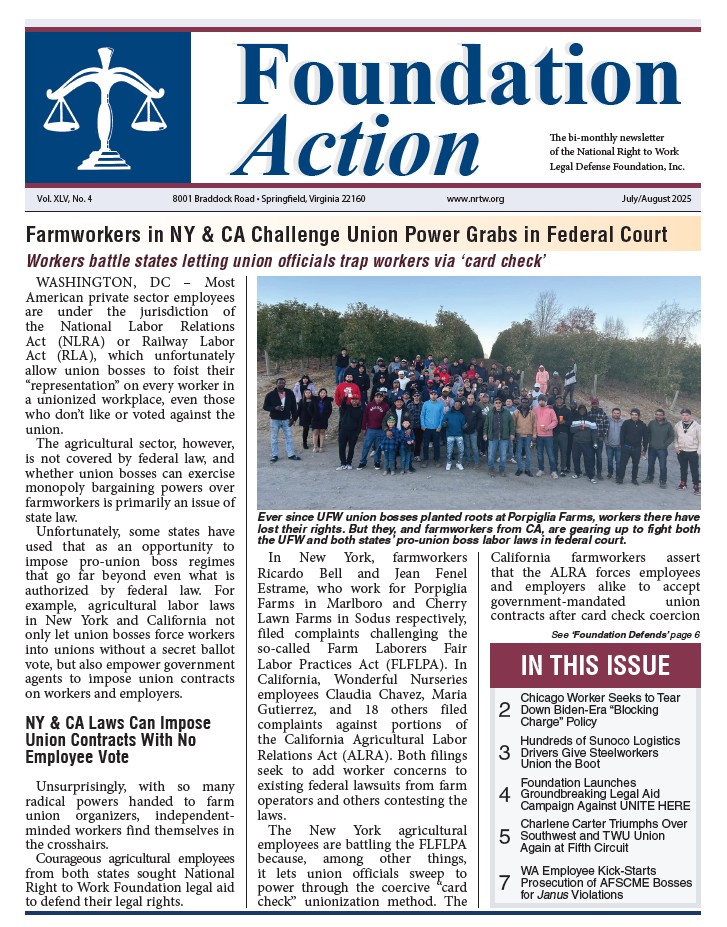
All articles from the July/August 2025 issue of Foundation Action are now online.
In this issue:
- Farmworkers in NY & CA Challenge Union Power Grabs in Federal Court
- Chicago Worker Seeks to Tear Down Biden-Era ‘Blocking Charge’ Policy
- Hundreds of Sunoco Logistics Drivers Give Steelworkers Union the Boot
- Foundation Launches Groundbreaking Legal Aid Campaign Against UNITE HERE
- Charlene Carter Triumphs Over Southwest and TWU Union Again at Fifth Circuit
- WA Employee Kick-Starts Prosecution of AFSCME Bosses for Janus Violations
Recent articles can be found here. To sign up for a free copy of the newsletter via mail please see the form at the bottom of the page.





