
Oregon Civil Servants Bring Class Action Lawsuit to Halt Unconstitutional Collection of Union Dues
Lawsuit challenges two public sector unions’ “window period” schemes as violation of the First Amendment under Supreme Court’s Janus decision
Portland, OR (November 20, 2018) – A group of Oregon public employees have filed a federal class action complaint against two public sector unions and their employers. The lawsuit seeks to end union officials’ “window period” policies that block thousands of workers from exercising their constitutional right under the U.S. Supreme Court Janus decision to refrain from financially supporting a union.
The case was filed at the United States District Court for the District of Oregon by ten public employees with free legal representation from staff attorneys at the National Right to Work Legal Defense Foundation and the Freedom Foundation. The lawsuit names as defendants Service Employees International Union (SEIU) Local 503, Oregon Public Employees Union; American Federation of State, Local, and Municipal Employees (AFSCME) Local 75; and the employers who continue to extract money from the workers’ wages under the “window period” policies without the workers’ consent.
After the Supreme Court decision in Janus v. AFSCME, briefed and won by Foundation staff attorneys, held that public sector workers cannot be forced to pay union fees without their affirmative consent, each plaintiff employee resigned his or her union membership and notified the union and their employer that they no longer authorized deductions of union dues and fees from their paychecks.
However, union officials refused to allow the workers to stop paying union dues. Instead, union officials informed them that they could only stop payments during a short annual “window period” of just a few days. Despite the workers’ asserting their rights under Janus, the government agencies continue to deduct union dues from their wages at the unions’ behest.
The case challenges the union officials’ “window period” policies as a violation of the First Amendment. In the landmark Janus decision, the Court ruled that it is unconstitutional to require government workers to pay any union dues or fees as a condition of employment. Additionally, the Court clarified that no union dues or fees can be taken from those workers without their affirmative consent and knowing waiver of their First Amendment right to refrain from financially supporting a union.
The class action lawsuit argues that the workers’ deduction authorizations signed before Janus were not and could not have been knowing waivers of their First Amendment rights, as the Janus protections had not been recognized at the time. The suit also argues that the unions’ policies restricting workers’ First Amendment rights to a window of time is unconstitutional.
The complaint asks that the court certify classes to include all employees under the monopoly bargaining contracts of SEIU Local 503 and AFSCME Council 75 who were blocked from exercising their First Amendment rights when they resigned union membership and attempted to halt dues deductions after the Janus decision. Only the union officials know the exact number of employees who have attempted to but have been blocked by the policies, but the classes potentially include hundreds or thousands of victims.
“These public sector workers join many others across the country in standing up to Big Labor’s coercive tactics,” commented National Right to Work Foundation President Mark Mix. “Union officials have a long history of manipulating ‘window period’ schemes, arbitrary union-enacted limitations trapping workers into forced dues, and other obstacles designed to block individuals from exercising their constitutional rights. The Foundation’s victory in Janus at the Supreme Court provided much-needed protection, but as this case shows union bosses are now defying the Supreme Court to continue their abusive practices.”
National Right to Work Foundation staff attorneys have filed similar class action lawsuits enforcing the Janus ruling across the country, and are receiving more calls from workers seeking to exercise their rights under the Janus precedent. To assist public employees in learning about their First Amendment rights under Janus, the Foundation established a special website: MyJanusRights.org.
Homecare Provider Files Class Action Lawsuit to Stop SEIU’s Unconstitutional Collection of Union Dues
SEIU officials’ “window period” policy traps provider into supporting union after unsolicited telemarketer pressured provider into forced dues
Sacramento, CA (November 2, 2018) – National Right to Work Legal Defense Foundation staff attorneys have filed a class action complaint challenging a union scheme to violate the rights of California homecare providers. The complaint challenges union officials’ “window period” policy that blocks the provider from exercising her constitutional right to refrain from financially supporting a union, despite the fact that she only became a member under pressure during an unsolicited phone conversation.
Delores Polk, who provides home healthcare to her daughter, is not a voluntary member of the Service Employees International Union (SEIU) Local 2015. However, an SEIU telemarketer called her and read Polk the terms of the local union’s membership and dues deduction authorization. Pressured by the unsolicited phone call, Polk reluctantly agreed to join.
Polk notes in her complaint that she was not notified of her First Amendment rights, protected by the Foundation-won U.S. Supreme Court decision Janus v. AFSCME, to refrain from joining or subsidizing SEIU Local 2015 and did not sign any written documentation agreeing to be a union member or waiving her First Amendment rights.
Days after the phone call, Polk researched SEIU Local 2015 and realized she did not want to financially support the organization, as doing so does not reflect her values and also for financial reasons. Polk called SEIU Local 2015 and told them she did not want to be a union member and did not consent to union dues deductions. However, in a letter sent after her phone call, SEIU officials claimed that Polk had missed the “window period” to cut off payments and could not opt out for another year, and then only through written notice.
Despite her lack of consent, the California State Controller, at the behest of SEIU Local 2015, continues to deduct union dues from the Medicaid funds Polk receives to care for her daughter. The State Controller and SEIU Local 2015 officials also continue to enforce their “window period” policy against other providers.
Polk came to Foundation staff attorneys for free legal aid in filing her class action complaint against SEIU Local 2015 and the State Controller of California. Polk’s charges allege that the “window period” policy violates her constitutional right to refrain from paying union dues or fees.
Under the Foundation-won Supreme Court Harris v. Quinn decision, Polk and homecare providers across the country cannot be forced to pay union fees without their consent. The 2014 ruling declared unconstitutional an Illinois scheme that classified individual homecare providers as “public employees” so they could be unionized by the SEIU and forced to pay union dues. Furthermore, in Janus v. AFSCME, the Supreme Court affirmed that it is unconstitutional for union dues and fees to be collected without an individual’s affirmative consent and clear, knowing waiver of their First Amendment rights.
The complaint requests that the court certify a class including all home healthcare providers who have been forced to pay union dues even after notifying the State Controller or SEIU Local 2015 officials that they do not consent to financially supporting the union.
“Ms. Polk’s case shows that union officials will ignore the clear wishes of the workers they claim to ‘represent’ simply to line their pockets with coerced fees,” commented National Right to Work Foundation President Mark Mix. “Union officials have a long history of manipulating ‘window period’ rules, arbitrary union-enacted limitations on ending dues payments, and other obstacles designed to block individuals from exercising their constitutional rights. Although the Foundation’s victories in Harris and Janus provide important protections, a clear ruling is needed to put an end to these union bosses’ abusive practices.”
Special Legal Notice to Rhode Island Public Employees: Supreme Court’s Janus Ruling Means You Can Resign from Union & Cut off Dues at Any Time
Legal group that won Janus case denounces Rhode Island union bosses and public officials who are misleading workers about their rights
RHODE ISLAND (October 11, 2018) – In response to reports that the Rhode Island Attorney General and Ocean State union officials are misinforming teachers and other public employees of their legal protections under the Foundation-won Janus decision, National Right to Work Legal Defense Foundation staff attorneys have issued a Special Legal Notice for all Rhode Island teachers who wish to exercise their right to stop financially supporting a union.
The notice can be found here: Setting the Record Straight on Teacher Rights in Rhode Island after Janus v. AFSCME Council 31.
The notice comes after Rhode Island Attorney General Peter Kilmartin – who signed onto an anti-Janus brief at the Supreme Court and received major support from union officials in his runs for public office – made the false claim that the U.S. Supreme Court’s ruling “only affects non-union members” and does not apply to union members.
The Attorney General is wrong. Under Janus all government employees have the right to resign their union membership and immediately stop any financial payments to union officials. Because the Supreme Court decision made it clear that public workers must opt-in to any union payments and explicitly waive their constitutional rights, union members cannot be restricted if they seek to resign from the union and stop the payment of any union dues or fees.
The Bristol-Warren Education Association (BWEA) and the National Education Association of Rhode Island (NEARI) also issued a letter blatantly misleading teachers about their Janus rights. The letter claims that union nonmembers must pay a NEARI attorney to file a grievance against the union. However, as the Foundation’s notice states, unions are legally obligated to provide grievance service to both members and nonmembers as part of its exclusive monopoly bargaining status.
The BWEA and NEARI union officials’ letter also incorrectly claims that nonmembers are unable to request days from the Sick Leave Bank, even though the BWEA’s monopoly bargaining agreement establishes the Sick Leave Bank for all teachers, including nonmembers, covered by the agreement.
Mark Mix, president of the National Right to Work Legal Defense Foundation, released the following statement regarding the notice:
“It’s shameful that the Attorney General of Rhode Island and union officials in the state are attempting to mislead public employees about their legal protections. Under Janus, any public sector employee can at any time exercise the First Amendment right to stop paying union dues and fees to a union they do not wish to support. Any suggestion to the contrary is false and is simply a cynical union boss money grab.
“Union officials ought to focus on earning the trust and support of the workers they claim to represent. Instead, they and their political allies are attempting to wield their unique monopoly bargaining privileges to discriminate against workers who seek to exercise their Janus rights. Any Rhode Island public teacher or other public employee who has been blocked from stopping union payments as is their right under Janus can turn to the National Right to Work Legal Defense Foundation for free legal assistance.”
National Right to Work Foundation staff attorneys are already representing workers in lawsuits across the country who have been wrongly blocked from exercising their rights under Janus.
Because of the numerous requests from workers for information about their rights under the Foundation-won Janus v. AFSCME decision, the Foundation established MyJanusRights.org to educate public employees about their protections under Janus.
The site also enables workers to request free legal assistance from the National Right to Work Foundation if their rights are not being respected by union officials.
Special Legal Notice to Marriott Employees Represented by the UNITE HERE Union
October 5, 2018 – Officials of UNITE HERE have ordered Marriott employees out on strike across the country.
The situation raises serious concerns for employees who believe there is much to lose from a union-ordered strike. Employees have the right under federal labor law to rebuff union officials’ strike demands, but it is important for you to be informed about that right before you do so.
IF YOU WOULD LIKE TO WORK DURING A STRIKE READ ALL OF THIS SPECIAL NOTICE BEFORE RETURNING TO WORK – IT MIGHT SAVE YOU THOUSANDS OF DOLLARS!
UNITE HERE union officials have a decades long history of disciplining, fining and abusing workers who do not kow-tow to their dictates, as these reports show:
Union Officials Attempt to Have Hotel Worker Fired for Exercising Workplace Rights
‘UNITE HERE!’ Union Bosses Forced to Refund Dues Illegally Seized from Nonmember Hotel Workers
Federal Government to Prosecute UNITE HERE! Local for Illegal Union Dues Seizures
For this reason, Marriott employees may want to contact the National Right to Work Legal Defense Foundation to learn how they can avoid fines and other vicious union discipline for continuing to report to work to support themselves and their families. Much of the important information about your rights can be found on our website here:
About Your Legal Rights: Private Sector Employees
What if I want to work during a strike?
The Foundation wants you to learn about your legal rights from independent sources. You should not rely on what self-interested union officials tell you. For over four decades, Foundation attorneys have worked in the courts to protect and expand the rights of individual employees in situations such as strikes. It is the nation’s premier organization exclusively dedicated to providing free legal assistance to employee victims of forced unionism abuse.
Marriott employees should know they have the following rights:
1) You have the right to resign your membership in the union. If you don’t support this union, you can send it a letter resigning your membership. You cannot legally be required to be a union member.
2) You have the right to go to work even if the union bosses order a strike. Union officials can (and often do) levy onerous monetary fines against union members who work during a strike. So, you should seriously consider resigning your union membership BEFORE you return to work during a strike, which is the only way to avoid these ruinous union fines and discipline. See Union Discipline and Employee Rights. Your resignation letter must be postmarked THE DAY BEFORE you return to work, or be hand delivered BEFORE you actually return to work, ideally with a witness.
3) If you become a nonmember, you will have the right to become a "Beck objector" and pay only reduced "financial core" fees instead of full membership dues. If you become a Beck objector, you will not be forced to pay for the UNITE HERE union’s far left political and social agenda.
4) You also have the right to revoke your dues check-off and stop allowing the union hierarchy to automatically collect money from your paycheck every week while no contract is in effect. You can send letters to the union and your employer revoking your authorization to have union dues deducted from your paycheck.
5) If you wish to eject an unaccountable union hierarchy from your workplace, you have the right to sign and circulate a decertification petition to obtain a secret ballot election to do so. See Decertification Election.
Here is a sample letter for employees who wish to resign their union membership and become Beck objectors.
NOTE: Although not legally required, it is a better practice to send your letter to the union by certified mail, return receipt requested, and save a copy of your letter and the return receipt to prove delivery. If you hand deliver a letter, make sure that you have a reliable witness to the delivery. In our experience, angry and dishonest union officials often pretend they did not actually receive resignations and initiate discipline against non-striking workers anyway. A copy of the letter should also be delivered to the employer’s human resources or payroll department.
Oregon Civil Servant Wins First Refund of Forced Fees under Janus
The following article is from the National Right to Work Legal Defense Foundation’s bi-monthly Foundation Action Newsletter, September/October 2018 edition.
SEIU officials forced to settle lawsuit and return nearly $3k in illegal forced fees

Debora Nearman won a settlement against SEIU with the help of Foundation staff attorneys. Thanks to Janus, she is no longer forced to fund the organization that ran an aggressive campaign against her husband, Rep. Mike Nearman.
EUGENE, OR – Workers have already begun claiming their new rights under Janus. After being forced for years to support a union that opposed her personal views, including her religious convictions and her husband’s campaign for office, Debora Nearman has won a settlement against SEIU Local 503 officials for their violations of her First Amendment rights.
SEIU officials are required to return over two years of illegally seized fees, nearly $3,000, to Nearman. The refund is the first return of forced fees as a result of the U.S. Supreme Court Janus v. AFSCME decision, which held that the First Amendment prohibits mandatory union fees.
Nearman, an employee at the Oregon Department of Fish and Wildlife, filed the lawsuit in April challenging the constitutionality of mandatory union fees as a condition of government employment. She objected to being forced to financially support and associate
with SEIU Local 503 because the organization actively opposed her personal and political views, including her religious beliefs, and her husband’s public service.
In the 2016 general election, Nearman’s husband, Mike Nearman, successfully ran for
State Representative in the Oregon Legislature. During the campaign, the SEIU local union that she was forced to fund spent over $53,000 to run an aggressive campaign against him, including distributing disparaging fliers.
After the Janus decision declared that forced fees for government employees were unconstitutional, the writing was on the wall for SEIU officials. In the process, Nearman’s
case became the first in which a public employee won a refund of fees seized by union officials prior to the Janus decision.
Janus overturned the erroneous 1977 decision in Abood v. Detroit Board of Education that declared public sector workers could be compelled to pay union fees for
bargaining-related purposes in order to get or keep their jobs. In Janus, the Court ruled that it is unconstitutional to force government employees to pay any union dues or fees as a condition of employment.
The Court also clarified that no union dues or fees can be taken from workers without their affirmative consent and knowing waiver of their First Amendment right to refrain
from supporting a labor union.
In addition to returning over two years of forced fees, SEIU officials will not collect any dues or fees from Nearman’s future wages unless she affirmatively chooses to become a
member of SEIU and authorize such deductions. To comply with Janus, SEIU Local 503 and the state of Oregon have removed their forced fees provision from their collective bargaining agreement.
“This is a great example for the countless public sector workers across the country who seek to have their First Amendment rights respected in light of the Foundation’s Janus Supreme Court victory,” commented National Right to Work Foundation Vice President Patrick Semmens. “Nearman’s refund represents the first of what should ultimately be hundreds of millions of dollars or even more returned to public employees for union fees
seized from them in violation of the First Amendment.”
Minnesota Court Employees Win Full Refunds of Forced Union Dues Seized in Violation of Supreme Court’s Janus Decision
Teamsters officials forced to return every dollar, plus interest, of fees seized by the union from the court workers
Minneapolis, MN (September 10, 2018) – A federal First Amendment lawsuit brought by National Right to Work Legal Defense Foundation staff attorneys for two Minnesota court employees against a Teamsters local union has ended with the workers winning a settlement that will return to the workers all forced union dues seized by union officials. The refund is a result of the Foundation-won U.S. Supreme Court Janus v. AFSCME decision, which held that the First Amendment prohibits mandatory union fees for public sector workers.
Carrie Keller and Elizabeth Zeien, employees of the State of Minnesota Court System, filed the lawsuit after Teamsters Local 320 union officials and Minnesota state officials forced them into union ranks without a vote and against their desire.
When Keller and Zeien starting working for the State, neither was a union member, and they both negotiated their own terms and conditions of employment and salaries free from union interference. In 2015, Teamsters union officials started proceedings to force a number of state employees who were not in monopoly bargaining units into union ranks, in which they could be required to pay union dues and fees.
In March 2017, Minnesota state officials complied with the Teamsters’ demands and added a number of employees, including Keller and Zeien, to a Teamsters controlled bargaining unit. Keller and Zeien were never given a vote on whether they should be part of the union bargaining unit, and they objected to the scheme.
Before being forced under the union contract, Keller and Zeien had pay scales and benefits for themselves that equaled or exceeded what they received under the union-mandated contract. The lower potential compensation and the imposition of mandatory union fees led them to approach the National Right to Work Foundation for assistance in challenging the forced unionization scheme.
The Foundation-won Supreme Court decision Janus v. AFSCME overturned the erroneous 1977 ruling in Abood v. Detroit Board of Education that public sector workers could be compelled as a condition of employment to pay union fees for bargaining-related purposes. In Janus, the Court ruled that it is unconstitutional to require government workers to pay any union dues or fees as a condition of employment. Additionally, the Court clarified that no union dues or fees can be taken from workers without their affirmative consent and knowing waiver of their First Amendment right not to financially support a labor union.
Deciding to settle the lawsuit after the Janus decision, Teamsters union officials will refund to Keller and Zeien the entirety of the unconstitutionally seized union dues plus interest. They and the Court System will not collect any dues or fees from the employees’ future wages unless either affirmatively chooses to become a member of Teamsters and authorizes such deductions.
“These two workers are among the first of millions of government employees to finally receive justice for the violation of their rights,” said National Right to Work Foundation President Mark Mix. “Thanks to the Foundation’s Janus Supreme Court victory, public sector workers can no longer be coerced into signing away their First Amendment rights to keep their jobs. The Foundation will continue to hold union officials accountable when they attempt to force workers into unconstitutional forced-fees schemes.”
The Foundation has created a special website, MyJanusRights.org, to assist public employees in exercising their rights under Janus, which was successfully argued by National Right to Work Foundation staff attorney William Messenger.
Connecticut State Employees File Class Action Lawsuit to Reclaim Forced Union Fees Outlawed by U.S. Supreme Court
Lawsuit seeks return under Janus precedent of all fees seized by SEIU union officials from nonmembers
Hartford, CT (September 6, 2018) – National Right to Work Legal Defense Foundation staff attorneys have filed a federal class action lawsuit for two Connecticut state employees to reclaim union fees SEIU officials unconstitutionally seized from them and similarly situated employees. The class action complaint potentially covers hundreds of individuals and seeks to enforce the Foundation-won U.S. Supreme Court Janus v. AFSCME decision, which held that the First Amendment prohibits mandatory union fees for public sector employees.
Kiernan Wholean and James Grillo, workers at the Connecticut Department of Energy and Environmental Protection (DEEP), filed the complaint against Service Employees International Union (SEIU) Local 2001 and the Secretary of Office of Policy Management, the Undersecretary of Labor Relations, and the Commissioner of DEEP of Connecticut.
The complaint, filed at the U.S. District Court for the District of Connecticut, alleges that by failing to refund the full amount of seized union fees from union nonmembers and by maintaining a union monopoly bargaining agreement that requires nonmembers to pay union fees as a condition of employment, SEIU Local 2001 violates the plaintiffs’ First Amendment rights as protected by the new Janus precedent.
Although Wholean and Grillo are not members of SEIU Local 2001 and had not consented to the deduction of forced fees, they and other non-union member employees were forced to pay union fees as a condition of employment under state law.
In the Foundation-won Supreme Court Janus v. AFSCME decision, the Court ruled that it is unconstitutional to require government workers to pay any union dues and fees as a condition of employment. Additionally, the Court clarified that no union dues or fees can be taken from those workers without their affirmative consent and knowing waiver of their First Amendment right not to financially support a labor union.
However, although Connecticut has stopped deducting union fees from the plaintiffs’ wages, Local 2001 has failed to refund the fees it seized without the plaintiffs’ consent before the Janus ruling. Additionally, despite that the Supreme Court ruled in Janus more than two months ago, DEEP maintains a collective bargaining agreement with SEIU Local 2001 officials that requires non-union members to pay union fees as a condition of employment.
The complaint requests that the court certify a class that includes all individuals who at any time since June 13, 2015, were forced to pay union fees to SEIU Local 2001 without their affirmative consent and knowing waiver of their First Amendment rights, so they can all receive refunds of the money taken from them in violation of their Constitutional rights within the statutory limitations period.
“The Supreme Court finally upheld public sector workers’ First Amendment right to choose whether or not to support a union without the threat of being fired, but justice also demands that the victims of such schemes have returned the money union bosses illegally seized from them,” commented National Right to Work Foundation President Mark Mix. “This class action is one of many across the country which together seek the return of more than $100 million to the victims of union bosses’ unconstitutional forced dues schemes.”
In July, Foundation staff attorneys secured the first such refund under the Janus decision for Oregon state employee Deborah Nearman. As part of a settlement, SEIU Local 503 refunded the Department of Fish and Wildlife worker almost $3,000 that had been collected as mandatory union fees.
The Foundation has created a special website, MyJanusRights.org, to assist public employees in exercising their rights under Janus, which was successfully briefed and argued by National Right to Work Foundation staff attorney William Messenger.
Supreme Court Strikes Down Forced Dues
The following article is from the National Right to Work Legal Defense Foundation’s bi-monthly Foundation Action Newsletter, Special Edition: Janus v. AFSCME.
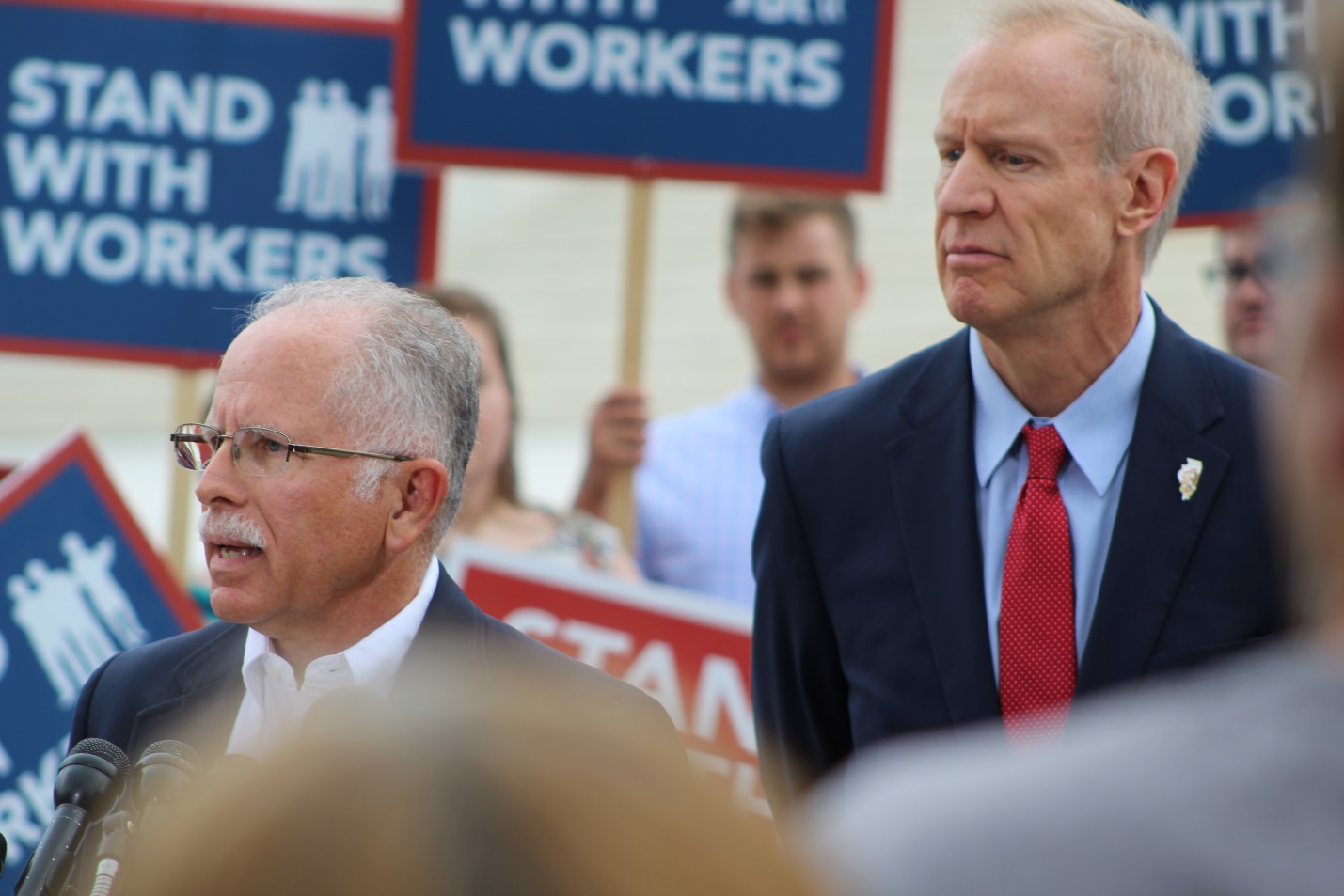
Plaintiff Mark Janus discussed his victory on the steps of the U.S. Supreme Court, alongside Illinois Governor Bruce Rauner, whose lawsuit initiated the case in which Janus intervened with Foundation free legal aid.
Washington, DC – On June 27, 2018, the U.S. Supreme Court ruled in Janus v. AFSCME that nonunion government workers cannot be required to pay union fees as a condition of working in public service. This landmark case restores the First Amendment rights of free speech and freedom of association to more than 5 million public school teachers, first responders, and other government workers across the country.
Janus, argued at the Supreme Court in February by veteran National Right to Work Foundation staff attorney William Messenger, is the 18th case Foundation staff attorneys have brought before the highest court in the land.
“I’m thrilled that the Supreme Court has restored not only my First Amendment rights, but the rights of millions of other government workers across the country,” said Mark Janus, plaintiff in the case and a child support specialist for state government in Illinois. “Across the country, so many of us have been forced to pay for political speech and policy positions with which we disagree, just so we can keep our jobs.”
Illinois is among 22 states that have required many government workers to pay union fees as a condition of employment. Janus has worked for state government in Illinois as a child support specialist since 2007.
Over the past decade, he was forced to pay thousands of dollars in union fees to the American Federation of State, County and Municipal Employees (AFSCME) – even though he opposes many of the union’s positions on public policy issues, felt he would be better off without the union’s so-called representation, and was never asked if he wanted to be covered by a union contract.
Now that the Supreme Court has ruled in his favor, Janus will not be required to pay these union fees.
“Under Illinois law, public employees are forced to subsidize a union, even if they choose not to join and strongly object to the positions the union takes in collective bargaining and related activities,” wrote Justice Samuel Alito in the Supreme Court’s opinion. “We conclude that this arrangement violates the free speech rights of nonmembers by compelling them to subsidize private speech on matters of substantial public concern.
The Supreme Court’s opinion further holds that the opt-out schemes that union bosses use to trap workers into paying dues without consent are unconstitutional. In their briefs for Janus, Foundation staff attorneys had asked the Court to settle that important issue.
Justice Alito wrote in his opinion for the Court that charging nonmembers union fees violates the First Amendment “unless employees clearly and affirmatively consent before any money is taken from them.”
The day after Janus was issued, the Court vacated the decision of the U.S. Court of Appeals for the Seventh Circuit in another Foundation-supported case, Riffey v. Rauner, for reconsideration in light of Janus. The Seventh Circuit had ruled that SEIU officials seizing nonmember in-home care providers’ money without their consent did not violate their First Amendment rights unless providers could prove that they affirmatively objected to the seizure.
Now, thanks to the Janus victory, the providers can continue their case seeking a return of the $32 million in union fees unconstitutionally seized by the SEIU.
“This victory represents a massive step forward in the fight to protect American workers from forced unionism, but that fight is far from over,” said Mark Mix, president of the National Right to Work Legal Defense Foundation. “Union officials and their allies in state governments have already taken steps to prevent workers from exercising their rights under the Janus decision, while millions of private sector workers in states without Right to Work protections are still forced to pay union fees or else be fired.”
“Further,” continued Mix, “workers of all stripes continue to have their freedoms of association violated by being forced under union monopoly ‘representation’ against their will. So while we celebrate today’s decision, there remains much work to do to both enforce and expand upon this historic victory over coercive unionism.”
A Supreme Court victory is only the beginning of the fight to ensure protections for independent-minded public sector workers against forced union fees. That’s why the National Right to Work Legal Defense Foundation has created a task force to enforce the new precedent set in Janus v. AFSCME, defending the rights of government employees and standing up to union bosses who attempt to circumvent and undermine the new protections.
The Foundation is offering free legal aid to all government workers who wish to refrain from union membership and union payments. The Foundation’s 20 staff attorneys defend workers’ rights in more than 200 cases each year, all at no cost to the employees aided.
The National Right to Work Foundation has also established a stand-alone website to assist workers in learning their rights and providing guidance on how to exercise them. That site, MyJanusRights.org, directs workers to the Foundation’s legal aid program for free assistance in exercising their First Amendment rights protected by the Janus decision.
Foundation legal aid can also be obtained through www.nrtw.org or by calling 1-800-336-3600.
“The victory in Janus means that public-sector workers can no longer be forced to pay dues or fees to union officials to keep their jobs,” said Mix. “Unfortunately, experience shows us that union officials frequently ignore restrictions on their power over workers, which is why we are establishing this task force to assist workers who want to enforce their new Janus rights.”
The Foundation has a long history of assisting employees seeking to exercise their Right to Work protections. Defending and enforcing Right to Work protections has long been one of the most critical tasks Foundation staff attorneys undertake.
Any public sector worker who has questions about his or her rights, or encounters any resistance or abuse while trying to exercise his or her workplace rights, is encouraged to contact Foundation staff attorneys for free legal aid.





