
Foundation Brief Exposes ILA Union Scheme to Destroy 270 Nonunion Port Jobs
Note: After this article was originally published, the Supreme Court declined to hear the case. The following article is from the National Right to Work Legal Defense Foundation’s bi-monthly Foundation Action Newsletter, January/February 2024 edition. To view other editions of Foundation Action or to sign up for a free subscription, click here.
Biden NLRB gutted union boycott prohibition under guise of ‘work preservation’

Despite employing hundreds of both union and nonunion employees and being a big boon to the Palmetto State’s economy, ILA union bosses want to shut down Charleston’s Leatherman Terminal until they gain a monopoly on jobs at the port.
CHARLESTON, SC – Charleston’s Hugh K. Leatherman shipping terminal represents the State of South Carolina’s roughly $1 billion investment to expand the state’s shipping sector. The terminal sports five massive ship-to-shore cranes, which rank among the tallest on the East Coast. Nonunion crane operators — state employees who have handled such work since Leatherman opened in 2021 and for years before that at other port facilities — work alongside unionized private sector employees to keep the port running.
But union bosses of the International Longshoremen’s Association (ILA) think that the port should be effectively shut down until they get control over all jobs at the facility — even the crane jobs that the union’s members have never performed. They’ve backed up that coercive vision by suing any cargo carrier that docks at Leatherman until the union gains control of
all crane lift equipment jobs at the facility. In December 2022, the Biden National Labor Relations Board (NLRB) outrageously ruled 2-1 against a challenge by the South Carolina Ports Authority (SCPA), holding that ILA union bosses’ secondary boycott scheme was lawful. Then the U.S. Court of Appeals, also by a 2-1 vote, affirmed that disastrous ruling.
Foundation Highlights Workers’ Plight After Disastrous Decision
As the U.S. Supreme Court now decides whether to hear the case, National Right to Work Foundation staff attorneys filed a legal brief with the High Court highlighting how the Biden NLRB’s rejection of longstanding precedent will let 270 nonunion state employees at Leatherman be put out of work. That’s despite them having done nothing wrong when performing crane work exactly as they have for years.
“In short, the decisions below, if affirmed, will cause grievous harm to 270 non-union Ports Authority workers and their families,” the brief reads. “The Foundation submits this brief to provide a voice for the otherwise voiceless non-union Ports Authority workers, so the Court has a clear view of the stakes involved for the workers and their families if the decisions below stand.”
Job-Destroying ILA Union Gambit Breaks Federal Law
The brief states that the ILA union’s scheme, if allowed to continue, would require South Carolina to both fire the nonunion state employees of the port, and then turn control of crane jobs over to a private company with an ILA union contract. That’s because South Carolina protects its public sector employees by banning union monopoly bargaining.
If the union’s gambit succeeds, the devastating effects for current employees would go beyond just getting fired. The brief reveals that, even if terminated state workers were to seek new employment at Leatherman with the private company under the union’s control, the ILA would likely give hiring priority to its existing unionized workers above the former state workers under the union seniority provisions and hiring hall referral rules contained in the contract.
“Crane and lift operators who have spent years as non-union Ports Authority employees will likely find themselves at the bottom of any ILA hiring hall list behind the union’s 2,000 current members,” the brief notes.
Additionally, the brief points out that the ILA union’s scheme violates the prohibition on secondary boycotts in the National Labor Relations Act (NLRA), the federal law the NLRB is responsible for enforcing. Secondary boycotts involve union agents targeting a neutral employer (in this case, cargo carriers) in order to win a labor dispute that the neutral employer isn’t even party to.
Finally, the brief notes, by granting the ILA control over the jobs of state employees who have never chosen to affiliate with the ILA, the NLRB is undermining the NLRA’s fundamental premise of employee free choice — the rule that “the employees pick the union; the union does not pick the employees.”
Supreme Court Must Intervene to Defend Worker Rights
“ILA union officials have a well-earned reputation for valuing power over the well-being of workers,” commented National Right to Work Foundation Vice President and Legal Director William Messenger. “While pursuing monopolistic schemes like this that upend the livelihoods of innocent nonunion workers, union agents were also organizing deals in which mob-linked longshoremen from New York and New Jersey could get paid for 27 hours of ‘work’ per day.
“The ILA union’s gambit here should be deemed no less illegal than their interactions with mob members, and the Biden NLRB’s greenlighting such a scheme effectively invites other union bosses to try unlawful secondary boycotts that end with workers and businesses suffering needless harm,” Messenger added.
IUOE Union Bosses Hit With Federal Charge for Illegal Termination
The following article is from the National Right to Work Legal Defense Foundation’s bi-monthly Foundation Action Newsletter, January/February 2024 edition. To view other editions of Foundation Action or to sign up for a free subscription, click here.
Longstanding law protects against mandatory dues deductions, formal union membership

Firestop inspector Alexandra Le isn’t going to let IUOE union bosses snuff out her livelihood over her refusal to join or support the union. She’s filed federal charges with Foundation aid.
PLEASANTON, CA – Sometimes, even the extraordinary power to demand payments from workers under threat of termination isn’t enough for union bosses, who frequently go beyond what is legal to coerce workers into membership and dues payment.
Alexandra Le, an employee of Construction Testing Services (CTS), found herself on the receiving end of such illegal demands from International Union of Operating Engineers (IUOE) officials in October. But Le is now fighting back, hitting IUOE bosses and her employer with federal charges at National Labor Relations Board (NLRB) Region 32 with free legal aid from the National Right to Work Foundation.
Union Misinformed Worker About Rights
Le’s charges state that IUOE bosses got her fired after she rebuffed their demands to formally join the union. Additionally, Le’s charges maintain that union officials unlawfully deducted union dues from her paycheck without her permission and failed to inform her of her right to pay reduced union dues as a non-member — a right secured by the Foundation-won CWA v. Beck Supreme Court victory.
Because California lacks Right to Work protections for its private sector workers, Le and her coworkers can be forced to pay some fees to the union to keep their jobs, even if they’ve abstained from formal union membership. However, as per Beck, in non-Right to Work states, union officials can’t force nonmember employees to pay for union expenses (such as union politics) that go beyond what the union claims goes to bargaining.
Other Supreme Court precedents require union bosses to seek workers’ express consent before deducting dues directly from their paychecks.
In Right to Work states, all union financial support is voluntary and the choice of each individual worker.
Employee Demands Federal Injunction to Reverse Illegal Union-Ordered Firing
“It’s outrageous that IUOE union officials believe they can get me fired simply because I don’t agree with their organization and don’t want to support or affiliate with them,” Le said. “IUOE union officials have been far more concerned with consolidating power in the workplace and collecting dues than caring about me and my coworkers, and I hope the NLRB will hold them responsible for their illegal actions.”
Le’s charge against the IUOE union states that, after she refused to affiliate with the union, IUOE bosses “caused Charging Party to be removed from the work schedule by her Employer as of October 2nd.” The NLRB v. General Motors Corp. U.S. Supreme Court decision protects the right of workers to refuse formal union membership, even in a non-Right to Work state.
As a remedy, the charge asks the NLRB Regional Director in Oakland to “invoke its authority under Section 10(j)” of the National Labor Relations Act (NLRA), which empowers the Board to seek an injunction from a federal court to stop IUOE and CTS management from committing the unfair labor practices.
Workers Need More Protections Against Union Boss Coercion
“Ms. Le’s case shows why Right to Work protections are important,” commented National Right to Work Foundation Vice President and Legal Director William Messenger.
“Even if IUOE union officials had followed federal labor law in this case, Ms. Le would still be forced to contribute to the activities of an organization she clearly doesn’t want to be part of.
“As Ms. Le’s case demonstrates, union bosses often value workers merely as sources of dues revenue and will go to extraordinary lengths to keep the money flowing,” Messenger added. “Workers deserve more protections against union boss coercion, not fewer.”
Right to Work Foundation SCOTUS Brief: Workers Exercising Right to Oppose Unions Isn’t “Harm” to Be Eliminated
In case to be heard by Court, Foundation argues NLRB wrongly asserts that independent-minded opposition to unions can justify injunctions
Washington, DC (February 29, 2024) – The National Right to Work Foundation has filed an amicus brief in Starbucks Corporation v. McKinney, a case set to be argued before the U.S. Supreme Court later this term that has major implications for the rights of workers who oppose union power in their workplaces.
In the brief, Foundation staff attorneys argue that federal courts should reject National Labor Relations Board (NLRB) requests for preliminary injunctions when the Labor Board claims employee discontent with a union is a “harm” that should be redressed. These injunctions, called 10(j) injunctions, are frequently used by the NLRB to force employers into certain union-demanded behavior, despite the NLRB not having fully adjudicated the underlying union allegations.
The brief points out that an employee’s decision not to support a union is not a harm that needs to be addressed, but rather a “legitimate choice employees have a right to make” under both the National Labor Relations Act (NLRA) and the First Amendment to the Constitution.
“Only if the NLRB can prove an employee was coerced by an employer to oppose a union against his or her will can that employee’s lack of support for the union be considered any sort of a harm to be redressed,” the brief says. “If the NLRB cannot muster such evidence, then the fact that employees are exercising their statutory and constitutional rights…provides no basis for [an] injunction.”
Foundation: Courts Shouldn’t Accept NLRB’s Assumption that Workers Want to Join Unions
In the Starbucks v. McKinney case, the NLRB sought an injunction at the behest of Starbucks Workers United (SBWU-SEIU) union officials against Starbucks for unfair labor practices the company allegedly committed at a location in Memphis, Tennessee. A major reason cited by the NLRB for the requested injunction was the fact that workers may choose to oppose the union if the injunction isn’t issued.
The case presents the question of what standard courts should use when evaluating whether to grant NLRB-requested injunctions under the NLRA. The Foundation brief opposes the lax standard that the NLRB and union officials are urging courts to use when deciding whether to issue injunctions.
That standard asks only whether alleged unfair labor practices could potentially coerce workers into not supporting a union. Foundation attorneys argue that “the Court must require the NLRB to prove employees were unlawfully coerced not to support a union because, absent such proof, employees have every right to make that choice” (emphasis added).
Foundation-Backed Starbucks Workers Disprove Specious NLRB Theory
Foundation staff attorneys are currently representing Starbucks employees at several locations across the country who seek to vote out (or “decertify”) the SBWU union. In the brief, Foundation attorneys point out that the NLRB in a similar case (Leslie v. Starbucks Corp.) cited a Foundation-backed union decertification case as a reason that an injunction should be issued against the company – despite the fact that the workers themselves say their opposition to the union had nothing to do with the conduct the union was challenging in that case.
“In taking this position, the NLRB has created a self-satisfying ‘heads I win, tails you lose’ dynamic for itself,” the brief reads. “Evidence that employees support a union is taken to mean they want to support the union. Evidence that employees oppose a union is taken to mean their employer must have wrongfully caused the employees not to support the union. All evidence conveniently leads to the conclusion desired by current NLRB leadership: employees should support unions.”
The case is set to be argued before the Supreme Court on Tuesday, April 23, with a decision expected by the end of the High Court’s term in June.
“The Biden NLRB is working hand in glove with unions to advance a standard that treats worker dissent from unions as a harm to be eradicated, rather than a decision made by competent adults,” commented National Right to Work Foundation President Mark Mix. “The Supreme Court in Starbucks v. McKinney must reject the idea that NLRB bureaucrats can simply twist evidence of legitimate worker discontent with unions into a tool to aid union bosses in gaining leverage over businesses and employees.”
Full Foundation Action September/October 2023 Newsletter Now Online
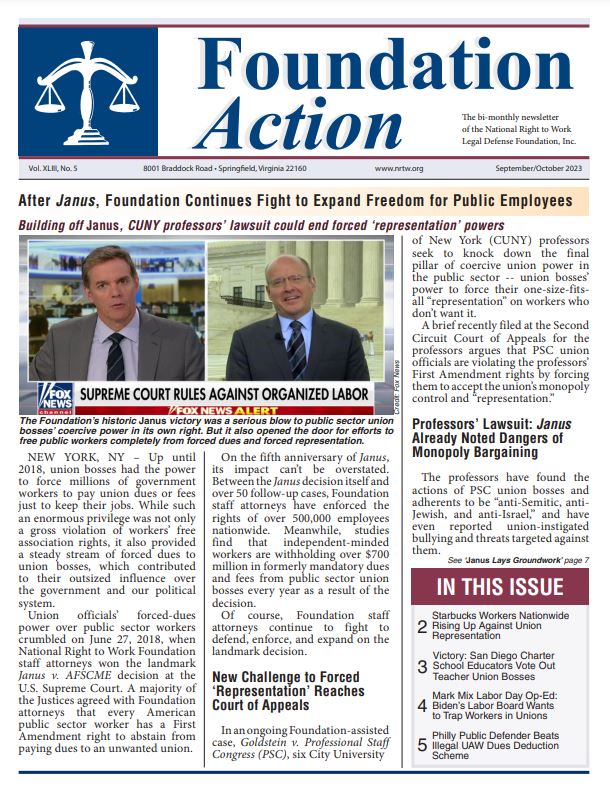 All articles from the September/October issue of Foundation Action are now online.
In this issue:
- After Janus, Foundation Continues Fight to Expand Freedom for Public Employees
- Starbucks Workers Nationwide Rising Up Against Union Representation
- Victory: San Diego Charter School Educators Vote Out Teacher Union Bosses
- Mark Mix Labor Day Op-Ed: Biden’s Labor Board Wants to Trap Workers in Unions
- Philly Public Defender Beats Illegal UAW Dues Deduction Scheme
Recent articles can be found here. To sign up for a free copy of the newsletter via mail please see the form at the bottom of this page.
Right to Work Foundation Brief: 2018 Janus Decision Means Union “Release Time” Violates AZ Constitution’s Gift Clause
Brief supports challenge pending at Arizona Supreme Court against Phoenix’s scheme to subsidize inherently political union activities with tax dollars
Phoenix, AZ (December 14, 2023) – The National Right to Work Foundation has just filed an amicus brief in Mark Gilmore v. Kate Gallego, a case currently pending before the Arizona Supreme Court. In the case, Phoenix city employees Mark Gilmore and Mark Harder are suing Phoenix Mayor Kate Gallego for engaging in a scheme that redirects taxpayer funds intended for public employees’ compensation toward political advocacy conducted by American Federation of State, County and Municipal Employees (AFSCME) Field II agents on so-called “release time.”
Specifically, the plaintiffs’ lawsuit argues the Arizona Constitution prohibits the use of taxpayer dollars to fund four full-time positions for union officials for the purpose of conducting union business, in addition to a bank of over 3,000 paid hours to be used by other union officials for union purposes, and multiple other perks for union agents.
The Foundation’s brief argues that the release time scheme violates Arizona’s Gift Clause, which forbids government transactions that bestow benefits on private entities while serving no public purpose. The brief points out that the U.S. Supreme Court’s ruling in the Foundation-won Janus v. AFSCME case demonstrates that, under the First Amendment, all government union activities are a form of lobbying designed to influence public policy for the benefit of the union. That means taxpayer subsidies of such activities inherently violate the Arizona Constitution’s Gift Clause.
Brief: “Release Time” Funnels Tax Dollars Unconstitutionally to Union Bosses
The policies unions lobby for “often are matters of substantial public concern, such as how much money the government expends on wages and benefits,” the brief reads. “With its release time policy, the City is effectively paying individuals to lobby the City for a private advocacy organization and its members. The notion that this political advocacy serves a public purpose is untenable.”
In the Janus decision, the U.S. Supreme Court ruled that forcing public sector workers to fund any union activities as a condition of employment constitutes forced political speech barred by the First Amendment.
The Foundation’s brief also deconstructs a proposition that the City of Phoenix’s ability to impose one-size-fits-all union contracts on entire swaths of employees somehow counts as a “public benefit” that the City receives in exchange for enforcing the release time scheme. Foundation attorneys instead argue that the municipal labor code already imposes this obligation on both the union and the City, and thus isn’t a benefit that union bosses are giving the City.
“Given the code already requires the City and AFSCME to impose uniform terms of employment on unit employees, union member and nonmember alike, it necessarily follows that the City did not need to provide AFSCME agents with release time to comply with its pre-existing legal obligations,” the brief contends.
“Union bosses, who will often screech about ‘corporate welfare,’ are more than happy to arrange so-called ‘release time’ schemes in which taxpayer dollars are funneled toward supporting their massive lobbying efforts,” stated National Right to Work Foundation President Mark Mix. “Janus made it plain and simple that compelling public sector employees to fund union activities constitutes forced political speech, and the Arizona Supreme Court has an obligation to declare unlawful compulsion foisted on taxpayers.”
National Right to Work Foundation Files SCOTUS Brief Defending Alaska’s Protections Against Forced Union Dues
Alaska facing ASEA union lawsuit over arrangement which requires union bosses to obtain affirmative consent from employees before deducting dues
Washington, DC (September 29, 2023) – Today, the National Right to Work Legal Defense Foundation filed an amicus brief with the U.S. Supreme Court in the case Alaska v. Alaska State Employees Association. The brief supports the State of Alaska’s attempt to safeguard public sector workers’ First Amendment right to refrain from paying dues to a union they disapprove of. This right was first recognized in the Janus v. AFSCME Supreme Court decision, which was successfully argued at the High Court by Foundation Legal Director William Messenger.
In the 2018 Janus decision, the Supreme Court held that the First Amendment protects public sector employees from being forced to pay union dues as a condition of getting or keeping a job. The High Court further recognized that unions must obtain a worker’s freely given waiver of his or her Janus rights before deducting union dues or fees from his or her paycheck.
In an attempt to ensure his state wasn’t violating its employees’ constitutional rights, Alaska Gov. Mike Dunleavy issued an executive order to protect workers’ Janus rights: The order requires the state to obtain consent from workers each year to deduct union dues from their paychecks. This arrangement ensures that the “freely given consent” element of Janus is satisfied, while also preventing union bosses from continuing to deduct money from a worker’s wages based on a “yes” given years ago.
However, Alaska State Employees Association (ASEA) union bosses sued the State of Alaska over its Janus protections, and were able to get the state’s highest court to block the arrangement. Even worse, as Foundation staff attorneys point out in the amicus brief, “five Circuit Courts have now held that states and unions can constitutionally seize payments for union speech from dissenting employees without proof they waived their constitutional rights.”
Amicus Brief: Lower Courts and States Are Letting Unions Seize Dues Without Workers’ Consent
The Foundation’s amicus brief maintains that, after the Janus decision, at least seventeen states either “amended their dues deduction laws…to require government employers to enforce restrictions on when employees can stop payroll deductions of union dues,” or “enforced restrictions on stopping payroll deductions under preexisting state laws.” Both lead to unacceptable restraints on public sector workers’ Janus rights, the amicus brief argues.
The amicus brief further contends that lower courts, especially the Ninth Circuit, have misinterpreted Janus to not require public employers to notify public workers of their Janus rights before collecting dues, which dips below the “waiver” standard mandated by the decision. Additionally, the amicus brief points out that the Ninth Circuit has issued decisions that free public employers from any obligation to prove that union bosses obtained authentic consent from workers before dues are taken from their wages.
“Unless the Court grants review and breathes new life into Janus’ waiver requirement, unions and their government allies will continue to severely restrict the right of millions of employees to stop subsidizing union speech,” the amicus brief concludes. “The Court should not tolerate this resistance to its holding in Janus.”
“Public sector union bosses, who prize their own dues-funded political influence far above the individual rights of the employees they claim to ‘represent,’ have tried everything in their power to dodge the Janus ruling and keep siphoning money from workers,” commented National Right to Work Foundation Vice President Patrick Semmens. “The Supreme Court has an opportunity in the State of Alaska’s case to set the record straight and ensure that workers’ free association rights can’t simply be molded according to their own schemes.”
Foundation Issues Statement on Glacier Northwest SCOTUS Decision
The Supreme Court of the United States has just ruled that union bosses who orchestrate property damage as part of a strike order aren’t immune to liability in state court.
In Glacier Northwest v. International Brotherhood of Teamsters Local 174, an 8-1 SCOTUS majority rejected Teamsters officials’ argument that the National Labor Relations Act (NLRA) prevented Glacier Northwest, a Washington State-based concrete company, from suing the union in state court for ordering cement truck drivers to abandon their trucks and leave copious amounts of cement spoiled and completely unusable.
National Right to Work Foundation President Mark Mix issued the following statement on the ruling:
The Supreme Court correctly ruled that union officials should not be granted immunity from state lawsuits over deliberate property damage perpetrated during union strike actions. The issue in Glacier Northwest, however, represents only the tip of the iceberg when it comes to union bosses’ special legal privileges – especially concerning the powers union officials have over rank-and-file workers.
As the Foundation noted in its amicus brief in the case, beyond the issue of deliberate property damage, union officials have vast special powers and immunities that no other private entity or individual enjoys. This long list includes not only forcing workers under union ‘representation’ they oppose and then extorting workers to pay union fees or else be fired, but also a court-created exemption from federal prosecution for extortionate violence if it is pursued for so-called ‘legitimate union objectives.’
Ultimately, this case shows how far courts and lawmakers have to go in order to level the playing field and stop allowing union bosses to play by a different set of rules from those that apply to all other citizens and private entities.
The Foundation’s amicus brief in Glacier Northwest can be viewed here. Mark also penned an op-ed for Fox News explaining the breadth and depth of union boss legal privileges.
Northwest Ohio Employees File Suit to Knock Down Another Janus Restriction
The following article is from the National Right to Work Legal Defense Foundation’s bi-monthly Foundation Action Newsletter, March/April 2023 edition. To view other editions of Foundation Action or to sign up for a free subscription, click here.
Foundation-aided Ohio workers have already won string of victories over union-imposed ‘escape periods’

From left: Penny Wilson, Theresa Fannin, and Kozait Elkhatib aren’t taking AFSCME union officials’ onerous First Amendment restrictions sitting down. With free Foundation legal aid, they will continue the fight to protect Janus in Ohio.
TOLEDO, OH – American Federation of State, County, and Municipal Employees (AFSCME) union bosses seem to have a knack for violating Ohio public workers’ First Amendment right to refrain from paying union dues.
Fortunately, National Right to Work Foundation staff attorneys are even more adept at forcing Ohio AFSCME bosses to back down from their unconstitutional dues schemes, and have led Ohio government workers to victory in several such cases.
The latest case in this saga comes from three Lucas County Job and Family Services (JFS) employees, who in December filed a federal civil rights lawsuit against the AFSCME Ohio Council 8 union and their employer for violating their constitutional rights.
Penny Wilson, Theresa Fannin, and Kozait Elkhatib’s lawsuit says AFSCME union officials illegally seized money from their paychecks in violation of their First Amendment rights as recognized in the landmark 2018 Foundation-won Janus v. AFSCME U.S. Supreme Court decision. The Ohio public employees are receiving free legal aid from the National Right to Work Foundation and the Ohio-based Buckeye Institute.
Union Officials Kept Employees in the Dark About Janus Freedoms
In Janus, the Court declared it a First Amendment violation to force public sector workers to pay union dues or fees as a condition of employment. The Court also ruled that union officials can only deduct money from the paycheck of a public sector employee who has voluntarily waived his or her Janus rights.
“Plaintiffs . . . file this suit to stop Lucas County JFS and AFSCME from seizing union payments from them without their consent and to receive compensation for violations of their First Amendment rights,” reads the workers’ complaint.
Officials from AFSCME Council 8 and Lucas County JFS enforce a policy which permits the direct deduction of union dues from employees’ paychecks. According to the policy, employees who wish to stop subsidizing the union have only a few days per year in which to do so — an “escape period” that effectively forbids the exercise of their First Amendment Janus rights for more than 90 percent of the year.
AFSCME union officials never informed Wilson, Fannin, and Elkhatib of this restriction. Union officials also never told the women that they had a First Amendment right under Janus to abstain from dues deductions, or that union dues could only be taken from them if they waived that right.
The employees discovered their Janus rights and attempted to exercise those rights twice by sending letters to AFSCME union officials stating that they were ending their union memberships and terminating dues deductions. AFSCME union officials denied all three women’s requests, stating that union dues deductions would continue because the letters missed the narrow “escape period” imposed by the union.
Wilson, Fannin, and Elkhatib’s lawsuit seeks to stop Lucas County JFS and AFSCME union officials from seizing dues from their paychecks. It also seeks a refund of all union dues taken from their wages without their consent.
Foundation Janus Victories Continue to Stack Up in Ohio
Independent-minded Ohio public employees are on a winning streak against AFSCME officials’ “escape period” arrangements. Foundation attorneys scored a significant victory for Ohio public servants’ Janus rights in a 2020 lawsuit against another Ohio AFSCME local (Council 11). Rather than face off against Foundation attorneys, those AFSCME union officials backed down and settled the case. As a result, Foundation attorneys freed almost 30,000 Ohio public employees from a “maintenance of membership” scheme that limited the exercise of Janus rights to roughly once every three years.
In fact, Wilson, Fannin, and Elkhatib’s suit isn’t the first time that Foundation attorneys have faced off against AFSCME Council 8 officials. In 2019, Foundation attorneys brought a similar First Amendment suit for seven Ohio employees that brought down another restrictive “escape period” enforced by Council 8 chiefs.
AFSCME Council 8 Officials Caught Red-Handed Again Violating First Amendment
“Even after abandoning other ‘escape period’ schemes to avoid facing Foundation staff attorneys in court, shameless AFSCME union officials continue to violate the Janus rights of the very employees they claim to ‘represent,’” commented National Right to Work Foundation Vice President Patrick Semmens.
“America’s public workers should not have to file federal lawsuits to protect their money and their First Amendment rights from the predations of public sector union officials.”
Foundation Brief to Court of Appeals: Lower Court’s Decision Conflicts with SCOTUS’ Janus Ruling
National Right to Work Foundation attorneys filed an amicus brief in Littler v. OAPSE with the Sixth Circuit Court of Appeals
Cincinnati, Ohio (April 6, 2023) – The National Right to Work Legal Defense Foundation filed an amicus brief with the Sixth Circuit Court of Appeals on April 5. The brief was filed in Littler v. OAPSE, brought by plaintiff Christina Littler. She attempted exercise her right to withdraw union membership and financial support, as recognized by the U.S. Supreme Court in the 2018 Janus v. AFSCME decision, only to be denied by union officials.
In the Foundation-won and argued Janus case, the Supreme Court recognized that the First Amendment protects government employees, like Littler, from being forced to fund union activities, and further that dues may only be deducted with the affirmative consent of an employee.
Littler is a school bus driver who, shortly after the Supreme Court issued its seminal decision in Janus, notified the Ohio Association of Public School Employees (OAPSE) that she resigned her union membership and revoked her dues deduction authorization. Rather than honor Littler’s timely request to stop paying union dues, union officials had her government employer continue to seize full dues from her paycheck. This prompted Littler to file a lawsuit to recover the dues OAPSE seized from her in violation of her First Amendment rights.
The U.S. District Court for the Southern District of Ohio, however, ruled the union was not liable for violating Littler’s constitutional rights. According to the court, the First Amendment did not apply to the union because the union supposedly did not engage in a state action when it caused a government employer to seize union dues from Littler’s wages.
The Foundation’s brief specifically counters this holding. The brief states “the lower court’s decision that a union does not violate the First Amendment when it has a government employer seize payments for union speech from a nonmember without her consent, because that union supposedly is not a state actor, conflicts with Janus and imperils employees’ right to not subsidize union speech that they oppose.”
The brief goes on to say that the “lower court has effectively given unions a free pass to infringe on employees’ speech rights under Janus without fear of liability” and that “it is important that the [Sixth Circuit] reverse the lower court’s erroneous state-action holding because it frees unions from constitutional constraints when they collaborate with government employers take union payments from employees.”
The case is one of many where union officials have sought to justify seizing dues from employees against their will. For example, in the Foundation-backed Savas case currently pending at the U.S. Supreme Court, Jonathan Savas and other California lifeguards are suing the California Statewide Law Enforcement Agency union for enforcing a “maintenance of membership” requirement that compel dissenting lifeguards to remain union members and to pay union dues for the four-year duration of the contract.
The U.S. Supreme Court recently scheduled the Savas petition for certiorari to be conferenced on April 21.
“While the Foundation is proud to assist workers in enforcing their constitutionally protected Janus rights, the increasing number of cases similar to Savas and Littler just highlight the lengths union bosses will go to in order to extract dues payments from workers against their will,” commented Mark Mix, President of the National Right to Work Legal Defense Foundation. “These cases show why it has become unfortunately necessary for the Supreme Court to again weigh in on this issue to disabuse union officials and lower courts of the notion that public employees’ First Amendment rights can be so callously ignored and restricted.”





