
T-Mobile Arena Worker Files Federal Charges Against Culinary Union for Stonewalling Requests to Stop Dues Deductions
Arena foodservice employee is latest to charge Culinary Union officials with undermining workers’ rights under federal law
Las Vegas, NV (March 20, 2025) – Renee Guerrero, an employee of Levy Restaurants, a foodservice provider at Las Vegas’ T-Mobile Arena, has hit Culinary Workers Union Local 226 (a Unite Here affiliate) and her employer with federal charges for illegally deducting full union dues from her paycheck despite her objections to both union membership and dues payments.
Guerrero filed her charges at the National Labor Relations Board (NLRB) with free legal aid from National Right to Work Legal Defense Foundation staff attorneys. The NLRB is the federal agency responsible for enforcing federal labor law, a duty which includes investigating and prosecuting unfair labor practice cases.
Under federal labor law and Supreme Court precedents like NLRB v. General Motors, all private sector workers have the right to refrain from formal union membership, though union officials oftentimes try to coerce union membership. Federal law also requires union officials to obtain written authorization from a worker before deducting union dues payments directly from their paycheck.
Further, because Nevada has Right to Work protections for its workers, Culinary Union officials can’t legally force Guerrero or her coworkers to pay any union dues or fees as a condition of keeping their jobs. In states that lack such protections union officials can require workers to pay at least some union dues just to keep their jobs. In all states, union officials must get the written authorization of workers before directly deducting forced dues and fees from a worker’s paycheck.
“I have a right under Nevada’s Right to Work law to stop all payments to Local 226, and yet rather than respect my rights they’re ignoring my requests and forcing me to pay. I don’t think Culinary Union bosses deserve my support, and their actions since I attempted to exercise my right to stop dues payments only confirms my decision,” stated Guerrero.
Challenge to Illegal Dues Seizures Follows Other Employee Cases Against Culinary Union
According to Guerrero’s charges against the union, she “submitted two written letters to the Union in which she resigned her union membership and revoked any dues check-off authorization she may have signed.” However, the charges state, union officials did not honor her membership resignation (if she had ever become a union member in the first place), and also refused to provide any documentation she may have signed in the past authorizing dues deductions.
In addition to her charge against the union, Guerrero has filed a separate charge against Levy Premium Foodservice Limited Partnership for its role in facilitating the continued deductions.
National Right to Work Foundation attorneys have a long history of helping workers at Las Vegas casinos and other venues oppose coercive Culinary Union legal maneuvers, including earlier this month in a case for Las Vegas Convention Center worker Rebecca Swank. Swank, an employee of Sodexo, filed similar federal charges against the union and her employer on the grounds they illegally seized full union dues from her paycheck despite her explicit resignation from membership and revocation of dues authorization.
“Between federal law, and Nevada’s popular Right to Work law workers like Renee Guerrero have a clear right to opt out of all union financial support and stop any union dues deductions,” commented National Right to Work Foundation President Mark Mix. “Unfortunately, Culinary Union officials have a troubling track record of violating the legal rights of the very workers they claim to represent.
“We are proud to assist Renee in ensuring her legal rights are enforced, and are available to provide free legal assistance to any Nevada workers who want to exercise their right to stop union dues payments,” added Mix.
Las Vegas Convention Center Worker Slams Culinary Union and Sodexo with Federal Charges for Illegally Seizing Dues From Wages
Employee maintains that both union and employer ignored requests to refrain from union membership and dues payments
Las Vegas, NV (March 12, 2025) – Rebecca Swank, an employee of foodservice provider Sodexo who works primarily at the Las Vegas Convention Center, has hit Culinary Workers Union Local 226 (a Unite Here affiliate) and her employer with federal charges for seizing full union dues from her paycheck despite her objections to both union membership and dues payments.
Swank filed her charges at the National Labor Relations Board (NLRB) with free legal aid from National Right to Work Legal Defense Foundation staff attorneys. Swank’s charges also state that Sodexo officials forced her to get a job referral from the Culinary Union’s hiring hall in person immediately upon being hired.
The NLRB is the federal agency responsible for enforcing federal labor law, a duty which includes investigating and prosecuting unfair labor practice cases. Under federal labor law and Supreme Court precedents like NLRB v. General Motors, all private sector workers have the right to refrain from formal union membership, though union officials sometimes try to coerce union membership anyway, including by subjecting employees to intimidation during hiring hall encounters. Federal law also requires union officials to receive written authorization from a worker before deducting union dues payments directly from their paycheck.
Further, because Nevada has Right to Work protections for its workers, Culinary Union officials can’t legally force Swank or her coworkers to pay any union dues or fees as a condition of keeping their jobs. In states that lack such protections, in contrast, union officials can require workers to pay at least some union dues just to keep their jobs, though must still seek the written authorization of workers before collecting those forced fees by direct deduction.
“Culinary Union officials have been very abrasive in our workplace and have been ineffective in standing up for our interests,” commented Swank. “But now they’re doing something full-on illegal by stopping me from exercising my right under Nevada’s Right to Work law to stop financially supporting them. That’s wrong, and I hope the NLRB gets to the bottom of this.”
Challenge to Illegal Dues Seizures Follows Other Employee Cases Against Culinary Union
According to Swank’s charges against the union, she “submitted two written letters to the Union in which she resigned her union membership and revoked any dues check-off authorization she may have signed.” However, the charges state, union officials did not honor her membership resignation (if she had ever become a union member in the first place), and also refused to provide any documentation she may have signed in the past authorizing dues deductions.
“Finally, the Union has accepted dues deducted from [Swank’s] paycheck without her written authorization and despite her written demand that it cease to do so and to refund her,” Swank’s charges against the union conclude. Swank also filed a charge against Sodexo management for its role in keeping dues flowing from her paycheck to the union.
National Right to Work Foundation attorneys have a long history of helping workers at Las Vegas casinos and other venues oppose coercive Culinary Union legal maneuvers, including in 2021 when Foundation attorneys defended Red Rock Casino workers’ majority vote against Culinary Union control from a district court judge’s order imposing the union on the workers anyway. Foundation attorneys also defended Red Rock Casino slot machine technician Jereme Barrios and his coworkers from a similar situation 2022, when a regional NLRB official blocked him and his fellow technicians from exercising their right to vote themselves out of a Culinary Union work unit. The regional NLRB official cited specious reasons for why the vote couldn’t occur, including allegations of employer malfeasance that didn’t even relate to Barrios and his colleagues.
“Culinary Union bosses have a track record of ignoring and trampling basic employee rights, simply to gain more power over the workers that they claim to ‘represent.’ Unfortunately, it’s unsurprising that independent-minded workers seek to exercise their Right to Work freedom to stop all financial support for this union,” commented National Right to Work Foundation President Mark Mix. “Culinary Union officials’ refusal to respect the exercise of basic rights is clearly at odds with both state and federal law, and our attorneys will defend Ms. Swank’s freedom of choice.”
Pipefitters Union Hit with Federal Charge for Illegal Retaliatory Fine against Non-Union Las Vegas Worker
For participating as an observer in an NLRB union election, the heating and plumbing worker faces $4,999 in punitive union boss initiated fines
Las Vegas, NV (March 10, 2022) – An employee in Las Vegas, Nevada, has filed federal charges against the United Association of Journeymen and Apprentices of the Plumbing and Pipe Fitting Industry (UA) union Local 525, in response to union officials illegally threatening to fine him. The employee, David Webb, chose to exercise his right to work during a National Labor Relations Board (NLRB)-sanctioned election. The case was filed at the National Labor Relations Board Region 28 by National Right to Work Legal Defense Foundation staff attorneys to challenge his retaliatory fines by the union officials.
Webb, a Universal Plumbing and Heating Inc. employee, has not been a union member since 2017. Despite this, UA union officials initiated internal union disciplinary charges against him, resulting in an attempt to levy a fine of $4,999 against him for exercising his right to participate in a NLRB-sanctioned election, including as an official election observer.
Although union bosses often initiate internal union discipline against voluntary union members, longstanding precedent protects workers who are not union members from being subjected to such retaliatory fines. Further, workers can never legally be fined by union officials for exercising their protected rights under federal labor law, including participating in an NLRB-supervised election to decide whether or not union officials become the monopoly bargaining “representative” of workers in a given workplace.
Nevada is a Right to Work state, meaning workers cannot legally be required to join or pay dues or fees to a union as a condition of keeping their jobs. However, even in Right to Work states, union officials who have obtained monopoly bargaining control in a workplace are granted the power to impose one-size-fits-all union contracts on all workers, including those who opt out of union membership and would prefer to negotiate their own terms of employment. In the election that triggered the illegal retaliatory fine against Webb, workers voted against granting UA union bosses such monopoly bargaining powers.
“Fining a nonmember worker for poll-watching is not only absurd but blatantly illegal,” commented National Right to Work Foundation President Mark Mix. “If UA union bosses want to know why workers are declining formal union membership and also voting against bringing so-called union ‘representation’ into their workplace, they should look at their own conduct and how they abuse the rights of rank-and-file workers.”
“Other workers nationwide facing similar backlash from union officials should know they can reach out to Foundation staff attorneys for free legal assistance in challenging union bosses,” added Mix.
Another Janus Victory: South Jersey Bus Drivers Win Back Illegally Seized Dues
The following article is from the National Right to Work Legal Defense Foundation’s bi-monthly Foundation Action Newsletter, January/February 2023 edition. To view other editions of Foundation Action or to sign up for a free subscription, click here.
New Foundation-backed challenges to Janus restrictions also pending at U.S. Supreme Court
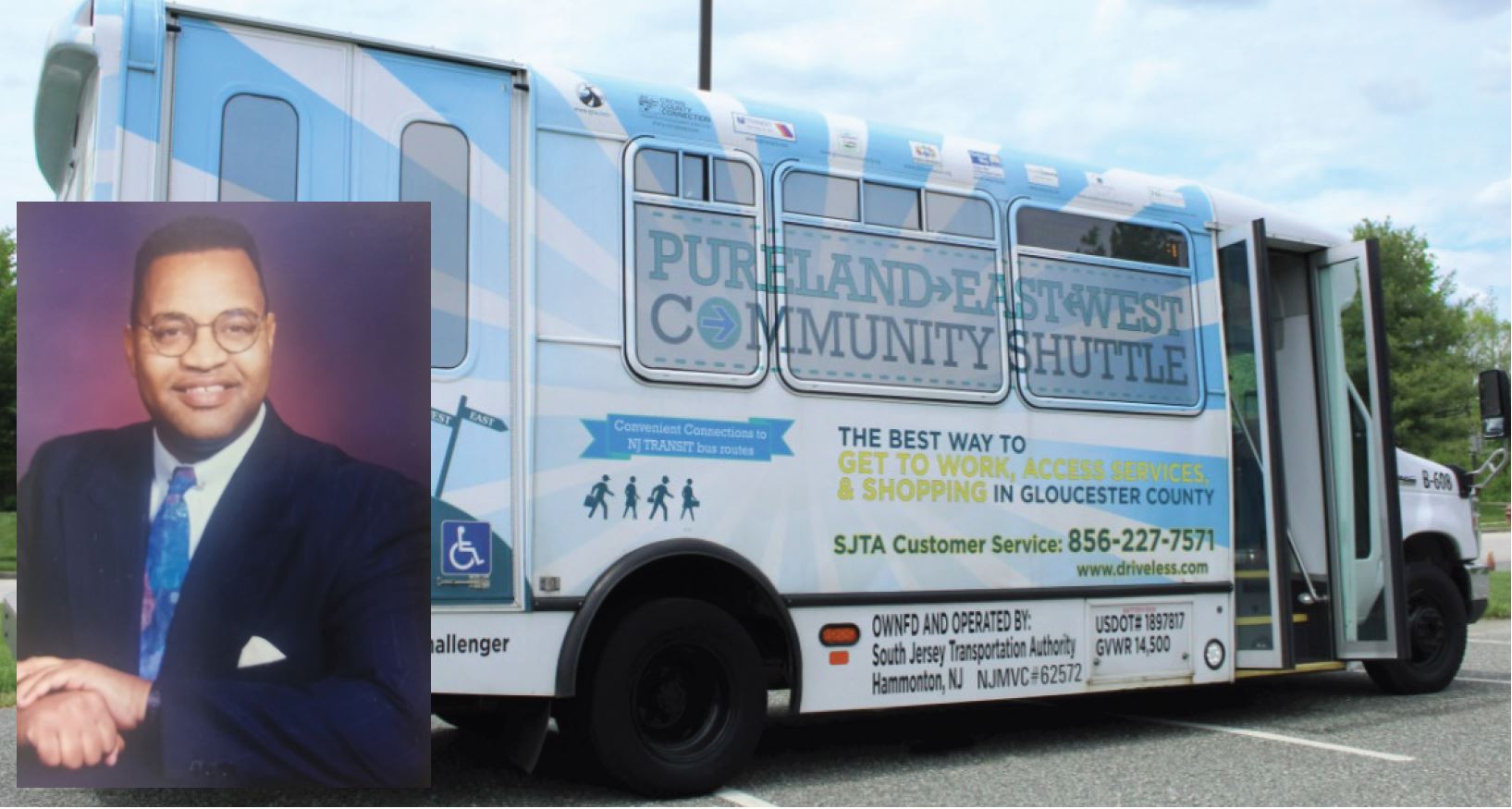
Stop Requested: Tyron Foxworth and his fellow South Jersey Transportation Authority bus drivers told union officials to cease union dues to no avail, until Foundation staff attorneys’ lawsuit forced union bosses to back down.
CAMDEN, NJ – Toward the end of 2021, South Jersey Transportation Authority (SJTA) bus driver Tyron Foxworth and his colleagues Doris Hamilton, Karen Burdett, Karen Hairston, Ted Lively, Arlene Gibson, and Stanley Burke decided they had had enough of International Federation of Professional and Technical Engineers (IFPTE) union bosses’ so-called “representation” and opted out of union membership. Union cards they had signed indicated that the union would cease taking money from their paychecks in January 2022.
But, January 2022 came and went, and neither Foxworth nor his fellow independent-minded colleagues saw dues deductions stop. As a result, with free legal representation from National Right to Work Foundation staff attorneys, they filed a First Amendment federal civil rights lawsuit against the IFPTE union. They argued that union officials violated their First Amendment rights under the Foundation-won 2018 Janus v. AFSCME Supreme Court precedent by continuing to seize dues despite their objections.
IFPTE Officials Subjected Drivers to Restrictions They Never Knew About
In Janus, the Court declared it a First Amendment violation to force public sector workers to pay union dues as a condition of employment. It also ruled that union officials can only deduct dues from the paycheck of a public sector employee who has voluntarily waived his or her Janus rights.
Rather than face Foundation staff attorneys in federal court, IFPTE union lawyers backed down and settled the case. As the settlement ordered, union bosses have now given back all money they seized unconstitutionally from Foxworth and his objecting coworkers, plus interest. The settlement also bars the IFPTE union from demanding or seizing any dues from the drivers going forward.
According to Foxworth and his colleagues, IFPTE dues deductions cards led them to believe that dues opt-outs would become effective on either the January or July following a request. However, the union’s monopoly bargaining contract with SJTA recognized dues revocations only in July. The drivers never consented to this greater restriction.
Foundation attorneys argued in the lawsuit that IFPTE union officials, by taking union dues after January 1, 2022, without the workers’ consent, “violate[d] Plaintiffs’ First Amendment right to free speech and association.”
Foxworth and his coworkers’ victory is the latest of numerous Foundation-won cases to vindicate American public workers’ First Amendment Janus rights. In the past few years, class action lawsuits brought by Foundation staff attorneys have led to settlements freeing tens of thousands of Ohio public employees from American Federation of State, County, and Municipal Employees (AFSCME) union schemes illegally restricting the exercise of their Janus rights.
Courageous public workers from California and Nevada are also asking the Supreme Court to take the next step and declare such Janus restrictions clearly violative of the First Amendment.
Lifeguards, Police Officer Battle Blatantly Unconstitutional Restrictions
Foundation attorneys just filed a petition asking the Supreme Court to hear several Southern California lifeguards’ suit against a so-called “maintenance of membership” scheme that California Statewide Law Enforcement Agency (CSLEA) union officials are using to trap the lifeguards in membership and full dues payments years after they resigned, in direct opposition to Janus.
Also awaiting Supreme Court review of her case is Las Vegas police officer Melodie DePierro, who with Foundation aid is battling an arrangement imposed by Las Vegas Police Protective Association (PPA) union officials that forbids the exercise of her Janus rights for over 90 percent of the year.
“Union officials across the country continue to enforce schemes that give them — not the workers they claim to ‘represent– control over the exercise of Janus rights, meaning more money in union coffers while employees’ constitutional rights are squashed,” commented National Right to Work Foundation President Mark Mix. “While many union bosses, aware of the indefensibility of their actions, run screaming from facing Foundation attorneys on Janus issues and settle quickly, American public workers should also know that Foundation attorneys will fight all the way up to the Supreme Court to ensure their First Amendment rights are protected.”
Las Vegas Police Officer Urges Supreme Court to Hear Case Battling Union’s Unconstitutional Dues Scheme
LVMPD officer argues union officials seized her money in violation of First Amendment through restrictive arrangement to which she never consented
Washington, DC (November 21, 2022) – Las Vegas police officer Melodie DePierro has submitted a petition asking the United States Supreme Court to hear her lawsuit defending her First Amendment right to abstain from paying dues to a union she does not support. DePierro is receiving free legal representation from National Right to Work Legal Defense Foundation staff attorneys.
DePierro, a Las Vegas Metropolitan Police Department (LVMPD) officer, contends in the lawsuit that officials of the Las Vegas Police Protective Association (PPA) union seized dues money from her paycheck in violation of her First Amendment rights pursuant to a so-called “window period” specified in the union contract. PPA officials’ “window period” scheme prohibits police officers from opting out of union financial support for over 90% of the year. DePierro never consented to – nor was ever informed of – this limitation.
DePierro seeks to enforce her First Amendment rights recognized by the Supreme Court in the landmark 2018 Janus v. AFSCME case, which was argued and won by Foundation attorneys. The Justices ruled in Janus that forcing public sector workers to subsidize an unwanted union as a condition of employment violates the First Amendment. They also held that union officials can only deduct dues from a public sector employee who has affirmatively waived his or her Janus rights.
“[I]f employee consent is not required, governments and unions can, and will…devise and enforce onerous restrictions on when employees can stop subsidizing union speech,” reads the brief.
PPA Union Officials Imposed on Officer Contract Provision She Never Knew About
According to DePierro’s original complaint, she began working for LVMPD in 2006 and voluntarily joined the PPA union at that time. However, in 2006 the union monopoly bargaining contract permitted employees to terminate dues deductions at any time.
In January 2020, she first tried to exercise her Janus rights, sending letters to both union officials and the LVMPD stating that she was resigning her membership. The letters demanded a stop to union dues being taken from her paycheck.
Her complaint reported that union and police department agents rejected that request because of the union-imposed “window period” restriction previously unknown to DePierro that purportedly limits when employees can exercise their Janus rights. As her brief notes, that “window period” restriction was added in the 2019 monopoly bargaining contract between union officials and the police department, despite the fact Janus had already been decided by then.
DePierro never agreed to such a restriction on the exercise of her First Amendment rights, but union agents nonetheless rebuffed her again when she renewed her demand to stop dues deductions in February 2020. When she filed her lawsuit, full union dues were still coming out of her paycheck.
DePierro’s Supreme Court petition argues that, because union officials kept seizing money from her wages under the guise of the “window period,” and never sought her consent to the restriction, they violated the First Amendment. As per Janus, union officials must obtain a worker’s waiver of their Janus rights before deducting dues or fees from their pay. DePierro asks the High Court to declare the “window period” scheme unconstitutional, forbid PPA and LVMPD from further enforcing it, and order PPA and LVMPD to refund with interest all dues unlawfully withheld from her pay since she tried to stop the deductions.
“This Court’s review is urgently needed because the Ninth Circuit’s decision is allowing governments and unions to unilaterally decide when and how to restrict employees’ right to refrain from subsidizing union speech—without the need to secure their affirmative consent to the restriction,” asserts the brief.
Officer Joins California Lifeguards in Asking Justices to Uphold Janus Ruling
DePierro’s petition comes as 21 Foundation-represented Southern California lifeguards are also urging the Supreme Court to hear their case challenging an anti-Janus dues scheme concocted by California Statewide Law Enforcement Agency (CSLEA) union officials. That scheme has trapped the lifeguards in union membership and full dues deductions until 2023, despite each of the lifeguards exercising his or her Janus right to abstain from union membership and union financial support.
As in DePierro’s case, the lifeguards were not explicitly informed of the so-called “maintenance of membership” restriction which now confines them in membership and full dues payment. Moreover, union officials never obtained voluntary waivers of Janus rights from any of the lifeguards before subjecting them to this scheme.
“Janus’ First Amendment protections are meant to ensure that workers are not being forced to subsidize union bosses of whom they disapprove, whether based on union officials’ ineffectiveness, political activities, divisive conduct in the workplace, or any other reason,” commented National Right to Work Foundation President Mark Mix. “Union officials’ defense of schemes that siphon money out of unwilling workers’ paychecks sends a clear message that they value dues revenue over the constitutional rights of the workers they claim to ‘represent.’”
“Two parties, here the union and police department, cannot enter into an agreement to restrict the First Amendment rights of an American citizen, yet that is exactly what has happened here to Officer DePierro,” Mix added. “The Supreme Court must defend Janus rights against such obvious violations, and ensure that these unconstitutional schemes are not allowed to stand.”
Casino Worker Challenges Order Installing Unwanted Union via ‘Card Check’
The following article is from the National Right to Work Legal Defense Foundation’s bi-monthly Foundation Action Newsletter, March/April 2022 edition. To view other editions of Foundation Action or to sign up for a free subscription, click here.
Ninth circuit panel signals willingness to end precedent allowing for imposition of union

NLRB officials stacked the deck against rank-and-file Red Rock Casino employees by imposing an unpopular union on them despite worker objections.
LAS VEGAS, NV – A large majority of the workers at Red Rock Casino in Las Vegas, Nevada voted “no” to unionization, but a federal district court judge ordered their employer to bargain with union officials anyway. Casino officials appealed, and Red Rock employee Raynell Teske supported their efforts to overturn the judge’s coercive order that overrides the choice workers made at the ballot box.
With free Foundation legal aid, Teske filed a brief arguing that the district judge had no reason to impose a union onto workers who had already soundly voted to reject it. A Ninth Circuit panel denied the initial appeal, but issued an unusual concurring opinion in which all three judges said they disagreed with that outcome, but were bound by Ninth Circuit precedent to uphold the district judge’s order.
Binding precedent can only be overturned through an en banc hearing before a larger Ninth Circuit panel. Red Rock lawyers filed for an en banc rehearing of their appeal. The court then ordered National Labor Relations Board (NLRB) lawyers defending the order to respond, another signal the judges may be willing to overturn this ridiculous precedent and rule in the workers’ favor. Teske filed a second amicus brief, urging the court to hear the case en banc.
Judge Overrides Workers’ Vote Against Union ‘Representation’
The situation at Red Rock began in December 2019, when the NLRB held a secret-ballot election on whether to unionize the Casino’s workers. Employees rejected union officials’ effort to become their monopoly bargaining “representatives” in an NLRB-supervised vote by a nearly 100-vote margin. Despite that outcome, NLRB Region 28 Director Cornele Overstreet sought a federal court injunction imposing the union over the workers’ objections.
On July 20, 2021, District Judge Gloria Navarro agreed with the NLRB Director’s request, and ordered Red Rock to bargain with union officials despite the employees’ vote against unionization. The judge said the order was justified because union officials claimed that, before the vote, a majority of workers had signed union authorization cards.
Teske’s amicus briefs argue those “Card Check” signatures don’t prove that union officials ever had majority support. She contends the level of union support was tested fairly by the secret-ballot election, in which workers voted 627-534 against unionization.
Her briefs point out that the NLRB and federal courts have long recognized that secret ballots are a more reliable way of gauging worker support for a union, because workers are often pressured, harassed, or misled by union organizers into signing cards.
Union officials know that Card Check signatures do not indicate solid worker support. The AFL-CIO admitted in its internal organizing handbook that it needed at least 75% Card Check support before having even a 50-50 chance of winning a secret-ballot election. Union bosses prefer Card Check unionization because they can more easily take control of workplaces where they lack popular support, and partisan NLRB appointees now are working to grant their wish.
Partisan NLRB Pushes Unreliable ‘Card Check’
Past legislative attempts to enact Card Check unionization, including the so-called “PRO Act,” pending in the U.S. Senate right now, faced bipartisan opposition. However, NLRB General Counsel Jennifer Abruzzo, a former high-ranking union lawyer, believes she can implement Card Check without congressional approval. Abruzzo has expressed interest in resurrecting a decades-old NLRB doctrine that allows unions to sue employers to try to force them to automatically bargain whenever the union possesses a pile of untested union cards.
“There is no reason why district court judges or NLRB bureaucrats should be able to override workers’ choice at the ballot box,” said National Right to Work Foundation Vice President Patrick Semmens. “A favorable ruling for Raynell Teske and her colleagues could provide legal ammunition for future workers if the NLRB tries to force them to accept union officials for whom they never even had a chance to vote.”
Workers Who Voted Against Union Oppose Order Forcing Union on Them
The following article is from the National Right to Work Legal Defense Foundation’s bi-monthly Foundation Action Newsletter, November/December 2021 edition. To view other editions of Foundation Action or to sign up for a free subscription, click here.
Biden NLRB seeks to overturn vote of Red Rock Casino workers against Unite Here
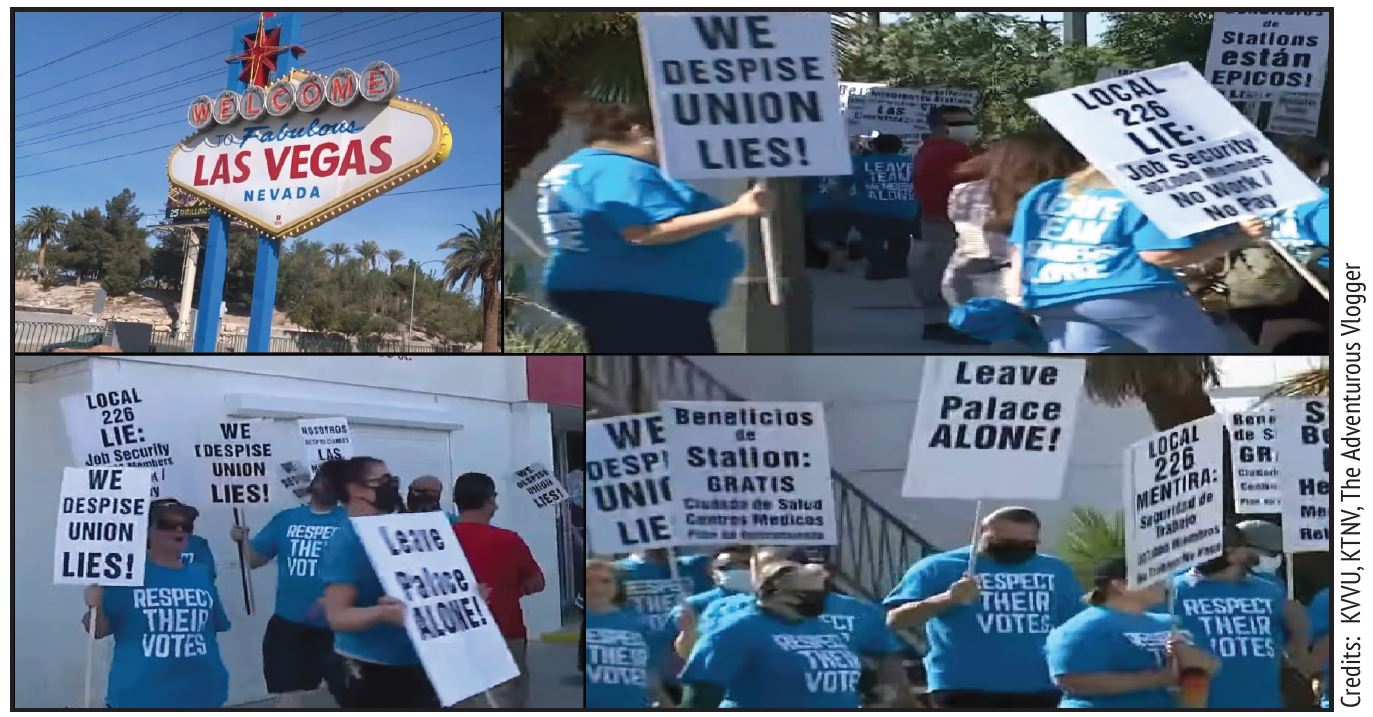
Red Rock Casino employees bearing the messages “We Despise Union Lies” and “Respect Their Votes” protested outside Culinary Union headquarters in Las Vegas after union bosses tried to block Red Rock Casino workers’ emphatic vote to remove the union.
LAS VEGAS, NV – A large majority of the workers at Red Rock Casino in Las Vegas, Nevada, voted “no” to unionization, but a federal district court judge later issued an order forcing their employer to bargain with union officials anyway.
The Casino appealed the judge’s order to the U.S. Court of Appeals for the Ninth Circuit. National Right to Work Legal Defense Foundation attorneys assisted Red Rock food service employee Raynell Teske for free in filing her legal brief at the Ninth Circuit, arguing the judge was wrong to impose a union monopoly on the workers after the union had already lost an election.
Judge Overrides Workers’ Election Choice
In December 2019, the National Labor Relations Board (NLRB) administered a secret-ballot election on whether to unionize Red Rock. A majority of those voting rejected union officials’ effort to become their monopoly bargaining “representatives.”
Nevertheless, NLRB Region 28 Director Cornele Overstreet sought a federal court injunction demanding the union be imposed over the workers’ objections. On July 20, 2021, notoriously partisan Judge Gloria Navarro, appointed by Barack Obama, granted the NLRB Director’s request. She fired off a rare “Gissel” order forcing Red Rock to bargain with union officials despite the employees’ vote against unionization. The judge based her order on union officials’ claim that a majority of workers had signed union authorization cards before the vote. Teske’s legal brief argues that those “card check” signatures are unreliable, and not reason enough to conclude the union ever had majority support. After all, the level of union support was tested by the secret-ballot election and the results were clear: union officials received only 40% support from the eligible employees’ votes. As the Supreme Court has long recognized, secret ballots are a far more reliable way of gauging worker support for a union, because workers are often pressured, harassed, or misled by union organizers into signing cards.
Union Handbook Admits: ‘Card Check’ Is Unreliable
Unions themselves know that “card check” signatures do not reliably indicate worker support. The AFL-CIO admitted in its 1989 organizing handbook that it needed at least 75% card check support before having even a 50-50 chance of winning a secret-ballot election. An earlier guidebook acknowledged that some workers sign cards just to “get the union off my back.” Teske’s brief argues the union’s possession of so-called “cards” does not give union officials permission to take over, especially after they lost a secret-ballot election.
Brief: A Judge’s Order Shouldn’t Overturn Workers’ Clear Choice
The Foundation-aided brief urges that the “Gissel” order be overturned and says that imposing the union’s monopoly power despite the workers’ vote against it treats workers “like children” who did not understand what they were doing when they voted against union affiliation.
“Ms. Teske and her coworkers chose to reject unionization at the ballot box, but Judge Navarro decided to use her power to overturn the election,” said National Right to Work Foundation Vice President and Legal Director Raymond LaJeunesse. “Time and time again, we see workers pressured, misled and even bribed to sign union cards, which is why ‘Card Check’ is widely accepted as unreliable, especially compared to an NLRB-supervised secret-ballot election.”
“The Court of Appeals should promptly overturn Judge Navarro’s coercive order, and restore the actual choice workers made at the ballot box. Federal judges and NLRB bureaucrats cannot be allowed to override workers’ choices,” added LaJeunesse.
Foundation Assists Workers in Kicking Out Unwanted Union Bosses
The following article is from the National Right to Work Legal Defense Foundation’s bi-monthly Foundation Action Newsletter, September/October 2021 edition. To view other editions of Foundation Action or to sign up for a free subscription, click here.
Worker decertification efforts target SEIU, Teamsters union officials
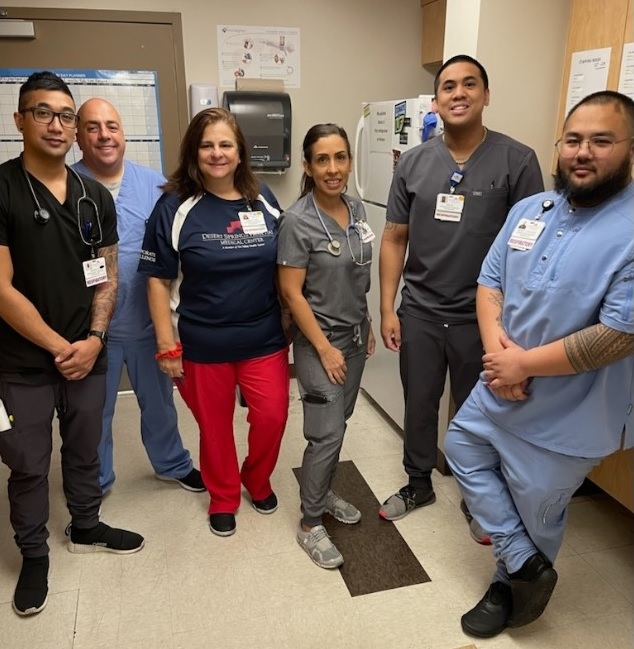
Desert Springs “Decert”: Tammy Tarantino (third from left) and her fellow healthcare workers at Desert Springs Medical Center booted SEIU union bosses from their workplace with Foundation aid, voting by a 3-1 margin for decertification.
CHICAGO, IL – Workers in three different states recently waged successful campaigns to remove the union bosses who controlled their workplaces. In each instance workers utilized free legal assistance from National Right to Work Legal Defense Foundation staff attorneys to navigate the overly-complicated process for getting a vote to remove an unwanted union.
The National Labor Relations Act (NLRA) — which is enforced by the National Labor Relations Board (NLRB) — gives workers the right to hold a decertification vote to end union officials’ monopoly bargaining power over workers. In theory, under the NLRA, workers who collect signatures from 30 percent of a workplace can hold a decertification vote at any time, provided there has not been a unionization vote there in the previous 12 months.
However, because of complicated NLRB doctrines compounded by union legal tactics, obtaining a vote to decertify a union can often be a challenge. That’s why workers in workplaces across the country turn to the Foundation for free legal aid as they seek to hold such a vote.
Workers’ ability to exercise their right to vote out an unwanted union is especially important in states without Right to Work protections, where union bosses can use their monopoly bargaining powers to force every worker to pay union dues or fees or else be fired.
But workers’ right to decertify a union is still critical in Right to Work states, because even without forced union payments, federal law gives union bosses the power to impose their so-called “representation” and resulting union monopoly contracts on members and non-members alike at unionized workplaces. Only once a union is decertified are workers free to represent themselves and communicate with their employer directly.
Foundation Helps Workers Navigate Tricky Legal Process
Highlighting recent activity, three separate workplaces have waged successful decertification efforts.
Petitioner Tim Mangia led the charge at Chicago’s Rush University Medical Center, where he and his fellow maintenance workers voted to remove Teamsters union bosses by a better than 3-1 margin. Separately, in Del Rio and Eagle Pass, Texas, salesmen for Frito-Lay also voted to free themselves from unwanted Teamsters union “representation” following free assistance from Foundation legal staff.
Meanwhile, Tammy Tarantino and her fellow technical employees at the Desert Springs Hospital Medical Center in Las Vegas successfully removed a Service Employees International Union (SEIU) local from their workplace with Foundation help.
Reforms: Union Bosses Can’t Use Bogus Charges to Block Decertification Elections
These cases proceeded without significant delays from union “blocking charges,” the often spurious charges against employers filed by union lawyers seeking to delay a decertification vote. Under old NLRB rules, such charges would have to be resolved before workers’ decertification votes could proceed, delaying the vote for months or even years.
Thanks to NLRB rulemaking advocated by the Foundation and backed by thousands of Foundation supporters, votes now virtually always proceed first with the results quickly announced, so that elections cannot be delayed nearly indefinitely by unsubstantiated union boss claims.
In the Las Vegas medical workers’ case, the new “blocking charge” rules allowed Tammy Tarantino continued from page 2 to have a vote, despite attempts by union lawyers to use charges against the hospital to delay the election. Without being able to rely on the “blocking charge” policy to maintain their power over the workplace, SEIU officials soon found themselves voted out with just 13 of 64 eligible voters voting for the union.
“While we look forward to the day when every individual worker has the freedom to decide whether to pay union dues or be represented by a union, it is especially egregious when union bosses are in power without even the support of a bare majority of rank-and-file workers,” said National Right to Work Foundation Vice President Patrick Semmens. “The National Right to Work Foundation is proud to help workers exercise their right to throw off the yoke of unwanted union so-called ‘representation.’”
Opposition Filed to Judge’s Order Imposing Culinary Union on Workers who Rejected Union in Secret Ballot Vote
Red Rock Casino workers vote against unionization, but nearly 2 years later judge ordered employer to bargain with union officials
Las Vegas, NV (August 24, 2021) – A large majority of the workers at Red Rock Casino in Las Vegas, Nevada voted “no” to unionization, but a federal district court judge is forcing their employer to bargain with union officials anyway.
The Casino is appealing the judge’s order at the U.S. Court of Appeals for the Ninth Circuit. Now Red Rock employee Raynell Teske has filed an amicus brief arguing the judge was wrong to impose the union on the workers, given the rejection of the union in the election. National Right to Work Legal Defense Foundation attorneys assisted Teske for free in filing the amicus brief with the appellate court.
In December 2019, the National Labor Relations Board held a secret ballot election whether to unionize Red Rock. A sizable majority of those voting rejected union officials’ effort to become their monopoly bargaining representatives. Despite that vote, NLRB Region 28 Director Cornele Overstreet filed a federal court injunction action seeking to have the union imposed over the workers’ objections.
On July 20, 2021, Judge Gloria Navarro agreed with the NLRB Director’s request, and issued a “Gissel” order forcing Red Rock to bargain with union officials despite the employees’ vote against unionization. The judge said the order was justified because, prior to the vote, union officials claimed that a majority of workers had signed union authorization cards.
Teske’s amicus brief argues those “card check” signatures are unreliable, and not reason enough to conclude the union ever had majority support. She contends the level of union support was tested fairly by the secret-ballot election, in which workers voted 627-534 against unionization. Secret ballots are a far more reliable way of gauging worker support for a union, because workers are often pressured, harassed, or misled by union organizers into signing cards.
Unions themselves know that “card check” signatures do not indicate solid worker support. The AFL-CIO admitted in its 1989 organizing handbook that it needed at least 75% card check support before having even a 50-50 chance of winning a secret ballot election. An earlier guidebook acknowledged that some workers sign cards just to “get the union off my back.”
Teske’s brief argues the union’s possession of so-called “cards” is an insufficient legal basis for imposing unionization, especially after a secret ballot election in which the union lost. It agrees with the employer that the “Gissel” order should be overturned, and that Teske and her coworkers should not be subjected to monopoly bargaining by a union they rejected in an NLRB-supervised secret ballot election.
This is not the only case in which union bosses are battling casino employees in court. Red Rock’s parent company, Station Casinos, also owns Palms Casino in Las Vegas, where employees filed a petition to decertify union officials in March, 2021. Union lawyers blocked the petition with a slew of charges that were accepted by NLRB bureaucrats as reason to block the workers’ petition. The Palms Casino worker represented by National Right to Work Foundation attorneys who filed the petition is appealing the decision to block the vote he requested.
“Ms. Teske and her coworkers had good reasons to reject the union. It is outrageous that the judge’s order imposing unwanted unionization brushes aside the workers’ contrary preference clearly demonstrated in the secret ballot vote,” said National Right to Work Legal Defense Foundation President Mark Mix. “There have been countless examples of workers being pressured, misled and even bribed to sign union cards, which is why ‘Card Check’ is widely accepted as unreliable, especially compared to an NLRB-supervised secret ballot election.”
“If federal labor law is to be about defending the rights and freedoms of rank-and-file workers, then the Court of Appeals should promptly overturn Judge Navarro’s order substituting the wishes of NLRB bureaucrats for the actual choice workers made at the ballot box,” added Mix.





