
Full Foundation Action November/December 2022 Newsletter Now Online
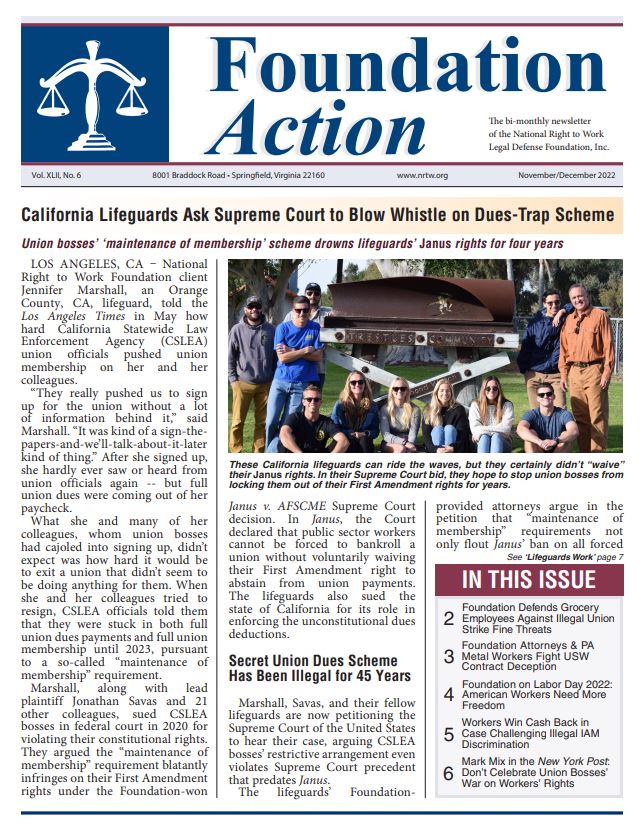
All articles from the November/December issue of Foundation Action are now on the website.
In this issue:
- South Jersey Bus Drivers Challenge Dues Trap Scheme in New Janus Lawsuit
- Slot Machine Technicians Appeal Outrageous Decision Denying Decertification Vote
- Worker Wins $18,000+ for Illegal Firing at IAM Union Bosses’ Behest
- Mark Mix in The Wall Street Journal: Jennifer Abruzzo’s Plan to Abolish Union Elections
- Flight Attendant Battling Religious Discrimination Beats Union Attempt to End Case
- Forced Dues For Politics: CWA Union Hit with Federal Charge by Pennsylvania Metal Worker
Recent articles can be found here. To sign up for a free copy of the newsletter via mail please see the form at the bottom of this page.
Full Foundation Action July/August 2022 Newsletter Now Online
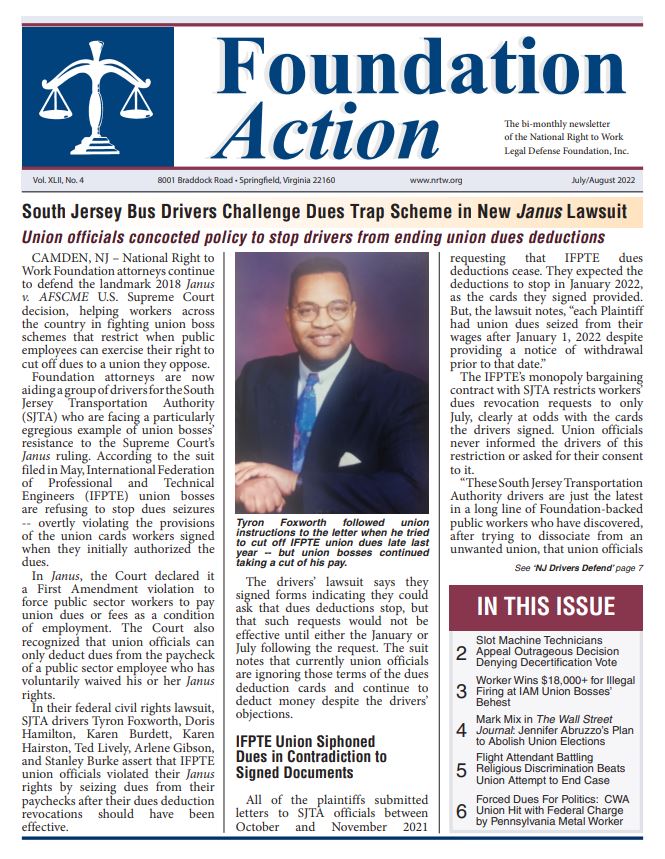
All articles from the July/August issue of Foundation Action are now on the website.
In this issue:
- South Jersey Bus Drivers Challenge Dues Trap Scheme in New Janus Lawsuit
- Slot Machine Technicians Appeal Outrageous Decision Denying Decertification Vote
- Worker Wins $18,000+ for Illegal Firing at IAM Union Bosses’ Behest
- Mark Mix in The Wall Street Journal: Jennifer Abruzzo’s Plan to Abolish Union Elections
- Flight Attendant Battling Religious Discrimination Beats Union Attempt to End Case
- Forced Dues For Politics: CWA Union Hit with Federal Charge by Pennsylvania Metal Worker
Recent articles can be found here. To sign up for a free copy of the newsletter via mail please see the form at the bottom of this page.
NYC University Professors Take Aim at Forced Union ‘Representation’
The following article is from the National Right to Work Legal Defense Foundation’s bi-monthly Foundation Action Newsletter, March/April 2022 edition. To view other editions of Foundation Action or to sign up for a free subscription, click here.
CUNY professors’ lawsuit argues NY law forces them under power of anti-Semitic union
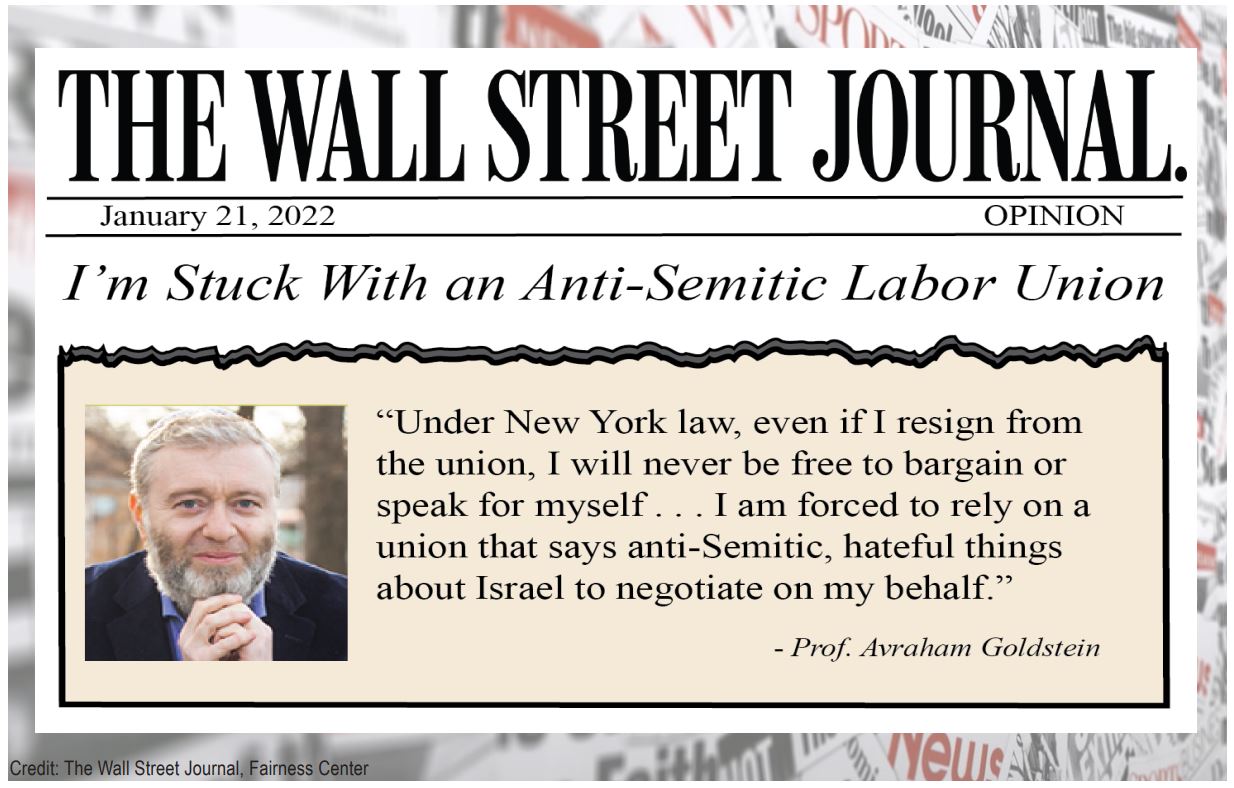
Prof. Avraham Goldstein recalled in a Wall Street Journal piece the anti-Semitism his family faced in the Soviet Union. He and other plaintiffs argue they shouldn’t be forced to associate with a union that subjects them to similar hostility.
NEW YORK, NY – For decades, government sector union bosses have relied on two pillars of coercion — forced dues and forced representation — to maintain their grip on power over America’s public servants and the public services citizens rely on.
While the Supreme Court in the 2018 National Right to Work Foundation-won Janus v. AFSCME Supreme Court case recognized that forcing government employees to pay dues to stay employed violates the First Amendment, a new Foundation-assisted civil rights lawsuit from six City University of New York (CUNY) system professors may finally defeat union bosses’ privilege to impose union representation over the objections of public workers.
CUNY professors Jeffrey Lax, Michael Goldstein, Avraham Goldstein, Frimette Kass-Shraibman, Mitchell Langbert, and Maria Pagano sued the AFL-CIO-affiliated Professional Staff Congress (PSC) union, CUNY executives, and New York State officials in January, challenging New York State’s “Taylor Law” that gives unions monopoly bargaining privileges in public sector workplaces like CUNY.
The plaintiffs, most of whom are Jewish, oppose the union’s “representation” on the grounds that union officials and adherents have relentlessly denigrated their religious and cultural identity. Several of the plaintiffs exercised their Janus right to cut off dues after PSC officials rammed through a resolution in June 2021 that they found “anti-Semitic, anti-Jewish, and anti-Israel,” according to the lawsuit.
Discrimination Cited in Groundbreaking First Amendment Case
The lawsuit, which was filed with legal aid from both the National Right to Work Foundation and Pennsylvania-based Fairness Center, says: “Despite Plaintiffs’ resignations from membership in PSC, Defendants . . . acting in concert and under color of state law, force all Plaintiffs to continue to utilize PSC as their exclusive bargaining representative.”
The resolution is not nearly the worst example of PSC officials’ anti-Semitism, according to the lawsuit. Prof. Michael Goldstein asserts that adherents of PSC are waging a campaign to get him fired and have targeted him with harassment and threats such that he must have an armed guard accompany him on campus. Prof. Lax cites in the lawsuit a determination he has already received from the Equal Employment Opportunity Commission (EEOC) that “PSC leaders discriminated against him, retaliated against him, and subjected him to a hostile work environment on the basis of religion.”
While all of the professors take issue with PSC bosses’ radicalism, they also want to break free from internal conflicts within the large and disparate unit, which consists of full-time, part-time, and adjunct teaching employees and others. Prof. Kass-Shraibman states in the lawsuit that “instead of prioritizing the pay of full-time faculty, PSC expended resources advocating on behalf of teachers in Peru, graduate students at various other universities and the so-called ‘Occupy Wall Street’ movement.”
On top of all that, Profs. Avraham Goldstein, Kass-Shraibman, and Langbert contend that PSC officials aren’t even respecting their First Amendment Janus rights. Although all three professors clearly indicated they wanted to cut off financial support to the union, the lawsuit explains that “Defendants PSC and the City . . . have taken and continue to take and/or have accepted and continue to accept union dues from [their] wages as a condition of employment . . .” in violation of Janus.
“I had paid thousands of dollars in union dues for workplace representation, not for political statements or attacks on my beliefs and identity,” Prof. Avraham Goldstein wrote in a piece for The Wall Street Journal. “I decided to resign my union membership and naively thought I could leave the union and its politics behind for good.”
“I was wrong,” recounted Prof. Goldstein. “Union officials refused my resignation and continued taking union dues out of my paycheck.”
Suit Seeks Damages and to Overturn NY Law Authorizing Union Control
The lawsuit seeks a declaration from the U.S. District Court for the Southern District of New York that the Taylor Law’s imposition of monopoly union control is unconstitutional, and that the defendants cease “certifying or recognizing PSC, or any other union, as Plaintiffs’ exclusive representative without their consent.” The lawsuit also demands the union and university return dues seized in violation of Janus to Profs. Avraham Goldstein, Kass-Shraibman, and Langbert.
“By forcing these professors into a monopoly union collective against their will, the state of New York mandates that they associate with union officials and other union members who take positions that are deeply offensive to these professors’ most fundamental beliefs,” observed National Right to Work Foundation President Mark Mix. “New York State’s Taylor Law authorizes such unconscionable compulsion. It is time federal courts fully protect the rights of government employees to exercise their freedom to disassociate from an unwanted union, whether their objections are religious, cultural, financial, or otherwise.”
Wall Street Journal: Texas AG Seeks to Enforce Government Employees’ First Amendment Rights Under Janus v AFSCME
The Editorial Board at The Wall Street Journal published a column on May 31, 2020, detailing efforts in Texas to enforce the landmark Janus v AFSCME U.S. Supreme Court decision argued and won by National Right to Work Foundation staff attorneys:
The Attorney General of Texas, Ken Paxton, plans to release an advisory opinion soon that could help free public employees who are fed up with their union. In 2018 in Janus v. Afscme, the Supreme Court said that union fees couldn’t be deducted from the paycheck of a government worker who didn’t ‘affirmatively consent.’
“The question is what flows from this logic. Last fall Alaska Governor Michael Dunleavy, citing Janus, signed an order to let state workers quit the union anytime, instead of only during 10 enchanted days once each year. Union members also would have to refresh their consent forms periodically.
The move by Attorney General Paxton came after Foundation President Mark Mix and staff attorney William Messenger — who argued the Janus case at the Supreme Court — called on states like Texas to emulate Alaska. They wrote that “state officials, along with federal agencies, should follow Alaska’s example” in an op-ed for The Wall Street Journal last August.
In addition, Mix and Messenger highlighted how Janus requires that government workers must voluntarily waive their First Amendment rights before union dues or fees can be deducted from their paycheck through a voluntary waiver:
Fourteen months ago the Supreme Court held that the First Amendment protects government employees from being forced to subsidize unions. Janus v. Afscme affirmed that some five million state and local workers have the legal right to stop such payments.
Another aspect of Janus, however, has been overshadowed. The decision requires that the government obtain proof that workers voluntarily, knowingly and intelligently waived their First Amendment rights not to subsidize union speech before deducting union dues or fees from their paychecks. “To be effective, the waiver must be freely given and shown by ‘clear and compelling’ evidence,” Justice Samuel Alito wrote. “Unless employees clearly and affirmatively consent before any money is taken from them, this standard cannot be met.”
Yet the federal government and many states and localities continue to deduct union dues without evidence that workers waived their speech rights, usually based on pre-Janus authorization forms that come nowhere close to demonstrating a waiver. Labor Department figures suggest unconstitutional deductions could be coming out of the paychecks of as many as 7.2 million government employees nationwide. The fix is simple: Governments must cease transferring wages to unions until they amend their dues-deduction policies to comply with Janus.
Foundation Case Featured in the Wall Street Journal: “Chicago’s Union Pickpockets”
The Wall Street Journal published an editorial in Tuesday’s paper detailing how two teachers are suing the Chicago Teachers Union (CTU) with free legal aid from the National Right to Work Foundation, because union officials are forcing workers to pay dues in violation of their rights as recognized in the Foundation’s Janus v. AFSCME Supreme Court victory.
The editorial quotes one of the two teachers represented by Foundation staff attorneys and shows how CTU and the Chicago School Board continued to take money from them in violation of their First Amendment rights:
When the CTU went on strike last fall, Joanne Troesch and Ifeoma Nkemdi didn’t want to stop teaching. Ms. Nkemdi says her second graders are “incredible, highly intelligent young people” but “already disenfranchised,” so “I didn’t feel they needed to be away from school, period. . . . Time away was going to be detrimental.”
Both teachers quit the union, and in late October asked Chicago Public Schools to stop deducting dues from their paychecks. But even after receiving notice, the union continued to pilfer $35.71 from Ms. Troesch and $59.51 from Ms. Nkemdi every two weeks. The CTU claims members may revoke permission for dues deductions only during the month of August, and anyone who leaves after that must pay until the next escape window.
The editorial also cites Foundation attorney Bill Messenger on such union-created “escape window” schemes:
As of May 1, there were some 89 active lawsuits nationwide challenging similar union “escape windows” or the forced collection of dues, says Bill Messenger, the National Right to Work Legal Defense Foundation lawyer who argued Janus. He represents the two teachers.
The editorial concludes that federal courts need to enforce the Janus decision against these “escape window” schemes:
[CTU’s top lawyer] says the union operates “stringently within the letter of the law.” The union’s escape-window shenanigans show otherwise. Federal courts need to enforce Janus or it will have no meaning.
National Right to Work Foundation In the Wall Street Journal: “Trapped by the Teamsters”
Recently the Wall Street Journal published a piece by National Right to Work Legal Defense Foundation President Mark Mix titled “Trapped by the Teamsters.”
The op-ed describes the numerous NLRB policies, doctrines and “bars” workers across the country face when merely attempting to hold a vote to oust Teamsters bosses and other union officials as their monopoly bargaining so-called “representative.” The article illustrates these coercive policies through recent examples faced by workers who have turned to the Foundation for free legal aid:
A majority of workers at a Wisconsin trucking company experienced this over the past two years. First, they were blocked from removing their union by the so-called voluntary-recognition bar. This stops workers from decertifying a union for up to a year after the union is installed through “card check”—a procedure that avoids the need for a secret ballot and makes workers vulnerable to union intimidation.
Then, after waiting a year for that bar to expire, the Wisconsin workers found they had been merged by Teamsters officials into a multicompany nationwide bargaining unit of about 24,000 workers. Suddenly the petition to oust the local union was 7,000 signatures short—for a workplace with fewer than 10 union workers. Last month the NLRB declined the Wisconsin workers’ appeal, though a majority of voting board members signaled they would revisit the “merger doctrine” policy in the future.
Other workers face other hurdles: The “settlement bar” blocks a decertification vote because of an NLRB settlement to which the workers weren’t a party; the “successor bar” blocks a vote for up to a year after a company is acquired; the “contract bar” blocks a vote for up to three years after a union contract is forged; and a “blocking charge” blocks a vote while union allegations against a company are pending. None of these are required by law.
The NLRB is addressing the voluntary-recognition bar and blocking charges through the current rule-making process, but the other policies are similarly destructive of workers’ legal right to vote out a union that lacks majority backing. Congress should act to protect workers from being trapped in union ranks they oppose, but in the meantime the NLRB has the authority to eliminate these barriers.
Union officials unable to win the support of a majority of the workers they purport to represent shouldn’t maintain power solely because of bureaucratic rules. Instead, whenever enough workers file a petition to remove a union they oppose, the NLRB should simply let them vote.
Read the whole piece here.





