
Public Servants Across Country Stand Strong in Defending Janus Rights
The following article is from the National Right to Work Legal Defense Foundation’s bi-monthly Foundation Action Newsletter, January/February 2026 edition. To view other editions of Foundation Action or to sign up for a free subscription, click here.
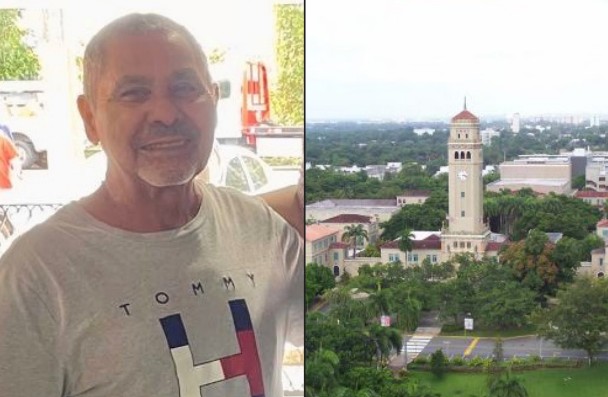
Jose Ramos, a University of Puerto Rico maintenance employee, isn’t going to let union bosses maintain their flimsy defense that they are entitled to keep his hard-earned money in violation of the First Amendment.
As 2025 waned, National Right to Work Foundation staff attorneys brought their expertise to bear as government employees in Washington State and Puerto Rico continued legal battles to get back money that union bosses never should have seized from their paychecks.
These workers are invoking their rights under the Foundation-won Janus v. AFSCME decision, which the Supreme Court handed down in 2018. In Janus, the Justices ruled that all American public sector workers have a First Amendment right to abstain from paying dues to union officials they don’t support.
Despite Janus’ commonsense protections, many union bosses, intent on keeping their coffers stocked with dues money seized from unwilling public employees, are still trying to skirt the Court’s ruling.
AFSCME Bosses Refuse to Return Illegally-Seized Money to Worker
That includes AFSCME union officials in Washington State, whom City of Everett employee Xenia Davidsen is fighting at the Washington State Public Employment Relations Commission (PERC). Davidsen charged AFSCME chiefs with accepting money that City officials had illicitly funneled from her paycheck to the union.
Davidsen had requested dues deductions to stop in 2024 in accordance with Janus, but City officials failed to monitor the email address through which AFSCME directed the City to stop the deductions. This incompetence led to the City seizing dues money from Davidsen at least 12 times without her authorization — and AFSCME union officials have stubbornly refused to admit they must post a notice stating they were wrong to accept the deductions.
“On none of those… instances did the Union stop to question why it was accepting dues that it knew were unauthorized to it,” argue Foundation attorneys in Davidsen’s latest brief before the PERC.
Meanwhile, Foundation attorneys also defended the Janus rights of two groups of Puerto Rico public employees in oral arguments before the First Circuit Court of Appeals last October.
Foundation Challenges Puerto Rico Court’s Refusal to Nix Anti-Janus Statute
In one case, Cruz v. UIA, Puerto Rico Aqueduct and Sewer Authority (PRASA) employee Reynaldo Cruz is trying to reclaim union dues money that officials of the Authentic Independent Union of Water and Sewer Authority Employees (UIA) took in violation of his First Amendment rights.
Cruz’s lawsuit challenges both union bosses’ demands that he pay union dues or lose his job, as well as the Puerto Rico territorial laws that allow such unconstitutional demands. Though UIA union bosses claim they have already deposited the illegally-seized money with a lower federal court, that court confusingly declined to issue a ruling that legally entitles Cruz to collect the funds.
During oral arguments, Cruz’s legal team argued that this legal sleight-of-hand created “a roadmap for civil rights defendants to violate civil rights plaintiffs’ rights.”
Foundation Won’t Let Union Bosses & Bureaucrats Ignore Janus
Also argued before the First Circuit at the end of 2025 was Ramos v. Delgado, in which Foundation attorneys represent Jose Ramos and other University of Puerto Rico maintenance employees who had dues illegally deducted from their paychecks for years.
Ramos and his colleagues are seeking refunds of all dues taken unlawfully since the Janus decision. Puerto Rico continues to be a hotbed for union violations of the Janus decision, but luckily, workers continue to stand up with Foundation legal aid.
Most recently, public employee Luis Rigau filed a federal lawsuit to challenge the Puerto Rico Industrial Commission (PRIC) union’s blatantly illegal reinstatement of automatic forced-dues deductions against nonmembers.
“Despite Janus’ clear constitutional command, union bosses, legislators, and public officials are still trying to do legal gymnastics to end-run the decision,” commented National Right to Work Foundation Vice President and Legal Director William Messenger.
“All public sector workers deserve the free choice that Janus secures, and Foundation attorneys will continue to back them in their court battles for freedom.”
St. Louis-Area Worker Battles Illegal Union Threats to Get Non-Members Fired
The following article is from the National Right to Work Legal Defense Foundation’s bi-monthly Foundation Action Newsletter, March/April 2025 edition. To view other editions of Foundation Action or to sign up for a free subscription, click here.
After divisive strike, IAM bosses demand non-members pay illegal ‘reinstatement fee’ to work

Robert Jacobs, an employee of power management company Eaton, filed federal charges showing IAM bosses clearly can’t manage their power: They are threatening union non-members with hundreds in illegal fees.
TROY, IL – “They’re threatening our jobs and livelihoods.”
This is how Robert Jacobs, an employee for power management company Eaton Corporation, described how International Association of Machinists (IAM) union bosses were treating him and his colleagues who dissented from the union’s agenda in an interview with the St. Louis Business Journal.
IAM officials ordered hundreds of Eaton employees at its St. Louis-area facility to strike in October 2024, which alienated many workers and made them question union bosses’ motives. Jacobs described seeing union agents take photos of his license plate during the strike and how he suspected union agents were following him home.
IAM Anti-Worker Activity Only Increased After Disruptive Strike Order
But for Jacobs and other workers, that was only the beginning of IAM’s coercive conduct. After the strike concluded, many Eaton employees chose to exercise their right to resign their union memberships. Even in states like Illinois that lack Right to Work protections, private sector workers are free to end their union memberships, even if union officials enforce a contract that requires non-members to pay some fees as a condition of employment.
Instead of respecting this right, IAM union officials began retaliating against those who wanted to cut ties with the union. With free legal assistance from the National Right to Work Foundation, Jacobs slammed the IAM with federal charges for threatening to get him and other employees who resigned union membership fired unless they pay hundreds in “reinstatement fees” concocted by the union. The National Labor Relations Board (NLRB) is now reviewing his charges.
“I and several of my colleagues don’t want to be part of the IAM union, but we are required by law to pay fees to union bosses just to keep our jobs,” commented Jacobs.
“That’s already something that we don’t want to do. But IAM officials are going even further and hitting us with hundreds of dollars in made-up fees just because we exercised our right to not be union members.”
IL Worker: Mandatory ‘Reinstatement Fee’ Not Permitted by Federal Law
Under federal labor law, which the NLRB is charged with enforcing, private sector employees have an absolute right to resign union membership. This right is codified in the National Labor Relations Act (NLRA), and was affirmed by landmark U.S. Supreme Court decisions such as General Motors v. NLRB.
Federal law further spells out that neither employers nor union officials can compel private sector workers to participate in union activities or refrain from such activities.
According to Jacobs’ federal charge, which was filed on the last day of 2024, “the Union is presently threatening Charging Party and [other employees who resigned from the union] with termination if they fail to pay a $306 ‘reinstatement fee’ by January 2025.” The charge argues that the IAM union is violating Eaton employees’ rights under Section 7 of the NLRA, which safeguards employees’ “right to refrain from any or all of ” union activities.
According to the Business Journal, IAM officials’ letter demanding this payment was what prompted him to contact Foundation attorneys. “[I]f you do not remit the total sum indicated in the enclosed letter within 30 days from receipt of this letter, the Union will be required to seek your termination from employment,” the letter read.
“Instead of seeking to win Eaton employees’ voluntary support, IAM union officials have decided to effectively extort the workers they claim to ‘represent,’” commented National Right to Work Foundation Vice President and Legal Director William Messenger. “Threatening to terminate workers if they don’t pay a fee which is apparently intended to punish those who don’t want union bosses speaking for them tarnishes employee rights and freedom.
“While we’re confident that Foundation attorneys will help Mr. Jacobs prevail in beating this illegal scheme, this case shows what self-interested union bosses will do to demand fealty from workers, and why all American workers deserve the Right to Work freedom to cut off financial support for such union hierarchies,” Messenger added
Philly-Area Manufacturing Employees Triumph Over UAW Intimidation Campaign
The following article is from the National Right to Work Legal Defense Foundation’s bi-monthly Foundation Action Newsletter, January/February 2025 edition. To view other editions of Foundation Action or to sign up for a free subscription, click here.
UAW bosses now required to attend federal training after trying to fire non-striking workers
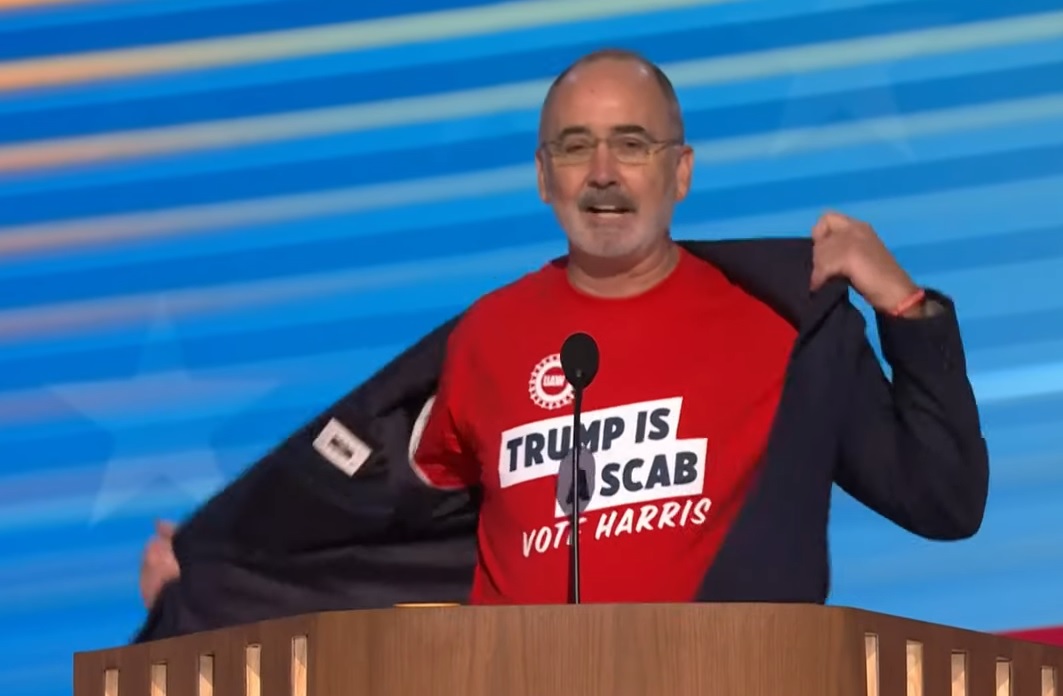
Despite an active federal corruption investigation, UAW President Shawn Fain and his underlings continue to push a radical political agenda using workers’ dues money while ignoring the rights of the rank-and-file employees union bosses claim to “represent.”
PHILADELPHIA, PA – It’s not particularly difficult to see why United Auto Workers (UAW) union officials are having trouble convincing workers that the union has their best interests in mind.
The union’s upper echelon is still reeling from a federal probe that hit about a dozen top union bosses with prison sentences for embezzling workers’ dues, and to this day it appears that UAW President Shawn Fain — a so-called “reformer” — is being scrutinized by federal monitors for manipulating his position to secure personal benefits.
But the corruption within the UAW goes far beyond the union’s top executives. Throughout 2024, National Right to Work Foundation-backed workers for auto accessory manufacturer Dometic fought illegal UAW demands that they strike or be fired.
UAW Union Used Mass Texts, Social Media to Bully Workers
In March 2024, seven Philadelphia-area Dometic employees filed unfair labor practice charges against the UAW Local 644 union, detailing that UAW bosses had ordered a strike and threatened to get fired anyone who decided to keep working.
Despite the employees’ resignation of their union memberships, UAW officials began internal proceedings against each of them soon after the strike began. Federal labor law forbids unions from imposing internal discipline on those who abstain from union membership.
The Dometic workers didn’t back down. With free Foundation legal aid, all the workers won settlements in October 2024 that fully vindicated their rights. UAW officials must now make postings correctly informing workers of their right to abstain from union activities, and the settlement even requires union chiefs to undergo mandatory training on the limits of “a union’s right to impose internal discipline,” among other topics.
As the workers’ legal battle dragged on, the Dometic workers continued to expose ugly details of the UAW’s intimidation campaign surrounding the strike. In April 2024, Dometic employee Mario Coccie filed a second round of charges against UAW Local 644 for a mass text message that threatened all Dometic employees — not just those who had filed charges against the union — with termination if they didn’t strike.
“The information in this text reveals union officials’ real intentions, which is to hurt anyone willing to stand up for themselves,” said Coccie at the time. “What is happening in this case is completely unjust.”
UAW officials also refused to respect Coccie and his coworkers’ rights under the Foundation-won CWA v. Beck Supreme Court decision, which prohibits union officials from requiring workers to pay for the union’s political expenditures just to keep their jobs. Because Pennsylvania lacks Right to Work protections for its private sector workers, UAW bosses can force workers to pay union fees as a condition of employment, but must abide by Beck.
Legal Privileges Enable UAW Corruption
In addition to the notice postings and required training, the Foundation-won settlement orders union officials to delete social media posts threatening workers who refused to strike.
“We’re proud to have helped Mario Coccie and his coworkers vindicate their rights,” commented National Right to Work Foundation Vice President Patrick Semmens. “But it has become all too clear that union corruption — which can take the form of anything from stealing millions in worker dues to intimidating workers to join a picket line — is only made easier when union bosses are granted more legal privileges.
“Policymakers need to protect workers’ freedom to cut off funding for union bosses who don’t serve their interests, and to fully abstain from union activities that individual employees do not see as in their own best interest,” Semmens added.
Flight Attendant Asks SCOTUS to Hear Case Challenging Union Boss Scheme to Discriminate Against Nonmembers
Petition: Ninth Circuit wrongly ruled that federal labor law lets union officials take away on-the-job benefits for refusal to pay union fees
Washington, DC (April 23, 2025) – Flight attendant Ali Bahreman has just filed a petition asking the U.S. Supreme Court to hear his case challenging a Transportation Workers Union (TWU) contract that deprived him of his ability to use his seniority to bid on flight assignments and secure other valuable job benefits. Bahreman, who refrained from formal union membership, is arguing that a union monopoly contract between Allegiant Airlines management and TWU union bosses violated the Railway Labor Act (RLA) by conditioning flight attendants’ “bidding privileges” on their payment of fees to the union.
The RLA governs employment arrangements like Bahreman’s in the rail and air industries. The RLA is a federal law that permits union officials and employers to enforce so-called “union security agreements” that require workers in a unionized workplace to pay union fees to keep their jobs.
Bahreman’s petition points out that although the RLA grants union officials the power to enter into contracts that require payment of union fees as a condition of employment, it has long been illegal for unions to enter into contracts that otherwise discriminate against certain classes of workers, like nonmembers. This goes all the way back to the 1944 Steele Supreme Court precedent that created what the court called the “Duty of Fair Representation” (DFR) in order to save the RLA from being declared unconstitutional after union officials used their power to impose a contract that discriminated against workers based on their race.
The petition argues that not only does the Ninth Circuit Court of Appeals’ decision upholding the discriminatory scheme conflict with opinions from other federal courts of appeal, but if left in place, the decision calls into question the constitutionality of union exclusive bargaining powers under both the RLA and the National Labor Relations Act (NLRA):
“Having unraveled the DFR, the Ninth Circuit’s decision allows unions to wield congressionally delegated exclusive representation power without the DFR’s limitations. That raises ‘serious constitutional questions’ regarding exclusive representation’s constitutionality…
“Ensuring that the Ninth Circuit’s decision does not dismantle employees’ RLA and NLRA speech and associational freedoms from forced unionism is of national importance. The Ninth Circuit’s decision jeopardizes employees’ ability to do their jobs free from union coercion, hostility, and discrimination in the workplace.”
Petition Exposes That Lower Court Decision in Favor of TWU Allows Union Bosses to Discriminate in Workplace
The petition comes after the Ninth Circuit Court of Appeals puzzlingly ruled that the RLA permits union officials to enforce contracts that require employers to eliminate on-the-job benefits from workers who refuse to pay union fees. Bahreman’s petition goes on to explain that the Ninth Circuit’s reasoning greenlights discrimination by union bosses in their treatment of union members and nonmembers, which flies in the face of the duty of fair representation that federal law imposes on all union officials.
Federal law permits union officials to extend their monopoly bargaining powers over all workers in a unit, including those who oppose the union, but requires that union officials not discriminate against nonmembers. Therefore, the petition says, monopoly bargaining itself should be reexamined if the Ninth Circuit’s ruling is upheld.
“Mr. Bahreman’s case shows how deep the rabbit-hole of union boss legal privileges goes,” commented National Right to Work Foundation President Mark Mix. “The Ninth Circuit’s decision turns the U.S. Supreme Court’s ‘duty of fair representation’ on its head, and exposes the underlying constitutional tensions that the Court identified long ago in the 1944 Steele High Court decision.
“Originally created in Steele as a bulwark against union bosses wielding their monopoly representation and forced dues powers to discriminate, the Ninth Circuit’s reinterpretation of the DFR doctrine allows union officials to engage in discrimination to coerce fee payment from union dissidents,” added Mix. “The Supreme Court should take Mr. Bahreman’s case to settle the circuit split and make it clear that Big Labor officials cannot wield their extraordinary government-granted powers to undermine the working conditions of workers who oppose union affiliation.”
Full Foundation Action November/December 2024 Newsletter Now Online
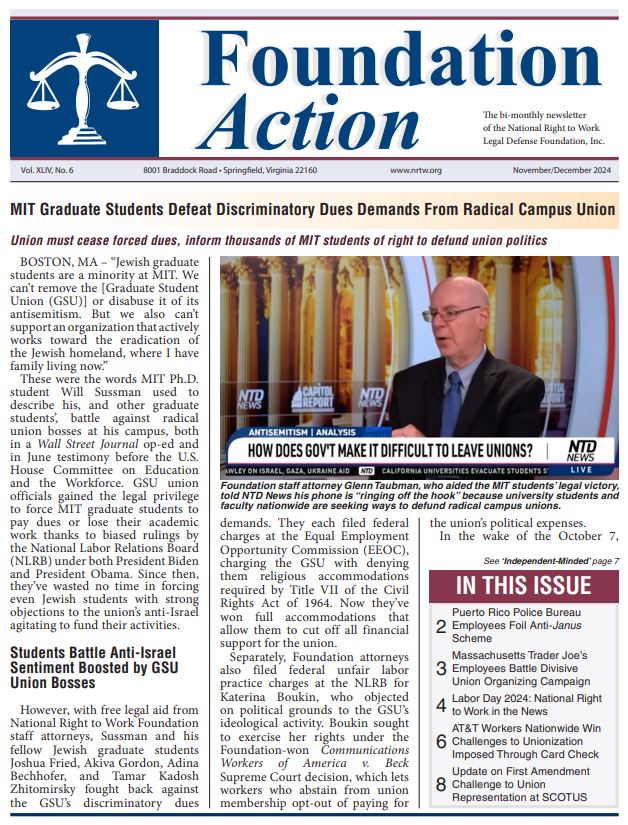
All articles from the November/December 2024 issue of Foundation Action are now online.
In this issue:
- MIT Graduate Students Defeat Discriminatory Dues Demands From Radical Campus Union
- Puerto Rico Police Bureau Employees Foil Anti-Janus Scheme
- Massachusetts Trader Joe’s Employees Battle Divisive Union Organizing Campaign
- Labor Day 2024: National Right to Work in the News
- AT&T Workers Nationwide Win Challenges to Unionization Imposed Through Card Check
- Update on First Amendment Challenge to Union Representation at SCOTUS
Recent articles can be found here. To sign up for a free copy of the newsletter via mail please see the form at the bottom of this page.
Chicago 911 Operators Notch Another Janus Victory Over IBEW
The following article is from the National Right to Work Legal Defense Foundation’s bi-monthly Foundation Action Newsletter, January/February 2025 edition. To view other editions of Foundation Action or to sign up for a free subscription, click here.
Foundation attorneys stopped deceptive cycle that kept illegal dues flowing for months

Patricia Whittaker heard ridiculous excuses from IBEW union officials about how they couldn’t honor her Janus rights. But after teaming up with Foundation attorneys, she’s cut off dues to IBEW bosses.
CHICAGO, IL – Another 911 operator employed by the City of Chicago has successfully defended her First Amendment rights under the National Right to Work Foundation-won Janus v. AFSCME Supreme Court decision. Late last year, Operator Patricia Whittaker sought free Foundation legal aid after facing months of stonewalling from International Brotherhood of Electrical Workers (IBEW) Local 21 union officials, who refused to stop taking dues from her paycheck against her will.
Whittaker fought these dues seizures by invoking her First Amendment rights under Janus. Foundation attorneys argued and won the Janus case before the Supreme Court in 2018. The Supreme Court agreed with Foundation attorneys and ruled that union officials could not force public sector employees to pay union dues or fees as a condition of employment, and that union officials must obtain affirmative employee consent before deducting union dues from any public worker’s paycheck.
In October, following unfair labor practice filings by Foundation attorneys at the Illinois Public Employment Relations Board (PERB), IBEW union bosses abandoned their unconstitutional dues demands — and other outrageous behavior they had subjected Whittaker to.
IBEW Union Outrageously Claimed They Had No Power to Stop Dues Deductions
Whittaker faced much more than just illegal dues deductions during her ordeal. IBEW officials engaged in a deceptive cycle in which Whittaker was told to resolve the matter with her employer, while the employer directed her back to the union, resulting in continued dues deductions for over 10 months. In doing so, the charges maintained, union officials misrepresented the law by making it appear as if they were the “good guys” by remitting dues deducted by the City of Chicago through checks back to her and claimed that only the employer — not the union — had the power to end dues deductions.
This isn’t the first time IBEW 21 union officials have been caught imposing illegal dues practices on Chicago 911 employees. In June 2024, Rhonda Younkins also triumphed in her months-long legal battle to exercise her First Amendment right to stop all union dues payments to IBEW Local 21. IBEW Local 21 union officials stopped their violation of Younkins’ Janus rights only after Foundation attorneys filed charges at PERB on Younkins’ behalf.
Independent-Minded Workers Continue to Defend Freedom with Janus
The Janus decision’s impact continues to grow. Immediately following the ruling, nearly a half a million public employees stopped paying union dues, with many others following in subsequent years as litigation backed by Foundation attorneys continues to defend their rights.
“The behavior of IBEW Local 21 union officials highlight just how crucial it is for public employees to be aware of, and assert, their Janus rights,” said National Right to Work Foundation President Mark Mix.
“While we at the Foundation are proud to help more workers protect their hard-earned money from funding union bosses and union agendas they don’t support, it is unacceptable that it takes aggressive legal action just to force union officials to respect workers’ constitutional freedoms.”
Puerto Rico Police Bureau Employees Foil Anti-Janus Scheme
The following article is from the National Right to Work Legal Defense Foundation’s bi-monthly Foundation Action Newsletter, November/December 2024 edition. To view other editions of Foundation Action or to sign up for a free subscription, click here.
Federal court strikes down discrimination against workers at the Puerto Rico Police Bureau who exercised First Amendment rights
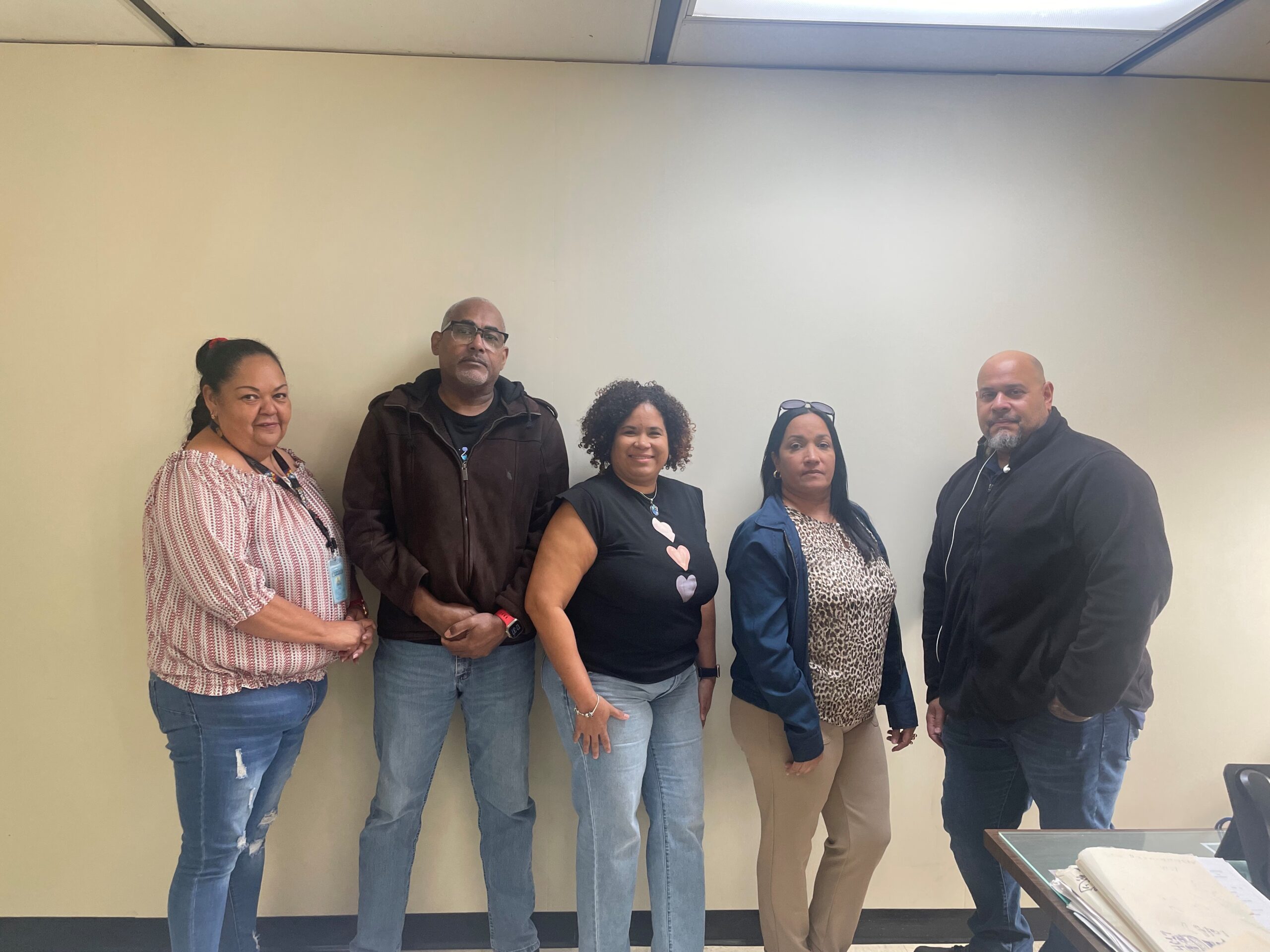
Vanessa Carbonell (center) and other employees of the Puerto Rico Police Bureau won big at the Puerto Rico District Court in September 2024. Their Foundation-won decision forces their employer and the union to stop violating their Janus rights.
SAN JUAN, PR – The National Right to Work Foundation’s 2018 victory at the U.S. Supreme Court in Janus v. AFSCME opened new horizons for employee freedom across the country. For the first time, the Justices recognized that the First Amendment prohibits union bosses from forcing public sector employees to join a union or pay dues as a condition of employment, and that union bosses can only take dues from a worker’s paycheck with their affirmative consent.
Foundation attorneys’ efforts to enforce the landmark decision yielded a big victory this September for a wide swath of civilian employees at the Puerto Rico Police Bureau (PRPB). In a class action federal lawsuit, more than a dozen PRPB employees charged officials of the Union of Organized Civilian Employees with violating their Janus rights by stripping them of an employer-provided health benefit because they refused to join the union.
A recent decision from the District Court of Puerto Rico found in favor of the employees’ arguments, stating that their employer had indeed taken away the health benefit because the employees exercised their right to not join or pay dues to the union.
Scheme Forced Workers to Join Union or Lose Access to Better Healthcare
“This is either retaliation for exercise of non-union members’ post-Janus non-associational rights under the First Amendment under the Constitution or simply discrimination,” said the Court.
According to lead plaintiff Vanessa Carbonell and her colleagues’ original lawsuit, they all exercised their Janus right to opt out of the union at various points after the 2018 Janus decision. They each began noticing that as dues ceased coming out of their paychecks, they also stopped receiving a $25-a-month employer-paid benefit intended to help employees pay for better health insurance.
The lawsuit demonstrated that PRPB officials cut the benefit off to employees who refused union membership — a clear case of discrimination against employees who exercise their First Amendment right to abstain from union affiliation.
Union and Employer Must Stop Discrimination
The District Court’s decision, in addition to declaring that the ploy by PRPB and the Union of Organized Civilian Employees is unconstitutional, orders an injunction to stop PRPB officials from continuing to withhold the benefit from Carbonell and other employees.
“Janus enshrined a very simple First Amendment principle: That union officials need to convince public employees to support their organization and activities voluntarily,” commented National Right to Work Foundation Vice President Patrick Semmens.
Right to Work Foundation SCOTUS Brief: Workers Exercising Right to Oppose Unions Isn’t “Harm” to Be Eliminated
In case to be heard by Court, Foundation argues NLRB wrongly asserts that independent-minded opposition to unions can justify injunctions
Washington, DC (February 29, 2024) – The National Right to Work Foundation has filed an amicus brief in Starbucks Corporation v. McKinney, a case set to be argued before the U.S. Supreme Court later this term that has major implications for the rights of workers who oppose union power in their workplaces.
In the brief, Foundation staff attorneys argue that federal courts should reject National Labor Relations Board (NLRB) requests for preliminary injunctions when the Labor Board claims employee discontent with a union is a “harm” that should be redressed. These injunctions, called 10(j) injunctions, are frequently used by the NLRB to force employers into certain union-demanded behavior, despite the NLRB not having fully adjudicated the underlying union allegations.
The brief points out that an employee’s decision not to support a union is not a harm that needs to be addressed, but rather a “legitimate choice employees have a right to make” under both the National Labor Relations Act (NLRA) and the First Amendment to the Constitution.
“Only if the NLRB can prove an employee was coerced by an employer to oppose a union against his or her will can that employee’s lack of support for the union be considered any sort of a harm to be redressed,” the brief says. “If the NLRB cannot muster such evidence, then the fact that employees are exercising their statutory and constitutional rights…provides no basis for [an] injunction.”
Foundation: Courts Shouldn’t Accept NLRB’s Assumption that Workers Want to Join Unions
In the Starbucks v. McKinney case, the NLRB sought an injunction at the behest of Starbucks Workers United (SBWU-SEIU) union officials against Starbucks for unfair labor practices the company allegedly committed at a location in Memphis, Tennessee. A major reason cited by the NLRB for the requested injunction was the fact that workers may choose to oppose the union if the injunction isn’t issued.
The case presents the question of what standard courts should use when evaluating whether to grant NLRB-requested injunctions under the NLRA. The Foundation brief opposes the lax standard that the NLRB and union officials are urging courts to use when deciding whether to issue injunctions.
That standard asks only whether alleged unfair labor practices could potentially coerce workers into not supporting a union. Foundation attorneys argue that “the Court must require the NLRB to prove employees were unlawfully coerced not to support a union because, absent such proof, employees have every right to make that choice” (emphasis added).
Foundation-Backed Starbucks Workers Disprove Specious NLRB Theory
Foundation staff attorneys are currently representing Starbucks employees at several locations across the country who seek to vote out (or “decertify”) the SBWU union. In the brief, Foundation attorneys point out that the NLRB in a similar case (Leslie v. Starbucks Corp.) cited a Foundation-backed union decertification case as a reason that an injunction should be issued against the company – despite the fact that the workers themselves say their opposition to the union had nothing to do with the conduct the union was challenging in that case.
“In taking this position, the NLRB has created a self-satisfying ‘heads I win, tails you lose’ dynamic for itself,” the brief reads. “Evidence that employees support a union is taken to mean they want to support the union. Evidence that employees oppose a union is taken to mean their employer must have wrongfully caused the employees not to support the union. All evidence conveniently leads to the conclusion desired by current NLRB leadership: employees should support unions.”
The case is set to be argued before the Supreme Court on Tuesday, April 23, with a decision expected by the end of the High Court’s term in June.
“The Biden NLRB is working hand in glove with unions to advance a standard that treats worker dissent from unions as a harm to be eradicated, rather than a decision made by competent adults,” commented National Right to Work Foundation President Mark Mix. “The Supreme Court in Starbucks v. McKinney must reject the idea that NLRB bureaucrats can simply twist evidence of legitimate worker discontent with unions into a tool to aid union bosses in gaining leverage over businesses and employees.”
Full Foundation Action September/October 2023 Newsletter Now Online
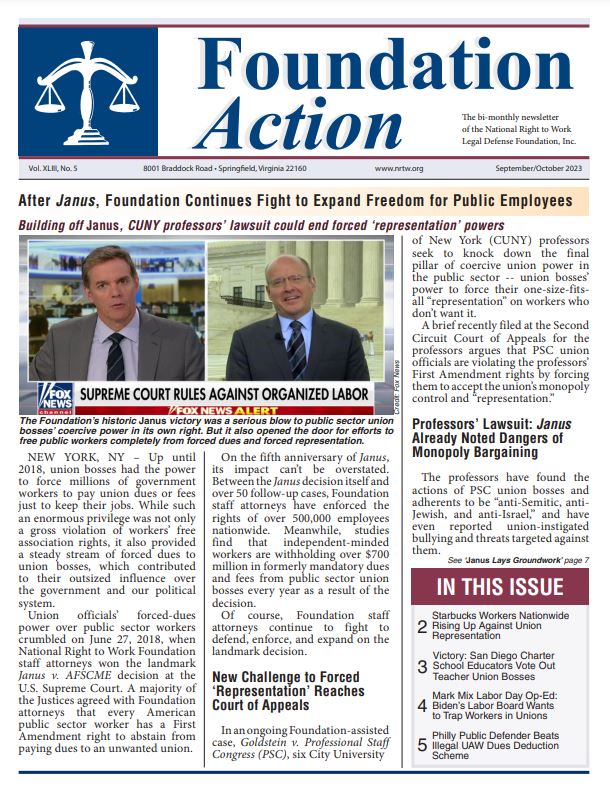 All articles from the September/October issue of Foundation Action are now online.
In this issue:
- After Janus, Foundation Continues Fight to Expand Freedom for Public Employees
- Starbucks Workers Nationwide Rising Up Against Union Representation
- Victory: San Diego Charter School Educators Vote Out Teacher Union Bosses
- Mark Mix Labor Day Op-Ed: Biden’s Labor Board Wants to Trap Workers in Unions
- Philly Public Defender Beats Illegal UAW Dues Deduction Scheme
Recent articles can be found here. To sign up for a free copy of the newsletter via mail please see the form at the bottom of this page.





