
National Right to Work Foundation Issues Special Legal Notice to Boeing Employees Impacted by IAM Union Boss Strike Order
Foundation notifies employees that those wishing to continue working during a strike should resign their memberships before returning to work
Seattle, WA (September 16, 2023) – The National Right to Work Legal Defense Foundation has released a special legal notice to the roughly 30,000 Boeing employees reportedly affected by the strike order issued by International Association of Machinists (IAM) union officials last week.
The Foundation’s legal notice informs Boeing employees of their rights, including their right to rebuff the strike order and to keep working to support their families as the strike is ongoing. The notice discusses why workers across the country frequently turn to the National Right to Work Foundation for free legal aid in such situations.
“The situation presents serious concerns for employees who believe there is much to lose from a union-ordered strike,” the notice reads. “That is why workers confronted with strike demands frequently contact the National Right to Work Legal Defense Foundation to learn how they can avoid fines and other harsh union discipline for continuing to report to work to support themselves and their families.”
The full notice is available at https://www.nrtw.org/BoeingStrike/.
The notice outlines the process that Boeing employees should follow if they want to exercise their right to return to work during the strike and avoid punishment by union bosses, complete with sample union membership resignation letters. The notice reminds workers that IAM union officials have no disciplinary power over workers who are not union members, and advises employees who wish to work during a strike to resign their memberships before returning to work.
“Union officials can (and often do) fine actual union members who work during a strike,” the notice says. “So, you should seriously consider resigning at least one day BEFORE you return to work during a strike, which is the best way to avoid these union fines and discipline.
“If possible, use certified mail, return receipt requested, and save copies of your letters and the return receipt to prove delivery,” the notice continues, adding that workers who choose to submit their union resignations to union officials in person should have a reliable witness present to combat potential false claims from union officials that they did not actually receive a worker’s resignation.
Further, the notice reminds employees of their rights to cut off all union dues payments in the absence of a monopoly bargaining contract between IAM union officials and Boeing management. The notice encourages employees to seek free legal aid from the Foundation if they experience union resistance as they attempt to exercise any of these rights.
“IAM union officials have a history of seeking to increase their own power instead of doing what’s right for rank-and-file workers,” commented National Right to Work Foundation President Mark Mix. “Foundation attorneys recently helped a Seattle Boeing worker take legal action against IAM officials for seizing his money illegally.
“On the eve of a strike order that may last months, many Boeing workers may decide that going on strike is not the best course of action for them, and Foundation attorneys stand ready to aid these workers in defending their right to continue working and providing for their families,” added Mix.
Seattle Mariners Employee Fights Biden Labor Board Cemex Decision Upending Right to Vote in Secret on Union ‘Representation’
In amicus brief at Ninth Circuit, employee shows how controversial Labor Board decision undermines rank-and-file workers’ freedom of choice
San Francisco, CA (February 12, 2024) – Tami Kecherson, a retail employee for the Seattle Mariners of Major League Baseball, has filed an amicus brief in Cemex Construction Materials Pacific LLC v. National Labor Relations Board (NLRB), a federal case currently before the Ninth Circuit Court of Appeals in San Francisco, CA.
The case is a challenge to the Biden NLRB’s radical overhaul of federal labor law that grants union bosses the power to bypass a traditional secret ballot election when trying to gain monopoly bargaining power over a workplace. Kecherson is receiving free legal aid from the National Right to Work Legal Defense Foundation.
Controversial NLRB Decision Lets Union Bosses Quash Secret Ballot Elections
The NLRB issued a decision in Cemex in August 2023 which requires employers to either grant a union’s demand for recognition based on “card check,” or immediately petition for a secret ballot election. Card check is a process that uses “authorization cards” collected by union organizers as a substitute for votes in a secret ballot election. The card check process lacks the security of a secret ballot union vote, and exposes workers to coercion and intimidation as union officials seek to collect authorization cards. Even AFL-CIO organizing guides admit card check drives aren’t representative of how workers would vote in elections, and that many workers sign cards just to “get the union off my back.”
Under Cemex, an employer who declines to recognize a union is required to quickly ask the NLRB to hold a secret ballot election. But the NLRB doesn’t have to grant that request. A union can easily prompt the NLRB to cancel an employee vote (or even overturn an election that doesn’t go in the union’s favor) by filing charges against the company and showing the employer committed an unfair labor practice during the “critical period” leading up to the election.
Seattle Mariners Employee Defends Workers’ Right to Secret Ballot Elections
Kecherson and her coworkers from the Seattle Mariners’ retail shops were the targets of a card check organizing drive by United Food and Commercial Workers (UFCW) union officials in October 2022. Kecherson filed a petition at the NLRB challenging the card check-based imposition of the union and demanding a secret ballot election to test if the union had the support it claimed.
In May 2023, the NLRB Regional Director in Seattle ordered an election over the objections of UFCW union bosses, noting UFCW union officials had not properly informed employees of their right to file for such an election. Kecherson and her colleagues eventually voted by a margin of 50 to 9 to remove the UFCW union.
Kecherson and her colleagues were able to request such a vote under the auspices of the Election Protection Rule (EPR), a set of Foundation-supported reforms that the NLRB adopted in 2020. The EPR gives workers a 45-day opportunity to request a secret ballot vote to challenge a union’s card check-based claims of majority support after the completion of such a campaign. The process by which workers can challenge card check drives was established by Foundation attorneys in the Dana Corp. NLRB case. Though this 2007 decision was overturned in 2010 by the Obama NLRB, “Dana elections” were codified in the EPR – but may soon be nixed due to Biden NLRB rulemaking.
As Kecherson’s amicus brief states, the situation in her workplace (where 85% of workers voted to reject the union despite the union’s claims of majority support via cards) demonstrates how the Cemex decision wrongly promotes union-solicited authorization cards as a reliable alternative to secret ballot votes. “In short, Local 3000’s ostensible claim to majority employee support, which was based on authorization cards the union collected from the employees, was totally refuted when tested in the crucible of a secret ballot election,” Kecherson’s brief says. “Yet under Cemex, the NLRB will routinely impose compulsory union representation on employees based on card checks and without a secret-ballot election.”
“In Cemex, the Biden NLRB is promoting union boss power to the detriment of employee free choice, a right that is supposed be at the center of the National Labor Relations Act,” commented National Right to Work Foundation President Mark Mix. “Ms. Kecherson’s story, where she and her colleagues overwhelmingly voted against the union despite union boss claims of majority support, is just the latest demonstration of what countless NLRB decisions, the U.S. Supreme Court, and even unions have admitted: Card check is unreliable and inferior to secret ballot elections where union organizers cannot see how each individual voted.”
“To defend the rights of rank-and-file workers like Tami Kecherson, the court must reject the NLRB’s biased and cynical Cemex framework that undermines the NLRA’s clear statutory preference for secret ballot votes,” added Mix.
Boeing Technician Files Federal Lawsuit Against Machinists Union Over Illegal Forced Dues Demands
Instead of reducing nonmember worker’s payments in accordance with Supreme Court precedent, union bosses charged him arbitrary higher amount
Seattle, WA (May 24, 2022) – With free legal aid from the National Right to Work Legal Defense Foundation, Seattle Boeing technician Don Zueger is suing International Association of Machinists (IAM) union officials in federal court for violating his right to refrain from paying for unwanted union activities.
Zueger, who is not a member of the IAM union, is defending his right under the Foundation-won 1988 CWA v. Beck U.S. Supreme Court decision, in which the Court ruled that union officials cannot charge full union dues to objecting private sector workers who have abstained from formal union membership. Under Beck, union officials can only charge union nonmembers “fees” which exclude expenses for things like union political activities.
Because Washington State lacks Right to Work protections for its private sector workers, nonmembers like Zueger can be forced to pay the reduced amount under Beck as a condition of keeping their jobs. In Right to Work states, in contrast, union membership and all union financial support are strictly voluntary.
IAM Officials Continue to Overcharge Worker in Violation of His Rights
According to Zueger’s lawsuit, filed in the U.S. District Court for the Western District of Washington, he submitted a request to IAM union officials in February resigning his union membership and asking for his dues payments to be reduced under Beck.
Zueger’s lawsuit reports that IAM officials’ response to his Beck request claimed that, under IAM’s nationwide policy, the portion of union dues he is required to pay is based on averages of selected audits that in each case include nine other local and district IAM affiliates. This means the forced union fee amount is not calculated using the actual amounts determined in the audits of the local and district IAM affiliates that Zueger is required to fund as a condition of employment. Unsurprisingly, this resulted in Zueger’s dues reduction being significantly less than it would have been had union officials only used the audits for the district and local affiliates Zueger is forced to fund.
According to his lawsuit, union officials are still demanding from Zueger dues in excess of the amount Beck permits. The lawsuit seeks to force IAM union bosses to return all money demanded in violation of Beck and to properly reduce his future union payments in accordance with Beck.
Workers Should Be Wary of Illegal Union Dues Schemes as Union Political Activity Increases
Zueger’s lawsuit comes after union bosses spent near-record sums on politics during the 2020 election cycle. A report by the National Institute for Labor Relations Research (NILRR) released in 2021 revealed that union officials’ own Department of Labor filings show about $2 billion in political spending during the 2020 cycle, primarily from dues-stocked union general treasuries. Moreover, other estimates strongly suggest that actual union spending on political and lobbying activities actually topped $12 billion in 2019-2020.
“It doesn’t take a rocket scientist to figure out when union officials are trying to strong-arm employees into subsidizing union activities, including politics, against their will. IAM officials’ nonmember dues scheme doesn’t pass the smell test,” commented National Right to Work Foundation President Mark Mix. “While we’re proud to help Mr. Zueger defend his Beck rights, ultimately no American worker should be forced to pay fees determined by the whims of union officials simply in order to keep their jobs.”
“This case shows why Right to Work laws are needed nationwide to ensure that the decision to join or financially support a union is strictly a matter of each individual worker’s own conscience. Workers should be especially aware of attempts by union officials to force them to fund union activities as union political activity heats up in advance of this year’s elections,” Mix added.
NLRB Cases Challenge Coercive ‘Neutrality Agreements’ Used to Impose Forced Unionism
The following article is from the National Right to Work Legal Defense Foundation’s bi-monthly Foundation Action Newsletter, March/April 2020 edition. To view other editions or to sign up for a free subscription, click here.
Housekeepers demand NLRB block unionization resulting from back-room “Card Check” deals
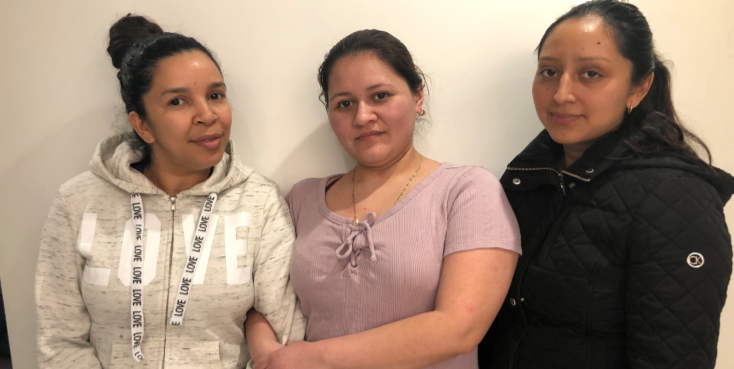
From left, housekeepers Lady Laura Javier, Cindy J. Alarcon Vasquez, and Yesica Perez Barrios are charging hotel officials and union bosses with illegally corralling workers into union ranks with a corrupted “Card Check” recognition.
SEATTLE, WA – Housekeeper Gladys Bryant was granted an appeal by the National Labor Relations Board (NLRB) General Counsel in her case challenging the use of a so-called “neutrality agreement” between UNITE HERE union officials and her employer to impose a union on the hotel’s workers.
Meanwhile, four Boston housekeepers have filed similar NLRB charges against their employer Yotel Boston and UNITE HERE Local 26, alleging that union officials violated federal law by imposing union representation on workers through a coercive “Card Check” drive with their employer’s assistance.
General Counsel Finds That UNITE HERE “Card Check” Unionization Was Tainted
Bryant filed the unfair labor practice charges after the UNITE HERE Local 8 union was installed at the Embassy Suites hotel in May 2018 through an oft-abused “Card Check” drive which bypassed the NLRB’s secret ballot election process.
As part of its so-called “neutrality agreement,” Embassy Suites agreed to give union organizers access to the hotel to meet and solicit employees. The agreement also provided union officials with a list of all employees’ names, jobs, and contact information to assist the union in collecting authorization cards from employees.
After NLRB Region 19 officials declined to prosecute the union or employer for violations of the National Labor Relations Act (NLRA), Bryant appealed the case to the NLRB General Counsel in January 2019. The NLRB General Counsel agreed with Bryant’s Foundation attorneys that Embassy Suites provided UNITE HERE’s organizing campaign with more than “ministerial aid” and thus violated the NLRA.
The NLRB has long held that an employer taints employees’ efforts to remove a union if it gives the employees support such as providing a list of bargaining unit employees or use of company resources. Bryant’s appeal successfully argued that the “ministerial aid” standard must also apply when an employer aids union officials’ efforts to gain monopoly bargaining power over workers.
Boston Housekeepers Argue Union “Card Check” Must Be Overturned
Faced with a similar situation, Boston-area housekeepers Cindy J. Alarcon Vasquez, Lady Laura Javier, Yesica Perez Barrios, and Danela Guzman filed unfair labor practice charges with the NLRB. With free legal aid from the National Right to Work Foundation, the housekeepers argue that UNITE HERE union officials violated federal law by imposing union representation on workers through a coercive “Card Check” drive with the assistance of their employer, Yotel Boston.
As in the Seattle case, they charge that Yotel Boston company officials provided UNITE HERE’s organizing campaign with more than “ministerial aid” and therefore illegally tainted the union’s installation as the employees’ exclusive representative in the workplace. The housekeepers charge union officials with violating the NLRA by requesting and accepting the illegal assistance, and the hotel for providing it.
“It is long past time that the NLRB put an end to this biased double standard that allows union bosses to abuse workers’ rights,” said National Right to Work Foundation Vice President and Legal Director Ray LaJeunesse. “The General Counsel is correct to finally recognize that what qualifies as more than ‘ministerial assistance and support,’ and thus violates the National Labor Relations Act, cannot depend on whether the employer is helping outside union organizers impose unionization on workers or assisting workers in exercising their right to remove an unwanted union.”
“These cases represent another breakthrough in the Foundation’s challenges to the pro-forced unionism skew at the NLRB,” added LaJeunesse.
Eleven Ridesharing Drivers File Federal Lawsuit to Block Seattle’s Forced Unionism Ordinance Targeting Uber & Lyft
Lawsuit says scheme to impose Teamsters union on independent contractors violates drivers’ First Amendment rights & federal labor law
Seattle, WA (March 10, 2017) – Today, eleven independent drivers are filing a federal lawsuit to block the Seattle City Council’s controversial ordinance designed to impose forced unionism on independent for-hire and ride-sharing drivers. These drivers use the popular Uber and Lyft apps to pick up customers. Dan Clark, lead plaintiff in the suit, is an independent driver who picks up riders through both Uber and Lyft.
The drivers are filing suit against the City of Seattle in the U.S. District Court for the Western District of Washington with free legal representation by staff attorneys from the National Right to Work Legal Defense Foundation and the Washington state-based Freedom Foundation. The drivers’ federal lawsuit argues that the Seattle ordinance is preempted by the National Labor Relations Act and that imposing union representation and forced dues on them violates their First Amendment rights of free speech and freedom of association.
Over 9,000 independent drivers in the Seattle area collect riders through the Uber and Lyft apps, accounting for tens of thousands of rides daily across the Emerald City area. Last week Teamsters union officials, who pushed for passage of the first-in-the-nation Seattle ordinance subjecting ride-sharing drivers to forced unionism, filed papers with the city formally declaring their intent to unionize drivers who work with Uber and Lyft, as well as Eastside Town Car and Limousine, LLC.
“Teamsters union bosses are attempting to impose their 1920s era forced unionism model on a 21st-century workforce,” said Mark Mix, President of the National Right to Work Legal Defense Foundation. “Polls consistently show Americans overwhelmingly oppose workers being forced to pay union dues or fees as a condition of working.”
“Expanding forced unionism to independent drivers is not only wrong, it is a violation of federal law and the First Amendment rights of drivers who never asked for and don’t want union officials’ so-called ‘representation,’” Mix continued. “Big Labor’s one-size-fits-all, top down model is the very antithesis of ride-sharing which attracts drivers by connecting them with consumers and providing them the freedom to decide when to work and through which app to find customers.”
Background: Teamster-Backed Seattle Law Attempts to Expand Forced Unionism to Ride-Sharing Independent Drivers
In 2015, the Seattle City Council passed an ordinance that targeted independent drivers, such as those who contract with Uber and Lyft, for compulsory unionization. The bill authorizes unionization through the coercive and unreliable card-check system as opposed to a secret ballot vote and allows union officials to make payment of union dues or fees mandatory, even for drivers who oppose union representation. Under ‘card check,’ cards solicited and collected from individuals by professional union organizers are counted as ‘votes’ for unionization, despite numerous examples of workers signing the cards as a result of being pressured, misled, threatened or even bribed.
The ordinance further mandates that companies turn over private personal contact information for drivers to union organizers, even for drivers who have shown no interest in unionization or actively oppose the union. In addition, should the Teamsters successfully “organize” drivers through a card check, city administrators are empowered to impose a union contract on the drivers and companies if an agreement isn’t reached within 90 days of the unionization certification.
The ordinance was passed by the Seattle City Council in September 2015 after heavy lobbying by Teamsters union officials who sought to take advantage of independent drivers and force them to pay dues to the union as a condition of picking up riders through the apps. Shortly after the bill was passed, the National Right to Work Foundation issued a special legal notice to Seattle independent driver contractors, notifying them of their rights and offering free legal aid. A number of concerned drivers then reached out to the Foundation for help.
After the bill became law in December 2015, the ordinance was put on hold until January 2017 while the Seattle Department of Finance and Administrative Services (FAS) finalized the unionization process. The final rule defines ‘qualifying drivers’ who are eligible to vote on unionization as drivers who have completed 52 rides beginning or ending in Seattle in the last 90 days, regardless of whether or not a driver wants anything to do with a union.
These so-called “qualifying drivers” will be the only drivers eligible to vote on union representation, despite the fact that all drivers who contract with these companies will be subject to the forced unionism terms. Effectively, Teamster cards collected from a small fraction of all drivers could result in the unionization of more than 9,000 drivers in Seattle, plus any future drivers.
On March 7, 2017, officials from Teamsters Union Local 117 filed a notice of their intent to unionize drivers associated with Uber and Lyft, as well as Eastside Town Car and Limousine, LLC. The three companies now have until April 2 to turn over to the union the personal contact information for the fraction of total drivers who are designated by the City as eligible to vote on unionization. These drivers are filing their lawsuit now because they have a limited window before their personal information will be forcibly delivered to union officials against their wishes.
To view a copy of the filed complaint please click here.
In the News: Foundation Defends Uber & Lyft Drivers Against Seattle Forced Unionism Scheme
On March 10th, a group of independent drivers gathered national media attention when they filed a lawsuit against the City of Seattle, seeking to block the City Council bill instituting forced unionism on independent driver contractors. The drivers’ lawsuit argues that the Council bill is an infringement on their First Amendment rights as well as being preempted by the federal National Labor Relations Act.
These drivers are being represented by staff attorneys from the National Right to Work Legal Defense Foundation and the Freedom Foundation. Below is a selection of media coverage about the Foundation’s efforts to protect the individual liberty of all the ride-sharing workers. To read the full article please click on the hyperlinked title of each publication. To read the Foundation’s press release about the lawsuit please click here.
Wall Street Journal Opinion Journal
Law 360 – Eleven independent drivers sued the city of Seattle in federal court Friday claiming its new ordinance allowing for-hire drivers for Uber, Lyft and other ride-hailing apps to unionize is unconstitutional and unfairly forces all drivers to comply with terms set by designated unions just to use the app.
Seattle Times – In a federal lawsuit, the drivers are seeking a temporary restraining order barring the city from enforcing the law — the first of its kind in the country — saying it goes against federal labor and privacy laws, as well as violates their rights to free speech and association.
Wall Street Journal –Seattle also is a crucial test case for millions of so-called gig economy workers who make deliveries, run errands and perform other freelance tasks as contractors. Uber and startups like delivery company Postmates Inc. and errands service TaskRabbit Inc. have withstood pressure to treat their contract workers as employees, thereby avoiding payment of full benefits or compensation for expenses like gasoline.
Reuters – The 11 drivers, represented by the National Right to Work Legal Defense Foundation, said in a lawsuit filed in federal court in Seattle on Friday that the city’s law violates their rights under the First Amendment of the U.S. Constitution by forcing them to join a union in order to work, and is preempted by the National Labor Relations Act.
KIRO TV – “It’s freedom, it’s the way of life these days if you want to be entrepreneur and own your own business. Be your own boss, manage your own life,” said driver Tianna Williamson.
Forbes – The Seattle ordinance also raises fundamental questions about the nature of work and employment, and the fairness of labor laws forged in the industrial era when they are applied to gig-economy workers.





