
Workers in North Carolina and California Ask Federal Labor Board to Nix Policy Letting Union Bosses Block Elections
With new quorum, National Labor Relations Board can eliminate “blocking charge” policy used to stop union removal elections
Washington, DC (January 6, 2026) – Workers in North Carolina and California are pushing the National Labor Relations Board (NLRB) to strike down its “blocking charge” policy, which is preventing them from removing unwanted union officials from their workplaces.
The workers, which include miners employed by The Quartz Corp. in Spruce Pine, NC, and Fresno, CA-based construction materials workers for CalPortland, both backed petitions in late 2025 asking the NLRB to administer votes to remove (or “decertify”) unions from their workplaces. Despite both petitions containing enough signatures to trigger union decertification elections, regional NLRB officials blocked both votes pursuant to the NLRB’s current blocking charge policy. This Biden-era policy permits union officials to stymie the union decertification process simply by filing unproven or unrelated “unfair labor practice” charges at the NLRB alleging employer misconduct.
Quartz Corp. employee Blake Davis and CalPortland worker Darrell Dunlap have both submitted Requests for Review to the NLRB in Washington, DC. These filings ask the Board to overturn the blocking charge policy and let their coworkers’ requested votes to remove the United Mine Workers and Teamsters unions (respectively) go forward. Davis and Dunlap are both receiving free legal aid from National Right to Work Foundation staff attorneys. While vacancies on the NLRB have caused a backlog of cases, the U.S. Senate recently approved two new presidential appointees to the NLRB, meaning the Board now has a “quorum” and can hear these and other cases.
“Blocking Charge” Policy Inconsistent With Federal Labor Law
Dunlap’s Request for Review argues that the NLRB’s blocking charge policy directly conflicts with the text of the National Labor Relations Act (NLRA), the federal law that the NLRB is responsible for enforcing. “Allowing a self-interested party to unilaterally block elections conflicts with [the NLRA], which requires the Board to hold an election” if employees submit a valid decertification petition, Dunlap’s brief says. “The blocking charge policy does not just contravene a clear Congressional command, but also offends the entire structure and purpose of the Act: employee free choice.”
Dunlap’s brief also maintains that the blocking charge rule violates the Administrative Procedure Act (APA) because it is arbitrary and fails to accomplish even its own stated goals. For example, the Request for Review says, NLRB bureaucrats impose the policy without considering key data showing the blocking charge policy has caused substantial delays in the union election process. Furthermore, the Board has argued that the rule is required to stop “coercive elections” from happening – even though its only mechanism for doing this is giving self-interested union bosses massive power to block elections or let them proceed.
Davis’ Request for Review makes many similar arguments, but adds that even if the Board were to uphold the blocking charge policy, regional NLRB officials egregiously misapplied it in his case. As his brief points out, even before he and his colleagues had submitted the union decertification petition, “the union filed a barrage of [unfair labor practice charges],” some of which were just speculation about employer activity aiding the union removal process. Even so, the regional NLRB appears to have blocked Davis and his coworkers’ requested election based on the mere quantity of the union’s charges, without explaining which allegation justified blocking. “By failing to distinguish between allegations that might warrant blocking and those that plainly would not, the Region reduced the rule to a numbers game,” the Request for Review says.
Trump NLRB Can Undo ‘Blocking Charge’ Policy and Empower Independent-Minded Workers
The National Right to Work Foundation has long advocated for the NLRB to return to the Election Protection Rule, which prevented many aspects of blocking charge-related gamesmanship before the Biden NLRB overturned it in 2022. Under the Election Protection Rule, allegations of misconduct related to a union decertification election could not block employees from exercising their right to vote, and in most cases permitted the immediate release of the vote tally as opposed to ordering ballots to be impounded during litigation over blocking charges.
“The NLRB’s ‘blocking charge’ policy serves only to let union officials stop the workers they claim to ‘represent’ from making a free choice about whether a union in their workplace is right for them,” commented National Right to Work Foundation President Mark Mix. “Mr. Dunlap and Mr. Davis speak for countless workers across the country who are trapped under union boss dictates and forced-dues payments because of this rule.
“If President Trump’s new NLRB appointees are serious about putting American workers back in control of their own livelihoods, reversing this union boss power giveaway is an excellent place to start,” Mix added.
NY Starbucks Barista Asks Federal Labor Board to Restore Employees’ Right to Vote Out SBWU Union Officials
SBWU union bosses prevented worker-requested union removal vote by filing unverified charges, never demonstrated link to worker effort
Niskayuna, NY (September 12, 2025) – Starbucks barista Nadia Kuban is asking the National Labor Relations Board (NLRB) in Washington, DC, to overturn federal policies that are preventing her colleagues from having a vote to remove unwanted Starbucks Workers United (SBWU) union officials from their workplace. Kuban is receiving free legal aid from the National Right to Work Legal Defense Foundation.
The NLRB is the federal agency responsible for enforcing federal labor law, a task that includes administering elections to install (or “certify”) and remove (or “decertify”) unions. Kuban’s effort to remove SBWU from the Niskayuna Starbucks began in February, when she submitted a petition backed by her colleagues asking the NLRB to hold a decertification vote at their store. Despite Kuban’s petition containing enough employee signatures to trigger a vote under NLRB rules, regional NLRB officials dismissed her petition and denied her colleagues their right to vote on the union’s continued control.
Kuban’s latest NLRB filing challenges the dismissal of her decertification petition. Regional NLRB officials issued the dismissal due to alleged unfair labor practice charges that SBWU bosses filed against the Starbucks Corporation at the national level. Her Request for Review argues that the NLRB violated employees’ due process rights by tossing her petition without a hearing into whether the allegations had anything to do with workers’ desire to oust the union at her location. It also contends that the NLRB’s Rieth-Riley precedent – which lets union bosses manipulate such allegations (also known as “blocking charges”) to derail worker-requested decertification votes entirely – is inconsistent with federal law.
Starbucks Employee Challenges NLRB Policy That Lets Union Bosses Block Votes
The NLRB’s Rieth-Riley decision in 2022 permits the agency to make so-called “merit-determination” dismissals of decertification petitions. Such dismissals let NLRB officials stop union decertification elections entirely – and invalidate already-cast ballots – based on union boss-filed “blocking charges” that haven’t even been litigated yet. Kuban’s brief explains that the ruling is at odds with federal labor law, which mandates that the NLRB conduct an election if employees submit a valid decertification petition.
“This is inconsistent with the plain language of [National Labor Relations Act] Section 9(c), which states what the NLRB ‘shall’ do, a nondiscretionary term,” the brief says. “The Board…should overturn Rieth-Riley’s merit-determination [ruling]….”
The Request for Review also explains that even under existing NLRB cases – including Rieth-Riley – the dismissal of Kuban’s decertification petition is not justified. NLRB case law doesn’t allow the dismissal of employees’ decertification petitions unless there is an outright refusal by an employer to negotiate with union officials, the brief says, which is not the case in Kuban’s situation. Furthermore, the NLRB’s Saint Gobain decision, won by Foundation staff attorneys, holds that “an evidentiary hearing is required when a union alleges that an employer’s unfair labor practice caused disaffection with the union.” Kuban never got such a hearing in her case, meaning she “has been significantly disadvantaged in defending her petition, to the point of being denied due process of law,” the brief says.
Trump NLRB Can Use Case to Defend Workers’ Freedom
Earlier this year, Rayalan Kent, a Foundation-backed asphalt worker in Michigan whose union decertification effort was stifled in the Rieth-Riley case, submitted a brief to the Sixth Circuit Court of Appeals. This brief defended his employer (Rieth-Riley Construction Company) in a case over its refusal to negotiate with International Union of Operating Engineers (IUOE) officials. IUOE bosses had dredged up years-old unfair labor practice charges to cancel the counting of Kent and his coworkers’ already-cast election ballots in 2022. Kent is now urging the Sixth Circuit to use the current case against his employer to undo the disastrous “merit-determination” doctrine, and order the NLRB to finally count his colleagues’ ballots.
“The NLRB’s so-called ‘merit-determination’ dismissal policy serves no purpose other than letting union officials block workers’ right to make a free decision on whether they want union monopoly ‘representation’ in their workplace,” commented National Right to Work Foundation President Mark Mix. “Ms. Kuban speaks for countless independent-minded workers across the country in seeking to eliminate this unfair policy. Upon confirmation, President Trump’s new appointees to the NLRB should prioritize cases like hers, and defend workers’ freedoms from union bosses’ attempts to gain more control over their working lives and pocketbooks.”
NYC Electrical Workers Prevail in Year-Long Battle to Kick Out Union
The following article is from the National Right to Work Legal Defense Foundation’s bi-monthly Foundation Action Newsletter, March/April 2024 edition. To view other editions of Foundation Action or to sign up for a free subscription, click here.
Union and NLRB colluded to stop worker vote with unsupported allegations
Shloime Spira and his coworkers fought for months against IUJAT union allegations designed to stop him and his coworkers from ousting the union — only to see NLRB officials admit there was no evidence at all to support them.
NEW YORK, NY – National Labor Relations Board (NLRB) bureaucrats frequently rush to advance flimsy union boss allegations (or “blocking charges”) as a justification for stopping or delaying employees’ efforts to remove an unwanted union. Yet as a recent Foundation decertification victory for a group of workers in New York City demonstrates, sometimes NLRB officials get especially creative when it comes to assisting union bosses’ efforts to trap workers in unionization they oppose.
Take the obstacles Shloime Spira and his colleagues, who work for Brooklyn, NY-based contracting company Horsepower Electric, faced in their effort to remove the International Union of Journeymen and Allied Trades (IUJAT) from their workplace. In December 2022, Spira submitted a petition asking the NLRB for a vote to decertify the union.
Labor Board Stalled Litigation to Keep Union in Power
The petition contained the requisite number of employee signatures to trigger such a vote. While the vote eventually took place in March 2023, NLRB bureaucrats sat for months on charges that IUJAT officials had levied against Horsepower Electric management, which delayed the ballot count and permitted IUJAT union officials to stay in power. Months later, following litigation at the NLRB and in federal court, it became apparent the NLRB lacked any evidence that could justify that delay.
Spira received free legal aid from the National Right to Work Legal Defense Foundation in defending his coworkers’ right under federal law to remove the union, and in suing the NLRB for the delays. Only at the end of 2023, after a year of delays and litigation, did IUJAT union officials finally back down and file a “disclaimer of interest” to end their control over the Horsepower Electric workers.
“While my colleagues and I are pleased with this result, it’s simply ridiculous that the NLRB sat on our ballots for so long over union charges that were apparently meritless,” Spira commented on his experience. “The NLRB is supposed to protect employees’ right to choose whether or not they want a union, not delay that process indefinitely to maintain union officials’ power.”
Federal Court Action ‘Shocks’ Labor Board into Ending Delays
Union “blocking charges” contain claims of employer misconduct that are usually unverified and often have no connection to employees’ desire to vote out the union. NLRB officials inexplicably refused to hold a hearing or otherwise advance the IUJAT’s “blocking charge” case for months, effectively using it as a pretense for delaying the vote count in Spira and his coworkers’ effort to remove the union.
The delayed ballot count meantIUJAT union bosses stayed in power, and also meant that forced union dues continued to flow out of Spira and his colleagues’ paychecks. Because New York lacks Right to Work protections that make union affiliation and financial support strictly voluntary, union bosses could force the Horsepower Electric workers to pay the union as a condition of keeping their jobs.
Eventually, the NLRB faced a federal lawsuit in the Eastern District of New York, alleging due process violations because the delay in the “blocking charge” case was being used to justify the delay of the decertification ballot count. That case, initially bought by the employer, was soon joined by Spira who successfully intervened with the help of his Foundation attorneys. The District Court demanded an explanation from the NLRB about the delay.
NLRB Agents Found Zero Witnesses to Back Union ‘Blocking Charges’
Faced with the threat of a federal court order to proceed with the ballot count, NLRB officials finally moved forward on the “blocking charge” case. But just minutes before a December 2023 hearing the NLRB had scheduled in the case — which Spira’s Foundation-provided attorneys had traveled all the way to New York to attend — NLRB lawyers conceded they could produce no witnesses to testify in support of the union’s charges against Horsepower Electric.
The NLRB formally dropped its complaint against Horsepower Electric that very day, clearing the way for the ballots to be counted. To avoid facing a vote result that would have very likely been an embarrassing loss, IUJAT union officials announced a “disclaimer of interest” that would finally result in the union leaving. With the union conceding defeat, both the NLRB and federal cases surrounding the union decertification election wrapped up in January.
Workers’ Struggle Shows NLRB Needs Reform
“That union officials were so easily able to manipulate NLRB processes to block Mr. Spira and his colleagues from exercising their basic right to choose whether they want union representation shows that the agency is desperately in need of reform,” commented National Right to Work Foundation Vice President Patrick Semmens. “It is outrageous that it took a federal court case to force the NLRB to admit that it had no evidence to back up union officials’ allegations that were being used to trap workers in a union they opposed.
“Worker free choice is supposed to be the center of the National Labor Relations Act. Foundation attorneys will continue to defend this principle, even as the Biden Labor Board continues to grant union officials sweeping new powers to coerce workers into union ranks,” Semmens added.
Foundation Assists Workers in Kicking Out Unwanted Union Bosses
The following article is from the National Right to Work Legal Defense Foundation’s bi-monthly Foundation Action Newsletter, September/October 2021 edition. To view other editions of Foundation Action or to sign up for a free subscription, click here.
Worker decertification efforts target SEIU, Teamsters union officials
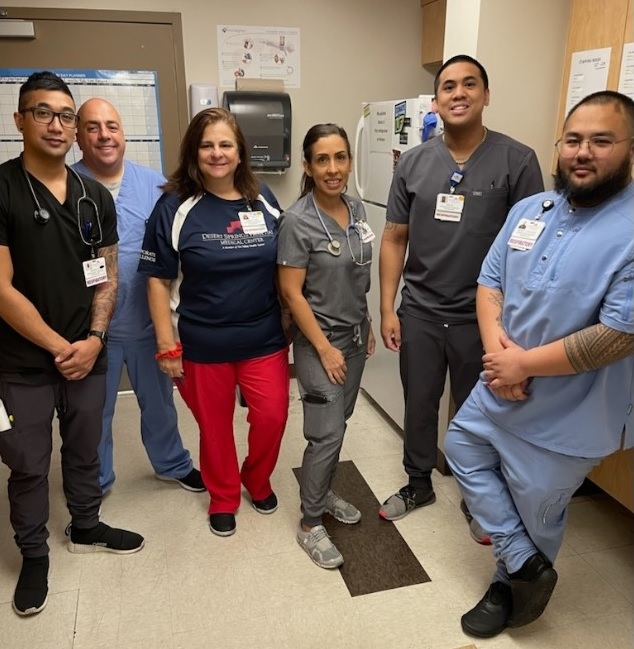
Desert Springs “Decert”: Tammy Tarantino (third from left) and her fellow healthcare workers at Desert Springs Medical Center booted SEIU union bosses from their workplace with Foundation aid, voting by a 3-1 margin for decertification.
CHICAGO, IL – Workers in three different states recently waged successful campaigns to remove the union bosses who controlled their workplaces. In each instance workers utilized free legal assistance from National Right to Work Legal Defense Foundation staff attorneys to navigate the overly-complicated process for getting a vote to remove an unwanted union.
The National Labor Relations Act (NLRA) — which is enforced by the National Labor Relations Board (NLRB) — gives workers the right to hold a decertification vote to end union officials’ monopoly bargaining power over workers. In theory, under the NLRA, workers who collect signatures from 30 percent of a workplace can hold a decertification vote at any time, provided there has not been a unionization vote there in the previous 12 months.
However, because of complicated NLRB doctrines compounded by union legal tactics, obtaining a vote to decertify a union can often be a challenge. That’s why workers in workplaces across the country turn to the Foundation for free legal aid as they seek to hold such a vote.
Workers’ ability to exercise their right to vote out an unwanted union is especially important in states without Right to Work protections, where union bosses can use their monopoly bargaining powers to force every worker to pay union dues or fees or else be fired.
But workers’ right to decertify a union is still critical in Right to Work states, because even without forced union payments, federal law gives union bosses the power to impose their so-called “representation” and resulting union monopoly contracts on members and non-members alike at unionized workplaces. Only once a union is decertified are workers free to represent themselves and communicate with their employer directly.
Foundation Helps Workers Navigate Tricky Legal Process
Highlighting recent activity, three separate workplaces have waged successful decertification efforts.
Petitioner Tim Mangia led the charge at Chicago’s Rush University Medical Center, where he and his fellow maintenance workers voted to remove Teamsters union bosses by a better than 3-1 margin. Separately, in Del Rio and Eagle Pass, Texas, salesmen for Frito-Lay also voted to free themselves from unwanted Teamsters union “representation” following free assistance from Foundation legal staff.
Meanwhile, Tammy Tarantino and her fellow technical employees at the Desert Springs Hospital Medical Center in Las Vegas successfully removed a Service Employees International Union (SEIU) local from their workplace with Foundation help.
Reforms: Union Bosses Can’t Use Bogus Charges to Block Decertification Elections
These cases proceeded without significant delays from union “blocking charges,” the often spurious charges against employers filed by union lawyers seeking to delay a decertification vote. Under old NLRB rules, such charges would have to be resolved before workers’ decertification votes could proceed, delaying the vote for months or even years.
Thanks to NLRB rulemaking advocated by the Foundation and backed by thousands of Foundation supporters, votes now virtually always proceed first with the results quickly announced, so that elections cannot be delayed nearly indefinitely by unsubstantiated union boss claims.
In the Las Vegas medical workers’ case, the new “blocking charge” rules allowed Tammy Tarantino continued from page 2 to have a vote, despite attempts by union lawyers to use charges against the hospital to delay the election. Without being able to rely on the “blocking charge” policy to maintain their power over the workplace, SEIU officials soon found themselves voted out with just 13 of 64 eligible voters voting for the union.
“While we look forward to the day when every individual worker has the freedom to decide whether to pay union dues or be represented by a union, it is especially egregious when union bosses are in power without even the support of a bare majority of rank-and-file workers,” said National Right to Work Foundation Vice President Patrick Semmens. “The National Right to Work Foundation is proud to help workers exercise their right to throw off the yoke of unwanted union so-called ‘representation.’”





