
National Right to Work Foundation Files SCOTUS Brief Defending Alaska’s Protections Against Forced Union Dues
Alaska facing ASEA union lawsuit over arrangement which requires union bosses to obtain affirmative consent from employees before deducting dues
Washington, DC (September 29, 2023) – Today, the National Right to Work Legal Defense Foundation filed an amicus brief with the U.S. Supreme Court in the case Alaska v. Alaska State Employees Association. The brief supports the State of Alaska’s attempt to safeguard public sector workers’ First Amendment right to refrain from paying dues to a union they disapprove of. This right was first recognized in the Janus v. AFSCME Supreme Court decision, which was successfully argued at the High Court by Foundation Legal Director William Messenger.
In the 2018 Janus decision, the Supreme Court held that the First Amendment protects public sector employees from being forced to pay union dues as a condition of getting or keeping a job. The High Court further recognized that unions must obtain a worker’s freely given waiver of his or her Janus rights before deducting union dues or fees from his or her paycheck.
In an attempt to ensure his state wasn’t violating its employees’ constitutional rights, Alaska Gov. Mike Dunleavy issued an executive order to protect workers’ Janus rights: The order requires the state to obtain consent from workers each year to deduct union dues from their paychecks. This arrangement ensures that the “freely given consent” element of Janus is satisfied, while also preventing union bosses from continuing to deduct money from a worker’s wages based on a “yes” given years ago.
However, Alaska State Employees Association (ASEA) union bosses sued the State of Alaska over its Janus protections, and were able to get the state’s highest court to block the arrangement. Even worse, as Foundation staff attorneys point out in the amicus brief, “five Circuit Courts have now held that states and unions can constitutionally seize payments for union speech from dissenting employees without proof they waived their constitutional rights.”
Amicus Brief: Lower Courts and States Are Letting Unions Seize Dues Without Workers’ Consent
The Foundation’s amicus brief maintains that, after the Janus decision, at least seventeen states either “amended their dues deduction laws…to require government employers to enforce restrictions on when employees can stop payroll deductions of union dues,” or “enforced restrictions on stopping payroll deductions under preexisting state laws.” Both lead to unacceptable restraints on public sector workers’ Janus rights, the amicus brief argues.
The amicus brief further contends that lower courts, especially the Ninth Circuit, have misinterpreted Janus to not require public employers to notify public workers of their Janus rights before collecting dues, which dips below the “waiver” standard mandated by the decision. Additionally, the amicus brief points out that the Ninth Circuit has issued decisions that free public employers from any obligation to prove that union bosses obtained authentic consent from workers before dues are taken from their wages.
“Unless the Court grants review and breathes new life into Janus’ waiver requirement, unions and their government allies will continue to severely restrict the right of millions of employees to stop subsidizing union speech,” the amicus brief concludes. “The Court should not tolerate this resistance to its holding in Janus.”
“Public sector union bosses, who prize their own dues-funded political influence far above the individual rights of the employees they claim to ‘represent,’ have tried everything in their power to dodge the Janus ruling and keep siphoning money from workers,” commented National Right to Work Foundation Vice President Patrick Semmens. “The Supreme Court has an opportunity in the State of Alaska’s case to set the record straight and ensure that workers’ free association rights can’t simply be molded according to their own schemes.”
National Right to Work Foundation Files Brief Defending Law to Protect Teachers’ First Amendment Rights
Court of Appeals reviewing teacher union bosses’ lawsuit against Indiana law to ensure compliance with Foundation-won Janus 2018 Supreme Court precedent
Chicago, IL (July 24, 2023) – The National Right to Work Legal Defense Foundation has just submitted a brief at the Seventh Circuit Court of Appeals in Anderson Federation of Teachers, et al. v. Rokita, defending an Indiana Law that protects teachers’ First Amendment rights against a lawsuit brought by teacher union bosses. The case is an appeal of a District Court judge’s preliminary injunction issued at the behest of union lawyers to stop the bill from going into effect.
At the District Court, the Anderson Federation of Teachers challenged Indiana’s State Enrolled Act 251 and 297. Those Acts require written consent from teachers, including an acknowledgement of their constitutional right to refrain from financially supporting a union, before taxpayer-funded government payroll systems can be used to deduct union dues from teachers’ paychecks.
The U.S. Supreme Court recognized that employees have a First Amendment right to refrain from subsidizing union speech in the 2018 Janus v. AFSCME Supreme Court decision. That case was argued and won by National Right to Work Foundation staff attorneys.
In Janus, the Court ruled that forcing public sector workers to subsidize union activities as a condition of employment violates the First Amendment. The Court also held that no union dues or fees can be taken from a public worker’s wages without a knowing and intelligent waiver of that employee’s First Amendment right not to pay, and that such a waiver “cannot be presumed.”
The brief filed by National Right to Work attorneys defends the Indiana law and urges the Seventh Circuit Court of Appeals to overturn the injunction, arguing the lower court ruling made three critical errors in justifying its ruling.
“It is outrageous that teacher union bosses in Indiana apparently believe they are entitled to use taxpayer-funded payroll systems to seize money directly from teachers’ paychecks – without the State taking steps to ensure that those teachers’ constitutional rights are protected,” said Mark Mix, President of the National Right to Work Legal Defense Foundation. “Precedents in the Seventh Circuit and elsewhere make it clear that the injunction should be rejected, and this law should be allowed to take immediate effect.”
“It would be fully within the prerogative of Indiana lawmakers to ban union officials from deducting dues from government workers’ paychecks all together, or ban all monopoly bargaining to ensure individual teachers are not subjected to unwanted union so-called ‘representation,’” Mix continued. “If anything, Indiana teacher union bosses should count themselves lucky lawmakers have so far not been more proactive in protecting teachers’ First Amendment free speech and freedom of association rights.”
Foundation Slams Biden Labor Board’s Biased Ruling in Federal Appeals Court
The following article is from the National Right to Work Legal Defense Foundation’s bi-monthly Foundation Action Newsletter, May/June 2023 edition. To view other editions of Foundation Action or to sign up for a free subscription, click here.
Brief contends NLRB distorted precedent to trap workers in union they oppose
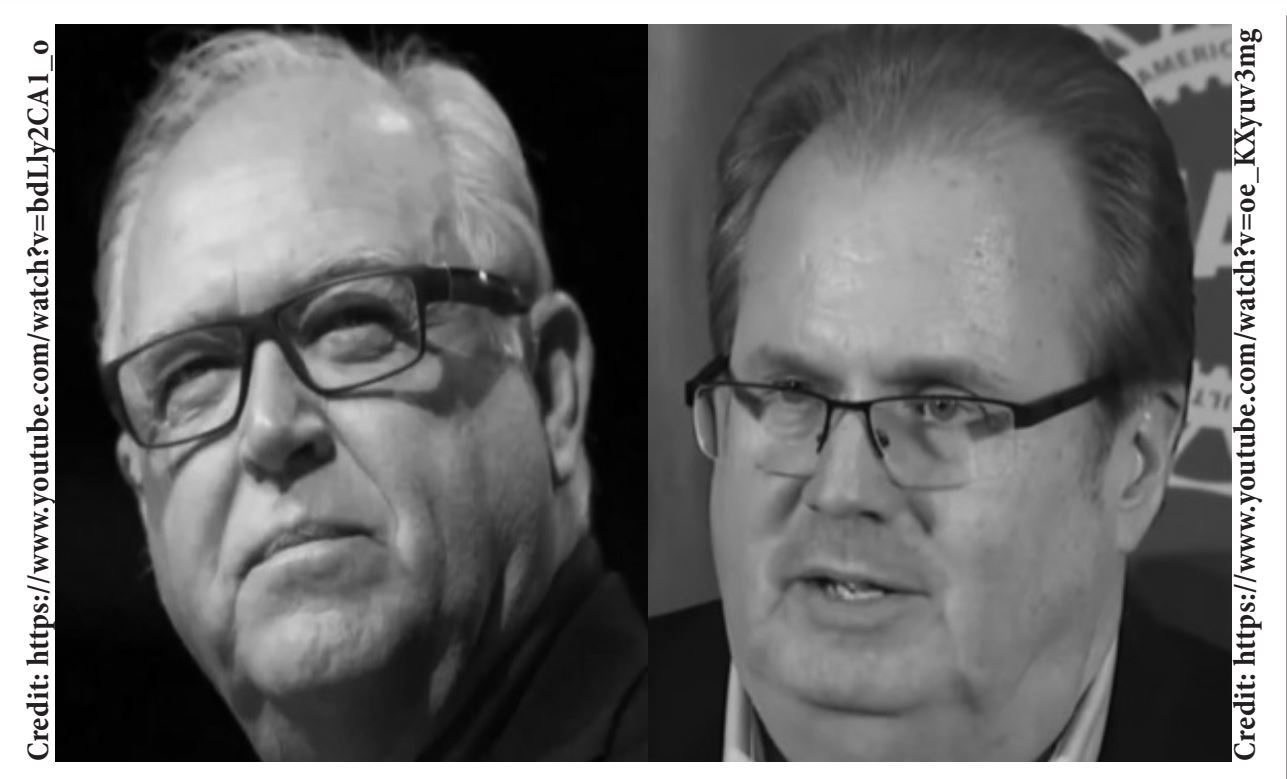
A majority of J.G. Kern employees petitioned to oust the UAW, which has seen two of its former presidents (Gary Jones, right, and Dennis Williams, left) go to jail for corruption. But a biased NLRB ruling trapped the workers in UAW ranks anyway.
WASHINGTON, DC – Foundation staff attorneys recently filed an amicus brief with the D.C. Circuit Court of Appeals in a case challenging a National Labor Relations Board (NLRB) decision reversing workers’ attempt to remove union “representation” they oppose.
In the case, J.G. Kern employees, frustrated with the United Auto Workers (UAW) Local 228 union, decided to petition to decertify, or formally remove, the union from their workplace. The workers presented this majority petition to their employer, leading to the company removing its recognition of the union.
The petition contained overwhelming support from workers in favor of removing the union. Yet, after the company withdrew recognition from the union, UAW officials ran to the Biden Labor Board in an attempt to remain in power. The Biden-appointed NLRB majority sided with the union officials by re-imposing the unpopular union over the workers’ objections.
With the case now in the federal court of appeals, the Foundation filed an amicus brief arguing the NLRB’s April 2022 ruling ignores precedent and misapplies longstanding law in siding with union officials.
Decertification Rules Already Rigged Against Workers Opposed to Union Affiliation
As the brief points out, workers looking to file a petition to remove a union they oppose already face numerous hurdles due to NLRB rules, most of which are contained nowhere in the federal statute the NLRB is charged with enforcing.
For example, a petition must be gathered outside of work hours, and outside of work-related areas. Also, unless employees use certain Board-specified language in their petition, the petition is invalid. Furthermore, employees cannot ask their employer for further information regarding the decertification process or the petition will be invalid.
The Foundation’s brief observes how workers must operate “in the dark, without help from their employer, and even if they do everything right, their efforts might come to naught through no fault of their own.” It also shows how the Biden Board has made it more difficult for individual workers to express their right to decertify unwanted, unpopular unions.
Biden NLRB Aims to Force Union on Workers Who Overwhelmingly Object
Under the Board’s “certification bar” doctrine, a union that wins a secret ballot election cannot be challenged for one year after its victory is certified by the NLRB. In this case, the UAW’s certification bar ended on October 3, 2019. In November 2019, J.G. Kern employees delivered a majority-backed petition to their employer.
The Biden Board claimed, however, that because J.G. Kern did not bargain in good faith during a three-month period at the beginning of the certification year, the employees’ majority petition was invalid. According to the Biden Board, the employer’s alleged unfair labor practices prospectively “extended” the certification year beyond its normal 12-month period.
The brief highlights the disingenuousness of the Board, pointing out that “the employees would have to divine the future to know they were collecting a petition during the ‘extended certification year.’” The Foundation urges the D.C. Circuit to command the Board to follow precedent that requires the Board to determine whether there was a “nexus” between the employer’s unfair labor practices and the decertification petition.
NLRB’s Power Grab Takes Away Workers’ Rights
The Foundation’s brief emphasizes how the Board’s decision can abolish employees’ rights guaranteed by the National Labor Relations Act. An example of that is the J.G. Kern workers’ petition, where it was only after the petition was gathered that the Board extended the union’s certification bar period.
The brief notes that usually “an employee’s decertification petition is presumptively valid unless there is a causal nexus between the unfair labor practice and the petition.” However, this is not the case under the J.G. Kern ruling.
Should the NLRB’s ruling be upheld, it “will further incentivize incumbent unions to file unfair labor practice charges to chill employees’ Section 7 ability to collect petitions,” the brief concludes.
“The NLRB’s blatant disregard for the rights of workers who don’t want anything to do with coercive unionism is on full display in this case,” commented Mark Mix, president of the National Right to Work Foundation. “The arbitrary cherry-picking of legal precedents to fit the Board’s agenda is outrageous, while expected, given the Biden Administration’s all-out effort to expand Big Labor’s coercive ranks.
National Right to Work Foundation Files Brief at Michigan Supreme Court Blasting TPOAM Union’s Forced Fee Scheme
Union “fee-for-grievance” scheme unlawfully pressures employees to become union members; Right to Work repeal does not make scheme legal
Lansing, MI (April 21, 2023) – The National Right to Work Foundation filed an amicus brief at the Michigan Supreme Court, opposing a scheme used by Technical, Professional, and Officeworkers Association of Michigan (TPOAM) union officials that weaponizes the union’s control over the grievance process to force nonmember public employees into paying fees to the union.
The case at issue is Technical, Professional and Officeworkers Association of Michigan (TPOAM) v. Daniel Lee Renner, in which Saginaw County employee Daniel Renner is challenging TPOAM union bosses’ so-called “fee-for-grievance” arrangement. Under it, union officials deprive Renner and other nonmember public employees of any power to file grievances themselves, and instead mandate that they pay fees to use the union’s grievance system – fees which often amount to a sum far greater than union dues.
Both the Michigan Employment Relations Committee (MERC) and the Michigan Court of Appeals have already rejected union officials’ arguments that they can refuse to file grievances for nonmembers unless nonmembers pay union fees. In Renner’s case, union officials demanded $1,290 from him simply to process his grievance to the first stage. Additionally, the union made clear to Renner that if the actual costs were higher as the proceeding continued, he would be responsible for more payments.
The current filing is the second amicus brief that the Foundation has submitted in the case. Notably, it addresses how Michigan legislators’ recent move to repeal the state’s popular Right to Work laws does not save the “fee-for-grievance” scheme from illegality. Michigan’s Right to Work protections prohibit union bosses from forcing workers to pay union dues or fees as a condition of employment, and remain valid until the repeal takes effect 90 days after the legislature adjourns, which is expected to be sometime in early 2024.
Forcing Nonmembers to Pay into Union Grievance System Violates Free Choice Rights
The brief refutes union arguments that the “fee-for-grievance” scheme does not restrain or coerce Renner or other union nonmembers in violation of their right under Michigan’s Public Employment Relations Act (PERA) to refrain from union activity. The National Labor Relations Act (NLRA), the federal law that PERA is based on, has consistently been interpreted “more broadly than simply prohibiting union or employer violence or heavy handed reprisals,” the brief points out.
The brief notes that the 1953 National Labor Relations Board (NLRB) case Hughes Tool Co. specifically held that a union’s refusal to process a nonmember’s grievance because he did not pay a fee violates workers’ right to refrain from union activity under the NLRA. “The NLRB has consistently reaffirmed these principles and Hughes Tool remains good law today,” the brief says.
In addition to ignoring a long line of NLRB precedents, the brief concludes, “TPOAM cavalierly defends its illegal fee on the basis that Renner made a choice to be a nonmember and he is the one requesting TPOAM assistance.” However, because Renner has a right under Michigan law to abstain from union activity, “[t]he fact TPOAM treated him differently because he exercised that statutory right is evidence it committed an unfair labor practice, not a defense.”
“TPOAM union officials’ scheme forcing nonmember public employees to pay into a union grievance system is illegal, just as it was both before and during Right to Work’s enactment in Michigan,” commented National Right to Work Foundation President Mark Mix. “As the Foundation’s amicus brief shows, TPOAM’s position ignores mountains of precedent and lets union bosses keep mandating fees designed to force dissenting workers into full union membership, in obvious violation of their rights.”
“Michigan public employees should also know that, as per the landmark Foundation-won Janus v. AFSCME U.S. Supreme Court decision, they can’t be fired for refusal to join or financially support a union,” Mix added.
Worker Advocate: NLRB Erred in Decision That Will Put 270 Nonunion Charleston Port Employees Out of Work
Amicus brief in Fourth Circuit case opposes ILA union bosses’ hostile bid to gain control over all jobs at Leatherman Terminal in South Carolina
Charleston, SC (April 11, 2023) – The National Right to Work Foundation has filed an amicus brief opposing the International Longshoremen’s Association (ILA) union’s gambit to gain control over all jobs at Charleston’s Hugh K. Leatherman Terminal. The brief argues that if ILA union bosses’ power grab succeeds, it will “cause grievous harm to 270 State port workers and their families.”
The case involved is South Carolina Ports Authority (SCPA) v. National Labor Relations Board (NLRB). In the case, the SCPA is challenging the Biden NLRB’s recent ruling permitting ILA union bosses to file lawsuits against any cargo carrier that docks at Leatherman until the union gains control of crane lift equipment jobs at the facility. That work is currently performed by state employees free from the union’s control, and those state employees have performed this work for the SCPA for many decades.
The Foundation, a nonprofit legal organization that provides free legal aid to workers facing compulsory unionism abuses, notes in the brief that it has “a strong interest in this case because the inevitable result of the National Labor Relations Board’s erroneous 2-1 decision will be devastating to Charleston, South Carolina port workers who have chosen to work as non-union employees for the State of South Carolina or its Port Authority.”
The Foundation “submits this brief to provide a voice for the otherwise voiceless non-union State employees, and to give the Court a unique perspective on the stakes involved for those workers and their families,” the brief says.
Union’s Aggressive Pursuit of Monopoly Power Will Lead to Hundreds Losing Their Jobs
The brief spells out the dire consequences of the ILA union’s maneuver for Leatherman’s 270 state employees, who are protected by state law from monopoly union control. It explains that South Carolina spent over $1 billion to develop the terminal, but because of the ILA’s aggressive attempts to enforce its alleged monopoly at the port, “the only way for South Carolina’s $1 billion Leatherman Terminal to be usable would be for the State to turn the facility over to a private employer with an ILA contract and discharge the 270 State employees.”
The devastating effects for current employees wouldn’t stop there if the ILA is victorious in the case, the brief argues. The brief points out that, even if fired state workers were to seek new employment at Leatherman with a private contractor under the union’s control, the ILA would prioritize those workers far below existing union members because of union seniority provisions and hiring hall referral rules.
ILA Union Has History of Malfeasance and Exploitation
The brief finishes by noting that South Carolina public employees likely want to avoid associating at all costs with the ILA because of the union’s “storied history of exploitation, resulting in a litany of federal prosecutions and civil litigation.” The New York Daily News reported in 2022 that ILA chiefs negotiated deals by which mob-linked longshoremen in the New York/New Jersey area could get paid for 27 hours of “work” per day. The ILA hierarchy organized such arrangements while trying to shut down ports like Leatherman which merely allow both unionized and union-free workers to work side-by-side.
“ILA union officials, aided and abetted by the Biden NLRB, are directly attacking the rights and livelihoods of hundreds of Charleston port employees simply because they work free of union monopoly control,” commented National Right to Work Foundation President Mark Mix. “The Fourth Circuit Court of Appeals must reverse the Biden NLRB’s erroneous ruling letting this union gambit move forward, bearing in mind that the real victims here are the nonunion port workers that ILA officials are seeking to have terminated.”
Foundation Brief to Court of Appeals: Lower Court’s Decision Conflicts with SCOTUS’ Janus Ruling
National Right to Work Foundation attorneys filed an amicus brief in Littler v. OAPSE with the Sixth Circuit Court of Appeals
Cincinnati, Ohio (April 6, 2023) – The National Right to Work Legal Defense Foundation filed an amicus brief with the Sixth Circuit Court of Appeals on April 5. The brief was filed in Littler v. OAPSE, brought by plaintiff Christina Littler. She attempted exercise her right to withdraw union membership and financial support, as recognized by the U.S. Supreme Court in the 2018 Janus v. AFSCME decision, only to be denied by union officials.
In the Foundation-won and argued Janus case, the Supreme Court recognized that the First Amendment protects government employees, like Littler, from being forced to fund union activities, and further that dues may only be deducted with the affirmative consent of an employee.
Littler is a school bus driver who, shortly after the Supreme Court issued its seminal decision in Janus, notified the Ohio Association of Public School Employees (OAPSE) that she resigned her union membership and revoked her dues deduction authorization. Rather than honor Littler’s timely request to stop paying union dues, union officials had her government employer continue to seize full dues from her paycheck. This prompted Littler to file a lawsuit to recover the dues OAPSE seized from her in violation of her First Amendment rights.
The U.S. District Court for the Southern District of Ohio, however, ruled the union was not liable for violating Littler’s constitutional rights. According to the court, the First Amendment did not apply to the union because the union supposedly did not engage in a state action when it caused a government employer to seize union dues from Littler’s wages.
The Foundation’s brief specifically counters this holding. The brief states “the lower court’s decision that a union does not violate the First Amendment when it has a government employer seize payments for union speech from a nonmember without her consent, because that union supposedly is not a state actor, conflicts with Janus and imperils employees’ right to not subsidize union speech that they oppose.”
The brief goes on to say that the “lower court has effectively given unions a free pass to infringe on employees’ speech rights under Janus without fear of liability” and that “it is important that the [Sixth Circuit] reverse the lower court’s erroneous state-action holding because it frees unions from constitutional constraints when they collaborate with government employers take union payments from employees.”
The case is one of many where union officials have sought to justify seizing dues from employees against their will. For example, in the Foundation-backed Savas case currently pending at the U.S. Supreme Court, Jonathan Savas and other California lifeguards are suing the California Statewide Law Enforcement Agency union for enforcing a “maintenance of membership” requirement that compel dissenting lifeguards to remain union members and to pay union dues for the four-year duration of the contract.
The U.S. Supreme Court recently scheduled the Savas petition for certiorari to be conferenced on April 21.
“While the Foundation is proud to assist workers in enforcing their constitutionally protected Janus rights, the increasing number of cases similar to Savas and Littler just highlight the lengths union bosses will go to in order to extract dues payments from workers against their will,” commented Mark Mix, President of the National Right to Work Legal Defense Foundation. “These cases show why it has become unfortunately necessary for the Supreme Court to again weigh in on this issue to disabuse union officials and lower courts of the notion that public employees’ First Amendment rights can be so callously ignored and restricted.”
National Right to Work Foundation Opposes NLRB Push to Mandate Abusive ‘Card Check’ Unionization Process
Amicus brief in Starbucks case says NLRB General Counsel’s plan will expose workers to coercive union tactics and contradicts SCOTUS precedent
Washington, DC (March 16, 2023) – The National Right to Work Legal Defense Foundation has just submitted an amicus brief at the National Labor Relations Board (NLRB) in a case involving SEIU union organizers’ attempt to impose unionization on workers at Starbucks without a secret ballot vote. The Foundation’s brief, attached to the motion, defends workers at Starbucks and workplaces nationwide from Biden-appointed NLRB General Counsel Jennifer Abruzzo’s attempt to effectively mandate coercive “card check” organizing campaigns.
In card check campaigns, professional union organizers can pressure workers into signing cards that are then used at “votes” for unionization in lieu of an NLRB-supervised secret ballot vote.
In the ongoing Starbucks case, former union lawyer Abruzzo is attempting to resurrect the long-discredited Joy Silk NLRB theory, which would force union monopoly control on workers who have not had an opportunity to vote in secret on whether they want a union in the workplace. SEIU officials attempted to impose union control on Starbucks baristas using the so-called “card check” process, in which union agents can bypass the traditional secret ballot method of gaining power in a workplace and can obtain union “authorization cards” directly from workers – often using coercive or misleading tactics.
Card check schemes are recognized by court and NLRB precedents and even AFL-CIO organizing handbooks as inaccurate gauges of true employee support for union control. Despite this, the Joy Silk theory that NLRB General Counsel Abruzzo seeks to revive forbids employers from challenging the results of a card check unionization.
Employers can contest the results of a card check by asking the NLRB to conduct a secret ballot union vote among the employees. Conversely, under Joy Silk, the NLRB has the power to force both workers and employers under union control if an employer objects to the results of a card check.
“Now, the General Counsel seeks to upend five decades of settled law to resurrect Joy Silk,” says the amicus brief. “She seeks a regime of instant unionization through compulsory bargaining orders issued to any employer that refuses to recognize a union based on authorization cards, even though such cards were most assuredly not collected through ‘laboratory conditions.’”
Joy Silk Prioritizes Union Power Over Employees’ Will and Conflicts with Court Precedent
The Foundation’s brief argues that card check unionization drives are “notoriously unreliable” for determining whether a majority of employees in a workplace want a union. Because card check schemes lack NLRB oversight and do not permit employees to vote in private, the brief argues, the door is open for union agents to deploy many kinds of pressure tactics, including soliciting ballots, electioneering, keeping lists of employees who have or have not signed cards, and more.
As opposed to employees in a secret ballot election who vote quickly and privately, “[t]his is not true for an employee caught in the maw of a year-long card check campaign, who may be solicited repeatedly and, perhaps coercively, month after month until he or she signs,” the brief says. If General Counsel Abruzzo brings back Joy Silk, that would allow union bosses to “bypass secret ballot elections at will and secure a compulsory bargaining order virtually anytime they are able to collect a bare majority of authorization cards.”
The amicus brief also maintains that the Joy Silk standard is at odds with a large number of court precedents, including from the D.C. Circuit Court (where many NLRB decisions are appealed), other circuit courts, and the U.S. Supreme Court twice. All of these courts have declared at one time or another that “authorization cards are inferior to secret ballot elections,” the brief says.
General Counsel Abruzzo Seeks to Compel Workers into Union Ranks Despite More Than 90% of American Workers Rejecting Unionization
“NLRB General Counsel Abruzzo – a former CWA union official – continues to show her extremist views when it comes to overturning precedent in the pursuit of greater coercive powers for her former colleagues in Big Labor’s upper echelon,” commented National Right to Work Foundation President Mark Mix. “Inevitably, this comes at the expense of the rights of independent-minded American workers, who want the right to choose whether or not they wish to associate with a union, free from the well-documented coercive tactics union organizers deploy during card check drives.”
“Big Labor advocates previously at least understood that a sweeping change to federal labor law, like eliminating secret ballot elections to mandate ‘card check,’ would at least require an act of Congress,” Mix added. “But with the Card Check Forced Unionism Bill dying in 2010 due to bipartisan opposition, and the so-called ‘PRO-Act’ blocked in the last and current Congress, the Biden Administration is apparently moving forward to radically rewrite federal labor law by bureaucratic fiat.”
Worker Advocate Files Supreme Court Brief Opposing Union Boss Attempt to Evade Liability for Property Damage
Amicus brief in Glacier Northwest argues “Unions need no further exemptions and special legal privileges” and SCOTUS should “scrutinize” existing ones
Washington, DC (November 7, 2022) – The National Right to Work Legal Defense Foundation today filed an amicus brief at the United States Supreme Court. The brief argues that the High Court should overturn a Washington Supreme Court decision that created a special exemption for union officials and their “more aggressive” members from liability under state tort law when property destruction and vandalism result from union boss-ordered actions.
The Foundation’s brief was filed in Glacier Northwest Inc. v. International Brotherhood of Teamsters Local 174, which deals with a union boss-ordered strike against construction company Glacier Northwest. Glacier Northwest’s attempt to sue the union over property damage caused by strike activities was denied by the Washington Supreme Court. Washington’s highest court accepted Teamsters lawyers’ argument that the National Labor Relations Act’s (NLRA) allowance for union strikes somehow also immunizes unions from liability when strike activities destroy and vandalize property.
The Supreme Court announced last month it would hear arguments in the case. Those arguments haven’t been scheduled yet but are expected to occur in early 2023.
The Foundation provides free legal aid to hundreds of workers every year whose rights have been violated by compulsory unionism abuses, including those that occur during strikes. It contends in the brief that the Washington Supreme Court’s creation of a new “carve-out” in state law for vandalism and property destruction organized by union officials will leave not only employers, but also employees, with no recourse when harmed by such strike violence and mayhem. The Foundation points out that union officials already enjoy a slew of privileges and immunities under state and federal law enjoyed by no other private organization or citizen, and that this power should be pared back instead of expanded.
Foundation: Union Officials’ Enormous Special Legal Privileges Should Not Be Expanded
The Foundation explains in the amicus brief that “states’ interest in protecting life, limb, and private property must be respected under principles of federalism” because federal remedies generally don’t exist for violations of these interests. Far from being a concern only for employers who face union strike efforts, the Foundation argues, employees are often targeted by hostile or violent strike behavior and state courts often are the only forum in which they can receive justice.
“For example, in Clegg v. Powers, employees sought damages in state court for union violence and property damage during a strike,” the brief says. “Cases like Clegg demonstrate that the Court should limit” unions’ ability to dodge liability in state courts, not extend it, says the brief.
The Foundation’s brief then points out that the exemption from liability for torts that Teamsters bosses seek should also be restricted given “the extraordinary privileges and exemptions already granted to unions” by Congress and courts all over the country.
These include, but are not limited to, the ability to perform acts that would be considered extortion if committed by any other private party, pursuant to the controversial 1973 United States v. Enmons Supreme Court decision. Union officials also have the privilege to foist monopoly “representation” over all workers in a workplace regardless of whether they are union members or voted for the union in power. Probably the most abusive union boss privilege of all is the power to force employees in non-Right to Work states to pay union dues or fees just to stay employed, while maintaining monopoly bargaining control in a workplace with no effective term limits.
“This Court should treat unions like all other citizens or entities, clarifying that they can be liable for damages in state courts under ‘the common law rule that a man is held to intend the foreseeable consequences of his conduct,’” the brief concludes.
“Union officials’ theory that they should be off the hook in state court for damaging or vandalizing property is outrageous on its face. The law already has plenty of carve-outs and privileges for union hierarchies that no other private organization or citizen gets to enjoy – least of all the workers union bosses claim to ‘represent,’” commented National Right to Work Foundation President Mark Mix. “Union officials regularly force millions of workers to pay union fees or be fired, and force their ‘representation’ on millions of workers who bitterly oppose it. The Supreme Court must reject this shocking union ploy for even more coercive powers, and hold the existing set of union boss privileges to much more scrutiny.”
West Virginia Supreme Court Hears Right to Work Case
The following article is from the National Right to Work Legal Defense Foundation’s bi-monthly Foundation Action Newsletter, January/February 2020 edition. The West Virginia Supreme Court heard arguments in this case on January 15 and a decision is expected in the coming months. To view other editions or to sign up for a free subscription, click here.
Foundation continues to defend all Right to Work laws against Big Labor attack
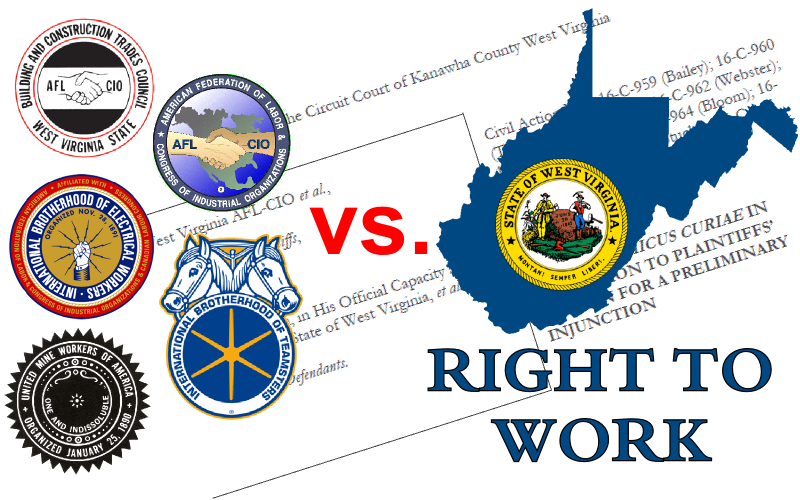
Forced-dues-hungry union bosses have been waging a legal battle to overturn West Virginia’s Right to Work Law since it was enacted in 2016. Foundation staff attorneys have been fighting back by filing amicus briefs in court.
CHARLESTON, WV – The West Virginia Supreme Court will hear arguments on January 15 in union bosses’ long-running case seeking to dismantle West Virginia’s Right to Work Law and restore their forced-dues powers over workers across the Mountain State. National Right to Work Foundation staff attorneys have already filed multiple legal briefs in this case for West Virginia workers in defense of West Virginia’s Right to Work Law.
After Passage, Union Bosses Immediately Target West Virginia Right to Work Law
Last year, union lawyers relied on discredited legal arguments to convince Kanawha County Circuit Court Judge Jennifer Bailey to declare West Virginia’s entire Right to Work Law invalid. Union lawyers dubiously claim that West Virginia union bosses have a “right” to forced dues. Judge Bailey issued a similar ruling blocking the Right to Work law after the legislation was signed into law in 2016. The West Virginia Supreme Court overturned that decision, citing arguments made in briefs by Foundation staff attorneys. “Of course, union partisans never willingly accept the loss of forced dues,” said National Right to Work Foundation President Mark Mix. “So now the issue is back at the state’s highest court.” If Big Labor’s lawsuit to overturn
West Virginia’s Right to Work Law succeeds, union bosses could have thousands of independent-minded workers across the state fired solely for refusing to subsidize union activities.
Foundation Files 10 Briefs to Protect Rights of West Virginia Workers
Foundation staff attorneys have filed 10 legal briefs in the multi-year case. The Foundation’s latest amicus brief was filed for West Virginia nursing home employee Donna Harper. Harper, like many other workers in West Virginia, chose not to pay dues or fees to union bosses, which is her legal right in a Right to Work state.
“Union bosses in West Virginia are intent on reclaiming their forced-dues power,” Mix said. “Big Labor is waging this protracted legal battle to return the Mountain State to a time when millions and millions of dollars in workers’ money were seized by union bosses to fill Big Labor’s coffers with forced dues.”
This case is the latest legal battle in the Foundation’s long history of effectively defending Right to Work laws in state and federal court from spurious attacks by Big Labor. Although federal law specifically authorizes states to pass Right to Work laws to protect workers from union boss coercion, union lawyers have repeatedly challenged these laws in an attempt to keep siphoning union dues and fees from workers’ paychecks.
Foundation Has Successfully Defended State Right to Work Laws Nationwide
In addition to West Virginia, Foundation staff attorneys have successfully pursued legal action in recent years to defend and enforce new Right to Work laws in Indiana, Michigan, Wisconsin and Kentucky, all of which have passed Right to Work protections for employees in just the last seven years. In Michigan alone, Foundation staff attorneys have assisted employees in over 100 cases since Right to Work went into effect in early 2013.
Foundation Case on Petition to U.S. Supreme Court Picks up Amicus Brief
Constitutional challenge would free childcare providers from being forced to accept unwanted union ‘representation’
On December 9th, a group of New York childcare providers, with free legal assistance from National Right to Work Foundation staff attorneys, petitioned the Supreme Court to strike down a compulsory unionism scheme on First Amendment grounds. The childcare providers are challenging a New York law that empowers union officials to speak for all childcare providers, including those who have not joined and do not support the union, when bargaining with state government.
Foundation attorneys argue that the current arrangement violates the providers’ First Amendment right to choose with whom they associate to petition their government by naming a union as their state-designated lobbyist.
Recently, The Pacific Legal Foundation together with the Goldwater Institute, Fairness Center, Pioneer Institute, and Empire Center, filed an amicus brief supporting the petition, arguing that Americans cannot be compelled to speak or associate, or petition the government, against their wishes. To read the full brief please click here and to learn more about the case click here.





