
CA Fire Safety Inspector Wins Reinstatement, Back Pay After Union-Instigated Firing
The following article is from the National Right to Work Legal Defense Foundation’s bi-monthly Foundation Action Newsletter, March/April 2024 edition. To view other editions of Foundation Action or to sign up for a free subscription, click here.
IUOE tried to compel union membership, settlement now mandates $9,000+ payout

Beaming: Fire safety inspector Alexandra Le can now return to her vital work knowing her rights are fully vindicated. Her settlement goes beyond reinstatement and provides refunds of illegal dues.
PLEASANTON, CA – Even in states like California that lack Right to Work protections, U.S. Supreme Court precedents forbid union bosses from compelling workers to become full union members. Thanks to the National Right to Work Foundation-won CWA v. Beck Supreme Court decision, workers in non-Right to Work states who wish to abstain from formal union membership also can’t be required to pay union dues for expenses beyond what the union claims goes toward its bargaining costs.
Union bosses have a legal obligation to inform workers of these rights. But that wasn’t the experience of Pleasanton, CA, fire safety inspector Alexandra Le, whom International Union of Operating Engineers (IUOE) officials got fired over her refusal to formally join the union in late September 2023. On top of that, union chiefs also deducted full union dues from her paycheck without her permission in violation of Beck — meaning she was likely paying for union political activities against her will.
IUOE Officials Backed Off Illegal Demands Following Foundation Involvement
Le sought out free legal aid from Foundation staff attorneys, who filed unfair labor practice charges for Le at National Labor Relations Board (NLRB) Region 32 in Oakland, CA. “It’s outrageous that IUOE union officials believe they can get me fired simply because I don’t agree with their organization and don’t want to support or affiliate with them,” Le said at the time. “IUOE union officials have been far more concerned with consolidating power in the workplace and collecting dues than caring about me and my coworkers, and I hope the NLRB will hold them responsible for their illegal actions.”
Rather than defend their blatantly illegal actions against Foundation staff attorneys, IUOE union officials backed down in January and settled the case. Now, as per the settlement, Le’s employer (Construction Testing Services) must reinstate Le, and both the union and company must jointly pay out to her over $9,000 in back wages and benefits.
Employee Highlights Struggle Against Forced Dues to U.S. House of Representatives
As Le’s case was ongoing, Le sought to expose the injustices that forced-dues and forced-membership demands impose on workers. Le submitted written testimony to the U.S. House of Representatives’ Committee on Education and the Workforce for a November hearing on a federal law which aims to expand Right to Work protections and make union dues and membership strictly voluntary nationwide.
In her testimony, she described the impact the illegal union-instigated firing had on her life: “My absence significantly set me back from a financial standpoint and has led to the stressful process of having to fight for my rights via the legal process . . . [a]nd while the union fees cause a notable decrease in my hard-earned take-home pay, the time lost and stress incurred by asserting rights that I had to discover independently has been equally detrimental.
“Simply put, nobody should be forced to join or pay any dues or fees to a union that they do not want to join,” Le concluded.
Despite Legal Victory, CA Workers Need Right to Work
Foundation attorneys’ favorable settlement for Le goes far beyond requiring just reinstatement and back pay from the company and union. The settlement also dictates that the company will only deduct the reduced Beck amount of union dues from Le’s paycheck going forward. The union will also waive fees totaling roughly $1,700 that its officials tried to force Le to pay from the time her case began back to the date of her hiring.
“Ms. Le’s battle to protect her freedom of association from IUOE union officials is courageous, but no worker should ever have to fight this hard to protect their livelihood from dues-hungry union officials,” commented National Right to Work Foundation Vice President and Legal Director William Messenger. “It’s also unfortunate the Golden State’s lack of Right to Work permits the same IUOE bosses who instigated her illegal firing to collect mandatory union fees from her.
“Workers themselves — not union bosses — should be in charge of determining whether a union is worthy of receiving their hard-earned cash,” Messenger added.
Worker Advocate Testifies Before Congress on Need to Defend Employees Against Increasingly Coercive Union Tactics
Testimony: Biden Labor Board undermining rights of workers opposed to union affiliation, censoring speech critical of unions
Washington, DC (May 22, 2024) – This morning, National Right to Work Legal Defense Foundation Vice President and Legal Director William L. Messenger is testifying before the U.S. House Subcommittee on Health, Employment, Labor and Pensions. The Subcommittee, which is chaired by Rep. Bob Good (R-VA), is holding a hearing titled “Exposing Union Tactics to Undermine Free and Fair Elections”.
As a National Right to Work Foundation staff attorney and now as Foundation Legal Director, Messenger has represented both public and private employees in numerous high-profile cases challenging coercive unionism. He was the lead counsel in multiple Supreme Court cases, including the landmark 2018 Janus v. AFSCME Supreme Court decision, where he successfully argued that the First Amendment protects public employees against being compelled to financially support union activities.
Building on his over two decades of experience litigating on behalf of workers, including in cases before the National Labor Relations Board (NLRB), Messenger will testify on some of the ways federal labor law has been twisted, especially by Biden appointees to the NLRB, to undermine the rights of employees opposed to union affiliation in order to promote union bosses’ coercive power.
In his testimony, Messenger documents how the NLRB, including through its radical 2023 Cemex decision, is promoting unreliable and abuse-prone “card check” organizing, undermining the protections workers enjoy by voting on unionization in the privacy of a secret ballot election, and infringing on the First Amendment by censoring speech critical of union officials:
“To suppress speech unfavorable to unions, the Biden NLRB operates the most repressive regime of government censorship in the nation. Even though Congress sought to foster free speech and debate about unionization with NLRA Section 8(c)—which provides that speech cannot be evidence of an unfair labor practice “if such expression contains no threat of reprisal or force or promise of benefit”—the Biden NLRB flouts that limitation by declaring employer utterances unfavorable to unions, or even just questions about unions, to carry unspoken and implicit threats or promises of benefit…
“Cemex itself is designed to muffle speech critical of unionization. The Biden NLRB’s rationale for nullifying secret ballot elections if an employer engages in speech or conduct NLRB officials consider wrongful, and installing the union as the employees’ representative without an election, is to dissuade employers from engaging in such speech or conduct. This rationale is perverse—the agency plans to deprive employees of their right to vote if their employer says or does something NLRB officials disapprove of. This is like a kidnapper threatening to harm innocent hostages if his victim does not comply with his extortionate demands.”
Testifying alongside Messenger will be Stephen Delie of the Mackinac Center for Public Policy, Michael Alcorn, a Trader Joe’s employee who saw firsthand the ways unions and their allies at the NLRB undermine the rights of workers who may be skeptical of unionization, and Lynn Rhinehart of the Economic Policy Institute (EPI). EPI is a union-funded front group whose Board of Directors includes many of the most powerful union bosses in the country.
“This hearing shines a badly-needed spotlight on the many ways the Biden NLRB has abandoned its Congressional mandate to be a neutral enforcer of the law, and instead is acting as a taxpayer-funded organizing arm for Big Labor,” said National Right to Work Foundation President Mark Mix. “Through its oversight and legislative powers Congress has an important role to play in stopping the Labor Board from continuing to undermine the freedoms of the vast majority of American workers who want nothing to do with union affiliation.”
National Right to Work Foundation Issues Notice to University of California Graduate Students Amid UAW Strike Orders
Foundation informs students of right to resign union membership and complete academic responsibilities despite politicized union strike command
California (May 21, 2024) – The National Right to Work Legal Defense Foundation has released a special legal notice to graduate students, teaching assistants, and researchers across the University of California system. The notice comes as officials of the United Auto Workers (UAW) union have ordered a strike at UC Santa Cruz over the university’s position on the Israel-Hamas conflict and related campus protests.
Union officials have indicated that similar strike orders could soon be in effect at other UC system schools and that the union’s strike authorization means these orders could be in effect until June 30. The notice provides legal information to the roughly 50,000 unionized students, a small fraction of which voted to approve the strike action.
The full notice is available at www.nrtw.org/UCstrike.
The Foundation’s legal notice informs UC graduate students of their right to resign union membership and resume their academic responsibilities. “This situation raises serious concerns for graduate students who believe there is much to lose from a union ordered strike,” the notice says. “Seven UC undergraduate campuses have exams scheduled for the second week of June, meaning the strike order is likely to cause major disruptions.”
“The Foundation wants you to learn about your legal rights from independent sources,” says the notice. “You should not rely on what self-interested union officials tell you.”
UC Graduate Students Must Resign Union Membership Before Returning to Work
The notice explains that, under California public sector labor law, graduate students who wish to resume working during the strike should resign their union memberships at least one day before returning to work if they want to avoid union discipline. “Union officials can (and often do) levy thousands of dollars in fines against union members who work during a strike,” reads the notice. “So, if you are currently a member, resigning your membership before you work during a strike is the most effective way to avoid union fines and other discipline.”
Links to sample union resignation letters and the Foundation’s page for requesting free legal aid are provided.
Janus Supreme Court Decision Also Protects Students’ Right to Stop Dues Payments to UAW
UC graduate students, who are considered “public employees” for the purposes of unionization, also have a First Amendment right to cut off dues deductions to the UAW as per the Foundation-won Janus v. AFSCME Supreme Court decision, the notice says. “[U]nion officials can only deduct union dues from a person’s paycheck if that person has affirmatively consented to pay,” the notice details, while also explaining that union officials sometimes try to limit when employees can stop union dues and that Foundation attorneys can provide legal aid if students encounter any difficulties in that regard.
The notice concludes by explaining that UC graduate students have a right to petition for a vote to end the UAW’s monopoly bargaining power, with a link to more information on California’s public sector law regarding union “decertification elections.”
“There is good reason to believe that this UAW boss-ordered strike may violate California law, but because that is still being determined, it is important that student ‘employees’ impacted by the strike know their legal rights to protect themselves against union retribution if they exercise their right not to join the strike action,” commented National Right to Work Foundation President Mark Mix. “University of California graduate students may oppose this strike simply because they want to complete their end-of-semester responsibilities efficiently and without disruption, notwithstanding the UAW’s combative reaction to controversial and divisive protests.
“Graduate students’ ability to complete their work can’t be stripped away by UAW union officials’ eagerness to make a political statement, and Foundation attorneys stand ready to defend these students’ right to work independently of union strike diktats,” added Mix.
Labor Board to Prosecute Teamsters for Illegally Threatening Long Beach Savage Services Employee with Termination and Fines
Complaint says union officials failed to properly inform worker of forced dues; Local 848 now under second federal prosecution this year
Long Beach, CA (May 20, 2024) – After facing federal charges from workers at transportation company Savage Services, Teamsters Local 848 union officials are now facing federal prosecution for saddling employees with illegal threats to have them fired. On May 15, National Labor Relations Board (NLRB) Region 21 in Los Angeles issued a complaint against the Teamsters union based on unfair labor practice charges filed by Savage Services employee Nelson Medina. Medina is receiving free legal representation from the National Right to Work Legal Defense Foundation.
In states like California that lack Right to Work protections for private sector workers, union officials have the legal privilege to enforce contracts that force nonmember workers to pay dues or fees as a condition of employment, though these demands are limited by the Right to Work Foundation-won Communications Workers of America v. Beck Supreme Court case to only dues or fees that go toward the union’s core bargaining activities. In contrast, in Right to Work states, union membership and all union financial support are strictly voluntary.
The complaint targets Teamsters officials’ violations of a 1962 NLRB decision. The precedent in Philadelphia Sheraton requires union officials to inform workers of exactly what obligations they must fulfill to satisfy the requirements of a forced unionism clause in a union contract. This includes providing employees notice of how the union calculates what the employee must pay in terms of dues and a reasonable opportunity for the employee to pay those amounts.
According to the complaint, Teamsters officials, in a July 2023 letter, “threatened [Medina] with sending a letter of removal to the Employer” if he didn’t pay allegedly outstanding fees to the union, without providing the legal protections required by Philadelphia Sheraton. The complaint also says that Teamsters bosses threatened Medina with a fine for the same reason.
New NLRB Complaint Latest in Flurry of Legal Actions Against Teamsters Local 848
This isn’t the first time that Teamsters Local 848 has been subject to federal prosecution at Savage Services. In February, NLRB Region 21 issued a complaint against Local 848 because its agents had threatened employees with violence for not supporting the union. That complaint followed an unfair labor practice charge from Savage Services employee Victor Avila detailing the threats.
Teamsters Local 848 has also faced recent pushback from Savage Services employees for illegal dues practices. In February 2022, Medina forced the union to settle charges that it illegally forced nonmember workers to pay for union political activities in violation of Communications Workers of America v. Beck. The settlement required union officials to pay back thousands of dollars in illegal dues they seized from about 60 of his coworkers who objected to union membership and to funding the union’s political activity.
“Teamsters Local 848 union chiefs are continuing their dismal track record of complying with employees’ legal rights,” commented National Right to Work Foundation President Mark Mix. “Their repeated threats and illegal dues practices show pretty clearly that they value power and dues revenue beyond the well-being of Savage Services employees, who have now attempted twice to throw the union out.
“It’s good that the union is being prosecuted for violating employees’ rights under federal law. But ultimately, Right to Work protections would solve such conflicts about whether or not union officials have complied with their obligations to justify forced union dues by ensuring every workers’ individual right to decide for themselves whether or not to voluntary fund union activities,” Mix added.
Penske Truck Rental Employees in Minneapolis and Nashville Overwhelmingly Vote to Remove Machinists Union
Majority of workers in both work units have prevailed in effort to free themselves of unwanted IAM union bosses’ so-called ‘representation’
MINNEAPOLIS, MN & NASHVILLE, TN – Majorities of Penske Truck Rental employees at locations in Minnesota and Tennessee have voted to remove the International Association of Machinists (IAM) union from their respective workplaces. The decertification petitions were filed by workers with free legal aid from the National Right to Work Legal Defense Foundation in April with the National Labor Relations Board (NLRB), asking the agency to hold votes to formally remove IAM union officials’ monopoly bargaining power.
On May 1 in Minneapolis, Minnesota workers voted 26 to 7 to remove IAM District Lodge No. 77 union officials. The NLRB-supervised decertification election took place after Penske employee Kyle Fulkerson submitted a petition on April 4, 2024 signed by a majority of his coworkers asking the NLRB to hold a vote to remove the union from the facility.
“This lopsided vote is a testament to the fact that after having seen the IAM up close and personal in our workplace, my colleagues and I are confident that we are better off without union officials so-called ‘representation,” said Fulkerson about the outcome, which became final on May 8 after a one-week objection period passed with no union challenge to the outcome being filed.
Meanwhile in Tennessee, Penske employee David Saylor filed his decertification petition on April 11 backed by a majority of the employees at the downtown Nashville Penske location. On May 8, they voted 15 to 8 to oust IAM District Lodge No. 735. Today, on Thursday, May 16, 2024, the vote became finalized absent a last ditch attempt by union officials to overturn the workers’ vote.
The Minneapolis and Nashville-based workers are not the only Penske employees to remove unwanted union so-called “representation” with legal aid from the National Right to Work Foundation. In 2022, every worker but one as a Penske facility in Indiana signed a petition seeking to decertify the Teamsters union officials at that location. Before an NLRB-supervised decertification election was scheduled, Teamsters officials issued a statement, disclaiming representation in an apparent attempt to spare themselves the embarrassment of an overwhelming vote by workers to reject the union’s so-called “representation.”.
“Workers across the country are increasingly exercising their rights to remove unwanted unions, with more decertification elections held last year than in any year since 2017,” said National Right to Work Foundation President Mark Mix. “No worker anywhere should be forced under the so-called ‘representation’ of a union they oppose, and Foundation staff attorneys stand ready to assist workers wanting to hold a decertification election to oust a union they oppose and believe they would be better off without.”
Healthcare Employees in PA, MN Oust Unions with Foundation Aid
The following article is from the National Right to Work Legal Defense Foundation’s bi-monthly Foundation Action Newsletter, March/April 2024 edition. To view other editions of Foundation Action or to sign up for a free subscription, click here.
Over 270 workers now free of AFSCME at Philly hospital; Steelworkers union booted in MN
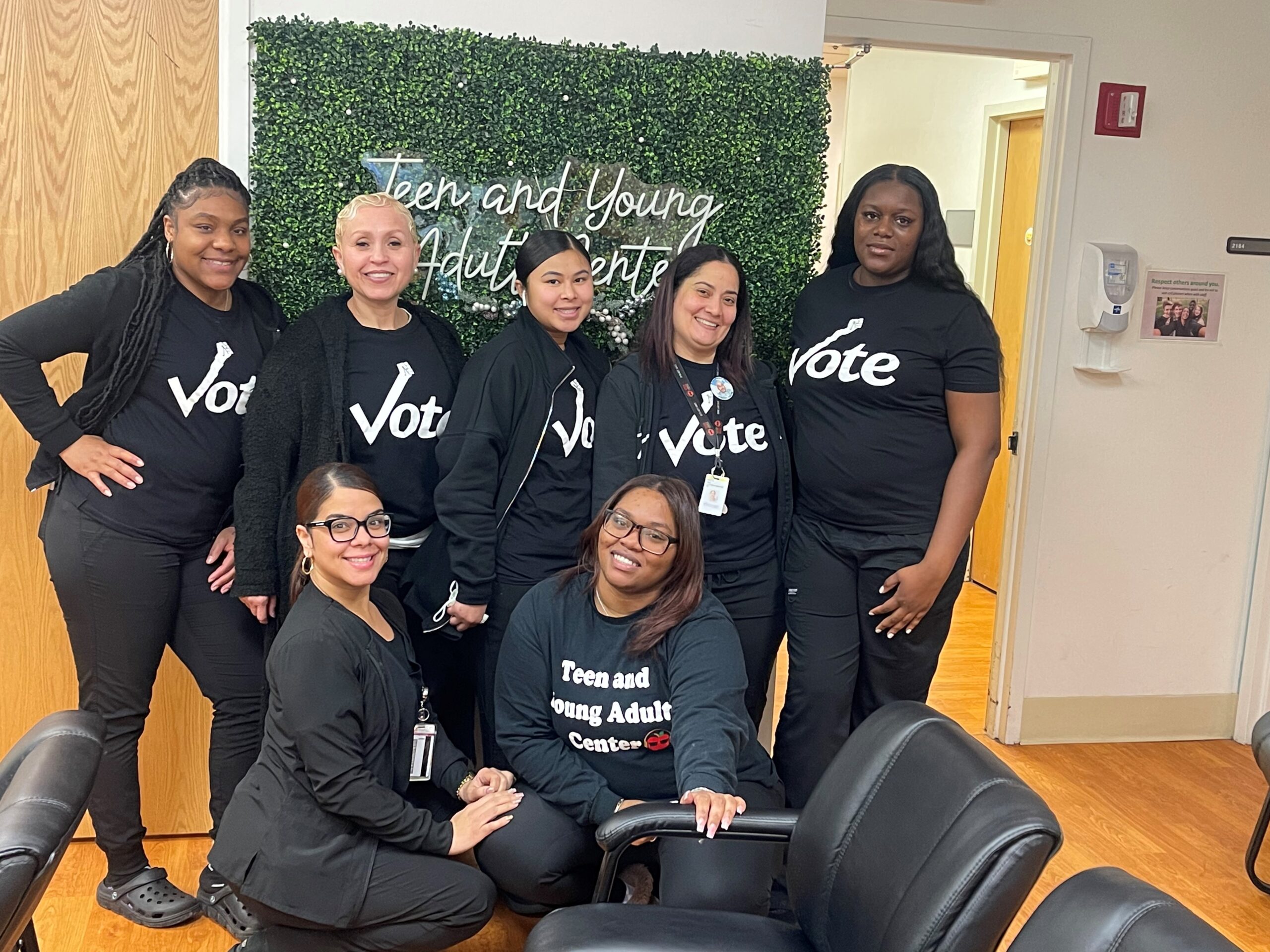
After being told by a union official that “the union isn’t going anywhere,” outpatient service coordinator Shidiah Jackson (back right) and her coworkers led a successful effort to kick the AFSCME union out of St. Christopher Hospital.
PHILADELPHIA, PA – In December 2023, National Right to Work Foundation-supported workers added two new victories to the growing string of successful union decertification efforts around the country.
In Philadelphia, a 270+ worker unit comprised of medical assistants, office coordinators, medical secretaries, and many other support employees voted by a nearly 60% margin to remove the American Federation of State, County and Municipal Employees (AFSCME) union from St. Christopher’s Hospital for Children.
Outpatient service coordinator Shidiah Jackson led the union decertification effort with free legal advice from the Foundation.
In Austin, MN, patient care specialist Erin Krulish and other support workers at the Austin Mayo Clinic location forced Steelworkers union officials out of their facility. That ouster follows multiple recent union removals involving other Minnesota healthcare employees, including nurses at Mankato Mayo Clinic, support staff at Mankato Mayo Clinic, and nurses at St. James Mayo Clinic, all of whom received free Foundation legal aid.
Both Krulish and Jackson kick-started these efforts by submitting decertification petitions to the National Labor Relations Board (NLRB). Each petition contained enough signatures from employees interested in having a union removal vote to prompt the NLRB to hold such a vote.
Healthcare Professionals Free of Monopoly Bargaining and Forced Dues
Both Pennsylvania and Minnesota lack Right to Work protections for their private sector workers, meaning that union officials had the power to enter into contracts with management that would force Krulish, Jackson, and their coworkers to pay union dues or fees just to keep their jobs. In contrast, in Right to Work states, union membership and all union financial support are strictly voluntary.
Steelworkers Officials Depart MN Clinic to Avoid Likely Embarrassing Vote
If a majority of workers vote against a union in a decertification vote or otherwise force a union out, the union loses not only its ability to demand forced dues from employees, but also its monopoly bargaining power.
Such power permits union officials to dictate the contract provisions of all employees in a unit, even those who oppose or voted against the union’s presence in the first place.
The effort by Krulish and her coworkers at Mayo Clinic Austin to remove the Steelworkers union was unique in that they had already stripped union officials of their forced dues power through a “deauthorization election,” which can be petitioned for in the same way as a decertification election. In December 2022, Krulish and her fellow employees voted 49-17 to revoke the union’s power to compel them to pay dues.
Deauthorization is the only way employees in non-Right to Work states can stop a union from seizing dues from workers as a condition of employment, outside of completely decertifying the union.
Krulish and her coworkers resorted to this option because the NLRB’s questionable “contract bar” doctrine prevented them from kicking the union out in December 2022, simply because the union’s contract was still active.
After experiencing a big loss in the deauthorization election, Steelworkers officials likely knew another devastating defeat was coming after Krulish filed her decertification petition. They departed the hospital before the election could take place.
Philly Workers Reject One-Size-Fits-All Union Bureaucracy
In an interview with The Philadelphia Inquirer, Jackson related that she had no contact with the union until she tried to ask for a raise she felt she had earned, at which point hospital administrators said her salary and benefits were a union matter. When she voiced her displeasure with the situation to the union and asked what the union actually did for her, a union official suggested her views didn’t matter anyway because “the union isn’t going anywhere.”
“OK, we’ll see about that,” she told the union agent, according to the Inquirer. Soon after, she proceeded with her decertification effort, which ultimately resulted in the overwhelming vote among her colleagues for ending the union’s so-called “representation.”
“It seems that American medical employees are discovering that union officials’ one-size-fits-all ‘representation’ doesn’t always work to their benefit, nor does it help them take better care of their patients,” commented National Right to Work Foundation President Mark Mix. “It’s easy to see why healthcare workers would want to avoid compulsory dues payments, or being ordered to strike and abandon their patients during a busy time.
“Those in the healthcare industry should know that they have a right to petition the NLRB for a vote to remove a union, and that National Right to Work Foundation staff attorneys can assist them through this daunting process,” Mix added.
DC-Area ‘Union Kitchen’ Employees Vote 24-1 to Remove UFCW Union
The following article is from the National Right to Work Legal Defense Foundation’s bi-monthly Foundation Action Newsletter, March/April 2024 edition. To view other editions of Foundation Action or to sign up for a free subscription, click here.
Foundation now defending workers against union attempt to overturn employee vote
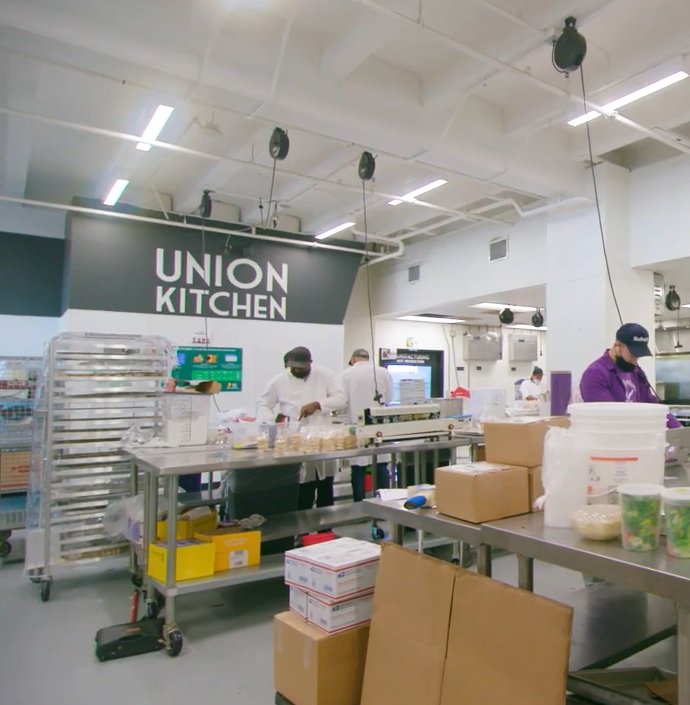
Union Kitchen, a unique grocery concept that helps local DC entrepreneurs get their food products to market, was the target of a dangerous UFCW picket scheme.
WASHINGTON, DC – Ashley Silva, an employee at independent DC-area food store Union Kitchen, could sense in July 2023 that her coworkers had had enough of the United Food and Commercial Workers (UFCW) union in their workplace.
UFCW union officials had been ordering contentious boycotts and pickets on the stores, and some of the demonstrations even required police intervention after union picketers blocked store exits.
“The vast majority of the workers at Union Kitchen are sick and tired of the UFCW’s picketing, harassment of employees, and constant disruptions of our day-to-day work life,” Silva said at the time.
Despite Searing Worker Rejection, UFCW Bosses Trying to Cling to Power
With free legal aid from the National Right to Work Foundation, Silva filed a decertification petition with the National Labor Relations Board (NLRB), asking the federal agency to hold a vote among the employees of Union Kitchen’s five stores on whether the union should be ousted. The vast majority of her coworkers signed the petition.
UFCW union officials levied allegations against Union Kitchen management in an attempt to stop the vote from happening. Despite some delays, Silva and her coworkers cast ballots in October 2023, and a January 2024 vote count revealed that she and her colleagues had voted against the union 24-1.
The union challenged eight employee ballots, meaning the full tally of votes against the union is most likely 32-1.
Once the NLRB certifies this election result, Silva and her coworkers will be free of the union. However, in an attempt to stop this, UFCW officials continue to press the “blocking charges” against Union Kitchen management that they filed at the NLRB before the vote, and have also piled on objections to the election that contain the same basic accusations as the blocking charges.
Blocking charges are often unverified or unrelated charges of employer misconduct that union officials can manipulate to stall a ballot count or a certification of results in a union decertification case.
If the NLRB issues a complaint against an employer based on a union’s “blocking charges,” the decertification process is halted.
Foundation Will Fight UFCW Bid to Overturn Vote
Foundation staff attorneys are defending Silva and her colleagues’ victory at the ballot box from UFCW union officials’ bald-faced attempts to oppose their will.
“We’re happy that Ms. Silva and her coworkers were finally able to exercise their right to vote out a union they oppose,” commented National Right to Work Foundation Vice President Patrick Semmens. “It’s unfortunate, though hardly surprising, that despite such an overwhelming rejection UFCW union officials won’t take a hint and stop attempting to impose their unwanted so-called ‘representation’ on Union Kitchen employees.
“The Foundation is proud to defend Silva and her coworkers against these union tactics as they seek freedom from coercive unionism,” Semmens concluded.
KIPP St. Louis Charter High School Educators to Vote This Week on Whether to Oust AFT Union Bosses
Union decertification election will take place among wide swath of school employees, including teachers, advisors, administrative staff, and others
St. Louis, MO (May 14, 2024) – Teachers, advisors, nurses, and other employees at KIPP St. Louis High School will vote this week on whether to remove American Federation of Teachers (AFT) union officials from power at the school. The union decertification vote follows KIPP teacher Robin Johnston’s submission of a “decertification petition” earlier this month to National Labor Relations Board (NLRB) Region 14 in St. Louis. Johnston filed the decertification petition with free legal aid from the National Right to Work Foundation.
The NLRB is the federal agency responsible for enforcing federal labor law, which includes administering elections to install (or “certify”) and remove (or “decertify”) unions. Johnston’s petition contains signatures from enough of her coworkers to trigger a decertification vote under NLRB rules.
Because Missouri lacks Right to Work protections for its private sector workers (which includes employees at public charter schools like KIPP), union officials have the legal privilege to enforce contracts that force workers to pay union dues or fees as a condition of getting or keeping a job. In contrast, in Right to Work states, union membership and union financial support are strictly voluntary.
However, in both Right to Work and non-Right to Work states, union officials in a unionized workplace are empowered by federal law to impose a union contract on all employees in the work unit, including those who oppose the union. A successful decertification vote strips union officials of both their forced-dues and monopoly bargaining powers.
Vote Set to Take Place May 17
“AFT union officials haven’t stood up for us,” commented Johnston. “I think the majority of my coworkers agree that they’ve only made it harder for us to help our students succeed, especially through a divisive strike order, and that’s a trend I hope we can reverse with this vote. We hope the election proceeds without delay and without interference from union officials.”
The NLRB has scheduled a vote to occur on Friday, May 17. According to Johnston’s petition, the vote will occur among “College and Career Advisors, English Language Learners, Leads, Lead Teachers, Learning Support Teachers, Mental health Professionals, School Nurses, Special Ed. Teachers, Specials Teachers, Speech Language Pathologists, Virtual Learning Facilitators, Behavior Support Specialists, High School Registrars, Long Term Subs, Office Coordinators, Paraprofessionals, Permanent Building Subs and Receptionists” at the school.
Foundation attorneys have recently aided other charter school educators in efforts to remove unwanted union officials, most recently in San Diego, CA, where employees of Gompers Preparatory Academy prevailed in 2023 after a nearly four-year effort to vote out the San Diego Education Association (SDEA) union, an affiliate of the National Education Association (NEA).
“Top teacher union officials, including Randi Weingarten of the AFT and Becky Pringle of the NEA, seem to regularly make headlines for political radicalism and not for anything related to helping teachers, which seems to be a reality on the ground at KIPP St. Louis,” commented National Right to Work Foundation President Mark Mix. “Ms. Johnston and her fellow educators join a growing number of workers across the country who are realizing that union boss agendas don’t align with what’s best for them, and Foundation attorneys are proud to help them exercise their right to vote away unwanted union control.”
Foundation-Aided Employees Tell Congress: All Workers Need Right to Work
The following article is from the National Right to Work Legal Defense Foundation’s bi-monthly Foundation Action Newsletter, March/April 2024 edition. To view other editions of Foundation Action or to sign up for a free subscription, click here.
Workers’ real-life battles against union bosses emphasize need to end forced union dues
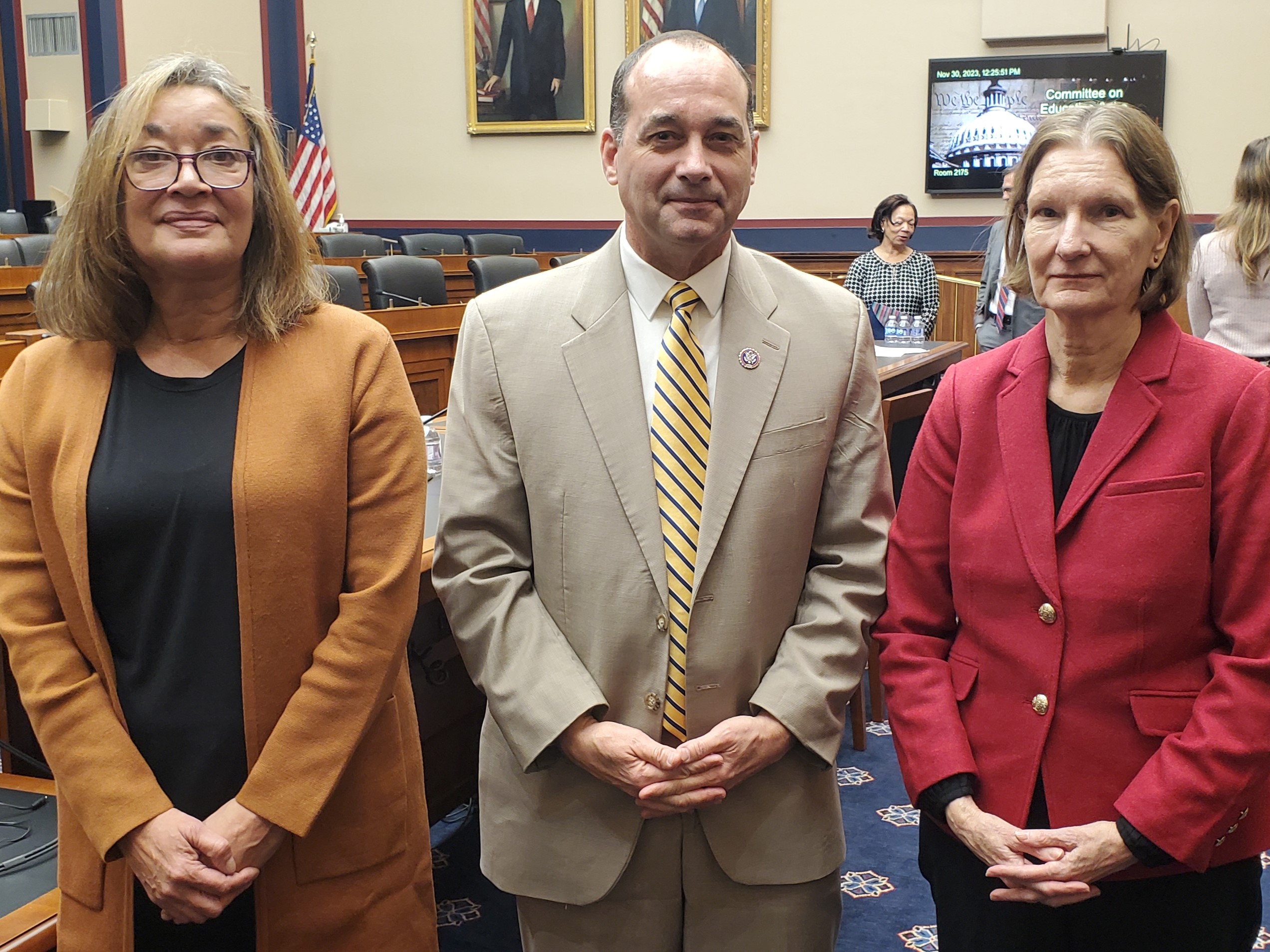
Foundation clients Brunilda Vargas (left) and Jeanette Geary (right) testified to Rep. Bob Good (center) and other members of the House Education and Workforce Committee about the danger forced dues still pose to America’s workers.
WASHINGTON, DC – In November, two recipients of National Right to Work Foundation free legal representation went to Capitol Hill to testify before the U.S. House Committee on Education and the Workforce about their battles against union bosses.
This was the first-ever congressional hearing on the National Right to Work Act, legislation that will safeguard American private sector workers’ freedom to refrain from paying dues to an unwanted union.
Jeanette Geary, a retired nurse, and Brunilda Vargas, a Philadelphia-based public defender, both successfully challenged illegal forced-dues demands with Foundation aid. Their testimony at the hearing, alongside Foundation President Mark Mix, gave policymakers stark examples of how union officials often manipulate their forced-dues powers to advance coercive agendas over the objections of workers.
Vargas, Geary Share Stories of Union Coercion
The current federal law governing most private sector workers in America — the National Labor Relations Act (NLRA) — grants union bosses the power to force workers to pay union dues just to keep their jobs. Only by passing Right to Work laws can states protect workers covered by the NLRA from forced dues.
Meanwhile, airline and railroad employees covered by the Railway Labor Act (RLA) can be required to pay union dues no matter where they work because federal law prevents them from being covered by state Right to Work laws. The one-page National Right to Work Act discussed in the hearing would repeal the portions of both the RLA and NLRA that authorize union officials to require union payments as a condition of employment.
“We’re proud and thankful that Ms. Geary and Ms. Vargas both agreed to testify before Congress on the struggles independent-minded workers face every day because of federal law’s lack of protection for worker freedom,” Mix commented. “Union bosses and their allied politicians don’t want to hear it, but the truth is rank-and-file workers are the victims of Big Labor’s government-granted coercive powers, which makes the stories of those victims especially powerful.”
Geary discussed her struggle against United Nurses and Allied Professionals (UNAP) union bosses, who subjected her and her fellow nurses in Rhode Island to an illegal scheme in which they were compelled to pay for union political expenditures, including lobbying in state legislatures. Geary fought UNAP union officials over the illegal dues demands for 12 years with free legal representation from Foundation staff attorneys. She finally prevailed in 2021, when the First Circuit Court of Appeals unanimously ruled in her favor and rejected a union appeal.
Vargas and Geary: Unions Purposely Hide Rights from Employees
“Unions do not tell employees about their rights because union officials have no incentive to do so, and regular employees without lawyers . . . are left to fend for themselves,” Geary testified before the House Committee. “This is America, and membership in a union and payment of dues should be strictly voluntary.”
Vargas testified about her case against United Auto Workers (UAW) union officials, who threatened to dock the salary of her and any other public defender in her office who refused to let the union seize money directly from their paychecks. Under federal law, even in forced-dues states, union officials must obtain express consent from workers before taking dues money by direct deduction. With Foundation legal aid, Vargas secured a favorable finding from the National Labor Relations Board (NLRB) that initiated a formal prosecution against the union. Eventually, UAW union bosses were forced to settle the matter and end their illegal conduct.
“As attorneys, we do have a level of sophistication when it comes to the law and legal processes. However, I cannot imagine a lay person having to face this type of pressure. I believe that most people sign union membership and authorization cards because they believe they have no choice, and they are often told that,” Vargas testified.
Michigan Security Guard Slams Union with Federal Charges for Illegal Dues Seizures, Transparency Issues
Union officials fail to provide required information on how dues money is spent, already face vote which could stop forced-dues spigot
Grand Rapids, MI (May 8, 2024) – James Reamsma, a security guard whose posts include the Gerald R. Ford Federal Building and other government sites in the Grand Rapids area, has hit the United Government Security Officers of America (UGSOA) union with federal unfair labor practice charges maintaining that UGSOA union officials are seizing dues money from his paycheck without providing required disclosures on how the union spends worker cash. Reamsma filed the charges at Region 7 of the National Labor Relations Board (NLRB) in Detroit.
Reamsma is also leading his fellow security guards at Triple Canopy Inc. in an effort to vote away the UGSOA’s power to compel guards to pay dues or fees to the union in what is known as a “deauthorization election.” He is receiving free legal aid in both actions from the National Right to Work Legal Defense Foundation.
Reamsma’s charges seek to enforce his rights under the Communications Workers of America v. Beck Supreme Court decision, which was won by Right to Work Foundation attorneys. The Court held in Beck that union officials cannot force workers who have abstained from union membership to pay union dues or fees for expenses not directly germane to contract negotiations, such as union political activities. Workers who exercise their Beck rights are also entitled to an independent audit of the union’s finances, a breakdown of how union officials spend forced contributions, and an opportunity to challenge how the union calculates its reduced “Beck fee.”
Beck rights are only relevant in non-Right to Work jurisdictions like Michigan, where union officials have the legal privilege to force private sector workers to pay dues or fees as a condition of getting or keeping a job. In contrast, in Right to Work states like neighboring Indiana and Wisconsin, union membership and all union financial support are strictly voluntary. Michigan had Right to Work protections until a 2023 repeal rammed through by union partisans on the Michigan Legislature became effective earlier this year.
Union Dubiously Claims No Dues Money Goes to Politics
According to Reamsma’s charge, he submitted a notice to UGSOA union agents in March that requested the union reduce his dues payments in accordance with Beck and provide him with the required financial information. In response, union officials claimed that the amount of dues chargeable to nonmembers was equal to 100% of full union dues. Reamsma’s charge states that UGSOA “failed to provide the required financial disclosures for itself and its affiliated unions, and a chance to object to its alleged reduced fee.”
The charge also notes that, despite Reamsma notifying union officials in April that he prefers to pay union dues by check, UGSOA ignored this request and has continued to take money directly from his paycheck by payroll deduction. Federal labor law forbids union officials from using direct deduction to collect union dues or fees without worker consent.
Foundation attorneys argue in the charge that the union’s continued seizing of dues money from Reamsma’s paycheck “restrain[s] and coerce[s] Charging Party in the exercise of his Section 7 rights” under the National Labor Relations Act (NLRA). The NLRA protects the right of workers to refrain from union activities.
Guards May Vote to End Forced Dues
The NLRB has scheduled May 17 to count the votes in Reamsma’s deauthorization election, which is currently taking place by mail. If a majority of his colleagues vote to deauthorize the union, it will no longer have the legal power to coerce Reamsma and his colleagues to pay dues or fees as a condition of employment. Michigan’s non-Right to Work environment forces workers to either deauthorize a union or vote it out of a workplace completely (via a similar process known as “decertification”) if they want to end union officials’ forced-dues power.
“UGSOA union officials appear to be withholding vital information about how they spend worker money from the very security guards they claim to ‘represent,’” commented National Right to Work Foundation President Mark Mix. “If union bosses won’t respect basic worker rights regarding the collection and spending of dues money, Triple Canopy security guards should rightly be skeptical of whether UGSOA deserves the privilege to force them to pay dues or fees at all.
“While it’s illegal everywhere to force workers to pay for union political expenditures they oppose, the choice to financially back a union at all should rest solely with each individual worker, which is why Right to Work protections are so important,” Mix added.





