
San Fernando Valley Kaiser Permanente Nurse Hits UNAC Union With Federal Charges for Forcing Nurses to Fund Union Politics
UNAC union officials stated she would be fired if she refused formal union membership and dues payments for political expenditures
Los Angeles, CA (July 18, 2025) – Sarah Warthemann, a nurse at Kaiser Permanente’s branch in Woodland Hills, has just filed federal charges against the United Nurses Association of California (UNAC) union at her workplace. She maintains that UNAC officials threatened that she would lose her job if she did not formally join the union, and have ignored her attempt to exercise her legal right to opt out of paying for union political expenses. Warthemann filed her charges at the National Labor Relations Board (NLRB) with free legal assistance from National Right to Work Legal Defense Foundation staff attorneys.
The NLRB is the federal agency responsible for enforcing federal labor law, a task that includes adjudicating labor disputes between employers, union officials, and individual employees. Section 7 of the National Labor Relations Act (NLRA) protects workers’ right to refrain from participating in or supporting union activities.
Warthemann’s charge concerns her rights under CWA Union v. Beck, a Foundation-won case in which the Supreme Court ruled union bosses could not require those abstaining from union membership to fund union ideological activities just to keep their jobs. The General Motors v. NLRB Supreme Court decision also forbids union officials from requiring formal membership as a condition of employment.
Because California is not a Right to Work state, UNAC chiefs can enforce union monopoly bargaining contracts that require Warthemann and her fellow nurses to pay union dues to keep their jobs, but Beck limits this amount to only the portion of dues that UNAC officials use for bargaining functions. In contrast, in Right to Work states like neighboring Arizona and Nevada, union membership and all union financial support are strictly voluntary.
“The radical political agenda promoted by the UNAC union is something I do not—and should not—be compelled to support,” Warthemann commented. “While I’m required to pay union dues to remain employed at the hospital, that obligation should not include funding extreme political activities. It is both unethical and, in my view, illegal.”
UNAC Union Bosses Snub Both Federal Law and Recent Settlement
Warthemann reports in her charges that a UNAC representative emailed her a union membership form in June, insisting that she “fill this out ASAP. It is a condition of employment.” Warthemann also notes that UNAC bosses have been ignoring her request to exercise her rights under Beck, and have persisted in demanding she pay full union dues. According to the charges, the union flouted other requirements mandated by the Beck decision – including that union officials provide nonmember employees with a financial breakdown of how the union spends employees’ money.
The UNAC union’s failure to follow Beck is especially flagrant in light of an NLRB-approved settlement union bosses recently reached with another Kaiser Permanente Woodland Hills nurse, Jillian Clausi. Clausi also accused the union of Beck violations, and the settlement in her case contains declarations by the union that it will “not charge Beck objectors the full amount of union membership dues,” among other things. This appears to be exactly the misbehavior Warthemann is describing in her new charge.
“It’s no surprise that UNAC union officials – who spent millions of dollars to influence the 2024 California elections – are trying to keep nurses in the dark about their right to stop their money from enriching the union’s political machine,” commented National Right to Work Foundation President Mark Mix. “But workers’ right to say ‘no’ to funding union boss agendas shouldn’t be limited to just politics. No worker should be forced to fund a union hierarchy that has been abrasive or just flat out incompetent while claiming to ‘represent’ workers.
“Ms. Warthemann’s case is Exhibit A in why all American workers deserve Right to Work protections. Union officials must rely on voluntarism – not government-backed force – to gain worker support,” Mix added.
Comfort Systems USA Pipefitters and Welders Win Two-Year Battle to Escape Steamfitters Local 52 Union
Union officials made dubious charges concerning pipefitter who collected worker signatures opposing union, but charges were dropped just before hearing
Montgomery, AL (July 15, 2025) – Brandon Davis and his fellow pipefitters and welders at Montgomery-based HVAC company Comfort Systems USA Mid-South have successfully removed Steamfitters Local 52 union bosses from their workplace. Davis, who spearheaded the nearly two-year struggle to oust the union, received free legal aid from National Right to Work Legal Defense Foundation staff attorneys.
Davis’ effort kicked off in March 2023, when he filed a petition backed by his coworkers asking the National Labor Relations Board (NLRB) to hold a workplace vote to remove (or “decertify”) the union. The NLRB is the federal agency in charge of enforcing federal labor law, a task that includes adjudicating labor disputes and administering elections to install or remove unions.
While Davis’ petition contained more than enough employee signatures under federal law to trigger a union decertification election, he had a backup plan: To avoid any attempts by union officials to use litigation to hold up or cancel the election, he also submitted a copy of his petition to his employer. Under the 2001 Levitz Furniture Co. NLRB precedent, employers can legally withdraw recognition from union bosses as the “exclusive representative” of their employees upon receiving a petition that shows the union does not enjoy majority support among workers – which Davis’ petition did.
Because Davis and his coworkers work in the Right to Work state of Alabama, state law barred Steamfitters union officials from enforcing contracts that required union membership or dues payments as a condition of employment. However, in Right to Work states and non-Right to Work states alike, union officials still have the ability to impose their “exclusive representation” on every worker in a unionized facility, even those who vote against or otherwise oppose the union.
Steamfitters Union Bosses Sought Order Compelling Workers Under Union Control
Comfort Systems stopped recognizing the Steamfitters union in March 2023 based on Davis’ petition. Unfortunately, Steamfitters union officials still tried to trap Davis and his coworkers under their control. Steamfitters union bosses filed a number of unfair labor practice charges against Comfort Systems management in an attempt to elicit an order from the NLRB that would force the company to submit to bargaining with the union – despite the petition showing that the union no longer enjoyed majority support from the workers. One union boss charge even accused Davis of being a manager or being put up to seeking an election, alleging his collection of worker signatures was part of an illegal company plot.
In February 2025, NLRB Region 15 issued a complaint finding merit to the union’s unfair labor practice charges, including the claim that Davis was a member or agent of management. Davis’ Foundation attorneys quickly sought to intervene in the case between the Steamfitters union and Comfort Systems to rebut the union’s allegations. “Should Mr. Davis be denied Intervenor status, an unfavorable determination in this case could destroy the impact of the decertification petition he prepared, i.e., the lawful withdrawal of recognition by his Employer,” read the motion to intervene.
Under pressure from Davis and his Foundation-provided legal team, the NLRB abandoned the allegations that threatened to reimpose the union and agreed to settle all others just three days before a hearing was scheduled to take place. With no remaining challenges to the company’s withdrawal of recognition, Davis and his colleagues are finally free of the Steamfitters union’s control.
“We’re proud to help Mr. Davis and his fellow Comfort Systems employees escape the clutches of Steamfitters union bosses who weren’t standing up for the employees’ interests, but their legal battle should have never lasted this long,” commented National Right to Work Foundation President Mark Mix. “As the Trump Administration selects new NLRB members, it should seek members who will eliminate policies that let union officials seize forced ‘representation’ powers over workers on the basis of unproven allegations. The Board should instead plan to defend equally workers’ right to associate or disassociate with a union as they please.”
Cornell University Graduate Student Files Federal Charges Seeking End to Union Boss Control Over Graduate Students
Student case attacks Obama-era federal labor board ruling that exposed graduate students to union boss power
Ithaca, NY (July 14, 2025) – Russell Burgett, a Ph.D. candidate in chemical physics at Cornell University, has just launched a groundbreaking federal labor case challenging the Cornell Graduate Student Union’s (an affiliate of United Electrical) authority to maintain exclusive representation powers over him and his fellow graduate students.
Burgett, who opposes the union and is not a member, filed his charges at the National Labor Relations Board (NLRB) with free legal aid from National Right to Work Foundation staff attorneys.
The NLRB is the federal agency responsible for enforcing private sector labor law. Burgett’s case is a direct challenge to the Obama NLRB’s 2016 Columbia University ruling, which overturned longstanding precedent and permitted union bosses to gain monopoly bargaining powers over graduate students at private universities like MIT, Columbia, and Cornell.
While union monopoly bargaining schemes in academia were already controversial at the time of the Columbia University ruling, student opposition to the policy has spiked in recent years as union officials have pursued increasingly radical and divisive ideological activities on campuses.
Charges: NLRB Must Reexamine Union Powers Over Students, Including Forced-Dues Mandates
Burgett’s charges assert that Cornell graduate students are not “employees” under the National Labor Relations Act. For that reason, the charges say, CGSU-UE union officials’ attempts to force them to abide by a union contract – including provisions that effectively mandate the students pay union dues or fees to complete essential parts of their graduate programs – violate federal labor law.
Furthermore, Burgett’s charges contend the union contract is illegal because it forbids the university from doing business with students who abstain from union membership or union financial support. Union agreements that require an entity to cease doing business with persons who refuse to associate with the union are a clear violation of the National Labor Relations Act.
“Mr. Burgett’s case is the latest chapter in a continuing saga showing why union bosses’ one-size-fits-all bargaining schemes have no place in academia,” commented National Right to Work Foundation President Mark Mix. “At America’s elite universities, union bosses empowered by the Obama and Biden NLRBs are coercing dissenting students into funding their political radicalism and constant agitation – including Jewish students who have sincere religious objections to the anti-Israel vitriol that campus unions push.
“Forcing students to choose between completing their graduate degrees or affiliating with an ideological group they find unconscionable is antithetical to principles of academic freedom, and Mr. Burgett’s case directly attacks the Obama NLRB’s and Biden NLRB’s flawed rulings allowing such coercion to happen in the first place,” Mix added.
DOJ Attorney Battles Biden Admin Union Power Grab Over Justice Department
The following article is from the National Right to Work Legal Defense Foundation’s bi-monthly Foundation Action Newsletter, March/April 2025 edition. To view other editions of Foundation Action or to sign up for a free subscription, click here.
Foundation attorneys challenge last minute DOJ unionization in violation of FLRA case law

NTEU union bosses backed Kamala Harris for President, but when voters rejected her, NTEU union officials and the Biden-Harris Administration hastily moved to install the union at the DOJ in an apparent attempt to obstruct Trump’s priorities.
WASHINGTON, DC – In states across the country, union officials go to great lengths to gain more political influence, and will often violate established law to do so.
As veteran Department of Justice attorney Jeffrey Morrison is discovering, federal agencies are no exception. Morrison is challenging a last-minute attempt by National Treasury Employees Union (NTEU) bosses to gain monopoly bargaining control over attorneys at both the DOJ Civil Rights Division (CRT, where Morrison is employed) and the DOJ Environment and Natural Resources Division (ENRD).
The unionization campaign was fast-tracked just days after Trump’s November election victory, in an apparent attempt to formally hand NTEU union officials power over the divisions prior to inauguration day. Morrison’s legal action asks the Federal Labor Relations Authority (FLRA) to formally review the actions by the Biden DOJ and NTEU officials. The FLRA is the federal agency responsible for adjudicating disputes between federal employees, union officials, and agencies within the federal government.
Brief: DOJ Holdovers and NTEU Bosses Colluded to Flout Existing Law
Morrison, who is receiving free legal aid from the National Right to Work Foundation, contends in filings before the FLRA that the NTEU’s scheme violates an existing FLRA decision in which the agency ruled that CRT attorneys did not comprise a work unit appropriate for unionization.
DOJ management raised this exact concern about the CRT unit with the FLRA after NTEU union bosses began their campaign, but the DOJ dropped its opposition just days after the November federal elections.
Morrison is asking the FLRA to review the decision of the Regional Director to allow the election to go forward in the CRT and ENRD divisions without properly considering if these divisions are an appropriate unit under the law.
Morrison’s filings (called “Applications for Review”) came after DOJ management and NTEU union officials agreed that the CRT and ENRD were work units appropriate for unionization. His Applications for Review point out that a prior FLRA decision, Antitrust Division, held that CRT lawyers “did not have a separate and distinct community of interest from other DOJ trial attorneys” and for that reason couldn’t stand as a distinct bargaining unit.
“[T]he Authority determined this very unit to not be an appropriate unit…The Regional Director’s failure to comply with current, binding Authority precedent is in error and must be reversed,” the Application for Review says regarding the CRT attorneys. This same argument is applied to the ENRD division because it is similarly situated to CRT in the DOJ hierarchy.
FLRA Failed to Conduct Investigation Into NTEU’s Union Scheme
Morrison’s applications also contend that the FLRA “fail[ed] to conduct an independent investigation into the appropriateness of the unit,” despite the law requiring that the FLRA make such a finding.
“An agency agreeing with a union that a unit is appropriate does not mean that unit is actually appropriate. Agencies, like DOJ here, cannot usurp the Authority’s role in deciding unit appropriateness…” say the Applications for Review.
“Right before power changed hands in Washington, DC, NTEU union bosses and DOJ bureaucrats appear to have colluded to flout longstanding precedent that says Justice Department attorneys cannot legally be unionized division by division,” commented National Right to Work Foundation President Mark Mix.
“The FLRA has ignored established precedent to let this hasty unionization attempt go through, and our attorneys are proud to assist Mr. Morrison in opposing this maneuver.”
National Right to Work Foundation Files Legal Brief Defending Wisconsin Act 10 as Union Bosses Seek to Regain Coercive Powers
Amicus brief exposes lower court’s flawed argument that union bosses have “right” to monopoly bargaining powers over workers and government
Washington, DC (July 9, 2025) – The National Right to Work Foundation has submitted an amicus brief to the Wisconsin Court of Appeals in Abbotsford Education Association v. Wisconsin Employment Relations Commission. The case, which is on appeal from the Dane County Circuit Court, is a challenge by a cadre of labor unions against Act 10, a 2011 state law that set important restrictions on public sector union officials’ ability to control Wisconsin public services and public workers.
Act 10, among other provisions, prevents unelected union bosses from enforcing monopoly bargaining contracts that would let them dictate key aspects of work and compensation for large portions of state government – even over the objections of public workers themselves and their managers. It also requires union officials to periodically submit to employee votes (or “re-certification”) to ensure that they still enjoy majority employee support in public workplaces where they are in power. The Wisconsin Supreme Court upheld the statute as constitutional in 2014, but union officials believe that the changed ideological makeup of the Court gives them a new opportunity to get the law overturned and regain power.
“[T]he Foundation has frequently offered its views as amicus curiae in cases impacting upon important aspects of employee freedom,” the Foundation’s amicus brief reads. “Most importantly here, the Foundation has provided free legal aid to employees in other challenges mounted by unions against various provisions of 2011 Wisconsin Act 10.”
Lower Wisconsin Court Ignores Clear Supreme Court Precedent in Flawed Act 10 Ruling
The Foundation’s amicus brief first contends that a state like Wisconsin “can define and limit the parameters of exclusive representation as it sees fit,” and union officials’ public sector monopoly bargaining powers are not a “right” that the U.S. or Wisconsin constitutions require the government to acknowledge.
“The United States Supreme Court recognized this principle long ago” in Smith v. Arkansas State Highway Employees, the amicus brief says. The Dane County Circuit Court erroneously called monopoly bargaining a “right” the Wisconsin legislature could not ban in certain public departments but allow in others.
In 2007, Foundation attorneys won a victory at the United States Supreme Court in Davenport v. Washington Education Association that established a similar point to Smith: Union officials have no constitutional “right” to seize money from nonconsenting workers. Wisconsin’s Right to Work law and the Foundation’s Supreme Court victory in Janus v. AFSCME continue to protect Wisconsin workers from being forced to pay union dues or fees to keep their jobs.
The Foundation’s amicus brief also states that the Dane County Circuit Court failed to consider whether, instead of striking down Act 10 as a whole, it could have expanded the statute’s pro-employee liberty provisions to cover all public departments to correct the alleged imbalances the court perceives in the law. “[T]he Circuit Court could have expanded the protection of Act 10’s re-certification requirements to all public employees in the State,” the brief says.
In addition to Act 10’s benefits for independent-minded public workers, public spending analyses indicate that the law has relieved Wisconsin taxpayers from the enormous financial weight of wasteful union contracts. Some estimates show that Act 10 has saved the state roughly $35 billion since it was enacted.
“Act 10 is a simple recognition that voters and taxpayers – not unelected union bosses – should be in control of how the public services Wisconsinites fund are managed,” commented National Right to Work Foundation President Mark Mix. “But the union boss attempt to nix it is an even more egregious attack on Wisconsin public workers, who under union officials’ proposed regime would be forced to sacrifice to unions the right to freely choose who will speak for them on workplace matters. Even convicted felons have the right to choose their own representation, but union officials seek to deny this right to dissenting public employees.
“The latest attempt to get Act 10 overturned is a power play by Wisconsin union officials that will severely harm the public interest, and no Wisconsin court should be complicit in that scheme,” Mix added.
Hundreds of OH Workers Exit Teamsters as Union Bosses’ Amazon ‘Strike’ Stunt Flounders
The following article is from the National Right to Work Legal Defense Foundation’s bi-monthly Foundation Action Newsletter, March/April 2025 edition. To view other editions of Foundation Action or to sign up for a free subscription, click here.
Teamsters O’Brien tried to take away Christmas cheer, but couldn’t take away Ohio workers’ freedom

Daniel Caughhorn led a scrappy group of his coworkers in voting Teamsters bosses out of their workplace, a scrap metal processing facility in Toledo, OH. They also beat back union bosses’ attempts to overturn their vote.
WASHINGTON, DC – This past December, Teamsters President Sean O’Brien announced the “largest-ever strike against Amazon,” claiming that thousands of workers would heed his strike order, abandon their delivery vehicles and hit the picket lines. O’Brien threatened that Christmas gifts would be delayed unless his demands were met.
Those who took O’Brien’s rhetoric at face value would have thought he was a veritable Grinch stealing Christmas (even though he tried to explain it was Amazon’s fault that the strike had to occur). But even reporting from pro-Big Labor outlets soon revealed that the order was more story than substance: According to Labor Notes, only about 600 employees obeyed the strike order despite Teamsters honchos claiming to “represent” some 7,000 to 10,000 Amazon employees.
Even the small number who did cease work on O’Brien’s command are arguably not employees of Amazon, and likely aren’t under Teamsters control at all: They work primarily for independent contractors that carry out some delivery functions for Amazon. Even if O’Brien’s dubious theory claiming he had control over those delivery drivers was correct, it would have only affected 10 out of the roughly 110 Amazon centers nationwide. Still, National Right to Work Foundation staff attorneys put a special legal notice out to delivery drivers nationwide informing them of their rights if they were illegally coerced to strike.
Workers Defeat Cynical Attempt by Teamsters to Overturn Vote
The December 2024 Teamsters “strike” against Amazon may go down in history as a strained publicity stunt. But the more significant Teamsters news that month was that hundreds of Foundation-backed workers across Northern Ohio took real action by voting to free themselves from unwanted Teamsters officials’ so-called “representation.”
Dusty Hinkle, an employee for Frito-Lay’s plant in Wooster, OH, and Daniel Caughhorn, a worker at scrap metal firm Omnisource’s facility in Toledo, OH, paved the way to freedom for their coworkers by submitting petitions asking the National Labor Relations Board (NLRB) to hold votes among their coworkers to remove or “decertify” Teamsters unions at their facilities. They submitted these in October and August 2024, respectively, with free Foundation legal assistance.
Because Ohio lacks Right to Work protections for its private sector workers, Teamsters officials enforced contracts that required Hinkle, Caughhorn, and their colleagues to pay union dues or fees as a condition of keeping their jobs. In contrast, in Right to Work states, union membership and all union financial support are strictly voluntary.
The NLRB, the federal agency that enforces federal labor law, administered decertification votes at Hinkle’s and Caughhorn’s workplaces after finding that both petitions contained enough employee signatures to trigger a vote under agency rules. Even though clear majorities of workers voted against Teamsters union control in both votes, Teamsters union officials filed objections alleging misconduct by Frito-Lay and Omnisource management in an attempt to overturn the election results.
However, in both cases regional NLRB officials tossed the union objections and certified the workers’ votes. The Omnisource and Frito-Lay employees — over 430 in total — thereby cut all ties with the Teamsters unions. Now both sets of employees are free both of union bosses’ forced-dues demands and their ability to impose one-size-fits-all contracts on the workplace.
In the final months of 2024, Foundation attorneys assisted a number of other workers from across industries with efforts to remove unwanted Teamsters officials. From just October to December 2024, truck drivers from Georgia, California, Virginia, and New Jersey successfully booted out Teamsters union officials or initiated removal efforts with Foundation aid. These cases came despite increasingly hostile rulemaking from the outgoing Biden Administration’s NLRB bureaucrats in 2024, which undid key Foundation-backed reforms that made it easier for workers to request decertification elections.
Teamsters Schemes to Steal Christmas and Workers’ Rights Both Failed
“Sean O’Brien’s Christmas publicity stunt might have made him seem like an attempted stealer of gifts and holiday cheer, but these two Foundation cases from Ohio demonstrate what Teamsters bosses really are: stealers of workers’ rights and freedom,” commented National Right to Work Foundation Vice President Patrick Semmens.
“That Teamsters officials in both these cases attempted to disenfranchise workers who opposed them shows why workers are turning against their power-hungry tactics, and why American workers deserve the Right to Work choice to withhold financial support from union officials who aren’t serving their interests.”
Evansville Electrician Files Federal Charges Against IBEW Local 16 for Union Bosses’ $1.29 Million Retaliatory ‘Fine’
Electrician validly resigned union membership and left union to purchase a non-union electrical firm, but union used sham proceeding to levy massive fine
Evansville, IN (June 30, 2025) – Brian Head, an Evansville-based electrician, has just filed federal charges against the International Brotherhood of Electrical Workers (IBEW) Local 16 union for threatening him with a $1.29 million fine after he exercised his right to resign from the union. Head filed his charges at the National Labor Relations Board (NLRB) with free legal aid from National Right to Work Foundation staff attorneys.
IBEW Union Bosses Threaten Fake Limits on Membership Resignation, Bogus Discipline
Head’s charges to the NLRB, which is the agency responsible for enforcing federal labor law, report that he resigned his IBEW union membership on March 27, 2025, in a notarized letter that IBEW officials acknowledged in an April 3 reply letter. However, the reply letter claimed that “[i]t is a six-month process before the resignation is finally effective.”
Putting such restrictions on workers’ right to resign their union memberships has no basis in law. Section 7 of the National Labor Relations Act (NLRA) and U.S. Supreme Court decisions like Pattern Makers v. NLRB spell out that workers have a right to end union membership and union officials cannot require such membership as a condition of getting or keeping a job (though states that lack Right to Work laws like Indiana’s let union officials force workers to pay dues or be fired). Union officials also may not impose union discipline, like fines, on workers who aren’t members.
In the interim between the two letters, IBEW Local 16 pursued union discipline against Head for “purchas[ing] a non-union electrical contractor and…decid[ing] not to sign a Letter of Assent” that would have likely handed the business over to union control without any kind of worker vote. Notably, the union’s discipline took place after Head’s March 27 union resignation – meaning Head was legally beyond the union’s powers to impose any sort of internal punishment.
Union Letter Imposes Million-Dollar-Plus ‘Punishment’ on Electrician
Nevertheless, IBEW Local 16 officials sent Head correspondence on May 1 demanding he appear before a union tribunal. Head later received a letter from IBEW Local 16 bosses on June 9 finding him “guilty” of violating the union’s constitution and imposing a “$1.29 Million dollar fine” as a penalty.
“IBEW Local 16 union bosses’ imposition of this cruel million-dollar-plus ‘punishment’ on a rank-and-file worker shows that their real priority is maintaining cartel-like control over Indiana electricians – not standing up for workers’ rights or freedom,” commented National Right to Work Foundation President Mark Mix. “IBEW bosses have no legal grounds for this obscene exploitation. But as ridiculous as this situation is, it’s important to remember that union monopoly bargaining is still the law of the land in all 50 states – a power that allows overtly self-interested union bosses like IBEW officials to extend their so-called ‘representation’ over every worker in a unionized facility, no matter how strenuously any worker opposes the union.”
Full Foundation Action May/June Newsletter Now Online
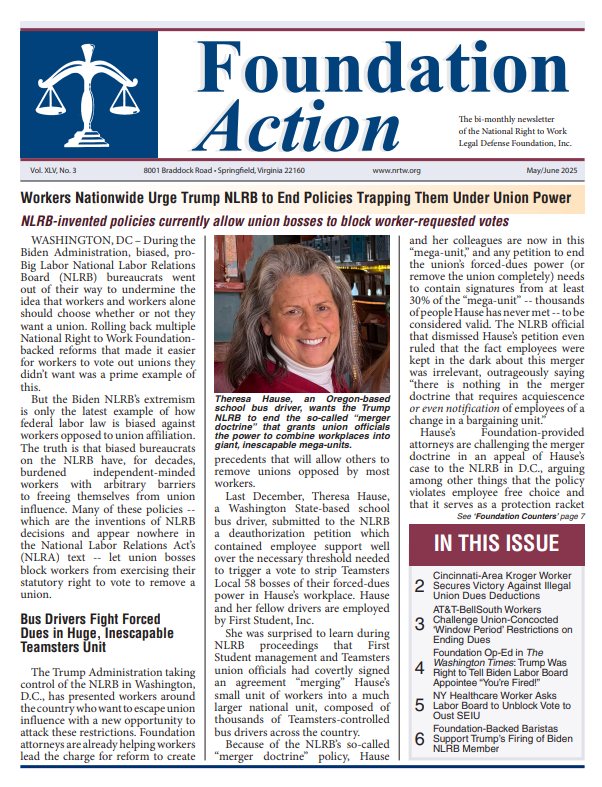
All articles from the May/June 2025 issue of Foundation Action are now online.
In this issue:
- Workers Nationwide Urge Trump NLRB to End Policies Trapping Them Under Union Power
- Cincinnati-Area Kroger Worker Secures Victory Against Illegal Union Dues Deductions
- AT&T-BellSouth Workers Challenge Union-Concocted ‘Window Period’ Restrictions on Ending Dues
- Trump Was Right to Tell Biden Labor Board Appointee “You’re Fired!”
- NY Healthcare Worker Asks Labor Board to Unblock Vote to Oust SEIU
- Foundation-Backed Baristas Support Trump’s Firing of Biden NLRB Member
Recent articles can be found here. To sign up for a free copy of the newsletter via mail please see the form at the bottom of the page.
Full Foundation Action March/April Newsletter Now Online
All articles from the March/April 2025 issue of Foundation Action are now online.
In this issue:
- Workers Nationwide Urge Trump NLRB to End Policies Trapping Them Under Union Power
- Cincinnati-Area Kroger Worker Secures Victory Against Illegal Union Dues Deductions
- AT&T-BellSouth Workers Challenge Union-Concocted ‘Window Period’ Restrictions on Ending Dues
- Trump Was Right to Tell Biden Labor Board Appointee “You’re Fired!”
- NY Healthcare Worker Asks Labor Board to Unblock Vote to Oust SEIU
- Foundation-Backed Baristas Support Trump’s Firing of Biden NLRB Member
Recent articles can be found here. To sign up for a free copy of the newsletter via mail please see the form at the bottom of the page.





