
Special Legal Notice Informs Los Angeles Teachers of Right to Work During Union Strike Against Public Schools
National Right to Work Foundation attorneys inform teachers of how to exercise legal right to continue working despite UTLA union-ordered strike
Los Angeles, CA (January 11, 2019) – The National Right to Work Legal Defense Foundation has issued a Special Legal Notice informing Los Angeles teachers of their rights regarding the strike that United Teachers Los Angeles officials have ordered.
The notice explains that, although union officials have ordered teachers out on strike, employees have the legal right to rebuff union officials’ strike demands. The notice informs teachers unwilling to abandon their students how to protect themselves against union retaliation by resigning their formal union membership prior to working while union officials are demanding they cease educating students.
According to the notice:
“Teachers and other school employees who don’t want to abandon their schools and their students are advised to carefully read the following notice about their legal rights. The situation raises serious concerns for employees who believe there is much to lose from a union ordered strike. Employees have the legal right to rebuff union officials’ strike demands, but it is important for them to be informed before they do so.”
The notice, which can be found on the National Right to Work Foundation website at www.nrtw.org/special-legal-notice-teachers-los-angeles, provides important legal information for any teacher who wishes to continue to work during the strike.
“Teachers shouldn’t be kept in the dark any longer about their legal protections in the event of a strike,” said Mark Mix, president of the National Right to Work Foundation. “Despite union boss pressure, Los Angeles educators should know that they do not have to abandon their classrooms simply because union officials make demands. The Foundation will provide free legal aid for any teacher or other worker who seeks to exercise his or her rights, or is subjected to threats for doing so.”
Workers can request free legal aid at www.nrtw.org/free-legal-aid or by calling the Foundation toll-free at 1-800-336-3600.
Minnesota Union Bosses Give Up “Window Period” Scheme Designed to Block Worker’s Janus Rights
IBEW union officials quickly settle after Minnesota police department employee filed lawsuit to stop forced illegal union dues seizures
Brainerd, MN (January 14, 2019) – A federal First Amendment lawsuit brought by National Right to Work Legal Defense Foundation staff attorneys for Minnesota public sector employee Sandra Anderson against International Brotherhood of Electrical Workers (IBEW) Local 31 has forced union officials to quickly settle. The settlement frees Anderson from IBEW union officials’ “window period” policy that had blocked her from exercising her constitutional right to refrain from financially supporting the union.
Anderson, a clerk for the City of Brainerd Police Department, filed the lawsuit after she attempted to resign her union membership and revoke her dues deduction authorization after the Foundation-won Janus v. AFSCME ruling at the U.S. Supreme Court.
When IBEW Local 31 and the City of Brainerd entered into a monopoly bargaining agreement in 2004 that required employees to pay union dues or fees to IBEW Local 31 to keep their jobs, Anderson was informed that she must either join the union or pay union fees. Faced with being forced to fund the union either way, she joined the union, signing a form authorizing the deduction of union dues from her paycheck.
Earlier this year, Foundation staff attorneys argued and won Janus at the Supreme Court. In Janus, the Court ruled it unconstitutional to require public employees to subsidize a labor union. The Court further held that deducting any union dues or fees without a public employee’s affirmative consent violates the employee’s First Amendment rights.
When Anderson signed her dues deduction authorization, she was not informed of her First Amendment right to refrain from paying union dues or fees and, therefore, could not give her affirmative consent to waiving her First Amendment right not to subsidize the union.
Soon after Janus, Anderson emailed an IBEW official and Brainerd representatives demanding that both parties cease collecting dues from her wages in accordance with Janus. However, IBEW officials claimed that Anderson could only stop dues payments either during a 10-day window prior to the expiration of the monopoly bargaining contract or a 10-day window prior to the anniversary date of her dues deduction authorization.
Anderson came to Foundation staff attorneys to file a lawsuit challenging the “window period” policy as unconstitutional, because the policy limits when she can exercise her First Amendment rights under Janus and allows IBEW Local 31 union officials to collect union dues without her affirmative consent.
Deciding to settle the lawsuit, IBEW will refund to Anderson all union dues they unconstitutionally collected from her after she notified the City of Brainerd and IBEW Local 31 that she no longer consented to financially supporting the union. IBEW officials have also acknowledged Anderson’s request to withdraw her union membership, and will not seek or accept union dues from her again unless she affirmatively chooses to become a union member.
Public employees across the country are pursuing similar lawsuits with assistance from Foundation staff attorneys. For example, in one ongoing class action lawsuit, two New Jersey public school teachers are challenging a state law that enforces a “window period” policy to block public sector workers’ attempts to exercise their rights under Janus.
“Ms. Anderson is the first of thousands of government employees to successfully challenge union boss ‘window period’ schemes designed to limit workers from exercising their First Amendment rights under Janus,” commented National Right to Work Foundation President Mark Mix. “This victory serves as an inspiration for civil servants across the country who are stepping up to challenge union bosses’ coercive tactics to limit public employees’ constitutional rights.”
The Foundation has created a special website, MyJanusRights.org, to assist public employees in exercising their rights under Janus, which was successfully argued by National Right to Work Foundation staff attorney William Messenger.
Massachusetts Supreme Court Hears Educators’ Challenge to Teacher Union’s Government-Granted Coercive Powers
Four Bay State educators argue that MTA scheme violates their rights by prohibiting nonmembers from having influence over workplace conditions
Boston, MA (January 7, 2019) – Tomorrow, a National Right to Work Legal Defense Foundation staff attorney will deliver arguments at the Massachusetts Supreme Judicial Court for a group of Massachusetts educators. The educators are challenging state law that grants union officials’ monopoly bargaining privileges which union officials use to gag nonmembers from having a voice and a vote in their working conditions. The educators argue this violates their First Amendment rights.
The group of four educators, from the University of Massachusetts and Hanover School Committee, all believe they would be better off without representation from the National Educators Association (NEA) and its affiliates.
The plaintiffs argue their First Amendment rights are violated when they are forced to be union members to exercise their rights under state law to have a say in their workplace conditions. Under the Foundation-won U.S. Supreme Court Janus v. AFSCME decision, workers cannot be required to fund a union. However, under Massachusetts labor laws the educators must waive their First Amendment rights and become full members to have any say in their working conditions.
The four plaintiffs have chosen to refrain from union membership. The lead plaintiff in the lawsuit, Dr. Ben Branch, is a finance professor. His colleague and fellow plaintiff, Dr. Curtiss Conner, is a chemistry professor, both at the University of Massachusetts Amherst.
Plaintiff Dr. Andre Melcuk is Director of Departmental Information Technology at the Silvio O. Conte National Center for Polymer Research at the University. Dr. Melcuk was born in the Soviet Union and opposes the union based on his dislike of collectivist organizations.
Plaintiff Deborah Curran is a long-term teacher in the Hanover Public Schools. The union officials who supposedly “represent” her attempted to invalidate her promotion to a position mentoring new teachers and pushed to have her investigated and suspended. She ultimately spent nearly $35,000 of her own money battling union officials just to protect her job.
In the case, Foundation staff attorneys argue that Massachusetts state law violates the educators’ First Amendment rights by barring their voice and vote in their workplace conditions if they decide to refrain from becoming union members, paying full union dues, and supporting union political activity.
In the June 2018 Janus victory, the U.S. Supreme Court declared that forcing any public sector employee to pay union dues or fees violates the First Amendment. The educators’ case points out that denying workers a voice in their workplace unless they are union members is another form of compulsion to support a union, and should be ruled a violation of the First Amendment.
“These are dedicated teachers and professors who are being forced to choose between losing their voice in the workplace or paying tribute to union bosses who clearly do not have their best interests in mind,” said Mark Mix, president of the National Right to Work Foundation. “Although the Foundation-won Janus decision upheld public sector workers’ First Amendment right to choose whether or not to pay union fees, union officials still seek to twist workers’ arms into funding Big Labor’s coffers. A clear ruling is needed to uphold these educators’ right to refrain from union membership without fear of retaliation or coercion.”
Federal Court Asked to Order NLRB to Rule in Nine Year Old Case Attacking Forced Union Fees for Lobbying
Case pending at Labor Board for more than five years also challenges union bosses’ failure to adequately disclose how they spend compulsory union fees
Washington, DC (January 2, 2019) – Today, National Right to Work Foundation staff attorneys have filed a petition seeking an order that the National Labor Relations Board (NLRB) take action on a nine-year-old case that has been awaiting a decision for more than five years. The case was brought by nurse Jeanette Geary after union officials kept her and her colleagues in the dark about how their forced union fees are spent.
Foundation staff attorneys filed the mandamus petition at the U.S. Court of Appeals for the District of Columbia Circuit seeking a court order that the NLRB promptly decide Geary’s case. The Board had issued a decision in 2012, but after the U.S. Supreme Court ruled that President Obama had violated the Constitution by making three illegal recess appointments to the Board, that decision and many others were invalidated. Of those invalidated, Geary’s case is among a few cases, if not the only one, still pending without a decision.
Geary, then a nurse at Kent Hospital in Warwick, Rhode Island, filed an unfair labor practice charge in 2009 with free legal aid from Foundation staff attorneys. Her charge stated that United Nurses and Allied Professionals (UNAP) union officials unlawfully spent her forced union fees and failed to meet financial disclosure requirements as to the amount of the compulsory fees required as a condition of employment.
Geary and other nurses informed UNAP union officials that they were exercising their right to refrain from formal union membership and from the payment of “non-chargeable” fees for activities unrelated to union bargaining, including politics, lobbying and member-only events.
UNAP union officials failed to provide Geary and other nonmember nurses with a disclosure of the part of union fees the workers are forced to pay, claiming Geary could be charged for union lobbying activities. According to the charge, union bosses failed to provide any evidence of an independent audit “beyond a mere assertion.” Moreover, union officials provided no breakdown of expenditures from a so-called “Defense Fund” despite claiming they included chargeable expenses.
In the Foundation-won Supreme Court Beck decision, the Court held that private-sector employees can only be forced to pay, as a condition of employment, union dues related to specific union activity. Additionally, union officials must provide employees with an independently verified breakdown of union expenditures showing how much objecting employees must pay to keep their jobs.
In 2012, President Obama’s illegally-appointed NLRB rejected Supreme Court precedent and granted union bosses power to charge nonmember workers for union political lobbying, including lobbying in other states. However, that decision was invalidated by the Court’s holding in NLRB v. Noel Canning that the Board lacked a valid quorum because of three unconstitutional “recess appointments” President Obama made.
“UNAP union bosses should be held accountable for their blatant refusal to respect the rights of the workers they claim to represent,” said National Right to Work Foundation President Mark Mix. “Justice delayed is justice denied, and it’s long past time the NLRB issues a decision that affirms workers’ protections from union boss coercion.”
New Mexico State Worker Files Class Action Lawsuit to Recover Unauthorized Dues Seized by CWA Union Officials
Constitutional rights of hundreds of public employees likely violated by CWA union “window period” scheme to deduct dues by force despite Supreme Court’s Janus ruling
Santa Fe, NM (December 27, 2018) – A New Mexico state employee has filed a class action lawsuit in federal court because union officials violated his First Amendment rights through a scheme to require him and other state employees to pay money to the union as a condition of employment.
IT technician David McCutcheon, employed by New Mexico’s Department of Information Technology (DoIT), filed the lawsuit in the U.S. District Court for the District of New Mexico against the Communication Workers of America (CWA) union, CWA Local 7076 union, and New Mexico Personnel Office Director Justin Najaka on December 20 with free legal aid from National Right to Work Legal Defense Foundation staff attorneys.
McCutcheon’s suit states that CWA officials seize unauthorized membership dues out of his paycheck and refuse to allow workers to opt out of union payments except during a union dictated “window period.” The lawsuit asks the court to end this scheme and seeks a refund of union membership dues and fees for all New Mexico public workers who were similarly victimized.
Union officials forced McCutcheon to pay nonmember union fees to keep his job beginning in April 2017. However, in Janus v. AFSCME on June 27, 2018, the U.S. Supreme Court ruled it unconstitutional to require any public employee to pay union membership dues or fees without his or her explicit consent.
Following the Janus ruling, McCutcheon informed union officials in writing that he did not consent to any deduction of union fees. Union officials responded that his request had been “submitted for processing.”
But, instead of halting deductions, union officials began seizing full membership dues, rather than the lesser nonmember fees, from McCutcheon’s wages without his permission starting in September. According to union officials, under the union contract McCutcheon could only stop these larger deductions by again revoking authorization during the annual two-week December “window period.”
Because union officials refused to respect his legitimate request, McCutcheon has asked the district court to recognize his First Amendment rights to free speech and free association in accord with Janus and strike down this unconstitutional “window period” scheme. McCutcheon also seeks a refund of membership dues and fees seized from himself and the likely hundreds of other public employees in New Mexico who have been similarly victimized during the past three years.
“Contrary to the wishes of New Mexico union bosses and their allies in state government, First Amendment rights cannot be limited to just a couple of weeks per year,” said Mark Mix, president of the National Right to Work Legal Defense Foundation. “All civil servants should be able to exercise their rights to free speech and free association by cutting off union payments whenever they choose without interference by union officials.”
“Unfortunately, even after the Foundation-won Janus decision by the Supreme Court, it appears more legal action is necessary to force union officials to end their ‘massive resistance’ and respect the rights of the very workers they claim to represent,” added Mix.
Workers’ Lawsuits Challenge State Attempts to Restrict their Janus Rights
The following article is from the National Right to Work Legal Defense Foundation’s bi-monthly Foundation Action Newsletter, November/December 2018 edition.
Cases seek to strike down laws that let union bosses block workers from stopping dues payments
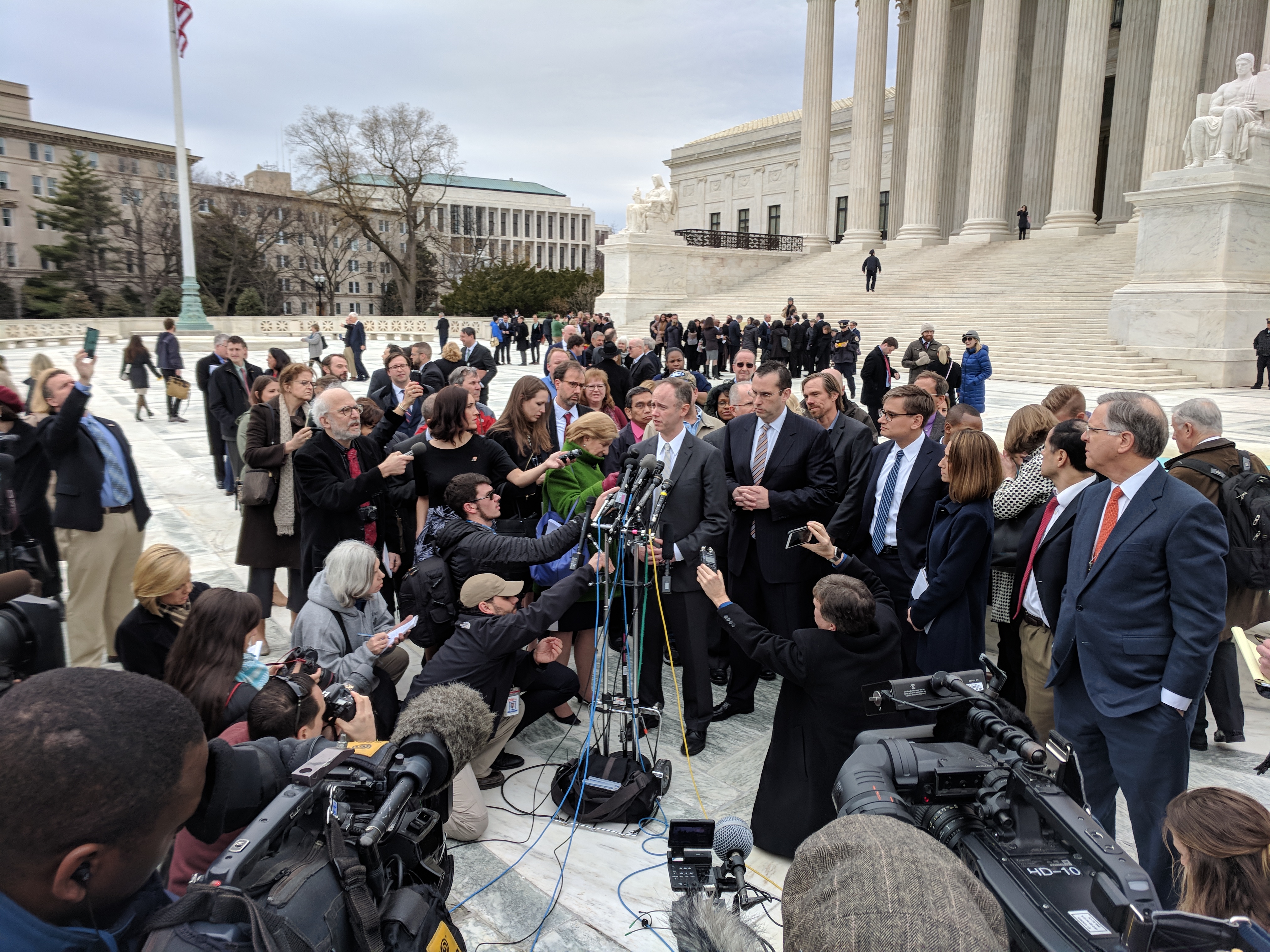
Foundation staff attorney William Messenger argued Janus at the Supreme Court. The Foundation’s victory must be vigilantly enforced.
SPRINGFIELD, VA – Since the 2012 passage of Right to Work legislation in the Wolverine State, Foundation staff attorneys have provided free legal assistance to Michigan workers in more than a hundred cases. With 41 ongoing cases and another 61 closed as of the publication of this article, Michigan cases continue to make up a disproportionate amount of the Foundation’s caseload of approximately 220-230 active cases at any given time. Developments in Foundation legal cases in recent months show that despite dozens of victories for workers, Michigan union bosses continue to attempt to force workers to pay dues despite the Right to Work laws.
These federal lawsuits are among dozens of legal actions workers have pursued, with the assistance of Foundation staff attorneys, to enforce the Supreme Court’s Janus ruling. As decades of Foundation litigation has amply demonstrated, without relentless enforcement, Big Labor ignores precedent and violates the rights of rank-and-file workers.
In California, Foundation staff attorneys are assisting Mark Smith, a court worker in Contra Costa County, who attempted to exercise his new protections days after the Janus decision.
Mr. Smith submitted his resignation from membership in American Federation of State, County, and Municipal Employees (AFSCME) Local 2700 and told union officials they did not have his authorization to deduct union dues from his paycheck.
AFSCME officials continued siphoning Mr. Smith’s hard-earned money without his consent and despite his multiple attempts to resign. When Mr. Smith sent his resignation via certified mail, postal service records show union officials left the delivery unclaimed.
After his requests were repeatedly ignored, Mr. Smith came to Foundation staff attorneys for free legal aid in filing a federal lawsuit against AFSCME officials and his government employer.
In the complaint, Mr. Smith challenges union officials’ violation of his First Amendment rights and a California law requiring public employers to deduct dues at the union’s request, even if the worker revokes authorization. This egregious law, enacted mere hours after the Janus decision, also blocks public employers from informing employees of their Janus rights.
In Pennsylvania, school bus driver Michael Mayer attempted to exercise his rights under Janus just weeks after the ruling. He resigned his membership in the Teamsters union on July 20 and hand-delivered a notice in August demanding that his employer stop deducting membership dues from his paycheck.
However, Teamsters Local 312 officials refused to honor his resignation, and his employer, Wallingford-Swarthmore School District, continued withdrawing union dues from Mr. Mayer’s hard-earned wages.
Teamster bosses claimed Mr. Mayer only had a 15-day window to escape from the union’s new monopoly bargaining contract under a section of Pennsylvania’s Public Employee Relations Act (PERA). Such a policy directly conflicts with the Supreme Court’s Janus ruling, which held that dues taken without workers’ clear and knowing affirmative consent violate the First Amendment.
When dues continued to be seized from Mayer’s paycheck in September, Foundation staff attorneys filed a federal lawsuit against the Teamsters union and the school district for violating his rights.
The lawsuit seeks a refund of the dues that the Teamsters conspired to take without his consent after his resignation and asks the court to rule that the PERA violates his First Amendment rights by restricting his ability to resign union membership and stop paying dues.
“Unfortunately, though not surprisingly, rather than work to earn the voluntary support of the workers they claim to represent, union officials coast-to-coast are resorting to illegal schemes to block workers from exercising their rights under the Janus decision,” said Mark Mix, president of the National Right to Work Foundation. “These cases likely won’t be the last challenging attempts to prevent workers from exercising their Janus rights.”
Seattle Housekeeper Challenges NLRB Policy Blocking Secret Ballot Vote to Remove Union
The following article is from the National Right to Work Legal Defense Foundation’s bi-monthly Foundation Action Newsletter, November/December 2018 edition.
Foundation attorneys seek to overturn Obama-era ruling that traps workers in union after abuse-prone “card check”
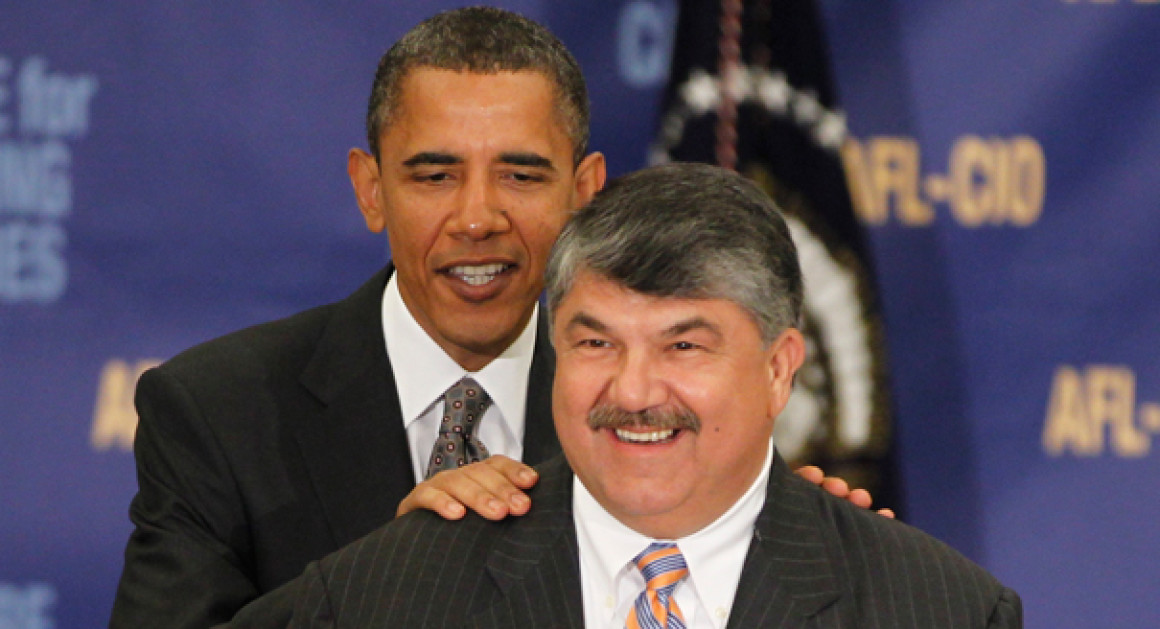
Foundation staff attorneys have asked the Trump NLRB to repeal Obama-era rulings that granted coercive powers to union officials, such as AFL-CIO top boss Richard Trumka (right), at the expense of worker freedom.
WASHINGTON, DC – Since 2011, a Big Labor-friendly ruling by the Obama National Labor Relations Board has barred workers from holding secret ballot votes to remove an unwanted union from their workplace.
Foundation staff attorneys have urged the new Trump NLRB to overturn the case called Lamons Gasket to restore employees’ protections against union officials’ coercion. The latest appeal, the third this year brought by staff attorneys, is on behalf of Seattle hotel housekeeper Gladys Bryant.
Bryant works at Embassy Suites. UNITE HERE Local 8 union officials unionized the workplace through a card check drive, which bypasses an NLRB-supervised secret ballot election and is often characterized by manipulation and intimidation. Union organizers misled Bryant and her fellow workers into signing cards, and then counted those cards as “votes” toward unionization.
When Bryant realized what had happened, she led a group of colleagues in filing an NLRB petition for a secret ballot decertification vote with free legal aid from Foundation staff attorneys.
However, the election petition was dismissed by a regional career NLRB official using the Lamons Gasket ruling.
Under the Foundation-won Dana decision, workers could collect signatures to request a secret ballot election during a 45-day window following notice that they had been forced under union representation via card check. Dana had provided an important, although limited, protection for workers against coercive card check drives. However in the 2011 Lamons Gasket ruling, an Obama-selected NLRB overturned Dana. This means that no matter how many workers sign a petition seeking to oust a union, they can be barred for one year before they can file for a secret ballot vote.
Instead of ceding her workplace voice when her secret ballot vote petition was dismissed under Lamons Gasket, Bryant continued the legal battle with help from Foundation staff attorneys.
Foundation attorneys have submitted an appeal to the NLRB asking the Board to overturn Lamons Gasket and restore workers’ protections against the coercive tactics union officials use to force their monopoly bargaining privileges onto employees.
Such protections are especially important for workers in states like Washington that lack Right to Work protections. In those states, private sector employees can be forced to pay fees as a condition of employment to a union about which they never even had the chance to vote.
“Ms. Bryant’s situation reveals the coercive nature of a card check drive, and why the Trump Labor Board must end the Obama Board’s disastrous precedent,” said National Right to Work Foundation Vice President and Legal Director Ray LaJeunesse. “The Lamons Gasket decision means that workers can be forced to pay union fees even if the majority of the workplace wants to vote out the union. Workers must be allowed to fight back against this coercive process.”
Foundation staff attorneys also filed unfair labor practice charges, still under NLRB investigation, for Bryant against the union and hotel management for coercive tactics used in the union card check process.
Homecare Providers Seeking to Recover Seized Union Fees File Petition at Appeals Court for Rehearing
Full 7th Circuit asked to review decision blocking return of $32 million in union fees seized from 80,000 providers in violation of First Amendment
Chicago, IL (December 20, 2018) – National Right to Work Legal Defense Foundation staff attorneys have filed a petition asking the full U.S. Court of Appeals for the Seventh Circuit to rehear their case in which Illinois homecare providers seek the return of over $32 million in union fees seized by SEIU officials in a scheme the U.S. Supreme Court declared unconstitutional.
The case, Riffey v. Rauner, is a continuation of the 2014 Foundation-won Supreme Court Harris v. Quinn case. In Harris, the Court ruled that a scheme imposed by the State of Illinois, in which over 80,000 individual homecare providers were forced to pay union fees out of the state funding they receive, violated the providers’ First Amendment rights.
Earlier this year, Foundation staff attorneys successfully petitioned the U.S. Supreme Court to review and reverse the Appeals Court’s ruling. The High Court did so the day after it issued the landmark Janus v. AFSCME case, ordering the Appeals Court to reconsider the case in light of the Janus ruling, which struck down public sector forced union fees as violating the First Amendment.
In Janus, which was argued by the same National Right to Work Foundation staff attorney who is lead counsel in the Riffey case, the Supreme Court clarified that any union fees taken without an individual’s informed consent violate the First Amendment. That standard supports the Riffey plaintiffs’ claim by that all providers who had money seized without their consent are entitled to refunds.
However, on December 6 a three-judge panel of the Appeals Court affirmed its previous ruling that no class can be certified from the over 80,000 providers whose money was seized in violation of their First Amendment rights. The panel based its decision on the ground that each individual homecare provider would have to prove that he or she objected to the taking of the fees when the seizures occurred.
In 2014, the case was re-designated Riffey v. Rauner and remanded to the District Court to settle remaining issues, including whether or not tens of thousands of providers who had not joined the union would receive refunds of the money taken from them unlawfully by the SEIU.
In June 2016, the District Court denied a motion for class certification. The ruling allowed the SEIU to keep the over $32 million in unconstitutional fees confiscated from union nonmembers who never consented to their money being taken for union fees. Foundation staff attorneys appealed that ruling to the Appeals Court.
Now Foundation staff attorneys have petitioned the Appeals Court to rehear the case en banc. The petition argues that Janus requires that the lower court’s class certification order be reversed. Foundation staff attorneys point out that the Janus precedent does not require a worker to prove his or her subjective opposition to forced union fees. Rather, Janus held that the First Amendment is violated if union dues or fees are seized without the worker’s clear affirmative consent.
The petition argues that the case is of exceptional importance because it concerns the return of more than $32 million seized from some 80,000 homecare providers in violation of their First Amendment rights.
“The U.S. Supreme Court ruled that SEIU had illegally confiscated union dues from thousands of Illinois homecare providers, but the ruling challenged by this petition denies those same caregivers the opportunity to reclaim the money that never should have been taken from them by SEIU in the first place,” said Mark Mix, president of the National Right to Work Foundation. “If SEIU’s bosses are not required to return the money they seized in violation of homecare providers’ constitutional rights, it will only encourage similar behavior from union officials eager to trample the First Amendment to enrich themselves with the money intended for the care of individuals who need it.”
NLRB Urged to Use Rulemaking to Eliminate All Board-Created Policies that Block Workers from Ousting Unwanted Unions
National Right to Work Foundation letter asks Board to address all non-statutory “bars” to decertification votes that trap workers in unions that lack majority support
Washington, DC (December 3, 2018) – Today the National Right to Work Legal Defense Foundation submitted a letter to the National Labor Relations Board (NLRB) asking the Board to expand the scope of upcoming rulemaking to address several Board-invented doctrines that block employees from exercising their right to vote whether to remove union representation under the National Labor Relations Act (NLRA).
According to statements Board Members recently made at an American Bar Association Labor and Employment Law Conference in San Francisco, the NLRB intends to use rulemaking this winter to address two policies that restrict workers’ right to vote out union officials’ unwanted representation: the “blocking charge” policy and the “voluntary recognition bar” doctrine.
The letter from Foundation Vice President and Legal Director Raymond LaJeunesse recognizes that the Board’s decision to address those two policies that have restricted workers’ rights for years is a good first step. However, it adds that Foundation staff attorneys believe that the Board should address all “bars” and “blocks” on employees’ right to hold elections to remove unwanted union representation which are not established by the NLRA itself, because they improperly obstruct employees from exercising their free choice rights guaranteed by that statute.
“Blocking charge” policies allow union officials to file unfair labor practice charges to block employees’ petitions to decertify unions, even when a majority of unit employees sign a petition. The “voluntary recognition bar” rule prevents workers’ attempts to hold secret ballot votes to decertify a union for at least a year, and potentially up to four years, after union officials force workers into union representation via a coercive card check drive.
The letter urges the Board to also address all of the other doctrines created by past Board Members that restrict workers’ right to hold decertification elections, highlighting three other “bars” that should be eliminated. The “successor bar” blocks workers from decertifying a union for an indefinite amount of time after the previous employer has been replaced by a successor. The “settlement bar” rule prevents workers from removing an unwanted union after a settlement agreement between a union and their employer. The “contract bar” restricts when workers can file decertification petitions to a narrow window of time that may occur only once in three years.
As the letter and the Foundation’s formal comments concerning the Obama Board’s “ambush election” rules filed with the NLRB earlier in the year point out, none of these bars are authorized by the statute. Moreover, all undermine workers’ rights under the NLRA by allowing union officials to maintain monopoly representation powers even when a majority of the workers they claim to represent oppose union representation.
“These restrictive doctrines have granted power to union bosses at the expense of the rights of the employees whose choice the National Labor Relations Act purports to protect,” said Mark Mix, president of the National Right to Work Foundation. “Each of these Board-invented doctrines actively undermines the NLRA’s central premise by trapping workers in unions that lack the support of a majority of workers, which is why the announced rulemaking should eliminate all of these non-statutory barriers to holding decertification votes.”
Lawsuits Seek Over $170 Million in Forced-Fees Refunds Under Janus Precedent
The following article is from the National Right to Work Legal Defense Foundation’s bi-monthly Foundation Action Newsletter, November/December 2018 edition.
Foundation fights to enforce SCOTUS victory and return illegally seized union fees to employee victims
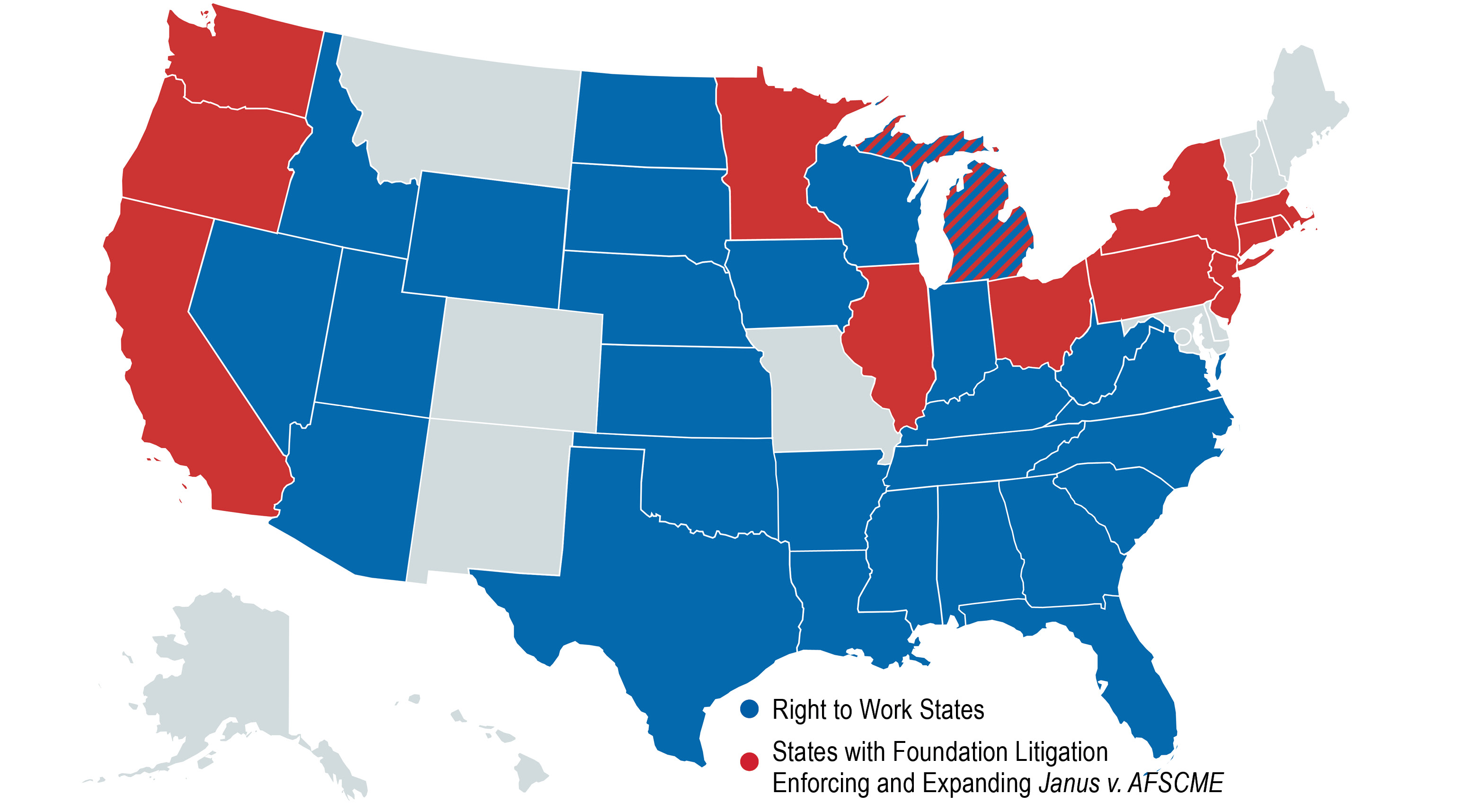
Foundation staff attorneys are already litigating more than a dozen cases for public sector employees previously forced to pay union fees in violation of their First Amendment rights, and receive more requests daily.
SALEM, OR – After years of being forced to financially support a union, public sector workers across the country are finally free from compulsory union fees as a result of the Foundation-won U.S. Supreme Court Janus v. AFSCME decision. Enforcing the monumental victory, Foundation staff attorneys are providing free legal aid to thousands of government employees to reclaim their hard-earned money through class action lawsuits.
In Janus, briefed and argued by Foundation staff attorneys, the U.S. Supreme Court ruled that charging any government employee union fees as a condition of employment is a violation of the First Amendment. Unions may collect fees when an employee gives their clear and affirmative consent.
Government employees are now looking to hold union officials accountable for money unconstitutionally seized before the Janus decision. Foundation staff attorneys have filed several class action lawsuits for workers.
Together, the suits seek more than $170 million to be reclaimed from union officials’ coffers and returned to the individuals who earned it in the first place. That amount will continue to grow as Foundation staff attorneys file more class action lawsuits to seek forced fees refunds for more government employees.
In one such lawsuit, potentially tens of millions of dollars are at stake for a class of thousands of Oregon state workers.
In September, a group of public employees filed a lawsuit against the three largest Oregon public sector unions with a class action complaint to enforce the Janus precedent. Foundation staff attorneys represent the group as they seek refunds of forced fees from Oregon affiliates of the Service Employees International Union (SEIU); American Federation of State, County, and Municipal Employees (AFSCME); and the National Education Association (NEA), as well as the Oregon-based Association of Engineering Employees (AEE).
The lawsuit seeks the return of affected workers’ money taken by the unions over the last six years, as allowed by the applicable statute of limitations, which is estimated by legal experts to total 30 million dollars or more. The Oregon employees’ lawsuit is just one of several across the country.
Also in September, Kiernan Wholean and James Grillo, workers at the Connecticut Department of Energy and Environmental Protection (DEEP), filed a complaint against the Connecticut State Employee Association (SEIU Local 2001) and the Secretary of Office of Policy Management, the Undersecretary of Labor Relations, and the Commissioner of DEEP of Connecticut.
Wholean and Grillo are not members of SEIU Local 2001 and had not consented to the deduction of forced union fees from their wages. Before Janus, they and other non-member employees had been forced to pay union fees as a condition of employment.
Connecticut stopped deducting union fees from the workers’ wages following a letter to the State Comptroller from the National Right to Work Foundation, which threatened legal action for any dues deductions from non-members that continued after Janus. However, DEEP still maintains a monopoly bargaining agreement with SEIU Local 2001 officials that requires non-members to pay union fees to get or keep jobs.
The complaint, filed at the U.S. District Court for the District of Connecticut with free legal aid from Foundation staff attorneys, asks that the court certify a class to include all individuals who during the statutory limitations period were forced to pay union fees to SEIU Local 2001 without their affirmative consent, and to order the union to return the unconstitutionally seized fees to the class. The class potentially includes hundreds of workers.
Adding to the legal attack on union officials’ ill-gotten gains, a California state employee filed a lawsuit to enforce the Janus victory and return unconstitutionally forced fees to potentially 5,000 workers.
William Hough has worked at the Santa Clara Valley Transportation Authority (VTA) since 2005. He in no way wished to support Service Employees International Union (SEIU) Local 521 and exercised his right to refrain from union membership. However, he and other non-member employees were still forced by state law to pay union fees to keep their jobs.
After the Janus decision, Hough seeks the return of the money union officials seized from him and other employees. With free legal aid from Foundation staff attorneys, he filed his class action lawsuit against the VTA, SEIU Local 521, and the Attorney General and Governor of California.
Hough’s lawsuit asks for the class to include all affected individuals who, at any time within the applicable limitations period, were forced to pay fees to SEIU Local 521 without their consent. With a potential class of 5,000 workers, those union fees may total five million dollars.
The lawsuit also challenges the constitutionality of California’s law that, despite Janus, still authorizes Local 521 and its affiliates to seize union dues from non-members without their consent. Hough asks the court to declare such California laws a violation of the First Amendment.
In addition to the new cases reported in this article, Foundation staff attorneys continue to pursue other lawsuits to recoup forced fees for workers, as reinforced by the Janus precedent. In Hamidi v. SEIU, a class of 30,000 California state workers seek more than $100 million in unconstitutionally seized forced union fees. In Riffey v. Rauner, a group of Illinois home care providers asks for the return of $32 million in union fees seized through another coercive scheme.
“While hundreds of thousands or more non-member government employees are no longer having forced fees deducted from their paychecks, that doesn’t address the decades of constitutional violations perpetrated by union officials against workers,” said National Right to Work Foundation Vice President Patrick Semmens. “Justice demands that the money union bosses illegally seized be returned to the victims of such schemes.”





