
Special Legal Notice for West Virginia Employees of AHF Products Issues by National Right to Work Foundation Staff Attorneys
Beverly, WV (March 16, 2020) – Amid reports of a strike called by Teamsters union officials, and due to requests for legal assistance that often accompany such union-instigated work stoppages, National Right to Work Legal Foundation staff attorneys have issued a special legal notice to workers at the AHF Products plant in Beverly, West Virginia.
The special legal notice outlines workers’ rights that union officials won’t share with them, and specifies what steps workers should take if they wish to exercise their right to work during the strike:
Teamster union officials have ordered AHF Products workers at the company’s Beverly, West Virginia plant to abandon their jobs and go on strike.
The situation raises serious concerns for workers who believe there is much to lose from engaging in a union-ordered strike.
Employees have the right under federal labor law to rebuff union officials’ strike demands, but it is important for you to be informed before you do so.
IF YOU WOULD LIKE TO CONTINUE WORKING OR RETURN TO WORK DURING A STRIKE READ ALL OF THIS SPECIAL NOTICE BEFORE CROSSING A PICKET LINE TO WORK – IT MIGHT SAVE YOU THOUSANDS OF DOLLARS!
Read the complete legal notice here.
West Virginia Supreme Court Hears Right to Work Case
The following article is from the National Right to Work Legal Defense Foundation’s bi-monthly Foundation Action Newsletter, January/February 2020 edition. The West Virginia Supreme Court heard arguments in this case on January 15 and a decision is expected in the coming months. To view other editions or to sign up for a free subscription, click here.
Foundation continues to defend all Right to Work laws against Big Labor attack
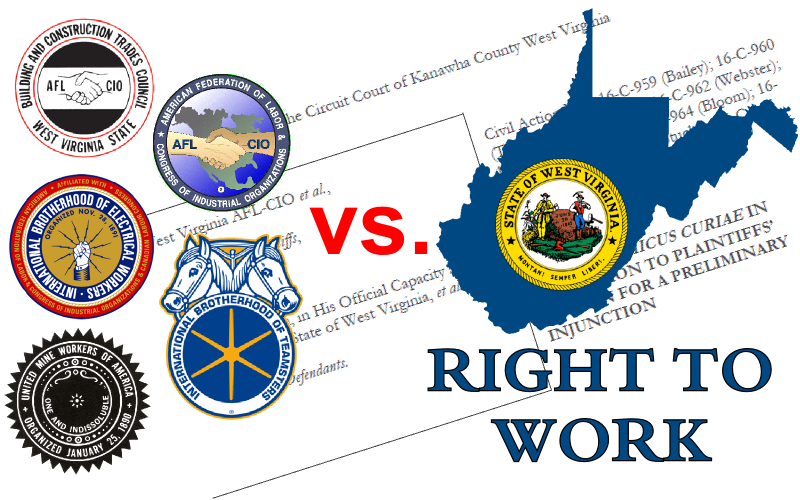
Forced-dues-hungry union bosses have been waging a legal battle to overturn West Virginia’s Right to Work Law since it was enacted in 2016. Foundation staff attorneys have been fighting back by filing amicus briefs in court.
CHARLESTON, WV – The West Virginia Supreme Court will hear arguments on January 15 in union bosses’ long-running case seeking to dismantle West Virginia’s Right to Work Law and restore their forced-dues powers over workers across the Mountain State. National Right to Work Foundation staff attorneys have already filed multiple legal briefs in this case for West Virginia workers in defense of West Virginia’s Right to Work Law.
After Passage, Union Bosses Immediately Target West Virginia Right to Work Law
Last year, union lawyers relied on discredited legal arguments to convince Kanawha County Circuit Court Judge Jennifer Bailey to declare West Virginia’s entire Right to Work Law invalid. Union lawyers dubiously claim that West Virginia union bosses have a “right” to forced dues. Judge Bailey issued a similar ruling blocking the Right to Work law after the legislation was signed into law in 2016. The West Virginia Supreme Court overturned that decision, citing arguments made in briefs by Foundation staff attorneys. “Of course, union partisans never willingly accept the loss of forced dues,” said National Right to Work Foundation President Mark Mix. “So now the issue is back at the state’s highest court.” If Big Labor’s lawsuit to overturn
West Virginia’s Right to Work Law succeeds, union bosses could have thousands of independent-minded workers across the state fired solely for refusing to subsidize union activities.
Foundation Files 10 Briefs to Protect Rights of West Virginia Workers
Foundation staff attorneys have filed 10 legal briefs in the multi-year case. The Foundation’s latest amicus brief was filed for West Virginia nursing home employee Donna Harper. Harper, like many other workers in West Virginia, chose not to pay dues or fees to union bosses, which is her legal right in a Right to Work state.
“Union bosses in West Virginia are intent on reclaiming their forced-dues power,” Mix said. “Big Labor is waging this protracted legal battle to return the Mountain State to a time when millions and millions of dollars in workers’ money were seized by union bosses to fill Big Labor’s coffers with forced dues.”
This case is the latest legal battle in the Foundation’s long history of effectively defending Right to Work laws in state and federal court from spurious attacks by Big Labor. Although federal law specifically authorizes states to pass Right to Work laws to protect workers from union boss coercion, union lawyers have repeatedly challenged these laws in an attempt to keep siphoning union dues and fees from workers’ paychecks.
Foundation Has Successfully Defended State Right to Work Laws Nationwide
In addition to West Virginia, Foundation staff attorneys have successfully pursued legal action in recent years to defend and enforce new Right to Work laws in Indiana, Michigan, Wisconsin and Kentucky, all of which have passed Right to Work protections for employees in just the last seven years. In Michigan alone, Foundation staff attorneys have assisted employees in over 100 cases since Right to Work went into effect in early 2013.
Healthcare Worker Sues Teamsters Union and Healthcare Facility for Violating West Virginia Right to Work Law
Former Tygart Center employee says union officials and employer violated her legal rights by demanding she join the union and pay union dues and fees to keep her job
Fairmont, WV (December 24, 2019) – With free legal aid from the National Right to Work Legal Defense Foundation, healthcare worker Donna Harper filed a lawsuit against Teamsters Local 175 and the Tygart Center for violating her rights under the State of West Virginia’s Right to Work law.
West Virginia’s Right to Work law prohibits requiring workers to pay union dues or fees just to get or keep a job. In defiance of West Virginia’s Right to Work law, Tygart Center and Teamsters union officials entered into a collective bargaining agreement that required employees to pay union dues and fees as a condition of employment.
When Harper was hired, Tygart Center officials informed Harper that she must become a union member and pay union dues as a condition of employment in violation of her legal rights. Tygart Center officials deducted full union membership dues and fees from Harper’s paycheck and remitted this money to Teamsters union officials.
In March 2019, Harper successfully exercised her legal rights by resigning her union membership. Even then union officials continued taking union dues from her paycheck. Union officials also never fully refunded the union dues unlawfully seized from her wages.
Foundation staff attorneys filed the suit against the Tygart Center and the Teamsters union for Harper in Marion County Circuit Court. Harper worked at the Tygart Center from February 2018 until September 2019 as a Laundry Aide and as a Certified Nursing Assistant.
Foundation staff attorneys also filed an amicus brief for Harper with the West Virginia Supreme Court defending the state Right to Work law against a protracted lawsuit brought by several unions seeking to overturn the law and restore union officials’ power to have workers fired for refusing to pay union dues or fees. That case is scheduled for oral arguments in the Supreme Court on January 15. That court has already rejected the unions’ arguments once, overturning a preliminary injunction against the Right to Work law.
“Teamsters union bosses demonstrated a blatant disregard for the law by illegally demanding Ms. Harper and her coworkers pay union dues and fees just to get or keep their jobs,” said National Right to Work Foundation President Mark Mix. “Contrary to Big Labor’s wishes, West Virginia’s Right to Work law is in full effect, meaning all union dues for workers covered by the law must be completely voluntary.”
Worker Files Brief in West Virginia Supreme Court Defending Right to Work Law
The new brief was filed by a pro-Right to Work West Virginia worker and the National Right to Work Legal Defense Foundation
Charleston, WV (March 29, 2017) – National Right to Work Legal Defense Foundation staff attorneys have filed an amicus curiae brief with the West Virginia Supreme Court in the case AFL-CIO v. Justice formerly (AFL-CIO v. Tomblin). The brief was filed Tuesday for the National Right to Work Foundation and Reginald Gibbs, an employee of the Greenbrier Hotel and Casino. Gibbs supports the state’s Right to Work Law and the protections it provides workers like him who, without Right to Work, could be fired for refusing to pay money to a union.
The brief responds to the legally dubious arguments that were presented by union lawyers, and accepted by Judge Jennifer Bailey of the Kanawha County Circuit Court. Similar arguments to the union lawyers’ primary arguments in this case for why the Right to Work protections for workers should be overturned have already been rejected by a Federal Court of Appeals and the Indiana Supreme Court when they were raised in cases involving Indiana’s Right to Work law. Furthermore, the Kanawha County Circuit Court decision unilaterally ignores nearly 70 years of legal precedent upholding the constitutionality of state Right to Work laws, including U.S. Supreme Court decisions.
After the Mountain State Right to Work law passed in February 2016, the National Right to Work Foundation offered free legal aid to any employees seeking to assert their rights under the new law. The Foundation also created a special task force to defend the West Virginia law in court from any Big Labor legal challenges. The task force filed an amicus brief in the case in Kanawha County Circuit Court, and moved for Gibbs’ intervention in the case.
“West Virginia’s popular new Right to Work law is a victory for workplace freedom, but union officials never relinquish their forced-dues privileges without a fight,” said Mark Mix, president of the National Right to Work Foundation. “Rather than being accountable by offering workers honest services they are willing to voluntarily pay for, Big Labor continues to pursue lawsuits against the very workers they claim to “represent,” raising spurious legal claims in the hopes that a judge will ignore the nearly 70 years of precedent that upholds Right to Work protections.”
The National Right to Work Foundation has a long history of successfully defending Right to Work laws in state and federal court. In addition to West Virginia, Foundation staff attorneys have taken legal action to defend and enforce new Right to Work laws in Indiana, Michigan, Wisconsin, and Missouri, all of which have passed Right to Work protections for employees since 2012.





