
Foundation Winning Protections Against Forced Unionism at Trump NLRB
The following article is from the National Right to Work Legal Defense Foundation’s bi-monthly Foundation Action Newsletter, September/October 2019 edition. To view other editions or to sign up for a free subscription, click here.
Series of victories adds protections against illegal forced dues, being trapped in union ranks
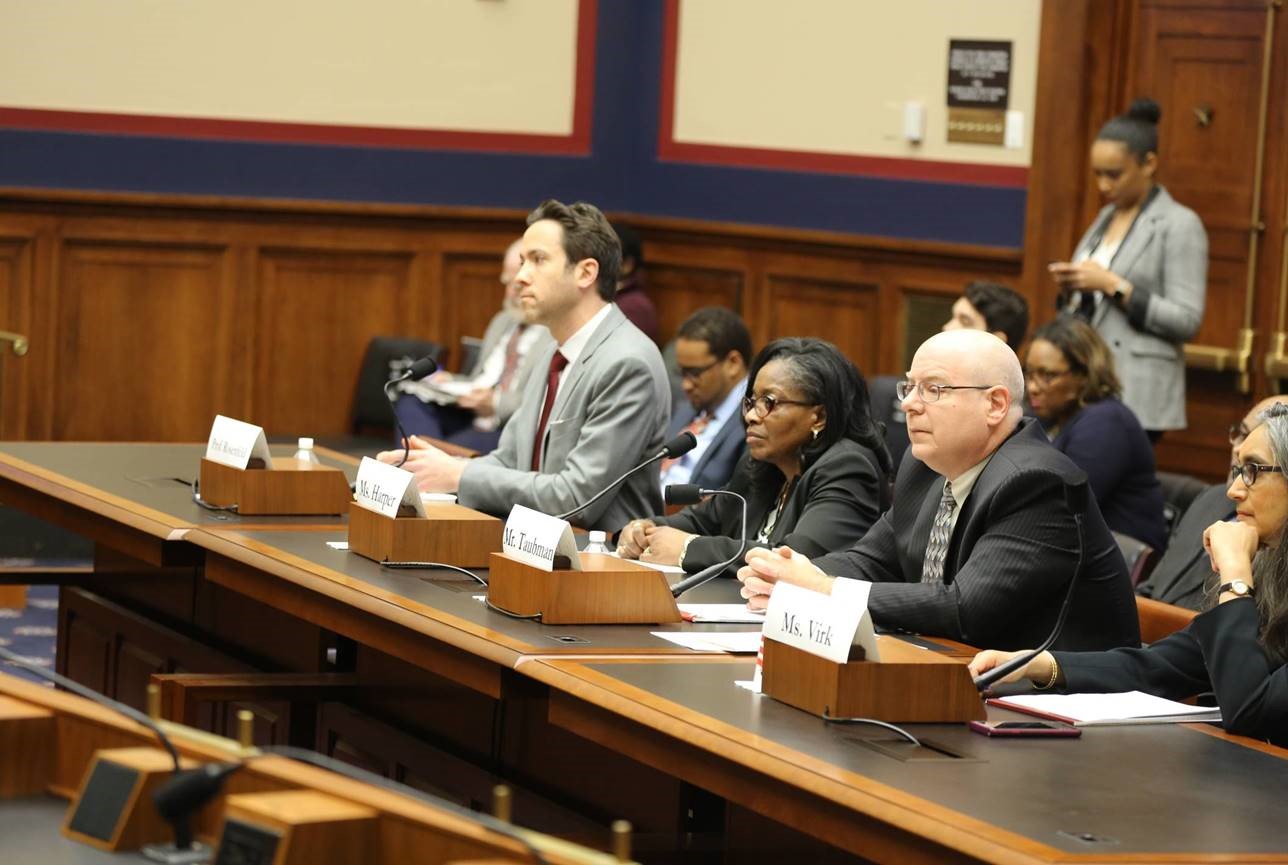
Staff attorney Glenn Taubman testified before Congress in July that existing NLRB rules wrongly favor union bosses over workers.
WASHINGTON, D.C. – In a series of recent victories, the National Labor Relations Board (NLRB) ruled in favor of workers challenging coercive union official practices, with free legal aid provided by the National Right to Work Foundation. The rulings are a stark departure from the Obama NLRB, which regularly stymied the rights of independent-minded employees opposed to associating with union bosses.
Foundation Wins Appeals in Dues Checkoff Cases
In separate cases brought by Foundation staff attorneys for Kacy Warner, a hospital worker, and Shelby Krocker, a Kroger grocery employee, the NLRB General Counsel ruled for the workers and ordered Regional Directors to prosecute union officials’ actions related to language in union dues checkoff forms.
The General Counsel’s decision to sustain Warner’s appeal concerning the checkoff authorized even more additions to the charges, saying the National Nurses Organizing Committee (NNOC) union violated the NLRA by “maintaining confusing and ambiguous dual-purpose authorization forms that unlawfully restrained employees in the exercise of their Section 7 rights.”
The General Counsel noted that the union’s forms failed to tell workers they can revoke authorizations for dues deductions after the union’s contract expires, failed to give workers adequate time to revoke authorizations, unlawfully required workers to use certified mail to send revocation requests, and failed to give “any indication to employees that payroll deduction authorization is voluntary.”
This came just a week after the General Counsel sustained another Foundation-led appeal for Krocker, who charged United Food and Commercial Workers (UFCW) union officials with illegally forcing her to sign a dues checkoff authorization. In both cases, the NLRB General Counsel authorized even more charges against union officials for misleading and confusing language regarding union dues deductions.
NLRB Regions Instructed to Prosecute Beck Violations
Also in July, the NLRB Division of Advice and General Counsel instructed regional directors to issue complaints against unions when union officials fail to inform employees of the amount of reduced union fees they can pay by objecting under the Communication Workers of America v. Beck U.S. Supreme Court decision.
The memos instruct NLRB Regional Directors to more stringently enforce workers’ Beck rights which protect workers from being forced to fund nonchargeable union activities such as union political activities. A memo issued to the Director of NLRB Region 32 read in part that “it is difficult for an employee to make an informed decision about whether to become a Beck objector without knowing the amount of savings that would result from the decision.”
“The Foundation is proud to have represented the California employee whose charge against the UFCW resulted in this Advice Memo, as well as necessitating this heightened disclosure standard by winning the Beck decision at the Supreme Court and the Penrod decision at the D.C. Circuit Court of Appeals,” National Right to Work Foundation Vice President and Legal Director Ray LaJeunesse said. Foundation staff attorneys are currently litigating several additional cases to secure and expand workers’ protections under Beck.
Ruling Aids Workers Trapped in Union Ranks They Oppose
In another Foundation victory for independent-minded workers in July, the NLRB issued a decision that limits union officials’ ability to game the NLRB system to trap workers in monopoly union ranks. The ruling allows employers to withdraw recognition from a union when a majority of its workers sign statements opposing unionization.
Foundation staff attorneys represented two workers, Brenda Lynch and Anna Marie Grant, who spearheaded the collection of signatures from a majority of workers opposed to union representation. Their employer complied with their wishes and sent the union bosses packing. After United Auto Workers (UAW) union officials sought to foist the union back onto the workers despite their clear opposition, Foundation staff attorneys persuaded the NLRB to uphold the UAW’s ouster.
“Instead of union lawyers playing legal games for months or even years to block the removal of a union that lacks majority support, the Board majority takes the common sense approach of asking union officials to prove their claim of support in a secret ballot vote of the workers,” said LaJeunesse.
Airline Workers Contest Union ‘Opt-Out’ Requirement for Political Dues
The following article is from the National Right to Work Legal Defense Foundation’s bi-monthly Foundation Action Newsletter, July/August 2019 edition. To view other editions or to sign up for a free subscription, click here.
Union bosses bullied and illegally threatened to discipline employee who defied strike demands

United Airlines fleet service employee Arthur Baisley (left) and JetBlue pilot Christian Popp (right) are challenging union boss “opt-out” rules that make nonmembers pay for union political spending without their consent.
AUSTIN, TX – United Airlines fleet service employee Arthur Baisley and JetBlue Airlines pilot Christian Popp have filed federal lawsuits against the International Association of Machinists (IAM) and Air Line Pilots Association (ALPA) unions, respectively, challenging union officials’ “opt-out” requirements designed to make non-members pay for union political activities without their consent.
Austin, TX-based Baisley and Fort Lauderdale, FL-based Popp filed their lawsuits with free legal aid from the National Right to Work Foundation. Their Foundation staff attorneys argue that the “opt-out” schemes perpetrated by IAM and ALPA bosses violate workers’ rights under the Railway Labor Act (RLA) and the First Amendment under the standard laid out in the landmark 2018 Supreme Court decision Janus v. AFSCME.
“No employee or private citizen should be trapped in a deliberately-complex system that funnels their money into political speech of which they disapprove. Unfortunately, that is exactly what IAM and ALPA union officials are doing to non-member workers across America,” commented National Right to Work Foundation Vice President and Legal Director Ray LaJeunesse.
The lawsuits contend that under Janus and the 2012 Knox v. SEIU Supreme Court case – both of which were argued and won by Foundation staff attorneys – no union dues or fees can be charged for union political activities without a worker’s affirmative consent.
Popp and Baisley, despite working in the Right to Work states of Florida and Texas, must still pay fees to their respective unions as the RLA preempts state law and permits forced dues. But, even in the absence of Right to Work protections, established Supreme Court precedent forbids unions from putting those compulsory fees towards ideological activities like lobbying or politics.
According to the lawsuits, the processes that IAM and ALPA union bosses require independent-minded workers to go through simply to exercise their constitutional right not to fund “nonchargable” activities are convoluted and typically involve having to “decipher” the opt-out requirements of the union.
Even worse, after Baisley submitted a letter to IAM agents in November 2018 objecting to funding all union political activities, the union officials only accepted his objection for 2019, and told Baisley he would be required to renew his objection to full dues and fees the next year or else be charged for full union dues.
The two complaints challenge these union boss-created policies on the grounds that they “require employees to opt-out of paying union fees that they have no legal obligation to pay” and thus violate workers’ First Amendment rights.
The complaints also allege that the “opt-out” requirements violate the RLA, which governs labor in the air and rail industries and “protects the right of employees to ‘join, organize, or assist in organizing’ a union of their choice as well as the right to refrain from any of those activities.”
Both suits are class-action, and seek court orders requiring union officials to ask for affirmative employee consent for any dues charged for political or ideological purposes in the future.
“These lawsuits show that although Janus’ most direct impact was to secure the First Amendment rights of public employees not to be required to fund Big Labor, the implications don’t stop there,” observed LaJeunesse. “Because the Janus decision made clear workers must opt-in to all political and ideological activity, Foundation staff attorneys are able to cite it in defense of airline workers covered by the Railway Labor Act.”
Foundation Legal Director Ray LaJeunesse’s commentary on Janus v. AFSCME featured on The Federalist Society Website
With free legal aid from National Right to Work Legal Defense Foundation staff attorneys, an Illinois state employee’s legal challenge to forced union dues and fees for public sector workers has garnered significant media attention nationwide since the petition to the Supreme Court of the United States was filed on June 6. Recently, Foundation Legal Director Ray LaJeunesse wrote a blog post on The Federalist Society’s website about the case, Janus v. AFSCME. An excerpt is below.
Twice in the past five years the United States Supreme Court has questioned its holding in Abood v. Detroit Board of Education, 431 U.S. 209 (1977) (6-3 decision on this issue), that the First Amendment allows a government to force its employees to pay “agency fees” to a labor organization that is their “exclusive representative” for purposes of “collective bargaining” with the government.
To read the whole post please click here.
Janus v. AFSCME Media Roundup
On June 6 the National Right to Work Legal Defense Foundation petitioned the Supreme Court to hear Janus v. AFSCME a case that could end forced union fees for all public sector employees. The case has generated a lot of media attention. Here are just some samples. Please click the link in the publication name to read the full article.
New York Times – “Last year, the Supreme Court seemed poised to deal a sharp blow to public sector unions. Then Justice Antonin Scalia died and the court deadlocked, granting the unions a reprieve. It may not last long.”
One News Now – “The Janus case is a very important step in our efforts to end the forced payment of fees to a union as a condition of employment,” says Mark Mix of National Right To Work Legal Defense Foundation. “The Janus case specifically deals with government employees. Interestingly enough, if we win at the Supreme Court, which we fully intend to do, it would protect every government employee in America from being fired for failure to tender dues or fees to a labor union.”
Washington Free Beacon – “The Supreme Court could revisit a 40-year-old precedent that allows government agencies to force public sector workers to pay union dues, an issue the court deadlocked on in 2016 following the sudden death of Antonin Scalia.”
Illinois News Network – “Foundation President Mark Mix said this is about compelled speech vs. free speech.Mix said what’s happened is there’s “a private institution in between taxpayers and elected officials and [the union] is able to speak for government employees that, heretofore, never asked for, never wanted, and in fact stand back and say, ‘I don’t want you to speak for me,’ as [plaintiffs] have said in this case,” Mix said.”
Foxnews.com – “It’s the state’s burden to justify infringing on a worker’s association rights,” he said. “The key is there’s no difference between collectively bargaining with the government and lobbying the government. If you can’t force people to pay to lobby the government, then you can’t force them to pay union dues or exclusively bargain with them.”
SCOTUSBLOG – “With Justice Neil Gorsuch now on the bench, however, Janus hopes that the Supreme Court will seize its third opportunity to reverse Abood. ”
Washington Examiner – “The case, called Janus v. American Federation of State, County and Municipal Employees, asks whether an Illinois state government employee can be forced to pay a so-called “security fee” to the union as a condition of employment. Such fees are common provisions in public-sector union contracts. Losing them would be a severe financial blow to the unions.”
Illinois State Employee Asks U.S. Supreme Court to Hear First Amendment Challenge to Mandatory Union Fees
Janus v. AFSCME could free all government workers in the U.S. from being forced to pay union fees as a condition of employment
Washington, D.C. (June 6, 2017) – Today, the U.S. Supreme Court will be asked to hear a case that could free government workers from being forced to pay union dues or fees as a condition of employment.
Forcing government employees to pay money to union officials to keep their jobs violates the First Amendment, argues plaintiff Mark Janus in the case Janus v. AFSCME. Janus is a child support specialist from Illinois, whose lawsuit was brought by attorneys from the National Right to Work Legal Defense Foundation and the Liberty Justice Center.
The request for the U.S. Supreme Court to hear this case follows a March ruling by the U.S. Court of Appeals for the 7th Circuit, which upheld forced dues and fees based on the Supreme Court’s 1977 Abood v. Detroit Board of Education decision. The plaintiffs in Janus v. AFSCME argue that Abood was wrongly decided and should be overturned, especially in light of subsequent U.S. Supreme Court rulings that have applied strict scrutiny to mandatory union fees. A copy of the petition is available here.
Mark Mix, president of the National Right to Work Legal Defense Foundation, issued the following statement about the case:
“For too long, millions of workers across the nation have been forced to pay dues and fees into union coffers as a condition of working for their own government. Requiring public servants to subsidize union officials’ speech is incompatible with the First Amendment. This petition asks the Supreme Court to take up this case and revisit a nearly half-century-old mistake that led to an anomaly in First Amendment jurisprudence. By applying the principles the Court laid out in two recent cases brought for workers by National Right to Work Legal Defense Foundation staff attorneys – Knox and Harris – the Court can end the injustice of public sector forced dues by the end of next term.”
Jacob Huebert, senior attorney at the Liberty Justice Center, described what is at stake in the Janus case:
“People shouldn’t be forced to surrender their First Amendment right to decide for themselves what organizations they will and won’t support just because they decide to work for the state, their local government or a public school. This case gives the Supreme Court an opportunity to restore to millions of American workers the right to choose whether to support a union with their money.”
Mark Janus works for the Illinois Department of Healthcare and Family Services and is forced to send part of his paycheck to AFSCME. He said, explaining why he brought the case:
“I went into this line of work because I care about kids. But just because I care about kids doesn’t mean I also want to support a government union. Unfortunately, I have no choice. To keep my job at the state, I have to pay monthly fees to the American Federation of State, County and Municipal Employees, a public employee union that claims to ‘represent’ me. I’m filing this case on behalf of all government employees who want to serve their community or their state without having to pay a union first.”
In addition to Janus v. AFSCME, six other ongoing cases brought by workers with free legal assistance from the National Right to Work Legal Defense Foundation are challenging public sector forced dues. These cases represent the full spectrum of public employees, including teachers in Pennsylvania, school aides in Kentucky, university professors in Massachusetts, medical center technicians in California, school electricians in New York and state troopers in Connecticut.
Janus’ case is the first of that group to reach the Supreme Court. The case is on track for the Supreme Court to decide whether to hear it at its first conference of the term beginning in the fall. If four justices agree, the Supreme Court could announce soon after its September 25 conference that it will hear the case.
Background: Janus v. AFSCME’s journey to the Supreme Court
The case now called Janus v. AFSCME began on February 9, 2015. Illinois Gov. Bruce Rauner issued an executive order prohibiting state agencies from requiring nonmember state employees to pay union fees, and directed that instead any such fees deducted be put in escrow pending the resolution of litigation.
On the same day, Rauner filed a federal lawsuit in the U.S. District Court for the Northern District of Illinois against the collection of forced fees from state employees, asking for a declaratory judgment that the forced fee provisions violate the First Amendment and that his executive order was valid.
On March 23, 2015, staff attorneys from the National Right to Work Legal Defense Foundation and the Liberty Justice Center filed a motion for Mark Janus to intervene in the case. Janus’s complaint requested not only a declaratory judgment but also an injunction and damages from the unions for the compelled fees.
Although the court then ruled that Rauner did not have standing necessary to pursue his lawsuit, the challenge continued because the judge granted Janus’ motion to intervene. The case was renamed Janus v. AFSCME. On July 2, 2015, the Illinois Attorney General asked the district court to stay the case pending the Supreme Court’s decision in a case with similar constitutional issues at stake, Friedrichs v. California Teachers Association. The district court granted a stay on July 8, 2015.
According to most legal observers, the Supreme Court appeared ready to rule for the teacher plaintiffs in Friedrichs and declare that forced union fees for public sector workers violate the First Amendment. However, after Justice Antonin Scalia’s death in February 2016, the court ultimately deadlocked 4-4 on Friedrichs. Soon after, a district court judge dismissed Janus, allowing the case to be appealed to the 7th Circuit.
The appeal was filed in October 2016, and oral argument was held on March 1, 2017. On March 21, the 7th Circuit upheld the district court’s decision, ruling that the Abood v. Detroit Board of Education precedent applied to Janus v. AFSCME. That expected decision by the 7th Circuit allowed Janus’ attorneys to file a certiorari petition with the U.S. Supreme Court.
Recent Supreme Court victories set stage for Janus case
Janus follows a series of decisions that demonstrate a willingness by the Supreme Court to reconsider the constitutionality of forced union fees. In 1977, in Abood, the High Court had held that although union officials could not constitutionally spend objectors’ funds for some political and ideological activities, unions could require fees to subsidize collective bargaining and contract administration with government employers.
In the 2012 Knox v. SEIU case, brought by National Right to Work Legal Defense Foundation staff attorneys, the Supreme Court began to question Abood’s underpinnings. The Court there held that union officials must obtain affirmative consent from workers before using workers’ forced union fees for special assessments or dues increases that include union politicking.
In the opinion Justice Samuel Alito authored, the door was left open to challenge all forced union fees as a violation of the First Amendment. Alito wrote, “By allowing unions to collect any fees from nonmembers and by permitting unions to use opt-out rather than opt-in schemes when annual dues are billed, our cases have substantially impinged upon the First Amendment rights of nonmembers.” Additionally he said, “Unions have no constitutional entitlement to the fees of nonmember-employees.”
Two years later, the Foundation assisted a group of Illinois home care providers, including Pam Harris, a mother taking care of her disabled son, in challenging a state scheme authorizing Service Employees International Union officials to require the providers to pay union dues or fees. National Right to Work Legal Defense Foundation attorneys took the case to the Supreme Court, which held that the forced dues requirement violated the First Amendment. The Liberty Justice Center filed an amicus brief in support of Pam Harris and the other plaintiffs with the Supreme Court.
In its Harris ruling, the Court heavily criticized the reasoning of Abood and refused to extend Abood to the “new situation” before it, “[b]ecause of Abood’s questionable foundations, and because the personal assistants are quite different from full-fledged public employees.” The decision held Illinois’ scheme unconstitutional and cracked the door even further open for the Court to revisit Abood and the constitutionality of forced union fees. Justice Alito wrote for the Court, “Except perhaps in the rarest of circumstances, no person in this country may be compelled to subsidize speech by a third party that he or she does not wish to support.”
Last year, it appeared that the Supreme Court was ready to strike down forced union fees for public sector workers for good in the Friedrichs v. California Teachers Association case. The case was brought by Rebecca Friedrichs and eight other teachers who argued that Abood should be overturned because the forced collection of union fees is a violation of the First Amendment. In that case, attorneys for the Liberty Justice Center filed an amicus brief for Mark Janus and National Right to Work Legal Defense Foundation staff attorneys filed a separate amicus brief. Both asked that the High Court strike down compulsory union fees for public employees as a violation of the First Amendment.
Most legal observers agreed that Scalia was set to cast the deciding fifth vote in favor of the plaintiffs. However, his death just weeks before the case was to be decided resulted in a deadlocked court and left Abood in place for the time being. Now, Janus provides another vehicle for the Supreme Court to revisit the constitutionality of compelled union fees for public employees.
To lean more about Janus v. AFSCME please visit .
Pennsylvania Teachers Seeking Fast Track in Legal Challenge to Forced Union Dues
PA teachers opposed to public sector forced unionism ask court to rule against them to move case toward U.S. Supreme Court
Pittsburgh, PA (May 19, 2017) – Four Pennsylvania teachers have filed a brief in federal court seeking judgment in their case against the Pennsylvania State Education Association (PSEA) union. The teachers are represented by staff attorneys from the National Right to Work Legal Defense Foundation and the Fairness Center.
These teachers, led by lead plaintiff Greg Hartnett, are challenging the constitutionality of mandatory union dues and fees for public-sector employees. The teachers are employed by three different school districts and have filed suit in the U.S. District Court for the Middle District of Pennsylvania in Harrisburg. Their case joins six other National Right to Work Foundation-litigated cases in other states that seek to win a ruling on the issue from the United States Supreme Court.
Nearly 40 years ago, the Supreme Court ruled in Abood v. Detroit Board of Education that public-sector workers can be compelled as a condition of employment to pay union fees. However, in two recent National Right to Work Foundation-won Supreme Court decisions, Knox v. SEIU (2012) and Harris v. Quinn (2014), the High Court suggested it was ready to revisit its 1977 precedent in Abood, expressing skepticism about the constitutionality of public sector union officials’ forced-dues privileges.
In the majority opinion in Knox v. SEIU, which struck down a Service Employee International Union (SEIU) forced dues scheme, Justice Samuel Alito wrote, “This form of compelled speech and association imposes a ‘significant impingement on First Amendment rights.’ The justification for permitting a union to collect fees from nonmembers – to prevent them from free-riding on the union’s efforts – is an anomaly.”
The brief filed in Hartnett notes that, because lower courts are bound by past Supreme Court precedents, only the Supreme Court could issue the ruling the teachers seek. The brief therefore asks the district court to grant judgement against the teachers to clear the way for this case to move to the U.S. Court of Appeals and eventually to the Supreme Court.
“Americans overwhelmingly agree that forced dues are wrong. It is an especially egregious violation of the First Amendment for public servants to be required to subsidize union officials’ speech as a condition of working for their own government,” said Mark Mix, president of the National Right to Work Foundation. “In Knox the Supreme Court majority acknowledged that compulsory union dues create a serious impingement on the First Amendment rights of public employees. That case only challenged an increase in forced fees imposed without notice. In this case, the teachers are simply asking that the High Court apply the same strict scrutiny to all public sector forced union fees.”
Twenty-nine states have laws that protect public school teachers from forced unionism. Public polling shows that nearly 80 percent of Americans and union members support the Right to Work principle of voluntary unionism.
Chicago Utility Employee Files Unfair Labor Practice Charges Against Union Officials for Illegal Dues Seizures
Union officials failed to follow Supreme Court precedent providing for disclosure to workers of how forced dues are spent
Chicago, IL (May 3, 2017) – A Chicago worker, assisted by National Right to Work Legal Defense Foundation staff attorneys, has filed federal charges against the Utility Workers Union of America (UWUA) and UWUA Local 18007. The charges were filed with the National Labor Relations Board (NLRB) Region 13 office in Chicago.
Gerald Howard is employed by Peoples Gas in Chicago, Illinois. UWUA Local 18007 has a monopoly bargaining contract in place with Peoples Gas that includes a requirement that workers can be fired for refusing to pay dues or fees to the union. Under federal law, no worker can be forced to formally join a union.
However, because Illinois is not a Right to Work state, workers can be forced to pay union dues or fees as a condition of employment. Under the National Right to Work Foundation-won Supreme Court case Communication Workers v. Beck, nonmember workers cannot be legally compelled to pay union dues used for union politics and member-only activities. Workers can also demand a breakdown of the dues and fees paid to see which fees are used for which purpose.
In a letter sent to UWUA Local 18007 on February 18, Howard formally resigned his membership in the UWUA and objected to paying full dues, as is his right under the Beck precedent, but UWUA Local 18007 union officials failed to acknowledge his resignation. A month later on March 15, Howard sent another letter, this time to officials at the UWUA International headquarters in Washington, DC.
In a letter dated April 3, Washington-based UWUA officials finally acknowledged Howard’s resignation and objection to paying full dues as of his February 18 letter. The UWUA official’s letter also claimed that Howard would be required to pay 90% of full union dues, but did not provide explanation for how it arrived at that figure.
To date the UWUA has still failed to provide Howard with the legally required breakdown to justify that non-chargeable activities like union political and lobbying activities only make up ten percent of full dues. Absent those disclosures – as required by the Supreme Court in Beck – union officials cannot legally require Howard to pay any fees, but continue to do so anyway.
“UWUA union bosses are ignoring clear Supreme Court precedent and violating the rights of a worker they claim to ‘represent’ in their grab for forced union dues,” said Mark Mix, president of the National Right to Work Foundation. “This type of disregard for the rights of rank-and-file workers highlights why Illinois desperately needs a Right to Work law making union affiliation and dues payments strictly voluntary.”
Twenty-eight states have Right to Work protections for employees. Public polling shows that nearly 80 percent of Americans and union members support the Right to Work principle of voluntary unionism.
Security Guard Union Hit With Federal Charges For Illegal Demand That Worker Be Fired
Union bosses ignore National Right to Work Foundation-won Supreme Court precedent as they demand worker pay up or be terminated
San Francisco, CA (April 26, 2017) – With free legal assistance from National Right to Work Foundation staff attorneys, a Eureka-area worker has filed federal unfair labor practice charges against the International Union of Security Police and Fire Professionals of America (SPFPA) Local 247 for illegally demanding the security guard be terminated.
The worker, Jeffrey Nyquist, works as a security guard at Inter-Con Security Systems, Inc. In January 2014, Nyquist sent the union a “Beck letter” stating his request to object to paying anything more than can be required by law and requested an independent financial audit of the union’s expenditures. Under the Foundation-won Communications Workers v. Beck Supreme Court decision, workers have the right to opt out of paying full union dues that include union political lobbying and spending and have the right to see an independent financial audit of the union’s expenditures.
Union officials ignored Nyquist’s letter requesting more financial information and made no further efforts to contact him. Suddenly, more than three years later, on April 10, 2017, union officials sent Nyquist and his employer a letter demanding that he be terminated after 14 days unless he paid full union dues or fees for February through March 2017. The letter came despite the fact that union officials ignored their legal obligations to Nyquist regarding his Beck objections, which supersedes his obligation to pay the union dues or fees.
This isn’t the first time an SPFPA union has been caught violating workers’ rights when it comes to illegal union dues seizures. Just weeks ago, an SPFPA local was ordered to pay back approximately $20,000 in illegally seized dues from Washington D.C. – area workers despite a majority of workers having voted to end the forced unionism clause in their contract through an NLRB deauthorization election.
“It is outrageous that union bosses think they can pick and choose what parts of the law they want to follow on any given day,” commented National Right to Work Foundation President Mark Mix. “No worker should be threatened with termination for simply exercising his rights under the law. This case highlights why California workers need Right to Work protections that would ensure that union membership and dues payment is strictly voluntary.”





