
Long Island Healthcare Employee Charges Union Officials With Illicit Attempt to Prevent Workers from Voting Union Out
Brief: 1199SEIU officials engaged in backchannel communications with federal labor board to block vote; same union is facing ouster effort by NJ workers as well
Long Island, NY (November 13, 2024) – Laura Gallo, a Senior Patient Representative at Sun River Health, Inc., has successfully reversed an attempt by United Healthcare Workers East (an affiliate of the Service Employees International Union) officials to snuff out a petition in which she and her coworkers are requesting an election to remove the union from Long Island workplaces. Gallo, who submitted the union decertification petition to the National Labor Relations Board (NLRB) on her own in August, is now receiving free legal aid from National Right to Work Legal Defense Foundation staff attorneys.
The NLRB is the federal agency responsible for enforcing federal labor law, which includes administering elections to install (or “certify”) and remove (or “decertify”) unions. Gallo and her coworkers are seeking a vote that, if successful, will end the 1199SEIU union’s control over nearly 230 Sun River Health workers across Long Island, including nutritionists, nurses, call center employees, and others.
Despite Gallo’s decertification petition containing enough employee signatures to satisfy instructions provided by an NLRB agent, an NLRB Regional Director dismissed her petition in October without giving her an opportunity to address what were alleged deficiencies with her filing. The dismissal also contradicted an NLRB agent’s earlier declaration that the decertification petition was valid.
After Gallo enlisted the help of Foundation attorneys, they quickly filed a brief challenging NLRB Region 29’s dismissal of the petition, which additionally pointed out that the dismissal may have occurred as the result of illicit backchannel communications between NLRB Region 29 and 1199SEIU officials.
Now, following the Foundation’s filing, NLRB Region 29 has agreed to reconsider the petition.
Gallo and her coworkers are based in New York, which lacks Right to Work protections for its private sector employees. As a result, union bosses can legally enforce contracts that require workers to pay union dues or fees as a condition of getting or keeping a job. In contrast, in Right to Work states, union membership and union financial support are the free choice of each individual worker.
A successful decertification vote strips union officials of both their forced-dues power and their ability to impose union monopoly bargaining contracts on every employee in a workplace, including those who oppose the union’s presence.
Brief: Federal Labor Board Officials Unilaterally Blocked Workers’ Petition Based on Secret Union Filing
Gallo’s brief argues that NLRB Region 29 “cannot unilaterally dismiss” Gallo’s petition because doing so would “strip Petitioner and her fellow workers of their [rights under federal labor law] to seek a representation election once they have raised a question of representation and the relevant Regional Office has approved [the petition’s signatures].”
The brief further asserts that NLRB Region 29 dismissed the petition based on documents that 1199SEIU officials covertly filed in clear violation of the NLRB’s notice requirements. “Here, the Region approved the [petition’s signatures] on August 9, 2024, and allowed the petition to proceed to a hearing all while conducting a clandestine investigation at the request of the Union without any opportunity to challenge [the regional NLRB’s determination],” says the brief. Whether rejection of the petition took place at the behest of the union or not, the brief explains, there was no legal basis for such action.
Clara Maass Medical Center Employees in NJ Also Seek to Remove 1199SEIU
The 1199SEIU union is currently facing opposition from other New York City-area healthcare workers. Foundation-backed registered nurses at Clara Maass Medical Center in Belleville Township, NJ, recently filed a union decertification petition seeking a removal vote against the same union. Despite having the requisite number of signatures to prompt a vote, the NLRB is preventing the nurses from voting due to unproven allegations of misconduct that 1199SEIU union officials are leveling at hospital management. Recent rulemaking by the Biden-Harris NLRB permits such allegations, also known as “blocking charges,” to stymie worker-requested decertification elections.
“Officials of 1199SEIU clearly value power far above the will and rights of the workers they claim to ‘represent,’” commented National Right to Work Foundation President Mark Mix. “Ms. Gallo stepped up on behalf of her coworkers at Sun River Health and filed a petition in which many of them expressed a desire to vote the union out. But 1199SEIU officials conducted shady proceedings behind her back to scuttle her petition and maintain their control over the workplace, likely thinking Gallo didn’t have the formal legal knowledge to fight back.
“While Foundation attorneys have scored a victory against 1199SEIU’s shameful attempt to strip Ms. Gallo and her coworkers of their right to vote on whether the union deserves to stay in their workplace, they’re unfortunately not the only employees that 1199SEIU is attempting to disenfranchise,” Mix added. “Healthcare workers in the New York City metro area and beyond should reach out to the Foundation for free legal aid in obtaining a vote to remove unwanted union officials – especially in the wake of Biden-Harris Administration rulemaking that makes it much easier for union officials to block worker-requested votes.”
New York Farmworkers Defend Effort to Vote UFW Union Out of Power in Case at NY State Labor Relations Board
UFW union officials gained power through “card check” and denied workers secret ballot vote, now stonewalling employee request for union removal
Marlboro, NY (October 8, 2024) – Employees of Porpiglia Farms, an apple grower located in Upstate New York, are taking legal action to defend their effort to remove the United Farm Workers (UFW) union from power. Porpiglia employee Ricardo Bell, who is leading the worker effort to oust the union, just filed a brief at the New York Public Employment Relations Board (PERB) refuting several arguments UFW lawyers put forth for why the employees’ union decertification petition should be dismissed. Bell is receiving free legal aid from National Right to Work Legal Defense Foundation staff attorneys.
The workers’ petition to kick the union out comes after UFW union agents foisted a hasty “card check” unionization drive on the farm employees. New York labor law mandates card check, and prohibits employers from insisting on secret ballot union elections.
Under the card check process, union officials bypass a traditional secret ballot union election and instead solicit union authorization cards directly from workers, which are later counted as “votes” for the union. Due to the lack of privacy in this method, workers are frequently subjected to pressure tactics, intimidation, or even threats by union agents.
After the UFW union gained power in the workplace using card check, Bell and his coworkers filed a union decertification petition with PERB challenging the union’s claims of majority status. PERB is New York’s agency in charge of enforcing state labor law for both the public and agricultural sectors, which includes managing representation proceedings to install and remove unions.
Union officials tried to block Bell’s petition by filing a motion to dismiss the case completely. UFW union officials claim they are entitled to an “insulated period” after the card check drive during which employees are barred from trying to remove the union. Bell’s latest filing in the case defends the union decertification petition and refutes all the arguments in the union’s motion to dismiss.
Worker Attacks Specious Union Arguments Against Letting Workers Vote to Oust Union
Bell’s brief notably attacks UFW union lawyers’ theory that once a union is certified as the monopoly union “representative” of all employees in a work unit, there can be no option at all to remove an unwanted union. “[New York labor law] does not indicate that employees have a single chance at self-organization, and once they make a choice, they are no longer permitted to make any other choice regarding self-organization,” the brief says. “If that were the case, the very action of choosing a representative under Section 703 would deprive employees of the ability to exercise Section 703 in perpetuity….”
The response brief also refutes union officials’ tyrannical contention that foisting a card check union campaign on the workplace should grant them a period of immunity from employees submitting another representation petition (including one to remove an incumbent union). “In fact, PERB’s FLFLPA regulations say the opposite…not only do the FLFLPA regulations not include an insulated period, PERB explicitly denied a request to add one via regulation,” the brief says.
In California, Foundation attorneys are aiding farmworkers from Wonderful Nurseries, the largest grapevine nursery in the U.S., in a similar situation. In unfair labor practice charges filed with the California Agricultural Labor Relations Board (ALRB), Wonderful Nurseries workers state that UFW union officials lied about the true purpose of cards that they collected from workers during a card check campaign that they used to sweep to power, and even presented English union authorization cards to Spanish-speaking employees whom they knew wouldn’t understand. They now report that UFW union officials are harassing and threatening employees who support an effort to vote the UFW out.
“The aggressive and often demeaning tactics that UFW union officials use to seize power over agricultural workers show clearly why ‘card check’ is a bad idea in the agricultural sector, the public sector, and in any sector,” commented National Right to Work Foundation President Mark Mix. “Forcing any workers under union representation they oppose is fundamentally wrong and anti-worker, and it is especially egregious when union organizers are authorized to do so through the unreliable and abuse-prone ‘card check’ scheme.”
Tire Wholesaler Employees Force RWDSU Union Out of 15 Locations
The following article is from the National Right to Work Legal Defense Foundation’s bi-monthly Foundation Action Newsletter, January/February 2024 edition. To view other editions of Foundation Action or to sign up for a free subscription, click here.
RWDSU union officials abandon 500+ employee unit ahead of vote at tire wholesaler
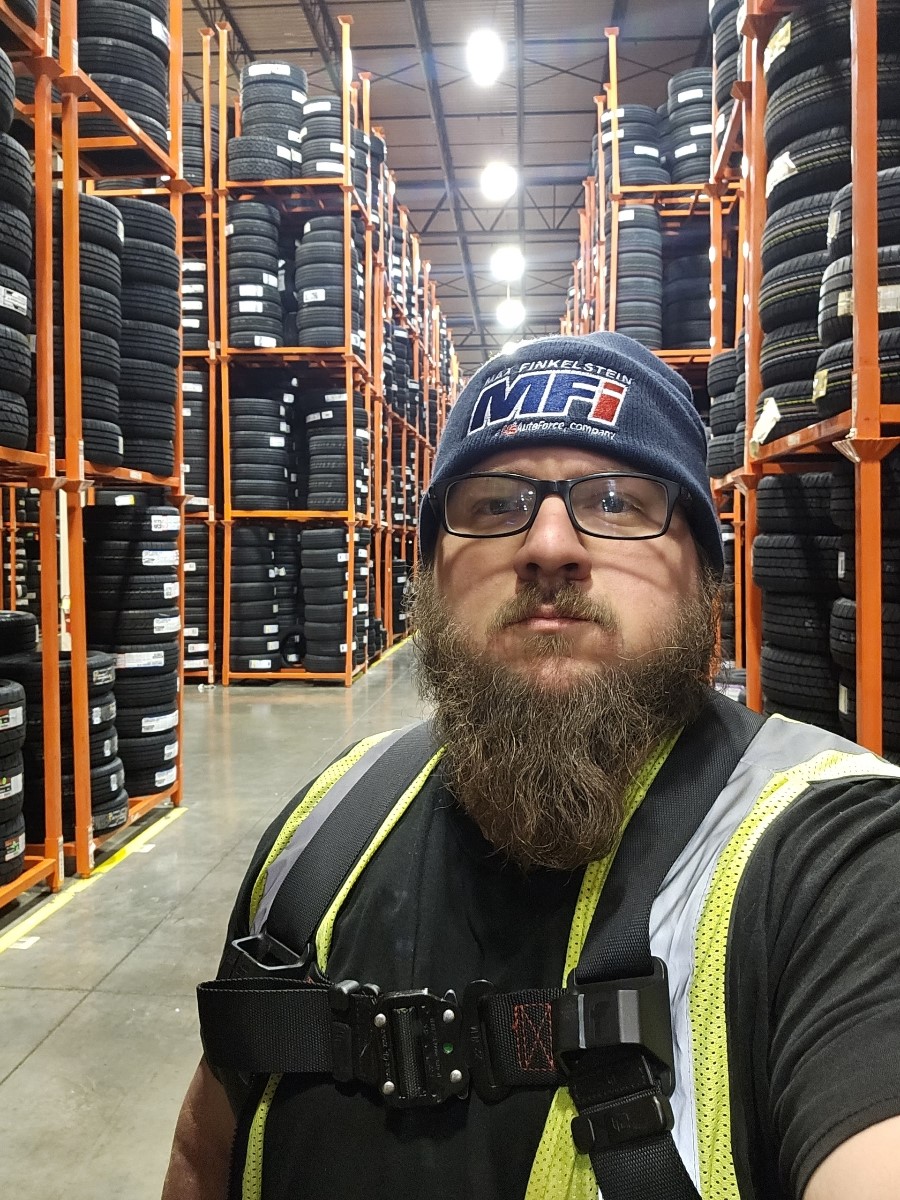
Tire-d of the RWDSU: Chris Dorney submitted a huge number of signatures from his coworkers at tire wholesaler Max Finkelstein when petitioning the NLRB for a vote to remove the RWDSU union.
WINCHESTER, VA – The Biden National Labor Relations Board (NLRB), which includes among its members two former union bosses from the Service Employees International Union (SEIU), is pursuing an agenda that hasn’t exactly been making it easy for workers to vote out a union they don’t want. But that hasn’t stopped workers across the country from going to extraordinary lengths to kick out unions that don’t serve their interests.
In October 2023, Chris Dorney, a Winchester, VA-based employee of tire wholesaler Max Finkelstein, kick-started a cross-country effort to vote the Retail, Wholesale and Department Store Union (RWDSU) out of 15 warehouse facilities across the eastern United States. This work unit included more than 500 employees across Virginia, Maryland, Massachusetts, Pennsylvania, New York, New Jersey, Vermont, Maine, and Connecticut.
Virginia Worker Mustered Strong Showing on Petition for Union Ouster Vote at Tire Wholesaler
With free legal aid from the National Right to Work Foundation, Dorney submitted a petition to the NLRB containing more than enough employee signatures to trigger a vote to remove the union from the large unit.
While Dorney and his fellow Virginia employees enjoyed the Right to Work freedom to opt-out of dues payments to the union, the same couldn’t be said for any of the other employees, all of whom hail from states where dues payments can be mandated as a condition of employment. But voting RWDSU bosses out of power entirely at the tire wholesaler would end the union’s forced-dues power.
“We warehouse workers and drivers at Max Finkelstein may be from many different facilities in many different states, but we are in agreement about one thing: RWDSU union officials don’t represent our interests,” Dorney said of the effort. “It’s our right under federal law to challenge RWDSU’s forced representation power.”
RWDSU Bosses Flee Unit as Union Officials Rack Up Losses Nationwide
However, before the vote could occur, RWDSU union officials disclaimed interest in continuing their monopoly representation powers over the unit, likely to avoid an embarrassing rejection by workers at the ballot box.
Unionized workers are increasingly requesting elections to remove unwanted unions — a potential reason for the Biden NLRB’s efforts to crack down on decertification votes. Additionally, union bosses are increasingly losing these contests. As of last year, filings for union decertification votes had shot up by over 40 percent since 2020. Of decertification elections that occurred, the number which resulted in union bosses losing went up by 72 percent.
“Mr. Dorney and his coworkers’ effort to kick out the RWDSU union, which spanned several states, 15 facilities, and hundreds of workers, is yet another example that workers often want to escape union officials’ one-size-fits-all agenda. It’s also a demonstration that workers will go to great lengths in order to exercise this right,” commented National Right to Work Foundation Vice President Patrick Semmens. “But the Biden NLRB, bent on empowering the President’s union boss political allies, plans to grant unions even more power to defeat workers’ will.”
Buffalo Starbucks Barista Counters NLRB’s Move to Trap Workers in Union
The following article is from the National Right to Work Legal Defense Foundation’s bi-monthly Foundation Action Newsletter, January/February 2024 edition. To view other editions of Foundation Action or to sign up for a free subscription, click here.
Appeals Court brief defends workers’ right to oppose and decertify union
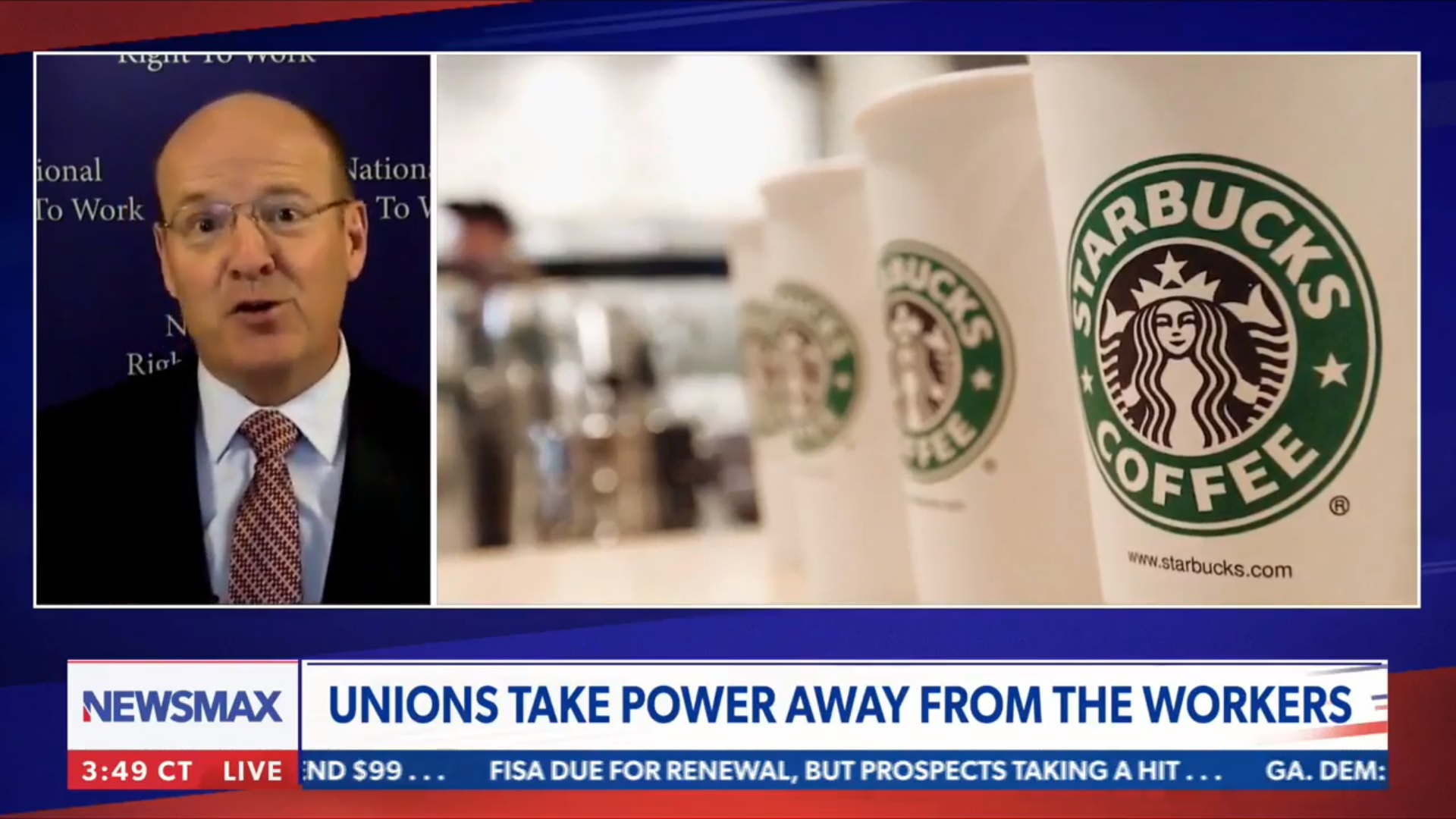
As Mark Mix explained on Newsmax TV, SBWU officials spent millions to infiltrate Starbucks with covert union agitators. That led to some of the first unionized Starbucks stores in Buffalo, NY, but now Buffalo baristas are trying to oust SBWU.
BUFFALO, NY – Although the National Labor Relations Board (NLRB) is charged with neutrally enforcing federal labor law, it has a notorious reputation for strengthening union officials’ power while diminishing the rights of workers opposed to union representation. Even with this biased history, the Biden Labor Board has already established itself as the most radically pro-forced unionism board in history.
The NLRB’s ideological bias is most apparent in its massive campaign to impose coercive unionism on Starbucks workers, while repeatedly blocking and undermining Starbucks employees’ attempts to remove unwanted union representation. While agency officials have approved hundreds of petitions for votes to bring the Starbucks Workers United (SBWU) union in, it has not let any of the roughly 20 worker-backed petitions seeking votes to remove the union advance to an election.
NLRB Cites Workers’ Desire to Oust Union as Reason to Impose Union
The NLRB’s anti-worker tactics have reached a new frontier. The NLRB is now citing a petition to remove the union as a reason why the union should not be removed and should serve as the basis for an injunction against Starbucks. NLRB lawyers are asking the Second Circuit Court of Appeals to overturn a District Court ruling and issue an injunction that would force Starbucks to engage in bargaining talks with the union, despite the fact that the decertification petition proves that a majority of employees at a Buffalo, NY, Starbucks want to throw the union out.
The decertification petition in question was collected by Starbucks barista Ariana Cortes. Cortes sought a vote to remove SBWU from her workplace, but the NLRB has refused to conduct the election. National Right to Work Legal Defense Foundation staff attorneys represent Cortes and Starbucks employees in nine other locations where workers are seeking votes to remove the SBWU. Now staff attorneys have filed a legal brief for Cortes and fellow Buffalo Starbucks employee Logan Karam in the Second Circuit Court of Appeals, countering the NLRB’s latest outrageous maneuver.
Cortes’ brief attacks the NLRB’s strategy as condescending toward workers. It argues the NLRB’s view that Cortes’ decertification must be stopped to protect workers is rooted in the wrongful idea that workers cannot think for themselves and lack independent reasons for wanting to get rid of a union.
Foundation Brief: NLRB Denies Workers’ Agency, Free Choice
“In reality, Cortes collected her petition because of the Union’s anti-employee behavior,” the brief says.
Foundation attorneys also contend in Cortes’ brief that what the NLRB is seeking from the Second Circuit — a 10(j) injunction under the National Labor Relations Act (NLRA) that will force Starbucks managers into working with SBWU union bosses to craft a monopoly bargaining contract — is extreme. Such injunctions can only be ordered when the harm done to workers in their absence would be “irreparable.” Foundation attorneys argue Cortes’ and other employees’ attempts to decertify do not make any injuries suffered by the union “irreparable.”
Dangerous Precedent Set If Court Grants Injunction That Undermines Right to Remove Unwanted Unions
If the Second Circuit grants the NLRB’s request for an injunction on behalf of SBWU union bosses, it would be the first time that a federal court has ordered a Starbucks store to engage in bargaining with union bosses on the basis of an employee’s decertification petition.
“The NLRB is digging an even deeper grave for employees trying to exercise their rights to remove an unwanted union from their workplace,” commented National Right to Work Foundation President Mark Mix. “The Board’s attempt to twist the limited employee rights to throw out a union into a reason to force a union upon employees is a new low.
“Ariana Cortes and Logan Karam are taking a courageous stand to ensure their coworkers aren’t disenfranchised and trapped under a union hierarchy they oppose, and we’re proud to support them,” Mix added.
Foundation Lawsuit: Biden NLRB Structure Violates the U.S. Constitution
The following article is from the National Right to Work Legal Defense Foundation’s bi-monthly Foundation Action Newsletter, November/December 2023 edition. To view other editions of Foundation Action or to sign up for a free subscription, click here.
Groundbreaking suit filed for Starbucks employee who was denied vote to oust unwanted union bosses
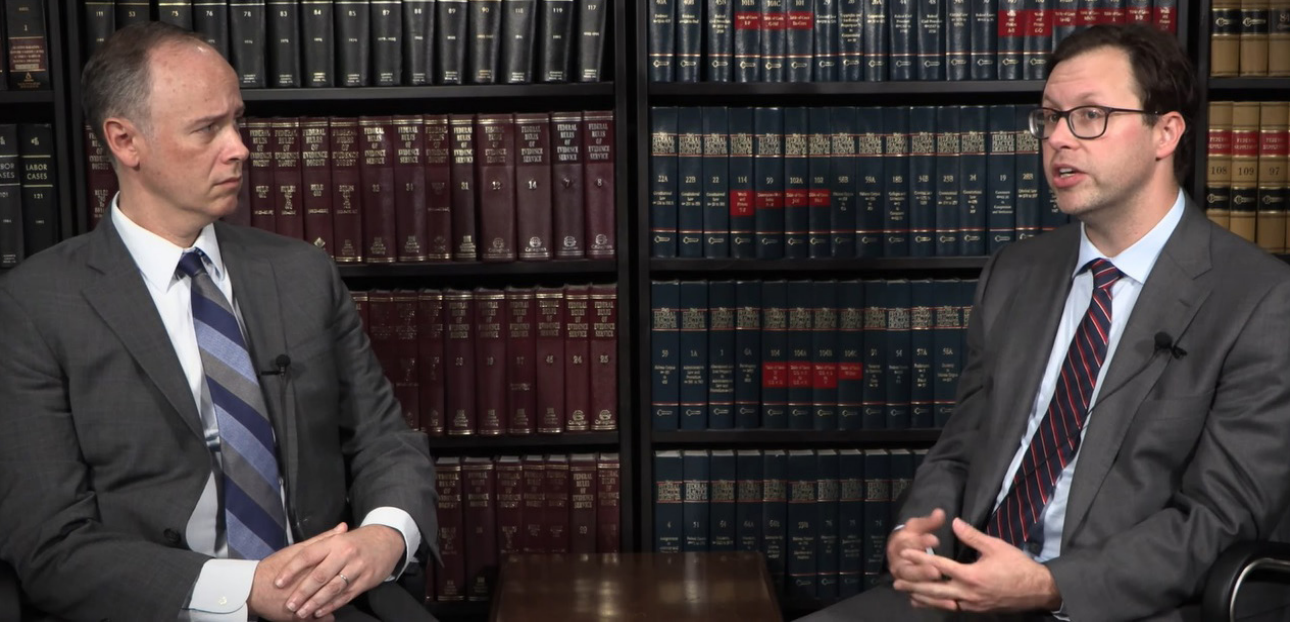
Starbucks employee Ariana Cortes’ Foundation attorney, Aaron Solem (right), is making a cutting-edge argument targeting the NLRB’s lack of accountability.
WASHINGTON, DC – The National Labor Relations Board (NLRB) is supposed to protect the right of workers to freely choose whether to associate with a union or not. The NLRB is also charged with holding unions and employers accountable when they violate worker rights. Too often, however, it has simply acted as an agency that generates policies to entrench union bosses’ power over workers while shielding union bosses from any kind of liability.
A new federal lawsuit from a National Right to Work Foundation-backed Starbucks employee, currently pending at the D.C. District Court, could upend the federal agency and result in a ruling that the current Labor Board’s structure violates the Constitution.
Employee Challenges NLRB Bureaucrats’ Protections from Presidential Removal
Ariana Cortes, a worker at the Buffalo, NY, “Del-Chip” Starbucks branch, hit the NLRB with the groundbreaking lawsuit in October, contending that the federal agency’s current structure violates the separation of powers mandated by the Constitution.
Cortes’ suit follows Foundation attorneys’ defense of her and her coworkers’ petition requesting a vote to remove Starbucks Workers United (SBWU) union officials from their workplace. Regional NLRB officials dismissed Cortes’ majority-backed petition based on SBWU allegations against Starbucks management that have no proven connection to Cortes and her coworkers’ desire for a union decertification vote.
Cortes’ lawsuit argues that because NLRB members cannot be removed at-will by the President, the NLRB’s structure violates Article II of the Constitution. Under Article II, the lawsuit contends, the President must have the power to remove officials that exercise substantial executive power.
Because the NLRB enforces federal labor law, manages union elections, and can issue legally binding rules and regulations, the lawsuit contends that the agency exercises substantial executive power. Therefore, it falls within the scope of the President’s power to remove officials at will. However, the National Labor Relations Act (NLRA), the law that established the NLRB, restricts the President’s ability to remove Board members except for neglect of duty or malfeasance.
“[T]hese restrictions are impermissible limitations on the President’s ability to remove Board members and violate the Constitution’s separation of powers. Thus, the Board, as currently constituted, is unconstitutional,” the complaint states.
Lawsuit: Unconstitutional NLRB Proceedings Must Stop
Cortes’ new federal lawsuit seeks a declaration from the District Court that the structure of the NLRB as it currently exists is unconstitutional.
“For too long the NLRB, especially the current Board, has operated as a union boss-friendly kangaroo court, complete with powerful bureaucrats who exercise unaccountable power in violation of the Constitution,” commented National Right to Work Foundation Vice President and Legal Director William Messenger. “The NLRB’s operation outside constitutional norms is easily exploited by Big Labor.”
“But as the story of Ms. Cortes shows, the NLRB’s unchecked power creates real harms for workers’ rights, especially when workers seek to free themselves from the control of union bosses they disagree with,” Messenger added.
Albany Starbucks Employees Seek Vote to Kick Out SBWU Union
“This isn’t what we signed up for” says NY worker who joins Starbucks partners across the country in demanding union ousters
Albany, NY (March 1, 2024) – A partner of the Stuyvesant Plaza Starbucks in Albany has filed a petition with National Labor Relations Board (NLRB) Region 3, asking the federal agency to hold a vote at her workplace to remove (or “decertify”) the Starbucks Workers United (SBWU) union. The employee, Rayghan Dowey, received free legal aid from the National Right to Work Legal Defense Foundation in submitting her petition.
“This isn’t what we signed up for, a new team has started to come in [to the Stuyvesant Plaza Starbucks] and we want to make sure that the voice that was once heard is still being heard two years later,” commented Dowey regarding the union. “We want to bring the inclusivity, community, and culture back. The culture we once had, that we were promised to get back, we never got to see.”
Dowey’s petition contains signatures from enough coworkers at her store to trigger a decertification vote under NLRB rules. Because New York lacks Right to Work protections for its private sector workers, SBWU union bosses can enter into contracts that compel Dowey and her coworkers to pay union dues as a condition of keeping their jobs. In Right to Work states, in contrast, union membership and all union financial support are strictly voluntary.
However, in both Right to Work and non-Right to Work states, union officials in a unionized workplace are empowered by federal law to impose a union contract on all employees in a work unit, including those who oppose the union. A successful decertification vote strips union officials of that power.
Amid Growing Requests to Remove SBWU, Starbucks Workers Also Challenge NLRB Authority
Dowey and her colleagues join Starbucks partners and other coffee company employees across the country in banding together to vote out SBWU union officials. In the past year, Starbucks employees in Manhattan, NY; two Buffalo, NY locations; Pittsburgh, PA; Bloomington, MN; Salt Lake City, UT; Greenville, SC; Oklahoma City, OK; San Antonio, TX; and Philadelphia, PA, have all sought free Foundation legal aid in filing or defending decertification petitions at the NLRB. Foundation attorneys have helped employees at independent Philadelphia coffee shops Good Karma Café and Ultimo Coffee successfully oust Workers United union officials, who are affiliated with SBWU.
Many employees of Starbucks or other coffee establishments are requesting decertification votes from the NLRB roughly one year after union bosses attained power in their workplaces, which is the earliest opportunity afforded by federal law to do so. Starbucks employees in particular were the targets of a multi-year, aggressive unionization campaign by SBWU, in which the union spent millions on paid union agents – including “salts” who obtained jobs at Starbucks locations with the covert mission of installing union power.
However, rather than respect the choice of workers opposed to the union, SBWU union officials are attempting to prevent Starbucks workers nationwide from exercising their right to decertify the union with charges against Starbucks management that are currently holding up the elections. Currently, Foundation staff attorneys are representing workers in about a dozen Starbucks stores seeking decertification votes.
NLRB Request for Review: Region Violating Starbucks Workers’ Rights by Blocking Vote
In fact, Foundation attorneys just filed a request for review with the National Labor Relations Board in Washington, DC, for Indya Fiessinger, a Starbucks employee at a Salt Lake City-area location who filed a petition for a decertification vote. The brief argues an NLRB Regional Director incorrectly applied federal law to block the decertification election requested by the workers at the store, and refused to even hold a hearing on the matter.
Foundation attorneys are also representing Buffalo, NY, and San Antonio, TX, Starbucks workers in challenging the NLRB as an unconstitutionally-structured federal agency. In two federal lawsuits now at the district court level, Starbucks employees argue that NLRB bureaucrats’ removal protections shield them from accountability in violation of separation of powers doctrines in the Constitution.
“Despite the wave of Starbucks workers who want to exercise their right to free themselves from unwanted union representation, SBWU union officials are twisting the law to trap workers under the union’s influence against their will,” commented National Right to Work Foundation President Mark Mix. “Federal labor law should protect workers who want to exercise their free choice rights, not power-hungry union bosses, and Foundation attorneys are proud to represent Ms. Dowey and other Starbucks workers who oppose SBWU officials’ coercive reign.”
Brooklyn Electrical Workers Win Year-Long Legal Battle to Remove Unwanted Union from Workplace
After Horsepower Electric employees voted to remove IUJAT union, Labor Board refused to count ballots for months based on empty union charges of misconduct
New York, NY (January 10, 2024) – Following a year-long legal battle, Brooklyn-based Horsepower Electric employee Shloime Spira and his colleagues are finally free of unwanted IUJAT (International Union of Journeymen and Allied Trades) representation. IUJAT union officials worked with the NLRB to manipulate the legal process with unproven claims against Horsepower Electric management to avoid the results of the workers’ union decertification vote. However, union officials have now chosen to renounce their so-called “representation” of the unit instead of facing a likely losing vote tally.
Spira received free legal aid from the National Right to Work Legal Defense Foundation in defending his coworkers’ right under federal law to remove the union, both before the National Labor Relations Board (NLRB) and the Federal Court for the Eastern District of New York. On December 31, 2023, IUJAT union officials’ “disclaimer of interest” became effective, and the union is no longer in the workplace. As a result, a federal case to demand the NLRB stop delaying the decertification effort has been voluntarily dismissed as moot.
“While my colleagues and I are pleased with this result, it’s simply ridiculous that the NLRB sat on our ballots for so long over union charges that were apparently meritless,” Spira commented. “The NLRB is supposed to protect employees’ right to choose whether or not they want a union, not delay that process indefinitely to maintain union officials’ power.”
NLRB Bureaucrats Sat On Case to Delay Counting Worker Votes, Necessitating Lawsuit
Spira first submitted a petition to the NLRB seeking an employee vote to remove the union in December 2022. Under NLRB rules, a petition requesting a union decertification vote must contain the signatures of at least 30 percent of the employees in a work unit to trigger a vote, a threshold which Spira’s petition met. The election took place in March 2023, but the NLRB ruled that the ballots could not be tallied because it had issued a complaint against Horsepower Electric based on allegations of employer misconduct (or “blocking charges”) filed by IUJAT union officials.
Union “blocking charges” contain claims of employer misconduct that are usually unverified and often have no connection to employees’ desire to vote out the union. NLRB officials inexplicably refused to hold a hearing or otherwise advance the “blocking charge” case for months, effectively using it as a pretense for delaying the vote count.
This delay meant Spira and his colleagues were trapped under the power of IUJAT union bosses without knowing the results of their vote. Because New York lacks Right to Work protections that make union affiliation and financial support strictly voluntary, IUJAT union bosses continued to collect forced dues from the workers, paid under threat of termination, while the vote count was indefinitely delayed.
No Witnesses Could Back Up Union’s Allegations Meant to Stymie Election
Pressure increased on the NLRB after the agency faced a federal lawsuit in the Eastern District of New York alleging due process violations. To defend his and his coworkers’ right to have their votes counted, Spira joined Horsepower Electric’s suit in the District Court and also intervened in the NLRB case to challenge the “blocking charges.”
Faced with this threat of federal litigation, including a “show cause” order from the judge in the federal case against the NLRB, Board officials finally moved forward on the NLRB “blocking charge” case and scheduled a hearing to take place on December 5, 2023. This was nearly a year after Spira had requested the vote to remove the union.
Spira’s legal team traveled to New York to defend his rights against the union’s allegations in the NLRB case. Minutes before the hearing was scheduled to begin before an NLRB Administrative Law Judge, NLRB lawyers conceded they could produce no witnesses to testify in favor of the union’s charges against Horsepower Electric. Soon after, the NLRB formally dropped its complaint against Horsepower Electric, thus clearing the way for the ballots to be counted.
Finally, on December 12, 2023, IUJAT union officials issued a disclaimer of interest effectively announcing they were departing the workplace. This was presumably done to avoid a vote count the union figured it would lose. The NLRB case ended on January 2, 2024, and the District Court declared the federal case dismissed on January 5, 2024.
“That union officials were so easily able to manipulate NLRB processes to block Mr. Spira and his colleagues from exercising their basic right to choose whether they want union representation shows that the agency is desperately in need of reform,” commented National Right to Work Foundation President Mark Mix. “It is outrageous that it took a federal court case to force the NLRB to admit that it had no evidence to back up union officials’ allegations that were being used to trap workers in a union they opposed.”
“Worker free choice is supposed to be the center of the National Labor Relations Act, but as this case shows, too often the Board has contorted the law into a shield to insulate union bosses from workers’ choices,” added Mix. “The Biden Labor Board is taking this bias to more and more extreme levels every day, granting union officials sweeping new powers to coerce workers into union ranks, while systematically undermining the rights of workers opposed to union affiliation.”
Buffalo Starbucks Baristas Blast National Labor Relations Board’s Move to Trap Workers in Union at Court of Appeals
NLRB lawyers claim workers’ opposition to union “justifies” union being imposed on unwilling employees
Buffalo, NY (November 28, 2023) – Ariana Cortes and Logan Karam, Starbucks partners in the Buffalo area, have just filed an amicus brief in the Second Circuit Court of Appeals case Leslie v. Starbucks Corp. In the case, NLRB officials are attempting to prosecute Starbucks for misconduct alleged by SEIU-affiliated Workers United union officials. The NLRB cites a petition that Cortes and her coworkers filed seeking a vote to remove the union as a reason why Starbucks management should be subjected to a court-ordered injunction.
Cortes and Karam, who are represented for free by National Right to Work Legal Defense Foundation staff attorneys, challenge this legal maneuver in their brief. The employee’s brief argues that the NLRB’s strategy treats workers as if they have no agency of their own and have no independent reasons for wanting to get rid of a union.
“Given the biases of the current Board, it is disheartening ― but not surprising ― to see the NLRB claim Cortes’ petition is the product of Starbucks’ alleged unfair labor practices,” the brief states. “Its own records show that nothing could be further from the truth. In reality, Cortes collected her petition because of the Union’s anti-employee behavior.”
The employees’ brief also contends that the relief NLRB lawyers are seeking from the Second Circuit – a 10(j) injunction under the National Labor Relations Act (NLRA) that will force Starbucks managers into working with SBWU union bosses to craft a monopoly bargaining contract – is extreme. Such injunctions can only be ordered when the harm done to workers in their absence would be “irreparable.” Foundation attorneys argue that the fact that Cortes and other employees have attempted to decertify does not make any injuries suffered by the union “irreparable.”
“The NLRB’s argument it needs an injunction to suppress decertification efforts already underway―which have already garnered majority support―is a tacit admission it is seeking to alter the status quo, not preserve it,” states the brief.
Cortes is also receiving Foundation legal aid in a case challenging the constitutionality of the NLRB’s structure. That case, currently pending at the D.C. District Court, argues that the structure of the NLRB is unconstitutional.
Dangerous Precedent Set If Court Grants Anti-Worker Injunction
If the Second Circuit grants the NLRB’s request for an injunction on behalf of SBWU union bosses, it would be the first time that a federal court has ordered a Starbucks store to engage in bargaining with union bosses on the basis of an employee’s decertification petition. This would be a horrendous precedent for independent-minded Starbucks workers across the country.
Starbucks workers all across the country have submitted decertification petitions seeking votes to remove SBWU union bosses, including at least nine groups of employees who are utilizing free Foundation legal aid. The NLRB would be able to use the federal court precedent to make the dubious argument that union bargaining should be mandated simply because employees want a chance to oust the union.
“The NLRB is digging an even deeper grave for employees trying to exercise their rights to remove an unwanted union from their workplace,” commented National Right to Work Foundation President Mark Mix. “The Board’s attempt to twist employees’ desire to exercise their right to throw out a union into a reason to force a union upon them is a new low.”
“Ariana Cortes and Logan Karam are taking a courageous stand to ensure their coworkers aren’t disenfranchised and trapped under a union hierarchy they oppose, and we’re proud to support them,” Mix added.
After Janus, Foundation Continues Fight to Expand Freedom for Public Employees
The following article is from the National Right to Work Legal Defense Foundation’s bi-monthly Foundation Action Newsletter, September/October 2023 edition. To view other editions of Foundation Action or to sign up for a free subscription, click here.
Building off Janus, CUNY professors’ lawsuit could end forced ‘representation’ powers
The Foundation’s historic Janus victory was a serious blow to public sector union bosses’ coercive power in its own right. But it also opened the door for efforts to free public workers completely from forced dues and forced representation.
NEW YORK, NY – Up until 2018, union bosses had the power to force millions of government workers to pay union dues or fees just to keep their jobs. While such an enormous privilege was not only a gross violation of workers’ free association rights, it also provided a steady stream of forced dues to union bosses, which contributed to their outsized influence over the government and our political system.
Union officials’ forced-dues power over public sector workers crumbled on June 27, 2018, when National Right to Work Foundation staff attorneys won the landmark Janus v. AFSCME decision at the U.S. Supreme Court. A majority of the Justices agreed with Foundation attorneys that every American public sector worker has a First Amendment right to abstain from paying dues to an unwanted union.
On the fifth anniversary of Janus, its impact can’t be overstated. Between the Janus decision itself and over 50 follow-up cases, Foundation staff attorneys have enforced the rights of over 500,000 employees nationwide. Meanwhile, studies find that independent-minded workers are withholding over $700 million in formerly mandatory dues and fees from public sector union bosses every year as a result of the decision.
Of course, Foundation staff attorneys continue to fight to defend, enforce, and expand on the landmark decision.
New Challenge to Forced ‘Representation’ Reaches Court of Appeals
In an ongoing Foundation-assisted case, Goldstein v. Professional Staff Congress (PSC), six City University of New York (CUNY) professors seek to knock down the final pillar of coercive union power in the public sector — union bosses’ power to force their one-size-fits=all “representation” on workers who don’t want it.
A brief recently filed at the Second Circuit Court of Appeals for the professors argues that PSC union officials are violating the professors’ First Amendment rights by forcing them to accept the union’s monopoly control and “representation.”
Professors’ Lawsuit: Janus Already Noted Dangers of Monopoly Bargaining
The professors have found the actions of PSC union bosses and adherents to be “anti-Semitic, anti-Jewish, and anti-Israel,” and have even reported union-instigated bullying and threats targeted against them.
The professors’ opening brief at the Second Circuit maintains that the Supreme Court already acknowledged in the Janus decision that public sector monopoly bargaining is “a significant impingement on associational freedoms,” and argues that New York State’s Taylor Law authorizes such bargaining in violation of workers’ rights.
“If the First Amendment prohibits anything, it prohibits the government from dictating who speaks for citizens in their relations with the government,” reads the brief.
The case, which will likely head to the U.S. Supreme Court no matter how the Circuit Court rules, could set a nationwide precedent forbidding public sector monopoly bargaining, just as Janus prohibits forced dues in all public sector workplaces. The combination of both Foundation-won precedents would guard public workers nationwide from both forced dues and forced representation.
Foundation Brief Defends State Law to Fortify Janus
The Janus victory also motivated freedom-loving state legislators to take extra measures to ensure workers’ First Amendment rights under Janus are being enforced.
In Indiana, a reform now forbids public employers from using taxpayer-funded government payroll systems to deduct union dues without a worker’s explicit consent. Public employers must obtain yearly consent from workers who wish to have union dues taken from their paychecks, and must also ensure that workers have notice of their constitutional right not to fund union activities. Unsurprisingly, dues-hungry Anderson Federation of Teachers (AFT) union officials sued the state to block these commonsense protections.
Foundation attorneys joined the fight recently to defend Indiana’s laws. A Foundation brief in the Seventh Circuit Court of Appeals urges the court to overturn a lower court’s injunction of these reforms, citing Seventh Circuit precedent.
Foundation attorneys helped successfully defend a similar law in West Virginia in 2021, which the West Virginia Supreme Court upheld on the basis that union bosses “have no constitutional entitlement to employees’ money or to the employer’s administration of union dues deduction schemes.”
Federal Courts Must End Union Monopolies
“Janus was a great triumph for American public workers’ freedom, but it was only a step toward the ultimate goal of freeing public workers from all unwanted union coercion,” commented National Right to Work Foundation Vice President Patrick Semmens. “No American worker should be forced to associate with union officials and union members that openly oppose their interests, including through attacks on their culture and religion as the plaintiffs in Goldstein have harrowingly experienced.”
“It’s encouraging to see that states like Indiana have stepped up to protect workers’ Janus rights,” Semmens added. “But ultimately, after recognizing in Janus and older precedents that union monopoly bargaining abridges workers’ free association rights, it’s high time for federal courts to end this enormous government-granted power for union bosses once and for all.”





