
Reed & Perrine Lawn Products Workers Escape Union After Fighting Frivolous Union Delay Tactics
After workers requested union removal vote in 2024, union bosses blocked the vote for a year and a half using specious allegations
Manalapan Township, NJ (April 22, 2026) – After a year-and-a-half delay caused by frivolous union legal tactics, employees at Reed & Perrine Lawn Products (a division of The Andersons, Nasdaq: ANDE) have finally succeeded in removing United Food and Commercial Workers (UFCW) Local 152 union officials from power at their workplace. Reed & Perrine employee Christine Bradach kicked off the effort among her coworkers to remove the UFCW union in November 2024 when she filed a decertification petition at the National Labor Relations Board (NLRB). Bradach received free legal aid from National Right to Work Foundation staff attorneys in filing her petition.
The NLRB is the federal agency responsible for enforcing private sector labor law, a task that includes administering elections to install (or “certify”) and remove (or “decertify”) unions. Bradach’s petition contained employee signatures well in excess of the threshold required to prompt the NLRB to hold a decertification election. Bradach’s work unit includes production department and shipping department employees at Reed & Perrine Lawn Products.
Almost immediately after Bradach had filed her petition, UFCW union bosses filed so-called “blocking charges” to stop the vote from happening. Blocking charges are unproven allegations of employer misconduct that union officials file in order to delay or derail an employee-requested union decertification election. Blocking charges often have little or nothing to do with employees’ reasons for wanting to vote out a union, yet NLRB officials will frequently delay decertification elections for months or years without even holding a hearing into the charges’ veracity or connection to employee dissatisfaction.
In Bradach’s case, NLRB Region 22 blocked Bradach and her coworkers’ requested vote based on UFCW officials’ blocking charges. Almost a year and a half later, UFCW union officials withdrew the blocking charges – presumably because the NLRB communicated that it would finally dismiss them for having no merit. Immediately after NLRB Region 22 announced it would finally take up Bradach’s petition, UFCW Local 152 officials announced they were “disclaiming interest” in continuing their control over the facility – in other words, leaving the facility immediately to avoid an employee vote that would have likely ended in a lopsided loss for the union.
UFCW Union Officials Continued to Take Dues While Blocking Removal Vote
New Jersey lacks Right to Work protections for its private sector employees. This means UFCW union officials had the power to enforce contracts that required Reed & Perrine employees to pay money to the union or be fired. In contrast, in states that have Right to Work laws, union membership and all union financial support are strictly voluntary.
“My colleagues and I had had it with the UFCW, but they stuck around in the workplace after we made it clear we no longer wanted the union,” commented Bradach. “It’s a farce for them to claim they ‘represented’ us, especially when they were actively trying to block us from just having a vote on whether we wanted to continue with the union. My colleagues and I are glad we’re finally free.”
Trump NLRB Urged to Eliminate ‘Blocking Charge’ Policy
The Foundation has pressed the NLRB for years to end its non-statutory blocking charge policy. The Foundation has instead advocated for a return to the Election Protection Rule, which prevented many aspects of blocking charge-related gamesmanship before the Biden NLRB overturned it in 2022. Under the Election Protection Rule, allegations of misconduct related to a union decertification election could not block employees from exercising their right to vote. In most cases, the Rule permitted the immediate release of the vote tally as opposed to ordering ballots to be impounded during litigation over blocking charges.
“As Ms. Bradach’s case shows all too well, the ‘blocking charge’ policy just incentivizes union officials to act cynically and opportunistically while the rights of the workers they claim to ‘represent’ suffer,” commented National Right to Work Foundation President Mark Mix. “An approach that is more protective of workers’ rights is found in the Election Protection Rule, which mandates that allegations over interference be dealt with after employees have had a chance to exercise their right to vote.
“The Trump NLRB should work quickly to protect workers’ freedom of choice from restrictive and unreasonable doctrines like the ‘blocking charge’ policy, which serve only to empower union special interests to the detriment of the rights of rank-and-file workers,” added Mix.
AT&T Workers Nationwide Win Challenges to Unionization Imposed Through Card Check
The following article is from the National Right to Work Legal Defense Foundation’s bi-monthly Foundation Action Newsletter, November/December 2024 edition. To view other editions of Foundation Action or to sign up for a free subscription, click here.
Victories by AT&T workers in five states preceded Biden-Harris NLRB rule change to block secret ballot votes

See You, CWA: Marquita Jones (left), Samantha Cain (middle), and Matthew Gonzalez rallied their fellow AT&T workers to escape unwanted CWA unions.
WASHINGTON, DC – While the Biden-Harris National Labor Relations Board (NLRB) sought to upend NLRB rules designed to protect workers’ ability to vote out unwanted unions, AT&T workers across the country won a series of victories highlighting the importance of allowing workers to challenge coercive union card check unionization with secret ballot votes. The decertification victories all relied on the National Right to Work Foundation-backed 2020 NLRB “Election Protection Rule” (EPR), which was formally eliminated by the Biden-Harris Labor Board in September.
In five separate cases covering well over 1,000 workers, AT&T Mobility employees have successfully overturned Communications Workers of America (CWA) unionization imposed through the notorious “card check” process.
Under card check, union organizers bypass the secret ballot election process and instead collect cards face-to-face from employees that are then counted as “votes” for the union. Without the privacy of a secret ballot vote, many workers report being pressured, bullied, or threatened into signing, which is among the reasons why card check has long been recognized as inherently unreliable and abuse-prone.
Foundation-Backed 2020 Rule Let Over 1,000 AT&T Workers Nix Union Card Checks
The 2020 Election Protection Rule reformed several rules that union officials manipulate to trap workers under monopoly “representation,” including by giving employees a way to challenge card check unionization with a secret ballot election. Foundation staff attorneys assisted AT&T employees in five states to do that in advance of the Biden-Harris Labor Board’s cynical repeal of the rule.
First, in Tennessee, AT&T employee Denis Hodzic filed a petition signed by two-thirds of his coworkers in the unit seeking a secret-ballot vote to remove the CWA union, after CWA agents installed themselves over 100 AT&T In-Home Experts by card check. Initially CWA union officials argued the election should be permanently blocked because the union had already merged the workers into a larger bargaining unit with thousands of other AT&T workers.
CWA Bosses Capitulated to AT&T Workers
However, citing the Election Protection Rule, which gives workers at least 45 days to challenge a card check with a decertification petition, Foundation staff attorneys were able to win a ruling with the NLRB allowing the vote to proceed. At that point CWA officials chose not to even contest the vote, instead filing paperwork with the NLRB freeing the employees from CWA ranks apparently to avoid an overwhelming final vote against the union.
“The Election Protection Rule was essential for us to rely on as we went through the process of seeking resolution to our tricky situation,” Hodzic said of his situation. “The 45-day petition window needs to remain regardless of which group holds the majority position in Washington.”
Since then, with legal aid, around 1,000 additional AT&T Mobility employees in California, Louisiana, Mississippi, and Texas have all also successfully removed the CWA union following installation through card check. In all four states, once the decertification vote became inevitable, CWA officials simply conceded defeat rather than wait for the results of a formal decertification vote.
NLRB Repeal of Election Protection Rule Traps Workers in Union Ranks
Despite these efforts from independent-minded employees, the Biden-Harris NLRB formally repealed the Election Protection Rule in September, dramatically expanding union bosses’ ability to block employee-requested decertification votes.
As a result, now, when workers in Hodzic’s situation attempt to challenge a card check with a secret ballot decertification, the NLRB will automatically block their vote for up to one year after a card check, which opens the door to countless other union delay tactics.
“If these AT&T employees had filed their five decertification petitions after September 30th, they would have been trapped in a union they oppose for years and likely forever,” commented National Right to Work Foundation Vice President Patrick Semmens.
“This is yet another example of the Biden-Harris NLRB steamrolling the rights of independent-minded employees, so union bosses can expand their forced dues ranks. “Despite this setback for employee freedom, Foundation staff attorneys remain committed to helping workers trapped in union ranks they oppose,” added Semmens. “That includes helping them navigate the increasingly rigged NLRB system.”
Tennessee AT&T Workers Force Unwanted CWA Union Bosses Out of Workplace Following Union ‘Card Check’
After union lawyers’ attempt to get the NLRB to block the vote failed, union bosses backed down and departed workplace rather than face workers’ vote
Tennessee (March 5, 2024) – Denis Hodzic, an In Home Sales Expert of AT&T Mobility Tennessee, and his coworkers have successfully pushed unwanted Communications Workers of America (CWA) union officials out of power.
The union ouster follows Hodzic’s submission of a “decertification petition” backed by his fellow employees, which asked the National Labor Relations Board (NLRB) to hold a vote to remove (or decertify) the union for AT&T Mobility In Home Sales Experts throughout Tennessee. Hodzic received free legal aid from National Right to Work Legal Defense Foundation staff attorneys.
The NLRB is the federal agency responsible for enforcing federal labor law, which includes administering votes to certify and decertify unions. Hodzic, who collected signatures from a majority of his coworkers (more than enough to trigger a decertification vote under NLRB rules), filed his decertification petition in December 2023 to challenge a so-called “card check” unionization scheme by CWA union bosses.
Last month, an NLRB Regional Director rejected union officials’ objections to the petition and ruled that a decertification election should go forward. However, before the vote could occur, CWA union officials filed paperwork disclaiming interest in continuing their control over the workers – likely to avoid an embarrassing rejection by employees at the ballot box.
Had Hodzic and his coworkers’ effort not succeeded, NLRB documents indicate that they would have been integrated into a nationwide bargaining unit comprised of thousands of employees, which would have made decertifying the union virtually impossible.
Because Tennessee is a Right to Work state, CWA union officials never had the power to force Hodzic and his colleagues to pay union dues or join the union as a condition of employment. However, even in Right to Work states, union officials can still force their one-size-fits-all contracts on all employees in a work unit, even those who oppose the union. A successful decertification election ends this monopoly bargaining power.
Biden NLRB Cracking Down on Employees’ Right to Vote in Secret on Union ‘Representation’
Under a card check, union officials can bypass the secret-ballot election process, which is the most secure and reliable way to determine if employees want to unionize. During a card check drive, union officials can engage in face-to-face interactions with employees and demand they sign union authorization cards, making the process a breeding ground for coercive and intimidating tactics. Even AFL-CIO organizing guidelines admit that employees often sign cards during a card check to “get the union off my back.”
Though union officials successfully gained control via card check, Hodzic was able to petition for a decertification vote to overturn the result thanks to the Right to Work Foundation-backed 2020 reforms to NLRB rules.
Collectively referred to as the “Election Protection Rule,” the reforms permit employees to submit decertification petitions within a 45-day window after the finalization of a card check. The Election Protection Rule also prevents union officials from manipulating charges they file alleging employer misconduct to block workers from casting ballots in a decertification election, among other things.
Unfortunately, the NLRB in Washington, DC, has begun rulemaking to undo the Election Protection Rule, which will make it much harder for employees to challenge card check drives. This is just one of several aggressive moves by the Biden NLRB to give union officials greater power to corral workers into unions, while limiting workers’ rights to get rid of unpopular unions.
Recently, the NLRB issued the Cemex decision, which gives union officials greatly expanded power to overturn elections that don’t go in their favor if an employer requests such an election to challenge a card check.
“Despite claiming to speak for workers, union bosses and their allies in the Biden NLRB seem to be intent on further constricting workers’ ability to have secure, private votes on whether union bosses deserve to have control over their working lives,” commented National Right to Work Foundation President Mark Mix. “Mr. Hodzic and his coworkers’ victory should serve as a reminder that ‘card check’ is not a reliable indicator of employee support for a union, and that giving this process priority over secret ballot elections will trap more workers under union boss control against their will.”
Foundation Blasts Biden NLRB’s Proposed Rule to Trap Workers in Unions
The following article is from the National Right to Work Legal Defense Foundation’s bi-monthly Foundation Action Newsletter, May/June 2023 edition. To view other editions of Foundation Action or to sign up for a free subscription, click here.
Former union lawyers target Foundation-backed reforms easing removal of unpopular unions
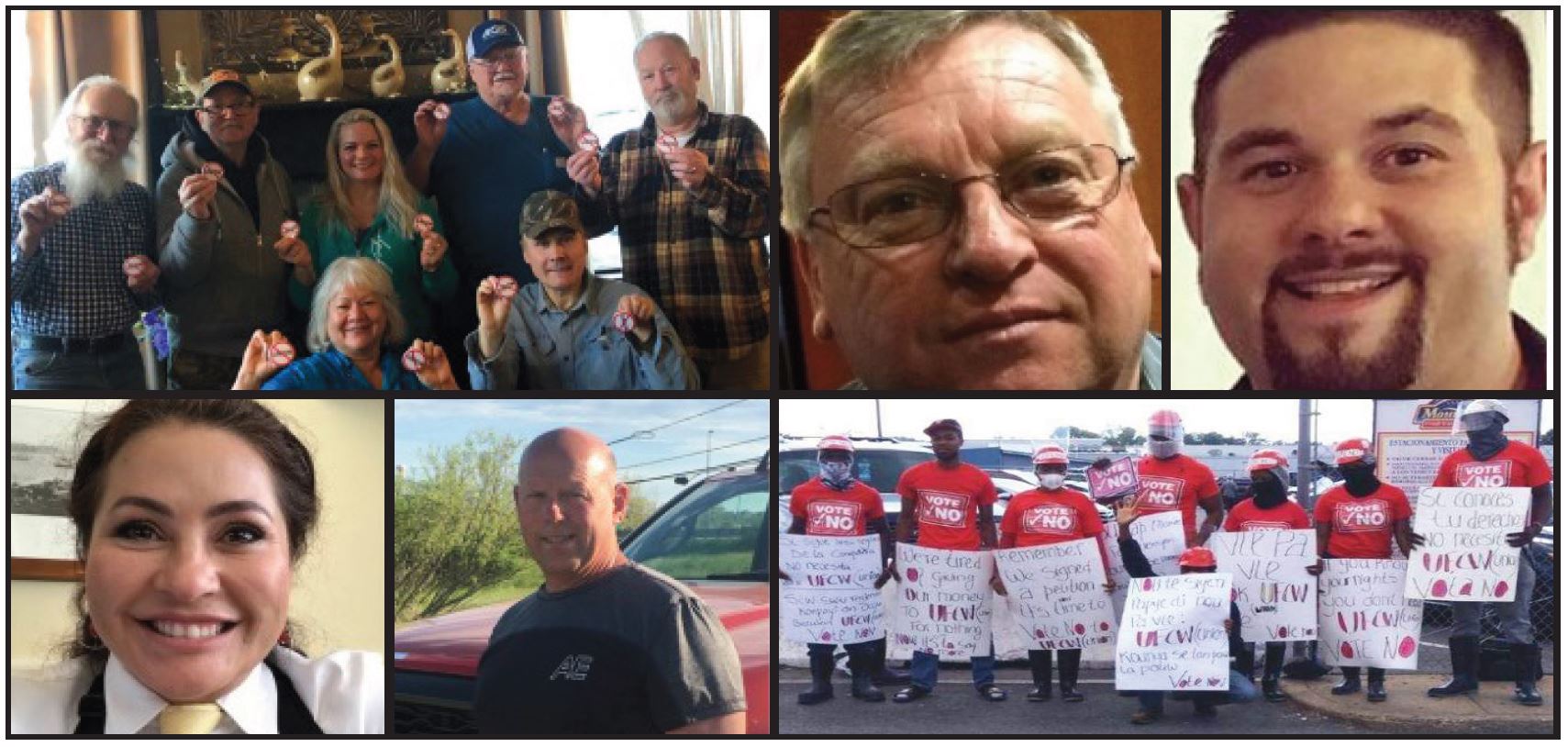
In its comments to the NLRB, the Foundation emphasized its leading role in defending workers’ right to vote out unwanted unions. Above are just a few workers whom Foundation attorneys have aided recently in decertification efforts.
WASHINGTON, DC – Bureau of Labor Statistics data show that over 90 percent of American workers have chosen not to affiliate with a union, and recent polling by Gallup shows non-union workers are overwhelmingly “not interested at all” in unionization. This isn’t a surprise considering modern day union officials’ overwhelming focus on politics, the way that monopoly “representation” often disadvantages the best employees, and union bosses’ “pay up or be fired” demands leveled at workers in non-Right to Work states, among other reasons.
The National Right to Work Foundation helped create an easier path for employees to vote out union officials they oppose by filing comments in support of the “Election Protection Rule,” which the National Labor Relations Board (NLRB) adopted in 2020. The Foundation-backed Rule eliminated several non-statutory NLRB policies that union officials manipulate to block any attempt by employees to vote them out of a workplace.
Now, former union lawyers Biden appointed to the NLRB are repaying the President’s union boss political allies by moving to eliminate the Election Protection Rule, thus restoring to union officials several coercive methods used to trap workers in unions they oppose by making it more difficult for employees to successfully petition for a decertification election.
The Foundation slammed the plan in February comments filed with the NLRB, maintaining that the rule change will trample workers’ statutory right to vote out unions they oppose while entrenching unpopular union officials. Foundation attorneys followed up with reply comments in March, which refuted several arguments union officials and Biden’s NLRB General Counsel put forth in comments supporting the Election Protection Rule’s elimination.
Biden NLRB Will Again Let Union Officials Weaponize Unproven ‘Blocking Charges’
The Foundation’s comments explain that, if the Election Protection Rule is tossed, union officials will again be able to exploit often-unproven allegations of employer unlawful behavior to delay employee-requested union decertification votes. Prior to the 2020 reforms, union officials could often stall a decertification vote for months or even years by filing these so-called “blocking charges.”
The 2020 Election Protection Rule overturned the blocking charge policy, so workers are currently allowed in most cases to cast ballots in a decertification vote before the NLRB deals with any allegations surrounding the election. This procedure eliminates the incentive outright deception. Once recognized via this card check process, under the NLRB proposal there will be a year-long non-statutory bar, during which unions are immunized from decertification attempts.
The Election Protection Rule gives employees the opportunity to challenge the union’s claim of majority support during a 45-day window period beginning upon notice of recognition. If workers collect a sufficient showing of interest for an election and file it during the 45-day window, the NLRB will hold an election in that bargaining unit. This provides a check against the most egregious card check campaigns. Barring these worker-submitted union decertification petitions “only shields what may well be a minority union from challenge” and “destroys employees’ [statutory] rights,” the Foundation’s comments say.
Worker Majority Support Doesn’t Matter for Union Elites
The comments also oppose the Biden NLRB’s plan to let union officials subject construction workers to monopoly union so-called “representation” without providing evidence of any individual worker’s support for such control, let alone a majority.
“The move to eliminate the Election Protection Rule will re-impose arbitrary policies that trample workers’ rights and allow union bosses to maintain power despite the overwhelming opposition of rank-and-file workers,” observed National Right to Work Foundation Vice President Patrick Semmens.
“The Biden NLRB, now stocked with former union lawyers, is putting on full display that its priorities lie with top D.C. union brass, not rank-and-file American workers.”





