
Overwhelming Majority of Wyoming Wells Fargo Bank Branch Employees Back Petition for Vote to Remove CWA Union Bosses
Wells Fargo employees across the country moving to terminate union affiliation
Casper, WY (March 25, 2026) – Employees at Wells Fargo’s Casper branch have filed a petition with the National Labor Relations Board (NLRB) seeking a “decertification” election to remove the Communications Workers of America (CWA) union bosses from their workplace. The workers’ efforts are spearheaded by Megan Wright, who filed the petition with free legal aid from the National Right to Work Foundation.
The NLRB is the federal agency responsible for enforcing federal labor law, a task that includes administering elections to install (or “certify”) and remove (or “decertify”) unions. Wright’s petition was signed by the vast majority of her Wells Fargo coworkers, easily surpassing the required threshold of signatures needed for the NLRB to schedule a decertification vote.
The workers’ petition requests the NLRB schedule a secret ballot election among all full-time and regular part-time tellers, personal bankers, relationship bankers, and branch operations coordinators employed by Wells Fargo at a Casper, WY branch. The workers will vote on whether to remove the so-called “Wells Fargo Workers United” union (an affiliate of the CWA union).
“CWA union officials have not made our workplace better and we are confident we would be better off without them,” stated Wright. “At this point we simply want an election so we can vote to take back our branch.”
Wyoming is one of the 26 states with Right to Work protections that safeguard workers from being forced to pay union dues or fees under threat of termination. However, even under Right to Work, union bosses can impose monopoly bargaining control over all employees in a workplace, including those who are opposed to the union’s representation. A successful decertification would end union officials’ monopoly bargaining powers.
The Casper, WY workers’ decertification effort comes almost a week after the Foundation assisted Wells Fargo employees in Spring Hill, FL, file a petition to remove CWA from their branch. The NLRB has scheduled the Spring Hill election for March 30. In yet another decertification effort, last week Wells Fargo employees in Apex, NC, overwhelmingly voted to remove the CWA union from their branch.
“Despite the headlines generated by CWA’s campaign to gain control over Wells Fargo employees, it is increasingly becoming clear to rank-and-file bank employees that they are better off without the CWA’s so-called ‘representation,’” commented National Right to Work Foundation President Mark Mix. “The Foundation is proud to be a resource for Ms. Wright and other Wells Fargo employees seeking to exercise their right to free themselves from unwanted unions.
“These Wells Fargo employees are just the latest in an ongoing trend, with NLRB statistics showing a nearly 40% rise in filed decertification petitions over the past five years,” Mix added.
Florida Wells Fargo Workers Successfully Remove CWA Union
Spring Hill bank branch employees union-free as CWA union bosses decline to face federally supervised vote of employees
Spring Hill, FL (March 30, 2026) – Employees at the Lakewood Plaza location of Wells Fargo in Spring Hill, FL, have successfully forced Communications Workers of America (CWA) union officials out of power at their workplace. The effort to remove the union kicked off earlier this month, when bank employee Virginia Fenton filed a petition asking the National Labor Relations Board (NLRB) to hold a union decertification vote at the Spring Hill Wells Fargo branch. Fenton filed the petition with free legal aid from the National Right to Work Legal Defense Foundation.
The NLRB is the federal agency responsible for enforcing private sector labor law, a task that includes administering elections to install (or “certify”) and remove (or “decertify”) unions. Fenton’s petition received more than the required threshold of her coworkers’ signatures to trigger the process for the NLRB to schedule a decertification vote. On March 12, the NLRB approved an agreement scheduling the election for March 30 among “[a]ll full-time and regular part-time tellers, personal bankers, relationship bankers, and premier bankers.”
However, shortly before the election, CWA union officials – who operate under the pseudonym “Wells Fargo Workers United” [sic] – announced they were no longer seeking to remain in power at the bank branch, presumably to avoid a lopsided loss at the ballot box. On March 27, the NLRB acknowledged the CWA union’s “disclaimer of interest,” leaving the Spring Hill Wells Fargo employees officially free of the unwanted union.
Florida is a Right to Work state, meaning union officials cannot impose contract provisions that require workers to pay money to the union as a condition of getting or keeping a job. In contrast, in non-Right to Work states, union officials can have workers fired for refusing to pay union dues or fees. However, in both Right to Work and non-Right to Work states, union bosses can still impose one-size-fits-all contracts over all employees in a workplace, even those who are opposed to the union’s presence. Following the union’s disclaimer, Spring Hill Wells Fargo employees are now free of the CWA’s exclusive representation powers.
Wells Fargo Workers Across Country Seeking Escape From CWA Union Ranks
The Spring Hill bankers are the second group of Wells Fargo employees to successfully boot out CWA officials, following union officials’ aggressive campaign in recent years to unionize the bank. Apex, NC, Wells Fargo employees voted out the union in a landslide earlier this month. Foundation staff attorneys are currently assisting Casper, WY, Wells Fargo workers in obtaining another decertification vote against the union.
“CWA union bosses’ campaign at Wells Fargo started with great fanfare, but now, when faced with the reality of the CWA’s so-called ‘representation,’ employees across the country seem to be coming to the conclusion that they would be better off without the union,” commented National Right to Work Foundation President Mark Mix. “Wells Fargo workers should not hesitate to contact Foundation attorneys for free legal aid in seeking a union decertification vote if they feel CWA union officials have been incompetent, unresponsive, or just haven’t served their interests.
“More broadly, the NLRB should push forward on reforming labor regulations to ensure that workers can freely exercise their right to vote out union officials who act opportunistically or coercively,” Mix added.
Bradenton Wells Fargo Employees Latest to Force Out CWA Union
Wells Fargo workers across country are seeking to escape from the CWA union, at least four branches already free
Bradenton, FL (May 1, 2026) – Following their request to a federal labor board for a vote to remove the union, employees at the Beachway Plaza Wells Fargo branch have successfully forced Communications Workers of America (CWA) union bosses out of their workplace. Wells Fargo employee Amanda Seda kicked off the union removal effort by submitting a decertification petition backed by her colleagues to the National Labor Relations Board (NLRB) on April 20. Seda filed the petition with free legal aid from National Right to Work Foundation staff attorneys.
The NLRB is the federal agency responsible for enforcing private sector labor law, a task that includes administering elections to install (or “certify”) and remove (or “decertify”) unions. Seda’s petition received more than the required threshold of her coworkers’ signatures to trigger the process for the NLRB to schedule a decertification vote. The petition requested that the NLRB hold the vote on May 14 among “[f]ull-time & regular part-time personal bankers, branch operations coordinators, [and] tellers.”
Only about a week after Seda filed her petition, CWA union officials announced they were “disclaiming interest” in continuing their control over the bank branch. In other words, CWA agents announced they were leaving the Wells Fargo location, likely to avoid an embarrassing lopsided loss at the ballot box.
Florida is a Right to Work state, meaning state law forbids union bosses from enforcing contracts that require workers to pay money to the union to keep their jobs. In contrast, in states that lack Right to Work protections, union bosses can get workers fired for refusing to pay union dues or fees. However, in both Right to Work and non-Right to Work states, exclusive “representation” privileges in federal labor law grant union officials the power to dictate terms of employment for every employee in a workplace, regardless of whether they voted for or support the union.
Wells Fargo Workers Across America Seeking Escape From CWA Union Ranks
Roughly four years after CWA union officials began a high-profile campaign to unionize Wells Fargo under the moniker “Wells Fargo Workers United,” employee opposition to the union is rising. Foundation staff attorneys are assisting multiple groups of workers across the country with efforts to oust CWA union officials, and some of these efforts have already seen success: After petitioning for union decertification elections, Foundation-backed Wells Fargo employees in Spring Hill, Florida; Seaside Park, New Jersey; and now Bradenton, Florida, are free of the CWA union’s exclusive “representation.” Wells Fargo workers in Apex, North Carolina, also voted out CWA union officials in March.
In addition to the case at Seda’s workplace, the Foundation’s cases for Wells Fargo workers at the Spring Hill and Seaside Park bank branches involved union bosses submitting “disclaimers of interest” shortly after workers began seeking a vote to scrap the union. However, CWA union officials have filed “blocking charges” in an attempt to prevent Foundation-supported Wells Fargo workers in Casper, Wyoming, from having their requested decertification vote. Blocking charges are unproven allegations of employer misconduct that union officials frequently file to stop decertification elections from moving forward. NLRB bureaucrats will often delay decertification elections for months or even years on the basis of union blocking charges, without ever ordering a hearing into the charges’ veracity or connection to worker discontent with the union.
“Wells Fargo employees nationwide are beginning to question how well CWA union officials are actually serving their interests, and many are choosing to exercise their right to vote out unions they oppose,” commented National Right to Work Foundation President Mark Mix. “While CWA bosses have quietly left some branches rather than face a vote of the employees they claim to ‘represent,’ at other branches they’re using legal maneuvering to try to disenfranchise workers by blocking elections from occurring.
“While Wells Fargo workers should not hesitate to reach out to Foundation attorneys for assistance in seeking to decertify unwanted CWA unions, the Trump NLRB should also seek to reform federal regulations that let union bosses trap workers in union ranks against their will,” Mix added.
Over 100 Windstream North Carolina Employees Vote to Free Themselves of Unwanted CWA Union
Workers across 12 North Carolina locations officially free from CWA officials’ ‘representation’
North Carolina (March 18, 2026) – Employees of telecommunications provider Windstream North Carolina LLC have successfully voted Communications Workers of America (CWA) union officials out of power at their workplaces across North Carolina. Windstream worker Grant Diorio kicked off his coworkers’ effort to oust the union by filing a petition with the National Labor Relations Board (NLRB) in January, impacting his work unit of roughly 120 Windstream employees. Diorio filed the petition with free legal aid from National Right to Work Foundation staff attorneys.
The NLRB is the federal agency responsible for enforcing private sector labor law, a task that includes holding votes to install (or “certify”) and remove (or “decertify”) unions. Diorio’s petition contained more than enough signatures from his coworkers to trigger a decertification vote under NLRB rules. In February, the NLRB approved an agreement that set aside three days for in-person voting at several Windstream locations across the state.
The agreement noted that the vote would take place among “[a]ll employees employed by [Windstream] in its Plant, Commercial, or Traffic Department at its Matthews, Marshville, Wadesboro, Waxhaw, Rockwell, Denton, Mooresville, Tryon, Rural Hall, Monroe, and Aberdeen facilities.”
North Carolina is a Right to Work state, meaning state law forbids CWA bosses and other union officials from forcing workers to pay money to the union just to get or keep a job. Diorio and his coworkers enjoyed these protections, but even in Right to Work states, union officials have exclusive “representation” power, which permits them to impose one-size-fits-all contracts on every worker in a unionized workplace, even those who voted against or otherwise oppose the union.
“Even though my coworkers and I have a variety of jobs for Windstream across North Carolina, we agreed that CWA union bosses were not making our working lives any better,” commented Diorio. “I’m glad that, despite the challenges that come with petitioning for a decertification vote to take place at multiple places across the state, we were able to stand firm, secure our rights, and vote this CWA union out. We look forward to being independent!”
Workers Across Country Seeking Union Decertification, but Biden-Era Policies Stand in the Way
Foundation attorneys have noticed a marked increase in worker requests for help in decertifying unpopular unions. NLRB statistics indicate that in 2025 (the last year for which data is available), decertification petition filings are up almost 40% since 2020.
“Mr. Diorio and his colleagues’ situation is an excellent example of what happens when labor law actually works to protect American employees’ individual rights as opposed to frustrating those rights. We were proud to assist them,” commented National Right to Work Foundation President Mark Mix. “Unfortunately, one only needs to look within the state of North Carolina to find an example of union bosses using biased doctrines within federal labor law to shore up their own power, even when it’s clear that workers want a chance to vote the union out. At The Quartz Corp. in Spruce Pine, United Mine Workers union officials have been manipulating unsubstantiated misconduct charges for months to block workers from having a union removal vote they validly requested.
“Luckily, Foundation attorneys are assisting Quartz Corp. employees and many other groups of independent-minded workers across the country in challenging unfair legal barriers to worker freedom,” Mix added. “The Trump NLRB should break from dysfunctional Biden-era policies and end the biased rules that have undermined workers’ explicit right under federal law to vote out unwanted unions.”
AT&T-BellSouth Workers Challenge Union-Concocted ‘Window Period’ Restrictions on Ending Dues
The following article is from the National Right to Work Legal Defense Foundation’s bi-monthly Foundation Action Newsletter, May/June 2025 edition. To view other editions of Foundation Action or to sign up for a free subscription, click here.
CWA officials trap dissenting workers, but case asks NLRB to declare ‘window period’ restrictions illegal

Jennifer Abruzzo went straight from being a top CWA union lawyer to being General Counsel of the Biden NLRB. Though President Trump fired her, that doesn’t mean that workers don’t still have to battle the anti-freedom policies she advanced.
MIAMI, FL – In August 2024, Communications Workers of America (CWA) union bosses ordered thousands of AT&T employees across the Southeast to abandon their jobs and go on strike. Unsurprisingly, despite union officials’ propaganda surrounding the strike, many workers disagreed with the decision.
“CWA union officials ordered us to abandon our jobs when many of us just wanted to keep working and supporting ourselves and our families,” commented Amanda Marc, a Miami-based worker for AT&T-BellSouth. “That’s bad enough, but now they’re putting up all these roadblocks to try to prevent those of us who don’t like the union’s agenda from stopping our money from flowing to them.”
Marc is referring to a situation that South Florida AT&T-BellSouth workers have been increasingly dealing with in the aftermath of the strike, which came to an end in September 2024. With free legal aid from National Right to Work Legal Defense Foundation staff attorneys, Marc and her coworker Sofia Hernaiz filed unfair labor practice charges against CWA union officials, detailing that the union hierarchy has ignored their requests to cut off dues payments and has continued to siphon money from their paychecks illegally. Additional charges for other AT&T-BellSouth workers are also being filed.
Dues Kept Flowing to Union After Workers Requested Stop
Marc and Hernaiz’s charges point out that CWA officials are imposing a “window period” scheme on workers who want to end financial support, limiting to just ten days per year the time in which workers can demand that dues deductions cease from their paychecks.
“This kind of behavior makes me feel like they’re really just interested in having control over us and taking our money,” Marc added. Marc and Hernaiz filed their charges with the National Labor Relations Board (NLRB), the agency responsible for enforcing federal labor law.
Marc’s charge in particular challenges the practice of imposing “window periods” as violating the National Labor Relations Act (NLRA): While the NLRA unfortunately allows union officials to prevent a worker from revoking his or her dues authorization card for the first year after it is initially signed, Marc’s charge notes that any further restrictions are unlawful.
“The unions have no statutory license to create tricky and arbitrary ‘window periods’ to force unwilling employees to keep paying dues,” Marc’s charges say.
Because Marc, Hernaiz, and their colleagues work in the Right to Work state of Florida, CWA union bosses are forbidden from forcing workers to pay any union dues or fees as a condition of keeping their jobs, though CWA union officials are trying to limit the exercise of this freedom with their window period scheme. In states that lack Right to Work protections, in contrast, union officials can force employees to pay fees to the union or be terminated, meaning even perfect “compliance” with a union boss’s arbitrary window period restriction would not get a worker out of forced union payments.
Marc and Hernaiz’s charges state that they, and many of their coworkers, resigned their union memberships in August 2024, which was around when CWA union officials ordered AT&T-BellSouth workers out on the strike. Despite the women’s requests to end union membership and stop financial support for the union, the charges read, CWA agents never responded to their requests to stop dues deductions, and never even informed them of the window period dates in which they would consider their requests valid.
Even worse, Hernaiz details in her charge that union officials tried to subject her to internal union discipline for not participating in the strike. Under federal law, union bosses cannot impose union proceedings on workers who are not union members. Foundation attorneys are in the process of aiding other AT&T-BellSouth workers targeted by such illegal discipline.
No Legal Justification for ‘Window Periods,’ New NLRB Should Toss Policy
“Federal labor law is supposed to protect the right of workers to decide freely whether they want to join or financially support a union,” commented National Right to Work Foundation President Mark Mix. “So-called ‘window periods’ exist only to restrict this freedom just so union officials can continue to funnel dues money from workers’ pockets straight into union agendas.
“The NLRB under the new Administration should recognize that this practice contradicts both worker freedom and federal law, and end it accordingly,” Mix added.
AT&T Workers Nationwide Win Challenges to Unionization Imposed Through Card Check
The following article is from the National Right to Work Legal Defense Foundation’s bi-monthly Foundation Action Newsletter, November/December 2024 edition. To view other editions of Foundation Action or to sign up for a free subscription, click here.
Victories by AT&T workers in five states preceded Biden-Harris NLRB rule change to block secret ballot votes

See You, CWA: Marquita Jones (left), Samantha Cain (middle), and Matthew Gonzalez rallied their fellow AT&T workers to escape unwanted CWA unions.
WASHINGTON, DC – While the Biden-Harris National Labor Relations Board (NLRB) sought to upend NLRB rules designed to protect workers’ ability to vote out unwanted unions, AT&T workers across the country won a series of victories highlighting the importance of allowing workers to challenge coercive union card check unionization with secret ballot votes. The decertification victories all relied on the National Right to Work Foundation-backed 2020 NLRB “Election Protection Rule” (EPR), which was formally eliminated by the Biden-Harris Labor Board in September.
In five separate cases covering well over 1,000 workers, AT&T Mobility employees have successfully overturned Communications Workers of America (CWA) unionization imposed through the notorious “card check” process.
Under card check, union organizers bypass the secret ballot election process and instead collect cards face-to-face from employees that are then counted as “votes” for the union. Without the privacy of a secret ballot vote, many workers report being pressured, bullied, or threatened into signing, which is among the reasons why card check has long been recognized as inherently unreliable and abuse-prone.
Foundation-Backed 2020 Rule Let Over 1,000 AT&T Workers Nix Union Card Checks
The 2020 Election Protection Rule reformed several rules that union officials manipulate to trap workers under monopoly “representation,” including by giving employees a way to challenge card check unionization with a secret ballot election. Foundation staff attorneys assisted AT&T employees in five states to do that in advance of the Biden-Harris Labor Board’s cynical repeal of the rule.
First, in Tennessee, AT&T employee Denis Hodzic filed a petition signed by two-thirds of his coworkers in the unit seeking a secret-ballot vote to remove the CWA union, after CWA agents installed themselves over 100 AT&T In-Home Experts by card check. Initially CWA union officials argued the election should be permanently blocked because the union had already merged the workers into a larger bargaining unit with thousands of other AT&T workers.
CWA Bosses Capitulated to AT&T Workers
However, citing the Election Protection Rule, which gives workers at least 45 days to challenge a card check with a decertification petition, Foundation staff attorneys were able to win a ruling with the NLRB allowing the vote to proceed. At that point CWA officials chose not to even contest the vote, instead filing paperwork with the NLRB freeing the employees from CWA ranks apparently to avoid an overwhelming final vote against the union.
“The Election Protection Rule was essential for us to rely on as we went through the process of seeking resolution to our tricky situation,” Hodzic said of his situation. “The 45-day petition window needs to remain regardless of which group holds the majority position in Washington.”
Since then, with legal aid, around 1,000 additional AT&T Mobility employees in California, Louisiana, Mississippi, and Texas have all also successfully removed the CWA union following installation through card check. In all four states, once the decertification vote became inevitable, CWA officials simply conceded defeat rather than wait for the results of a formal decertification vote.
NLRB Repeal of Election Protection Rule Traps Workers in Union Ranks
Despite these efforts from independent-minded employees, the Biden-Harris NLRB formally repealed the Election Protection Rule in September, dramatically expanding union bosses’ ability to block employee-requested decertification votes.
As a result, now, when workers in Hodzic’s situation attempt to challenge a card check with a secret ballot decertification, the NLRB will automatically block their vote for up to one year after a card check, which opens the door to countless other union delay tactics.
“If these AT&T employees had filed their five decertification petitions after September 30th, they would have been trapped in a union they oppose for years and likely forever,” commented National Right to Work Foundation Vice President Patrick Semmens.
“This is yet another example of the Biden-Harris NLRB steamrolling the rights of independent-minded employees, so union bosses can expand their forced dues ranks. “Despite this setback for employee freedom, Foundation staff attorneys remain committed to helping workers trapped in union ranks they oppose,” added Semmens. “That includes helping them navigate the increasingly rigged NLRB system.”
Third AT&T-BellSouth Worker Hits CWA Union With Federal Charges, Challenges Thousands in Illegal Strike Fines
Newest charge challenges union boss $5,300 strike fine demand, while other workers challenge CWA union officials’ restrictive dues collection tactics
Miami, FL (March 28, 2025) – Henry Gonzalez, an employee of AT&T-BellSouth in Miami, has just hit the Communications Workers of America (CWA) union in his workplace with federal charges – the third worker to do so in just a month. Gonzalez’s charges, which were filed at the National Labor Relations Board (NLRB) with free legal aid from the National Right to Work Legal Defense Foundation, describe how CWA union officials are wrongfully targeting him with thousands of dollars in disciplinary fines for not participating in a strike.
The NLRB is the federal agency responsible for enforcing private sector labor law and investigating and prosecuting unfair labor practices. Under federal labor law, union officials can mete out internal strike discipline only on employees who are formal members of the union. A worker who ends his union membership before exercising his right to continue working during a strike action cannot be punished by the union hierarchy. Gonzalez maintains that he resigned his union membership, yet union bosses still slammed him afterward with illegal fines in excess of $5,000.
In addition to preventing union bosses from imposing discipline on workers who have abstained from union membership, federal labor law and U.S. Supreme Court decisions like NLRB v. General Motors protect workers’ right to freely maintain or end union membership.
Freedom to resign union membership is also protected at the state level in Florida by the state’s Right to Work protections, which forbid union officials from forcing private sector workers to join or pay union dues or fees just to keep their jobs. This is in contrast to forced-unionism states, in which union bosses can require all employees in a workplace, even those who are not union members or who are otherwise opposed to the union, to financially support some union activities.
Within the past month, Miami-based AT&T-BellSouth employees Sofia Hernaiz and Amanda Marc have also filed unfair labor practice charges against the CWA union. Hernaiz and Marc, who have also opted out of union membership, both maintain that union officials are enforcing confusing “window periods” that restrict to just a few days per year when workers can revoke their consent to union dues deductions. Marc’s charge maintains that window periods violate federal labor law because they force unwilling workers to subsidize unwanted unions. Hernaiz’s charge also reports unlawful post-strike discipline similar to Gonzales’.
“Principled, independent-minded workers at AT&T-BellSouth are increasingly deciding that they will not take CWA union officials’ arbitrary restrictions and coercive ‘discipline’ sitting down,” commented National Right to Work Foundation President Mark Mix. “Big Labor union bosses and their cronies on the NLRB have for decades been trying to contort federal labor law to favor their own power and influence over workers’ freedom, especially during the Biden Administration. Foundation-backed workers in Florida and across the nation are fighting to reverse this trend.”
Tennessee AT&T Workers Force Unwanted CWA Union Bosses Out of Workplace Following Union ‘Card Check’
After union lawyers’ attempt to get the NLRB to block the vote failed, union bosses backed down and departed workplace rather than face workers’ vote
Tennessee (March 5, 2024) – Denis Hodzic, an In Home Sales Expert of AT&T Mobility Tennessee, and his coworkers have successfully pushed unwanted Communications Workers of America (CWA) union officials out of power.
The union ouster follows Hodzic’s submission of a “decertification petition” backed by his fellow employees, which asked the National Labor Relations Board (NLRB) to hold a vote to remove (or decertify) the union for AT&T Mobility In Home Sales Experts throughout Tennessee. Hodzic received free legal aid from National Right to Work Legal Defense Foundation staff attorneys.
The NLRB is the federal agency responsible for enforcing federal labor law, which includes administering votes to certify and decertify unions. Hodzic, who collected signatures from a majority of his coworkers (more than enough to trigger a decertification vote under NLRB rules), filed his decertification petition in December 2023 to challenge a so-called “card check” unionization scheme by CWA union bosses.
Last month, an NLRB Regional Director rejected union officials’ objections to the petition and ruled that a decertification election should go forward. However, before the vote could occur, CWA union officials filed paperwork disclaiming interest in continuing their control over the workers – likely to avoid an embarrassing rejection by employees at the ballot box.
Had Hodzic and his coworkers’ effort not succeeded, NLRB documents indicate that they would have been integrated into a nationwide bargaining unit comprised of thousands of employees, which would have made decertifying the union virtually impossible.
Because Tennessee is a Right to Work state, CWA union officials never had the power to force Hodzic and his colleagues to pay union dues or join the union as a condition of employment. However, even in Right to Work states, union officials can still force their one-size-fits-all contracts on all employees in a work unit, even those who oppose the union. A successful decertification election ends this monopoly bargaining power.
Biden NLRB Cracking Down on Employees’ Right to Vote in Secret on Union ‘Representation’
Under a card check, union officials can bypass the secret-ballot election process, which is the most secure and reliable way to determine if employees want to unionize. During a card check drive, union officials can engage in face-to-face interactions with employees and demand they sign union authorization cards, making the process a breeding ground for coercive and intimidating tactics. Even AFL-CIO organizing guidelines admit that employees often sign cards during a card check to “get the union off my back.”
Though union officials successfully gained control via card check, Hodzic was able to petition for a decertification vote to overturn the result thanks to the Right to Work Foundation-backed 2020 reforms to NLRB rules.
Collectively referred to as the “Election Protection Rule,” the reforms permit employees to submit decertification petitions within a 45-day window after the finalization of a card check. The Election Protection Rule also prevents union officials from manipulating charges they file alleging employer misconduct to block workers from casting ballots in a decertification election, among other things.
Unfortunately, the NLRB in Washington, DC, has begun rulemaking to undo the Election Protection Rule, which will make it much harder for employees to challenge card check drives. This is just one of several aggressive moves by the Biden NLRB to give union officials greater power to corral workers into unions, while limiting workers’ rights to get rid of unpopular unions.
Recently, the NLRB issued the Cemex decision, which gives union officials greatly expanded power to overturn elections that don’t go in their favor if an employer requests such an election to challenge a card check.
“Despite claiming to speak for workers, union bosses and their allies in the Biden NLRB seem to be intent on further constricting workers’ ability to have secure, private votes on whether union bosses deserve to have control over their working lives,” commented National Right to Work Foundation President Mark Mix. “Mr. Hodzic and his coworkers’ victory should serve as a reminder that ‘card check’ is not a reliable indicator of employee support for a union, and that giving this process priority over secret ballot elections will trap more workers under union boss control against their will.”
Forced Dues For Politics: CWA Union Hit with Federal Charge by Pennsylvania Metal Worker
The following article is from the National Right to Work Legal Defense Foundation’s bi-monthly Foundation Action Newsletter, July/August 2022 edition. To view other editions of Foundation Action or to sign up for a free subscription, click here.
CWA officials defied decades of law by rejecting worker’s resignation
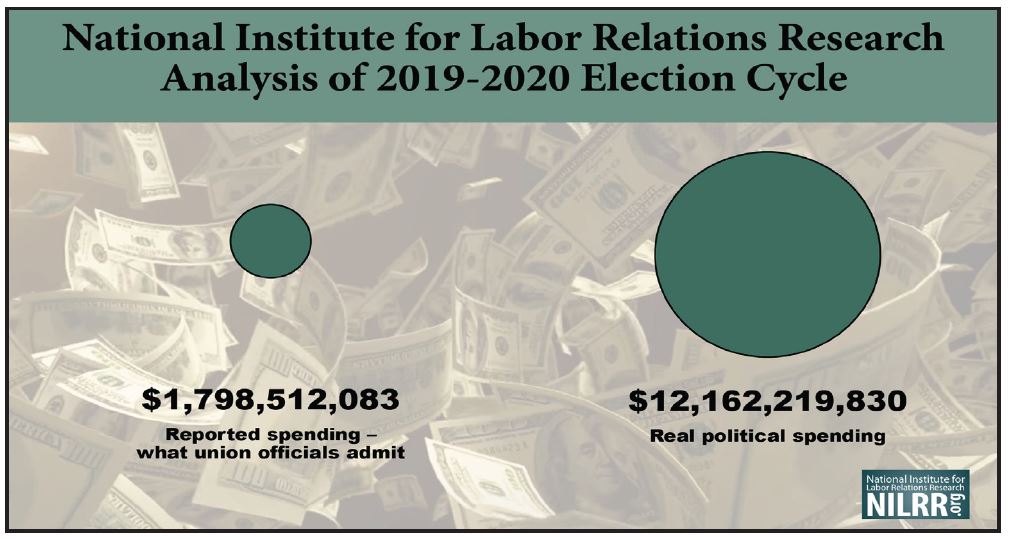
Coates’ case challenging illegal seizure of forced dues for politics comes after one analysis found that union officials likely spent over $12 billion on political activities during the 2019-2020 election cycle, far more than union officials publicly admit.
GALETON, PA – An employee of metal corporation Catalus hit a Communications Workers of America (CWA) union local this May with federal charges for illegally seizing full union dues from his paycheck, including dues for politics. Curtis Coates, a metal worker for Catalus, is receiving free legal aid from the National Right to Work Legal Defense Foundation.
Foundation attorneys filed Mr. Coates’ charges with National Labor Relations Board (NLRB) Region 6 in Pittsburgh, Pennsylvania. The Region is now investigating the charges.
CWA Union Officials Continue to Collect Dues from Worker, Despite Lack of Authorization
On October 20, 2021, Mr. Coates sent a message to CWA union officials declaring that he was resigning from his position as shop steward and terminating his union membership.
Because no union monopoly contract was in effect, under longstanding law, Coates should have been able to immediately cut all financial support for the CWA union which he no longer supports. The charges say a union official rebuffed both of Mr. Coates’ requests the next day, insisting that he had to remain both a union member and a shop steward.
From December 2021 to February 2022, Mr. Coates followed up with union officials several times via email and mail. He repeatedly asked when union officials would cease taking dues money from his paychecks and what process he had to follow to revoke his dues deduction authorization to stop money from being seized from his paychecks.
“To date, the Union has not responded . . . and dues and contributions continue to be deducted from his wages,” the charge reads. Because Pennsylvania currently lacks a Right to Work law, union officials can legally force employees to pay some union fees just to keep their jobs. However, those forced fees cannot be demanded when no union contract is in effect.
Further, even in states without Right to Work protections full union membership cannot be required. Additionally, under the U.S. Supreme Court’s decision in CWA v. Beck (1988), won by Foundation attorneys, forced fees are limited to only the part of union dues that union officials claim goes toward a union’s core “representational” functions and cannot be collected for other activities like union politics and lobbying.
Conflict of Interest: NLRB General Counsel is a Former CWA Union Official
Currently, the NLRB General Counsel is former CWA attorney Jennifer Abruzzo, who has expressed support for a number of policies which give union officials greater power to force workers into dues-paying union ranks, even without a vote. Foundation attorneys requested last year that Abruzzo recuse herself from a case involving an Oregon ABC cameraman who accused another CWA local of demanding illegal dues from him, including dues for politics.
Coates’ case represents another potential conflict of interest for Abruzzo, who has repeatedly sided with union officials against the rights of workers opposed to union affiliation.
“Mr. Coates’ right to refrain from funding union activities is being ignored by CWA union officials as they continue to unlawfully seize full union dues, which includes money used for union political activities,” commented National Right to Work Foundation Vice President Patrick Semmens. “This case shows why Pennsylvania workers need the protection of a Right to Work law to make all union payments strictly voluntary: So union bosses cannot so brazenly collect money to which they are not entitled under longstanding federal law.”
“Further, Mr. Coates’ case demonstrates the obvious conflict of interest that exists as Abruzzo, a former CWA lawyer, is charged with enforcing workers’ rights violated by her former CWA union colleagues,” Semmens added.
Foundation Demands Recusal of Former SEIU Lawyers Appointed to Labor Board
The following article is from the National Right to Work Legal Defense Foundation’s bi-monthly Foundation Action Newsletter, November/December 2021 edition. To view other editions of Foundation Action or to sign up for a free subscription, click here.
Biden NLRB appointees have blatant conflicts of interest in case brought by SEIU officials
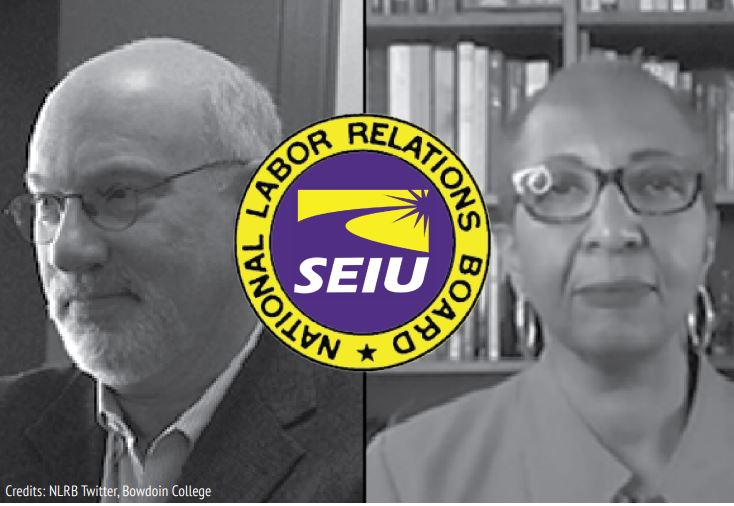
Foundation attorneys demand that the NLRB IG stop David Prouty (left) and Gwynne Wilcox, fresh off tenures as high-ranking SEIU lawyers, from derailing efforts to ensure workers can resist union influence they oppose.
WASHINGTON, DC – The National Right to Work Legal Defense Foundation submitted a letter to the National Labor Relations Board (NLRB) Inspector General (IG) and chief ethics officer, urging them to remove NLRB members David Prouty and Gwynne Wilcox from involvement in an ongoing federal case and any cases brought by Foundation-assisted workers against Service Employees International Union (SEIU) affiliates.
Prouty and Wilcox were both appointed to the Board by President Biden. Prior to their appointment, both were lawyers for influential SEIU affiliates. The NLRB members, including Prouty and Wilcox, are currently being sued by the SEIU in federal court over a rule finalized by the Trump NLRB. That rule clarified that a company that does not exercise direct control over employee wages and working conditions cannot be charged with unfair labor practices committed by its related entities, such as franchisees.
Union officials want to change that so-called “joint employer” standard to launch top-down organizing campaigns to target workers for monopoly unionization. During such campaigns, union officials often attack companies in the press and through coordinated litigation in order to get employer assistance in imposing unionization on workers, including by bypassing the secret ballot vote process for unionization.
Workers Regularly Charge SEIU Union Affiliates with Rights Violations
The letter from Foundation President Mark Mix points out Prouty and Wilcox’s recusal is of particular interest to the Foundation because “Foundation Staff Attorneys frequently provide free legal representation to employees involved in litigation before the National Labor Relations Board against SEIU or its affiliates,” and that the same considerations “should mandate the recusal of Member Wilcox and Member Prouty in those cases as well.”
Each year, Foundation staff attorneys handle more than 100 cases brought for workers at the NLRB challenging union violations of workers’ rights. SEIU affiliates are among the most often cited in those cases for violating federal law. Just since 2018, Foundation attorneys have assisted workers in 67 cases against SEIU affiliates, over half of which have been at the NLRB.
The letter also asks that the NLRB IG “apply the same level of vigor in examining their conflicts as he did in matters involving former Board Member William J. Emanuel.” Although the NLRB finalized its “joint employer” standard through the rulemaking process, an earlier 2017 case decision that would have adopted the same standard was gutted because the NLRB IG ruled that then-Member Emanuel should have recused himself.
The Foundation’s letter details Member Prouty’s history as General Counsel of SEIU Local 32BJ, a powerful SEIU affiliate. It further points out that Member Prouty “played a key role in opposing the Board’s final rule on joint employment,” personally signing comments against the rule, which is further evidence of his specific conflict of interest in the pending case.
Letter: Ex-SEIU Board Member Even Headed Up Group at ‘Core’ of Litigation
Member Wilcox’s conflicts go even deeper, according to the Foundation’s letter. It notes that Member Wilcox was at the forefront of a union campaign that openly opposed the NLRB’s “joint employer rule,” a campaign that is “specifically named as interested in, and a core part of, the Litigation” against that rule.
The Biden Administration has gone above and beyond in its efforts to entrench union boss influence at the NLRB. Just minutes after being inaugurated, President Biden took the unprecedented step of firing then-NLRB General Counsel Peter Robb, who still had 11 months left on his Senate-confirmed term. Robb had aggressively supported cases in which workers sought to free themselves from coercive union boss-created schemes.
Foundation Also Calls Out NLRB General Counsel
Robb’s replacement, Biden appointed Jennifer Abruzzo, is a former Communications Workers of America (CWA) union lawyer who, Freedom of Information Act (FOIA) records requests from the Foundation revealed, was half of a two-person Biden NLRB transition team that engineered Robb’s first-of-its-kind ouster.
In a separate letter, Foundation staff attorneys have demanded Abruzzo’s recusal from an ongoing NLRB case brought by an ABC cameraman against a CWA affiliate.
The letter points out that, while at the CWA International as special counsel, Abruzzo was responsible for the very legal policies that CWA affiliates are bound to follow, including the one challenged by the worker’s Foundation-provided attorneys in the case.
“The Biden Administration has already displayed some of the most biased and politically motivated behavior at the NLRB since the agency’s inception, all in an attempt to unfairly rig the system to favor Biden’s union boss political allies over protecting workers’ individual rights,” commented National Right to Work Foundation President Mark Mix. “If Prouty and Wilcox’s obvious conflicts of interest are unaddressed in this case, the message from the Board will be clear that ethics policies and recusal rules no longer apply now that pro-union boss Biden appointees are in power.”





