
Public Overwhelmingly Opposes Labor Department Proposal to Loosen Union Financial Disclosures
Over 97% percent of comments oppose proposal to let union bosses hide more political spending from workers
The National Right to Work Foundation recently filed detailed comments in opposition to a Department of Labor Office of Labor Management Standards (OLMS) proposed rule to significantly reduce financial disclosures union officials are required to file. With the comment period concluding last week, it is now clear that commenters overwhelmingly agree with the Foundation that the rule should be rejected.
Of 299 public comments submitted, over 97% strongly opposed the rule change.
The full comment submitted by the National Right to Work Foundation can be read here.
The Foundation’s comments note that the rule cannot be justified because workers’ rights will be undermined if union officials are permitted to more easily hide their spending of dues money, including money seized from workers forced to pay dues or else be fired:
“OLMS data for the past year…shows over 7,700 filings from unions with receipts under $450,000 that are located in states that lack Right to Work laws. These unions reported combined annual receipts of over $523 million, annual disbursements of over $514 million, and over 4 million members… The lack of more detailed reporting requirements for these unions therefore harms over 4 million workers by denying them meaningful details…”
These sentiments were echoed by hundreds of Americans, including rank-and-file workers, who are furious with the OLMS for proposing to deprive millions of workers of vital information on how union officials spend their dues payments, especially spending on union political and ideological activities. As over 225 of the comments point out, this change would allow over 850 unions, spending over $200 million annually, to hide their activities from detailed financial disclosure accessible to workers and the public.
Former union members used the public comments to share their personal experiences with union misconduct, and their desire for more accountability:
- A former member of the International Brotherhood of Teamsters shared retaliation he experienced for speaking out about errors in union financial reports.
- A former professor recalled being forced to pay union dues and being coerced into supporting union candidates and policies.
- A former member of the International Brotherhood of Electrical Workers remembers union chiefs spending lavish amounts of money on politicians he would never vote for.
- A former member of the Communications Workers of America felt betrayed by union bosses and urges the Department to make them account for every cent they misuse.
Other detailed comments opposing the rule came from the National Institute for Labor Relations Research, Institute for the American Worker, Yankee Institute, and Coalition for a Democratic Workplace, as well as others.
Of the just seven comments that actually favored the change, a majority were filed by union officials who predictably want more leeway to hide their spending of dues money from the rank-and-file they claim to “represent.”
Among them was the National Education Association (NEA) which unsuccessfully attempted to hide its controversial 2025 handbook from the public just as comments were being solicited.
Meanwhile, union bosses at the AFL-CIO and AFSCME actually argued for even less disclosure to workers than the rule proposed, with AFL-CIO even suggesting that thresholds should be automatically raised every year.
The United States establishes a government of the people, by the people, and for the people. OLMS should reject these union bosses’ personally-motivated requests, and instead listen to the voice of the overwhelming majority calling for this change to be withdrawn.
DOJ Attorney Battles Biden Admin Union Power Grab Over Justice Department
The following article is from the National Right to Work Legal Defense Foundation’s bi-monthly Foundation Action Newsletter, March/April 2025 edition. To view other editions of Foundation Action or to sign up for a free subscription, click here.
Foundation attorneys challenge last minute DOJ unionization in violation of FLRA case law

NTEU union bosses backed Kamala Harris for President, but when voters rejected her, NTEU union officials and the Biden-Harris Administration hastily moved to install the union at the DOJ in an apparent attempt to obstruct Trump’s priorities.
WASHINGTON, DC – In states across the country, union officials go to great lengths to gain more political influence, and will often violate established law to do so.
As veteran Department of Justice attorney Jeffrey Morrison is discovering, federal agencies are no exception. Morrison is challenging a last-minute attempt by National Treasury Employees Union (NTEU) bosses to gain monopoly bargaining control over attorneys at both the DOJ Civil Rights Division (CRT, where Morrison is employed) and the DOJ Environment and Natural Resources Division (ENRD).
The unionization campaign was fast-tracked just days after Trump’s November election victory, in an apparent attempt to formally hand NTEU union officials power over the divisions prior to inauguration day. Morrison’s legal action asks the Federal Labor Relations Authority (FLRA) to formally review the actions by the Biden DOJ and NTEU officials. The FLRA is the federal agency responsible for adjudicating disputes between federal employees, union officials, and agencies within the federal government.
Brief: DOJ Holdovers and NTEU Bosses Colluded to Flout Existing Law
Morrison, who is receiving free legal aid from the National Right to Work Foundation, contends in filings before the FLRA that the NTEU’s scheme violates an existing FLRA decision in which the agency ruled that CRT attorneys did not comprise a work unit appropriate for unionization.
DOJ management raised this exact concern about the CRT unit with the FLRA after NTEU union bosses began their campaign, but the DOJ dropped its opposition just days after the November federal elections.
Morrison is asking the FLRA to review the decision of the Regional Director to allow the election to go forward in the CRT and ENRD divisions without properly considering if these divisions are an appropriate unit under the law.
Morrison’s filings (called “Applications for Review”) came after DOJ management and NTEU union officials agreed that the CRT and ENRD were work units appropriate for unionization. His Applications for Review point out that a prior FLRA decision, Antitrust Division, held that CRT lawyers “did not have a separate and distinct community of interest from other DOJ trial attorneys” and for that reason couldn’t stand as a distinct bargaining unit.
“[T]he Authority determined this very unit to not be an appropriate unit…The Regional Director’s failure to comply with current, binding Authority precedent is in error and must be reversed,” the Application for Review says regarding the CRT attorneys. This same argument is applied to the ENRD division because it is similarly situated to CRT in the DOJ hierarchy.
FLRA Failed to Conduct Investigation Into NTEU’s Union Scheme
Morrison’s applications also contend that the FLRA “fail[ed] to conduct an independent investigation into the appropriateness of the unit,” despite the law requiring that the FLRA make such a finding.
“An agency agreeing with a union that a unit is appropriate does not mean that unit is actually appropriate. Agencies, like DOJ here, cannot usurp the Authority’s role in deciding unit appropriateness…” say the Applications for Review.
“Right before power changed hands in Washington, DC, NTEU union bosses and DOJ bureaucrats appear to have colluded to flout longstanding precedent that says Justice Department attorneys cannot legally be unionized division by division,” commented National Right to Work Foundation President Mark Mix.
“The FLRA has ignored established precedent to let this hasty unionization attempt go through, and our attorneys are proud to assist Mr. Morrison in opposing this maneuver.”
Victory: San Diego Charter School Educators Vote Out Teacher Union Bosses
The following article is from the National Right to Work Legal Defense Foundation’s bi-monthly Foundation Action Newsletter, September/October 2023 edition. To view other editions of Foundation Action or to sign up for a free subscription, click here.
SDEA officials stonewalled vote at charter school for years with “blocking charges” and pressure from elected officials
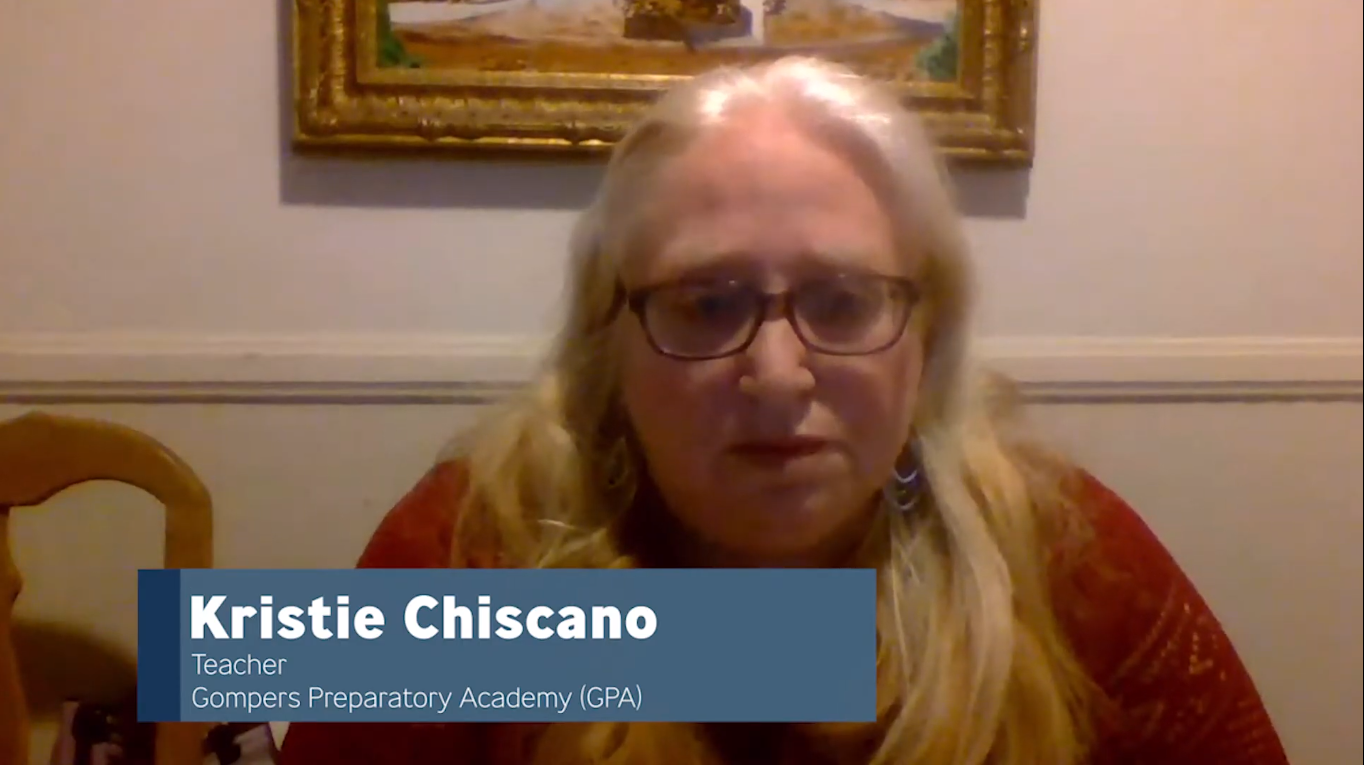
Kristie Chiscano kick-started the first effort at Gompers to remove the SDEA union. She witnessed firsthand that union control was ruining the independent nature of the charter school.
SAN DIEGO, CA – When San Diego Education Association (SDEA) union officials rose to power in 2019 at Gompers Preparatory Academy (GPA), educators and parents were rightfully concerned about what impact it would have on students’ progress and well-being.
Gompers had made an impressive transition to being a union-free charter school in 2005 after years of being plagued by unresponsive union bureaucracies, violence, high teacher turnover, and poor academic achievement. Teachers who feared that union monopoly control would allow such problems to creep back into Gompers quickly began an effort to vote out the union.
“I chose to work at a school that didn’t have a union, and now they’ve come in and they’re running everything about my contract and my work,” Kristie Chiscano, then a Gompers chemistry teacher and proponent of the decertification effort, said at the time.
While union stall tactics derailed Gompers educators’ 2019 effort to oust the union, Gompers educators didn’t give up. A majority of Gompers teachers backed another petition asking the California Public Employment Relations Board (PERB) for a vote to remove the union in 2023. Now, after years of legal maneuvers from union officials, Gompers educators have successfully ousted the SDEA with free legal aid from the National Right to Work Foundation.
SDEA Officials Used Spurious Charges to Block Earlier Teacher Effort
“There is definitely a lot more joy that’s going to be in classrooms now, instead of a burden with the union,” Cynthia Ornelas, a sixth grade Gompers teacher, told KPBS. “The union was making decisions for us, oh my goodness! We never knew what they were deciding because they didn’t communicate with teachers.”
Gompers teachers’ first effort to eliminate the SDEA union stemmed from an October 2019 petition that had the backing of a significant number of teachers, more than required by state law. However, SDEA union bosses averted the election by filing so-called “blocking charges” containing allegations of employer misconduct.
Union officials often manipulate “blocking charges” at the PERB and other state and federal labor relations agencies to stifle worker attempts to eliminate unpopular union “representation.”
As Foundation attorneys defended Gompers educators’ first petition, they also challenged a regulation requiring PERB agents and attorneys to accept union bosses’ “blocking charge” allegations as true. This regulation almost guarantees union defeat of any worker attempt to vote a union out.
Despite the PERB never holding a hearing into whether SDEA union bosses’ claims had any merit or whether they were related to the workers’ dissatisfaction with the union, PERB officials denied a decertification election to Gompers educators in October 2020.
Aside from legal maneuvers, union officials used intimidation and pressure to avoid being voted out. Chiscano and another Gompers educator filed charges maintaining that SDEA agents targeted them on social media for opposing the union hierarchy. California law makes it illegal for union officials to intimidate or retaliate against employees who exercise their right to refrain from union membership. Union-label California legislator Lorena Gonzalez, then an assemblywoman and now a top California AFL-CIO official, even wrote a screed to Gompers management that attacked the National Right to Work Foundation for simply providing legal aid to Gompers educators.
Teachers’ Long Struggle Exposes Massive Power of CA Public Sector Unions
Gompers educators submitted the March 2023 petition at the earliest time permitted by California labor regulations, which immunize union officials from employee-led decertification efforts for all but a tiny window while union contracts are active. Now, nearly four years after their original effort began, Gompers educators are finally free from union control.
“Gompers educators witnessed that SDEA union officials were not acting in the best interests of the students or the school community at large, and they fought courageously to bring back the independent environment that made Gompers a success,” commented National Right to Work Foundation President Mark Mix. “However, Gompers teachers shouldn’t have had to fight as long or as hard as they did simply to exercise their rights. No special interest group in California, or in America, should wield this kind of power over teachers and the public education system.
Workers Sweep to Victory: Laborers Union Bosses Flee to Avoid Worker Decertification Vote to Remove Union
Decatur EnviroServe industrial cleaning workers are finally free from unwanted union “representation”
Decatur, IL (June 20, 2023) – Jerry Guzzie and his coworkers at the industrial cleaning company EnviroServe in Decatur, Illinois have succeeded in their effort to free themselves from unwanted Laborers Union officials’ so-called “representation.”
On May 30, Guzzie filed a decertification petition with the National Labor Relations Board (NLRB) seeking a vote to remove Southern and Central Illinois Laborers’ Local 159, an affiliate of Laborers’ International, AFL-CIO.
The decertification petition was filed with the NLRB Region 25 office with free legal aid from the National Right to Work Legal Defense Foundation and asked for a vote to be held on June 20. However, before the decertification election could take place, union officials disclaimed interest in the bargaining unit to avoid facing removal by the workers. Guzzie filed the decertification petition for all service and maintenance employees at the facility.
Under federal law, when the required number of workers in a bargaining unit sign a petition seeking the removal of union officials’ monopoly bargaining powers, an NLRB-conducted secret ballot vote whether to remove the union is triggered. If a majority of workers cast ballots against the union, the union is stripped of its government-granted monopoly “representation” powers.
In this case, union officials apparently knew they lacked the support to stay in power, so rather than contest the vote they just conceded defeat and walked away.
“We’re glad to finally be free of the union. They saw the writing on the wall and knew how unwelcome they were at EnviroServe,” Guzzie commented. “I couldn’t have done this without the National Right to Work Foundation supporting me and my coworkers.”
“Union officials knew they were unwanted in the workplace, so rather than face workers in an election, they disclaimed interest and ran,” said National Right to Work Foundation President Mark Mix. “Workers everywhere should know they can turn to the National Right to Work Foundation for free legal aid to help enforce their rights and remove unwanted union officials from their workplace.”
NYC University Professors Take Aim at Forced Union ‘Representation’
The following article is from the National Right to Work Legal Defense Foundation’s bi-monthly Foundation Action Newsletter, March/April 2022 edition. To view other editions of Foundation Action or to sign up for a free subscription, click here.
CUNY professors’ lawsuit argues NY law forces them under power of anti-Semitic union
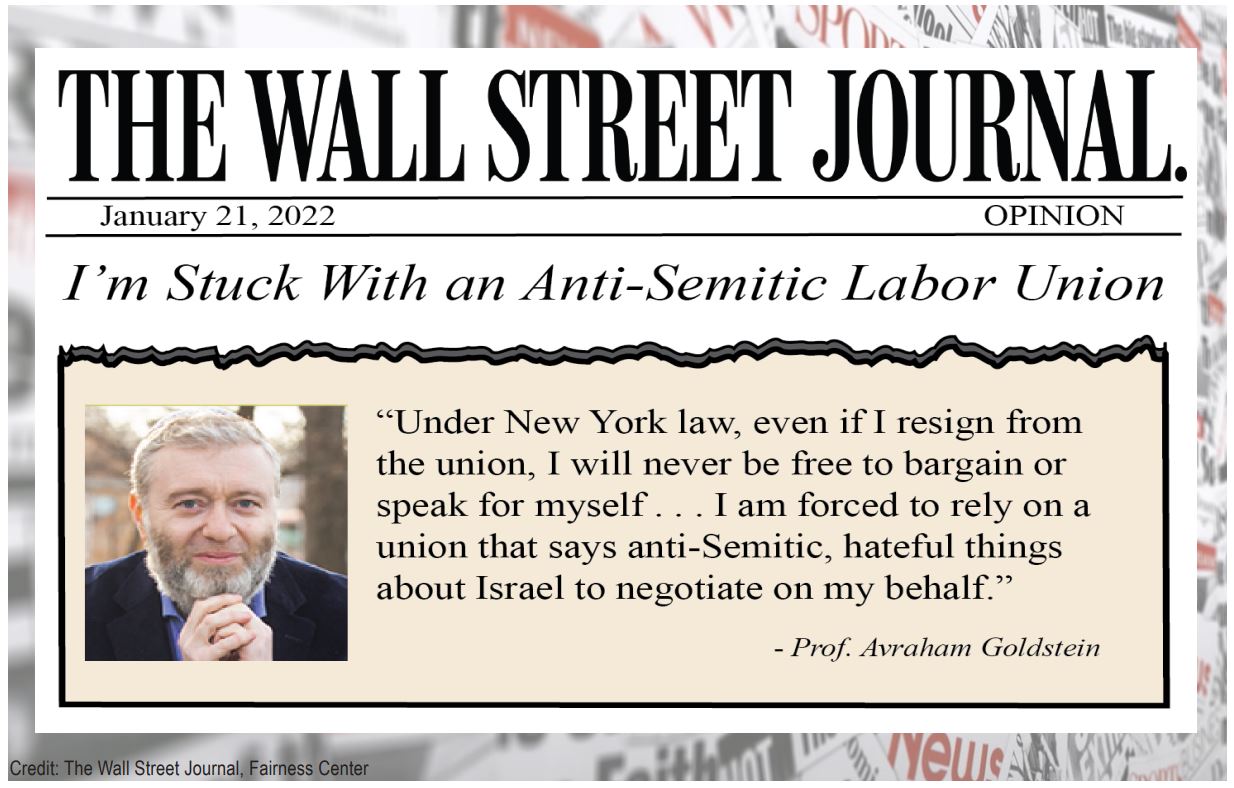
Prof. Avraham Goldstein recalled in a Wall Street Journal piece the anti-Semitism his family faced in the Soviet Union. He and other plaintiffs argue they shouldn’t be forced to associate with a union that subjects them to similar hostility.
NEW YORK, NY – For decades, government sector union bosses have relied on two pillars of coercion — forced dues and forced representation — to maintain their grip on power over America’s public servants and the public services citizens rely on.
While the Supreme Court in the 2018 National Right to Work Foundation-won Janus v. AFSCME Supreme Court case recognized that forcing government employees to pay dues to stay employed violates the First Amendment, a new Foundation-assisted civil rights lawsuit from six City University of New York (CUNY) system professors may finally defeat union bosses’ privilege to impose union representation over the objections of public workers.
CUNY professors Jeffrey Lax, Michael Goldstein, Avraham Goldstein, Frimette Kass-Shraibman, Mitchell Langbert, and Maria Pagano sued the AFL-CIO-affiliated Professional Staff Congress (PSC) union, CUNY executives, and New York State officials in January, challenging New York State’s “Taylor Law” that gives unions monopoly bargaining privileges in public sector workplaces like CUNY.
The plaintiffs, most of whom are Jewish, oppose the union’s “representation” on the grounds that union officials and adherents have relentlessly denigrated their religious and cultural identity. Several of the plaintiffs exercised their Janus right to cut off dues after PSC officials rammed through a resolution in June 2021 that they found “anti-Semitic, anti-Jewish, and anti-Israel,” according to the lawsuit.
Discrimination Cited in Groundbreaking First Amendment Case
The lawsuit, which was filed with legal aid from both the National Right to Work Foundation and Pennsylvania-based Fairness Center, says: “Despite Plaintiffs’ resignations from membership in PSC, Defendants . . . acting in concert and under color of state law, force all Plaintiffs to continue to utilize PSC as their exclusive bargaining representative.”
The resolution is not nearly the worst example of PSC officials’ anti-Semitism, according to the lawsuit. Prof. Michael Goldstein asserts that adherents of PSC are waging a campaign to get him fired and have targeted him with harassment and threats such that he must have an armed guard accompany him on campus. Prof. Lax cites in the lawsuit a determination he has already received from the Equal Employment Opportunity Commission (EEOC) that “PSC leaders discriminated against him, retaliated against him, and subjected him to a hostile work environment on the basis of religion.”
While all of the professors take issue with PSC bosses’ radicalism, they also want to break free from internal conflicts within the large and disparate unit, which consists of full-time, part-time, and adjunct teaching employees and others. Prof. Kass-Shraibman states in the lawsuit that “instead of prioritizing the pay of full-time faculty, PSC expended resources advocating on behalf of teachers in Peru, graduate students at various other universities and the so-called ‘Occupy Wall Street’ movement.”
On top of all that, Profs. Avraham Goldstein, Kass-Shraibman, and Langbert contend that PSC officials aren’t even respecting their First Amendment Janus rights. Although all three professors clearly indicated they wanted to cut off financial support to the union, the lawsuit explains that “Defendants PSC and the City . . . have taken and continue to take and/or have accepted and continue to accept union dues from [their] wages as a condition of employment . . .” in violation of Janus.
“I had paid thousands of dollars in union dues for workplace representation, not for political statements or attacks on my beliefs and identity,” Prof. Avraham Goldstein wrote in a piece for The Wall Street Journal. “I decided to resign my union membership and naively thought I could leave the union and its politics behind for good.”
“I was wrong,” recounted Prof. Goldstein. “Union officials refused my resignation and continued taking union dues out of my paycheck.”
Suit Seeks Damages and to Overturn NY Law Authorizing Union Control
The lawsuit seeks a declaration from the U.S. District Court for the Southern District of New York that the Taylor Law’s imposition of monopoly union control is unconstitutional, and that the defendants cease “certifying or recognizing PSC, or any other union, as Plaintiffs’ exclusive representative without their consent.” The lawsuit also demands the union and university return dues seized in violation of Janus to Profs. Avraham Goldstein, Kass-Shraibman, and Langbert.
“By forcing these professors into a monopoly union collective against their will, the state of New York mandates that they associate with union officials and other union members who take positions that are deeply offensive to these professors’ most fundamental beliefs,” observed National Right to Work Foundation President Mark Mix. “New York State’s Taylor Law authorizes such unconscionable compulsion. It is time federal courts fully protect the rights of government employees to exercise their freedom to disassociate from an unwanted union, whether their objections are religious, cultural, financial, or otherwise.”
Casino Worker Challenges Order Installing Unwanted Union via ‘Card Check’
The following article is from the National Right to Work Legal Defense Foundation’s bi-monthly Foundation Action Newsletter, March/April 2022 edition. To view other editions of Foundation Action or to sign up for a free subscription, click here.
Ninth circuit panel signals willingness to end precedent allowing for imposition of union

NLRB officials stacked the deck against rank-and-file Red Rock Casino employees by imposing an unpopular union on them despite worker objections.
LAS VEGAS, NV – A large majority of the workers at Red Rock Casino in Las Vegas, Nevada voted “no” to unionization, but a federal district court judge ordered their employer to bargain with union officials anyway. Casino officials appealed, and Red Rock employee Raynell Teske supported their efforts to overturn the judge’s coercive order that overrides the choice workers made at the ballot box.
With free Foundation legal aid, Teske filed a brief arguing that the district judge had no reason to impose a union onto workers who had already soundly voted to reject it. A Ninth Circuit panel denied the initial appeal, but issued an unusual concurring opinion in which all three judges said they disagreed with that outcome, but were bound by Ninth Circuit precedent to uphold the district judge’s order.
Binding precedent can only be overturned through an en banc hearing before a larger Ninth Circuit panel. Red Rock lawyers filed for an en banc rehearing of their appeal. The court then ordered National Labor Relations Board (NLRB) lawyers defending the order to respond, another signal the judges may be willing to overturn this ridiculous precedent and rule in the workers’ favor. Teske filed a second amicus brief, urging the court to hear the case en banc.
Judge Overrides Workers’ Vote Against Union ‘Representation’
The situation at Red Rock began in December 2019, when the NLRB held a secret-ballot election on whether to unionize the Casino’s workers. Employees rejected union officials’ effort to become their monopoly bargaining “representatives” in an NLRB-supervised vote by a nearly 100-vote margin. Despite that outcome, NLRB Region 28 Director Cornele Overstreet sought a federal court injunction imposing the union over the workers’ objections.
On July 20, 2021, District Judge Gloria Navarro agreed with the NLRB Director’s request, and ordered Red Rock to bargain with union officials despite the employees’ vote against unionization. The judge said the order was justified because union officials claimed that, before the vote, a majority of workers had signed union authorization cards.
Teske’s amicus briefs argue those “Card Check” signatures don’t prove that union officials ever had majority support. She contends the level of union support was tested fairly by the secret-ballot election, in which workers voted 627-534 against unionization.
Her briefs point out that the NLRB and federal courts have long recognized that secret ballots are a more reliable way of gauging worker support for a union, because workers are often pressured, harassed, or misled by union organizers into signing cards.
Union officials know that Card Check signatures do not indicate solid worker support. The AFL-CIO admitted in its internal organizing handbook that it needed at least 75% Card Check support before having even a 50-50 chance of winning a secret-ballot election. Union bosses prefer Card Check unionization because they can more easily take control of workplaces where they lack popular support, and partisan NLRB appointees now are working to grant their wish.
Partisan NLRB Pushes Unreliable ‘Card Check’
Past legislative attempts to enact Card Check unionization, including the so-called “PRO Act,” pending in the U.S. Senate right now, faced bipartisan opposition. However, NLRB General Counsel Jennifer Abruzzo, a former high-ranking union lawyer, believes she can implement Card Check without congressional approval. Abruzzo has expressed interest in resurrecting a decades-old NLRB doctrine that allows unions to sue employers to try to force them to automatically bargain whenever the union possesses a pile of untested union cards.
“There is no reason why district court judges or NLRB bureaucrats should be able to override workers’ choice at the ballot box,” said National Right to Work Foundation Vice President Patrick Semmens. “A favorable ruling for Raynell Teske and her colleagues could provide legal ammunition for future workers if the NLRB tries to force them to accept union officials for whom they never even had a chance to vote.”
Opposition Filed to Judge’s Order Imposing Culinary Union on Workers who Rejected Union in Secret Ballot Vote
Red Rock Casino workers vote against unionization, but nearly 2 years later judge ordered employer to bargain with union officials
Las Vegas, NV (August 24, 2021) – A large majority of the workers at Red Rock Casino in Las Vegas, Nevada voted “no” to unionization, but a federal district court judge is forcing their employer to bargain with union officials anyway.
The Casino is appealing the judge’s order at the U.S. Court of Appeals for the Ninth Circuit. Now Red Rock employee Raynell Teske has filed an amicus brief arguing the judge was wrong to impose the union on the workers, given the rejection of the union in the election. National Right to Work Legal Defense Foundation attorneys assisted Teske for free in filing the amicus brief with the appellate court.
In December 2019, the National Labor Relations Board held a secret ballot election whether to unionize Red Rock. A sizable majority of those voting rejected union officials’ effort to become their monopoly bargaining representatives. Despite that vote, NLRB Region 28 Director Cornele Overstreet filed a federal court injunction action seeking to have the union imposed over the workers’ objections.
On July 20, 2021, Judge Gloria Navarro agreed with the NLRB Director’s request, and issued a “Gissel” order forcing Red Rock to bargain with union officials despite the employees’ vote against unionization. The judge said the order was justified because, prior to the vote, union officials claimed that a majority of workers had signed union authorization cards.
Teske’s amicus brief argues those “card check” signatures are unreliable, and not reason enough to conclude the union ever had majority support. She contends the level of union support was tested fairly by the secret-ballot election, in which workers voted 627-534 against unionization. Secret ballots are a far more reliable way of gauging worker support for a union, because workers are often pressured, harassed, or misled by union organizers into signing cards.
Unions themselves know that “card check” signatures do not indicate solid worker support. The AFL-CIO admitted in its 1989 organizing handbook that it needed at least 75% card check support before having even a 50-50 chance of winning a secret ballot election. An earlier guidebook acknowledged that some workers sign cards just to “get the union off my back.”
Teske’s brief argues the union’s possession of so-called “cards” is an insufficient legal basis for imposing unionization, especially after a secret ballot election in which the union lost. It agrees with the employer that the “Gissel” order should be overturned, and that Teske and her coworkers should not be subjected to monopoly bargaining by a union they rejected in an NLRB-supervised secret ballot election.
This is not the only case in which union bosses are battling casino employees in court. Red Rock’s parent company, Station Casinos, also owns Palms Casino in Las Vegas, where employees filed a petition to decertify union officials in March, 2021. Union lawyers blocked the petition with a slew of charges that were accepted by NLRB bureaucrats as reason to block the workers’ petition. The Palms Casino worker represented by National Right to Work Foundation attorneys who filed the petition is appealing the decision to block the vote he requested.
“Ms. Teske and her coworkers had good reasons to reject the union. It is outrageous that the judge’s order imposing unwanted unionization brushes aside the workers’ contrary preference clearly demonstrated in the secret ballot vote,” said National Right to Work Legal Defense Foundation President Mark Mix. “There have been countless examples of workers being pressured, misled and even bribed to sign union cards, which is why ‘Card Check’ is widely accepted as unreliable, especially compared to an NLRB-supervised secret ballot election.”
“If federal labor law is to be about defending the rights and freedoms of rank-and-file workers, then the Court of Appeals should promptly overturn Judge Navarro’s order substituting the wishes of NLRB bureaucrats for the actual choice workers made at the ballot box,” added Mix.
Foundation Defends New Rules Protecting Right to Remove Unwanted Unions
The following article is from the National Right to Work Legal Defense Foundation’s bi-monthly Foundation Action Newsletter, September/October 2020 edition. To view other editions or to sign up for a free subscription, click here.
AFL-CIO kingpins suing to overturn NLRB rules slashing barriers to decertification votes

Over the past few years, the Foundation has provided free legal aid to workers
across the country who were blocked by pro-union boss NLRB rules from voting
out an unwanted union. Above are just a handful of them.
WASHINGTON, DC – The National Labor Relations Board’s (NLRB) new rules, designed to safeguard the right of workers to remove an unwanted union hierarchy in their workplace, went into effect on July 31. The policies, which were finalized in April, closely followed comments submitted by National Right to Work Foundation staff attorneys and petitions sent by thousands of Foundation supporters.
The policies specifically curtailed the non-statutory “blocking charge” and “voluntary recognition bar” policies used to trap workers in unions they oppose, and also eliminated a scheme used by union bosses in the construction industry to impose unionization without any evidence of worker support.
Less than a month before the reforms went into effect, union lawyers with the AFL-CIO filed a lawsuit against the NLRB in an attempt to reimpose these coercive restrictions on workers. Foundation attorneys are primed to defend the reforms and counter the wild claims AFL-CIO legal operatives make in the lawsuit.
New Rules Designed to Shield Workers from Unwanted Unions
The new rules are meant to eliminate virtually all union “blocking charges,” which are filed by union bosses to prevent rank-and-file employees from exercising their right to vote to remove a union.
Under the NLRB’s new policy, union charges cannot indefinitely stall the employees’ vote from taking place, and in most instances the vote will occur without delay. Additionally, as the Foundation advocated in comments, the NLRB modified its original proposed rule so that after employees vote, the ballots will be tallied and the vote announced in most cases instead of being impounded for months or even years while “blocking charges” are resolved.
The NLRB also reversed an Obama-era ruling imposing the so-called “voluntary recognition bar” policy. Under that policy, workers were blocked for up to a year from requesting a secret-ballot election to challenge a union which was installed as their monopoly bargaining agent through an abuse-prone “Card Check” drive, which bypasses the NLRB-supervised secret-ballot election process. In reversing the Obama NLRB, the current Labor Board reinstated a precedent won by Foundation staff attorneys for workers in the 2007 Dana Corp NLRB decision.
Under the Dana Corp. system, employees subject to “Card Check” drives and so-called “voluntary recognition” can promptly file for a secret-ballot election to contest the installation of a monopoly representative at their workplace.
Foundation Prepares to Counter Dubious Claims of AFL-CIO Suit Against NLRB
Unwilling to lose their power to block workers’ efforts to vote them out, the AFL-CIO filed suit against the rules even before they went into effect. The union boss lawsuit alleges, among other things, that the NLRB was misusing the rulemaking process by advancing these protections for independent-minded workers, even though union bosses widely cheered Obama NLRB efforts to use rulemaking to expand union boss power.
Foundation staff attorneys quickly began preparing to counter the AFL-CIO’s lawsuit aiming to reverse these reforms.
“Anyone who is familiar with the tactics of union bosses knows that they will fight tooth and nail to keep government-granted privileges in place that allow them to force their one-size-fits-all ‘representation’ on workers, even when a majority oppose their presence,” observed National Right to Work Foundation Vice President Patrick Semmens. “Foundation supporters should be proud that their advocacy helped obtain these new protections for workers opposed to unionization, but as the union boss lawsuit shows, the Foundation’s litigation program will continue to be critical to defending the rights of independent-minded workers.”
San Diego Charter School Teachers Demand Election to Oust Union Bosses
The following article is from the National Right to Work Legal Defense Foundation’s bi-monthly Foundation Action Newsletter, March/April 2020 edition. To view other editions or to sign up for a free subscription, click here.
Union bosses attempt to block educators from voting to escape controversial union

Dr. Kristie Chiscano, chemistry teacher at GPA, spearheaded the effort for a vote to remove SDEA union bosses from the school. Despite having the signatures of more than enough teachers, union bosses are trying to block the vote.
SAN DIEGO, CA – Teachers at San Diego’s Gompers Preparatory Academy (GPA) have collected enough signatures to trigger a vote to remove the San Diego Education Association (SDEA) union from monopoly bargaining power at the school.
Dr. Kristie Chiscano, a chemistry teacher at the charter school, submitted the decertification petition at the California Public Employment Relations Board (PERB) with free legal aid from the National Right to Work Legal Defense Foundation. However, rather than allow the teachers to vote in a secret ballot election whether to remove the union, SDEA bosses have filed “blocking charges” at the PERB in an attempt to block the election.
Teachers and Parents Oppose Union Power Grab at School
Controversy has surrounded the SDEA’s presence at GPA, as the union installed itself in January 2019 after conducting a “Card Check” drive. In the abuse-prone “Card Check” process, union organizers bypass a secret-ballot election and instead rely on a variety of pressure tactics to get employees to sign union cards that are later counted as “votes” for unionization.
GPA transitioned from being a regular public school to a charter preparatory academy in 2005 as the result of a campaign by parents, teachers, and administrators who believed that school district and union bureaucracies were not serving the students’ interests. Specifically, many in the community felt the old regime was failing to combat gang violence and teacher attrition at the school.
Since the school’s unionization without a secret ballot vote in January 2019, no monopoly bargaining contract has been approved. All the while, GPA parents and educators have accused SDEA agents of sowing division at the school, including by supporting anti-charter school legislation, making unnecessary and disparaging comments to school leadership during bargaining sessions, and plotting to prevent the California NAACP from giving the school’s director, Vincent Riveroll, an award for helping minority students succeed.
“It all changed once the union started,” GPA parent Theressah Rodriguez told the San Diego Union-Tribune about the union in January. “Now, whenever you come in, you feel the hostility.”
Foundation Aids Educators in Filing Popular Petition to Remove Union
Dr. Chiscano, who teaches chemistry to 10th and 11th grade students, began circulating the decertification petition last October. She soon obtained the signatures of well over the number of her fellow educators necessary to trigger a PERB-supervised secret-ballot vote to remove the union. The petition was filed with PERB immediately following the one-year anniversary of the union’s installation, the soonest she could file the petition under California law.
However, last December, union officials preemptively filed a charge at PERB seeking “that the certification year be extended.” That would block the educators’ right to remove the union from their workplace for another year despite no evidence or even an allegation that any educator violated the law. Such “blocking charges” are a tactic union lawyers frequently use to block rank-and-file employees from holding secret-ballot elections that could result in the removal of union officials from power as the employees’ designated monopoly representative.
With an impending legal battle over the union’s attempt to block her decertification petition, Dr. Chiscano turned to the National Right to Work Foundation to challenge this attempt by union officials to stymie her and her coworkers’ right to hold a decertification vote to oust a union they believe lacks the support of a majority of the school’s educators.
“Rather than face a secretballot vote of the rank-and-file educators they claim to represent, SDEA union bosses are resorting to legal trickery to trap teachers in a union they oppose by blocking their right to hold a decertification election,” observed National Right to Work Foundation Vice President Patrick Semmens. “By using these coercive tactics to attempt to trap teachers in union ranks, SDEA union officials do wrong by GPA’s namesake, AFL-CIO union founder Samuel Gompers, who himself urged devotion to ‘the principles of voluntarism’ and reminded all American workers that ‘no lasting gain has ever come from compulsion.’”
Worker Advocate Files Brief for Flight Attendant Backing Rule Change for Voting Out Unwanted Airline & Railroad Unions
Brief opposes union lawsuit challenging rule eliminating overly complex procedure for workers seeking to decertify an unwanted union
Washington, D.C. (March 12, 2020) – The National Right to Work Legal Defense Foundation filed an amicus brief in United States District Court for a flight attendant opposing an effort led by the AFL-CIO to overturn a recent rule by the National Mediation Board (NMB) that simplifies the process for workers seeking to vote out a union they oppose.
Foundation staff attorneys filed the amicus brief for Allegiant Airlines flight attendant Steven Stoecker to defend the NMB’s rule removing decertification election barriers. The brief was also filed for the Foundation itself, which has provided free legal representation to numerous workers under the jurisdiction of the Railway Labor Act (RLA), which the NMB is charged with enforcing.
Previously, to remove an unwanted union the NMB required an unnecessarily complex process in which workers had to create and solicit support for a fake “straw man” just to vote out the incumbent union. Under the NMB’s new rules finalized in July, workers can simply petition for a direct vote to decertify a union they oppose by a majority of the workers in their bargaining unit.
Stoecker, whose employment is governed by the RLA, attempted from 2014 to 2016 to remove the Transport Workers Union (TWU) from its monopoly bargaining status in his workplace, but those attempts ultimately failed when he lost his “straw man” election. The TWU is currently still the monopoly bargaining representative over his workplace.
“The National Mediation Board’s Final Rule simplifies the union selection or rejection process under the Railway Labor Act and erases nonstatutory barriers that hinder employees’ efforts to freely choose or reject a representative,” the amicus brief reads. “In response, the Plaintiffs, a group of labor unions that benefit from the complexities of the straw man decertification process, challenge the Final Rule and the Board’s statutory authority to establish it.”
Before the NMB issued the final rule last year, workers like Stoecker had to sign authorization cards designating an employee to be the “strawman” even though that employee had no intention of representing the unit. In the election that followed, the ballot options included the name of the union workers wished to decertify, the name of the straw man applicant, e.g., “John Smith,” the option for a write-in candidate and, confusingly, the option for “no union.”
Under the old guidelines, workers who voted for either the straw man or “no union” in hopes to oust union officials would unknowingly be splitting the vote opposed to unionization, as votes counted for these options were not tallied together but separately. The NMB’s final rule allows workers to vote out union representatives directly, without the cumbersome prior rules.
“That union bosses are suing the National Mediation Board for adopting this common-sense reform shows they are far more concerned with maintaining their power than respecting the right of rank-and-file workers to decide whether or not they actually want to remain in union ranks,” commented National Right to Work Foundation President Mark Mix. “The Foundation has long advocated this type of change in the union decertification process. We are pleased the NMB has – as we called upon it to do in comments filed last year – finally made this commonsense reform.”
“Ultimately the Railway Labor Act has many fundamental problems that require legislative action, not the least of which is that it grants union bosses the power to have workers fired for nonpayment of union dues or fees even in states with Right to Work laws,” observed Mix. “That makes it all the more important that while we wait for more sweeping reforms, workers are not trapped in forced dues ranks simply because of the unnecessarily complex ‘straw man’ decertification process.”





