
National Right to Work Foundation Issues Notice to VW Chattanooga Employees Impacted By UAW Boss-Ordered Strike
Notice informs VW Team Members of their rights in light of a potential strike at Tennessee production plant
Chattanooga, TN (November 4, 2025) – The National Right to Work Legal Defense Foundation has released a special legal notice to thousands of autoworkers at Volkswagen’s production plant in Chattanooga, TN. The notice comes as officials of the United Auto Workers (UAW) have just announced that they could order a strike at the facility at any time.
The full notice is available at https://www.nrtw.org/vw/.
The Foundation’s legal notice informs autoworkers of their rights that union officials often hide, including the right to continue working to support their families. The notice gives workers who want to return to work information on how to avoid fines and punishment that could be imposed by union officials. When union bosses call strikes, they will often fine workers who don’t abide by the strike. In many cases, the fines far exceed a day’s wage. The most foolproof way for workers to avoid union discipline is to resign their union membership before returning to work.
“The situation presents serious concerns for employees who believe there is much to lose from a union-ordered strike,” the legal notice reads. “That is why workers confronted with strike demands frequently contact the National Right to Work Legal Defense Foundation to learn how they can avoid fines and union discipline for continuing to work during a strike to support themselves and their families.”
The Foundation’s special legal notice highlights workers’ right to resign union membership, and provides guidance on best practices for doing so. Because Tennessee enjoys right-to-work protections, the notice also highlights employees’ right to not pay union dues.
Finally, the notice provides helpful information for removing the union by using a decertification petition to obtain a secret ballot election. Such an NLRB-supervised election would be like ones previously held in 2014, 2019, and 2024 at the facility, and would give workers the opportunity to vote in private on UAW affiliation.
Workers Can Receive Free Legal Aid and Avoid Illegal Union Retaliation
The National Right to Work Foundation is the nation’s premier organization exclusively dedicated to providing free legal assistance to employees victimized by forced-unionism abuses. The full notice can be found at https://www.nrtw.org/vw/.
The Foundation has a long history of assisting workers in cases against the UAW. In fact, Foundation staff attorneys have helped workers at the VW production plant in Chattanooga before, challenging union organizers’ attempts to bypass a secret ballot election and impose the union through an unreliable and abuse-prone Card Check. Recently, Foundation attorneys successfully defended auto accessory manufacturing employees against illegal strike fine threats by UAW officials in Pennsylvania.
“Despite fearmongering, pressure tactics, and misleading statements from union officials, workers always have the right to continue to work during a strike, providing for their families,” commented National Right to Work Foundation President Mark Mix. “This legal notice reflects the Foundation’s longstanding commitment to helping independent-minded workers who want to exercise their rights, protecting them from union bosses’ coercive tactics that regularly go hand-in-hand with strike demands from union officials.”
Vanderbilt Grad Students Free From Aggressive UAW Campaign
The following article is from the National Right to Work Legal Defense Foundation’s bi-monthly Foundation Action Newsletter, March/April 2025 edition. To view other editions of Foundation Action or to sign up for a free subscription, click here.
Foundation-assisted students challenged union-backed NLRB demand for private info

Notorious UAW President Shawn Fain saw his union rebuffed by many Vanderbilt students concerned about the union’s intrusive organizing methods. Facing legal and political headwinds, UAW bosses dropped their campaign.
NASHVILLE, TN – Union monopoly bargaining creates barriers to freedom for people across the country. It requires workers to accept self-motivated union bosses as their sole “voice” on issues in their workplace. But, in the private sector, it’s unfortunately the law of the land.
That’s not as clear when it comes to colleges and universities. Although the National Labor Relations Board (NLRB) under President Obama upended existing precedent to dubiously let union officials impose monopoly arrangements on graduate students — a ruling continued by the Biden NLRB — the Family Educational Rights and Privacy Act (FERPA) generally bans universities from sharing student information without student permission. This puts FERPA and federal labor law at odds, as such information is something employers are required by the NLRB to produce during a unionization campaign.
After the United Auto Workers (UAW) union launched a campaign in late 2024 to sweep Vanderbilt University’s graduate students under their monopoly power, NLRB officials required the college to fork over the info of thousands of students. But three courageous students stood up with free legal aid from the National Right to Work Legal Defense Foundation, arguing that disclosure without any procedure violated their privacy rights under FERPA.
Now, union officials have backed down and withdrawn the entire union campaign at the college. The three students and others are free from being forced into UAW union monopoly ranks and from the disclosure of their FERPA-protected information.
“The withdrawal of UAW organizers’ petition seeking a vote to unionize us against our will is a welcome victory for us in our defense of our rights and the rights of our fellow graduate students,” commented one of the Foundation-assisted Vanderbilt graduate students, identified as Jane Doe 1 in legal filings to protect her identity.
Students: FERPA Lets Us Protect Private Info From Unionization Scheme
The students’ effort to protect their privacy began in October 2024, when two students identified in filings as John Doe 1 and John Doe 2 moved to intervene in the NLRB case. They argued that FERPA’s language permits students to seek “protective action” if a university receives a subpoena seeking their personal information, as Vanderbilt had from the NLRB. A regional NLRB official denied their motion to intervene. Foundation attorneys submitted an emergency appeal for John Doe 1 and John Doe 2 to the NLRB in Washington, DC, emphasizing that the students needed an opportunity to “address the serious privacy issues raised by the Region’s subpoena.”
Foundation attorneys additionally filed an updated motion to intervene that included Jane Doe 1 as another student seeking to intervene in the case. Several other graduate students also submitted less-formal objections urging the agency not to enforce a subpoena divulging their private information. The District Court for the Middle District of Tennessee issued a ruling on November 22, 2024, temporarily releasing Vanderbilt from its obligation to comply with the NLRB subpoenas. A few weeks later, UAW union officials announced they were withdrawing their petition to unionize Vanderbilt graduate students, meaning the subpoenas seeking student information are effectively null and void.
Foundation Fights Union Malfeasance at Colleges Nationwide
Meanwhile, Foundation attorneys are assisting graduate students at Dartmouth and MIT with fighting attempts by United Electrical (UE)- affiliated unions to demand dues payments from students against their will and in violation of their rights. Kara Rzasa, a Dartmouth graduate student, and Michael Fernandez, an MIT graduate student, have each hit UE local and national affiliates with charges for illegal polices UE officials are utilizing nationwide when demanding forced dues payments.
“While we’re happy that the private information of Vanderbilt grad students is now secure, it’s clearer than ever that the biased NLRB decisions granting union bosses the ability to foist union monopolies over graduate students were wrong,” commented National Right to Work Foundation Vice President and Legal Director William Messenger. “In Foundation cases, we’ve seen union bosses put students’ academic freedom, religious freedom, and privacy protections all at risk, which is why the new appointees to the NLRB need to clarify that students are off-limits to union monopoly power schemes.”
Philly-Area Manufacturing Employees Triumph Over UAW Intimidation Campaign
The following article is from the National Right to Work Legal Defense Foundation’s bi-monthly Foundation Action Newsletter, January/February 2025 edition. To view other editions of Foundation Action or to sign up for a free subscription, click here.
UAW bosses now required to attend federal training after trying to fire non-striking workers
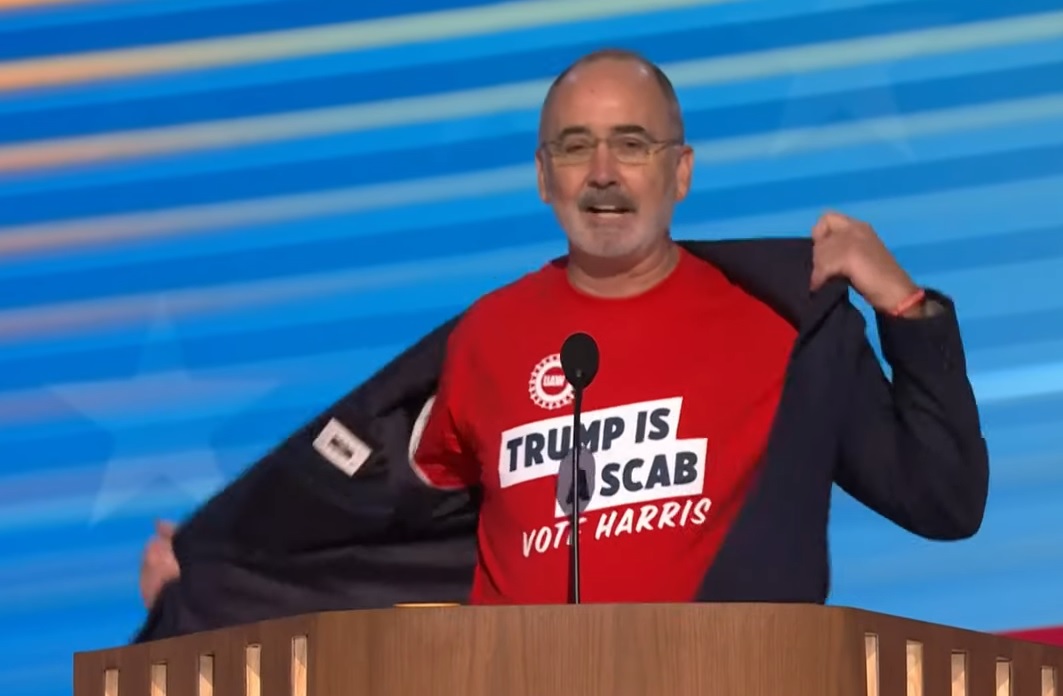
Despite an active federal corruption investigation, UAW President Shawn Fain and his underlings continue to push a radical political agenda using workers’ dues money while ignoring the rights of the rank-and-file employees union bosses claim to “represent.”
PHILADELPHIA, PA – It’s not particularly difficult to see why United Auto Workers (UAW) union officials are having trouble convincing workers that the union has their best interests in mind.
The union’s upper echelon is still reeling from a federal probe that hit about a dozen top union bosses with prison sentences for embezzling workers’ dues, and to this day it appears that UAW President Shawn Fain — a so-called “reformer” — is being scrutinized by federal monitors for manipulating his position to secure personal benefits.
But the corruption within the UAW goes far beyond the union’s top executives. Throughout 2024, National Right to Work Foundation-backed workers for auto accessory manufacturer Dometic fought illegal UAW demands that they strike or be fired.
UAW Union Used Mass Texts, Social Media to Bully Workers
In March 2024, seven Philadelphia-area Dometic employees filed unfair labor practice charges against the UAW Local 644 union, detailing that UAW bosses had ordered a strike and threatened to get fired anyone who decided to keep working.
Despite the employees’ resignation of their union memberships, UAW officials began internal proceedings against each of them soon after the strike began. Federal labor law forbids unions from imposing internal discipline on those who abstain from union membership.
The Dometic workers didn’t back down. With free Foundation legal aid, all the workers won settlements in October 2024 that fully vindicated their rights. UAW officials must now make postings correctly informing workers of their right to abstain from union activities, and the settlement even requires union chiefs to undergo mandatory training on the limits of “a union’s right to impose internal discipline,” among other topics.
As the workers’ legal battle dragged on, the Dometic workers continued to expose ugly details of the UAW’s intimidation campaign surrounding the strike. In April 2024, Dometic employee Mario Coccie filed a second round of charges against UAW Local 644 for a mass text message that threatened all Dometic employees — not just those who had filed charges against the union — with termination if they didn’t strike.
“The information in this text reveals union officials’ real intentions, which is to hurt anyone willing to stand up for themselves,” said Coccie at the time. “What is happening in this case is completely unjust.”
UAW officials also refused to respect Coccie and his coworkers’ rights under the Foundation-won CWA v. Beck Supreme Court decision, which prohibits union officials from requiring workers to pay for the union’s political expenditures just to keep their jobs. Because Pennsylvania lacks Right to Work protections for its private sector workers, UAW bosses can force workers to pay union fees as a condition of employment, but must abide by Beck.
Legal Privileges Enable UAW Corruption
In addition to the notice postings and required training, the Foundation-won settlement orders union officials to delete social media posts threatening workers who refused to strike.
“We’re proud to have helped Mario Coccie and his coworkers vindicate their rights,” commented National Right to Work Foundation Vice President Patrick Semmens. “But it has become all too clear that union corruption — which can take the form of anything from stealing millions in worker dues to intimidating workers to join a picket line — is only made easier when union bosses are granted more legal privileges.
“Policymakers need to protect workers’ freedom to cut off funding for union bosses who don’t serve their interests, and to fully abstain from union activities that individual employees do not see as in their own best interest,” Semmens added.
Dartmouth, MIT, Vanderbilt Graduate Students Challenge Forced Unionism
The following article is from the National Right to Work Legal Defense Foundation’s bi-monthly Foundation Action Newsletter, January/February 2025 edition. To view other editions of Foundation Action or to sign up for a free subscription, click here.
Foundation-backed students defend rights as union bosses seek more power at universities

Ben Logsdon is a Ph.D. student in mathematics at Dartmouth College. But it doesn’t take a genius to realize that union officials’ refusals to accommodate his religious objections just don’t add up.
HANOVER, NH – Just weeks after National Right to Work Foundation staff attorneys triumphed in anti-discrimination cases for Jewish Massachusetts Institute of Technology (MIT) graduate students who sought to stop forced dues payments to a radically anti-Israel union, union officials began creating other problems for university students.
In nearby New Hampshire, Dartmouth graduate student Benjamin Logsdon sought free Foundation legal aid against Graduate Organized Laborers of Dartmouth (GOLD-UE) union officials. The GOLD union — which is an affiliate of the same United Electrical (UE) union involved in the Foundation’s MIT cases — is forcing Logsdon to accept the union’s monopoly “representation” powers against his will, even after he voiced his religious objections to the union’s radical stances on the conflict against Israel.
Grad Students Exposed to Union Coercion & Privacy Violations
Meanwhile, several graduate students at Vanderbilt University in Nashville, TN, are pushing back against an attempt by Vanderbilt Graduate Workers United (VGWU, an affiliate of United Auto Workers) union bosses to impose union control over them and their colleagues. Specifically, three students are seeking to intervene in a federal case in which VGWU union officials are illegally demanding the university hand over the students’ private information to aid in their unionization campaign. Foundation staff attorneys filed motions for intervention for these students in October 2024.
Foundation attorneys are arguing that union officials severely violate students’ rights in both of these cases. However, the reason that union officials are in power on college campuses at all traces back to flawed rulings from the National Labor Relations Board (NLRB) under both the Obama Administration and Biden Administration. These rulings subject graduate students to pro-Big Labor provisions of the National Labor Relations Act (NLRA), which create issues for students’ freedom both inside and outside the classroom.
Logsdon, a Christian Ph.D. student in mathematics at Dartmouth, slammed the GOLD union with federal anti-discrimination charges in September 2024 at the Equal Employment Opportunity Commission (EEOC). According to those charges, shortly after the GOLD union finalized its first monopoly bargaining contract with the Dartmouth administration, he sent a letter to United Electrical General Secretary-Treasurer Andrew Dinkelaker explaining that he objected to being affiliated with GOLD on religious grounds and needed an accommodation.
“I sought to be removed from the UE and GOLD-UE bargaining unit as a reasonable accommodation,” Logsdon’s Foundation-backed charges say.
Dinkelaker refused to offer Logsdon an accommodation that “satisf[ied] [his] religious conscience or beliefs,” according to the charges, which violated his rights under Title VII of the Civil Rights Act of 1964.
Courts have recognized a variety of Title VII religious accommodations over the years for men and women who have religious objections to union affiliation, including paying an amount equivalent to union dues to a charity instead of union bosses. However, Logsdon seeks a different accommodation: to remove himself from union bosses’ control entirely.
At Vanderbilt, three students who identify themselves in legal documents as “John Doe 1,” “John Doe 2,” and “Jane Doe 1” are contending in their Foundation-backed motions for intervention that the Family Educational Rights and Privacy Act (FERPA) forbids the Vanderbilt administration from disclosing their personal information to any third parties without their permission, including the VGWU union.
At the union’s behest, NLRB Region 10 has already hit the Vanderbilt administration with a pair of subpoenas demanding personal student info, while ignoring objections from several students expressing concern at the disclosure.
So far Vanderbilt has resisted the NLRB’s subpoenas, and fortunately a federal court has temporarily allowed the university to refuse to comply with them.
The Foundation-backed students’ motions to intervene argue that the subpoenas “are an attempt to violate FERPA’s protections, privileging union interests over the graduate students[’] privacy rights.” It also points out that FERPA allows students to seek “protective action” if a university receives a subpoena seeking their personal information, as in this case.
The Vanderbilt students and their Foundation attorneys are demanding an opportunity to properly defend their privacy interests under FERPA. Foundation attorneys have already filed Requests for Review asking the NLRB in Washington, DC, to weigh in on the matter.
Union Monopoly Power Has No Place at Universities
“Graduate students around the country are discovering that union bosses don’t respect their individual rights and would rather use students as pawns to force their demands on a university administration, or advance an extreme political agenda,” commented National Right to Work Foundation Vice President and Legal Director William Messenger.
“Union monopoly bargaining is a system particularly ill-suited to an academic environment. Indeed, it is wrong for anyone to have a union monopoly imposed on them against their will and then be forced to pay union dues under threat of termination.”
Philly Public Defender Beats Illegal UAW Dues Deduction Scheme
The following article is from the National Right to Work Legal Defense Foundation’s bi-monthly Foundation Action Newsletter, September/October 2023 edition. To view other editions of Foundation Action or to sign up for a free subscription, click here.
UAW boss threatened to reduce workers’ wages for not signing dues card
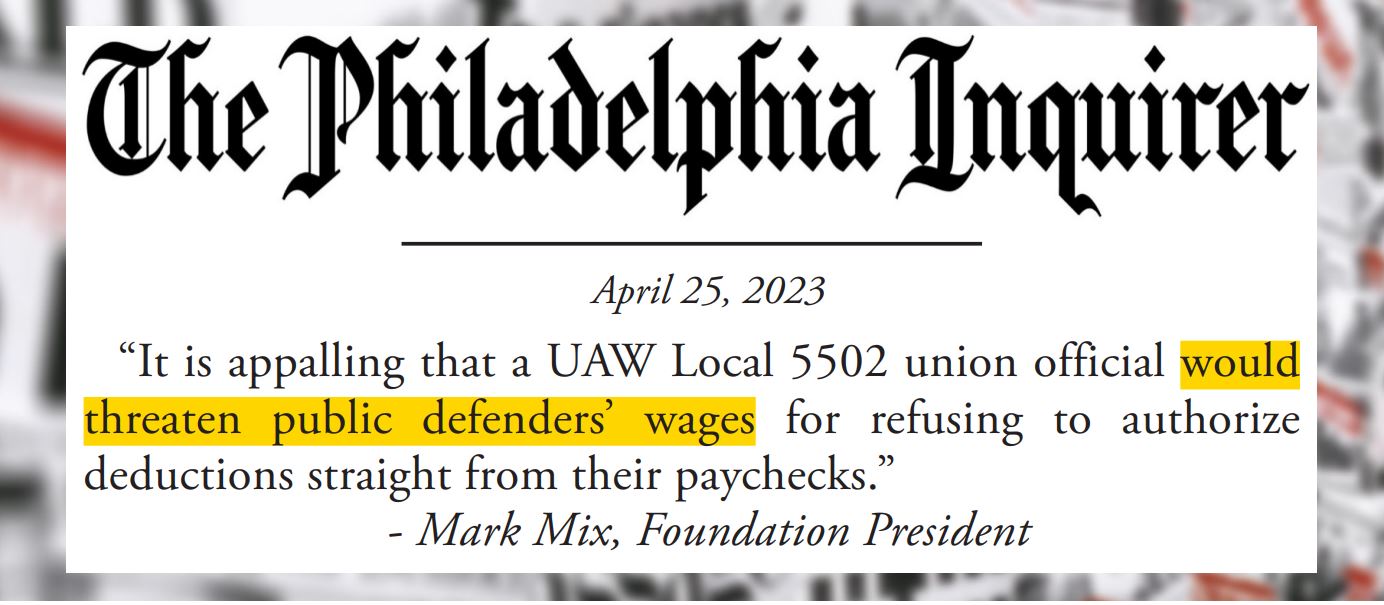
Philly Public Defender Brunilda Vargas surely didn’t feel “represented” by UAW bosses when they sought to reduce her and her colleagues’ pay just for not signing dues cards. Mark Mix expressed the outrageousness of this scheme to The Philadelphia Inquirer.
PHILADELPHIA, PA – Brunilda Vargas, a public defender for the City of Philadelphia, staunchly objected when United Auto Workers (UAW) Local 5502 union bosses sought to gain power over her and her colleagues at the Defender Association of Philadelphia.
After UAW union officials were installed in her workplace, things only got worse for her. A UAW union official threatened Vargas and her coworkers that, if they didn’t sign cards authorizing the direct deduction of union dues from their paychecks, their wages would be reduced. This threat was a blatant violation of federal law.
Vargas challenged UAW officials’ illegal demands with free legal aid from the National Right to Work Legal Defense Foundation. Union bosses quickly backed down, and in June entered into a settlement approved by National Labor Relations Board (NLRB) Region 4 which fully vindicates Vargas’ and her coworkers’ rights.
Public Defender Hits UAW with Federal Charges Following Intimidation
On April 18, 2023, Vargas filed her federal unfair labor practice charge with NLRB Region 4 for the threats made against her and her colleagues at the Defender Association of Philadelphia. UAW officials issued these threats against public defenders who chose not to sign automatic dues deduction authorization forms.
Even though Vargas works in the non-Right to Work state of Pennsylvania and can be forced to pay some union dues as a condition of employment, federal law prohibits forcing workers to authorize automatic dues deductions from their paychecks. Had Vargas lived in a Right to Work state, not only would she have the right to refrain from automatic dues deductions from her paycheck, but she could also refrain from financially supporting the union altogether. In Right to Work states, workers are fully protected from mandatory union membership and financial support, both of which must be completely voluntary.
Settlement Forces Union Bosses to Fully Abandon Illegal Threats
Now, pursuant to settlements, the UAW must email and post notices informing workers that the union will not work with the workers’ employer to reduce wages of nonmembers that do not sign automatic dues deductions forms. The union must also not suggest failure to sign a dues deduction card could lead to a worker’s termination. Finally, the union must not coerce or restrain individuals from expressing their rights under Section 7 of the National Labor Relations Act.
“[UAW] will not threaten objecting non-members that we will notify the Employer it can seek refunds of their contractual salary increases if they do not sign a dues deduction authorization form. Neither employees nor members are legally required to execute a dues deduction authorization form,” the notice reads.
“While we are happy that we were able to help Vargas and her coworkers fight UAW misconduct, this instance is but the tip of the iceberg when it comes to UAW malfeasance,” commented National Right to Work Foundation Vice President Patrick Semmens. “The recent federal probe into UAW officials stealing and misusing workers’ money has sent multiple top UAW bosses to jail, and uncovered a shocking culture of contempt for workers’ rights.”
“Fortunately, the numerous victims of UAW boss abuses need not fight alone,” continued Semmens. “They have an ally in the National Right to Work Foundation.”
Foundation-Backed Workers Notch Victories Over Dues-Hungry UAW Bosses
The following article is from the National Right to Work Legal Defense Foundation’s bi-monthly Foundation Action Newsletter, July/August 2023 edition. To view other editions of Foundation Action or to sign up for a free subscription, click here.
UAW caught using threats and coercion to illegally seize workers’ dues
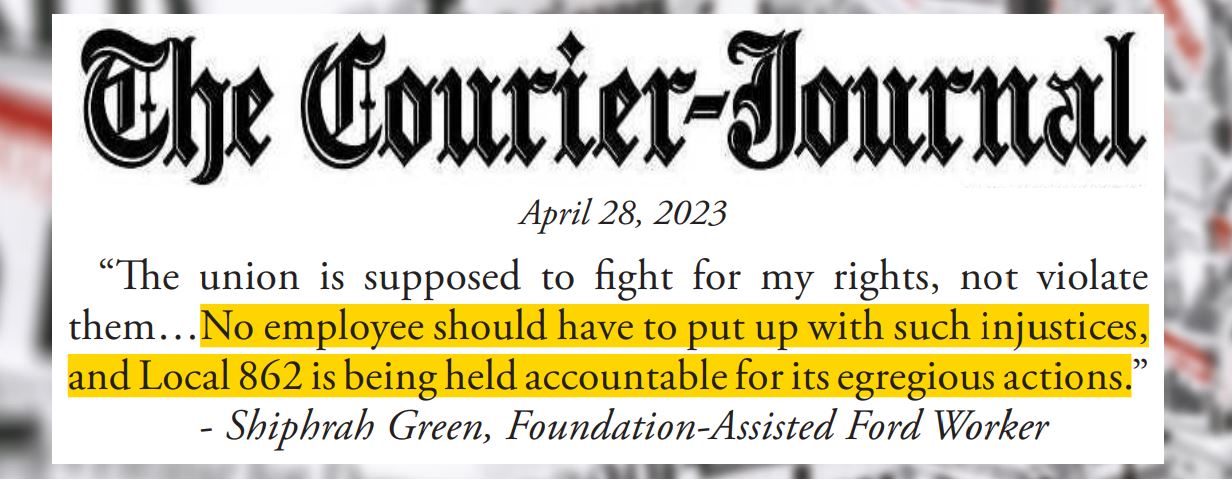
Ford employee Shiphrah Green excoriated UAW bosses in the Louisville Courier Journal over their blatant disregard for her rights. Foundation attorneys are helping her and others battle the notoriously corrupt union.
LOUISVILLE, KY – United Auto Workers (UAW) union officials have a well-deserved reputation for looking out for their own interests while throwing rank-and-file workers under the bus. The most prominent recent example is the corruption and embezzlement scandal, in which federal investigators revealed that UAW officials had siphoned millions of dollars in workers’ money to fund opulent golf vacations in luxury condos and private villas, spa and amusement park visits, $60,000 cigar-buying sprees, and much more.
But the federal corruption probe that led to eleven top UAW bosses pleading guilty, including former union presidents Gary Jones and Dennis Williams, is hardly the only time greedy UAW bosses abused their government-granted monopoly bargaining powers.
In a series of recent cases brought by National Right to Work Foundation staff attorneys against the UAW, workers are utilizing the Foundation’s free legal aid to vindicate their rights in the face of illegal dues demands by UAW officials.
Foundation-won Settlements Force UAW to Return Money to KY, IA Workers
Shiphrah Green, an employee of Ford Motor Company’s Louisville Assembly Plant, prevailed over UAW Local 862 bosses with free Foundation legal aid in April. UAW bosses were forced to settle and return money they had unlawfully taken from Green’s pay.
Green’s federal charges against the union maintained not only that UAW officials had made her jump through unnecessary hoops to exercise her right to cut off union dues, but also that UAW bosses made threats against her job when she tried to resign, with one union official warning her “if it were up to me, you’d lose your job for leaving the union.” Green’s settlement also forced UAW officials to refrain from such illegal threats in the future.
Meanwhile in Iowa, four employees of air filter manufacturer Donaldson won a recent settlement in which UAW officials were required to return over $1,000 in illegally-seized dues.
In each Donaldson worker’s case, UAW bosses had either refused to stop dues deductions despite producing no original documentation showing the workers had consented to such deductions in the first place, or had kept seizing money after an employee resigned union membership and revoked authorization to deduct dues, which should have been effective in stopping the flow of dues.
Because Ms. Green and the Donaldson workers reside in Right to Work states, the Foundation-won cases mean they will be free from all union financial support going forward.
Philly Public Defender Hits UAW with Charges
Even in non-Right to Work states where union officials have the power to compel workers to pay some fees under threat of termination, UAW bosses still go far beyond what is legal in their greedy forced-dues demands.
For example, Foundation staff attorneys recently filed a case for Philadelphia public defender Brunilda Vargas. Vargas, a vocal opponent of the UAW’s unionization drive, was told by UAW organizers that the union would reduce her and her coworkers’ wages if they did not grant the union the power to automatically deduct union dues directly from their paychecks.
Not only is the threat illegal, but further, employees can never be required to authorize automatic dues deductions from their paychecks under long-established federal law. This is true even in a state like Pennsylvania where workers lack the protection of a Right to Work law. Vargas’ charge, filed in June, is now being investigated.
“American workers likely have a plethora of reasons for wanting nothing to do with UAW union officials, including but not limited to the dizzying corruption in the union that has led to so many union officials going to prison,” commented National Right to Work Foundation Vice President Patrick Semmens. “As Foundation attorneys have experienced, UAW officials will often resort to clearly illegal methods to squeeze money out of dissenting workers in violation of federal law.”
“Union bosses who cannot convince workers to pay union dues voluntarily should not be allowed to seize union dues under threat of termination,” Semmens added.
Foundation Slams Biden Labor Board’s Biased Ruling in Federal Appeals Court
The following article is from the National Right to Work Legal Defense Foundation’s bi-monthly Foundation Action Newsletter, May/June 2023 edition. To view other editions of Foundation Action or to sign up for a free subscription, click here.
Brief contends NLRB distorted precedent to trap workers in union they oppose
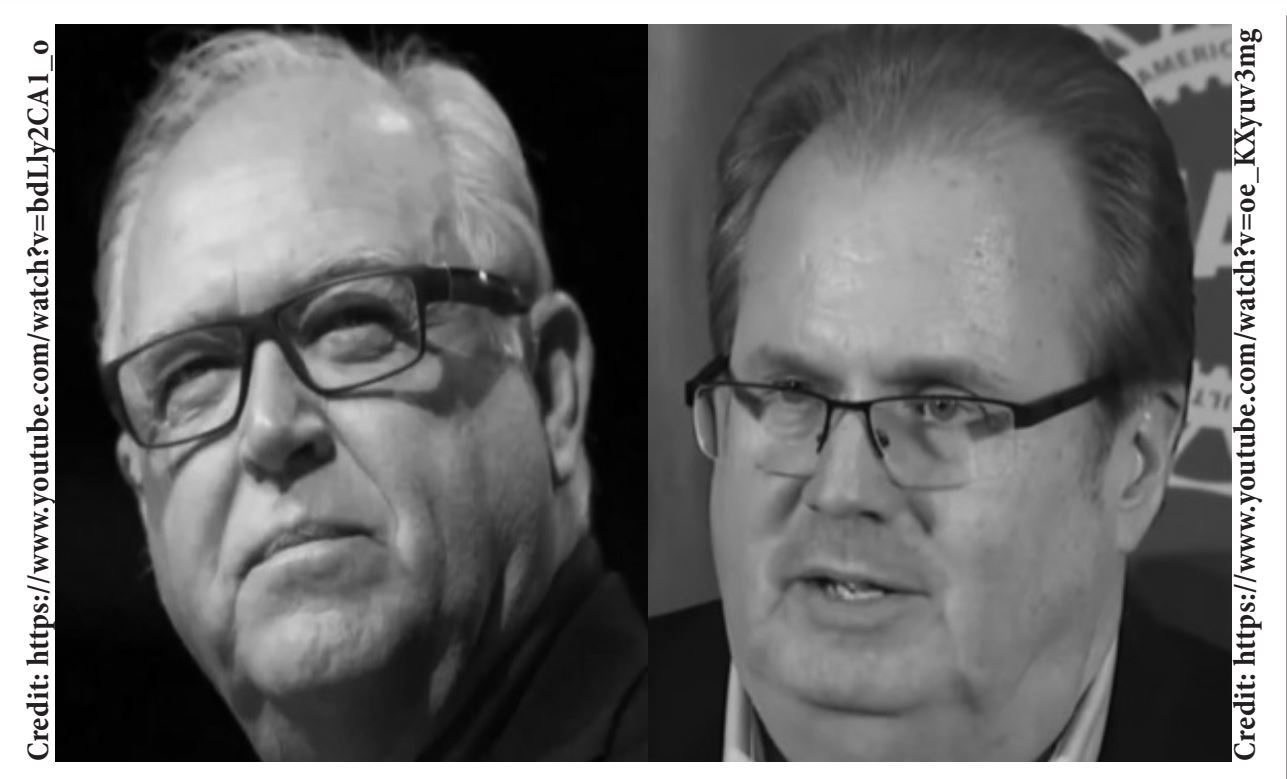
A majority of J.G. Kern employees petitioned to oust the UAW, which has seen two of its former presidents (Gary Jones, right, and Dennis Williams, left) go to jail for corruption. But a biased NLRB ruling trapped the workers in UAW ranks anyway.
WASHINGTON, DC – Foundation staff attorneys recently filed an amicus brief with the D.C. Circuit Court of Appeals in a case challenging a National Labor Relations Board (NLRB) decision reversing workers’ attempt to remove union “representation” they oppose.
In the case, J.G. Kern employees, frustrated with the United Auto Workers (UAW) Local 228 union, decided to petition to decertify, or formally remove, the union from their workplace. The workers presented this majority petition to their employer, leading to the company removing its recognition of the union.
The petition contained overwhelming support from workers in favor of removing the union. Yet, after the company withdrew recognition from the union, UAW officials ran to the Biden Labor Board in an attempt to remain in power. The Biden-appointed NLRB majority sided with the union officials by re-imposing the unpopular union over the workers’ objections.
With the case now in the federal court of appeals, the Foundation filed an amicus brief arguing the NLRB’s April 2022 ruling ignores precedent and misapplies longstanding law in siding with union officials.
Decertification Rules Already Rigged Against Workers Opposed to Union Affiliation
As the brief points out, workers looking to file a petition to remove a union they oppose already face numerous hurdles due to NLRB rules, most of which are contained nowhere in the federal statute the NLRB is charged with enforcing.
For example, a petition must be gathered outside of work hours, and outside of work-related areas. Also, unless employees use certain Board-specified language in their petition, the petition is invalid. Furthermore, employees cannot ask their employer for further information regarding the decertification process or the petition will be invalid.
The Foundation’s brief observes how workers must operate “in the dark, without help from their employer, and even if they do everything right, their efforts might come to naught through no fault of their own.” It also shows how the Biden Board has made it more difficult for individual workers to express their right to decertify unwanted, unpopular unions.
Biden NLRB Aims to Force Union on Workers Who Overwhelmingly Object
Under the Board’s “certification bar” doctrine, a union that wins a secret ballot election cannot be challenged for one year after its victory is certified by the NLRB. In this case, the UAW’s certification bar ended on October 3, 2019. In November 2019, J.G. Kern employees delivered a majority-backed petition to their employer.
The Biden Board claimed, however, that because J.G. Kern did not bargain in good faith during a three-month period at the beginning of the certification year, the employees’ majority petition was invalid. According to the Biden Board, the employer’s alleged unfair labor practices prospectively “extended” the certification year beyond its normal 12-month period.
The brief highlights the disingenuousness of the Board, pointing out that “the employees would have to divine the future to know they were collecting a petition during the ‘extended certification year.’” The Foundation urges the D.C. Circuit to command the Board to follow precedent that requires the Board to determine whether there was a “nexus” between the employer’s unfair labor practices and the decertification petition.
NLRB’s Power Grab Takes Away Workers’ Rights
The Foundation’s brief emphasizes how the Board’s decision can abolish employees’ rights guaranteed by the National Labor Relations Act. An example of that is the J.G. Kern workers’ petition, where it was only after the petition was gathered that the Board extended the union’s certification bar period.
The brief notes that usually “an employee’s decertification petition is presumptively valid unless there is a causal nexus between the unfair labor practice and the petition.” However, this is not the case under the J.G. Kern ruling.
Should the NLRB’s ruling be upheld, it “will further incentivize incumbent unions to file unfair labor practice charges to chill employees’ Section 7 ability to collect petitions,” the brief concludes.
“The NLRB’s blatant disregard for the rights of workers who don’t want anything to do with coercive unionism is on full display in this case,” commented Mark Mix, president of the National Right to Work Foundation. “The arbitrary cherry-picking of legal precedents to fit the Board’s agenda is outrageous, while expected, given the Biden Administration’s all-out effort to expand Big Labor’s coercive ranks.
General Motors Worker Forces UAW Bosses to Stop Seizing Dues for Politics
Illegal seizures came after multi-billion-dollar Big Labor political spending

A massive UAW embezzlement scandal didn’t stop UAW officials from ignoring at least two attempts by Roger Clemons to exercise his right to stop subsidizing union political activity.
ROCHESTER, NY – Even after a sweeping federal corruption probe that has resulted in jail sentences for at least 12 union executives, it seems some United Auto Workers (UAW) officials haven’t learned their lesson regarding misuse of worker funds.
Rochester General Motors employee Roger Clemons this January won a settlement forcing UAW officials at his plant to stop illegally funneling money from his paycheck into union politics. Clemons filed federal charges in September 2021 against UAW Local 1097 and the UAW’s international branch, after union agents ignored his requests to opt-out of funding the union’s political agenda. He received free legal representation from National Right to Work Foundation staff attorneys.
A Foundation-won settlement required UAW international and local officials to give back to Clemons all money that was deducted from his paycheck in violation of the Foundation-won CWA v. Beck Supreme Court decision. Beck forbids union officials from forcing workers under their control to fund union politics.
Because New York State lacks Right to Work protections for its private sector workers, union officials can legally force workers to pay a reduced amount of union dues under threat of termination. In Right to Work states, union membership and all union financial support are strictly voluntary.
UAW Chiefs Repeatedly Violated Worker’s Beck Rights
Clemons stated in his September 2021 charge against UAW Local 1097 officials that UAW officials had a history of flouting his Beck rights, failing to reduce his union dues even after he ended his union membership and became a “Beck objector” in October 2019. “Only after Mr. Clemons filed an [earlier] unfair labor practice charge . . . did the union comply with the requirements of the law,” the charge noted, detailing that union officials finally sent him rebate checks in June and July 2020 for excess dues they took from his paycheck.
However, UAW officials continued to create obstacles for Mr. Clemons’ Beck rights. The September 2021 charge asserted that despite Clemons renewing his Beck objection in October 2020, he then did not receive “a single rebate check or a reduction in the dues deducted from his wages” for almost a year.
Clemons also charged General Motors for its role in enforcing the illegal dues deductions.
The settlement now forbids UAW officials from “accept[ing] dues or fees which have been deducted from the paycheck of Roger Clemons, or any other Beck objector, which are in excess of the amount we can lawfully charge to Beck objectors.” UAW officials also have returned dues that they seized from Clemons above the reduced Beck amount.
Union officials devote enormous sums to political activity. A report the National Institute for Labor Relations Research (NILRR) released in 2021 revealed that union officials’ own Department of Labor filings show over $2 billion in political spending during the 2020 election cycle, primarily from dues-stocked union general treasuries. Another study found that actual union spending on political and lobbying activities likely topped $12 billion during the 2020 cycle.
Union Bosses Likely to Splash Cash on 2022 Midterm Elections and Beyond
“Rank-and-file workers should know they have a right to refuse to fund union politics, especially with union political spending in 2020 having approached record numbers and midterm elections coming up,” commented National Right to Work Foundation Vice President and Legal Director Raymond LaJeunesse. “Workers under UAW control, like Mr. Clemons, have special reason to be on guard, given the UAW’s perennial interest in politics, and because several UAW officials now find themselves behind bars for embezzlement and corruption.”





