
New York Farmworkers Seek to Challenge ‘Card Check’ & Uproot UFW Union Bosses
The following article is from the National Right to Work Legal Defense Foundation’s bi-monthly Foundation Action Newsletter, January/February 2025 edition. To view other editions of Foundation Action or to sign up for a free subscription, click here.
Farmworkers fight union argument that New York labor law lets union bosses trap workers forever

Porpiglia Farms workers, who were targeted by an aggressive UFW ‘card check’ campaign against the farmworkers, are banding together to vote the union out and ensure that union officials reap what they have sown.
MARLBORO, NY – In 2020, the New York State Assembly passed a Big Labor-backed law that granted union officials sweeping new powers to impose their monopoly bargaining control over the state’s farmworkers. Since New York is one of 24 states that lacks a Right to Work law, the law authorizes union bosses to force farmworkers to pay union dues or else be fired.
But that’s not all: New York labor law went even further by mandating “card check” organizing, in which union officials deny workers a secret ballot union vote and instead claim majority support by submitting cards ostensibly showing worker support. These cards are often collected through pressure tactics, intimidation, or even threats.
But even that dramatic increase in power over the agricultural sector and agricultural workers is not enough for United Farm Workers (UFW) union officials.
UFW tyrants are advancing the cynical argument that, under New York law, workers can be forced into union ranks but can never escape forced unionism. They argue this to counter a recent National Right to Work Foundation-backed union decertification case for employees of Porpiglia Farms, an apple farm in the Hudson Valley of New York.
NY Fruit Farmworkers Seek Union Ouster After ‘Card Check’
Porpiglia employee Ricardo Bell submitted a petition last year in which he and his coworkers asked the New York Public Employment Relations Board (PERB) to hold a vote at the orchard on whether to remove the UFW. (Despite its name, PERB is responsible for enforcing labor law in both New York’s public and agricultural sectors.)
In late 2024, Foundation attorneys filed a brief for Bell countering union officials’ absurd argument that one card check drive should lock employees in a union forever. Additionally, more Foundation-backed decertification cases are sprouting up in both New York and other Big Labor-dominated states for farmworkers who are rejecting UFW officials’ card check schemes.
Brief Challenges Theory That Workers Have No Right to Remove Incumbent Union
Bell filed his decertification petition with Foundation legal aid after UFW union officials seized power at his workplace through a hasty card check unionization drive. His newest filing attacks union bosses’ contention that once a union is certified as the monopoly union “representative” of a work unit, there can be no option to remove it.
“[New York labor law] does not indicate that employees have a single chance at self-organization,” the brief says. “If that were the case, the very action of choosing a representative under [New York labor law] would deprive employees of the ability to exercise [their rights] in perpetuity….”
Foundation-Backed Workers Battle UFW ‘Card Checks’ Across Country
Since Bell’s filing, Foundation attorneys have also assisted in a union decertification effort for workers at Cherry Lawn Fruit Farms near Rochester, NY, who were targeted by a similar UFW card check campaign. These two groups of New York farmworkers join Foundation-backed employees of Wonderful Nurseries in California in challenging the UFW’s tactics.
Wonderful Nurseries workers still have multiple unfair labor practice charges pending against UFW bosses for deceptive behavior during an early 2024 card check drive. The charges detail UFW agents lying about the true purpose of cards that they collected from workers, and harassing workers who now back an effort to vote the union out.
“The aggressive and often demeaning tactics that UFW union officials use to seize control over agricultural workers show clearly why ‘card check’ is a bad idea in the agricultural sector, the public sector, and in any sector,” commented National Right to Work Foundation Vice President and Legal Director William Messenger. “UFW officials are arguing that workers should have little or no chance at all to challenge a union’s ascent to power by this process.
“The idea that workers have no ability to eject a union once it is installed in power further demonstrates that this is not about workers’ choices at all, only about union bosses’ power over workers, even when workers overwhelmingly want nothing to do with union bosses’ so-called ‘representation,’” added Messenger.
Max Finkelstein Workers Across East Coast Force RWDSU Union to Abandon 500+ Employee Unit
Work unit spans several states; union bosses disclaimed interest after Winchester, VA-based worker submitted enough employee signatures for ouster vote
Winchester, VA (October 30, 2023) – Employees of tire wholesaler Max Finkelstein from Virginia to Maine have successfully freed themselves from the control of Retail, Wholesale and Department Store Union (RWDSU) officials. The worker victory comes after Winchester, VA-based Max Finkelstein truck driver Christopher Dorney submitted a petition on behalf of his coworkers asking the National Labor Relations Board (NLRB) for a vote to remove the union. Dorney received free legal aid from the National Right to Work Legal Defense Foundation.
The NLRB is the federal agency responsible for enforcing private sector labor law and administering elections to install or remove unions. By NLRB rules, Dorney’s petition contained enough signatures from his colleagues across several states to prompt a union decertification vote.
Because the work unit spans multiple states, the RWDSU union exercised varying amounts of power over Dorney and his coworkers. In states that lack Right to Work protections, such as Maine, New York, and Maryland, RWDSU union officials could enforce agreements with Max Finkelstein management that required workers to pay union dues simply to keep their jobs. In Right to Work states like Virginia, in contrast, union dues payment and union membership are strictly voluntary. However, federal law gives union officials in all states the power to impose their “representation” over every worker in a unionized workplace, even those who are not union members or oppose the union’s agenda.
However, late last week RWDSU officials announced they were departing the work unit, possibly to avoid an embarrassing rejection by workers at the ballot box.
“We warehouse workers and drivers at Max Finkelstein may be from many different facilities in many different states, but we are in agreement about one thing: RWDSU union officials don’t represent our interests,” commented Dorney. “It’s our right under federal law to challenge RWDSU’s forced representation power.”
RWDSU Faces Another Setback as Employees Increasingly Oppose Unions
The RWDSU union has recently tried several high-profile unionization campaigns at Amazon warehouses across the country, most notably at the large Bessemer, AL, facility, where employees voted against the union by substantial margins in both 2021 and 2022. Gallup polling shows that 58 percent of nonunion workers are “not interested at all” in joining a union.
Workers currently under union control are also increasingly seeking to obtain votes to free themselves, often with Foundation aid. Currently, the NLRB’s data shows a unionized private sector worker is far more likely to be involved in a decertification effort than their nonunion counterpart is to be involved in a unionization campaign. NLRB statistics also show a 20% increase in decertification petitions last year versus 2021.
Biden Labor Board Seeks to Stifle Workers’ Right to Vote Out Unwanted Unions
Dorney and his coworkers’ effort comes as the Biden NLRB in Washington, D.C., is attempting to make it more difficult for workers to exercise their right to remove unwanted unions, while giving union officials more tools to gain power in a workplace without even a vote. The NLRB is expected to soon issue a final rule overturning the Election Protection Rule, a Foundation-backed 2020 reform which made commonsense improvements to the decertification process.
The Biden NLRB’s proposed rule, among other things, will give union bosses the power to use “blocking charges,” or unproven allegations of employer misconduct, to prevent workers from voting to decertify a union. The rule will also strip workers of the ability to file for a secret ballot election after a union installs itself via “card check,” a coercive process that bypasses the NLRB’s standard election process and instead permits union bosses to collect cards from workers (often through strong-arm tactics) that are later counted as “votes” for the union.
“Mr. Dorney and his coworkers’ effort to kick out the RWDSU union, which spanned several states, at least 15 facilities, and hundreds of workers, is yet another example that workers often want to escape union officials’ one-size-fits-all agenda. It’s also a demonstration that workers will go to great lengths in order to exercise this right,” commented National Right to Work Foundation President Mark Mix. “But the Biden NLRB, bent on empowering the President’s union boss political allies, plans to grant unions even more power to defeat workers’ will.”
Illinois Security Officer Defends Janus Rights Amidst Union Discrimination
The following article is from the National Right to Work Legal Defense Foundation’s bi-monthly Foundation Action Newsletter, March/April 2023 edition. To view other editions of Foundation Action or to sign up for a free subscription, click here.
Union officials sought to coerce membership by preventing non-members from defending their jobs
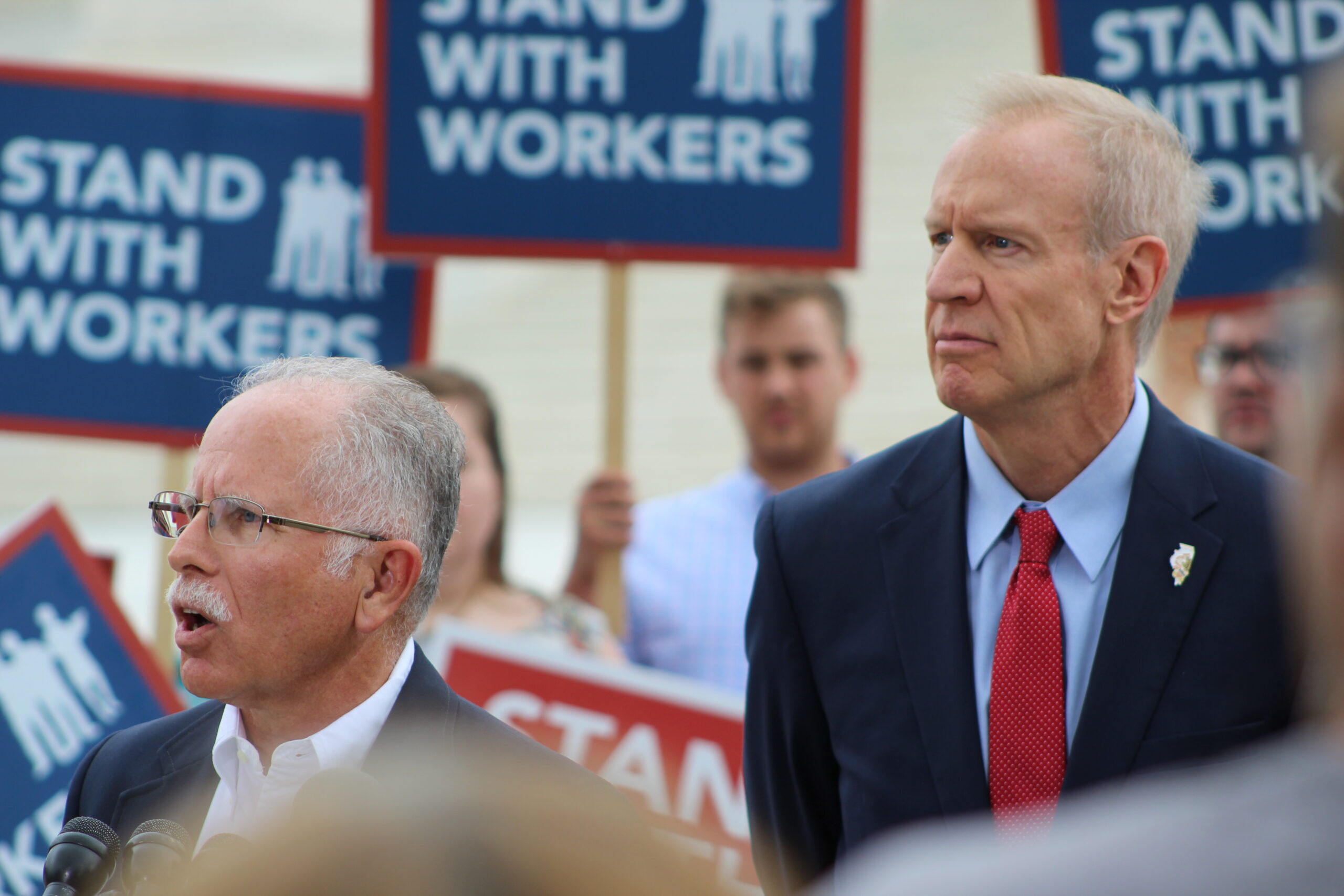
Foundation attorneys aided Illinois public employee Mark Janus with former Illinois Governor Bruce Rauner (right) in his landmark First Amendment victory. But Foundation attorneys often must fight to enforce Janus rights, as in Chris Logan’s case.
CHICAGO, IL – The National Right to Work Foundation’s landmark Supreme Court victory in Janus v. AFSCME was a milestone for public sector workers. For the first time, the Court recognized that every American public sector worker had the constitutional right to cut off dues to a union they oppose.
Even with this important First Amendment protection, however, union bosses unfortunately still wield an enormous amount of power over workers who have ended their affiliation with the union. Because of laws that authorize monopoly union “representation” in the public sector, union officials still have significant control over independent-minded employees’ working conditions, pay, benefits, and more.
City of Chicago aviation security officer Chris Logan discovered just how painful Illinois Council of Police (ICOP) union bosses could make life for him after he exercised his Janus rights. In 2020, following a dispute about his job performance, Logan took action to protect his job under the terms of his employment contract, only to have union bosses exploit the opportunity to attack Logan. The union would not allow Logan to file a grievance to protect his job unless he joined the union.
Officer Challenges Discriminatory Grievance Scheme with Foundation Aid
“ICOP union officials basically tried to force me to join and pay dues to the union by making it impossible for me to defend my job otherwise,” commented Logan. “I exercised my Janus rights and left the union because I didn’t think that ICOP officials were good ‘representatives’ of me or my coworkers.”
“Instead of trying to win back my support voluntarily, union bosses used their power to deprive me of all options when I tried to defend my job — I couldn’t even file or arbitrate a grievance myself,” Logan added. “In my mind, that simply confirms I made the right decision when I left this union.”
However, with free legal representation from National Right to Work Legal Defense Foundation staff attorneys, Logan won a decision from the Illinois Labor Relations Board (ILRB) in late 2022 that decisively declared ICOP officials’ “members only” grievance scheme illegally discriminatory against non-members.
Logan first exercised his Janus rights in October 2019, telling the union by letter that he no longer wished to pay union dues. Throughout 2020, Logan faced allegations about his job — possibly instigated by union militants. Per the union monopoly agreement he was subjected to, he tried to get union officials to fulfill their role, as monopoly “representatives” of the workplace, to file grievances challenging the City of Chicago’s disciplinary actions against him.
Union officials who maintain “monopoly bargaining power” in a workplace can legally impose their control over every worker, even those who have disaffiliated with the union. Because of this privilege, however, they are also legally obligated not to discriminate against non-members when it comes to grievances or other matters. However, as Logan discovered, union officials regularly ignore this “duty of fair representation.”
Union Officials Completely Ignored ‘Fair Representation’ Legal Obligation
ICOP union officials summarily rejected all of Logan’s requests to file grievances, and even told him that he could not file grievances himself. At one point, after an ICOP union official sent Logan an email falsely claiming the union had no legal obligation to participate because Logan had exercised his Janus rights, the ICOP lawyer chimed in to tell Logan, “I concur. Good luck.” The union stated it would not file grievances for Logan simply because he was a non-member.
Logan filed unfair labor practice charges against ICOP and the City of Chicago in August 2020, maintaining that the union’s actions were illegal. An ILRB Administrative Law Judge agreed with Logan’s charges in May 2022, declaring that ICOP “violated [Illinois labor law] when its agents restrained or coerced the Charging Party in the exercise of rights . . . by threatening to deny the Charging Party equal representation in the disciplinary and grievance matters.” The ILRB later adopted this ruling, leading to Logan’s Foundation-won victory when union officials did not attempt to appeal the decision to Illinois state court.
Monopoly Bargaining Powers Open Door to Corruption
“Union bosses maintain unilateral control over workers under a ‘monopoly bargaining’ regime,” commented National Right to Work Foundation Vice President and Legal Director Raymond LaJeunesse. “For public sector workers across the country, Janus is the only check they can use against this power, and even then they could face retaliation for doing so.”
“Cases like Mr. Logan’s, where union bosses used their bargaining powers to discriminate against a worker who exercised Janus rights, ought to make our elected leaders reconsider how much privilege our laws grant unions,” LaJeunesse added.
Northwest Ohio Employees File Suit to Knock Down Another Janus Restriction
The following article is from the National Right to Work Legal Defense Foundation’s bi-monthly Foundation Action Newsletter, March/April 2023 edition. To view other editions of Foundation Action or to sign up for a free subscription, click here.
Foundation-aided Ohio workers have already won string of victories over union-imposed ‘escape periods’

From left: Penny Wilson, Theresa Fannin, and Kozait Elkhatib aren’t taking AFSCME union officials’ onerous First Amendment restrictions sitting down. With free Foundation legal aid, they will continue the fight to protect Janus in Ohio.
TOLEDO, OH – American Federation of State, County, and Municipal Employees (AFSCME) union bosses seem to have a knack for violating Ohio public workers’ First Amendment right to refrain from paying union dues.
Fortunately, National Right to Work Foundation staff attorneys are even more adept at forcing Ohio AFSCME bosses to back down from their unconstitutional dues schemes, and have led Ohio government workers to victory in several such cases.
The latest case in this saga comes from three Lucas County Job and Family Services (JFS) employees, who in December filed a federal civil rights lawsuit against the AFSCME Ohio Council 8 union and their employer for violating their constitutional rights.
Penny Wilson, Theresa Fannin, and Kozait Elkhatib’s lawsuit says AFSCME union officials illegally seized money from their paychecks in violation of their First Amendment rights as recognized in the landmark 2018 Foundation-won Janus v. AFSCME U.S. Supreme Court decision. The Ohio public employees are receiving free legal aid from the National Right to Work Foundation and the Ohio-based Buckeye Institute.
Union Officials Kept Employees in the Dark About Janus Freedoms
In Janus, the Court declared it a First Amendment violation to force public sector workers to pay union dues or fees as a condition of employment. The Court also ruled that union officials can only deduct money from the paycheck of a public sector employee who has voluntarily waived his or her Janus rights.
“Plaintiffs . . . file this suit to stop Lucas County JFS and AFSCME from seizing union payments from them without their consent and to receive compensation for violations of their First Amendment rights,” reads the workers’ complaint.
Officials from AFSCME Council 8 and Lucas County JFS enforce a policy which permits the direct deduction of union dues from employees’ paychecks. According to the policy, employees who wish to stop subsidizing the union have only a few days per year in which to do so — an “escape period” that effectively forbids the exercise of their First Amendment Janus rights for more than 90 percent of the year.
AFSCME union officials never informed Wilson, Fannin, and Elkhatib of this restriction. Union officials also never told the women that they had a First Amendment right under Janus to abstain from dues deductions, or that union dues could only be taken from them if they waived that right.
The employees discovered their Janus rights and attempted to exercise those rights twice by sending letters to AFSCME union officials stating that they were ending their union memberships and terminating dues deductions. AFSCME union officials denied all three women’s requests, stating that union dues deductions would continue because the letters missed the narrow “escape period” imposed by the union.
Wilson, Fannin, and Elkhatib’s lawsuit seeks to stop Lucas County JFS and AFSCME union officials from seizing dues from their paychecks. It also seeks a refund of all union dues taken from their wages without their consent.
Foundation Janus Victories Continue to Stack Up in Ohio
Independent-minded Ohio public employees are on a winning streak against AFSCME officials’ “escape period” arrangements. Foundation attorneys scored a significant victory for Ohio public servants’ Janus rights in a 2020 lawsuit against another Ohio AFSCME local (Council 11). Rather than face off against Foundation attorneys, those AFSCME union officials backed down and settled the case. As a result, Foundation attorneys freed almost 30,000 Ohio public employees from a “maintenance of membership” scheme that limited the exercise of Janus rights to roughly once every three years.
In fact, Wilson, Fannin, and Elkhatib’s suit isn’t the first time that Foundation attorneys have faced off against AFSCME Council 8 officials. In 2019, Foundation attorneys brought a similar First Amendment suit for seven Ohio employees that brought down another restrictive “escape period” enforced by Council 8 chiefs.
AFSCME Council 8 Officials Caught Red-Handed Again Violating First Amendment
“Even after abandoning other ‘escape period’ schemes to avoid facing Foundation staff attorneys in court, shameless AFSCME union officials continue to violate the Janus rights of the very employees they claim to ‘represent,’” commented National Right to Work Foundation Vice President Patrick Semmens.
“America’s public workers should not have to file federal lawsuits to protect their money and their First Amendment rights from the predations of public sector union officials.”
California Lifeguards Ask Supreme Court to Blow Whistle on Dues-Trap Scheme
The following article is from the National Right to Work Legal Defense Foundation’s bi-monthly Foundation Action Newsletter, November/December 2022 edition. To view other editions of Foundation Action or to sign up for a free subscription, click here.
Union bosses’ ‘maintenance of membership’ scheme drowns California lifeguards’ Janus rights for four years

These California lifeguards can ride the waves, but they certainly didn’t “waive” their Janus rights. In their Supreme Court bid, they hope to stop union bosses from locking them out of their First Amendment rights for years.
LOS ANGELES, CA – National Right to Work Foundation client Jennifer Marshall, an Orange County, CA, lifeguard, told the Los Angeles Times in May how hard California Statewide Law Enforcement Agency (CSLEA) union officials pushed union membership on her and her colleagues.
“They really pushed us to sign up for the union without a lot of information behind it,” said Marshall. “It was kind of a sign-the-papers-and-we’ll-talk-about-it-later kind of thing.” After she signed up, she hardly ever saw or heard from union officials again but full union dues were coming out of her paycheck.
What she and many of her colleagues, whom union bosses had cajoled into signing up, didn’t expect was how hard it would be to exit a union that didn’t seem to be doing anything for them. When she and her colleagues tried to resign, CSLEA officials told them that they were stuck in both full union dues payments and full union membership until 2023, pursuant to a so-called “maintenance of membership” requirement.
Marshall, along with lead plaintiff Jonathan Savas and 21 other colleagues, sued CSLEA bosses in federal court in 2020 for violating their constitutional rights. They argued the “maintenance of membership” requirement blatantly infringes on their First Amendment rights under the Foundation-won Janus v. AFSCME Supreme Court decision. In Janus, the Court declared that public sector workers cannot be forced to bankroll a union without voluntarily waiving their First Amendment right to abstain from union payments. The lifeguards also sued the state of California for its role in enforcing the unconstitutional dues deductions.
Secret Union Dues Scheme Has Been Illegal for 45 Years
Marshall, Savas, and their fellow lifeguards are now petitioning the Supreme Court of the United States to hear their case, arguing CSLEA bosses’ restrictive arrangement even violates Supreme Court precedent that predates Janus.
The lifeguards’ Foundation provided attorneys argue in the petition that “maintenance of membership” requirements not only flout Janus’ ban on all forced dues in the public sector, but even violate the Supreme Court’s now-overturned 1977 decision in Abood v. Detroit Board of Education. Abood let union officials force dissenting public sector employees to pay a portion of union dues as a condition of employment.
“Maintenance of membership” requirements – which force public employees to pay full union dues often for years after they try to resign from the union – are worse than anything permitted by Abood, Foundation staff attorneys argue.
The petition also takes to task CSLEA union bosses’ paltry defense that the lifeguards somehow voluntarily agreed to the “maintenance of membership” scheme. In Janus, the Supreme Court ruled that union officials can only take dues from a public employee’s paycheck if that employee gives a “clear and compelling” waiver of Janus rights. Foundation attorneys point out that the CSLEA union’s dues deduction forms contained only a “vague reference” to an unexplained limit on when withdrawal from membership is permitted, which is not even close to satisfying Janus’ waiver requirement.
“A vague reference to unspecified limitations in ‘the Unit 7 contract and State law’ does not establish the Lifeguards contractually consented” to union membership for four years, the petition says.
Supreme Court Must Intervene to Stop Spread of Unconstitutional Restrictions
The petition for Savas and his fellow lifeguards emphasizes how crucial it is for the Supreme Court to strike down cumbersome “maintenance of membership” restrictions, pointing out that California unions and legislators will continue to force public employees to remain formal union members and pay full dues as a condition of employment if the schemes are left unchecked.
“Other states likely will follow suit, such as Pennsylvania, whose laws also authorize maintenance of membership requirements,” the brief states.
Challenged Scheme Gives Union Bosses Control of Workers’ Janus Rights
“‘Maintenance of membership’ restrictions give union officials complete control over when public employees can exercise their rights to end union membership and cut off union dues deductions,” observed National Right to Work Foundation Vice President and Legal Director Raymond LaJeunesse.
“The Supreme Court must intervene in these lifeguards’ case to protect the First Amendment rights of all American public sector employees, and prevent union bosses and their political allies from replicating across the country these patently unconstitutional restrictions.





