
Foundation Op-Ed: ‘Biden’s Labor Board Wants to Trap Workers in Unions they Oppose’
In an op-ed for The Hill published on Labor Day (September 5, 2023) entitled “Biden’s labor board wants to trap workers in unions they oppose,” National Right to Work Foundation President Mark Mix highlighted the coercive pro-union boss policies being pushed by Biden-majority National Labor Relations Board to the detriment of the rights of independent-minded workers:
Big Labor bosses have a problem: Despite their vitriolic rhetoric and a small number of loud online activists, most workers want nothing to do with unions.
A Gallup poll released last Labor Day spotlighted the issue: A strong majority of nonunion workers in the U.S. (58 percent) say they are “not interested at all” in joining a union, whereas just 11 percent say they are “extremely interested.”
Since it takes a majority of workers in a given workplace to support a union before monopoly union representation can be imposed, union organizers face a basic math problem — one that explains why only 6 percent of private-sector workers are unionized today.
Yet rather than consider ways of making unionization more attractive to rank-and-file workers, politically-connected union bosses have a different plan: Rig the rules to force more workers into their ranks, willing or not.
President Biden, who campaigned on being “the most pro-union president in American history” and is counting on Big Labor’s multi-billion-dollar political machine again in 2024, is unleashing his administration to the benefit of his favorite special interest.
The National Labor Relations Board (NLRB), stocked with Biden appointees and former union lawyers, has been busy doing just that. If workers won’t voluntarily vote unions in, Biden’s NLRB, whose rules cover most private sector workers, wants to take their vote away.
That’s why the NLRB, at the end of August, effectively mandated the “card check” unionization process by bureaucratic fiat. Never mind that numerous union-backed measures in Congress to require this abuse-prone unionization process have failed to pass into law.
Card-check drives occur when employers, usually in the face of union-applied political and economic pressure, waive workers’ right to a secret ballot election. During these drives, union officials are allowed to demand union authorization cards directly from workers using coercive tactics that would be unlawful during a secret ballot vote.
Union organizers can show up at workers’ homes over and over again demanding signatures, in some instances requiring workers to call the police to get organizers to leave. Workers report being misled about the true implications of signing the cards, and some have been told they would be fired if they didn’t sign just before the union successfully took over.
Some workers even face threats of violence. In one SEIU organizing drive, a worker reported being told that the union would “come and get her children” and “slash her tires” if she didn’t sign a union card…
Read the rest of Mark’s piece on the website of The Hill here.
Passaic, NJ, Woodworking Employees Win Two-Year Legal Battle to Oust Unwanted Carpenters Union Officials
Patella employees’ ordeal shows how union officials trap workers in unions they oppose, yet Biden NLRB is moving to make union decertification even harder
Passaic, NJ (September 8, 2023) – Following the third attempt by employees of Passaic-based woodworking firm Patella to obtain a vote to remove them, Carpenters Local 252 union officials have backed down and abandoned the facility. The union’s disclaimer of interest, received last week by National Labor Relations Board (NLRB) Region 22, caps off a years-long legal battle between Patella employees and recalcitrant Carpenters union officials. The workers ousted the union with free legal aid from staff attorneys at the National Right to Work Legal Defense Foundation.
Patella employee Steve Urso led the effort to vote out the union, which began in July 2021 with the filing of a petition requesting an NLRB-administered vote to decertify the Carpenters union. Union officials used unverified allegations of employer misconduct, also known as “blocking charges,” to derail attempts by Urso and his colleagues to oust the union. Urso filed the most recent decertification petition near the end of August 2023, and instead of seeking to continue their control over the clearly dissatisfied Patella workers, Carpenters union officials finally moved to leave the facility.
Because New Jersey lacks Right to Work protections for its private sector workers, Carpenters union officials had the power to force Urso and his coworkers to pay at least some union dues as a condition of keeping their jobs. In contrast, in states with Right to Work laws, union bosses can’t enter agreements with employers that force employees to fork over a portion of their paychecks to the union just to get or keep a job.
Carpenters Union Used Unproven Allegations Against Management to Block Employees from Voting
“Carpenters union bosses completely ignored our wishes for years, and apparently thought violating our rights and continuing to collect dues was better than simply letting us vote on whether we thought they deserved to stay,” Urso commented. “It’s extremely unfair that Carpenters officials were able to manipulate NLRB rules and processes for as long as they did to keep us trapped under union ‘representation’ that we opposed, but we didn’t give up and we’re glad we’re finally out.”
After Urso submitted the first employee-backed decertification petition in July 2021, an election did occur, but the ballots were never tallied after Carpenters officials filed “blocking charges” against the employer. Carpenters union bosses stopped a vote from occurring at all after Urso’s second attempt, again using “blocking charges.” Patella management settled the charges in February, but afterward Carpenters union officials did not request any bargaining sessions with the employer.
The Carpenters union’s disclaimer of interest followed Urso’s third petition. Now that the NLRB has certified the disclaimer, Urso and his colleagues are finally free of the unwanted union.
Biden NLRB Seeks to Empower Union Officials While Undermining Workers Who Seek Votes
Urso and his colleagues’ hard-fought victory comes as the Biden NLRB in Washington, D.C., is attempting to make it even more difficult for workers to obtain votes to remove unwanted unions, while giving union officials more tools to gain power in a workplace without a vote. The NLRB will soon issue a final rule overturning the Election Protection Rule, a Foundation-backed 2020 reform which made commonsense improvements to the decertification process.
The Rule’s repeal will grant union officials even greater power to use “blocking charges” to stop union decertification elections from happening. The repeal will also block workers from seeking a union decertification vote for a year after union bosses attempt to impose unionization by “card check.”
The card check process lets union officials bypass the NLRB’s traditional secret ballot vote procedures and instead allege majority support by collecting union authorization cards directly from workers – often using coercive or intimidating tactics. Foundation attorneys are currently aiding a group of paramedics and EMTs in Sonora and Groveland, California, who were unionized by card check only to vote to remove Steelworkers union bosses a few months later.
“Instead of defending the individual rights of workers across the country who are seeking to vote out union officials they oppose, the Biden NLRB is instead trying to make it harder than ever for workers to obtain an election,” commented National Right to Work Foundation President Mark Mix. “As Mr. Urso, his colleagues, and countless other workers can attest, the NLRB process for workers to remove a union they oppose is already far too difficult.”
“The Biden NLRB’s continued moves to stifle worker decertification efforts demonstrate yet again that they and their union boss allies are focused on gaining greater control over workers and their pocketbooks – not on employees’ freedom of association,” added Mix.
Philly Good Karma Café Employees Will Soon Vote on Whether to Boot Out Workers United Union Officials
Workers United has been targeted for removal by Starbucks and other coffee employees across country; vote slated for September 7
Philadelphia, PA (August 23, 2023) – Employees at two locations of Good Karma Café, an independent Philadelphia-based coffee shop, are requesting a vote to end the Workers United union’s monopoly bargaining power over workers. Good Karma employee Marco Camponeschi submitted a petition backed by his coworkers to the National Labor Relations Board (NLRB) Region 4 in Philadelphia with free legal aid from the National Right to Work Foundation.
Camponeschi’s petition contained signatures from enough Good Karma workers to trigger a vote to remove the union (or “decertification election”) under the NLRB’s rules. NLRB Region 4 this week scheduled the election to take place on Thursday, September 7, at Good Karma’s locations on 331 S. 22nd Street and 265 S. Broad Street in Philadelphia.
Because Pennsylvania lacks Right to Work protections for its private sector employees, Workers United union officials have the power to enter into an agreement that will compel Camponeschi and his coworkers to pay money to the union hierarchy as a condition of keeping their jobs. In contrast, in states with Right to Work laws, union membership and all union financial support are strictly voluntary and the choice of each individual worker.
The Good Karma employees’ election comes as coffee employees across the country are seeking votes to remove unwanted unions from their workplaces, most notably at Starbucks. Workers United is the same union that is waging an aggressive and high-profile unionization campaign on Starbucks, bolstered by the money and resources of the gigantic Service Employees International Union (SEIU). The New York Post reported in July that Workers United spent nearly $2.5 million on hiring “salts” and other union activists. “Salts” are covert union agents who obtain jobs at nonunion firms to agitate in favor of union control, and often quit soon after the union is installed.
“After the Workers United union was installed, there was a lot of employee turnover and we soon found ourselves very short-staffed,” Camponeschi commented. “Workers United union officials have been bad for the stability of Good Karma and have not stood up for the interests of me and my coworkers, and I’m sure that a majority of my coworkers will vote to move forward without their presence.”
Coffee Employees Nationwide Seek Foundation Aid in Exercising Right to Remove Unwanted Unions
In just the past few months, Starbucks employees in Manhattan, NY, Buffalo, NY, Pittsburgh, PA, Bloomington, MN, Salt Lake City, UT, and Greenville, SC, have all sought free Foundation legal aid in pursuing decertification efforts against Workers United union bosses at the NLRB. Foundation attorneys also assisted Seattle-based Storyville Coffee Company employees in a decertification effort against United Food and Commercial Workers (UFCW) union officials in July, but UFCW bosses disclaimed interest in the unit before an election could occur, likely to avoid an unfavorable election result.
The flurry of decertification attempts at Starbucks is occurring roughly one year after Workers United union officials unionized many of the coffee chain’s employees. Workers United union officials also gained power at Good Karma last April. Federal labor law forbids workers from decertifying a union for a year after a union’s installation, meaning many coffee workers are seizing on the earliest possible opportunity to rid themselves of the Workers United union’s “representation.”
Outside of coffee shops, union decertification efforts are becoming much more common. Currently, the NLRB’s data shows a unionized private sector worker is far more likely to be involved in a decertification effort as their nonunion counterpart is to be involved in a unionization campaign. NLRB statistics also show a 20% increase in decertification petitions last year versus 2021.
“Workers United union officials seem to have a penchant for rapidly expanding their control over employees without regard for their interests,” commented National Right to Work Foundation President Mark Mix. “It is thus unsurprising that coffee employees nationwide are banding together to vote Workers United out.”
“While we’re glad the NLRB plans to hold an election for Good Karma employees, it should be noted that NLRB officials across the country are blocking Starbucks employees from exercising that same right at the behest of Workers United union officials,” Mix added. “Workers should be in charge of their own right to vote out unwanted unions, and the NLRB should not stifle that right according to union officials’ whims. That’s especially important as the Biden NLRB seeks to make several rule changes which will make it harder for workers to vote out union officials.”
Foundation Slams NLRB, ILA Union Officials in Brief to Fourth Circuit Court
The following article is from the National Right to Work Legal Defense Foundation’s bi-monthly Foundation Action Newsletter, July/August 2023 edition. To view other editions of Foundation Action or to sign up for a free subscription, click here.
Foundation defends union-free SC port workers who would lose their jobs under NLRB ruling

Foundation staff attorneys are fighting to ensure that Charleston’s state-of-the-art Hugh K. Leatherman Terminal doesn’t become a safe harbor for ILA union bosses’ anti-worker schemes.
CHARLESTON, SC – National Right to Work Foundation staff attorneys have joined the fight against the International Longshoremen’s Association (ILA) union’s ongoing gambit to idle Charleston’s state-of-the-art Hugh K. Leatherman Terminal if the union can’t get control of all jobs at the facility.
Hostile Union Power Play Seeks to Put Non-Union Workers Out of Job
The Foundation recently filed a legal brief with the Fourth Circuit Court of Appeals in the case South Carolina Ports Authority (SCPA) v. National Labor Relations Board (NLRB). In the case, the SCPA is challenging the Biden NLRB’s ruling permitting ILA union bosses to file multi-million-dollar lawsuits against any cargo carrier that docks at Leatherman until the union gains control of all crane lift equipment jobs at the facility.
Since its opening in March 2021, some of the work at Leatherman Terminal has been performed by non-union state employees, some of whom have worked for the SCPA for years. The brief argues that if ILA union bosses’ power grab succeeds, it will “cause grievous harm to 270 State port workers and their families.”
The Foundation “submits this brief to provide a voice for the otherwise voiceless non-union State employees, and to give the Court a unique perspective on the stakes involved for those workers and their families,” the brief states. The brief highlights the dire consequences of the ILA maneuver for control of Leatherman’s 270 employees, who are otherwise protected by state law from monopoly union control.
According to the brief, South Carolina spent over $1 billion to develop the terminal, but due to the ILA’s power grab “the only way for South Carolina’s $1 billion Leatherman Terminal to be usable would be for the State to turn the facility over to a private employer with an ILA contract and discharge the 270 State employees.” The devastating effects for current employees and their families wouldn’t stop there if the ILA is victorious in the case. Even if the fired state workers were to seek new employment at Leatherman with a private contractor under the union’s control, the ILA union’s seniority provisions and hiring rules would likely bar them from being rehired.
ILA Union Officials Have History of Corruption
The attempt by ILA union officials to seek total control over workers at the Leatherman terminal is hardly the only underhanded tactic the ILA has been linked to. In 2022, the New York Daily News reported ILA chiefs negotiated “deals” where mob-linked longshoremen in New York and New Jersey could get paid for 27 hours of “work” per day.
“ILA union officials, with assistance from the NLRB, are directly working to destroy the livelihoods of these 270 South Carolinians,” commented National Right to Work Foundation Vice President Patrick Semmens. “The NLRB’s blatant disregard of the rights and wellbeing of workers and siding with union tyrants is outrageous.”
“The non-union port workers who have called Leatherman their workplace for over a decade must be protected,” added Semmens.
Foundation Fights For Starbucks Workers Seeking to Oust Union
The following article is from the National Right to Work Legal Defense Foundation’s bi-monthly Foundation Action Newsletter, July/August 2023 edition. To view other editions of Foundation Action or to sign up for a free subscription, click here.
Majority of workers at flagship NYC Starbucks Roastery want decertification vote
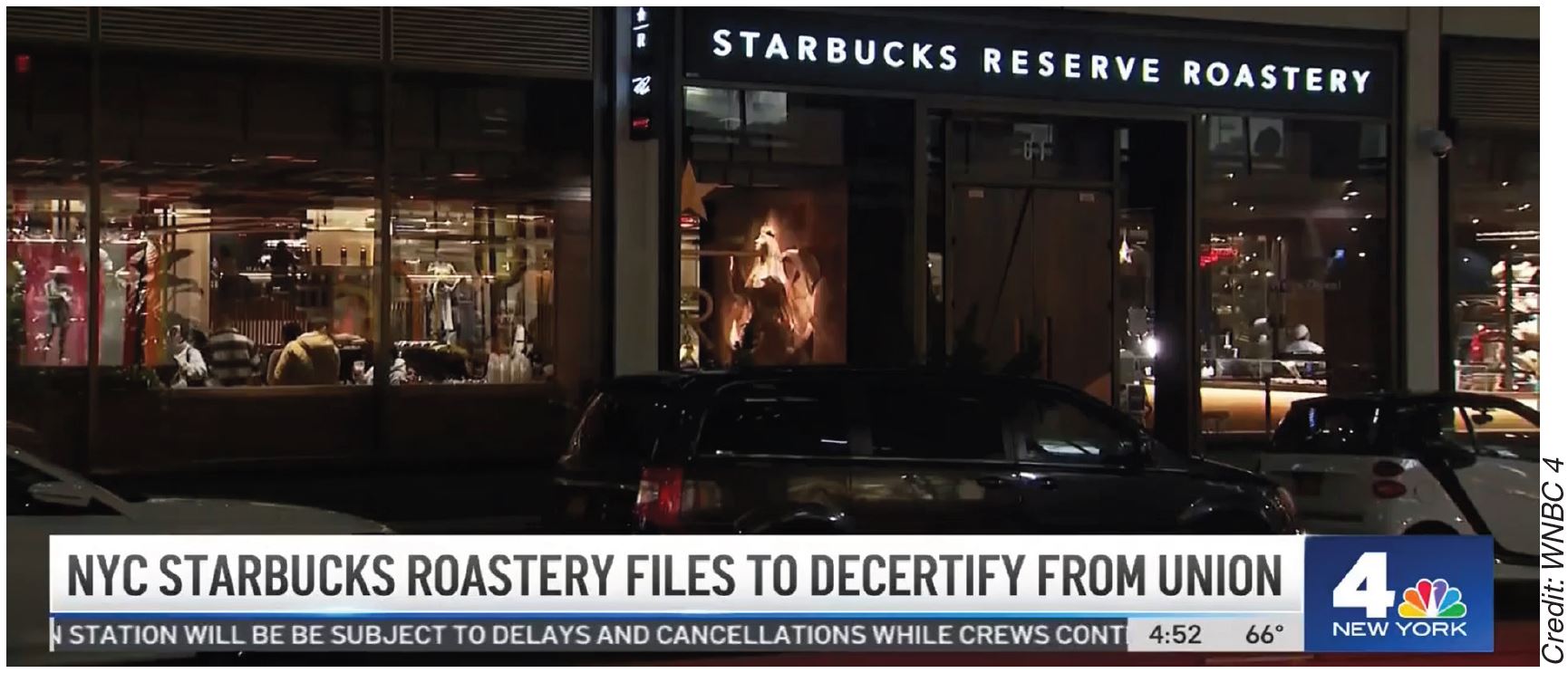
NEW YORK, NY – Union bosses and their bought-and-paid-for political allies have been touting Starbucks as the latest and greatest frontier in union organizing. But, as soon as legally permitted after several high-profile Starbucks unionization efforts, workers are already seeking to vote out union officials.
Kevin Caesar, an employee of the high-end Starbucks Reserve Roastery location in Manhattan, sought out Foundation legal aid this May. He sought assistance in submitting a petition backed by a majority of his colleagues to the National Labor Relations Board (NLRB) for a vote to remove, or “decertify,” Starbucks Workers United (SBWU), and their puppet-masters at the Service Employees International Union (SEIU), from the Roastery. Under the National Labor Relations Act (NLRA), workers must wait one year after a union is installed before seeking to remove it, meaning Caesar and his colleagues essentially filed their decertification petition as soon as allowed by the law.
“We have seen our workplace both with and without the union. We believe that the union is looking out for itself more than it is looking out for Starbucks partners, who do not want forced dues and who can advocate for ourselves,” stated Caesar about why he wants to be free of the union.
“That is why a majority of us have decided we would be better off without the union. The fact that the union officials have forced us to go through this decertification process despite the majority of workers stating they do not want to be represented by this union shows how little regard the union has for the will of the workers,” he added. “We call on union officials to respect our rights and not attempt to fight this vote.”
With the petition filed, the NLRB should now promptly schedule a secret ballot election to determine whether a majority of workers want to end union officials’ power to impose a contract, including forced dues, on the workers. However, SBWU officials have already announced they will seek to block the vote, a matter Foundation attorneys quickly opposed in a brief to the NLRB.
Worker Dissatisfaction with Unions Growing Nationwide
The Starbucks workers are just the latest example of growing dissatisfaction with union officials’ so-called “representation.” Currently, worker requests for Foundation aid in decertifying an unwanted union are at an all-time high. NLRB statistics similarly show a 20% increase in decertification petitions last year versus 2021.
Unfortunately, the NLRB’s union decertification process is prone to union boss-created roadblocks, which can impact the Starbucks workers if union officials plot to stay in power regardless of workers’ wishes. Foundation-backed NLRB reforms from 2020, collectively known as the “Election Protection Rule,” have made it somewhat easier for workers to escape unwanted union “representation,” by eliminating the most egregious “blocking charge” tactics used by union bosses to delay or stop decertification elections entirely. “Blocking charges” are unverified union boss allegations of employer misconduct, often unrelated to workers’ desire to decertify.
Currently, the Biden-appointed NLRB majority is conducting rulemaking to roll back these protections and make it much harder for workers to decertify a union.
Foundation Provides Legal Notice to Starbucks Employees
After being in contact with multiple Starbucks workers interested in how to resist union control, the Foundation issued a legal notice informing employees of the coffee chain of their right to petition for a vote to oust an unpopular union.
“No worker anywhere should be forced under so-called union ‘representation’ they oppose,” commented National Right to Work Foundation President Mark Mix. “Starbucks workers around the nation that fall victim to union tyranny should know they can turn to Foundation staff attorneys for assistance.”
“Foundation staff attorneys are now fighting to ensure that these workers are not denied the vote that they are entitled to under federal law to remove union control they oppose,” continued Mix. “Union bosses should not be allowed to keep their grip on power simply by disenfranchising those they claim to ‘represent.’”
New Flyer Employee Slams CWA Union with Federal Charges, Claims Union Lied to Employees to Attain “Majority Status”
Following suspect ‘card check,’ union bosses seek to invalidate worker-backed petition for secret ballot vote to oust union
Shepherdsville, KY (August 9, 2023) – An employee of bus manufacturer New Flyer has filed federal charges against his employer and the Communications Workers of America (CWA) union, maintaining that CWA officials illegally imposed union control over him and his coworkers despite the union lacking a demonstrated majority support among the workers. The employee, Gregory Mabrey, filed his charges at National Labor Relations Board (NLRB) Region 9 in Cincinnati with free legal aid from the National Right to Work Legal Defense Foundation.
Mabrey’s charges explain that CWA union officials gained power in his workplace through a process called “card check,” which bypasses the NLRB’s standard secret ballot election process for installing a union. Under card check, employees are denied the right to vote in private on whether they want the union in the workplace, and union officials can instead claim majority status by demanding union authorization cards directly from workers.
The card check scheme’s lack of privacy exposes workers to a variety of coercive behaviors from union officials who are seeking to collect cards from a majority of employees in a work unit. Workers often report being told signing the card only requests “more information” about the union or serves some other purpose, even though the card will be equivalent to a “vote” in favor of union representation. Workers have also experienced threats and unwanted home visits during card check campaigns.
Cards Union Bosses Used to Support “Majority Status” Claims Had Multiple Problems
Mabrey’s unfair labor practice charges report that his employer, New Flyer, recognized the CWA union despite multiple flaws with the union’s card check claim of majority status. The charges state that union officials “misrepresent[ed] to employees that the cards were for a single, restricted purpose other than to designate the Union as their representative,” and that “the Employer and CWA relied on authorization cards that employees revoked or cancelled prior to the date of recognition.”
To make matters even worse, the charges also point out that “the card check was based on a unit of employees that was smaller than the Employer-recognized bargaining unit.” This means that, even if CWA bosses hadn’t made misrepresentations or relied on cards that workers had actually revoked, the number of cards they submitted to support their claim of majority status may have been too small, even under the coercive card check regime.
Mabrey’s charges seek an NLRB prosecution of the union and employer for their respective roles in illegally granting CWA union officials monopoly bargaining powers over his coworkers.
NLRB Blocks Workers’ Attempt to Vote Out the Union, Even Amid Deception
Mabrey’s charges come as another New Flyer employee, Megan Sowder, is pressing for the NLRB to accept an employee-backed petition she submitted to the NLRB in June that asks for a secret ballot vote to remove the CWA union. Sowder sought to take advantage of a Foundation-backed reform the NLRB adopted in 2020, which gives workers a 45-day window to file for a secret ballot election after an employer notifies employees that it has recognized a union pursuant to a card check.
Filing for a secret ballot vote in this way counters the NLRB’s so-called “voluntary recognition bar,” which normally locks workers under union power for up to a year or more after a card check recognition.
However, as the Request for Review filed by Sowder’s Foundation staff attorneys points out, NLRB Region 9 wrongly dismissed Sowder’s petition. Although Sowder submitted the requisite number of signatures twice to support her petition for a decertification election (30% or more is required to trigger a vote), NLRB Region 9 dubiously claims that Sowder collected the signatures “too early” and that an arbitration meeting that modifies the unit also nullifies the petition. NLRB Region 9 even claims that it never received all the signatures, despite Sowder’s evidence of faxing them directly to NLRB Region 9.
“The Region’s error has caused severe prejudice to Sowder and the bargaining unit employees’ rights under [the National Labor Relations Act], and review should be granted to correct that error,” Sowder’s Request for Review to the full National Labor Relations Board in Washington, D.C., states.
Biden NLRB Plans to Eliminate Workers’ Ability to Challenge “Card Check” Drives
The New Flyer employees’ cases come as the Biden NLRB is poised to issue a final rule as soon as this month to overturn the 2020 Foundation-backed reforms that allow workers to challenge the imposition of union monopoly bargaining power via card check with a secret ballot election. Foundation attorneys filed comments opposing the Biden NLRB’s proposed rule to nix these provisions.
“This situation demonstrates exactly how rank-and-file workers’ rights will be further trampled if the Biden NLRB moves forward with its attempt to expand union bosses’ card check power and simultaneously restrict workers’ statutory right to hold decertificiation votes to remove unwanted unions,” commented National Right to Work Foundation President Mark Mix. “Even absent the misrepresentations CWA union bosses made to foist union so-called ‘representation’ on workers, such card check drives are inherently prone to union pressure tactics that would be grounds for invalidating an NLRB-supervised vote.”
“Meanwhile, despite a lack of evidence of true majority support, the NLRB has improperly denied two submissions of valid employee signatures from workers simply asking for a vote to challenge the invalid card check recognition,” added Mix. “It is not too late for the Biden Board to stop its rulemaking to eliminate the Election Protection Rule, and give rank-and-file workers some hope that their statutory right to decertify a union they oppose will not be steamrolled by the NLRB’s desire to protect incumbent union power.”
Busted: Kroger Worker’s Card Illegally Altered to ‘Authorize’ Forced Dues
The following article is from the National Right to Work Legal Defense Foundation’s bi-monthly Foundation Action Newsletter, May/June 2023 edition. To view other editions of Foundation Action or to sign up for a free subscription, click here.
Employee’s UFCW union card indicating objection to financial support changed without her knowledge

Jessica Haefner clearly exercised her rights under Texas’ Right to Work law. Foundation attorneys will get to the bottom of who faked her consent to dues deductions and restore her rights.
HOUSTON, TX – Supermarket clerk Jessica Haefner began her job at a suburban Houston Kroger store in August 2022. She attended a mandatory meeting for new employees run by United Food and Commercial Workers (UFCW) local union agents. Despite the union’s hard-sell at the meeting, she knew her rights under Texas’ Right to Work law: Union bosses couldn’t force her to pay any dues or fees to the union to keep her job.
During the meeting, Haefner followed a union representative’s instructions to indicate on a union form that she did not want to be a part of the union or pay dues or fees. But she was shocked to discover just weeks later not only that union dues were coming out of her paycheck, but also that the union form she was required to sign had been altered to indicate she consented to those deductions.
Haefner, with free legal representation from National Right to Work Foundation staff attorneys, slammed UFCW officials and Kroger with federal charges at the National Labor Relations Board (NLRB). The charges state that UFCW bosses’ and Kroger’s actions violate her rights under Section 7 of the National Labor Relations Act (NLRA), which guarantees American private sector workers’ right to abstain from any and all union activities.
“I was lied to . . . and my rights were not only violated as an employee but as an American citizen,” said Haefner.
Employee’s Dues Form Was Altered, Forced Dues Deductions Began
According to Haefner’s charges, a UFCW agent passed out a union membership application and a dues checkoff on a single form that he claimed was mandatory for meeting attendees to complete. Another piece of onboarding literature stated that Kroger management had the “opinion that you should participate and be active in the Union.”
When Haefner asked how she could exercise her right to refrain from joining the union or paying union dues, the union agent instructed Haefner to write “$0” in the field marked “union dues” on the form.
Haefner followed these instructions. But after discovering later that union dues were indeed coming out of her paycheck, Haefner quickly obtained a copy of the form on which Kroger and UFCW officials based their dues deductions. She saw that someone had changed the dues deduction amount in the field she marked “$0” to a dollar amount to induce dues deductions from her paycheck.
UFCW Chiefs Illegally Seizing Dues from Grocery Workers Across Country
UFCW’s violation of Haefner’s rights is not an isolated incident. In Pennsylvania, Foundation staff attorneys are also representing Giant Eagle supermarket cashier Josiah Leonatti, who charges UFCW Local 1776KS union officials with refusing to accommodate his religious objections to union membership (see page 3). King Soopers grocery employees from Colorado are also receiving free legal aid from Foundation staff attorneys in opposing illegal UFCW strike fines, some of which are as high as about $4,000 per worker.
“Jessica Haefner knew her rights under Texas’ popular Right to Work law and actively asserted them, yet UFCW union officials still brazenly took her money against her will,” commented National Right to Work Foundation President Mark Mix.
“As cases brought for workers with free Foundation legal aid show, UFCW bosses have a long and documented history of violating workers’ rights, whether through thousands of dollars in illegal strike fines, illegal religious discrimination, threatening teenagers’ jobs, and now by altering a worker’s dues authorization,” Mix added.
Dallas-Based Danone North America Employee Slams Union with Federal Charges for Illegally Seizing Money from Pay
Charge comes while employees seek vote to remove UFCW union from facility
Dallas, TX (July 11, 2023) – Alex Botello, a Dallas-based employee of food manufacturer Danone North America, has hit the United Food and Commercial Workers (UFCW) Local 540 union with federal charges after union officials illegally seized union dues from his paycheck. Botello filed his charges at Region 16 of the National Labor Relations Board (NLRB) in Dallas with free legal aid from the National Right to Work Legal Defense Foundation.
Botello’s charge says that UFCW bosses rebuffed or ignored his two attempts to revoke a dues checkoff authorization. Botello maintains that the union’s actions violate his rights under Section 7 of the National Labor Relations Act (NLRA), which is supposed to protect American private sector workers’ right to refrain from union activity.
Because Texas is a Right to Work state, UFCW union officials lack the legal authority to demand any money from Botello as a condition of employment. Right to Work laws provide more comprehensive protections than the NLRA by making union membership and all union dues payment strictly voluntary for private sector workers. In non-Right to Work states, in contrast, union officials can force workers to pay some union fees as a condition of getting or keeping a job.
Worker Followed Union Instructions to Stop Dues Deductions, But Union Continued to Take Money
Botello’s charge says that he first tried to stop dues deductions from his paycheck in October 2022. The UFCW rejected his request in a letter, which stated that his attempt was untimely and that he could only revoke his dues checkoff during a narrow union-created “window period” lasting from March 27, 2023, until April 11, 2023.
Botello resubmitted his revocation request on April 3, 2023, within the “window period” specified by the union. However, union dues did not stop coming out of his paycheck. “The Union’s failure to accept Charging Party’s timely revocation letter and immediately cease deducting dues violates the National Labor Relations Act,” reads Botello’s charge.
Workers Nationwide Battle Illegal UFCW Dues Schemes
Botello’s charge is just the latest Foundation-backed legal action that workers across the country have taken against UFCW union officials for illegal dues practices. Also in Texas, Houston Kroger employee Jessica Haefner is challenging UFCW Local 455 union officials’ collection of dues from her paycheck under the guise of a union card that was altered to show her consent to dues deductions she never agreed to. As in Botello’s case, Haefner followed union officials’ directions on how to end union dues deductions, but money continued to come out of her wages.
In Pennsylvania, Foundation attorneys represented Giant Eagle supermarket cashier Josiah Leonatti, who charged UFCW Local 1776KS union officials with refusing to accommodate his religious objections to union membership. His charges say union officials tried to subject him to an illegal “religion test” before they considered granting him an accommodation.
UFCW Officials Attempting to Remain in Power Despite Danone Employees’ Request for Union Decertification Vote
Separately, Botello and his coworkers submitted two petitions to the NLRB, asking the agency for a vote to remove, or “decertify,” the UFCW union. Botello submitted the first petition on August 29, 2022, but regional NLRB officials rejected the petition at UFCW bosses’ behest. NLRB officials claimed that a contract ratified by union bosses and management in 2019 would remain in effect until November 15, 2022. As per the NLRB’s non-statutory “contract bar” policy, union officials can block workers from exercising their right to vote them out of a workplace for up to three years after a contract is finalized.
Botello submitted the second petition after the 2019 union contract expired, based on the NLRB Region’s decision on the first petition finding that the 2019 contract was operative on August 29, the day that Botello submitted the first petition. However, regional NLRB officials blocked the second petition on the grounds that a more recent contract had actually been in effect since August 25. This is a contradiction to the regional NLRB decision blocking the first petition, as that decision rested on the conclusion that the 2019 contract was in effect on August 29, not the union’s August 25 contract.
Botello filed requests for review challenging the Region’s dismissals of both petitions. The NLRB granted Botello’s requests and directed Region 16 to take another look at these cases.
“The situation at the Dallas Danone plant illustrates how far UFCW union bosses, and in many instances NLRB officials, are willing to go to trap workers under union monopoly control and forced dues, even when there’s clear evidence that workers do not support them,” commented National Right to Work Foundation President Mark Mix. “Any worker under UFCW control who experiences similar infringements of their rights should not hesitate to reach out to the Foundation for free legal aid.”
Teen Supermarket Cashier Fired for Refusing to Join and Fund UFCW Union
The following article is from the National Right to Work Legal Defense Foundation’s bi-monthly Foundation Action Newsletter, May/June 2023 edition. To view other editions of Foundation Action or to sign up for a free subscription, click here.
Union officials required teen to violate his religious beliefs or be fired

Josiah Leonatti may be young, but he’s not afraid to stand up to UFCW bosses, who got him fired over objecting to union membership and dues on religious grounds.
PITTSBURGH, PA – Josiah Leonatti, a high schooler, was fired last year for his religious beliefs. Giant Eagle and the United Food and Commercial Workers (UFCW) union compel employees, like Leonatti, to either join or fund the union to keep their jobs. The problem for Leonatti is that he cannot do so without compromising his religious beliefs.
When Leonatti was hired, he never expected that union bosses would force him to choose between his job and his religious convictions. But the union officials did just that.
With free legal aid from National Right to Work Foundation staff attorneys, Leonatti hit UFCW union officials and Giant Eagle in January with federal discrimination charges. Although Giant Eagle rehired Leonatti to limit liability, neither Giant Eagle nor the union agreed to accommodate his religious beliefs. So Leonatti faces discharge, again, unless he funds the union.
Moreover, the union demands that Leonatti submit to an illegal “religion test.” Before the company and union will consider accommodation, they demand that Leonatti answer irrelevant and inappropriate questions to determine whether his religious beliefs are valid.
UFCW Bosses Tried to Get Teen Fired After He Voiced Religious Objections
Foundation attorneys filed charges for Leonatti against the union at both the Equal Employment Opportunity Commission (EEOC) and the National Labor Relations Board (NLRB) based on federal law. Foundation attorneys also filed charges against Leonatti’s employer, Giant Eagle.
Federal law requires unions and employers to accommodate employees who have religious objections to joining or paying dues to a union. And federal law also prohibits forced union membership regardless of a worker’s reason for not wanting to affiliate with a union.
Leonatti’s charges report that he attended employee training last year as a cashier trainee. There, a store manager told new hires that they “must sign papers to join the United Food And Commercial Workers.” According to the NLRB charges, “No other options were even hinted at.”
After reviewing the papers with his family, Leonatti’s charges explain, he mailed a letter to UFCW officials detailing his sincere religious objections to joining and supporting the union. He also presented the same letter in person at training.
Rather than accommodate his religious beliefs as required by law, a company official “dismissed [Leonatti] from training and sent [him] home.” The same official later called Leonatti and told him that union membership is compulsory at Giant Eagle, and admitted the grocery store had terminated him over his refusal to join.
UFCW officials responded to Leonatti’s letter by mail on November 10, 2022, rejecting the written explanation of his religious objection and demanding he “complete its religious examination” before they even considered granting him an accommodation. Even if he passed this “test,” the charges say, union officials threatened that he would still have to pay an amount equal to full UFCW union dues to a charity approved by union bosses. Giant Eagle has not offered a religious accommodation to Leonatti, and the union has not retracted its threats or agreed to accommodate him.
Teen’s Firing Shows Need for Pennsylvania Right to Work Protections
Leonatti’s EEOC charges seek to compel the UFCW union and Giant Eagle to provide him a legally required religious accommodation. In addition, the NLRB charges state that relief must include unitwide notice and corporate training regarding workers’ right to refrain from union membership, among other remedies.
“Union bosses’ attempt to coerce a high school student to violate his religious beliefs is unconscionable and illegal,” commented National Right to Work Foundation Vice President Patrick Semmens. “We’re proud to support Mr. Leonatti as he defends his rights and beliefs. This should serve as a stark reminder that all Americans deserve Right to Work protections.”
“If Pennsylvania were a Right to Work state, Leonatti wouldn’t be forced to present his religious objections to expectedly hostile union chiefs,” Semmens added. “In a Right to Work state, he and other dissenting employees would have a statutorily protected right to cut off dues payments for any reason. All employees deserve the right to choose whether to fund a union.”
Foundation Slams Biden Labor Board’s Biased Ruling in Federal Appeals Court
The following article is from the National Right to Work Legal Defense Foundation’s bi-monthly Foundation Action Newsletter, May/June 2023 edition. To view other editions of Foundation Action or to sign up for a free subscription, click here.
Brief contends NLRB distorted precedent to trap workers in union they oppose
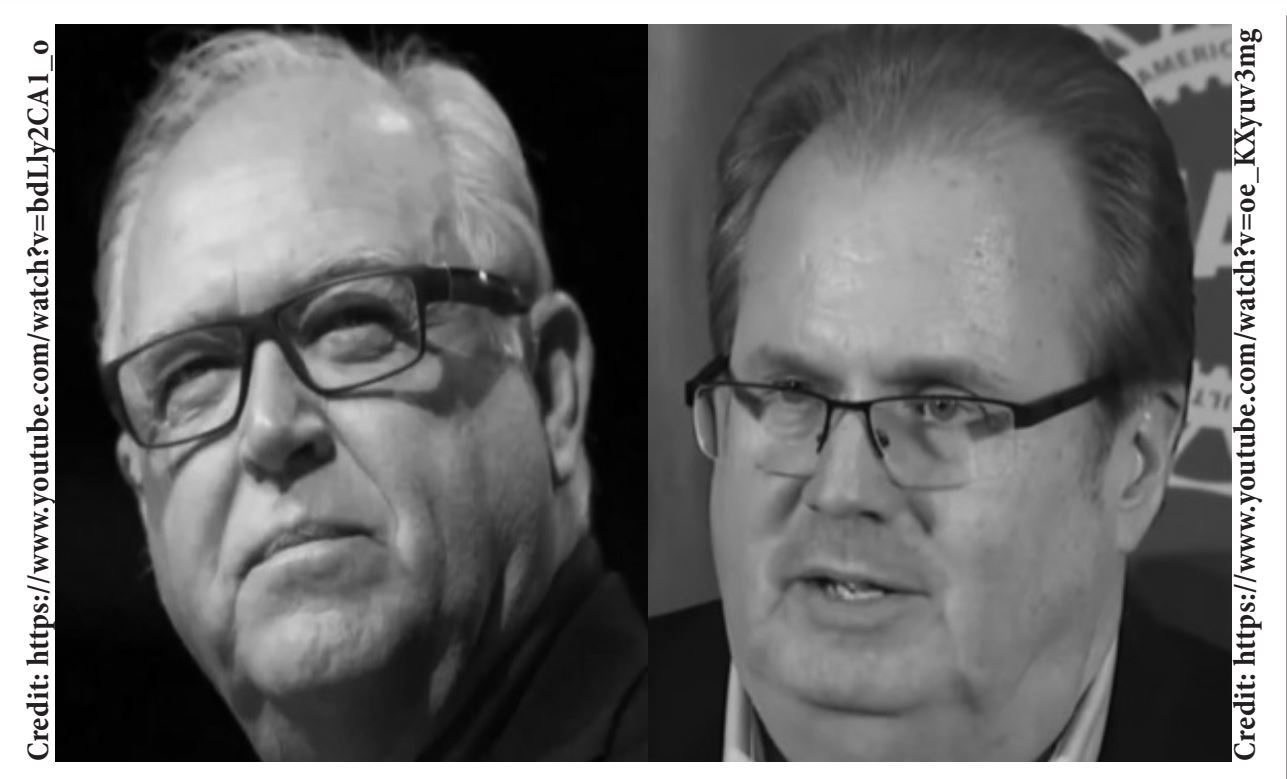
A majority of J.G. Kern employees petitioned to oust the UAW, which has seen two of its former presidents (Gary Jones, right, and Dennis Williams, left) go to jail for corruption. But a biased NLRB ruling trapped the workers in UAW ranks anyway.
WASHINGTON, DC – Foundation staff attorneys recently filed an amicus brief with the D.C. Circuit Court of Appeals in a case challenging a National Labor Relations Board (NLRB) decision reversing workers’ attempt to remove union “representation” they oppose.
In the case, J.G. Kern employees, frustrated with the United Auto Workers (UAW) Local 228 union, decided to petition to decertify, or formally remove, the union from their workplace. The workers presented this majority petition to their employer, leading to the company removing its recognition of the union.
The petition contained overwhelming support from workers in favor of removing the union. Yet, after the company withdrew recognition from the union, UAW officials ran to the Biden Labor Board in an attempt to remain in power. The Biden-appointed NLRB majority sided with the union officials by re-imposing the unpopular union over the workers’ objections.
With the case now in the federal court of appeals, the Foundation filed an amicus brief arguing the NLRB’s April 2022 ruling ignores precedent and misapplies longstanding law in siding with union officials.
Decertification Rules Already Rigged Against Workers Opposed to Union Affiliation
As the brief points out, workers looking to file a petition to remove a union they oppose already face numerous hurdles due to NLRB rules, most of which are contained nowhere in the federal statute the NLRB is charged with enforcing.
For example, a petition must be gathered outside of work hours, and outside of work-related areas. Also, unless employees use certain Board-specified language in their petition, the petition is invalid. Furthermore, employees cannot ask their employer for further information regarding the decertification process or the petition will be invalid.
The Foundation’s brief observes how workers must operate “in the dark, without help from their employer, and even if they do everything right, their efforts might come to naught through no fault of their own.” It also shows how the Biden Board has made it more difficult for individual workers to express their right to decertify unwanted, unpopular unions.
Biden NLRB Aims to Force Union on Workers Who Overwhelmingly Object
Under the Board’s “certification bar” doctrine, a union that wins a secret ballot election cannot be challenged for one year after its victory is certified by the NLRB. In this case, the UAW’s certification bar ended on October 3, 2019. In November 2019, J.G. Kern employees delivered a majority-backed petition to their employer.
The Biden Board claimed, however, that because J.G. Kern did not bargain in good faith during a three-month period at the beginning of the certification year, the employees’ majority petition was invalid. According to the Biden Board, the employer’s alleged unfair labor practices prospectively “extended” the certification year beyond its normal 12-month period.
The brief highlights the disingenuousness of the Board, pointing out that “the employees would have to divine the future to know they were collecting a petition during the ‘extended certification year.’” The Foundation urges the D.C. Circuit to command the Board to follow precedent that requires the Board to determine whether there was a “nexus” between the employer’s unfair labor practices and the decertification petition.
NLRB’s Power Grab Takes Away Workers’ Rights
The Foundation’s brief emphasizes how the Board’s decision can abolish employees’ rights guaranteed by the National Labor Relations Act. An example of that is the J.G. Kern workers’ petition, where it was only after the petition was gathered that the Board extended the union’s certification bar period.
The brief notes that usually “an employee’s decertification petition is presumptively valid unless there is a causal nexus between the unfair labor practice and the petition.” However, this is not the case under the J.G. Kern ruling.
Should the NLRB’s ruling be upheld, it “will further incentivize incumbent unions to file unfair labor practice charges to chill employees’ Section 7 ability to collect petitions,” the brief concludes.
“The NLRB’s blatant disregard for the rights of workers who don’t want anything to do with coercive unionism is on full display in this case,” commented Mark Mix, president of the National Right to Work Foundation. “The arbitrary cherry-picking of legal precedents to fit the Board’s agenda is outrageous, while expected, given the Biden Administration’s all-out effort to expand Big Labor’s coercive ranks.





