
National Right to Work Foundation Highlights Michigan Workers’ Legal Options as Right to Work Repeal Looms
Legal notices: Though forced dues will again be legal in the private sector, Michigan workers can still reject union boss demands to join union and fund union political activities
Lansing, MI (February 9, 2024) – The National Right to Work Legal Defense Foundation has issued special legal notices to public and private sector workers in Michigan, which explains what rights workers still have to resist union boss demands as the repeal of the state’s Right to Work law takes effect.
In March 2023, the Michigan Legislature voted against the will of over 70% of Michiganders and repealed the state’s protections against being forced to pay union dues or fees as a condition of employment. The repeal formally takes effect on February 12, 2024.
The legal notices are available at the Foundation’s website: https://www.nrtw.org/michigan-private-sector-notice/ (for private sector workers) https://www.nrtw.org/michigan-public-sector-notice/ (for public sector workers).
MI Public Sector Workers Can Still Refrain from Union Membership and Dues Payment
By repealing Michigan’s Right to Work law, Michigan politicians granted union officials the power to compel private sector workers to pay money to a union to keep their jobs. The legal notice explains that, despite this massive expansion of government-granted power for Michigan union bosses, private sector workers still have rights under federal law to refrain from formal union membership and to refuse to pay for union political or ideological expenditures, among other rights.
“[U]nder the National Labor Relations Act (NLRA) workers subject to these forced fee arrangements cannot lawfully be compelled to be actual union members or pay full union dues to keep their jobs,” the notice reads.
As for public sector workers, the legal notice informs Michiganders that even though Michigan’s politicians have undone the state’s statutory protection against being forced to pay union bosses as a condition of employment, the repeal “does not—and cannot—strip [public sector] workers of their constitutional right” to refrain from funding union activities. The Supreme Court recognized public employees’ First Amendment right to abstain from union financial support in the 2018 Foundation-won Janus v. AFSCME ruling.
MI Union Bosses Still Can’t Force Private Sector Workers to Become Formal Members or Directly Support Union Politics
The notices inform Michigan private sector employees that, under the U.S. Supreme Court’s decision in Pattern Makers v. NLRB, independent-minded workers have a right to refrain from formal union membership. The Foundation-won CWA v. Beck Supreme Court ruling further holds that the most that union bosses can force nonmember workers to pay is a fee equal to “what the union can prove is its costs of collective bargaining, contract administration, and grievance adjustment with their employer.” This fee cannot include union expenses for political and ideological activities.
“Unions often fail to meet their legal obligation to inform workers of their right not to be a union member and to object to paying full union dues,” the notice reads. “In fact, unions oftentimes mislead workers to believe that they must join the union to keep their jobs.”
MI Private Sector Workers Have Right to Vote Out Unpopular Union Bosses
Private sector employees also have the right to petition for National Labor Relations Board-supervised “decertification elections,” which can strip union officials of their coercive powers of monopoly control over a work unit entirely.
Foundation attorneys assist hundreds of workers every year in exercising their legal right to obtain a vote to decertify unions of which they disapprove.
“Union boss allies in the Michigan Legislature foisted this repeal on workers for one reason: To enlarge the coffers of their favorite special interest,” commented National Right to Work Foundation President Mark Mix. “Instead of letting Michigan workers continue to enjoy the right to freely choose whether or not union officials have earned a cut of their hard-earned pay, Michigan legislators have granted union bosses a power that strips away basic free speech and association rights.”
“The truth is, even with this great expansion of their powers, Michigan union bosses will still try to look for ways to expand their powers beyond the law and compel more workers to associate with them,” Mix added. “That’s why it’s important for Michiganders to know their rights in this new legal landscape; they should also know that Foundation attorneys stand ready to defend the rights of any Michigan worker opposing union coercion.”
Foundation Defends Michigan Workers with Forced Dues Looming
The following article is from the National Right to Work Legal Defense Foundation’s bi-monthly Foundation Action Newsletter, July/August 2023 edition. To view other editions of Foundation Action or to sign up for a free subscription, click here.
With Right to Work repeal law passed, workers seek to escape mandatory payments

Michigan legislators’ unpopular decision to repeal the state’s Right to Work law helped prompt Mary Soltysiak and her coworkers’ move to vote out the IAM union.
LANSING, MI – Despite poll after poll showing 70 percent of Michiganders wanted Michigan’s decade-old Right to Work law left in place, Gov. Gretchen Whitmer and union cronies in the Michigan Legislature voted to strip Wolverine State workers of their right to refrain from funding unwanted union bosses in March. In response, the Foundation sprang into action, issuing a Special Legal Notice to Michigan workers advising them of their legal options as the state transitions to a forced-dues regime. The notice reminded workers that, despite what union bosses may claim, the state’s Right to Work law remains in effect until 90 days after the legislative session ends later this year — and also what they can do in advance of forced dues being legal again. Unsurprisingly, given Right to Work’s popularity even among union households, Michigan workers are stepping up and taking action to defend their rights against coercive unionism.
Michigan Workers Battle Forced-Dues Schemes Ahead of Repeal
For example, Foundation attorneys are currently assisting Grand Rapids-area Kroger employee Roger Cornett’s challenge to an illegal dues scheme perpetrated by United Food and Commercial Workers (UFCW) union officials. Cornett hit UFCW bosses with federal charges this May, accusing them of ignoring a letter in which he exercised his right to cut off dues deductions from his paycheck. Cornett’s charges also maintained that UFCW bosses sought to seize money from him using a form that blatantly violates existing federal law. Cornett’s charge says the form is illegal because of its “dual purpose” nature, meaning just one signature confusingly locks a worker into both membership and dues deductions. Federal law requires any authorization for union dues deductions to be voluntary and separate from a union membership application. UFCW bosses’ contempt for longstanding federal protections in Cornett’s case likely indicates how aggressively union officials will pursue forced dues under a non-Right to Work regime. The Foundation’s legal notice also counsels workers that they can avoid forced-dues arrangements entirely by petitioning the NLRB to hold “decertification elections” at their workplaces, in which workers can vote unpopular unions out.
Legal Notice Counsels Workers of Right to Vote Out Unwanted Unions
Mary Soltysiak, who opposes forced dues, heard news of the upcoming repeal and filed a petition to decertify the International Association of Machinists and Aerospace Workers (IAM) District Lodge 60/Local Lodge 475 union with free legal aid from Foundation staff attorneys. Soltysiak and her colleagues work at Terryberry, a manufacturing firm in Grand Rapids, MI.
Soltysiak stated that she and some of her colleagues “contacted [a Foundation attorney] and filled out paperwork to get out of paying union dues around the year 2018 because of the Right to Work . . . law.”
“The union has done nothing but hurt my paycheck and my vacation hours,” Soltysiak added.
Soltysiak and her coworkers achieved victory this May, when the NLRB certified their majority vote ousting the IAM union. Hopefully, their success portends the future success of the growing number of workers in Michigan and across the country looking to decertify the unions in their workplaces.
Foundation Also Defending Public Sector Right to Work Protections
As noted in the Foundation’s legal notice, the Michigan Right to Work repeal does not affect public sector Michigan employees. Under the Foundation-won Janus v. AFSCME Supreme Court decision, no public worker in America can be forced to subsidize a union as a condition of employment. But, as the repeal is looming, Michigan public sector union officials are nonetheless seeking to undermine public employees’ freedom to refrain from union support through so-called “fee-for-grievance” schemes.
This April, the Foundation submitted a brief in the Michigan Supreme Court case Technical, Professional and Officeworkers Association of Michigan (TPOAM) v. Renner, in which TPOAM officials are trying to enforce a “fee-for-grievance” policy against Saginaw County employee Daniel Renner. Under it, union bosses strip nonmember public employees of any power to file grievances themselves, and instead mandate that they pay fees sometimes exceeding yearly union dues to use the union’s grievance system.
Michigan legislators’ unpopular decision to repeal the state’s Right to Work law helped prompt Mary Soltysiak and her coworkers’ move to vote out the IAM union.
In the brief, Foundation staff attorneys refute the union’s claims for this newfound power, stating that “fee-for-grievance” schemes were never authorized by the Michigan Legislature and are inconsistent with federal law.
Foundation Attorneys Will Defend Worker Freedom in Michigan
“Michigan union officials and their allies in the state legislature have contempt for workers’ individual rights that knows no bounds,” commented National Right to Work Foundation Vice President and Legal Director William Messenger. “That was made clear by the repeal of the popular Right to Work law, and the attempt to undermine Right to Work protections for public sector employees which are safeguarded by the First Amendment under the Foundation’s Janus U.S. Supreme Court victory.”
“Michigan workers have a long road ahead to restore their rights against union coercion, but Foundation attorneys are fighting alongside these workers, and will continue to fight until no Michigan worker can be forced to pay union bosses they disapprove of just to keep a job,” Messenger added.
National Right to Work Foundation Issues Special Legal Notice to Infinity Healthcare Employees Amid SEIU Strike Threat
Foundation warns workers that those wishing to continue caring for patients during a strike should resign their memberships before returning to work
Chicago, IL (September 2, 2023) – The National Right to Work Legal Defense Foundation has issued a special legal notice to the approximately 1,000 Illinois nursing home workers who may be impacted by Service Employees’ International Union (SEIU)-Healthcare Illinois union officials’ planned strike order. If SEIU officials order the strike, employees from 11 Infinity Healthcare nursing facilities in the Chicago area will be ordered off the job.
The legal notice informs Infinity Healthcare workers of their rights, including their right to not abandon their patients and to keep working despite the union-ordered strike. The notice discusses why workers across the country frequently turn to the National Right to Work Foundation for free legal aid in such situations.
“This situation raises serious concerns for healthcare employees who believe there is much to lose from a union boss-ordered strike,” the notice reads. “Employees have the legal right to rebuff union officials’ strike demands, but it is important for them to be fully informed before they do so.”
The full notice is available at www.nrtw.org/infinity
The notice outlines the process that Infinity Healthcare workers should follow if they want to exercise their right to return to work during the strike and avoid punishment by union bosses, complete with sample union membership resignation letters. The notice reminds workers that SEIU union officials have no disciplinary power over workers who are not union members, and advises Infinity Healthcare employees who wish to work during the strike to resign their memberships at least one day before returning to work.
“That is the best way to avoid potential union fines and other discipline,” the notice says.
Further, the notice reminds employees of their rights to cut off all union dues payments in the absence of a monopoly bargaining contract with the nursing home company. The notice encourages employees to seek free legal aid from the Foundation if they experience union resistance as they attempt to exercise any of these rights.
“Infinity Healthcare employees are likely aware of the impact this strike may have on the Chicago senior population, and may rightfully question whether the upcoming union-ordered strike is really best for employees, their families, and their patients,” commented National Right to Work Foundation President Mark Mix. “Infinity Healthcare employees should know they unequivocally have the right to reject union strike orders and continue to care for those in need.”
“Any nursing facility employee who wants to exercise her or her right to rebuff SEIU union officials’ sweeping strike order should immediately contact the Foundation for free legal aid should SEIU bosses violate their legal rights,” added Mix.
Foundation Fights For Starbucks Workers Seeking to Oust Union
The following article is from the National Right to Work Legal Defense Foundation’s bi-monthly Foundation Action Newsletter, July/August 2023 edition. To view other editions of Foundation Action or to sign up for a free subscription, click here.
Majority of workers at flagship NYC Starbucks Roastery want decertification vote
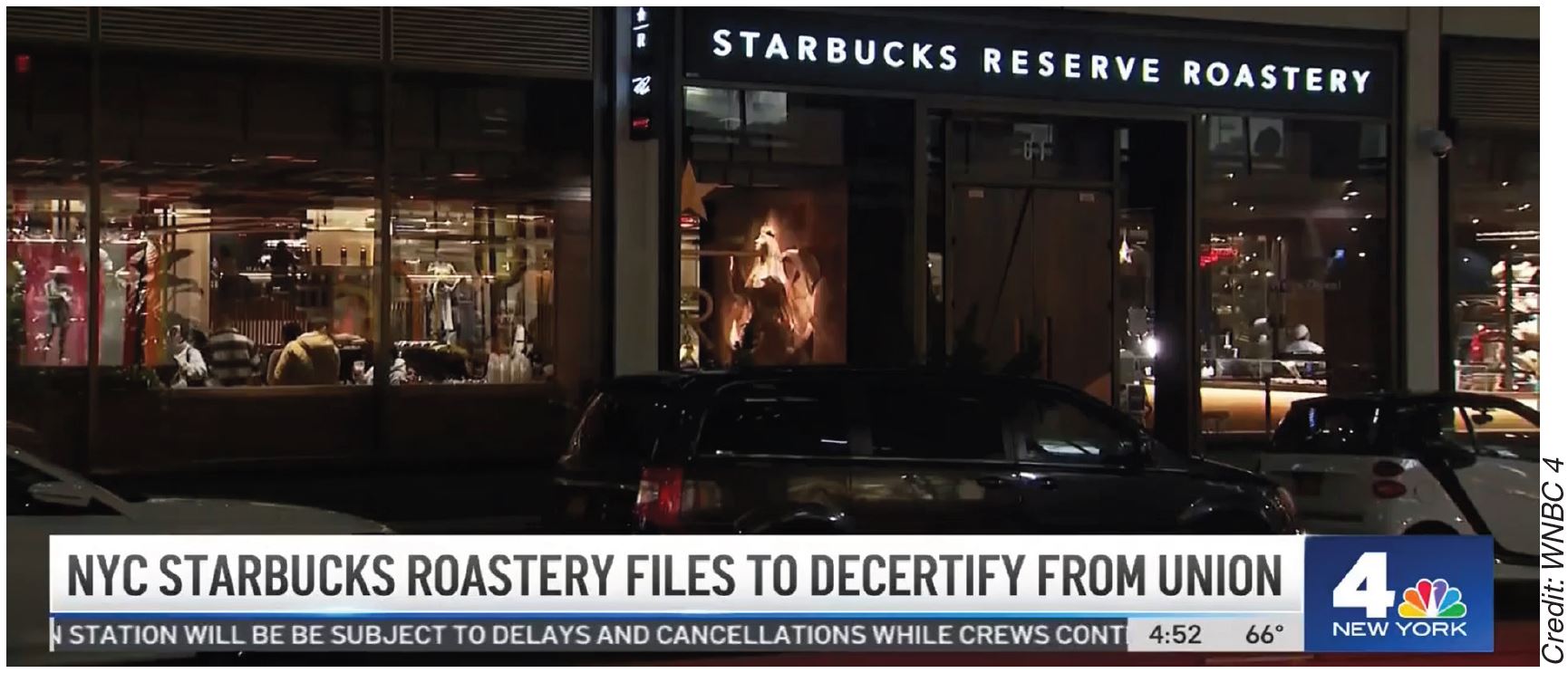
NEW YORK, NY – Union bosses and their bought-and-paid-for political allies have been touting Starbucks as the latest and greatest frontier in union organizing. But, as soon as legally permitted after several high-profile Starbucks unionization efforts, workers are already seeking to vote out union officials.
Kevin Caesar, an employee of the high-end Starbucks Reserve Roastery location in Manhattan, sought out Foundation legal aid this May. He sought assistance in submitting a petition backed by a majority of his colleagues to the National Labor Relations Board (NLRB) for a vote to remove, or “decertify,” Starbucks Workers United (SBWU), and their puppet-masters at the Service Employees International Union (SEIU), from the Roastery. Under the National Labor Relations Act (NLRA), workers must wait one year after a union is installed before seeking to remove it, meaning Caesar and his colleagues essentially filed their decertification petition as soon as allowed by the law.
“We have seen our workplace both with and without the union. We believe that the union is looking out for itself more than it is looking out for Starbucks partners, who do not want forced dues and who can advocate for ourselves,” stated Caesar about why he wants to be free of the union.
“That is why a majority of us have decided we would be better off without the union. The fact that the union officials have forced us to go through this decertification process despite the majority of workers stating they do not want to be represented by this union shows how little regard the union has for the will of the workers,” he added. “We call on union officials to respect our rights and not attempt to fight this vote.”
With the petition filed, the NLRB should now promptly schedule a secret ballot election to determine whether a majority of workers want to end union officials’ power to impose a contract, including forced dues, on the workers. However, SBWU officials have already announced they will seek to block the vote, a matter Foundation attorneys quickly opposed in a brief to the NLRB.
Worker Dissatisfaction with Unions Growing Nationwide
The Starbucks workers are just the latest example of growing dissatisfaction with union officials’ so-called “representation.” Currently, worker requests for Foundation aid in decertifying an unwanted union are at an all-time high. NLRB statistics similarly show a 20% increase in decertification petitions last year versus 2021.
Unfortunately, the NLRB’s union decertification process is prone to union boss-created roadblocks, which can impact the Starbucks workers if union officials plot to stay in power regardless of workers’ wishes. Foundation-backed NLRB reforms from 2020, collectively known as the “Election Protection Rule,” have made it somewhat easier for workers to escape unwanted union “representation,” by eliminating the most egregious “blocking charge” tactics used by union bosses to delay or stop decertification elections entirely. “Blocking charges” are unverified union boss allegations of employer misconduct, often unrelated to workers’ desire to decertify.
Currently, the Biden-appointed NLRB majority is conducting rulemaking to roll back these protections and make it much harder for workers to decertify a union.
Foundation Provides Legal Notice to Starbucks Employees
After being in contact with multiple Starbucks workers interested in how to resist union control, the Foundation issued a legal notice informing employees of the coffee chain of their right to petition for a vote to oust an unpopular union.
“No worker anywhere should be forced under so-called union ‘representation’ they oppose,” commented National Right to Work Foundation President Mark Mix. “Starbucks workers around the nation that fall victim to union tyranny should know they can turn to Foundation staff attorneys for assistance.”
“Foundation staff attorneys are now fighting to ensure that these workers are not denied the vote that they are entitled to under federal law to remove union control they oppose,” continued Mix. “Union bosses should not be allowed to keep their grip on power simply by disenfranchising those they claim to ‘represent.’”
National Right to Work Foundation Issues Legal Notice to UPS Employees as Nationwide Strike Looms
Notice provides important information to those who want to work during the strike
Washington, DC (July 10, 2023) – Today, the National Right to Work Legal Defense Foundation issued a special legal notice to employees of UPS in light of news reports indicating that Teamsters union officials are on the brink of issuing a nationwide strike order against the shipping giant. The legal notice is available at the Foundation’s website here: www.nrtw.org/UPS.
The Foundation is the nation’s premier organization dedicated to defending workers’ legal rights from forced unionism abuses. Rank-and-file workers who are interested in continuing to work and providing for their families during a strike often contact the Foundation for free legal aid to avoid strike discipline, or to resist intimidation often perpetrated by union officials.
“The Foundation wants you to learn about your legal rights from independent sources,” the notice reminds UPS workers. “You should not rely on what self-interested union officials tell you.”
Employees Have Right to Rebuff Union Strike Orders
The legal notice informs UPS workers who want to work during a strike that they should submit resignations prior to returning to work, because doing so is the best way to avoid union fines and vindictive union discipline. “Your resignation letter must be postmarked THE DAY BEFORE you return to work, or hand delivered BEFORE you actually return to work,” the notice reads. Sample union membership resignation letters are available on the Foundation’s website.
The notice also informs employees of other actions they can take to disaffiliate from the Teamsters union, including how to stop funding unwanted union activities.
“If you work in a state with Right to Work protections, you have a right to cut off all payments of dues and fees to the union if you don’t support its activities,” the notice reads. “If you do not work in a state with Right to Work protections, you at least have a right to opt-out of dues payments for union politics, and may be able to avoid other union financial support.”
Foundation Attorneys Have Won Many Cases for Workers Challenging Teamsters Coercion
The Foundation frequently provides free legal assistance to workers who are victims of coercion and even violence from Teamsters militants. Foundation staff attorneys made headlines across the country in 2001, when they won a monetary settlement for UPS employee and former Dallas Cowboys linebacker Rod Carter, a victim of union violence during the 1997 Teamsters union officials’ nationwide strike against UPS.
More recently, Foundation attorneys have aided several groups of workers in voting Teamsters officials out of power at their workplaces. Since 2021, Foundation attorneys have assisted at least five groups of XPO Logistics employees in decertifying unwanted Teamsters unions, including in Miami, FL, where truck drivers voted out the union despite Teamsters officials’ claims that the union’s contract at the Miami facility was a breakthrough.
Also in recent years, Foundation staff attorneys have won a series of victories for UPS workers challenging Teamsters union officials’ attempts to coerce workers into union membership or full dues payments. In one case brought by Foundation attorneys, the National Labor Relations Board ruled Teamsters officials “repeatedly and deliberately” engaged in illegal coercion against UPS workers, and ordered notification of thousands of workers affected by the Teamsters officials’ violations of federal law.
“UPS employees across the country will undoubtedly have very reasonable concerns about whether Teamsters officials’ sweeping strike order is really in workers’ best interests,” commented National Right to Work Legal Defense Foundation President Mark Mix.
“The fact is Teamsters bosses have a long history of pursuing their own agenda and what advances their interests with respect to internal union politics at all costs, even if it means tossing aside the well-being of the workers they claim to ‘represent,’” Mix continued. “Fortunately, UPS workers seeking to exercise their right to work despite Teamsters bosses’ strike order can turn to the National Right to Work Legal Defense Foundation for free legal assistance.”
“National Right to Work Foundation staff attorneys have a well-established track record of winning cases on behalf of workers, especially UPS workers, against Teamsters union bosses’ illegal tactics,” added Mix.
Special Legal Notice for Employees of Wabtec Impacted by UE Union Boss Strike Order
News reports suggest that union officials of United Electrical, Radio and Machine Workers of America (UE) union have ordered employees of Westinghouse Air Brake Technologies Corporation (Wabtec) to abandon their jobs and go on strike. This situation raises serious concerns for employees who believe there is much to lose from a union-ordered strike.
All employees have the legal right to rebuff union officials’ strike demands, but it is important that employees know their rights before they do so. If you would like to work during a strike, read all of this special notice before returning to work – it might save you thousands of dollars.
The National Right to Work Legal Defense Foundation believes you should learn about your legal rights from independent sources. You should not rely on what self-interested union officials tell you. Workers frequently contact the Foundation to learn how to avoid fines and other union discipline for continuing to report to work during a union ordered strike to support themselves and their families. For over five decades, Foundation attorneys have worked to protect and expand the rights of individual employees to reject unwanted union control. It is the nation’s premier organization exclusively dedicated to providing free legal assistance to employee who are victims of forced unionism abuse.
Wabtec employees should know they have the following legal rights:
1) You have the right to resign your membership in the union at any time. If you don’t support this union, you can send the union a letter resigning your membership.
2) You have the right to go to work even if the union bosses ordered a strike. Union officials can (and often do) fine actual union members who work during a strike. If you want to work during a union strike, you should seriously consider resigning before working. This is the principal way to put yourself beyond the reach of internal union discipline, and avoid these union fines.
3) You also have the right to revoke your dues check-off authorization and stop allowing the union hierarchy to collect money from your paycheck every week. You can send letters to the union and your employer revoking your authorization to have union dues deducted from your paycheck during periods when there is no collective bargaining agreement in effect.
4) If you wish to eject an unaccountable union hierarchy from your workplace, you have the right to circulate and sign a decertification petition to obtain a secret ballot election to do so. All Wabtec employees should know they have the right to petition the National Labor Relations Board (NLRB) for a secret ballot election to remove a union. However, the NLRB process is complex and open to manipulation from union officials, so we strongly recommend you reach out to Foundation attorneys, who regularly provide free legal advice and representation to workers interested in decertifying a union.
A sample letter for employees who wish to resign their union membership and revoke their dues check-off is here.
We know you are busy, and we know that unionization can create tension within a workplace and a lot of confusion regarding your legal rights. If you have any questions about the rights listed above or any of your other rights, do not hesitate to contact Foundation staff attorneys for free legal help at 1-800-336-3600 or at https://www.nrtw.org/free-legal-aid/.
National Right to Work Foundation Issues Legal Notice to Starbucks Employees as Multiple Locations Seek to Boot Unions
Notice contains details on how employees can petition for union decertification vote, as well as how to resign membership and cut off dues
Washington, DC (May 23, 2023) – After being in contact with multiple Starbucks workers, the National Right to Work Legal Defense Foundation today issued a special legal notice to Starbucks employees who are interested in removing union control in their workplace. The legal notice is available at the Foundation’s website here: https://www.nrtw.org/starbucks/.
The Right to Work Foundation is the nation’s premier organization dedicated to defending workers whose rights have been violated by forced unionism abuses. Foundation staff attorneys are already assisting Starbucks employees at the Starbucks Reserve Roastery in Manhattan, NY, in exercising their right to vote unwanted union officials out of their store, and similar efforts are taking place at Starbucks locations in Buffalo, NY, and Rochester, NY. At the New York Roastery location, a majority of the employees signed the petition asking for a vote to remove the union.
“The Foundation wants you to learn about your legal rights from independent sources,” the notice says. “You should not rely on what self-interested union officials tell you.”
In Addition to Seeking to Vote Out Union, Employees Can Take Individual Steps to Resist Union Activity
The legal notice advises Starbucks workers of their right to petition the National Labor Relations Board (NLRB) to hold a vote among employees on whether a resident union should be ousted from the workplace, a process known as a decertification vote. However, it cautions workers that this process is complex and prone to manipulation from union officials, and for that reason workers should consider obtaining Foundation legal aid in navigating the process.
The notice also advises employees of actions they can take as individuals to disaffiliate from the union, including how to exercise their right to resign union membership, revoke cards authorizing direct union dues deductions, and potentially stop funding union activities. The notice provides sample letters to workers interested in exercising those rights.
“If you work in a state that lacks Right to Work protections, union officials with a monopoly bargaining agreement can unfortunately force you to pay some union fees in order to keep your job. However, there are still limitations on how much and under what circumstances you can legally be required to pay,” the notice reads, while counseling such workers of their right to cut off dues payments for union politics as per the Foundation-won CWA v. Beck Supreme Court decision. “If you work in a state with Right to Work protections, you have a right to opt-out of all union financial support.”
“As many Starbucks locations pass the one-year anniversary of unionization, Starbucks employees are now able to hold votes to remove the union, a right many are now seeking to exercise,” commented National Right to Work Legal Defense Foundation President Mark Mix. “No one who claims to be pro-worker should oppose simply letting these workers hold a secret ballot vote to determine if they oppose union affiliation.”
“Unfortunately, between union officials who prioritize their own power over the wishes of rank-and-file workers, and an NLRB that is actively seeking to make it harder for workers to even hold decertification votes, it is more important than ever that workers fully understand these legal issues,” Mix added. “That’s why workers should carefully read our legal notice and know that they can request free legal aid from the National Right to Work Foundation for help in protecting their legal rights.”
National Right to Work Foundation Issues Special Legal Notice to Rutgers Professors Impacted by Union Officials’ Strike Order
Rutgers employees can legally attend work regardless of union boss demands to strike
New Brunswick, NJ (April 13, 2023) – Today, the National Right to Work Legal Defense Foundation has issued a special legal notice to professors and other employees of Rutgers University. The notice was issued to inform Rutgers employees of their individual rights during the union official-ordered strike currently taking place.
The legal notice is available at the Foundation’s website: https://www.nrtw.org/legal-notice/legal-notice-rutgers04122023/.
On the morning of Monday, April 10, union officials from three Rutgers unions ordered a strike against the university. The officials were from the Rutgers Adjunct Faculty Union (RAFU); Rutgers American Association of University Professors, American Federation of Teachers (AAUP-AFT); and Rutgers American Association of University Professors, Biomedical and Health Sciences of New Jersey (AAUP-BHSNJ).
The legal notice explains that, despite the lack of Right to Work protections in the state of New Jersey, non-union public sector workers still have rights under the First Amendment to abstain from union financial support. These rights are bolstered by the 2018 Foundation-won Janus v. AFSCME Supreme Court ruling.
“The United States Supreme Court has held that nonmembers of a public-sector union have a First Amendment right not to pay any union fees or dues, unless they have freely waived their First Amendment rights,” the notice reads. “A union has the burden of proving employees waived their First Amendment rights by ‘clear and compelling’ evidence.”
In regards to union members, the Foundation’s notice informs workers that they maintain the right to resign from union membership at any time. The notice also suggests, if employees wish to continue working during the strike and avoid union discipline such as fines, that current union members resign their union membership at least one full day before returning to work.
“It is Foundation attorneys’ best legal opinion that public sector employees have the right to resign their membership in a union at any time. At least two federal district courts have reached that conclusion,” mentions the notice. “If you are now a union member and want to work during the strike, you should seriously consider resigning your union membership at least one day, if not more, BEFORE you return to work during the strike.”
“By initiating a strike that affects thousands of Rutgers employees, these union bosses are not only threatening the education of students, but are also potentially upending the livelihoods of countless families,” commented National Right to Work Legal Defense Foundation President Mark Mix. “Rutgers professors should know that they have the right to reject union boss strike orders and can continue working.”
“Unfortunately union misinformation and intimidation tactics are all too common during union boss-ordered strikes, which is why rank-and-file Rutgers employees must be on alert and should immediately contact the Foundation for free legal aid if they believe union officials may be violating their legal rights,” added Mix.
Special Legal Notice for Employees Affected by Rutgers Strike Order
Media reports show that union officials with three unions – Rutgers Adjunct Faculty Union (RAFU); Rutgers American Association of University Professors, American Federation of Teachers (AAUP-AFT); and Rutgers American Association of University Professors, Biomedical and Health Sciences of New Jersey (AAUP-BHSNJ) – have initiated a strike this week at Rutgers University.
This situation raises serious concerns for professors and other university employees who believe they have much to lose from a union boss-ordered strike and want to continue working to not abandon their students, and to support themselves and their families.
All employees have the legal right to rebuff union officials’ strike demands, but it is important for them to be informed before they do so.
IF YOU WOULD LIKE TO WORK DURING A STRIKE, READ ALL OF THIS SPECIAL NOTICE BEFORE RETURNING TO WORK – IT MIGHT SAVE YOU THOUSANDS OF DOLLARS!
The Foundation wants you to learn about your legal rights from independent sources. You should not rely on what self-interested union officials tell you. For more than five decades, Foundation attorneys have worked in the courts and labor agencies to protect and expand the rights of individual employees in situations such as strikes. It is the nation’s premier organization exclusively dedicated to providing free legal assistance to employee victims of forced unionism abuse.
Rutgers Employees under AAUP-AFT, AAUP-BHSNJ, or RAFU monopoly representation should know they have the following rights:
1) A union has no disciplinary power over nonmembers and cannot discipline them for crossing a picket line and working during a strike. If you are currently not a member of an AAUP-AFT, AAUP-BHSNJ, RAFU, or any affiliated union, you have the right to go to work even when the union bosses have ordered a strike.
2) If you are currently a union member, you have the right to resign your union membership. Union officials can (and often do) levy large fines against union members who work during a strike. If you are now a union member and want to work during the strike, you should seriously consider resigning your union membership at least one day, if not more, BEFORE you return to work during the strike. That is the only way to avoid possible ruinous union fines and other discipline. To have the best legal defense possible against fines the union may try to impose anyway, you should give the union notice of your resignation a day or two BEFORE you cross the picket line so that when you return to work during the strike you are not a member of the union.
The decisions whether to resign your union membership and/or cross the picket line are wholly yours. The Foundation is simply providing this information so that your decisions are informed. If you are a member and decide to resign your union membership, please follow this link, https://myjanusrights.org/, for a sample letter resigning your membership in the union and revoking any authorization for the union and employer to collect any fees or dues from your pay. While you have the right to revoke any dues authorization at any time, state law may affect the date the revocation becomes effective. If you encounter any difficulties in exercising your right to resign union membership and revoke union dues deductions, you can contact the Foundation to request free legal aid at www.nrtw.org/free-legal-aid/.
NOTE: Although not legally required, the best practice to send your union resignation and dues revocation letters to the union and employer by certified mail, return receipt requested, and save copies of your letters and return receipts to prove delivery. If you hand deliver a letter, make sure that you have a reliable witness to the date and means of delivery. In our experience, angry and dishonest union officials often pretend they did not actually receive resignations and initiate discipline against non-striking workers anyway. If you encounter any difficulties in exercising your right to work during a strike, you can contact the Foundation to request free legal aid at www.nrtw.org/free-legal-aid/.
3) It is Foundation attorneys’ best legal opinion that public sector employees have the right to resign their membership in a union at any time. At least two federal district courts have reached that conclusion. See McCahon v. Pa. Turnpike Comm’n, 491 F. Supp. 2d 522 (M.D. Pa. 2007); Debont v. City of Poway, No. 98CV0502-K, 1998 WL 415844 (S.D. Cal. Apr. 14, 1998). If you encounter any difficulties in resigning your union membership, you can contact the Foundation to request free legal aid at www.nrtw.org/free-legal-aid/.
4) The United States Supreme Court has held that nonmembers of a public-sector union have a First Amendment right not to pay any union fees or dues, unless they have freely waived their First Amendment rights. See Janus v. AFSCME, Council 31, 138 S. Ct. 2448, 2486 (2018). A union has the burden of proving employees waived their First Amendment rights by “clear and compelling” evidence. Some unions have claimed that employees who authorized their employer to deduct union dues and fees in the past have waived their First Amendment rights. Whether a dues deduction authorization is an effective waiver depends on when it was signed and how it was worded. New Jersey law may also affect the date the dues deduction revocation becomes effective. You can contact the Foundation to request free legal aid at www.nrtw.org/free-legal-aid/ if you encounter any difficulties in getting the union and employer to stop collecting union fees or dues from you.
5) If you wish to eject an unwanted union hierarchy from your workplace, you may have the right to petition for a secret ballot decertification election to do so. More information about New Jersey laws on decertification is available here: https://www.state.nj.us/perc/documents/NJ_PERC_Representation_Petition_Form.pdf. If you have questions about how to proceed with decertification, need assistance getting through the NJ PERB process, or encounter legal difficulties interfering with your efforts, you can contact the Foundation to request free legal aid at www.nrtw.org/free-legal-aid/.
National Right to Work Foundation Issues Special Legal Notice for State of Ohio Employees Freed from Illegal OCSEA Union Dues Scheme
Notice explains that workers under OCSEA union power can freely cut off union dues deductions, warns employees against signing away their rights
Columbus, OH (August 6, 2020) – National Right to Work Foundation staff attorneys today issued a special legal notice to State of Ohio employees regarding their First Amendment rights under the Janus v. AFSCME US Supreme Court case. The notice comes after an estimated 28,000 State of Ohio workers were freed of restrictions in exercising those rights as a result of a lawsuit against the Ohio Civil Service Employees Association (OCSEA, AFSCME Council 11) union brought by a group of State of Ohio employees with free legal representation from the National Right to Work Legal Defense Foundation.
The class-action lawsuit Allen v. AFSCME challenged OCSEA’s “maintenance of membership” policy that blocked workers from exercising their right to end union dues deductions except for a brief “escape period” once every three years at the expiration of the union monopoly bargaining contract.
Right to Work attorneys argued that the restriction was unconstitutional under the 2018 Janus v. AFSCME Supreme Court decision, which was argued and won by Foundation staff attorneys. In Janus, the Court struck down mandatory union fees for public sector workers as an infringement of their First Amendment rights. It also ruled that the government can only deduct union dues or fees with an individual’s affirmative consent, including a knowing waiver of their First Amendment right not to fund union activities.
As a result of this lawsuit’s settlement, union officials have given up their attempts to enforce the coercive policy based on union-designed “dues deduction” cards, which Foundation staff attorneys argued failed to meet the standard laid out in Janus. This means approximately 28,000 workers are now free to stop dues at any time.
The full notice is available at https://www.nrtw.org/ohio-janus/.
The notice explains the simple process by which state employees can exercise their right to end dues deductions, complete with sample resignation letters. It also warns employees that OCSEA union bosses may solicit them to sign new dues deduction forms which are not covered by the terms of the settlement. In light of that, the notice reminds workers that under Janus no State of Ohio worker can be forced to sign a union dues deduction form as a condition of employment, no matter what union agents may tell them.
“OCSEA intends to solicit employees to sign new membership and dues deduction cards that purport to restrict when employees can stop the deduction of union dues from their wages,” the notice reads.
“All State of Ohio public workers must be aware that they cannot be forced into abandoning their First Amendment right to refrain from subsidizing an unwanted union hierarchy just to keep their jobs,” commented National Right to Work Foundation President Mark Mix. “Any State of Ohio public servant who is falsely told that they must sign a union dues deduction form should contact the Foundation for free legal assistance in defending their Janus rights.”
The recent settlement is not the only time Ohio public employees have with National Right to Work Foundation legal aid successfully challenged union boss attempts to limit their rights.
Seven other Ohio public employees won the first-in-the-nation victory against unconstitutional “escape periods” with Foundation aid in January 2019, after they filed a class-action federal lawsuit challenging a similar policy created by AFSCME Council 8 bosses. They won a settlement ending the restrictions for themselves and their coworkers. That win was followed by two other Ohio public workers, Connie Pennington and Donna Fizer, successfully ending “escape period” restrictions with Foundation assistance in 2019.





