
Workers Sweep to Victory: Laborers Union Bosses Flee to Avoid Worker Decertification Vote to Remove Union
Decatur EnviroServe industrial cleaning workers are finally free from unwanted union “representation”
Decatur, IL (June 20, 2023) – Jerry Guzzie and his coworkers at the industrial cleaning company EnviroServe in Decatur, Illinois have succeeded in their effort to free themselves from unwanted Laborers Union officials’ so-called “representation.”
On May 30, Guzzie filed a decertification petition with the National Labor Relations Board (NLRB) seeking a vote to remove Southern and Central Illinois Laborers’ Local 159, an affiliate of Laborers’ International, AFL-CIO.
The decertification petition was filed with the NLRB Region 25 office with free legal aid from the National Right to Work Legal Defense Foundation and asked for a vote to be held on June 20. However, before the decertification election could take place, union officials disclaimed interest in the bargaining unit to avoid facing removal by the workers. Guzzie filed the decertification petition for all service and maintenance employees at the facility.
Under federal law, when the required number of workers in a bargaining unit sign a petition seeking the removal of union officials’ monopoly bargaining powers, an NLRB-conducted secret ballot vote whether to remove the union is triggered. If a majority of workers cast ballots against the union, the union is stripped of its government-granted monopoly “representation” powers.
In this case, union officials apparently knew they lacked the support to stay in power, so rather than contest the vote they just conceded defeat and walked away.
“We’re glad to finally be free of the union. They saw the writing on the wall and knew how unwelcome they were at EnviroServe,” Guzzie commented. “I couldn’t have done this without the National Right to Work Foundation supporting me and my coworkers.”
“Union officials knew they were unwanted in the workplace, so rather than face workers in an election, they disclaimed interest and ran,” said National Right to Work Foundation President Mark Mix. “Workers everywhere should know they can turn to the National Right to Work Foundation for free legal aid to help enforce their rights and remove unwanted union officials from their workplace.”
Illinois Security Officer Defends Janus Rights Amidst Union Discrimination
The following article is from the National Right to Work Legal Defense Foundation’s bi-monthly Foundation Action Newsletter, March/April 2023 edition. To view other editions of Foundation Action or to sign up for a free subscription, click here.
Union officials sought to coerce membership by preventing non-members from defending their jobs
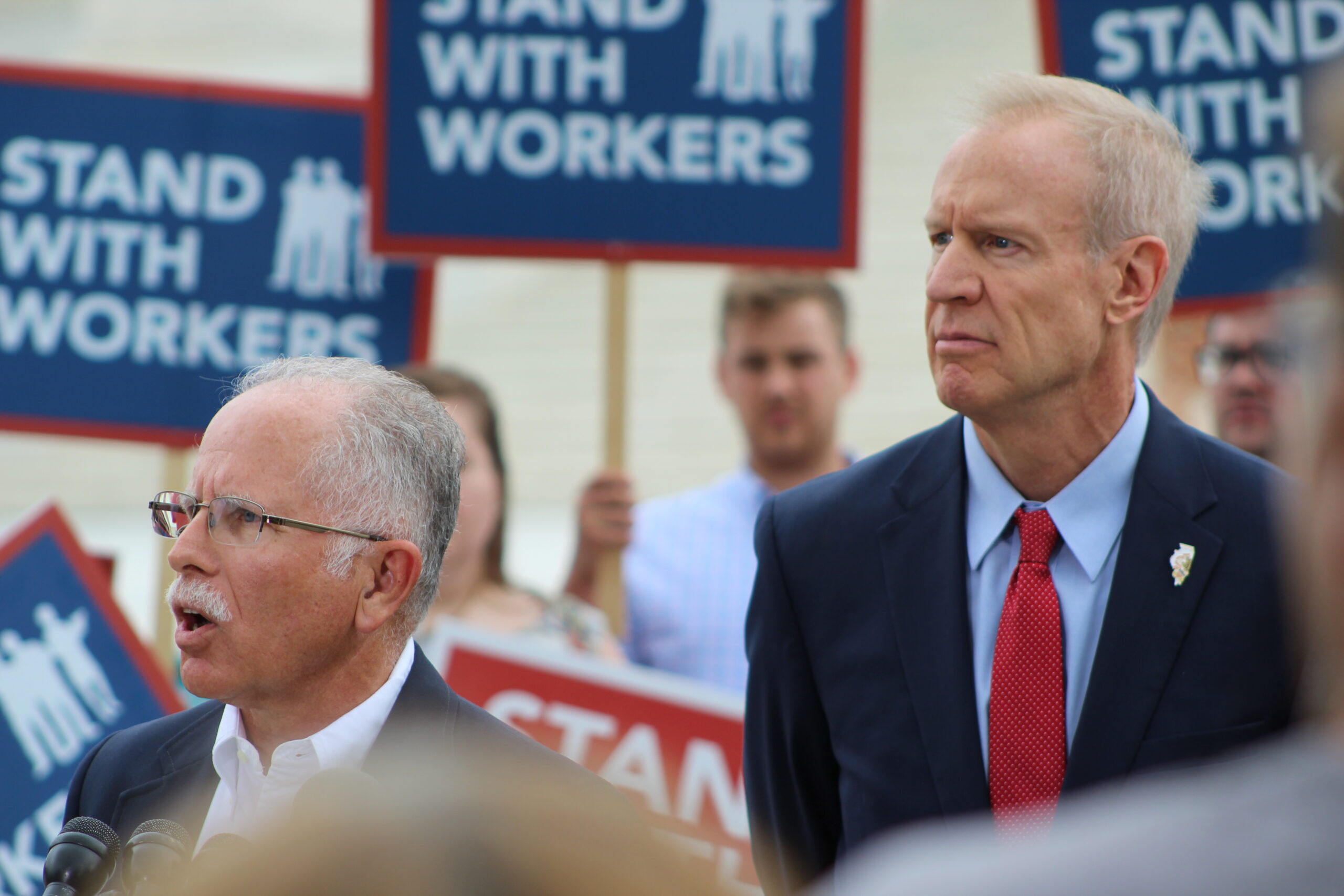
Foundation attorneys aided Illinois public employee Mark Janus with former Illinois Governor Bruce Rauner (right) in his landmark First Amendment victory. But Foundation attorneys often must fight to enforce Janus rights, as in Chris Logan’s case.
CHICAGO, IL – The National Right to Work Foundation’s landmark Supreme Court victory in Janus v. AFSCME was a milestone for public sector workers. For the first time, the Court recognized that every American public sector worker had the constitutional right to cut off dues to a union they oppose.
Even with this important First Amendment protection, however, union bosses unfortunately still wield an enormous amount of power over workers who have ended their affiliation with the union. Because of laws that authorize monopoly union “representation” in the public sector, union officials still have significant control over independent-minded employees’ working conditions, pay, benefits, and more.
City of Chicago aviation security officer Chris Logan discovered just how painful Illinois Council of Police (ICOP) union bosses could make life for him after he exercised his Janus rights. In 2020, following a dispute about his job performance, Logan took action to protect his job under the terms of his employment contract, only to have union bosses exploit the opportunity to attack Logan. The union would not allow Logan to file a grievance to protect his job unless he joined the union.
Officer Challenges Discriminatory Grievance Scheme with Foundation Aid
“ICOP union officials basically tried to force me to join and pay dues to the union by making it impossible for me to defend my job otherwise,” commented Logan. “I exercised my Janus rights and left the union because I didn’t think that ICOP officials were good ‘representatives’ of me or my coworkers.”
“Instead of trying to win back my support voluntarily, union bosses used their power to deprive me of all options when I tried to defend my job — I couldn’t even file or arbitrate a grievance myself,” Logan added. “In my mind, that simply confirms I made the right decision when I left this union.”
However, with free legal representation from National Right to Work Legal Defense Foundation staff attorneys, Logan won a decision from the Illinois Labor Relations Board (ILRB) in late 2022 that decisively declared ICOP officials’ “members only” grievance scheme illegally discriminatory against non-members.
Logan first exercised his Janus rights in October 2019, telling the union by letter that he no longer wished to pay union dues. Throughout 2020, Logan faced allegations about his job — possibly instigated by union militants. Per the union monopoly agreement he was subjected to, he tried to get union officials to fulfill their role, as monopoly “representatives” of the workplace, to file grievances challenging the City of Chicago’s disciplinary actions against him.
Union officials who maintain “monopoly bargaining power” in a workplace can legally impose their control over every worker, even those who have disaffiliated with the union. Because of this privilege, however, they are also legally obligated not to discriminate against non-members when it comes to grievances or other matters. However, as Logan discovered, union officials regularly ignore this “duty of fair representation.”
Union Officials Completely Ignored ‘Fair Representation’ Legal Obligation
ICOP union officials summarily rejected all of Logan’s requests to file grievances, and even told him that he could not file grievances himself. At one point, after an ICOP union official sent Logan an email falsely claiming the union had no legal obligation to participate because Logan had exercised his Janus rights, the ICOP lawyer chimed in to tell Logan, “I concur. Good luck.” The union stated it would not file grievances for Logan simply because he was a non-member.
Logan filed unfair labor practice charges against ICOP and the City of Chicago in August 2020, maintaining that the union’s actions were illegal. An ILRB Administrative Law Judge agreed with Logan’s charges in May 2022, declaring that ICOP “violated [Illinois labor law] when its agents restrained or coerced the Charging Party in the exercise of rights . . . by threatening to deny the Charging Party equal representation in the disciplinary and grievance matters.” The ILRB later adopted this ruling, leading to Logan’s Foundation-won victory when union officials did not attempt to appeal the decision to Illinois state court.
Monopoly Bargaining Powers Open Door to Corruption
“Union bosses maintain unilateral control over workers under a ‘monopoly bargaining’ regime,” commented National Right to Work Foundation Vice President and Legal Director Raymond LaJeunesse. “For public sector workers across the country, Janus is the only check they can use against this power, and even then they could face retaliation for doing so.”
“Cases like Mr. Logan’s, where union bosses used their bargaining powers to discriminate against a worker who exercised Janus rights, ought to make our elected leaders reconsider how much privilege our laws grant unions,” LaJeunesse added.
Foundation Assists Workers in Kicking Out Unwanted Union Bosses
The following article is from the National Right to Work Legal Defense Foundation’s bi-monthly Foundation Action Newsletter, September/October 2021 edition. To view other editions of Foundation Action or to sign up for a free subscription, click here.
Worker decertification efforts target SEIU, Teamsters union officials
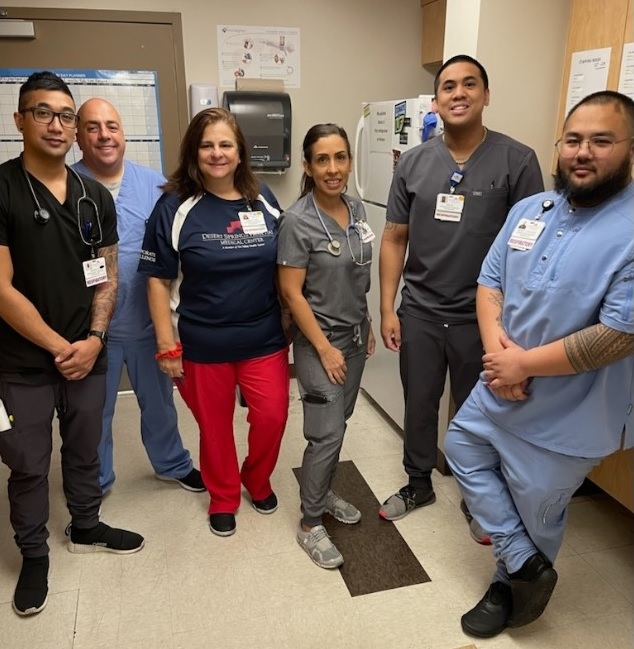
Desert Springs “Decert”: Tammy Tarantino (third from left) and her fellow healthcare workers at Desert Springs Medical Center booted SEIU union bosses from their workplace with Foundation aid, voting by a 3-1 margin for decertification.
CHICAGO, IL – Workers in three different states recently waged successful campaigns to remove the union bosses who controlled their workplaces. In each instance workers utilized free legal assistance from National Right to Work Legal Defense Foundation staff attorneys to navigate the overly-complicated process for getting a vote to remove an unwanted union.
The National Labor Relations Act (NLRA) — which is enforced by the National Labor Relations Board (NLRB) — gives workers the right to hold a decertification vote to end union officials’ monopoly bargaining power over workers. In theory, under the NLRA, workers who collect signatures from 30 percent of a workplace can hold a decertification vote at any time, provided there has not been a unionization vote there in the previous 12 months.
However, because of complicated NLRB doctrines compounded by union legal tactics, obtaining a vote to decertify a union can often be a challenge. That’s why workers in workplaces across the country turn to the Foundation for free legal aid as they seek to hold such a vote.
Workers’ ability to exercise their right to vote out an unwanted union is especially important in states without Right to Work protections, where union bosses can use their monopoly bargaining powers to force every worker to pay union dues or fees or else be fired.
But workers’ right to decertify a union is still critical in Right to Work states, because even without forced union payments, federal law gives union bosses the power to impose their so-called “representation” and resulting union monopoly contracts on members and non-members alike at unionized workplaces. Only once a union is decertified are workers free to represent themselves and communicate with their employer directly.
Foundation Helps Workers Navigate Tricky Legal Process
Highlighting recent activity, three separate workplaces have waged successful decertification efforts.
Petitioner Tim Mangia led the charge at Chicago’s Rush University Medical Center, where he and his fellow maintenance workers voted to remove Teamsters union bosses by a better than 3-1 margin. Separately, in Del Rio and Eagle Pass, Texas, salesmen for Frito-Lay also voted to free themselves from unwanted Teamsters union “representation” following free assistance from Foundation legal staff.
Meanwhile, Tammy Tarantino and her fellow technical employees at the Desert Springs Hospital Medical Center in Las Vegas successfully removed a Service Employees International Union (SEIU) local from their workplace with Foundation help.
Reforms: Union Bosses Can’t Use Bogus Charges to Block Decertification Elections
These cases proceeded without significant delays from union “blocking charges,” the often spurious charges against employers filed by union lawyers seeking to delay a decertification vote. Under old NLRB rules, such charges would have to be resolved before workers’ decertification votes could proceed, delaying the vote for months or even years.
Thanks to NLRB rulemaking advocated by the Foundation and backed by thousands of Foundation supporters, votes now virtually always proceed first with the results quickly announced, so that elections cannot be delayed nearly indefinitely by unsubstantiated union boss claims.
In the Las Vegas medical workers’ case, the new “blocking charge” rules allowed Tammy Tarantino continued from page 2 to have a vote, despite attempts by union lawyers to use charges against the hospital to delay the election. Without being able to rely on the “blocking charge” policy to maintain their power over the workplace, SEIU officials soon found themselves voted out with just 13 of 64 eligible voters voting for the union.
“While we look forward to the day when every individual worker has the freedom to decide whether to pay union dues or be represented by a union, it is especially egregious when union bosses are in power without even the support of a bare majority of rank-and-file workers,” said National Right to Work Foundation Vice President Patrick Semmens. “The National Right to Work Foundation is proud to help workers exercise their right to throw off the yoke of unwanted union so-called ‘representation.’”
Foundation Asks Supreme Court to Hear Janus Case Again, Seeking Return of Forced Fees
The following article is from the National Right to Work Legal Defense Foundation’s bi-monthly Foundation Action Newsletter, May/June 2020 edition. To view other editions or to sign up for a free subscription, click here.
Case could set precedent for hundreds of millions of dollars in refunds to Big Labor’s victims
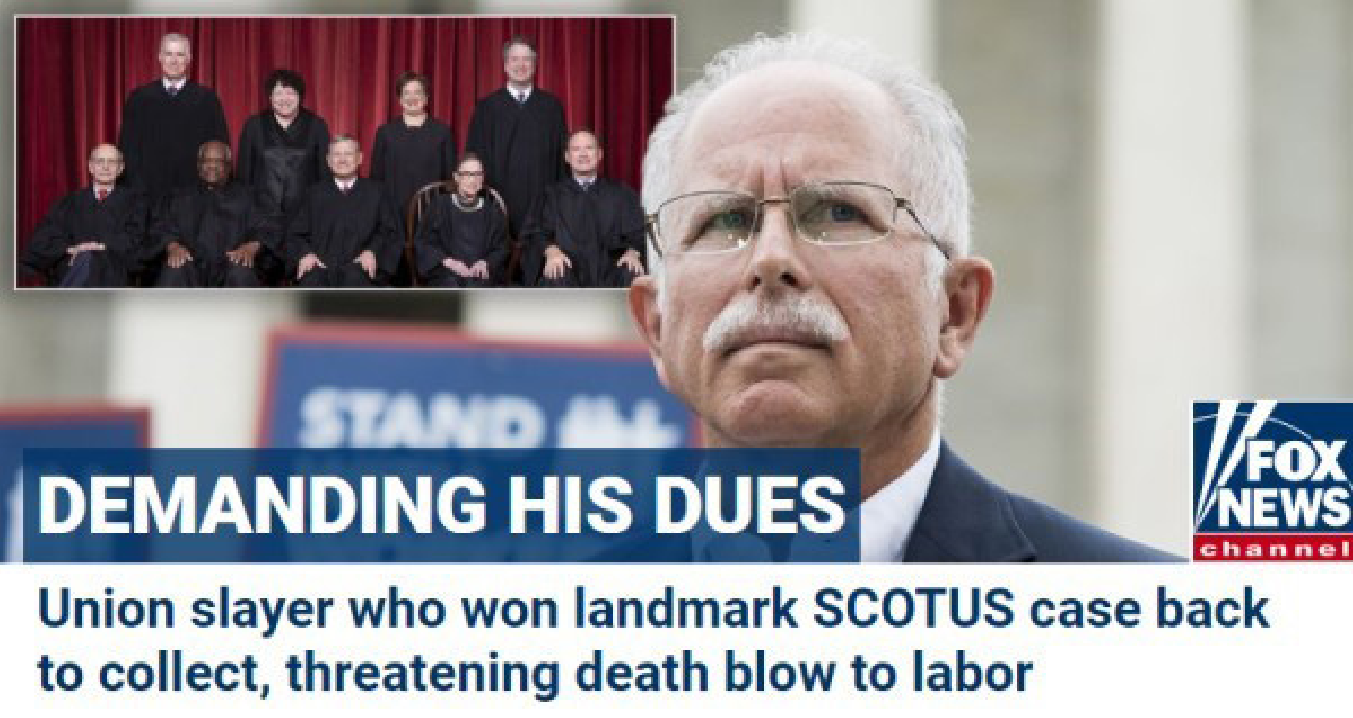
Mark Janus’ second Foundation-backed appeal to the Supreme Court landed the top spot on Fox News’ website. If Janus prevails again, hundreds of millions of dollars in unconstitutional union dues could be returned to public sector employees.
WASHINGTON, DC – Mark Janus is returning to the U.S. Supreme Court, this time asking the Justices to hear the continuation of Janus v. American Federation of State, County, and Municipal Employees (AFSCME), Council 31. Janus seeks repayment of the thousands of dollars in fees the union took from his paycheck in violation of his First Amendment rights. Another Supreme Court victory for Janus could set a precedent resulting in the return of hundreds of millions of dollars seized by union officials in violation of workers’ constitutional rights.
The original Janus v. AFSCME was argued successfully before the Supreme Court by veteran National Right to Work Foundation staff attorney William Messenger. In a landmark victory, the Court sided with Janus on June 27, 2018, and declared it illegal to force public employees to subsidize a union as a condition of employment. The Court recognized that compelling public workers to pay fees to a union violates their First Amendment rights.
Illinois Child Support Public Servant Intervenes in Lawsuit with Foundation Aid
As a result of Janus, more than five million public sector employees across the country are no longer required to pay union dues or fees to keep their jobs. However, Janus’ case continues as he seeks the return of the fees that AFSCME seized from his paycheck without his permission from June 27, 2018, to March 23, 2013, representing the two-year statute of limitations from the date his case started in March 2015 through the Supreme Court’s 2018 decision in his favor.
The Janus case began in February 2015, when then-newly elected Illinois Governor Bruce Rauner issued an executive order prohibiting state agencies from requiring employees who had abstained from formal union membership to pay union fees, based on a Right to Work Foundation U.S. Supreme Court victory in 2014 in another Illinois case. Rauner also filed a federal lawsuit seeking a declaratory judgment that forced union fees violate the First Amendment rights of public workers.
Staff attorneys from the Foundation, in partnership with the Illinois-based Liberty Justice Center, filed a motion for Mark Janus and two other plaintiffs to intervene in the case in March 2015, and have represented Janus ever since. The U.S. District Court for the Northern District of Illinois granted Janus’ motion to file a complaint in intervention, which allowed the suit to move forward even after the court ruled that Rauner lacked standing to pursue the lawsuit.
The Supreme Court permitted union bosses to impose forced union fees on public workers in the 1977 Abood v. Detroit Board of Education decision. However, before the Janus victory, Foundation staff attorneys secured several victories for workers which called the constitutionality of forced fees into question. In 2012, the court ruled in Knox v. SEIU that union officials must obtain affirmative consent from workers before using workers’ forced union fees for special assessments or risk infringing on their First Amendment rights. In 2014, the court ruled in Harris v. Quinn that requiring home healthcare providers who receive a subsidy from the government to pay union dues is a First Amendment violation.
Following Janus’ groundbreaking win at the Supreme Court in June 2018, Foundation attorneys continued his case in Illinois federal courts, arguing that the Supreme Court’s ruling is retroactive and that AFSCME should be required to return dues they seized unconstitutionally before the decision. In this and similar cases, union bosses have made a so-called “good faith” argument to defend their seizing of dues before Janus was issued. The U.S. Seventh Circuit Court of Appeals in Chicago ruled in 2019 that AFSCME could keep the unconstitutional dues, prompting Janus’ petition to the Supreme Court.
Hundreds of Millions of Dollars Potentially At Stake
“The Supreme Court agreed that the union taking money from non-members was wrong but the union still has the money it illegally garnished from my paycheck,” commented Janus. “It’s time for AFSCME to give me back the money they wrongfully took.”
Foundation staff attorneys are currently fighting for thousands of workers in about 20 cases which seek refunds of dues seized unconstitutionally before Janus was decided. While Janus is seeking the return of $3,000 of his own money, a favorable decision for him would set a precedent that could result in the return of over $120 million to public servants just in Foundation-backed cases. Other cases brought by workers could bring that total to hundreds of millions of dollars.
Workers Already Winning Refunds of Illegal Dues with Foundation Legal Aid
“The Supreme Court has already sided with the Foundation arguments for Mark Janus and ruled that forcing public employees to fund union activities violates the First Amendment,” said National Right to Work Foundation Vice President and Legal Director Raymond LaJeunesse. “The Supreme Court should take this case again to ensure that public sector union bosses are not permitted to profit from their widespread violation of workers’ First Amendment rights.”
Foundation staff attorneys in July 2018 secured the nation’s first-ever refund of dues seized unconstitutionally before Janus for Debora Nearman, an Oregon state wildlife employee. SEIU bosses were forced to settle and give back to Nearman over $3,000 in illegal fees they had seized from her over two years, during which they had sponsored an aggressive political campaign against her own husband, who ran successfully for the Oregon Legislature in 2016.
Final Briefs Filed at Appeals Court in Continuation of Janus v. AFSCME
The following article is from the National Right to Work Legal Defense Foundation’s bi-monthly Foundation Action Newsletter, September/October 2019 edition. To view other editions or to sign up for a free subscription, click here.
Foundation seeks first-in-nation appellate court ruling to order non-member dues refunded
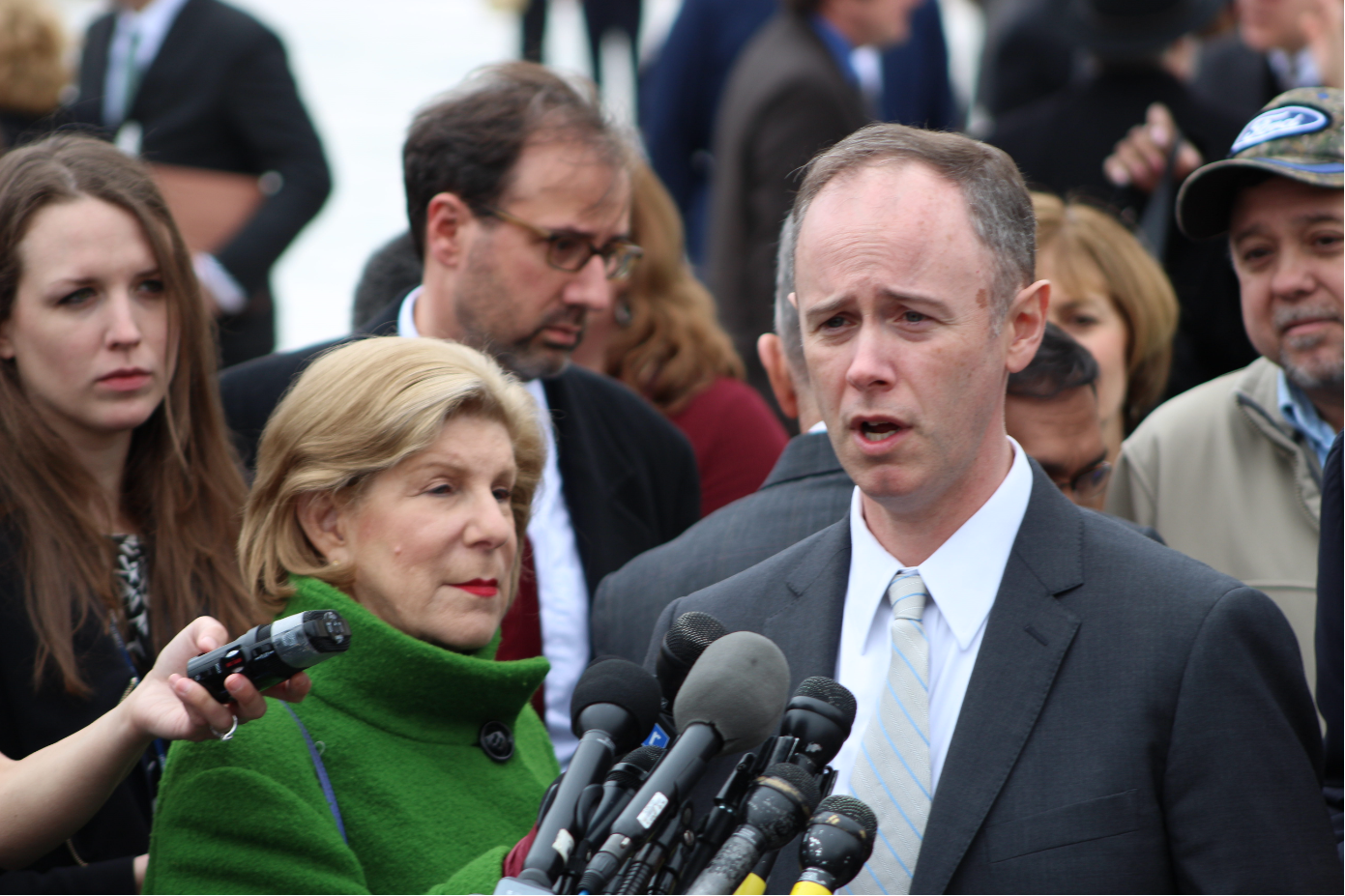
Veteran Foundation staff attorney William Messenger, seen here speaking to reporters after Supreme Court oral arguments in Janus, leads the Foundation’s Janus enforcement task force.
CHICAGO, IL – Although Janus v. AFSCME secured a landmark victory at the U.S. Supreme Court for government employees’ First Amendment rights, Mark Janus’ case is not over because AFSCME union bosses have refused to return the funds taken from him in violation of the First Amendment.
Janus’ attorneys from National Right to Work Foundation and Illinois-based Liberty Justice Center have completed briefing with the Seventh Circuit Court of Appeals on the issue of whether union officials can keep money they seized from non-members in violation of their constitutional rights. The case is likely to mark the first time an appellate court will rule on the issue, potentially establishing a precedent that could result in the return of hundreds of millions of dollars seized by union bosses in violation of the Janus precedent.
Janus Secured Workers’ First Amendment Rights
Mark Janus was an Illinois child support specialist whose case was successfully argued at the Supreme Court by National Right to Work Foundation staff attorney William Messenger.
The Supreme Court’s June 27, 2018, decision in Janus’ favor found that any union fees taken from workers like Mark Janus – who was not a member of AFSCME – without the workers’ affirmative and knowing consent violate the First Amendment. Justice Samuel Alito wrote for the majority that compulsory fees “[violate] the free speech rights of non-members by compelling them to subsidize private speech on matters of substantial public concern.”
The Supreme Court sent the case back to the lower courts to determine, among other things, whether Janus is entitled to all the union fees he was forced to pay since March 23, 2013.
Janus’ appeal comes after a district court judge ruled that union officials are not required to refund forced fees seized from non-member workers prior to the Janus decision.
“Just like a thief would not be allowed to keep the money he stole, union bosses must be forced to return funds unlawfully seized from workers,” said National Right to Work Foundation Vice President and Legal Director Ray LaJeunesse. “It would be a massive injustice to deny workers victimized by Big Labor the refunds to which the Supreme Court made clear they are entitled.”
Seventh Circuit Likely First Appeals Court to Rule on Non-member Refunds
Janus will likely be the first case in which an appellate court will evaluate the so-called “good faith” defense that union lawyers have asserted in response to worker lawsuits seeking refunds, arguing that union officials should be allowed to keep funds seized prior to the Janus decision.
This contention has generally succeeded in lower courts despite the Supreme Court asserting that union bosses have been “on notice” for years that mandatory fees likely would not comply with the heightened level of First Amendment scrutiny articulated in the Supreme Court’s earlier Knox v. SEIU decision, also won by Foundation staff attorneys.
Mark Janus is asking the Seventh Circuit to rule that he is entitled to refunds of approximately $3,000 in fees he was forced to pay since March 23, 2013, as the statute of limitations permits. In addition, the case has significant implications for dozens of other cases being litigated around the country for hundreds of thousands of other workers seeking the return of forced fees seized unlawfully by union officials.
Janus Refund Efforts Continue Nationwide
Foundation staff attorneys are currently litigating over a dozen such cases that collectively seek over $120 million in refunds for non-members forced to pay union fees before Janus. Other ongoing lawsuits and potential cases could result in half a billion dollars or more returned to government workers from union treasuries.
“The Janus case is a milestone of worker freedom, but union bosses continue to block workers from exercising their rights and deny workers refunds for dues and fees seized against their wishes,” said LaJeunesse. “We hope the Seventh Circuit Court of Appeals will follow the clear logic of the Supreme Court’s decision in Janus and establish that union bosses cannot profit from violating workers’ First Amendment rights.”
Illinois Care Providers Ask Supreme Court to Take Case Challenging Forced Union ‘Representation’ Law
Home and Childcare Providers ask the court to strike down unwanted ‘representation’ as a violation of the First Amendment
Washington, D.C. (June 6, 2017) – With free legal assistance from National Right to Work Legal Defense Foundation and the Illinois-based Liberty Justice Center staff attorneys, six personal care and child care providers today petitioned the Supreme Court to strike down a compulsory unionism scheme that grants Service Employees International Union (SEIU) officials exclusive monopoly “bargaining” powers with state government for thousands of Illinois caregivers – including many who never joined the union and oppose the union’s so-called ‘representation.’
In the brief, Foundation staff attorneys contend that the state law infringes on the providers’ First Amendment rights by forcing them to associate with a union they do not wish to join or support. Granting the union exclusive power to deal with the State of Illinois over caregiving practices violates the caregivers’ right to choose with whom they associate to petition their own government.
The caregiver’s petition to the Supreme Court in Hill, follows the Right to Work Foundation’s landmark 2014 Supreme Court victory in Harris v. Quinn, which was also filed on behalf of several home-based Illinois care providers. That decision prohibited union officials from collecting mandatory dues or fees from home-based caregivers.
The Hill petition argues that although the Harris case dealt with compelled fees, because the Court ruled that the state’s justification for mandatory fees was insufficient under the First Amendment, the Supreme Court should strike down the compelled association on the same grounds. The petition asks the Court to take the case so that it can apply the same standard to the First Amendment infringements created when state law forces home care providers to accept a government-appointed monopoly union agent against their will. Foundation staff attorneys have also helped home and childcare providers challenge similar schemes in Massachusetts, Minnesota, New York, Oregon, and Washington State.
“It is outrageous that across the country state laws force home and child care providers to accept unwanted ‘representation’ from a union they have no interest in joining or supporting,” commented Foundation President Mark Mix. “This is a clear violation of providers’ freedom of association and we are hopeful that this case will build on the Foundation’s landmark 2014 victory in Harris v. Quinn and end these corrupt forced unionism schemes for good.”
Appeals Court to Hear Illinois Homecare Providers’ Case Seeking More Than $32 Million in Illegally Seized Union Dues
Despite Supreme Court ruling that the SEIU’s dues scheme was illegal, union officials refuse to refund workers’ money
Chicago, IL (May 17, 2017) – Today, National Right to Work Legal Defense Foundation staff attorney Bill Messenger will argue before the U.S. Court of Appeals for the Seventh Circuit on behalf of Illinois homecare personal assistants in Riffey v. SEIU. The case attempts to win back more than thirty-two million dollars in forced dues illegally seized by a Service Employees International Union (SEIU) scheme that the U.S. Supreme Court deemed unconstitutional in the 2014 Foundation-won Harris v. Quinn decision.
The case stems from an executive order issued by former Governor Rob Blagojevich that classified as “public employees” more than 20,000 individuals who provide in-home care to disabled persons receiving state subsidies” which meant that the providers could be unionized. As a result, these in-home care givers, many of them parents caring for their own children, were targets of coercive “card-check” union organizing drives.
Staff attorneys with the National Right to Work Foundation assisted eight of these providers in filing a federal lawsuit challenging the scheme and eventually in petitioning the Supreme Court to hear the case. The High Court took the case and, on June 30, 2014, it Court ruled that SEIU’s forced dues scheme imposed by Governor Blagojevich is unconstitutional because it violates the First Amendment rights of the in-home care providers.
“If we accepted Illinois’ argument” that homecare workers can be forced to pay union dues, wrote Justice Samuel A. Alito Jr. in the majority opinion, “we would approve an unprecedented violation of the bedrock principle that, except perhaps in the rarest of circumstances, no person in this country may be compelled to subsidize speech by a third party that he or she does not wish to support.”
After the Supreme Court’s June 2014 ruling in Harris – now designated Riffey v. SEIU – the case was remanded to the District Court to settle the remaining issues, including whether SIEU would be required to return more than $32 million in dues confiscated from nonmembers through its unconstitutional scheme.
In June 2016, the District Court ruled that SEIU did not have to repay these funds. That decision was immediately appealed to the Seventh Circuit Court of Appeals where Foundation staff attorney Bill Messenger will appear today.
“If SEIU union bosses are allowed to keep the millions in unconstitutionally seized dues it would be outrageous and a perversion of justice,” commented National Right to Work Foundation President Mark Mix. “These homecare providers should not have to jump through all these hoops just to get the money that is rightfully theirs after the Supreme Court ruled the dues seizures unconstitutional.”
Chicago Utility Employee Files Unfair Labor Practice Charges Against Union Officials for Illegal Dues Seizures
Union officials failed to follow Supreme Court precedent providing for disclosure to workers of how forced dues are spent
Chicago, IL (May 3, 2017) – A Chicago worker, assisted by National Right to Work Legal Defense Foundation staff attorneys, has filed federal charges against the Utility Workers Union of America (UWUA) and UWUA Local 18007. The charges were filed with the National Labor Relations Board (NLRB) Region 13 office in Chicago.
Gerald Howard is employed by Peoples Gas in Chicago, Illinois. UWUA Local 18007 has a monopoly bargaining contract in place with Peoples Gas that includes a requirement that workers can be fired for refusing to pay dues or fees to the union. Under federal law, no worker can be forced to formally join a union.
However, because Illinois is not a Right to Work state, workers can be forced to pay union dues or fees as a condition of employment. Under the National Right to Work Foundation-won Supreme Court case Communication Workers v. Beck, nonmember workers cannot be legally compelled to pay union dues used for union politics and member-only activities. Workers can also demand a breakdown of the dues and fees paid to see which fees are used for which purpose.
In a letter sent to UWUA Local 18007 on February 18, Howard formally resigned his membership in the UWUA and objected to paying full dues, as is his right under the Beck precedent, but UWUA Local 18007 union officials failed to acknowledge his resignation. A month later on March 15, Howard sent another letter, this time to officials at the UWUA International headquarters in Washington, DC.
In a letter dated April 3, Washington-based UWUA officials finally acknowledged Howard’s resignation and objection to paying full dues as of his February 18 letter. The UWUA official’s letter also claimed that Howard would be required to pay 90% of full union dues, but did not provide explanation for how it arrived at that figure.
To date the UWUA has still failed to provide Howard with the legally required breakdown to justify that non-chargeable activities like union political and lobbying activities only make up ten percent of full dues. Absent those disclosures – as required by the Supreme Court in Beck – union officials cannot legally require Howard to pay any fees, but continue to do so anyway.
“UWUA union bosses are ignoring clear Supreme Court precedent and violating the rights of a worker they claim to ‘represent’ in their grab for forced union dues,” said Mark Mix, president of the National Right to Work Foundation. “This type of disregard for the rights of rank-and-file workers highlights why Illinois desperately needs a Right to Work law making union affiliation and dues payments strictly voluntary.”
Twenty-eight states have Right to Work protections for employees. Public polling shows that nearly 80 percent of Americans and union members support the Right to Work principle of voluntary unionism.
Illinois Grocery Workers Appeal Decision Blocking Vote to Remove Union Despite Unanimous Opposition to UFCW Union
NLRB asked to review Regional Director’s refusal to process decertification petition signed by workers who unanimously want union ousted
Winnetka, IL (April 14, 2017) – With free legal assistance from National Right to Work Foundation staff attorneys, a Chicago area worker has asked the National Labor Relations Board (NLRB) to review a case in which she and her co-workers were denied the right to decertify a union claiming to represent them, despite the fact that every employee in the bargaining unit signed a petition to remove union representation.
The worker, Maureen Madden, is employed at Lakeside Foods. On March 2, 2017 she filed a petition to decertify the United Food and Commercial Workers Local 1456 (UFCW). Under the National Labor Relations Act (NLRA), if a decertification petition garners signatures from 30% or more of the employees in a bargaining unit, the NLRB will conduct a secret-ballot election to determine whether a majority of the employees wish to decertify the union. Every single employee in Madden’s bargaining unit signed the petition in support of removing the union.
Even though the decertification petition had one-hundred percent employee support, the NLRB regional director refused to honor it, citing the so-called “successor bar.” The “successor bar” stems from a 2011 NLRB decision that strips away the rights of employees to decertify a union if a new employer has taken over a bargaining unit.
Although a “successor bar” does not appear anywhere in the NLRA, and the Act’s stated purpose is to give employees a choice in their representative, including declining union representation, the NLRB Region used this doctrine as its justification to keep employees under union control for up to three additional years. Furthermore, because Madden and her co-workers work in Illinois, a state that does not provide Right to Work protections, the NLRB Regional Director’s decision allows UFCW to continue collecting forced fees from the employees as a condition of employment.
Madden’s petition points out that so-called “successor bars” are in conflict with decisions of the Sixth and Seventh Circuits and the Supreme Court, all of which hold that a union’s presumption of majority support can be overcome by proof that a majority of employees do not support the union, as has happened in this case.
“It is absolutely outrageous that this NLRB Regional Director dismissed a petition filed by a worker with every single one of her co-workers supporting it,” commented Mark Mix, President of the National Right to Work Foundation. “Far from being a neutral arbitrator as the NLRB claims to be, the NLRB Regional Director is actively allowing UFCW to continue to collect forced fees from workers although one-hundred percent object to the union and its so called ‘representation.’ This case highlights why Illinois workers need the protections that Right to Work provides.”
Worker Advocate Files Brief with Seventh Circuit Court of Appeals in Defense of Wisconsin Right to Work Law
National Right to Work Foundation brief responds to Big Labor attempt to overturn longstanding Right to Work protections against forced union fees
Chicago, IL (March 21, 2017) – National Right to Work Legal Defense Foundation staff attorneys have filed a legal brief for six Wisconsin workers with the Seventh Circuit Court of Appeals in defense of Wisconsin’s Right to Work law. The brief was filed after union lawyers appealed a district court judge’s decision to dismiss a challenge by union officials to Wisconsin’s Right to Work law.
Union officials have asked that the lawsuit be heard before an en banc panel of Seventh Circuit Court of Appeals judges because a three judge panel on the same appeals court previously upheld Right to Work laws as constitutional in 2015 in a similar union boss challenge to Indiana’s Right to Work law. The attempt to have this en banc hearing is part of a nation-wide strategy by union officials to have Right to Work protections for workers struck down.
Union lawyers are claiming that Right to Work laws, which simply allow an individual to work without being forced to pay dues or fees to a union boss, should be overturned. First, union lawyers claim that they are constitutionally entitled to a portion of each worker’s paycheck. Second, union lawyers argue that despite decades of precedents to the contrary, section 14 (b) of the Taft-Hartley Act, which gives individual states the ability to pass Right to Work laws, was never intended to allow workers to stop paying union fees and should be completely reinterpreted.
Foundation staff attorneys argue in the workers’ brief that union bosses do not have a ‘constitutional right’ to a worker’s paycheck and that Section 14 (b) of the Taft-Hartley Act has been correctly interpreted for the past 70 years to allow states to pass Right to Work laws that prohibit any requirement that workers pay union fees as a condition of their employment. The brief further argues, to the extent that U.S. labor laws create a “taking” it is union bosses using the forced unionism provisions in federal law to seize mandatory union fees from workers without Right to Work protections.
Additionally, Foundation staff attorneys point out that the National Labor Relations Act compensates unions by granting them immense workplace power to impose one-size-fits-all union contracts on all employees – union and nonunion alike – in union-controlled bargaining units.
Right to Work laws have withstood intense legal scrutiny for over 60 years, having never been struck down by a federal court or state appellate court. Foundation staff attorneys have also defended newly-enacted Right to Work laws in Indiana, Michigan, Wisconsin, and West Virginia from various union legal challenges.
National Right to Work Foundation President Mark Mix commented, “It is outrageous that union officials are once again advancing this dubious legal theory that Right to Work protections that give workers choice over handing over a portion of their paycheck to a union somehow constitute an ‘illegal taking’ of union resources. Workers in non-Right to Work states are the ones having something taken from them. The Seventh Circuit should uphold Right to Work as constitutional as it did in 2015 and toss out this legal challenge.”





