
Cornell Ph.D. Student’s Appeal to NLRB’s Top Prosecutor Urges Agency to End Union Control Over Graduate Students
Case attacks Obama-era federal ruling that exposed graduate students to union boss power and forced dues
Ithaca, NY (February 18, 2026) – Russell Burgett, a Ph.D. candidate in chemistry and chemical biology at Cornell University, is asking newly-seated National Labor Relations Board (NLRB) General Counsel Crystal Carey to issue a complaint and ask the NLRB to free graduate students across the country from being forced to fund and associate with union bosses.
Burgett filed an Appeal to the General Counsel on February 10, with free legal aid from National Right to Work Foundation staff attorneys. In his filing, Burgett presses the General Counsel to have the NLRB reconsider the disastrous 2016 Columbia University decision, a controversial Obama-era ruling that classified graduate students as “employees” subject to the National Labor Relations Act (NLRA). Under Columbia University, union bosses are permitted to gain one-size-fits-all exclusive “representation” powers over graduate students at private universities.
“A graduate student’s primary relationship with his or her school is as a customer of that school’s educational instruction and services, not as a statutory employee,” reads Burgett’s Appeal. “[U]niversities forcing graduate students to pay union dues to act as teaching and research assistants interferes with their ability to complete their course of studies and earn their degrees. Here, the [union contract] effectively makes financially supporting [the union] a condition of receiving a Cornell graduate degree.”
Burgett, who is not a member of the Cornell Graduate Student Union (CGSU-UE, an affiliate of United Electrical), opposes the radical ideology and agitation of CGSU agents on campus. Because New York, where Cornell is located, is not a Right to Work state, CGSU bosses can legally force students (mischaracterized as “employees”) to pay money to the union to complete their graduate programs.
Adding insult to injury, CGSU union officials rejected Burgett’s request to opt-out of paying the portion of dues that goes toward the union’s politics, which is a right guaranteed to workers under the Foundation-won CWA v. Beck Supreme Court decision. CGSU union bosses speciously claimed that Beck objections could only be submitted during a narrow, union-concocted “window period” of 30 days per year.
NLRB Must Reexamine Union Powers Over Students, Including Forced-Dues Mandates
Burgett’s Appeal asks the NLRB General Counsel to prosecute CGSU union officials and Cornell management on the grounds that the union contract is blocking the university from doing business with students who abstain from union membership or union financial support. Union agreements that require an entity to cease doing business with those who refuse union association blatantly violate the NLRA.
The Appeal’s argument hinges on the Board reaffirming that students have a “business and academic” relationship with their universities and are not “employees” was wrongly held in Columbia University.
In addition to his primary argument, Burgett’s Appeal contends that the NLRB should prosecute CGSU union officials for arbitrarily limiting when students can exercise their Beck right to opt out of funding union politics.
“It is unconscionable that current NLRB case law allows union officials, like those from CGSU-UE, to upend the academic careers of students who refuse to associate with them,” commented National Right to Work Foundation President Mark Mix. “Union bosses’ one-size-fits-all bargaining schemes have no place in the world of academia, where freedom of thought and association should be paramount.
“We’re proud to stand behind Mr. Burgett, and urge the Board to affirm the commonsense idea that graduate students are students and were never intended to be subjected to the NLRB’s forced unionism regime,” Mix added.
Cornell University Graduate Student Files Federal Charges Seeking End to Union Boss Control Over Graduate Students
Student case attacks Obama-era federal labor board ruling that exposed graduate students to union boss power
Ithaca, NY (July 14, 2025) – Russell Burgett, a Ph.D. candidate in chemical physics at Cornell University, has just launched a groundbreaking federal labor case challenging the Cornell Graduate Student Union’s (an affiliate of United Electrical) authority to maintain exclusive representation powers over him and his fellow graduate students.
Burgett, who opposes the union and is not a member, filed his charges at the National Labor Relations Board (NLRB) with free legal aid from National Right to Work Foundation staff attorneys.
The NLRB is the federal agency responsible for enforcing private sector labor law. Burgett’s case is a direct challenge to the Obama NLRB’s 2016 Columbia University ruling, which overturned longstanding precedent and permitted union bosses to gain monopoly bargaining powers over graduate students at private universities like MIT, Columbia, and Cornell.
While union monopoly bargaining schemes in academia were already controversial at the time of the Columbia University ruling, student opposition to the policy has spiked in recent years as union officials have pursued increasingly radical and divisive ideological activities on campuses.
Charges: NLRB Must Reexamine Union Powers Over Students, Including Forced-Dues Mandates
Burgett’s charges assert that Cornell graduate students are not “employees” under the National Labor Relations Act. For that reason, the charges say, CGSU-UE union officials’ attempts to force them to abide by a union contract – including provisions that effectively mandate the students pay union dues or fees to complete essential parts of their graduate programs – violate federal labor law.
Furthermore, Burgett’s charges contend the union contract is illegal because it forbids the university from doing business with students who abstain from union membership or union financial support. Union agreements that require an entity to cease doing business with persons who refuse to associate with the union are a clear violation of the National Labor Relations Act.
“Mr. Burgett’s case is the latest chapter in a continuing saga showing why union bosses’ one-size-fits-all bargaining schemes have no place in academia,” commented National Right to Work Foundation President Mark Mix. “At America’s elite universities, union bosses empowered by the Obama and Biden NLRBs are coercing dissenting students into funding their political radicalism and constant agitation – including Jewish students who have sincere religious objections to the anti-Israel vitriol that campus unions push.
“Forcing students to choose between completing their graduate degrees or affiliating with an ideological group they find unconscionable is antithetical to principles of academic freedom, and Mr. Burgett’s case directly attacks the Obama NLRB’s and Biden NLRB’s flawed rulings allowing such coercion to happen in the first place,” Mix added.
Full Foundation Action November/December 2024 Newsletter Now Online
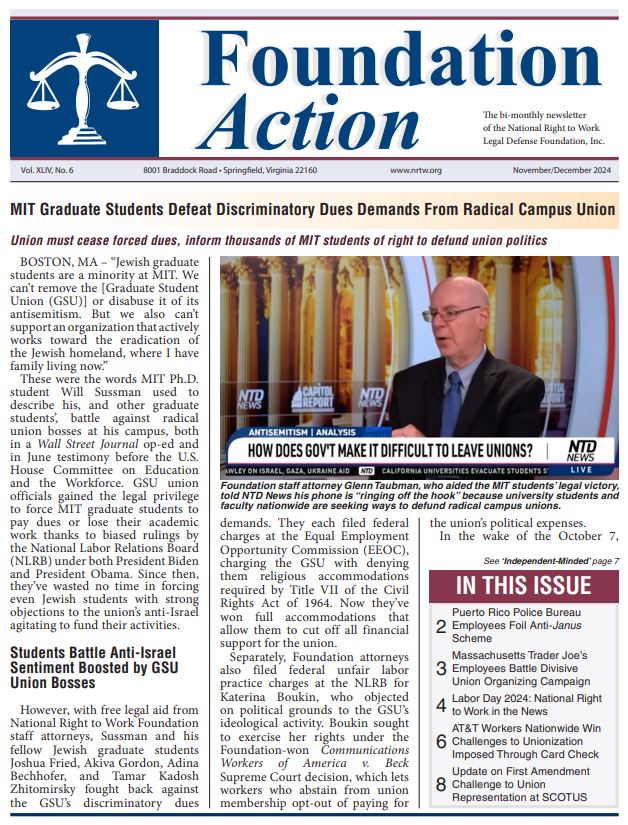
All articles from the November/December 2024 issue of Foundation Action are now online.
In this issue:
- MIT Graduate Students Defeat Discriminatory Dues Demands From Radical Campus Union
- Puerto Rico Police Bureau Employees Foil Anti-Janus Scheme
- Massachusetts Trader Joe’s Employees Battle Divisive Union Organizing Campaign
- Labor Day 2024: National Right to Work in the News
- AT&T Workers Nationwide Win Challenges to Unionization Imposed Through Card Check
- Update on First Amendment Challenge to Union Representation at SCOTUS
Recent articles can be found here. To sign up for a free copy of the newsletter via mail please see the form at the bottom of this page.
Dartmouth, MIT, Vanderbilt Graduate Students Challenge Forced Unionism
The following article is from the National Right to Work Legal Defense Foundation’s bi-monthly Foundation Action Newsletter, January/February 2025 edition. To view other editions of Foundation Action or to sign up for a free subscription, click here.
Foundation-backed students defend rights as union bosses seek more power at universities

Ben Logsdon is a Ph.D. student in mathematics at Dartmouth College. But it doesn’t take a genius to realize that union officials’ refusals to accommodate his religious objections just don’t add up.
HANOVER, NH – Just weeks after National Right to Work Foundation staff attorneys triumphed in anti-discrimination cases for Jewish Massachusetts Institute of Technology (MIT) graduate students who sought to stop forced dues payments to a radically anti-Israel union, union officials began creating other problems for university students.
In nearby New Hampshire, Dartmouth graduate student Benjamin Logsdon sought free Foundation legal aid against Graduate Organized Laborers of Dartmouth (GOLD-UE) union officials. The GOLD union — which is an affiliate of the same United Electrical (UE) union involved in the Foundation’s MIT cases — is forcing Logsdon to accept the union’s monopoly “representation” powers against his will, even after he voiced his religious objections to the union’s radical stances on the conflict against Israel.
Grad Students Exposed to Union Coercion & Privacy Violations
Meanwhile, several graduate students at Vanderbilt University in Nashville, TN, are pushing back against an attempt by Vanderbilt Graduate Workers United (VGWU, an affiliate of United Auto Workers) union bosses to impose union control over them and their colleagues. Specifically, three students are seeking to intervene in a federal case in which VGWU union officials are illegally demanding the university hand over the students’ private information to aid in their unionization campaign. Foundation staff attorneys filed motions for intervention for these students in October 2024.
Foundation attorneys are arguing that union officials severely violate students’ rights in both of these cases. However, the reason that union officials are in power on college campuses at all traces back to flawed rulings from the National Labor Relations Board (NLRB) under both the Obama Administration and Biden Administration. These rulings subject graduate students to pro-Big Labor provisions of the National Labor Relations Act (NLRA), which create issues for students’ freedom both inside and outside the classroom.
Logsdon, a Christian Ph.D. student in mathematics at Dartmouth, slammed the GOLD union with federal anti-discrimination charges in September 2024 at the Equal Employment Opportunity Commission (EEOC). According to those charges, shortly after the GOLD union finalized its first monopoly bargaining contract with the Dartmouth administration, he sent a letter to United Electrical General Secretary-Treasurer Andrew Dinkelaker explaining that he objected to being affiliated with GOLD on religious grounds and needed an accommodation.
“I sought to be removed from the UE and GOLD-UE bargaining unit as a reasonable accommodation,” Logsdon’s Foundation-backed charges say.
Dinkelaker refused to offer Logsdon an accommodation that “satisf[ied] [his] religious conscience or beliefs,” according to the charges, which violated his rights under Title VII of the Civil Rights Act of 1964.
Courts have recognized a variety of Title VII religious accommodations over the years for men and women who have religious objections to union affiliation, including paying an amount equivalent to union dues to a charity instead of union bosses. However, Logsdon seeks a different accommodation: to remove himself from union bosses’ control entirely.
At Vanderbilt, three students who identify themselves in legal documents as “John Doe 1,” “John Doe 2,” and “Jane Doe 1” are contending in their Foundation-backed motions for intervention that the Family Educational Rights and Privacy Act (FERPA) forbids the Vanderbilt administration from disclosing their personal information to any third parties without their permission, including the VGWU union.
At the union’s behest, NLRB Region 10 has already hit the Vanderbilt administration with a pair of subpoenas demanding personal student info, while ignoring objections from several students expressing concern at the disclosure.
So far Vanderbilt has resisted the NLRB’s subpoenas, and fortunately a federal court has temporarily allowed the university to refuse to comply with them.
The Foundation-backed students’ motions to intervene argue that the subpoenas “are an attempt to violate FERPA’s protections, privileging union interests over the graduate students[’] privacy rights.” It also points out that FERPA allows students to seek “protective action” if a university receives a subpoena seeking their personal information, as in this case.
The Vanderbilt students and their Foundation attorneys are demanding an opportunity to properly defend their privacy interests under FERPA. Foundation attorneys have already filed Requests for Review asking the NLRB in Washington, DC, to weigh in on the matter.
Union Monopoly Power Has No Place at Universities
“Graduate students around the country are discovering that union bosses don’t respect their individual rights and would rather use students as pawns to force their demands on a university administration, or advance an extreme political agenda,” commented National Right to Work Foundation Vice President and Legal Director William Messenger.
“Union monopoly bargaining is a system particularly ill-suited to an academic environment. Indeed, it is wrong for anyone to have a union monopoly imposed on them against their will and then be forced to pay union dues under threat of termination.”
Citing Federal Student Privacy Law, Vanderbilt Graduate Students Move to Block UAW Union Organizers from Obtaining Their Personal Info
“John Doe” grad students resist Labor Board claim that labor law can override Family Educational Rights and Privacy Act
Nashville, TN (October 23, 2024) – Two graduate students at Vanderbilt University are seeking to intervene in a federal case in which Vanderbilt Graduate Workers United (VGWU, an affiliate of the United Auto Workers union, UAW) union officials are demanding personal information that the students wish to keep private. The students, who identify themselves in legal documents as “John Doe 1” and “John Doe 2,” have obtained free legal aid from the National Right to Work Legal Defense Foundation to challenge a union subpoena demanding their personal information.
The students’ motion to intervene is now before the National Labor Relations Board (NLRB) in Washington, DC, following a special appeal from an NLRB Region 10 decision that tossed the motion on the specious ground that the students are “not a labor organization” and consequently have no interest in the case.
VGWU union bosses are seeking the students’ personal information as part of the union campaign to place Vanderbilt graduate students under UAW union monopoly bargaining control. NLRB Region 10 in Atlanta has issued a subpoena at the union’s behest seeking to force Vanderbilt University to hand over this information to union officials. However, the graduate students argue that the Family Educational Rights and Privacy Act (FERPA) forbids the Vanderbilt administration from disclosing this information to any third parties without their permission, including the UAW.
“The…subpoena to Vanderbilt is an attempt to violate FERPA’s protections, privileging union interests over the graduate students[’] privacy rights,” reads the graduate students’ appeal. “The Graduate Students seek to provide the Region legal arguments in support of their privacy interests, and against the…subpoena of Vanderbilt.”
Students Want Stop in Subpoena Enforcement So They Can Defend Their Privacy
The students’ original motion to intervene notes that FERPA’s language permits students to seek “protective action” if a university receives a subpoena seeking their personal information, as in this case. In light of that, the students are asking for a halt in the subpoena’s enforcement so they can properly defend their privacy interests. While the motion notes that the NLRB’s standards for allowing intervention have been unclear over the years, it argues that the students’ goal to defend their privacy interests provides a solid ground for intervention.
The VGWU union is an affiliate of the UAW union, which has a penchant for ignoring or violating employee rights in pursuit of gaining greater power over workers, businesses, and other institutions. The union is still under federal monitoring following a years-long embezzlement probe that uncovered millions of dollars in workers’ dues money misspent on luxury items, gambling, vacations, and more. The probe resulted in the convictions of about a dozen top UAW bosses.
“UAW officials are seeking to override college students’ federal privacy protections, which in addition to having no basis in law also treats students as pawns in the union’s ascent to power at the university,” commented National Right to Work Foundation President Mark Mix. “The NLRB under both Obama and Biden has twisted longstanding labor law to give union bosses the power to force students into dues-paying union ranks. But graduate students across the country are increasingly discovering that heavy-handed union monopoly bargaining power means less freedom both in and out of the classroom and more inefficiency, disruption, and radical political activism.
“Union monopoly bargaining is a system particularly ill-suited to an academic environment. But it also forces workers all over the country to associate with and pay dues to union bosses they never wanted and may have explicitly voted against,” Mix added. “The Vanderbilt students we represent are right to resist this kind of compulsion and we will defend their right to privacy.”
Dartmouth Ph.D. Student Hits Graduate Student Union With Federal Charges for Illegal Religious Discrimination
Student opposes union’s anti-Israel activities; charges that union officials refused to provide religious accommodation
Hanover, NH (September 30, 2024) – Benjamin Logsdon, a Ph.D. student in mathematics at Dartmouth College, has slammed the Graduate Organized Laborers of Dartmouth (GOLD-UE) union with federal anti-discrimination charges for failing to accommodate him and his religious beliefs. Logsdon filed the charges at the Equal Employment Opportunity Commission (EEOC) with free legal aid from National Right to Work Legal Defense Foundation staff attorneys.
Logsdon is a Christian whose sincere religious beliefs put him at odds with GOLD union officials and the radical activity and ideological positions they are promoting. Logsdon’s charges state that he is opposed not only to being forced to pay union dues, but also to GOLD-UE union officials’ monopoly representation powers that affect him as part of the graduate student body.
A series of rulings by the National Labor Relations Board (NLRB) during the Obama and Biden Administrations gave union officials the ability to seize monopoly bargaining power over graduate students, and at private institutions like Dartmouth, unionized graduate students are subject to federal private sector labor law. Such law allows union officials to force those under their power to pay dues or fees as a condition of employment in a state like New Hampshire (where Dartmouth is located) that lacks Right to Work protections.
However, Title VII of the Civil Rights Act of 1964 requires union officials to provide religious objectors like Logsdon religious accommodations. While such accommodations vary from case to case, they often free the objector from any further obligation to provide financial support to the union.
Logsdon seeks an accommodation in his case that will free him both from any forced union payments and from being forced to accept the GOLD union’s “representation.”
GOLD Union Officials Fail to Provide Reasonable Accommodation to Religious Objector
According to Logsdon’s charges, shortly after the GOLD union finalized its first monopoly bargaining contract with the Dartmouth administration, he sent a letter to United Electrical (UE, GOLD’s parent union) General Secretary-Treasurer Andrew Dinkelaker explaining that he objected to being affiliated with GOLD on religious grounds and needed an accommodation. “I sought to be removed from the UE and GOLD-UE bargaining unit as a reasonable accommodation,” Logsdon’s charges say.
Dinkelaker denied his requested accommodation in an August 30, 2024 message, refusing to offer Logsdon an accommodation that satisfies his sincere religious beliefs. Logsdon’s charges state that the union’s proposal “does not satisfy my religious conscience or beliefs,” and the refusal to accommodate him violates his rights under Title VII.
Foundation Attorneys Recently Scored Victory for Jewish MIT Students in Similar Case
Foundation staff attorneys recently prevailed in a similar batch of cases for five Jewish graduate students at the Massachusetts Institute of Technology (MIT), who objected to the anti-Israel activity of the MIT Graduate Student Union on campus (GSU, also an affiliate of UE). Notably, UE General Secretary-Treasurer Andrew Dinkelaker similarly refused to provide accommodations to each of those students when asked, telling the students that “no principles, teachings or tenets of Judaism prohibit membership in or the payment of dues or fees to a labor union.” However, UE officials quickly backed down after Foundation legal involvement.
“Mr. Logsdon is just one of many university students and staff across the country that are appalled by the divisive and inflammatory activity that union bosses have been engaging in, and have called on the Foundation for help in defending their freedom from these union hierarchies,” commented National Right to Work Foundation President Mark Mix. “Union officials shouldn’t be able to manipulate their forced-dues and forced-representation powers to make graduate students choose between keeping their academic positions and honoring their sincere religious beliefs.
“As the political and ideological temperature skyrockets at college campuses, the frequency of these stories is unfortunately likely to continue growing across the country. We encourage those on college campuses who seek to protect their religious freedom from union boss coercion to contact the Foundation for free legal aid,” Mix added.
MIT Grad Student Charges ‘Marxist’ Union with Illegal Forced Dues for Politics
The following article is from the National Right to Work Legal Defense Foundation’s bi-monthly Foundation Action Newsletter, July/August 2024 edition. To view other editions of Foundation Action or to sign up for a free subscription, click here.
Five other MIT students also filed religious discrimination charges against radical UE
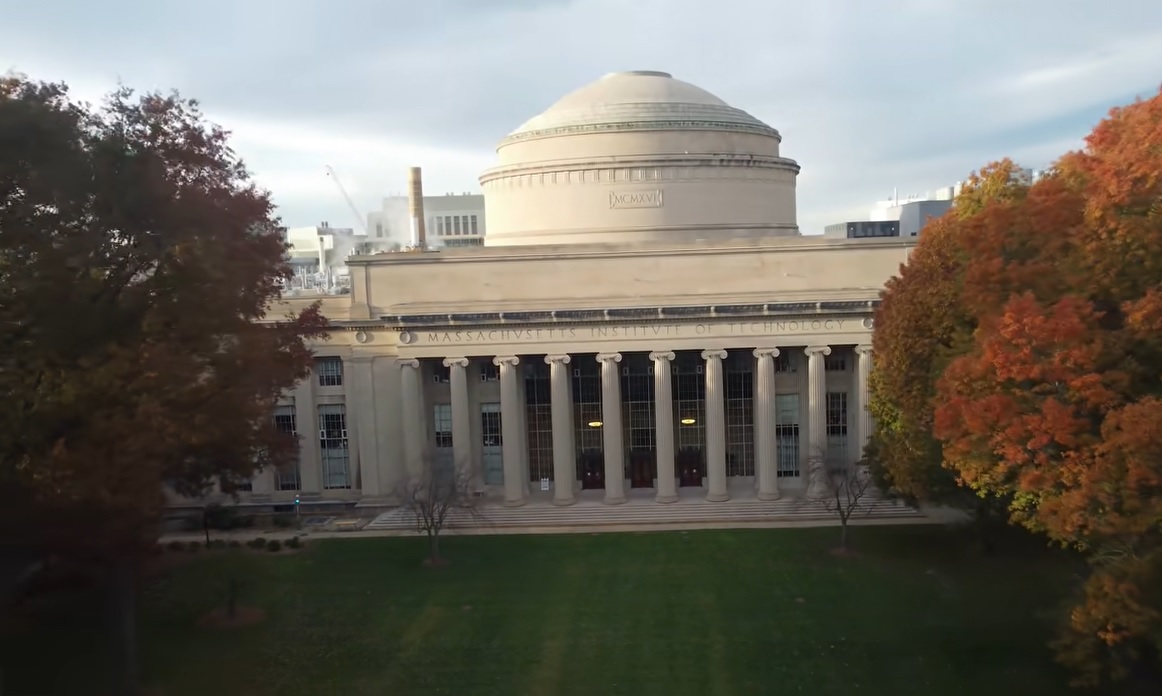
More clouds are gathering over at MIT as yet another graduate student targets the university with federal charges. She maintains the GSU union and MIT administration are illegally funneling student money into union politics.
BOSTON, MA – Following five Jewish students at the Massachusetts Institute of Technology (MIT) filing federal religious discrimination charges against the same union, the MIT Graduate Student Union (GSU-UE, an affiliate of the United Electrical Workers union) is now facing new federal unfair labor practice charges from civil engineering graduate student Katerina Boukin.
Under a series of controversial National Labor Relations Board (NLRB) rulings, graduate students at private universities like MIT are treated as “employees” of the university who can be subjected to forced union “representation.” Boukin’s charges, filed at the NLRB with free legal aid from the National Right to Work Legal Defense Foundation, maintain that union officials are unlawfully seizing money from her research compensation to support union political activities she abhors.
Extremist Union Politics Foisted on Graduate Students
“GSU union officials are going above and beyond what is legal and are forcing me to pay for their political activities, including their opposition to Israel and promotion of Leninist-Marxist global revolution, that I find deeply offensive,” commented Boukin. “The GSU’s political agenda has nothing to do with my research as a graduate student at MIT, or the relationships I have with my professors and the university administration, yet outrageously they demand I fund their radical ideology.”
Boukin’s charges seek to enforce her rights under the Foundation-won 1988 CWA v. Beck Supreme Court decision. This landmark ruling established that even in states like Massachusetts that lack Right to Work protections, union officials cannot legally compel individuals to pay for union expenses unrelated to bargaining activities, like union boss political activities.
According to Boukin’s charge, GSU union officials are violating the law by claiming she cannot exercise her rights under Beck because she missed a union-created annual “window period.” However, her charge asserts this restriction is blatantly illegal.
In fact, the GSU union was already forced to settle a prior Beck case, agreeing there to properly process students’ attempts to exercise their Beck rights. Boukin’s charges against the union argue that the union may be violating not only her rights but also the settlement it made with the NLRB.
GSU Union Bosses Also Charged for Illegal Religious Discrimination
MIT graduate student Will Sussman, along with fellow students Joshua Fried, Akiva Gordon, Tamar Kadosh Zhitomirsky, and Adina Bechhofer, have also filed religious discrimination charges against the GSU union with the Equal Employment Opportunity Commission (EEOC). They’ve also obtained free Foundation legal help.
The students, who are Jewish, oppose the union’s advocacy for the Boycott, Divestment, and Sanctions (BDS) anti-Israel movement. Despite asking union officials for legally-required religious exemptions from union dues payment, GSU officials denied their requests and even attempted to explain in letters how the students didn’t truly understand their faith.
As of this article, those EEOC charges remain pending against the GSU, with a federal lawsuit likely the next step if the union refuses to stop its illegal discrimination.
“Freedom of association is apparently a foreign concept to GSU union officials, who are flouting layers upon layers of federal law to compel students to fund their radical political agenda,” commented National Right to Work Foundation Vice President and Legal Director William Messenger. “However, both this case and Foundation attorneys’ cases for the five Jewish MIT graduate students show on a deeper level that the choice to provide support to a union should rest solely with workers, who may have sincere religious, political, or other objections to funding any or all of a union’s activities.”
Another MIT Grad Student Hits GSU Union with Federal Labor Charges for Illegally Seizing Money for Radical Union Agenda
Charges: Union officials imposing so-called ‘window period’ restriction to forbid civil engineering grad student from cutting off dues for politics
Boston, MA (April 26, 2024) – Following five Jewish students filing federal religious discrimination charges against the union, the MIT Graduate Student Union (GSU-UE) is now facing new federal unfair labor practice charges from civil engineering graduate student Katerina Boukin. Boukin’s charges, filed at the National Labor Relations Board (NLRB) with free legal aid from the National Right to Work Legal Defense Foundation, maintain that union officials are unlawfully seizing money from her research compensation to support union political activities she abhors.
Boukin seeks to enforce her rights under the 1988 Right to Work Foundation-won CWA v. Beck Supreme Court decision. The Court held in Beck that union officials cannot force those under their control to pay dues or fees for union expenses not directly related to collective bargaining, such as political expenses. Nonmembers who exercise their Beck rights are entitled to an independent audit of the union’s finances and a breakdown of how union officials spend forced contributions.
Beck rights are only relevant in non-Right to Work jurisdictions like Massachusetts, where union officials have the legal power to compel the payment of some union fees in a unionized environment. Because of controversial rulings by the Obama and Biden NLRBs, graduate students at private educational institutions like MIT are treated as “employees” who can be subjected to forced union representation and mandatory payments. In jurisdictions that have Right to Work protections, in contrast, union membership and all union financial support are strictly voluntary.
“GSU union officials are going above and beyond what is legal and are forcing me to pay for their political activities, including their opposition to Israel and promotion of Leninist-Marxist global revolution, that I find deeply offensive,” commented Boukin. “The GSU’s political agenda has nothing to do with my research as a graduate student at MIT, or the relationships I have with my professors and the university administration, yet outrageously they demand I fund their radical ideology.”
Union Still Seizing Dues for Politics Under Guise of ‘Window Period’ Restriction
According to Boukin’s charges, she and other graduate students resigned their memberships in the GSU union, revoked their dues “checkoff” authorizations, and objected under Beck to paying anything going toward GSU’s “political and non-representational agenda and expenditures.”
Despite these requests, the charges note, union bosses have “refused to process those Beck objections, refused to immediately reduce the amount of dues and fees collected from Charging Party’s and other graduate students’ [compensation], refused to stop the dues checkoff, and refused to provide Charging Party” with an independent audit explaining the union’s expenses and reduced fee calculation.
Instead, a GSU vice president told Boukin that she had missed an annual “window period” in which to exercise her Beck rights and that her objections would not be considered until November 2024. “In fact, the UE union has adopted an unlawfully restrictive Beck objection policy, precisely to diminish and destroy [the students’]…rights,” says the charge.
The charges note that the union’s unlawful dues scheme restrains and coerces the graduate students from exercising their right under the National Labor Relations Act (NLRA) to refrain from union activity. MIT is also charged for its role in enforcing the union scheme and continuing to collect dues.
Previously, another MIT graduate student, Will Sussman, filed NLRB charges against the UE union for violating his rights under Beck. Sussman filed the charges on his own but later obtained free legal representation from the National Right to Work Foundation.
GSU Also Faces Religious Discrimination Charges, May Be Violating Past Beck-Related Settlement
Sussman’s case concluded because UE settled with the NLRB. As part of that settlement, GSU union officials are required to “notify [all graduate students] of your rights under…Communications Workers v. Beck” and email notices informing students of those rights and post a notice for 60 days. Despite still being within the 60-day notice-posting period, as Boukin’s case shows, GSU officials appear to be violating the spirit if not the letter of that settlement.
Boukin’s unfair labor practice charges come as federal discrimination charges are pending at the Equal Employment Opportunity Commission (EEOC) for five Jewish graduate students who requested religious accommodations to paying money to the GSU union. Among other things, these students oppose the union’s advocacy for the anti-Israel “Boycott, Divestment, and Sanctions” (BDS) movement.
“Freedom of association is apparently a foreign concept to GSU union officials, who are flouting layers upon layers of federal law to compel students to fund their radical political agenda,” commented National Right to Work Foundation President Mark Mix. “However, both this case and Foundation attorneys’ case for the five Jewish MIT graduate students show on a deeper level that the choice to provide support to a union should rest solely with workers, who may have sincere religious, political, or other objections to funding any or all of a union’s activities.”
Jewish MIT Graduate Students Slam BDS-Linked Union with Federal Discrimination Charges
Students assert their rights under Civil Rights Act by requesting religious exemptions from funding union, but union officials continue to demand dues payments
Boston, MA (March 21, 2024) – Graduate students from the Massachusetts Institute of Technology (MIT) have filed federal discrimination charges against the United Electrical Workers (UE) and MIT Graduate Students Union (GSU), stating that union officials have illegally denied their requests for religious accommodations to the forced payment of union dues. The students submitted their charges at the Equal Employment Opportunity Commission (EEOC) with free legal aid from the National Right to Work Legal Defense Foundation.
The students, William Sussman, Joshua Fried, Akiva Gordon, Tamar Kadosh Zhitomirsky, and Adina Bechhofer, are Jewish and conduct various research activities for professors at MIT. For example, Sussman is earning his PhD in Computer Science at MIT. He is also President of MIT Graduate Hillel, is a member of the MIT Israel Alliance, and has family in Israel.
The university students object to the union’s anti-Semitic advocacy, including the union’s endorsement of the anti-Israel “Boycott, Divestment and Sanctions” (BDS) movement. Each of the EEOC charges state that the union is “discriminating against me based on a failure to accommodate my religious beliefs and cultural heritage” and “discriminating against me based on national origin, race, cultural heritage & identity.”
The students sent individual letters asserting their religious objections to supporting the union and asserting their rights to religious accommodations, but union officials brazenly rejected each request and continue to demand dues from the students.
Union officials’ form letter denying the students’ requested religious accommodations explained Judaism to these Jewish students, callously claiming “no principles, teachings or tenets of Judaism prohibit membership in or the payment of dues or fees to a labor union.” The union also attempted to justify its position on the grounds that a founder of GSU’s parent union was himself Jewish.
“Jewish graduate students are a minority. We cannot remove our union, and we cannot talk them out of their antisemitic position — we’ve tried,” said Sussman. “That is why many of us asked for a religious accommodation. But instead of respecting our rights, the union told me they understand my faith better than I do.”
Religious Accommodations Are Required Under Title VII
Because Massachusetts lacks Right to Work protections, union officials in the private sector (which includes private educational institutions like MIT) generally have the power to compel those under their monopoly bargaining power to pay union dues or fees. However, as per Title VII of the Civil Rights Act of 1964, religious accommodations to payment of dues or fees must be provided to those with sincere religious objections.
For decades, National Right to Work Foundation staff attorneys have successfully represented religious objectors in cases opposing forced dues. While religious accommodations in these cases have varied, all of them forbid union bosses from demanding the worker pay any more money to the union.
If the EEOC finds merit to the students’ charges of discrimination, the agency will either take legal action against the union itself, or will issue a “right to sue” letter to the students, which will entitle them to file a federal civil rights lawsuit against the union in federal court. Because MIT has a contract with this union and is also involved in enforcing the union’s dues demands on the students, Foundation attorneys sent a letter to MIT President Sally Kornbluth, notifying her of the EEOC charges and warning that the university will face similar charges if it does not promptly remedy the situation. MIT is already under fire in Congress and elsewhere due to its treatment of Jewish students in the face of widespread harassment.
Jewish Grad Student Already Won Federal Labor Board Case Against GSU Union Related to Dues
Sussman already dealt a blow against GSU officials in late February, when he forced union officials to settle federal charges he filed at the National Labor Relations Board (NLRB) concerning the union’s dues demands. In those charges, Sussman invoked his right under the Right to Work Foundation-won CWA v. Beck Supreme Court decision, which prevents union officials from forcing those under their control to pay dues for anything beyond the union’s core bargaining functions.
While the settlement required GSU union officials to send an email to all students under their control stating that they would now follow Beck, Sussman and his fellow students’ current EEOC case seeks to cut off all financial support to the union, as is their right under Title VII of the Civil Rights Act.
“GSU union officials appear blinded by their political agenda and their desire to extract forced dues,” commented National Right to Work Foundation President Mark Mix. “Their idea of ‘representation’ apparently includes forcing Jewish graduate students to pay money to a union the students believe has relentlessly denigrated their religious and cultural identity, all during a time when anti-Semitism is ripping across our nation and world.
“GSU union bosses’ refusal to grant these students religious accommodations is as illegal as it is unconscionable, and Foundation attorneys will fight for their freedom from this tyrannical union hierarchy,” Mix added.





