
California Nurse Adds New Claim in Federal Labor Board Case Against United Nurses Association of California
Charge: union officials illegally demanded nurse join union, plus maintain illegal policy that restricts right to cut off funding for political spending
Woodland Hills, CA (September 5, 2025) – Sarah Warthemann, a nurse at Kaiser Permanente, has just filed new charges in her ongoing case against the United Nurses Association of California (UNAC) union challenging union officials’ illegal demands that she pay full union dues or be fired. Warthemann’s charges were filed at the National Labor Relations Board (NLRB) with free legal aid from National Right to Work Foundation staff attorneys.
Her original charges, filed in July, stated that UNAC union bosses illegally threatened her with termination of her employment at the hospital if she did not formally join the union. Now, the amended charges also challenge union policies that require nonmembers to opt-out of paying for union political and ideological activities.
The NLRB is the federal agency responsible for enforcing the National Labor Relations Act (NLRA) and adjudicating disputes between employers, unions, and individual employees. The charges allege UNAC union bosses are violating Warthemann and all other nurses’ NLRA Section 7 right to refrain from participating in or supporting union activities.
Because California lacks Right to Work protections, UNAC union bosses can impose union monopoly bargaining contracts that force employees to pay union dues or fees as a condition of employment. By comparison, in neighboring Right to Work states like Arizona and Nevada, union membership and all union financial support are strictly voluntary.
However, under Communications Workers of America v. Beck, a landmark Foundation-won Supreme Court case, even where forced dues are authorized, union officials cannot compel workers to fund activities unrelated to union bargaining, like union political activities. The charges note that UNAC officials have “repeatedly demanded payment from [Warthemann] for non-chargeable political and ideological expenditures without [her] affirmative consent” and argue that these demands represent illegal coercion under the NLRA.
“As the facts of this case demonstrate, the NLRB needs to step up to protect workers from being trapped into paying full union dues, including the portion used for union political activism,” observed National Right to Work Foundation President Mark Mix. “Union bosses are not above the law, they cannot be permitted to threaten and bully workers into paying dues that go towards union political activities that many workers find objectionable.”
National Right to Work Foundation Attorney to Appear Before U.S. House in Hearing on Labor Board Reforms
Aaron Solem will call for demise of coercive Biden-era policies
Washington, DC (June 11, 2025) – In a hearing today, veteran National Right to Work Foundation Staff Attorney Aaron Solem will testify before the U.S. House Committee on Education and the Workforce’s Subcommittee on Health, Employment, Labor, and Pensions. He will discuss the reforms needed to reverse the ways the National Labor Relations Board (NLRB), especially under the Biden Administration, rigged the rules to promote union boss power at the expense of the rights of independent-minded workers.
During a hearing titled “Restoring Balance: Ensuring Fairness and Transparency at the NLRB,” Solem will discuss how current NLRB rules allow union officials to corral and keep workers in union ranks without a vote, and let union officials force workers to subsidize union ideological activities. Solem, who has a thirteen-year career of defending workers from union coercion before the courts and administrative agencies like the NLRB, will be urging several reforms to protect workers’ individual rights.
Solem will appear as an expert witness at the hearing chaired by Georgia Congressman Rick Allen. Also appearing on the witness stand will be Jennifer Abruzzo, a former high-ranking lawyer for the Communications Workers of America (CWA) union and ex-General Counsel of the Biden NLRB, who during her time at the agency pushed to make it more difficult for workers to escape union control.
“These are anti-employee policies because they cancel worker choices and replace them with decisions made by unions and the government,” Solem’s written testimony reads. “President Trump won reelection because he was the candidate who listened to employees. The Board should follow in those footsteps by pursuing a truly pro-employee agenda. This agenda would put power in the hands of workers—not unions or employers—— to decide whether they want to be represented by a labor union.”
Biden-Era NLRB Policies Stripped Workers of Right to Exit & Defund Unwanted Unions
Solem’s written testimony breaks down several policies advanced by the Biden NLRB that strip workers of their right to vote themselves free of unwanted union influence. Among these are the “blocking charge” policy, which “allows unions to unilaterally block [union] decertification elections just by filing a charge against an employer, no matter how meritless it may be,” and the so-called “voluntary recognition bar,” which prevents workers from requesting an election to remove a union after union officials gain power through the unreliable “card check” method. Card check abandons the security of a secret-ballot union vote and instead relies on union authorization cards collected by union officials from workers – often through coercive tactics.
Solem also urges the NLRB to “follow Supreme Court precedent and require non-member employees to opt-in to paying for union political expenditures.” As it currently stands, employees who are not union members must “jump through several procedural hoops” to pay a reduced amount of union dues that excludes expenses for union political activities they may staunchly disagree with. The right to pay this reduced amount is enshrined in the Foundation-won CWA v. Beck Supreme Court decision, but current NLRB policies don’t sufficiently protect it.
Freedom vs. Coercion for Workers on Display
“At this hearing, House members will see two starkly differing visions for American workers,” commented National Right to Work Foundation President Mark Mix. “Aaron Solem will advocate for a future where workers can decide for themselves whether or not a union in their workplace is right for them, while Jennifer Abruzzo will double down on granting union officials sweeping coercive powers to impose their will on working people.
“American workers, who are affiliating with unions at near-record-low numbers and overwhelmingly support voluntary and not forced unionism, deserve to have an NLRB where their individual rights are protected and not ceded to union officials and their political cronies,” Mix added. “The incoming Trump NLRB should relegate the cynical, top-down, forced-unionism approach of Jennifer Abruzzo and the Biden NLRB to the dustbin of history, and empower workers by protecting their individual freedoms.”
Federal Lawsuit Hits Guards Union of America for Illegally Forcing DC-Based Security Guard to Pay for Union Politics
Union officials provided contradictory information on amount a guard must pay the union to keep a job
Washington, DC (April 19, 2024) – Rosa Crawley, a DC-based security guard employed by Master Security, has just hit the International Guards Union of America (IGUA) Local 160 with a federal lawsuit, which maintains that full union dues, including dues for union political activities, are being illegally deducted from her paycheck. Crawley filed the complaint in the U.S. District Court for the District of Columbia with free legal aid from National Right to Work Foundation staff attorneys.
Crawley, who with her coworkers provides security services to the Department of Homeland Security’s “Nebraska Avenue Complex,” seeks to enforce her rights under the 1988 Right to Work Foundation-won CWA v. Beck Supreme Court decision. The Court held in Beck that union officials cannot force workers who have abstained from union membership to pay union dues or fees for any expenses not directly germane to contract negotiations. Nonmember workers who exercise their Beck rights are also entitled to an independent audit of the union’s finances and a breakdown of how union officials spend forced contributions.
Beck rights are only relevant in non-Right to Work jurisdictions like the District of Columbia, where union officials have the legal prvivilege to force private sector workers to pay dues or fees as a condition of getting or keeping a job. In jurisdictions that have Right to Work protections, like neighboring Virginia, union membership and all union financial support are strictly voluntary.
“I shouldn’t have to pay for the IGUA union’s political activity just so I can continue to do my job,” commented Crawley. “Union officials have a legal obligation to stop charging me for politics and provide me with an accounting of how they are using my money, and so far they have done neither. This isn’t how they should treat the workers they say they ‘represent.’”
Union Officials Haven’t Revealed How They Spend Worker Money
According to the suit, Crawley sent a letter to union officials resigning her union membership back in July 2023. Instead of immediately providing her with her Beck rights, union officials informed her that she would be charged a so-called “agency fee” which “is the same exact cost as what the union members pay.”
“So there will be absolutely no change in a financial sense,” the union’s reply letter stated.
Not satisfied with that explanation, Crawley in September 2023 formally invoked her Beck rights and asked union officials to reduce her dues payments in accordance with the decision. She also asked them to “provide [her] with an accounting, by an independent certified public accountant, that justifies Local 160’s calculation of its agency [forced] fee,” according to her lawsuit. In an October 2023 reply to her Beck request, union officials used a confusing percentage averaging calculation to determine a fee amount that contradicted what they told Crawley when she resigned her membership. An independent audit of the union’s finances was nowhere to be found.
Crawley’s lawsuit recounts that, since October 2023, union officials have made her reiterate her request for an accounting, pay an initiation fee equal to the initiation fee paid by full members, and “[have] collected and [continue] to collect from Crawley amounts equal to full union dues.”
“Federal labor law’s default position is that union officials are empowered to demand workers’ hard-earned money as a condition of employment. This is problematic because there are any number of reasons workers may not want to support the union, including religious, political, or financial reasons,” observed National Right to Work Foundation President Mark Mix. “While the Beck decision provides important protections, a Right to Work environment is ultimately better because workers are completely free to decide whether or not union officials deserve any of their hard-earned money.”
Teamsters Officials ‘Beck’ Down: Must Return Thousands in Dues Seized for Politics
Foundation-won settlement also forces union officials to stop threatening non-members
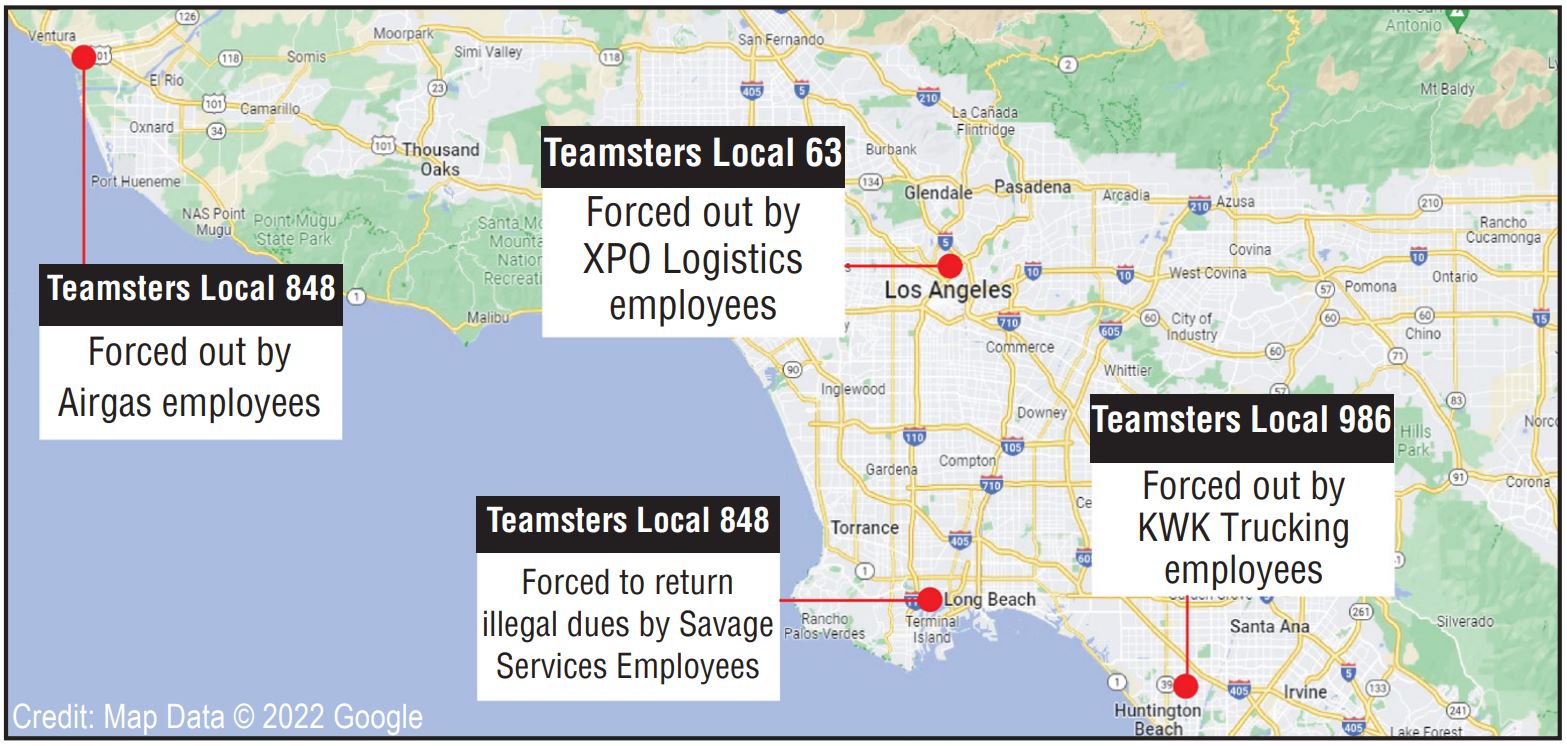
SoCal Shenanigans: Teamsters officials’ disrespect for rank-and-file workers and their rights led to multiple Foundation-backed employee actions against them in just the past year.
LOS ANGELES, CA – When Nelson Medina and about 60 of his coworkers at Savage Services in Long Beach tried to exercise their right as union non-members to opt out of funding Teamsters Local 848 officials’ political expenditures, Teamsters bosses responded with harassment, misinformation, and threats of termination.
Now, with free legal aid from the National Right to Work Foundation, they have won a settlement that required Teamsters honchos to pay back thousands of dollars in dues union officials seized in violation of workers’ rights under the Foundation-won CWA v. Beck Supreme Court decision.
Because California lacks Right to Work protections, even Golden State private sector workers who oppose a union’s presence in their workplace can be required to pay union dues or fees to keep their jobs. However, under the Beck decision, union officials can never require non-members to subsidize union political activity. Beck also entitles employees who have abstained from union membership to receive union financial disclosures.
Teamsters Bosses to Workers: Fund Union Politics or Be Fired
Medina originally filed charges against Teamsters officials for illegal dues practices in September 2021. The charges stated that he had sent Teamsters officials a letter on August 15 exercising his right to reject formal union membership and invoking his right under Beck to cut off dues deductions for union politics.
About a month after the letter, the charge noted, union officials informed Savage Services management by mail that if Medina and 12 fellow employees who also objected to full union membership did not complete membership applications and pay full dues for the month of September, the employer should terminate the employees before September’s final week.
The settlement, in addition to requiring Teamsters bosses to return nearly $6,000 in illegally taken dues to Savage Services employees, also mandated that union officials declare in a public notice that they “will not fail to provide non-member employees with a breakdown of dues and fees required for Beck objectors upon request.”
They also had to declare they “will not threaten employees who have raised Beck objections with termination for failing to complete a union application as a condition of employment.”
“That Teamsters Local 848 officials illegally siphoned money for politics from almost 60 Savage Services employees and threatened termination of those who dared to stand up for their rights demonstrates clearly that Teamsters officials prioritize power far above the employees they claim to ‘represent,’” commented National Right to Work Foundation Vice President and Legal Director Raymond LaJeunesse. “Based on the sheer number of employees in Medina’s workplace who received refunds as the result of this settlement, Teamsters officials apparently played fast and loose with the rights of all workers who objected to the union agenda.”
Foundation Attorneys Counter Teamsters Coercion Across Southern California
Last September, Foundation staff attorneys also aided Ventura, CA, Airgas employees in removing Teamsters Local 848 from their facility. After litigation that had lasted almost a year, as well as two submissions of petitions demonstrating a majority of workers at the plant wanted the Teamsters gone, union officials finally departed the plant. They did so just before the NLRB was slated to conduct a secret-ballot vote whether to remove the union at the plant, likely leaving to avoid an embarrassing rejection by the workers.
The string of Foundation-assisted worker victories over unwanted Teamsters officials in Southern California continued last year when Ozvaldo Gutierrez and his XPO Logistics coworkers forced Teamsters Local 63 union bosses out of their Los Angeles facility in October.
Boeing Technician Files Federal Lawsuit Against Machinists Union Over Illegal Forced Dues Demands
Instead of reducing nonmember worker’s payments in accordance with Supreme Court precedent, union bosses charged him arbitrary higher amount
Seattle, WA (May 24, 2022) – With free legal aid from the National Right to Work Legal Defense Foundation, Seattle Boeing technician Don Zueger is suing International Association of Machinists (IAM) union officials in federal court for violating his right to refrain from paying for unwanted union activities.
Zueger, who is not a member of the IAM union, is defending his right under the Foundation-won 1988 CWA v. Beck U.S. Supreme Court decision, in which the Court ruled that union officials cannot charge full union dues to objecting private sector workers who have abstained from formal union membership. Under Beck, union officials can only charge union nonmembers “fees” which exclude expenses for things like union political activities.
Because Washington State lacks Right to Work protections for its private sector workers, nonmembers like Zueger can be forced to pay the reduced amount under Beck as a condition of keeping their jobs. In Right to Work states, in contrast, union membership and all union financial support are strictly voluntary.
IAM Officials Continue to Overcharge Worker in Violation of His Rights
According to Zueger’s lawsuit, filed in the U.S. District Court for the Western District of Washington, he submitted a request to IAM union officials in February resigning his union membership and asking for his dues payments to be reduced under Beck.
Zueger’s lawsuit reports that IAM officials’ response to his Beck request claimed that, under IAM’s nationwide policy, the portion of union dues he is required to pay is based on averages of selected audits that in each case include nine other local and district IAM affiliates. This means the forced union fee amount is not calculated using the actual amounts determined in the audits of the local and district IAM affiliates that Zueger is required to fund as a condition of employment. Unsurprisingly, this resulted in Zueger’s dues reduction being significantly less than it would have been had union officials only used the audits for the district and local affiliates Zueger is forced to fund.
According to his lawsuit, union officials are still demanding from Zueger dues in excess of the amount Beck permits. The lawsuit seeks to force IAM union bosses to return all money demanded in violation of Beck and to properly reduce his future union payments in accordance with Beck.
Workers Should Be Wary of Illegal Union Dues Schemes as Union Political Activity Increases
Zueger’s lawsuit comes after union bosses spent near-record sums on politics during the 2020 election cycle. A report by the National Institute for Labor Relations Research (NILRR) released in 2021 revealed that union officials’ own Department of Labor filings show about $2 billion in political spending during the 2020 cycle, primarily from dues-stocked union general treasuries. Moreover, other estimates strongly suggest that actual union spending on political and lobbying activities actually topped $12 billion in 2019-2020.
“It doesn’t take a rocket scientist to figure out when union officials are trying to strong-arm employees into subsidizing union activities, including politics, against their will. IAM officials’ nonmember dues scheme doesn’t pass the smell test,” commented National Right to Work Foundation President Mark Mix. “While we’re proud to help Mr. Zueger defend his Beck rights, ultimately no American worker should be forced to pay fees determined by the whims of union officials simply in order to keep their jobs.”
“This case shows why Right to Work laws are needed nationwide to ensure that the decision to join or financially support a union is strictly a matter of each individual worker’s own conscience. Workers should be especially aware of attempts by union officials to force them to fund union activities as union political activity heats up in advance of this year’s elections,” Mix added.
Paramedic Files Appeal after NLRB Disregards Illegal Union Retaliation
The following article is from the National Right to Work Legal Defense Foundation’s bi-monthly Foundation Action Newsletter, January/February 2020 edition. To view other editions or to sign up for a free subscription, click here.
Appeal to NLRB General Counsel comes just months after Region 14 was reversed in similar case

Paramedic Jarod Aubuchon is appealing his case against Teamsters officials after they punished him for informing his coworkers of their rights to resign union membership and pay reduced dues.
St. LOUIS, MO – Jarod Aubuchon, a St. Louis-area paramedic who charged Teamsters Local 610 union officials with illegal retaliation after he tried to inform his coworkers of their right to pay reduced union dues, is filing an appeal in his case to the National Labor Relations Board (NLRB) General Counsel in Washington, D.C. He is represented free of charge by National Right to Work Legal Defense Foundation staff attorneys.
Aubuchon’s appeal comes after the October 2019 dismissal of his case by NLRB Region 14 officials in St. Louis. Region 14 was reversed by the NLRB General Counsel in a similar union retaliation case this summer, which was also brought by Foundation staff attorneys.
Union Officials Vow Punishments after Worker Posted Rights Notices
Aubuchon discovered the right of private sector workers under the Foundation-won CWA v. Beck Supreme Court decision to resign union membership and pay a reduced portion of union dues. Because Missouri is not a Right to Work state, private sector workers can still be compelled to pay part of union dues as a condition of employment.
Beck, won by Foundation staff attorneys in 1988, guarantees that employees who are not union members can only be required to pay fees to a union for expenses that are directly germane to bargaining, such as contract administration.
Armed with this new knowledge, Aubuchon posted flyers in common areas of his workplace informing his coworkers of their Beck rights. According to his charge, Teamsters agents responded by tearing down these notices and later demanding that his employer, Medic One, discipline him for the postings. Actions by union officials that cause an employer to discriminate against workers on such grounds are prohibited by the National Labor Relations Act (NLRA).
Aubuchon resigned his own union membership and asserted his Beck rights. Aubuchon’s charge states that neither his resignation nor his Beck rights have been acknowledged by Teamsters bosses, and full dues are still being seized from his paychecks.
Employee Appeals to NLRB General Counsel with Free Foundation Legal Aid
After NLRB Region 14 officials rejected his case, Aubuchon petitioned the NLRB General Counsel to overturn the decision and order remedies for the retaliation he experienced from Teamsters officials.
“They spend union money on political activism without consideration of its members,” Aubuchon said of Teamsters officials to the St. Louis Record after his appeal was filed. “We have a right to not have our money used in that manner and in the end I hope employees are better educated on their rights and how to exercise them.”
In July 2019, the General Counsel reversed Region 14 officials’ dismissal of a similar case brought by Foundation staff attorneys for Kansas City-area hospital worker Kacy Warner. Warner charged officials of the National Nurses Organizing Committee (NNOC) union with illegally interfering with a petition she was circulating for a vote to remove the union. That included tearing down flyers she had hung in bathrooms and other common areas in her workplace informing employees of the petition. In her case the NLRB General Counsel reversed Region 14’s dismissal and ordered region officials to prosecute the charge.
Region 14 officials were also overturned by the full Labor Board in October 2019 after the Region dismissed a petition for a vote to remove the union from St. Elmo, Illinois-based ConAgra Foods worker Robert Gentry’s workplace. United Food and Commercial Workers (UFCW) union bosses had attempted multiple times to stop workers at the plant from exercising the right to vote out the union.
“The NLRB is charged with enforcing workers’ rights under the National Labor Relations Act, yet there is a disturbing pattern of Region 14 failing to enforce the rights of rank-and-file workers when doing so advances the interests of union bosses,” commented National Right to Work Foundation Vice President Patrick Semmens. “It should not take an appeal to Washington, D.C., for workers to have their rights fully protected against union boss abuses.”
Foundation Winning Protections Against Forced Unionism at Trump NLRB
The following article is from the National Right to Work Legal Defense Foundation’s bi-monthly Foundation Action Newsletter, September/October 2019 edition. To view other editions or to sign up for a free subscription, click here.
Series of victories adds protections against illegal forced dues, being trapped in union ranks
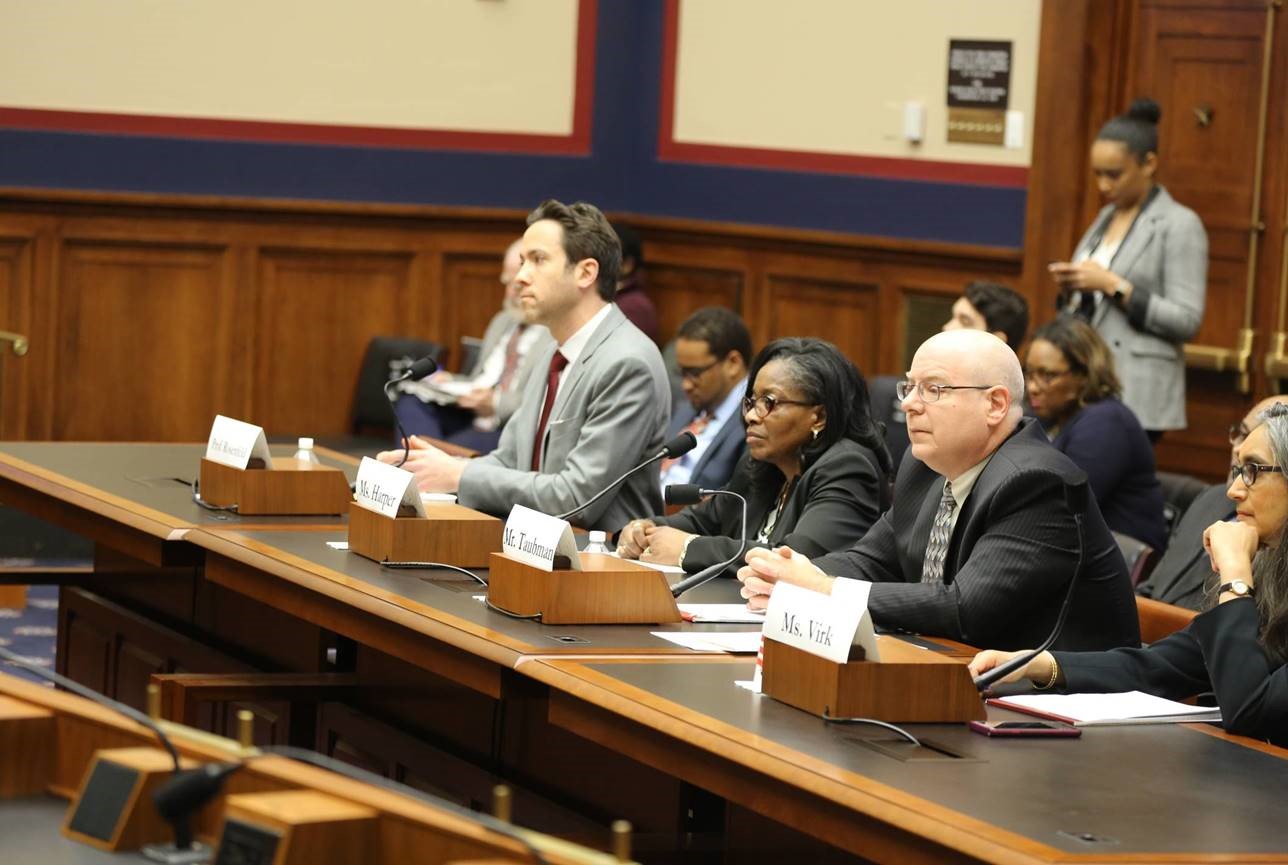
Staff attorney Glenn Taubman testified before Congress in July that existing NLRB rules wrongly favor union bosses over workers.
WASHINGTON, D.C. – In a series of recent victories, the National Labor Relations Board (NLRB) ruled in favor of workers challenging coercive union official practices, with free legal aid provided by the National Right to Work Foundation. The rulings are a stark departure from the Obama NLRB, which regularly stymied the rights of independent-minded employees opposed to associating with union bosses.
Foundation Wins Appeals in Dues Checkoff Cases
In separate cases brought by Foundation staff attorneys for Kacy Warner, a hospital worker, and Shelby Krocker, a Kroger grocery employee, the NLRB General Counsel ruled for the workers and ordered Regional Directors to prosecute union officials’ actions related to language in union dues checkoff forms.
The General Counsel’s decision to sustain Warner’s appeal concerning the checkoff authorized even more additions to the charges, saying the National Nurses Organizing Committee (NNOC) union violated the NLRA by “maintaining confusing and ambiguous dual-purpose authorization forms that unlawfully restrained employees in the exercise of their Section 7 rights.”
The General Counsel noted that the union’s forms failed to tell workers they can revoke authorizations for dues deductions after the union’s contract expires, failed to give workers adequate time to revoke authorizations, unlawfully required workers to use certified mail to send revocation requests, and failed to give “any indication to employees that payroll deduction authorization is voluntary.”
This came just a week after the General Counsel sustained another Foundation-led appeal for Krocker, who charged United Food and Commercial Workers (UFCW) union officials with illegally forcing her to sign a dues checkoff authorization. In both cases, the NLRB General Counsel authorized even more charges against union officials for misleading and confusing language regarding union dues deductions.
NLRB Regions Instructed to Prosecute Beck Violations
Also in July, the NLRB Division of Advice and General Counsel instructed regional directors to issue complaints against unions when union officials fail to inform employees of the amount of reduced union fees they can pay by objecting under the Communication Workers of America v. Beck U.S. Supreme Court decision.
The memos instruct NLRB Regional Directors to more stringently enforce workers’ Beck rights which protect workers from being forced to fund nonchargeable union activities such as union political activities. A memo issued to the Director of NLRB Region 32 read in part that “it is difficult for an employee to make an informed decision about whether to become a Beck objector without knowing the amount of savings that would result from the decision.”
“The Foundation is proud to have represented the California employee whose charge against the UFCW resulted in this Advice Memo, as well as necessitating this heightened disclosure standard by winning the Beck decision at the Supreme Court and the Penrod decision at the D.C. Circuit Court of Appeals,” National Right to Work Foundation Vice President and Legal Director Ray LaJeunesse said. Foundation staff attorneys are currently litigating several additional cases to secure and expand workers’ protections under Beck.
Ruling Aids Workers Trapped in Union Ranks They Oppose
In another Foundation victory for independent-minded workers in July, the NLRB issued a decision that limits union officials’ ability to game the NLRB system to trap workers in monopoly union ranks. The ruling allows employers to withdraw recognition from a union when a majority of its workers sign statements opposing unionization.
Foundation staff attorneys represented two workers, Brenda Lynch and Anna Marie Grant, who spearheaded the collection of signatures from a majority of workers opposed to union representation. Their employer complied with their wishes and sent the union bosses packing. After United Auto Workers (UAW) union officials sought to foist the union back onto the workers despite their clear opposition, Foundation staff attorneys persuaded the NLRB to uphold the UAW’s ouster.
“Instead of union lawyers playing legal games for months or even years to block the removal of a union that lacks majority support, the Board majority takes the common sense approach of asking union officials to prove their claim of support in a secret ballot vote of the workers,” said LaJeunesse.





